http://dx.doi.org/10.4236/ajcm.2013.34040
Characterization of Periodic Eigenfunctions of the
Fourier Transform Operator
Comlan de Souza1, David W. Kammler2
1Department of Mathematics, California State University at Fresno, Fresno, USA 2Department of Mathematics, Southern Illinois University at Carbondale, Carbondale, USA
Email: [email protected], [email protected]
Received October 4, 2013; revised November 4, 2013; accepted November 11,2013
Copyright © 2013 Comlan de Souza, David W. Kammler. This is an open access article distributed under the Creative Commons Attribution License, which permits unrestricted use, distribution, and reproduction in any medium, provided the original work is properly cited.
ABSTRACT
Let the generalized function (tempered distribution) f on be a p-periodic eigenfunction of the Fourier transform
operator , i.e.,
f x
p
f x
,f f , for some . We show that 1, , 1, ori i, that p Nfor some N1, 2, , and that f has the representation
1 0
N
m n
n
f x n x
p
mp where is the Diracfunctional and is an eigenfunction of the discrete Fourier transform operator N with
1
0
N n
21
e ikn N ,
N k n
N
k 0, ,
N
k 1, N1. We generalize this result to -periodic
eigenfunctions of on and to -periodic eigenfunctions of on .
1, p p2
2 p p
1, 2,p3
3
Keywords: Eigenfunction; Fourier Transform Operator
1. Introduction
In this paper, we will study certain generalizations of the Dirac comb (or III functional, see [1])
III :
n
x x n
(1)where is the Dirac functional. We work within the context of the Schwartz theory of distributions [2] as developed in [1,3-7]. For purposes of manipulation we use “function” notation for , and related func- tionals. Various useful proprieties of
III
and are developed in [1,3-5].
III
The functional is used in the study of sampling, periodization, etc., see [1,4,5]. We will illustrate this process using a notation that can be generalized to an
n-dimensional setting. Let III
1
a with a10, and let 1
1
1 :
A a
. We define the lattice
1: 1:
a na n
and the corresponding a1-periodic Dirac comb
1
1
grid : .
a
a a
x x a
(2)
The Fourier transform of the -periodic Dirac comb
is 1
a
1 1
grida s A gridA1 s . (3)
Let g be any univariate distribution with compact
support. We can periodize g by writing
: grida1
,f x x g x
(4)where represents the convolution product, to obtain the weakly convergent Fourier series
2 11 1 e ikA x
k
f x A g kA
We observe that 1 has support at the points
1 of the lattice a1, while the Fourier
transform
grida
, 0, 1, 2,
na n
1
1gridA
A has support at the points
1
, 0, 1, 2,
n n
a of the lattice A1. It follows that
1 1
grida grida
if and only if
1 1, a
i.e., if and only if
1
grida III. (6)
Let be the Fourier transform operator on the space of tempered distributions. It is well known [1,4,5], that is linear and that
4 ,
(7)
where denotes the identity operator on the space of tempered distributions. We are interested in tempered distributions such that
f
,
f f
(8) where is a scalar. Any distribution f that satisfies (8),
and that we will call eigenfunction of , must also sat- isfy the following equation
,
nf nf n
(9) due to the linearity of the operator . When n4,
then 4 4
f f
1, ,i i
. Thus the eigenvalues of the operator
are 1, .
Eigenvectors of N
We first consider the eigenvectors of the discrete Fourier transform operator N since, as we will see later, they
can be used to construct all periodic eigenfunctions of the Fourier transform operator [8,9].
Definition 1. Let N 1, 2, . The matrix
2 1
2 4 2 2
1 2 2 1 1
1 1 1 1
1 1
: 1 ,
1
N N N
N N N N
N
2π : e i N
, is said to be the discrete Fourier transform
operator.
It is easy to verify the operator identity
2 1
N N
N
where
1 0 0 0 0
0 0 0 0 1
0 0 0 1 0
:
0 0 1 0 0
0 1 0 0 0
N
is the reflection operator. It is easy to verify
2
4 2
2 2
1 1 1
N N N IN
N N N
where IN is the NN identity matrix. In this way we
see that if
, 0
Nf f f ,
then
4 2
1 0,
N
so must take one of the values 1 N,i N .
Let Mr
N be the multiplicity of the eigenvalue
ri
N
of N,r0,1, 2,3, and let
, , , 1, 2, ,
N r r
f n M N (10)
be orthonormal eigenvectors of N corresponding to
the eigenvalue
r , 0,1, 2,3i r N
.
Example 1. N 2
The matrix
2
1 1 1
1 1
2
has the eigenvalues 11 2, 2 1 2 with cor-
responding eigenvectors
1 1
, .
1 2 1 2
We normalize these vectors to obtain
2,0,1 2,0,1
1 1
0 , 1
4 2 2 4 2 2
f f
2 ,
2,2,1 2,2,1
1 1
0 , 1
4 2 2 4 2 2
f f
0
2. The Main Results
1 1 2 2 2
III III III III ,
2 2 2 2 2
f x
x x x x
A generalized function ,f f , is said to be an
eigen-function of the Fourier transform operator if
3 2
f f
is such an eigenfunction, constructed from the eigen-
vector f4,0,2 of 4. We will now characterize all such
periodic eigenfunctions.
For 1, i. We would like to characterize all
pe-riodic eigenfunctions f of the Fourier transform operator
, i.e.,
Since f is p-periodic, f is represented by its weakly
convergent Fourier series
, 0
f f f ,
e2ikx p kf x k
(11) within the context of 1,2,3 dimensions.We Fourier transform term by term to obtain the weakly convergent series
2.1. Periodic Eigenfunctions of or
Let f be a p-periodic generalized function on ,
, and assume that
0
p
k
k
F s k s
p
(12) :F f f for the Fourier transform of
f . Now since Ff
and 0, F must also be p- periodic with
where 1, i and f 0. The 2-periodic function
2 2
0 0
1 .
m
k p k p
k k
F s k s s mp k s
p p
s p p
We recognize this as the Fourier transform of
2 2
2
2 2
2 2
0 0
2 2
0 0
1
e e
1 1
e e
ikx p ikx p n
k p k p
ikx p ikn p
n k p n k p
n
f x k px k x
p p
n n
k x k x
p p p
.p
We define 2
,
n p n
p p
22
2 0
: e ikn p
k p
n k
i.e,,
and write
2 ,
p n n
1
.n
n
f x n x
p p
(13)and
n n .
Now if the term
n x n ,
n 0p
thus
2
p N
appears in the sum (13) then (since f is p-periodic)
for some N1, 2,, and since
n is N-periodic, wecan use (13) to write
nn x p
p
1 0
1
1
n
N
m n
n
f x n x
N N
n
n x m N
N N
must also appear. Thus
(14)
n
p2n x n x
p p
n
1
2 0e
N
ikn N k
n k
is the inverse Fourier transform of the N-periodic
sequence of Fourier coefficients . Since F f we
can use (12), (14) to see that
k
N
k
k ,k 0,1, ,NN
1,
i.e., that is an eigenvector of the discrete Fourier
transform operator N associated with the eigenvalue N
. In this way we prove the following
Theorem 1. Let the generalized function f on be a -periodic eigenfunction of the Fourier transform
operator with eigenvalue
p
1, , 1i , or i .
Then p N for some integer N1, 2, and f
has the representation
1
0
N
m n
n
f x n x
p
mp (15)where is an eigenvector of the discrete Fourier
transform operator N with
1 0
N
n
k
2
1
e
, 0,1, , 1.
N
ikn N
n N
k k N
N
Example 2. When N1 we obtain the corres- ponding 1-periodic
III
,n
f x x n
N
x
with
III III.
Of course, this particular result is well known, see [1]. Our argument shows that a periodic eigenfunction of the Fourier transform operator that has one singular point per unit cell must be a scalar multiple of the Dirac comb
.
III
Example 3. When 2, we obtain the 2-periodic eigenfunctions
1
1 1 2
2 2
2
4 2 2 4 2 2
1 1 2 1
+ ,
2
2 2
2 4 2 2 2 4 2 2
n n
f x x n x n
x x
1 and
2
1 1 2
2 2
2
4 2 2 4 2 2
1 1 2 1
2
2 2
2 4 2 2 2 4 2 2
n n
f x x n x n
x x
1 from the eigenvectors f2,0,1 and f2,2,1 for . It is
easy to verify that 2
f1 s f s1
, f2
s f2
s .Characterization of periodic eigenfunctions of on
2
Let f be a bivariate generalized function and
assume that f is an eigenfunction of , i.e.,
:
F f f
with 1, , 1,i or , (and ). Assume further
that
i
f 0
f is a a1, 2-periodic, i.e.,
1
, 2
.f xa f x f xa f x
Here a a1, 2 are linearly independent vectors in 2.
We simplify the analysis by rotating the coordinate system as necessary so as to place a shortest vector from the lattice a a1 2, along the positive x-axis. We can and
do further assume with no loss of generality that have the form
2 1,a
a
T
T1 1,0 , 2 1, 2
a a
where
1 0
(16)
2 2 1 1
2 2
(17)
2 0
(18)
1 1
The dual vectors then have the representation
T
T1 2 1 2
1 2 1 2
1 1
, , 0,
A A
1 ,
1 2 2
and
1 2
1 2
, 1
grida a
n n
x x n a n a
has the Fourier transform
1 2
1 2
, 1
grida a
k k
1 2 2
s s k A k A
where det
A A1, 2
. Now since f is1, 2-periodic,
a a f can be represented by the weakly
convergent Fourier series
1 1 2 21 2
2π
1, 2 e
ix k A k A
k k
f x k k
. (20)We Fourier transform the series (20) to obtain the
weakly convergent series
1 2
1, 2 1 1 2 2 .
k k
F s k k s k A
k A (21)From (21), we see that the support of F lies on the
lattice A A1, 2 and since Ff , F must also be
-periodic so we can write
1, 2
a a
1 21 1 2 2
1, 2 1 1 2 2 g a a,
k A k A
F s
k k s k A k A s
rid
(22) where
1 1 2 2 1 2
: x a x a : 0x1,0x1
is a primitive unit cell associated with the lattice a a1 2, ,
where 1 2
,
x x are affine coordinates, and is the
bivariate convolution product. Using the bivariate inverse Fourier transform, we see that
1 2
1 1 2 2 1 1 2 2
1 2 1 1 2 2
2 2 2 2 2
1 2 1 1 1 1 1 2 2 1 1 2 2 1 2
1 2 1 1 2 2
,
2π
1 2 1 1 2 2
2π
1 2 1 2
1 2 1
1 2
grid
, e
1
, e
,
a a
i k A k A n A n A n n k A k A
i n k n k n k n k n n k A k A
f x F x x
k k x n A n A
k k
n
x x
1 1 2 1 2
1 2
.
n n
We define
1 1 2 2
2 2 2 2 2
1 2 1 1 1 1 1 2 2 1 1 2 2 1 2
1 2 1 2
2π
, : ,
e
k A k A
i n k n k n k n k
n n k k
(23)
and write
1 2
1 2 1 2
1 2
1 2 1 1 2 1
1 2
1 2 1
2
2
2
1
, ,
,
n n
f x x n n
n n n
x x
(24)
Now f is a a1, 2-periodic, so if
n n1, 2
0 forsome integers n n1, 2, then the term
1 2 1 1 2 11 2 1 1 2
1 2 1 2
, n , n n
n n x x
equals the term
1 2 1 1 2 11 2 1 2
1 2 1 2
, n , n n
n n x x
and the term
1 2 1 1 2 11 2 1 1 2 2
1 2 1 2
, n , n
n n x x n
equals the term
1 2 1 1 2 11 2 1 2
1 2 1 2
, n , n n
n n x x
for some integers n n n n1 , , ,2 1 2. From the supports of
these -functions we see that
1 2 1 2 1
1 2 1 2
,
n n
i.e.,
2
1 1
2
1 1
n n
N
1
1 1 2 1 1 1 2 1 1 1 1 2 2 1 2
1 1 2 2 1 1 1 2 2
, , ,
n n n n
n n n n
n n
n n M
for some M 0, 1, 2,, and analogously
1 2 1 2 1
1 2 1 2
1 1 1 1
,
.
n n
n n M
Finally,
1 1 2 1 1 1 2 1
2
1 2 1 2
2 1
2 1 1 2 2
1
2 1
2 1 1 2 2
1
2 2
2 1 2
,
,
,
n n n n
n n n n
n n N
for some . Using these expressions we can now write 2
1, 2,
N
1 1 1
1 2 1 2 2 1 T 1 1 1 T 2
2 1 2
1
T 2
1 1 2
2 1 1 2
T
2 1
2 1 1 2
, , 1 ,0 1 , 1 , 1 0, M N N
N N M
N
a N
N
a M N N M
N
A N N
N N N M
A N
N N N M
M M
1
where, in view of (16)-(19)
1 2, 0
N N M N
and
1 1, 2 .
a N a N2
From (21), (23) we also have
1 1 2 2
2
2 1 1 1 2 2 1 1 2 2
1
2 1
2
1 2 1 2
2π
, ,
e
k A k A
i N n k M n k n k N n k N N M
n n k k
(25)
1 2 1 21 2 1 1 2 2
1
1 2 1
1
1 2 1
2 2 1 1 2 2 , , . k k k k
F s k k s k A k A
k
k k s
N
k M k N
s
N N N M
, (26)We will now consider separately the cases
0, 0
M M . Case M 0
When M 0 the vectors a a1, 2 are orthogonal and f has the corresponding periods
1 N1, 2 N ,
2
along the x-axis and y-axis, respectively. The function
is represented by the synthesis equation
1 2
1 1 1 2 2 2
1 2
1 1
2π
1 2 1 2
0 0
, , e
N N
i n k N n k N
k k
n n k k
, (27)and by using (24) and (26), in turn we write
1 2 1 2 1 2 1 21 2 1 2
1 2
1 2 1 2
1 2 2 2 1 2 1 2 1 2 , , , , , , . k k n n
F s s
k k
k k s s
N N
f s s n n
N N k k s s N N
In this way we conclude that
1 2
1 2 1 2, ,
k k k k
N N
. (28)
Thus must be an eigenvector of the bivariate discrete Fourier transform N N1, 2 associated with the
eigenvalue
1 2
N N
, ( 1, , 1 i , or i). Since is
an 1 2-periodic sequence of complex numbers, we
can write ,
N N
1 2
1 2 1 2
1 1
1 2 0 0
1 2
1 1 1 2 2
1 2 2 2 , , . N N m m n n
f x n n
n n
x m N x m N
Case M 0
We observe that
T
1 1
1
T T
2
1 2 1 1 1 2 1
T 2 1 1 2 1
1
,0 ,
, ,
1 0, .
a N
N
N a Ma N M N N M M N
N N N M
N
0
Since f is a a1, 2 -periodic, then f is also
-periodic. Thus
1, 1 2 1
a N a Ma f has the periods
2
1 N1, and 2 N1 N N1 2
M
along the x-axis and the y-axis, respectively, a situation
covered by the analysis from the case. In this
way we prove 0
M
Theorem 2. Let the generalized function f on
be an 1 2-periodic eigenfunction of the Fourier
transform operator with eigenvalue
2
,a
a
1, , 1i , or . Assume that the linearly independent periods 1 2
from have been chosen as small as possible subject to the constraint that
i
a a,
2
1 2
0 a a . Then there are
positive integers N1N2 such that
1 1, 2
a N a N2
and there is a nonnegative integer M N1 such that
is orthogonal to 1
a
2: 1 2 a N a Ma1
with
2
2 2, 2: 1 1 2
a N N N N N M .
The generalized function f is -periodic and
there is an orthogonal transformation 1 such that 2
,
a a Q
:
Q
f x f Qx
is
N1,0 , 0,
T N2
T-periodic with the representation
1 2
1 2 1 2
1 1 1 2 0 0
1 2
1 1 1 2 2
1 2
,
, .
N N
Q
m m n n
f x n n
n n
x m N x m N
N N
2
Here is an eigenfunction of N N1, 2 with
1 2
1 2
1 1 1 2 2 2
1 2
, 1 2 1 1
2π
1 2 0 0 1 2
1 2 1 2
, 1
, e
,
N N N N
i k n N k n N n n
k k
n n N N
k k N N
for 0k1N11, 0k2N21. N N
Note that the 1 2 normalized eigenfunctions denoted by
1 1, , ;1 2 2, , 2 1, 2 : 1 1, ,1 1 2 2, , 2 2
N r N r N r N r ,
f n n f n f n (29)
with 1, , M
N ,k 1, 2k
k r k of N N1, 2 serve as
an orthonormal basis for the 1 2 dimensional space
1, 2
N N
N N of 1 2-periodic discrete real valued functions.
Here (29) has the corresponding eigenvalue
N N,
1 21 2 1 2
, , 0,1, 2,3.
r r
i i
r r
N N
Theorem 3. Let the generalized function on
be an 1 2 3-periodic eigenfunction of the Fourier
transform operator with eigenvalue
f
1, i
3
, ,
a a a
, 1, or
i
. Assume that the linearly independent periods
1 2 3 from have been chosen as small as
possible subject to the constraint that , ,
a a a 3
1 2
1 2
N N N
3 . Then there are positive integers
0 a a a
3
such that
1 1, 2 2, 3
a N a N a N3
2
and there are nonnegative integers
1 1 2 1 3 1
0M N, 0M N , 0M N N
such that a1,
2: 1 2 1 , a N a M a1
and
3 1 1 3 2 2 1 1 3 1 2 2 2
1 2 1 3
:
a N M M N M a N M M M a
N N M a
are pairwisely orthogonal with
2 2, 3
a N a N3
where
2
2:= 1 1 2 1 ,N N N N M
2 2
3 1 1 2 1 1 2 3 1 2 3
2 2 2
1 3 2 2 3 1
: 2
N N N N M N N N M M M
N M N M N M
The generalized function is -periodic, and there is an orthogonal transformation such that
f a a a1, ,2 3 Q
:
Q
f x f Qx
is
T
T
1,0,0 , 0, 2,0 , 0,0,
N N N3 T
1 2 3
1 2 3 1 2 3
1 1 1
3
1 2
1 2 3 1 1 1 2 2 2 3 3 3
, , 0 0 0 1 2 3
, , , , .
N
N N
Q
m m m n n n
n
n n
f x n n n x m N x m N x m N
N N N
(30)Here
2 3
1 1 1 2 2 2 3 3 3
1 2 3
1 1 1 1
2π
, , 1 2 3 1 2 3 1 2 3
0 0 0 1 2 3
1 2 3
, , , , e , ,
N N N
i k n N k n N k n N
N N N
n n n
k k k n n n k k k
N N N
where (with an:a0) where
1 2 3
1
N N N
Q 01 01
for is a quarter turn rotation. We will use this fact to generate
quasiperiodic eigenfunctions of on with rotational symmetry.
2
1 1 2 2
0k N 1, 0k N1,
. and
We will now construct a family of quasiperiodic eigenfunctions of that have rotational symmetry. Let
3, 4,
n , and , 0,1, 2, ,n
3 3
0k N1
1
k
a k be given by (34),
let be given by (33), and let
2.2. Some Quasiperiodic Eigenfunctions of the Fourier Transform Operator on 2
1
1
, ,
0
: grid grid ,
k k k k
n
n a a a a
k 1
f x x
In this section we will construct some quasiperiodic eigenfunctions of the Fourier transform operator. A generalized function f is said to be quasiperiodic if the
Fourier transform f is a weighted sum of Dirac
functionals with isolated support [10].
x
1 ,
(35)
and
1
1
, ,
0
: n grid k k gridk k
n a a a a
k
f x x
x (36)Lemma 1 Let be linearly independent vectors in . If
1, 2
a a
2
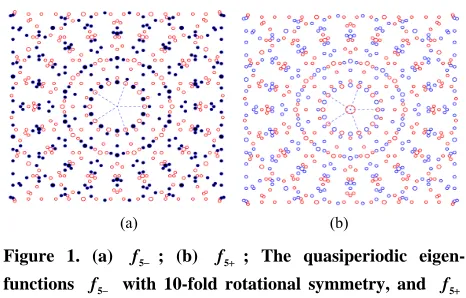
(with an:a0). Figures 1 and 2 show representations of
such eigenfunctions with n5 an resp Filled circles correspond to negatively scaled Dirac
1 2
det a a 1, d n7 ectively.
’s, and unfilled cir les correspond to positively scaled Dirac and grida a1 2, is distinct from , then
1 2,
grida a
’s. The radius of ea circle is proportional to the c square root of the modulus of the scale factor for the corresponding
1 2, 1 2,
: grida a grida a
f x x x (31) ch
. By construction
: grida a1 2,
grida a1 2,
f x x x (32) ,
are eigenfunctions of the Fourier transform operator associated with
1, 1
, respectively. fn fn and fn fn .
Quasiperiodic eigenfunctions of on with
m-fold rotational symmetry.
2
3. Representation of Some Quasiperiodic
Eigenfunctions
Let
2 1 sin
n
(33)
for some n3, 4, , and let
Tcos 2 ,sin 2
k
a k n k n
1,
(34)
where 0 k n be the vertices of a regular
gon
n with center at the origin. The parameter
has been chosen so that (a) (b)
1
det ak ak 1 for each k1, 2, , n1. Thus
1 1
, ,
gridak ak gridQa Qak k ,k 0,1, ,n 1
Figure 1. (a) f5 ; (b) f5 ; The quasiperiodic eigen- functions f5 with 10-fold rotational symmetry, and f5
[image:8.595.306.539.564.713.2](a) (b)
Figure 2. (a) f7 ; (b) f7 ; The quasiperiodic eigen- functions f7 with 14-fold rotational symmetry, and f7 with 28-fold rotational symmetry for the Fourier transform operator with respectively = 1 , and = 1.
REFERENCES
[1] R. N. Bracewell, “Fourier Analysis and Imaging,” Kluwer Academic, New York, 2003.
http://dx.doi.org/10.1007/978-1-4419-8963-5
[2] L. Schwartz, “Theorie des Distributions,” Hermann, Paris, 1950.
[3] R. Strichartz, “A Guide to Distribution Theory and Fou- rier Transforms,” CRC Press, Inc., Boca Raton, 1994.
[4] B. Osgood, “The Fourier Transform and Its Applications,” Lecture Notes, Stanford University, 2005.
[5] D. W. Kammler, “A First Course in Fourier Analysis,” Prentice Hall, New Jersey, 2000.
[6] J. I. Richards and H. K. Youn, “Theory of Distributions: A Non-technical Introduction,” Cambridge University Press, Cambridge, 1990.
http://dx.doi.org/10.1017/CBO9780511623837
[7] M. J. Lighthill, “An Introduction to Fourier Analysis and Generalized Functions,” Cambridge University Press, New York, 1958.
http://dx.doi.org/10.1017/CBO9781139171427
[8] L. Auslander and R. Tolimieri, “Is Computing with the Finite Fourier Transform Pure or Applied Mathematics?” Bulletin of the American Mathematical Society, Vol. 1, 1979, pp. 847-897.
http://dx.doi.org/10.1090/S0273-0979-1979-14686-X [9] J. H. McClellan and T. W. Parks, “Eigenvalue and Eigen-
vector Decomposition of the Discrete Fourier Transform,” IEEE Transactions on Audio and Electroacoustics, Vol. 20, No. 1, 1972, pp. 66-74.
http://dx.doi.org/10.1109/TAU.1972.1162342
[image:9.595.59.285.85.200.2]