Munich Personal RePEc Archive
Migration and Human Development in
India
Deshingkar, Priya and Akter, Shaheen
Overseas Development Institute
1 April 2009
Human Development
Research Paper
2009/13
Migration and
Human Development
in India
United Nations Development Programme
Human Development Reports
Research Paper
April 2009
Human Development
Research Paper
2009/13
Migration and
Human Development
in India
U
nited Nations Development Programme
Human Development Reports
Research Paper 2009/13
April 2009
Migration and Human Development
in India
Priya Deshingkar and Shaheen Akter
Priya Deshingkar is Research Fellow at the Overseas Development Institute, London. E-mail: [email protected].
Shaheen Akter is Researcher Assistant at the Overseas Development Institute, London. E-mail: [email protected].
Abstract
The paper discusses how gaps in both the data on migration and the understanding of the role of
migration in livelihood strategies and economic growth in India, have led to inaccurate policy
prescriptions and a lack of political commitment to improving the living and working conditions
of migrants. Field evidence from major migrant employing sectors is synthesised to show that
circular migration is the dominant form of economic mobility for the poor; especially the lower
castes and tribes. The authors argue that the human costs of migration are high due to faulty
implementation of protective legislation and loopholes in the law and not due to migration per se.
The paper discusses child labour in specific migration streams in detail stressing that this issue
needs to be addressed in parallel. It also highlights the non-economic drivers and outcomes of
migration that need to be considered when understanding its impacts. The authors calculate that
there are roughly 100 million circular migrants in India contributing 10% to the national GDP.
New vulnerabilities created by the economic recession are discussed. Detailed analysis of
village resurveys in Madhya Pradesh and Andhra Pradesh are also presented and these show
conclusively that migration is an important route out of poverty.
Keywords: India; circular migration; caste; tribe; child labour; human development.
1.
Background and Introduction
Migration in India is not new and historical accounts show that people have moved in search of
work, in response to environmental shocks and stresses, to escape religious persecution and
political conflict. However improved communications, transport networks, conflicts over natural
resources and new economic opportunities have created unprecedented levels of mobility. But as
we discuss in following sections, the increase in mobility is not fully captured in larger surveys
often leading to erroneous conclusions about mobility levels in India.
Although significant in recent years, growth has been unequal in India (Balisacan and Ducanes
2005), characterised by industry in developed states such as Gujarat, Maharashtra and Punjab
drawing labour from agriculturally backward and poor regions such as eastern Uttar Pradesh,
Bihar, southern Madhya Pradesh, western Orissa and southern Rajasthan. High productivity
agricultural areas (“green revolution areas”) continue to be important destinations, but
rural-urban migration is the fastest growing type of migration as more migrants choose to work in
better paying non-farm occupations in urban areas and industrial zones. Delhi and the states of
Gujarat and Maharashtra are top destinations for inter-state migrant labour. Labour mobility has
grown and will probably continue to grow once the economy recovers from the current crisis.
Migrant labour makes enormous contributions to the Indian economy through major sectors such
as construction, textiles, small industries, brick-making, stone quarries, mines, fish and prawn
processing and hospitality services. But migrants remain on the periphery of society, with few
citizen rights and no political voice in shaping decisions that impact their lives (Kabeer 2005).
Unlike countries in Southeast Asia and East Asia, the bulk of the migrant workforce in India has
little or no education (Srivastava 2003). In fact migrants are poorly endowed all-round: they
come from poor families where access to physical, financial and human capital is limited and
where prospects for improving living standards are constrained by their inferior social and
political status. Historically disadvantaged communities such as the Scheduled Castes, Scheduled
Tribes
1and Other Backward Castes are heavily represented in migration. Poor migrants are
1 These groups accounted for more than 250 million people in India in 2001 (167 million SCs, 86 millions STs and
absorbed in informal sector jobs, much maligned for being insecure, poorly paid and
unproductive but offering the only option for labourers to improve their capabilities.
2.
Structure of the paper
The paper begins with a brief critique of official statistics, discussing their major shortcomings.
This is followed by detailed accounts of the different sectors and subsectors employing migrant
workers with case studies showing how migrants are recruited and the conditions in which they
work and live. This is followed by an assessment of the magnitude of migration and the
contribution of migrant labour to the Indian economy. The third part of the paper focuses on the
human development impacts of internal migration using secondary as well as primary data
collected from Andhra Pradesh and Madhya Pradesh in 2001/2, 2003/4 and 2006/7. The analysis
addresses questions related to poverty reduction and political participation. The paper ends with
policy recommendations to provide more support to migrants, reform policy and improve data.
3.
Official estimates of migration
The two main sources of data on migration are the National Census and the National Sample
Survey (NSS) and most estimates of migration are based on these.
The total population of India at the last Census was over a billion. According to the National
Census for 2001 30% of the population or 307 million were migrants. Of these, nearly a third
had migrated during the previous decade. It is topical to note at the outset that both the National
Census and the National Sample Survey (NSS) use definitions of migration that are not
employment related. These are change in birthplace and change in last usual place of residence.
Secondly they give only the main reason for migration and thus miss secondary reasons which
are often work related particularly in the case of women, third they count migrant stocks and not
flows which are actually more important for policy and finally, they seriously underestimate
categories of work that employ migrant workers. The findings of the Census and NSS on
migration must be viewed against this backdrop.
Other patterns revealed by the census were:
•
There were 65.4 million female migrants and 32.8 million male migrants. However a
majority (42.4 million) of female migrants had not migrated for work and had cited
marriage as the main reason for the change in residence. Among males the most
important reason for migration was ‘Work/Employment’ given b y 12.3 million male
migrants.
•
Rural to rural migration still dominated and accounted for 53.3 million; Rural to urban
migration: 20.5 million Urban to rural migration: 6.2 million and Urban to urban
migration: 14.3 million.
•
Interstate migration has grown by 53.6%. The total number of interstate migrants was
42.3 million. Uttar Pradesh (-2.6 million) and Bihar (-1.7 million) were the two states
with the largest net outmigration.
The 55th round of NSS of 1999-00 was the first to cover short-duration migration defined as:
“persons staying away from usual place of residence for 60 days or more for employment or
better employment or in search of employment”. It estimates that roughly 1% of the Indian
population or 10 million people migrated temporarily (NSSO 2001). But this is also a gross
underestimate because the data do not properly count part-time occupations and short term
migrations. The true figure probably lies at around 100 million as we argue later.
In sum, there are six major shortcomings of official data:
•
They tend to underestimate short term movements and thus underestimate or miss altogether,
seasonal and circular migration which, according to recent village studies account for the
•
Women’s migration is not adequately captured because the surveys ask for only one reason
for migration to be stated. This is usually stated as marriage and the secondary reason i.e.
finding work at the destination may not be mentioned.
•
They do not capture migration streams that are illegal or border on illegality i.e. trafficking
for work and various forms of child labour. The census of India reported 12.66 million
working children but estimates by agencies working against child labour such as The Global
March and the International Center on Child Labor and Education (ICCLE) calculate that
there are roughly 25-30 million child workers in India (ITUC 2007) and Human Rights
Watch says that more than 100 million could be working because so many are out of
education. Smaller studies and NGO assessments (some of which are reviewed later) show
that child migrants form a large part of the workforce in several major sectors such as
construction, brick-kilns, small industries, domestic work and farm work.
•
They do not count properly rural-rural circulatory migrants who work on commercial farms
and plantations or rural-urban migrants who migrate for a few months at a time to work in
very small industries.
•
They do not capture adequately the movement of scheduled caste and scheduled tribe people
mainly because these groups are engaged in short term migration and this is not measured
properly in the surveys for the reasons stated above. There are numerous case studies which
show high mobility levels among these groups.
•
They mis-represent the relationship between poverty and migration. While village studies
show high levels of migration amongst the poor (not the poorest), official statistics show that
migration is higher among better off groups because they cover mainly permanent migration
which has a higher representation of people from more affluent and better educated
backgrounds.
Much of the quantitative evidence in the Indian literature on migration is drawn from these
datasets and so inevitably exhibits a number of shortcomings. For example Dubey et al (2006)
argue on the basis of their analysis of the 1999-2000 round of the NSS that individuals from
scheduled castes and scheduled tribes and those with little or no education are less likely to
to argue that the probability of being poor among migrants (both urban-urban and rural-urban
including seasonal migrants) is lower than among non-migrants.
4.
Major Migrant Employing Sectors
The Magnitude and Economic Contribution of Migration and the Characteristics of
Migration Streams in these Sectors
A search through published and grey literature on migration shows that there is large number of
studies which portray a very different picture of migration. They show that circular migration is
the main form of mobility for work and that such migration is higher among the poor and
especially SCs and STs . They also show higher rates of migration among women and children.
All three sectors of the Indian economy namely agriculture, industry and services employ very
large numbers of migrant workers. Field evidence shows that the major subsectors using migrant
labour are textiles, construction, stone quarries and mines, brick-kilns, small scale industry
(diamond cutting, leather accessories etc), crop transplanting and harvesting, sugarcane cutting,
plantations, rickshaw pulling, food processing including fish and prawn processing, salt panning,
domestic work, security services, sex work, small hotels and roadside restaurants/tea shops and
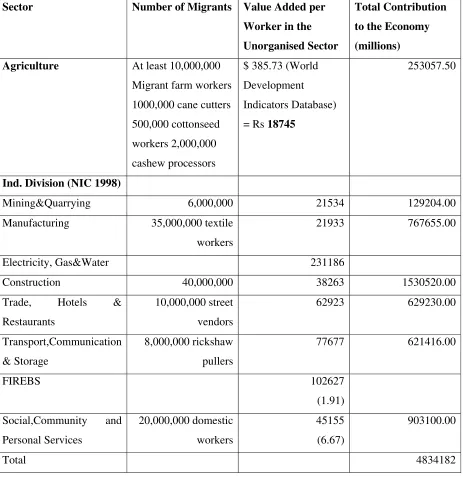
street vending. We piece together available information on the numbers of workers involved and
their contribution to the economy. There are gaps in the information and we have not been able
to cover all sectors but we can convey the significance of migration to India’s economy. Some of
the sectors are strongly associated with specific migration streams (e.g. migration from western
Orissa for brick kiln work in Andhra Pradesh and migration from Bihar for agricultural work in
Punjab) which have differing recruitment and remuneration patterns and varying impacts on
human development. A small number are discussed here to provide insights into the recruitment
practices of companies and agents and how they circumvent the legal system to extract cheap
labour in return for few obligations to migrant labourers and their families. The earnings and
human development impacts of these migration streams are discussed wherever evidence has
been available. These accounts also show that distinctions between migration, trafficking,
bonded labour and child labour are often difficult to make because of the widespread use of child
next part pulls together all the available evidence to analyse the implications of migration for
human development and how policy distortions and implementation failures can be addressed.
5.
Industry
5.1
Construction
The construction industry provides direct employment to at least 30 million workers in India
(Chen 2007) but recent expansions (before the economic crisis) had resulted in a higher number:
trade Unions estimate that there were roughly 40 million migrant construction workers in India
in 2008 (Sarde 2008). Although numbers will have gone down with the recent economic crisis
there will nevertheless be a continuation of urban construction which will attract migrant
workers. There is anecdotal evidence that some categories of returnee migrants from the Gulf
have been absorbed in construction
2. Construction attracts both skilled workers (masons,
carpenters) and unskilled workers and although there is some scope for upward mobility, poorer
and lower caste/tribe migrants tend to remain in low-paid unskilled jobs. This is because of
discrimination against them and being excluded from opportunities to gain skills. Women work
mainly as unskilled workers.
Migration for construction work has brought economic gains and freedom for many but has also
brought incredible hardship and personal risk. Many analysts have concluded that it is coping at
best and does not result in any long term accumulation for the poor (Reddy 1990, Srivastava
2003, Sundari 2005). However the situation has changed in some locations recently as migrants
have acquired more confidence and knowledge of the labour market and have begun to negotiate
jobs by themselves without depending on agents and contractors. This has led to faster
improvements in living standards (for Madhya Pradesh see Deshingkar et al 2008).
As the discussion below shows, the failure to properly implement labour laws has resulted in
heavy costs of such migration especially because of the deterioration in living conditions, the
inability to educate children and access health or subsidised food schemes. Two major streams of
2 Andhra absorbs many Gulf returnees in construction sector, Thaindian News, August 24th, 2008. Available at
migration involving construction workers are discussed below; one involving tribals from
southern Madhya Pradesh and the other involving scheduled caste workers from a drought-prone
district in the southern state of Andhra Pradesh.
Tribal areas of southern Madhya Pradesh
Tribal and forested areas of Madhya Pradesh have been identified among the 15 pockets of
chronic poverty in India (Shah 2007). Migration is an important livelihood activity and research
by Mosse et al (1997) in the tribal districts of southern Madhya Pradesh covered under the DFID
funded Western India Rainfed Farming Project revealed that 65 per cent of households included
migrants who worked mainly in the construction sector. The incidence of migration was clearly
growing in the area as a few years later another study in the same area found that in many
villages up to three-quarters of the population were absent between November and June (Virgo et
al, 2003).
Madhya Pradesh has ranked among the least developed states in India. It has the largest
population of Scheduled Tribes of all states and a high proportion of Scheduled
Castes. Landlessness, nominal and unproductive landholdings and the inability to invest in
farming continue to characterize the tribal population of the state. Migration has long been a
livelihood strategy for tribals from the southern districts. Many migrate to the neighbouring
states of Maharashtra and Gujarat.
Until about 2005 the recruitment of migrant construction workers from this area was largely
done by agents locally known as mukkaddams. Mukkaddams provide the labourers a cash
advance to help the family left behind in the absence of the migrant. The advance is also used by
the migrant to purchase essentials for the journey. The advances are repaid through migrant
wages and the length of time that this takes depends on the payment that the migrant receives at
the destination. The mukkaddam recruits migrants in groups who stay together at the destination.
Mukkaddams take care of other needs as well including small health expenses, travel expenses,
shelter and communication with the family in the village. Mukkaddams are almost never
registered with the government although they are required to do so under the Inter-state Migrant
themselves and their workers and provide them with decent accommodation, crèche facilities,
access to health care and minimum wages. Activists and researchers of labour laws
3say that it is
extremely difficult to prosecute agents from one state in another state. They feel that that the
ISMWA in its current form is non-implementable.
Migrants work long hours in harsh conditions; injuries are common and there is inadequate
medical assistance or compensation (Mosse et al 2002). Water, fuel, sanitation and security are
major problems. A study by DISHA, an NGO in Gujarat found that over half the migrants slept
in the open and the rest had very perfunctory accommodation. They face harassment, abuse,
theft, forcible eviction or the demolition of their dwellings by urban authorities or police. The
sexual exploitation of women by masons, contractors, the police and others is routine but
unreported by women for fear of the consequences (loss of employment, violence). Children are
even more vulnerable to such abuse. Although unions have taken up the cause of such migrants,
many do not register with unions because of their continuously changing work destinations.
Mahbubnagar in Andhra Pradesh
The poor, drought prone district of Mahbubnagar in the Telangana region of Andhra Pradesh is
well known all over India for its construction workers. Andhra Pradesh (AP) is the poorest
southern State in India and ranks lowest among south Indian States on human development
indicators as well as growth and per capita income. The origins of rural labour migration for
manual work in Andhra Pradesh can be traced back to the pre-Independence era. Rural labourers
were mobilized for executing major public works in both rural and urban areas such as irrigation
projects and public buildings.
Migration has been an important way of coping with drought in Mahabubnagar which has huge
tracts of unirrigated land with only a single cropping season (Deb et al 2002). The Village Level
Studies (VLS) conducted by ICRISAT (International Crop Research Institute for Semi-Arid
Tropics) over the last three decades in two villages of Mahbubnagar district in Andhra Pradesh
3 Pers.comm. Vipul Pandya of Disha in Ahmedabad; Ashok Khandelwal, legal expert on labour laws and Action Aid
show that both seasonal and permanent migration have increased during the reference period
(Deb et al 2002). A majority of construction workers from this district are SCs (Samal 2006).
The situation here is similar to that found in southern MP: workers are recruited by contractors
and agents (mestries) who are hired by construction companies to find labourers. The companies
pay the agent and not the workers and underpayment of workers is common. In early 2008, a
group of workers interviewed by Deshingkar during the course of research for the DFID funded
Andhra Pradesh Rural Livelihoods Project, showed that they were receiving the equivalent of Rs
1200 per month in cash and food even though the mestris were being given Rs 150 per worker
per day (Rs 4500 per month). Mestris recruit workers against an advance of Rs 20-25000 and
this lump sum is used to repay older debts. Underpayment traps the workers in a continuous
cycle of debt. There is a strong power relationship between the worker and the agent: Olsen and
Ramanamurthy (2000) show the variety of insidious ways in which migrant construction workers
are exploited by mestries ranging from trapping them in bonded labour by paying less than
subsistence level, extracting overtime and child labour and using caste based and patriarchal
modes of oppression to maintain exploitative labour relations. The workers are aware of the
exploitation but do not migrate independently because they do not have the information to find
work regularly and the risks are too great. And sadly, workers believe that the mestries will help
them during times of difficulty because of the feudal history of the region and their faith in
patron-client relationships.
Living conditions at construction sites are appalling and mestris provide only the most basic
shelter. Drinking water and sanitation are not easily accessible and girls and children left are
highly vulnerable to disease, injuries and sexual abuse. Harassment by the police, urban
authorities and contractors is common. Additionally migrants do not have access to propoor
schemes such as subsidised food, health care and schooling and must pay for everything
themselves. Here too unionisation of workers has been difficult and violation of labour laws is
widespread with the result that migrants are underpaid and excluded from urban services.
These are not isolated examples and similar conditions have been noted elsewhere in the
construction industry in India. One study of 800 migrants in urban areas of Tamil Nadu notes
children with supervisors shouting at them''
4. On the whole, construction workers do not have
access to social security
5, compensation for injuries, access to drinking water or healthcare. India
has the world’s highest accident rate among construction workers - a recent ILO study shows
that 165 out of every 1000 workers are injured on the job (quoted in Sarde 2008).
5.2
Brick kilns
Closely linked to the construction industry is the brick kiln industry which also employs large
numbers of low caste and tribal circular migrants. There are 50,000 brick kilns all over India,
employing, on an average, 100 workers
6(ILO 2005). Brick-kiln workers often migrate with their
wives and children and if women are counted as well, the number of brick kiln workers in India
is at least 10 million. Recruiting is done through an agent who gives the family in the village a
wage advance of Rs 15-20,000. This is a substantial lump sum and is wrongly perceived by the
workers and their families as a cheap loan because there is not interest. The money has to be paid
back through work and the wages paid are well below the legal minimum effectively making the
arrangement a kind of debt-bondage. The entire family comprising the husband, wife and
children live on the site and work as one unit for the full season. The overall situation is
exploitative as everything necessary to manage daily needs is sold by the employers and agents
(at higher rates than the market) on credit and subsequently deducted from actual wages. Each
couple earns between Rs 70-130 a day and many are cheated out of their full payment. They
spend heavily on country liquor and usually come home with a saving of not more than
Rs.1000-2000 at the end of the season. Some are perpetually in debt and migrate again the following year
so that they can get a lump sum to repay outstanding debts.
This kind of migration appears to be the domain of the poorest migrants. Two streams of brick
kiln workers are discussed here: the migration of tribals from Western Orrisa and the migration
of musahars in Bihar. While both involve inter-state migrants they differ in the level of
representation that they have received from supportive civil society organisations.
4 The study was conducted by TN-Forces (Tamil Nadu Forum for Creche and Childcare Services); the quote is from
an interview with a Ms Bhuvaneshwari a TN-Forces staff member involved in the study, published in The Hindu
`Migrant woman labourers facing economic disparity' 30 April 2002.
5 The newly passed Social Security for Unorganised Sector Workers bill may provide some benefits but how
effective the implementation will be remains to be seen.
Migration from Western Orissa
Western Orissa has long been a major source area for migrants because of its highly unequal land
distribution, high levels of poverty among landless and marginal farmers and low levels of
human capital, industrialisation, urbanisation and diversification into non-farm occupations
combined with poor governance. It suffers from multiple social, political and economic
disadvantages leaving the poor with few local options for making a living.
ActionAid estimates that nearly 200,000 people migrate from Western Orissa to brick kilns
surrounding major cities of Andhra Pradesh (ActionAid, 2005). Research conducted under the
DFID-funded Western Orissa Rural Livelihoods Project (WORLP) in Nuapada and Bolangir
shows a dominance of STs and SCs in migration streams from these poor districts (Panda 2005).
The poorest and the richest as well as the upper castes did not migrate seasonally. In Bolangir
more than 90% migrants were going to work in brick-kilns in Andhra Pradesh. The WORLP
research also shows that although migration rates among females are lower than males,
significant numbers of females do migrate (39% of the migrants in Khariar block were female).
There were also many migrating children: male children (below 14 years) constituted 14.89% of
the total number of migrants and female children (below 14 years) constituted 13.47% of the
total migrating individuals in the sample.
Workers are usually recruited by an agent or contractor known as a Sardar or Khatadars. This is
the notorious “Dadan” system attracted attention for being highly exploitative and led to the
formulation of the Inter-State Migrant Workmen Act. At the time of recruitment Sardars give the
worker an advance and promise a wage which is to be adjusted against the advance at the end of
every month. But this promise is rarely kept. Brick kiln workers are usually paid Rs 175-200 for
1,000 bricks made. They work for 12 to 15 hours, sometimes 18 hours a day to make more
money. Wages are settled at the end of the brick-making season and it is common for the
workers to be cheated because they are illiterate.
Children are an essential part of the workforce hired by contractors for brick work. A recent
migrants were children, of which 22% were of elementary school age. According to Sristi child
labour is much a part of the brick making process that if a family does not have a child, a child
from another family is hired (Sristi 2008). These child labourers are extremely vulnerable and
become part of unwritten, exploitative, contracts with labour contractors. Hardly 10% of the
migrants are registered with the labour department. Often, contractors take migrants in the
middle of the night to escape detection. Many migrating children eventually drop out of school.
A recent unpublished study of 300 brick kilns around Hyderabad revealed that as many as 35%
of the total migrants were children, of which 22% were of elementary school age (Panigrahi
2006). Although migrants are allowed to send their children to schools in other states, there are
often language barriers and schools may not be available near work sites. The working
conditions of brick kiln workers have been widely condemned. Brick kiln work has many of the
characteristics of bonded labour – restricted freedom, hiring workers against advances, long
working hours, underpayment and physical and verbal abuse of the workers by contractors and
employers.
Two NGOs - Vikalpa and Lok Drishti together with Action Aid have worked to free labourers
from bondage and provide education for their children. But the strong links between political
interests and contractors make it difficult to improve the conditions of employment of kiln
workers. A number of large labour contractors who supply tribal workers to brick-kilns in
Andhra Pradesh also have close links with government officials. There are strong vested interests
in keeping the workforce pliable and poor so that cheap labour continues to be available for brick
making. The experience of NGOs working with cross-border migrants has shown that it is
difficult for any contractor to be prosecuted in another state and there have been very few cases
to date (personal communication Umi Daniel, Action Aid). There is also a view that the Orissa
government is reluctant to take any action because it would be like admitting that there are so
many poor seasonal migrants in bondage. Not only would this show that the Orissa government
has been ineffective in controlling migration but it would also call into question the resource
allocations received by the state from the Centre based on population (personal communication
Migration from Bihar
A large number of people belonging to the musahar caste migrate from Bihar to brick kilns in
Uttar Pradesh and West Bengal where they stay for 7-8 months in a year. The musahar (literal
translation is rat-eaters), are classified as a scheduled caste and they have remained largely on the
periphery of society
7. They are usually found in the least paid and most degrading jobs with the
worst terms of employment. Apart from brick kiln work, large numbers of musahar work in crop
harvesting, which is also one of the least well paid occupations. Recruiting for brick kiln work is
done through an agent who gives their families a wage advance similar to the practice seen in
Orissa.
The striking difference between the brick-kiln migrants here and the migrants in Orissa is that
there is no one to fight on behalf of the musahar for better working conditions and wages. While
Orissa has NGOs which have given the issue national and international publicity, the musahar
are less visible. Although there are NGOs in Bihar working on issues that touch the lives of
migrants such as HIV/AIDS there do not appear to be any initiatives for providing schooling for
their children.
Thus brick kiln workers continue to work without any form of social protection or social security
and the overall benefit for the migrant is being able to eat regularly. However in the absence of
education and health systems that cater to migrants, the costs have remained very high.
5.3
Textile Industry
The textile industry in India (including the garment industry) is the largest foreign exchange
earner among all other industrial sectors and provides direct employment to around 35 million
people
8. A large proportion of these workers are migrants, judging from micro-studies (Unni and
Bali 2006) but it is difficult to put a precise figure on the numbers. The textile industry is
extremely complex in its structure, with handlooms and home-based production at one end of the
spectrum, to capital intensive, large mills at the other. Small, privately owned power looms now
dominate the industry. Yarn production is still in large mills but 78 per cent of the cloth
7 Mukul 1999.Everyday Life of Musahars in North Bihar EPW Special Articles December 4, 1999
production occurs in smaller power looms and handlooms. According to labour statistics
published by the Labour Bureau 31% of the workers in the manmade textile industry were
migrants.
The conditions of textile workers are described by in a study of Bhiwandi, the largest power
loom site in Maharashtra “A visit to Bhiwandi reminds one of scenes usually associated with the
beginning of the Industrial Revolution: thousands of persons sleeping in or next to numberless
ramshackle sheds in which the deafening sound of the looms is heard 24 hours a day, with no
ventilation, proper light, children doing tedious work for long hours, and dust and dirt
everywhere. The exact number of power looms is unknown, as is the specification of their
production, the ownership of looms, the quantity of work done on behalf of the mills.”
(Ramaswamy and Davala 2008).
The garment industry is a sub-sector of the textile industry and also generates many jobs for
migrant workers. India’s readymade garment exports increased significantly as a share of total
exports (12% or Rs 254,780 million in 2001-2). There were 1,001,000 garment workers in 2004
(Mezzadri 2008)
While the number of workers in formal employment is going down due to fewer registered
factories, the numbers in small and unregistered units is growing and employers often choose to
employ migrants because they are easily controlled (Ghosh 2001). In order to evade stringent
labour laws, larger factories have now split their operations into groups of 11-15 workers who
work on the same premises. If any worker divulges information during labour inspections he or
she is given no further work from the next day (Unni and Bali 2006).
The Garment Industry in Delhi
A case study of the Delhi garment industry which accounts for 35-40 per cent of the value of the
country’s total garment exports estimated that there are 3,000-4,000 production units where poor,
first generation industrial workers are hired by contractors known as thekedars from rural areas.
Migrant workers are preferred because they do not pose the threat of unionization. The workers
Garment units employ large numbers of women migrants. The work is characterized by long
hours, and a lack of health and welfare benefits, minimum wages, and job security. Work-related
illnesses and disorders include: headaches and stress-related fatigue, back problems, disturbances
of the menstrual cycle, repetitive strain injury, loss of weight, respiratory problems, kidney and
bladder infections from retaining urine for long periods of time, and sinus problems and allergies
from the dust and materials used.
Embroidery work is now big business for traders and exporters in the garment sector. Many of
the workers are Muslim boys and young men from Bihar who work in small units in villages
outside Delhi. Workers are paid piece rates and are almost completely invisible in the global
supply chain. Interviews and group discussions with migrants in sending areas of Bihar show
that these jobs are regarded as well paid and have helped many families to accumulate assets and
repay debts (Deshingkar et al 2006).
Silk Industry
Sericulture is a labour-intensive industry and employs roughly 6 million people in different
stages of production including rearing silk worms, reeling thread, twisting, dyeing, weaving,
printing and finishing (Ministry of Textiles) in all its phases, namely, cultivation of silkworm
food plants, silkworm rearing, silk reeling, and other post-cocoon processes such as twisting,
dyeing, weaving, printing and finishing. It provides employment to approximately 6 million
persons, most of them being small and marginal farmers, or tiny & household industry mainly in
the hand reeling and hand weaving sections. Mulberry silk is produced extensively in the states
of Karnataka, West Bengal and Jammu and Kashmir. About 85 per cent of the country's
production is contributed by the Karnataka
9. Silk thread making and sari folding have now
become notorious for employing large numbers of children (see box).
Box 1 Child Labour In The Silk Industry
The prevalence of child labour in the silk industry was exposed after a Human Rights Watch
Report in 2003. HRW says “Boiling cocoons, hauling baskets of mulberry leaves, and
9 From a note on the Sericulture industry in India and its potential. Available at
embroidering saris, children are working at every stage of the silk industry. Conservatively, more
than 350,000 children are producing silk thread and helping to weave saris. The children work
twelve or more hours a day, six and a half or seven days a week, under conditions of physical
and verbal abuse. Starting as young as age five, they earn from nothing at all to around Rs. 400
(U.S.$8.33) a month, some or all of which is deducted against loans ranging from around Rs.
1,000 to 10,000 (U.S.$21 to $208).”
Source: Human Rights Watch (2003)
Migration from Eastern Orissa to Gujarat
Surat is one of the main destinations for migrants from eastern Orissa. Many go to work in the
textile industry and the diamond cutting and polishing industry. A study by Jagori, an NGO in
Delhi put the number of Oriya power loom workers in Surat at roughly 100,000 in 2001 (Jagori,
2001). However later informal estimates are higher and increasing: A Times of India report
(Times of India 18 May 2003) mentions 500,000 Oriya workers in Surat; Narasimham (2004)
estimated that there were roughly 800,000 Oriya labourers in Gujarat of which 80 per cent work
in the power loom and diamond polishing businesses (see under small industries below) in and
around Surat and the others are spread across the state, working in various factories including
plastics, textiles, salt manufacturing, pharmaceuticals, brick manufacturing, and fertilisers.
Increases in migrants from Orissa have been widely attributed to the super cyclone of 1999,
severe drought of 2000 and unprecedented floods after that. The most recent informal estimates
suggest that there are around 900,000 Oriya migrant workers in Surat of whom 600,000 are from
Ganjam district alone (UNDP 2007).
There has also been a shift in the caste composition of migrants: earlier studies (e.g. Nayak 1993,
Sahoo 1993) note that a majority of migrants belonged to the other castes (i.e. upper castes) and
a much smaller proportion belonged to the scheduled castes and tribes. Furthermore earlier
studies noted that most migrants belonged to the small and marginal farmer category. However
towards the end of the last decade migration streams had a high proportion of SCs (Samal 1998).
By all accounts working and living conditions of textile workers are dismal. Workers are not
wages. Most of them aim to maximise their savings so that they can send money home and spend
very little at the destination. Living quarters are shared and crowed with only the most basic
facilities. Since many migrants to industrial zones are single men, problems associated with the
separation from family such as visiting brothels and alcoholism are common. Oriya migrants to
Surat have been named in AIDS control projects as a highly vulnerable group. Although more
educated and better connected than the tribal migrant from western Orissa, migrants from eastern
Orissa are vulnerable in different ways. Sahoo (1993) documents the numerous ways in which
workers are deprived of their legal rights in the factories of Surat: they are not registered under
their real names; they are not issued with ID cards; they remain casual workers without a
permanent contract even if they have worked there for more than 10 years; they work in shifts of
12 hours with 30 minute breaks. If other workers are absent they may have to work without a
break for 24 hours and they are given only one (unpaid) holiday every week.
5.4
Other Small Industries In The Informal Sector
Small industry is a broad term used to describe the millions of manufacturing units in the
informal sector which make (among other things), shoes, bags, steel utensil, vehicle parts, plastic
goods, glassware and electrical items. Until the early 1990s, large manufacturing units in the
organised sector attracted intrastate migrant workers. But the pattern has changed now and small,
unregulated and often completely illegal manufacturing units have become the new destination
for interstate migrants from poorer states to the more developed areas around the capital city and
western India.
Leather Industry
The Indian leather industry with an economic value of around US $ 2 billion employs roughly
two million people (CUTS International 2008). One of the major centres of the leather
accessories industry is in Dharavi, Mumbai (the largest slum in Asia). The industry now attracts
large numbers of migrants from Bihar and UP although only a few years ago a majority were
from poorer parts of Maharashtra (Pais 2006).
Parts of the leather industry also employ large numbers of children. For example, the footwear
ages between 10 and 15 in assembling shoes. The industry is concentrated in Tamil Nadu,
Mumbai, Uttar Pradesh, Punjab and Delhi. 80 percent of the children work for contractors at
“home” i.e. small units which can evade the law. The rooms are cramped, poorly lit and poorly
ventilated. Many suffer from respiratory problems, lung diseases and skin infections through
constant exposure to glue and fumes. They are also exposed to risk of nasal cancer, neurotoxicity
and adverse physical factors (Tiwari 2005).
Yet this kind of work is perceived as a good work opportunity because it is well-paid compared
to work at home. Interviews with migrants and key informants in rural Bihar indicate that those
families who have migrants in such occupations regard themselves as fortunate and acquire the
jobs through social networks. In Barhi village in Bihar for example, there is migration to many
different kinds of industry in different parts of the country.
Box 2 Migration for Industrial Employment from Rural Bihar
Barhi is a large and remote village in Madhubani district populated by Yadavs (BCs), Muslims
and SCs with 470 households. Hardly anyone is educated beyond high school and local
employment opportunities are limited. Migration rates are very high among the BCs and SCs and
most BCs and Muslims are working in industries in Mumbai, Delhi, Gurgaon, Surat,
Ahmedabad, Kolkata, Arunachal Pradesh, Trivandrum, Kathmandu and Nepal. Earnings vary
but are usually “good”. In the mattress industries of Gurgaon for example they earn Rs
1500-2000 a month and manage to get 10 days of overtime work in a month (there is competition for
scarce overtime work) taking their earnings upto Rs 2500. In bag making and shoe industries in
Delhi and Mumbai they earn Rs 3000-3500 if they work 12 hours a day.
In an autorickshaw workshop in Delhi workers are paid Rs 2000 per month (of which some
proportion is cut for the Provident Fund each month). The attraction of this job is that they get
PF payments even if they work for a few months. In wires and coil industries in Delhi workers
are paid Rs 2500-3000 per month (Rs 9/hr for overtime). Most of these industries have shifts of 8
hours but workers try to work overtime as often as possible. Many also work as welding
machine operators and earn Rs 4000-5000 per month. Others who work as their helpers earn Rs
Barhi village is typical of Madhubani district where migration rates are extremely high.
Migration from Madhubani has been increasing steadily over the last 10 years because of poor
yields in farming and reduced job opportunities locally with the closure of several large
industries
10. According to key informants about 70% of the households are engaged in migration
each with 1-4 male members working outside. Roughly 60-75% of SC households have migrants
and 40% of OBC households have migrants.
Source: adapted from Deshingkar et al (2006)
Migration to industries has resulted in rapid improvements in living standards and contributed to
improved well being through improvements in assets and agriculture (see next section on Human
development impacts). But on the down side, those working in Mumbai reported a constant
threat of being bullied by local hooligans and the police. None of the women left behind in the
village had heard of AIDS and they never used any contraceptives which made them especially
vulnerable to infections brought back by migrating husbands.
5.5
Mines and Quarries
By one estimate there are around 3 million people working in artisanal and small mines in India
(Lahiri-Dutt 2006) which are mainly illegal. Other estimates are higher: a Rajasthan-based NGO,
the Mines and Labour Protection Campaign, estimates that there are two million workers in the
M&Q sector in the state (quoted in Lahiri-Dutt 2006). There are additionally 4-5 million quarry
workers in Maharashtra according to Santulan, an NGO working on education (quoted in AIF
2006). This is in contrast to the formal mining industry in India which employs just 560,000
people and this number is coming down.
Mica Industry
A case study of the mica mining and processing industry in Andhra Pradesh by the People’s
Union for Civil Liberties (PUCL) shows widespread under-reporting of both production and
employment in order to escape royalty payments to the government. Mica production in India is
concentrated in Bihar, Andhra Pradesh and Rajasthan. Mica mine owners do not report casual
10 Anand Kumar Jha, Samadhan, Madhubani, Ram Pramod Yadav (Master Trainer, Swayamsiddha
and temporary workers on the rolls and do not show them in their statutory returns to the
Director General of Mines safety (Subrahmanyam 1985). Mica processing units are operated by
the mica owners, the dealers who work as middlemen between the mine owner and the exporters.
All these agencies besides recruiting their own workers also outsource to home splitters. A
common malpractice is to employ workers on a temporary basis even though the mine is under
continuous operation. In Andhra Pradesh, such workers are listed in a 'B' register. These 'B'
registers are the muster rolls for workers who have been working for more than three months. To
avoid the statutory requirements of changing the status of a temporary labourer into a permanent
labourer after three months, the names of the workers along with the names of their parents are
altered. In this way the mine owner avoids paying the minimum wages, provident fund, bonus
and other benefits.
Migrant workers are preferred because they are not unionised and are employed by the contractor
so do not create disputes. They also tend to work harder under the direct supervision of the
contractor and they do not have to be paid bonuses, provident fund payments etc. The mine
owners approach contractors (sirdars) whenever they need more workers. The contractor recruits
a group of 30-30 workers and pays a small advance to each worker, at their native village on
signature of a promissory note in which they specify their assets (cattle or small land holdings) as
collateral. The workers stay in dormitories at the site. The mine management pays the daily
wages of these workers to the contractor who makes a profit because he pays the workers much
less than he receives.
Working in mines and quarries is dangerous and outside regulatory regimes. There are no safety
standards, medical care or protective clothing. The methods and machines used are primitive and
injuries are common. When workers take time off work due to injuries they have to pay for their
own food, fuel, water and medical expenses (Sarde 2008). A study on the health of mining and
quarry workers by Tiwari et al (2007) published in the Indian Journal of Occupational and
Environmental Medicine found that the prevalence of TB among stone crushers was 10.7%
which was higher than the average while among slate pencil workers it was as high as 22.5%.
In India, the value of mineral production has more than tripled since the sector was ‘liberalised’,
from about Rs 250,000 million in 1993-94 to more than Rs 840,000 million in 2005-06, an
nation’s GDP has stagnated at 2.2-2.5% for more than a decade now because it contributes very
little to the exchequer through taxes and royalties (CSE 2007).
6.
Agriculture
Peak season operations in agriculture continue to be performed by migrant labour. For example
there were more than 819,000 migrant workers, mainly from Uttar Pradesh and Bihar, in rural
Punjab in 2007 accounting for 23% of the workforce engaged in agriculture sector activities
(Singh, Singh and Ghuman 2007). Although most find work for only 50 days in a year in
agriculture they migrate in the hope of finding casual work in urban areas after the peak seasons
of wheat harvesting, paddy sowing and paddy harvesting are over. Many are absorbed by small
industries. Similarly paddy transplanting and harvesting in the Bardhmann region of West
Bengal attracts around 500,000 migrant workers every season (Rogaly et al 2001, 2002).
In addition to these there are migration streams which involve the poorest migrants such as
sugarcane cutting and child workers such as cottonseed work which we discuss below.
6.1
Sugarcane Cutting In Western India
Maharashtra, Gujarat and Karnataka are the leading producers of sugar in India. The
Maharashtra sugar industry alone produces nearly 40 percent of India's sugar. According to
official statistics issued by the Maharashtra State Sugar Cooperative Federation, there are 1.6
million sugarcane farmers growing the crop on 0.7 million hectares of land, producing 60 million
tonnes of sugarcane. There are 172 sugar factories in the State providing employment, directly or
indirectly, to 15 million people.
The industry employs more than a million cane-cutters who are almost always SC, ST and OBC
migrants with little or no land from the poor, arid districts of the Marathwada region. The cutting
cycle lasts for six months from November to April/May. Cane cutters usually migrate in families
and are recruited by a contractor against an advance payment. The contractor provides very basic
accommodation without proper sanitation. Access to fuel and drinking water are difficult and this
increases the work burden on women. While the earnings from such work are good compared to
one of the most exploited labour groups in India by researchers such as Jan Breman who
famously said that even dogs are better off (Breman 1990).
But the most serious cost of such migration is that children who accompany their parents miss
school and eventually drop out altogether. A study
11in six districts in Western Maharashtra by
the Centre for Development Research and Documentation in 2003 found that roughly 200,000
children migrate with their parents and half of them are in the age group of 6 – 14. According to
Janarth, an NGO working on education for migrant workers’ another 200,000 migrate from the
Khandesh region in Maharashtra to sugar factories in Surat in Gujarat and 100,000 migrant
workers come into Belgaum in Karnataka each year (all quoted in AIF 2006).
6.2
Cottonseed farms
Cottonseed production relies heavily on migrant child workers. It is concentrated in five states
namely Andhra Pradesh, Gujarat, Karnataka, Maharashtra and Tamilnadu. These five states
account for more than 95% of the area under cottonseed production in the country. In 2003-04,
nearly 55,000 acres were under cottonseed production in the country, out of which Gujarat
accounted for 26,000 acres, Andhra Pradesh 14,000 acres and Karnataka 4,000 acres. Andhra
Pradesh was the largest cottonseed producing state in the country until recently but Gujarat
surpassed its production (Venkateswarlu 2004). Venkateswarlu estimates that roughly 286,000
workers were employed in cottonseed farms in Gujarat in 2003-04. Of these around 91,000 were
children in the age group of 8 to 14 years. His calculations for Karnataka show that nearly
26,800 child labourers (7-14 years) were employed in cotton seed farms in 2003-4 and 88% of
them were girls. A large number of the child migrants in cotton fields in Gujarat are tribals from
southern Rajasthan (Katiyar 2005).
Estimates of the numbers of children working in cottonseed farms vary. According to UNICEF
cotton plantations in AP employ 200,000 children below the age of 14. The vast majority are
girls, as they are preferred over boys. The Environmental Justice Foundation puts the number at
around 100,000. Children working in cottonseed farms are recruited by agents who pay their
parents an advance. The children pay off this money by working long days from July to
February. The children work 13 hours a day for around Rs 30 which is less than 50 pence per
day
12. On average 10 to 12 girls work per acre and are mostly drawn from the traditionally
oppressed and marginalised communities whose families are heavily indebted and have pledged
their child’s labour to pay off the debt. Even if parents do not want to exploit their children, they
are often compelled to do it because of desperate poverty and debt. Living and working
conditions are basic and many children drop out of school. A UNICEF case study found that 60
per cent of the children working in cottonseed fields have dropped out of school and 29 per cent
have never attended school. As about half of them began working before the age of 11, literacy
levels are very low
13.
6.3
Food Processing
There were 7.85 million workers directly employed in the food Processing Industry including
Sea Food and Marine Products factories
14in 2001-02, and this number was expected to grow to
8.6 million persons in 2006-07 (Ministry of Labour 2008, NCAER). The size of the food
processing industry has been estimated at over USD 70 billion by the Ministry of Food
Processing, contributing 6-7% of the GDP
15. Fish and cashew nut processing employ large
numbers of migrant women (ICSF/SIFFS/NFF 2004). The cashew processing industry alone
employs around 2 million people across India. (Action Aid 2008b) Many of these workers are
migrant women who earn as little as Rs 25 (50 cents) a day, less than half of the minimum wage.
Work in fish processing involves standing in damp and cold conditions for 14-16 hours a day
without any protective equipment such as warm clothing, tall boots or gloves (Misra 2008). Skin
problems and fatigue are common and separation from families causes stress and depression. The
women live within the factory premises in quarters that have been described as inhuman and
marked by congestion, poor ventilation and inadequate sanitation. Women who raise their voice
against the facilities provided are sent back home. In 1997 around 250 women were sent back to
12 http://www.ejfoundation.org/page330.html
13 http://www.unicef.org/india/child_protection_1739.htm
14 Canning and Preservation of Fruits and Vegetables (Industry code 202), Processing, Canning and Preservation of
fish, etc. (Industry code 203), Production of Common salt (Industry code 208), Manufacture of Cocoa Products, Confectionery (Except Sweet Meat) (Industry code 209), Malted Food, Grinding and Processing of Spices, Papads, Appalams, Sago and Sago Products etc (Industry code 219).
15 Cited in Denmark Indian Food Processing Sector– Technology and Market Trends.
Kerala and Tamil Nadu and this subdued others from asking the factory management for better
conditions and pay.
When the earnings of workers in food processing are viewed against the revenue generated it
becomes obvious how much migrants are contributing to the economy and how little they are
receiving in return. While the monthly earnings for fish processing workers would be around Rs
3000, the total GDP from fisheries was Rs 300,000 million in 2008.
7.
Services
Although the latest figures for the Indian economy show that the service sector now contributes
more than 60% to the GDP, it is likely that workers and the economic contribution of certain
categories of services are not counted properly. These include domestic services, certain kinds of
transport services such as rickshaw pulling, security services and sex work. All are discussed
briefly below.
7.1
Domestic Work
With the rise of the middle class in India
16, domestic work has emerged as an important new
occupation for migrant women and girls. Some 20 million people (mainly women and girls)
migrate for domestic work to Mumbai, Delhi and other large cities from the eastern states of
Bihar, Orissa, Chhattisgarh, Jharkhand, Assam and Mizoram (Social Alert quoted in SCF 2005).
Roughly 20% of these workers are under the age of 14. A study of domestic workers in Delhi
(Neetha 2004) shows that although domestic work has brought higher incomes to many women
and their families it is still far from decent work being characterised by long working hours, low
wages and hardly any social security. The study covered 465 women in part-time domestic work
living in three settlements in Delhi. Most were employed through placement agencies. Often
15-20 girls were forced to stay in a small room without proper washing and toilet facilities. The
agencies took up to half of the migrant’s salary and savings were therefore meagre.
16 According to the National Council for Applied Economic Research, 13 per cent of India’s population will have an
NGOs working in sending areas of Bihar such as Gaya district say that the numbers of child
migrants for domestic work has increased in the last five years because poor families have had
no other choices for supporting their children. The children are in the age group of 13-18 and
belong to musahar and manjhee castes (SC and BC). Roughly 500 children (girls and boys) had
migrated in 2006 through middlemen. There have been cases of sexual exploitation and physical
abuse and according to a key informant from an NGO knows as AVS, 10-20% of the children
have experienced serious difficulties. Some have come back with diseases (one 14 year old boy
came back with HIV/AIDS). Their earnings are used by their families to buy essentials and repay
debts.
Domestic workers are more vulnerable than other kinds of workers because they are not
officially classified as workers at all and are therefore not covered by laws that apply to workers.
However a few civil society organisations have campaigned on behalf of domestic workers and
have succeeded in obtaining state government orders related to working hours, minimum wages
and weekly days.
7.2
Rickshaw Pulling
There are roughly eight million cycle rickshaw pullers in India according to the Centre for Rural
Development (CRD)
17which runs self-employment projects for rickshaw pullers in several
states. Cycle rickshaws have remained an important mode of transport in old town/city centres
with narrow streets all over India. There are still at least 100,000 rickshaws operating in Delhi
(Kurosaki et al 2007). Most rickshaw pullers in Delhi originate in Uttar Pradesh and Bihar and
belong predominantly to the scheduled castes, tribes and other backward castes with little or no
education. A pilot sample survey of 80 rickshaw pullers in Delhi indicates that rickshaw pulling
may help migrants and their families break out of poverty. More than 40% of the migrants
reported that they had been unemployed in their villages while the others were engaged in very
small scale cultivation or other activities like agricultural and non-agricultural casual labour and
their economic status before rickshaw pulling was “almost desperate”.
Rickshaw pullers do not migrate in groups under an agent like construction or brick-kiln
workers. They migrate on their own through social networks. If work is available regularly their