Munich Personal RePEc Archive
Contract enforcement, litigation, and
economic development
Massenot, Baptiste
University of Lausanne
December 2010
Online at
https://mpra.ub.uni-muenchen.de/27501/
Contract Enforcement, Litigation, and Economic
Development
Baptiste Massenot
∗December 2010
Abstract
This paper introduces a model of litigation in a growth framework. Investors use litigation to enforce their financial contracts with entrepreneurs. A contest ensues in which both agents hire lawyers to increase their probability of winning the trial. The issue and the cost of the contest determine how much investors are willing to lend. More lawyers are hired when judicial efficiency is lower and damages are higher. Higher judicial efficiency and tighter restrictions on the supply of lawyers benefit the economy, while the impact of higher damages is ambiguous. Some empirical evidence is also presented.
1
Introduction
Lawyers and litigation are often blamed for diverting resources from productive to-wards redistributive activity, and thus for harming the economy. Some empirical evidence is consistent with this claim: Magee et al. (1989) and Murphy et al. (1991) document negative correlations between the number of lawyers and law graduates per country and economic growth. This theory, however, is difficult to reconcile with the other theory according to which effective contract enforcement institutions are beneficial for the econ-omy (North, 1990). Lawyers are indeed necessary to make litigation work, and litigation is necessary to enforce contracts. This apparent contradiction calls for a better
under-∗Toulouse School of Economics; [email protected]. I am grateful to Stefanie Brilon, Chiara
standing of the links between contract enforcement, litigation, and the economy, which is the objective of the paper.
One natural way to relate litigation to the economy is to think of a creditor wary of lending to a debtor because he fears the latter may run away with the money. Examples of such situations include bankruptcy fraud or shareholder expropriation. The possibility of litigation offers creditors a remedy to recover their money. The efficiency of this remedy influences the amount and the price at which creditors are willing to lend, and thus the economy.
Litigation is efficient if it is cheap, if innocent defendants are acquitted and guilty ones convicted. Several factors, however, make litigation inefficient: First, when judges render a decision, they rely on evidence gathered by biased lawyers whose objective is not to establish the truth but to maximize their payoff. Second, the demand for lawyers depends partly on the number of lawyers hired by the opponent. This makes litigation look like a contest, in which the number of lawyers hired can be inefficiently high. Both agents could keep their payoff from litigation constant by hiring fewer lawyers. Third, judges may be more or less competent and courts may be overly procedural. These inefficiencies increase the cost of enforcing contracts and curb lending.
Inefficient litigation also affects directly the economy. Final-good producers compete with law firms over a limited stock of human capital. If the number of lawyers can be inefficiently high, then the number of engineers or businessmen, and thus production, can be inefficiently low. In the United States, the number of lawyers is of the same order of magnitude as the number of engineers, close to one million. Given that the number of lawyers per capita in the United States is twice higher than in Germany and thirty times higher than in Japan, this effect may be sizeable.
of judges, formalism of courts), and possible restrictions on the supply of lawyers. First, the model predicts that the demand for lawyers increases with the level of damages and decreases with judicial efficiency. Intuitively, higher damages increase the stakes of the contest and thus increase the resources spent into the contest. Higher judicial efficiency by contrast is equivalent to a more competent referee. As a consequence, it becomes less profitable for the party in the wrong to spend resources in the contest. The other party also responds by spending less as he now expects to fight a less aggressive opponent. The paper presents a new data set consisting of the number of lawyers in 74 countries around 2004. Consistent with these predictions, the empirical evidence shows a negative relationship between the number of lawyers and several indicators of judicial efficiency.
The debtor and the creditor form expectations on the issue of a possible contest when they sign the financial contract. The creditor is willing to lend more when the quality of contract enforcement (the probability of convicting guilty debtors) is higher and when the cost of enforcement (total spending on lawyers) is lower. Then, higher judicial efficiency increases finance because it increases the quality and decreases the cost of enforcement. Higher damages, by contrast, increase both the quality and the cost of enforcement and thus have an ambiguous impact on finance.
The legal environment affects economic development through two channels. First, through finance, that has a positive impact on the economy. Second, through the number of lawyers, who affect the cost for the final-good sector of hiring engineers. In the model, higher judicial efficiency unambiguously benefits the economy because it decreases the number of lawyers and increases finance. Higher damages increase the number of lawyers and have an ambiguous impact on finance. The overall impact of higher damages on economic development is still ambiguous.
Restricting the number of lawyers also reduces the wage of engineers. The overall effect of a lower cap on the supply of lawyers on the economy is thus positive.
We are now in a position to answer our initial puzzle. How can we reconcile the idea that lawyers are harmful for the economy with the idea that they are necessary to make litigation and thus contract enforcement work. In the model, a better quality of contract enforcement does benefit the economy and lawyers do make litigation work. The technology of litigation is such, however, that lawyers defending parties in the wrong waste the productive effort of lawyers defending parties in the right. As a consequence, a larger number of lawyers means a higher cost of enforcement but not necessarily a better quality of enforcement. This implies less finance, more expensive engineers, and thus less production.
Sections 2 and 3 lay out the economic and legal foundations of the model. The optimal financial contract is solved in Section 4. The impact of the legal system on the economy is analyzed in Section 5. Section 6 presents some empirical evidence. Section 7 concludes.
1.1
Related Literature and Contribution
interest rate reduces future capital accumulation.
The empirical part of this paper documents relationships between the number of lawyers per country per capita and indicators of economic activity. Magee et al. (1989) documented the same relationship in the 1980s for 35 countries while my data set contains 74 observations for 2004. Murphy et al. (1991) reported correlations between the number of law college graduates and economic growth. This approach has the advantage of a greater data availability as their data set contains more than 90 observations. Their focus is, however, different, as they are interested in measuring the allocation of individuals in different activities while I am interested in measuring litigation activity.
The paper also documents the relationship between different legal variables and the number of lawyers. The only paper I am aware of that documents such a relationship is Buonanno and Galizzi (2010). Using an instrumental variable approach, they find a causal link from the number of lawyers to the number of trials in Italian provinces. By contrast, I focus on cross-country data and document correlations with various characteristics of the legal system, albeit not the number of trials.
Finally, the assumptions and the results of this paper are consistent with a number of criticisms against lawyers that have appeared in the legal literature. According to Galanter (1993), critics of lawyers portray them as “corrupters of discourse, fomenters of strife, betrayers of trust, and economic predators”. It should be noted, however, that lawyers are no different from other economic agents in the model of this paper. As a consequence, this paper suggests that the structure of litigation, and not the lawyers themselves, is to be held responsible.
2
The Economic Environment
consumption. When they are young, individuals supply inelastically their unit of labor either as lawyers or as engineers in exchange for a wage w. When they are old, some of them become entrepreneurs and the rest become investors. Individuals are risk neutral and consume at the end of their life. As a consequence, they save their whole labor income s=w.
Entrepreneurs make use of the following final-good production technology:
y=F(k, ly) = ˜akαl1y−α, (1)
where ly are engineers; ˜a is a random productivity parameter that can be high (˜a = a)
with probability π or low (˜a = 0) with probability 1−π. Engineers are hired after the productivity is realized. The cost of hiring engineers is given by the cost function:
C(ly) = wαly. (2)
This cost function will make it easier to solve for the equilibrium wage. It artificially decreases the marginal cost of engineers and thus affects the results quantitatively. Qual-itative insights, however, remain unchanged.
Entrepreneurs use their savings s to finance the capital for their project. They can borrow additional capitalk−s from investors. The ensuing contract specifies a return r
2.1
The Demand for Engineers
The decision to hire engineers is taken once entrepreneurs have learned their produc-tivity. The entrepreneur maximizes its expected profit for a given financial contract and for a given wage.
max
ly
aF(k, ly)−C(ly), (3)
The first-order condition gives us a standard demand function for engineers decreasing in the price:
ly =
Ak
w , (4)
where A= ((1−α)a)1/α.
Once plugged into the production function of the entrepreneur, this gives:
y=φ(w)k, (5)
where φ(w) =(A
w
)1−α
.
3
The Legal Environment
The purpose of the legal system is to induce entrepreneurs to report truthfully their productivity. It relies on courts in which parties and their lawyers can present arguments to convince a judge of what the true state of the world is. The legal system also awards damages to compensate victims and to punish offenders. This section presents a model of litigation along these lines and that follows closely Katz (1988).
Consider the following scenario: An entrepreneur claims that his project failed and the investor decides to sue him to verify his productivity. Then, both parties hire lawyers who produce arguments according to the following production functions:
I = ln(li) (6)
whereleis the number of lawyers hired by the entrepreneur,li the number of lawyers hired
by the investor,I the number of arguments found in favor of the investor, E the number of arguments found in favor of the entrepreneur. The number of arguments increases with the number of lawyers hired and each additional lawyer has a lower marginal productivity. Lawyers present these arguments to a judge, who himself produces J arguments in favor of the case of the investor. Note that no restrictions on the sign of J is imposed. TheseJ additional arguments may be either interpreted as the evidence collected by the judge in civil law countries, the merits of the case, or the competence of the judge. The entrepreneur is convicted if the number of arguments in his favor is less than the number of arguments against him plus some error term, that is, if and only if:
I +J > E+Su, (8)
where u is an error term that follows a logistic distribution the variance of which is proportional toS. The parameter S may be interpreted as the scrutiny in looking at the evidence, the complexity of interpreting the arguments, or the competence of the judge in weighing each argument.
Finally, the probability of conviction can be found by plugging Equation (8) into the cumulative distribution function of the logistic distribution 1+eeuu:
X = jli
jli+le
if the entrepreneur is guilty, (9)
with j = eJ/S. The parameter j represents a general quality of the legal system or
judicial efficiency. I assume that innocent entrepreneurs are always acquitted. This nor-malization simplifies the presentation of the results without affecting them qualitatively. The probability of conviction X takes a convenient form as it is bounded between zero and one. It also has the following desirable properties: When judicial efficiency j
increases, the probability of conviction X increases as well; When investors hire more lawyers li, the probability of convicting the entrepreneur increases, while when
If an entrepreneur is convicted, he has to pay damages d per unit of capital to com-pensate the investor.
To ensure the presence of litigation in equilibrium, I further assume that a proportion
p of entrepreneurs are optimistic and anticipate a zero probability of being caught even though they are guilty. The remaining 1 − p are rational and anticipate the correct probability of being convicted. The introduction of divergent expectations ensures the presence of litigation in equilibrium (Spier, 2007). Furthermore, entrepreneurs learn whether they are optimistic or rational only after they hired lawyers. This assumption simplifies the presentation of the results.
3.1
Timing
The time at which lawyers are hired determines the interpretation we give to lawyers. In reality, lawyers act both as advocates and as advisers. As advocates, they repre-sent their clients in trials by prerepre-senting evidence or by arguing in court. As advisers, they counsel their clients about their legal rights and obligations and suggest particu-lar courses of action in business and personal matters. In the following timing, lawyers are hired before the decision to litigate has been taken, that is before productivity has been announced. As a consequence, lawyers can be interpreted both as advisers and as advocates. This is a natural assumption because most lawyers spent little time in court.
The timing of events is as follows:
1. The financial contract is signed.
2. Productivity is realized.
3. Lawyers and workers are hired.
4. Entrepreneurs learn whether they are optimistic or rational.
5. Entrepreneurs announce their productivity.
7. The judge observes the evidence presented and renders a decision.
8. If found guilty, the entrepreneur pays damages.
This particular timing has implications on the resolution of the equilibrium. Three important decisions are to be made in this order:
1. What is the optimal financial contract?
2. How many engineers to hire?
3. How many lawyers to hire?
As a consequence, the choice of the financial contract is made in anticipation of the numbers of lawyers and engineers hired. By contrast, these hiring decisions are made for a given financial contract.
3.2
The Demand for Lawyers
Investors and entrepreneurs choose the number of lawyers that maximize their utility for a given wage and for a given number of lawyers hired by their opponent:
max
li
pXd−wli, (10)
max
le
−pXd−wle. (11)
The first-order conditions of this maximization program give the reaction functions
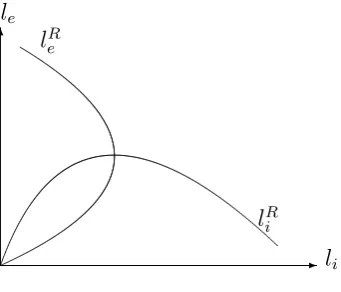
ljR. They yield the number of lawyers that maximizes the utility of agent j = i, eas a function of the number of lawyers hired by agent −j. Figure 1 represents these reaction functions. They are first increasing in the number of lawyers hired by the opponent and then decreasing. In anticipation of a small number of lawyers, the optimal response is to respond aggressively by hiring more lawyers. This is true until some point where parties start playing more defensively.
✻
✲ li
le
lRe
[image:12.595.223.394.98.244.2]lRi
Figure 1: Reaction curves
lawyers and a second solution where they both hire a positive number of lawyers. Because the focus of the paper is on litigation, the analysis focuses on the second equilibrium. This is consistent with a setting in which litigation involves fixed costs (because of mandatory legal representation for example). Indeed, starting from any given strictly positive number of lawyers hired by one of the parties, parties converge towards the interior solution.
The demands for lawyers are given by the following symmetric solution:
le(w) =li(w) =
pdj
w(j + 1)2 (12)
Then the following result holds:
Result 1 The demand for lawyers decreases with judicial efficiency j and increases with
damages d.
When judicial efficiencyj increases, both parties “fight” less because they expect that the judge is more likely to find out the truth. When damages d increase, the investor wants to hire more lawyers because he will receive a higher payoff if he wins the case.
Replacing the expression for the demand for lawyers into the probability of conviction gives the equilibrium probability of conviction:
X∗ = j
j + 1 (13)
on damages dand on the wagew. This is driven by the symmetric number of lawyers. A change in damages or in the wage modifies the number of lawyers and thus of arguments in the same way. The probability of conviction only depends on the relative number of arguments presented by the two parties the two parties. As a consequence, the probability of conviction is not affected by such changes. By contrast, a change in judicial efficiency
j gives a higher weight to the case of one party and thus does affect the probability of conviction.
3.3
Discussion
The litigation technology assumed so far is inefficient because the parties could hire less lawyers and still keep their expected benefit from litigation constant. Set the demands for lawyers to any arbitrarily small number and plug them in Equation (9). Then, the solution in Equation (13) still holds. This inefficiency arises because guilty entrepreneurs are able to produce arguments in their favor even though they are guilty. This leads to a wasteful contest. One way to make the litigation technology more efficient is to make it less efficient for guilty entrepreneurs to produce arguments. This could be for technolog-ical reasons, or because judges are more competent and thus better able to distinguish between good and bad arguments. I model this feature by introducing a productivity parameter η that enters the production function of arguments of the entrepreneur in the following way:
E =ηln(le). (14)
Taking into account this difference and solving the model as before, the probability of convicting a guilty entrepreneur becomes:
X = jli
jli+lηe. (15)
lawyers hired by the investor. There are no more inefficiencies.
The rest of the paper focuses on the case η = 1, first because this is consistent with the literature on litigation and second because it makes the analysis tractable. The case
η= 0 also allows for analytical solutions, but boils down to a standard setting where the only insight is that contract enforcement is good for the economy. The author conjectures that all the following results hold providing η is high enough.
4
The Financial Contract
Anticipating the number of engineers ly and of lawyers le and li, investors and
en-trepreneurs sign financial contracts specifying an amount to be lent k−s at an interest rate r .
Investors only accept to lend if they get a positive profit. Because they compete with each other by offering the most attractive contracts to entrepreneurs, they end up with nothing. The expected profit of entrepreneurs is the sum of the repaymentr(k−s) from successful and rational entrepreneurs (a proportion π(1−p) of them), of the expected compensatory damages x∗d received from successful and optimistic entrepreneurs (the
remaining proportion πp), and their opportunity cost of lending that is equal to the return from storing k−s. This boils down to the following zero-profit condition:
π(1−p)r(k−s) +πpX∗d−πpwl
i(w)−(k−s)≥0. (16)
translates in a larger loan. This gives the following incentive compatibility constraint:
r(k−s)≤X∗d (17)
It can be shown that Equations (16) and (17) are binding. Combining these two equations gives the optimal financial contract:
k=s−πpwli(w) +πX∗d (18)
r= X
∗d
πX∗d−πpwl
i(w)
(19)
Equation (18) shows that the legal environment affects the size of firms k through two channels. First, through the number of lawyers. When judicial efficiencyj increases, the demand for lawyers shifts to the left as Equation (12) tells us. As a consequence, the number of lawyers decreases for a given wage and the amount of capital tends to decrease as well. If investors can reach the same quality of contract enforcement with less lawyers, this relaxes their participation constraint and they are willing to lend more. By contrast, when damages d increase, the demand for lawyers increases, see Equation (12). A larger number of lawyers makes it more costly to enforce contracts and investors respond by lending less. Second, the legal environment affects the size of projects through the quality of enforcement X∗d. When judicial efficiency j or damages d increase, the
quality of contract enforcement increases as well. This relaxes the incentive compatibility constraint of the investor and he is willing to lend more.
We now replace the number of lawyers by their analytical solutions given in Equation (12). The financial contract now looks like that:
k =s+πdj(1 +j −p
2)
(j+ 1)2 (20)
r = 1 +j
π(1 +j−p2) (21)
Result 2 Higher judicial efficiency j and higher damages d have a positive impact on
capital k.
Higher damages increase both the quality and the cost of enforcement. The model pre-dicts, however, an unambiguous increase in lending. Higher judicial efficiency decreases the cost of enforcement and increases the quality of enforcement. Lending increases as a result.
5
Economic Development
This section describes the two channels through which the legal environment affects economic development: First, more capital benefits the economy. Second, a larger de-mand for lawyers makes it more costly to hire engineers and thus to produce.
Normalize the number of entrepreneurs and of investors to one. This implies that the aggregate demands for engineers and lawyers are equal to the individual demands and that L= 2. Then, the equilibrium wage is given by:
ly(w) +le(w) +li(w) = 2. (22)
Replacing the demands for engineers and lawyers from Equations (4) and (12) into Equation (22) gives the equilibrium wage:
w= B+Ak
2 , (23)
where B = (1+j)pdj2 is a constant.
Higher judicial efficiency j or lower damages d increase the parameter A and the equilibrium wage w. This happens because these parameter changes shift the demand for lawyers to the right. Because of the higher pressure on the labor market, the limited supply of labor implies that the wage has to increase.
We get the following result:
while lower damages d have no impact.
According to Equation (5), production decreases with the wage (because φ′ <0) and
with capital. Then, higher judicial efficiency increases production through both channels. By contrast, higher damages both increase the capital and the wage, and thus have an ambiguous impact on production. Doing the algebra shows that these two effects exactly cancel out.
5.1
Limited Supply of Lawyers
In some countries, the supply of lawyers is limited. Law departments were inexistent in Japan until recently for example or admission rates to the bar exam may be lowered. This section studies the consequences of limiting the supply of lawyers on the economy. The overall effect is not clear. First, a smaller number of lawyers should be beneficial because it reduces the inefficiency of lawyers. An artificially low number of lawyers, however, works against the market forces and drives a wedge between the wage of lawyers and the one of engineers. The cost of hiring lawyers increases and this harms the economy.
Constrain the supply of lawyers by an upper bound ¯l. If ¯l≥le(w)+li(w), the capacity
constraint on lawyers does not bind and we are back to the equilibrium previously de-scribed. An increase in the capacity constraint on lawyers ¯l has no impact on production. If If ¯l < le(w) +li(w), the equilibrium changes. Let wy be the wage of engineers and
wl the wage of lawyers. The supply of engineers is now L−¯l. The demand is still given
by Equation (4). The equilibrium wage of engineers is then given by:
wy =
2−¯l
Ak (24)
The supply of lawyers is ¯l. The demand for lawyers is the sum of the demands for lawyers in Equation (12). The equilibrium wage of lawyers is given by:
wl=
pdj
¯
Then, the following result holds:
Result 4 An increase in the capacity constraint of lawyers ¯l has a positive increase on economic development y.
An increase in the capacity constraint of lawyers ¯l increases the wage of engineers wy
and decreases the one of lawyers wl. From Equation 20, cheaper lawyers do not affect
capital. More expensive engineers, by contrast, decrease production.
5.2
Dynamics
This section describes the dynamics of the economy. We first assume that a first generation of agents is endowed with an amount of capital k0. Young agents work as
lawyers or workers and save all their wage to consume it when they are old st = wt−1.
From Equation (20), the stock of capital becomes:
kt+1 =wt+C, (26)
where C = πdj(1+j−p2)
(1+j)2 is a constant.
Combining this equation and the equilibrium wage from Equation (23) gives the law of evolution of capital:
kt+1 =Akt+B +C, (27)
If the conditions A+C > 0 and B < 1 are satisfied, then the economy converges to a stable steady state equilibrium kss such that:
kss= B+C
1−A (28)
at the growth rate gt of capital given by:
gt ≡
kt+1
kt
= Akt+B+C
kt
. (29)
the existence of a steady-state, B < 1, requires an assumption on a lower bound on the size of the population ((1−α)a)1/α<2.
Since the growth of output is an increasing function of g, the results above on eco-nomic development apply also to ecoeco-nomic growth. For example, higher judicial efficiency implies a larger growth rate of output along the convergence path. Along this path and at the steady state, an economy with higher judicial efficiency also produces more.
6
Some Empirical Evidence
The objective of this section is to see whether the predictions of the model are con-sistent with the data. It presents new cross-country data on the number of lawyers per capita. It then documents the relationship between various measures of judicial efficiency and the number of lawyers. Finally, it shows the relationships between the number of lawyers and financial and economic development.
6.1
Data
Table 2 gives summary statistics for some of the following variables.
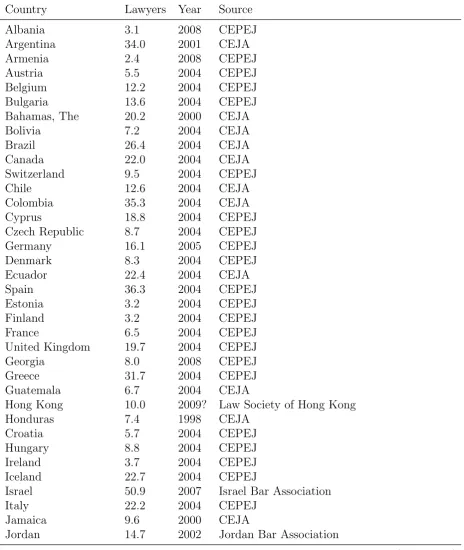
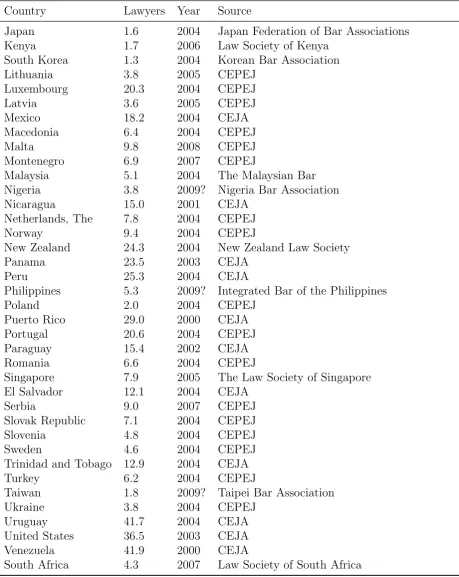
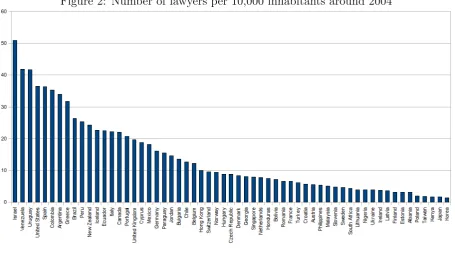
whereas South Korea has a little bit more than 1. Almost the same gap exists between the United States and Japan. The average number of lawyers per 10,000 inhabitants of the whole sample is 13.7.
How to measure judicial efficiency j? In the model, judicial efficiency refers to the productivity of judges. I use three variables that are likely to affect judicial productivity: formalism of courts, accounting standards, and legal origins.
First, the rigidity of judicial procedures makes judges more constrained and thus less productive. Djankov et al. (2003) collected data on the legal procedures to collect a bounced check in court. I use their measure of legal formalism as a proxy for how procedural the legal system is. A higher formalism entails higher costs and longer trials. I normalize this variable between zero and one, where a higher value means a more formal legal system. This variable covers 65 countries of the sample.
Second, higher accounting standards give a more accurate overview of the accounts of a firm. As a consequence, judges are better able to justify their decision when accounting standards are higher. I use a measure of accounting standards from the Center for International Financial Analysis and Research. I normalize this variable between zero and one, where a higher value means higher accounting standards. This variable only covers 37 countries of the sample.
Third, I use data on the legal origin of a country from La Porta et al. (2008). There are four legal origins in the sample: English common law, French civil law, German civil law, and Scandinavian civil law. A good rule of thumb is to thinks of common law countries as the United Kingdom and all its former colonies. Countries with a French legal origin are France, Italy, Spain, Portugal and all their former colonies. Countries with a German legal origin include Germany, Japan, South Korea and some East European countries. Countries with a Scandinavian legal origin are Denmark, Finland, Iceland, Norway and Sweden. These data cover the whole sample. Almost half of the countries have a French legal origin and almost one quarter are common law countries.
civil law, and Scandinavian civil law than in French civil law. Judges belonging to the French civil law family should thus be less productive than elsewhere as they are are more constrained by rigid civil codes. Second, the common law gives less investigative powers to judges than to lawyers in common law compared to civil law. This regulation constrains the productivity of judges in common law countries. Then, we should expect less lawyers in German and Scandinavian civil law countries. This classification, however, does not predict whether common law or French civil law countries have more lawyers. See Merryman (1969) and Zweigert and K¨otz (1998) for further details on the differences between legal origins.
Financial and economic development. I use real GDP per capita as a measure of economic development from Heston et al. (2009). I average this variable over 2001-2005 and 1980-1985 and take its logarithm. It covers all the sample in 2001-2001-2005 and 61 out of 74 countries in 1980-1985. The data on the share of credit to GDP averaged over 2001-2005 comes from the World Bank. It covers 71 countries.
6.2
Legal Environment and Lawyers
How is the legal environment related to the number of lawyers? This section shows OLS estimates of the number of lawyers on formalism of courts, accounting standards, legal origins, and controlling for past GDP. The results are given in Table 3 and are described below.
Countries that were richer in the 1980’s have more lawyers in the 2000’s. A one percent increase in past income increases the number of lawyers by 0.6-1 percentage points.
estimates are significant at the one percent level in all specifications.
The higher number of lawyers in common law countries is not surprising because of the adversarial nature of their trials that relies more heavily on lawyers than the inquisitorial nature of civil law trials. A bit more surprising is the finding that French civil law countries also have many lawyers. Latin American and Mediterranean countries are representative of this feature. One important difference between French civil law, on the one hand, and German and Scandinavian civil law, on the other hand, concerns the ability of judges to make the law and to rely less heavily on civil codes when making a decision. This greater constraints imposed on French civil law judges seem to increase drastically the number of lawyers.
The degree of formalism increases the number of lawyers. This is consistent with the model and with the view that lawyers take advantage of the rigidities of the legal system. The measure is normalized from 0 to 1, 0 being Venezuela and 1 being Hong Kong. The coefficient estimate predicts a 180 percent increase in the number of lawyers if Hong Kong was to adopt the same degree of formalism as the legal system of Venezuela and is significant at the 1 percent level.
Lower accounting standards increase significantly the number of lawyers. This is consistent with the model and with the view that lawyers can affect the judgment in their favor when standards are low. The measure is normalized from 0 to 1, 0 being Uruguay and 1 being Sweden. The coefficient estimate predicts a 220 percent in the number of lawyers if Sweden was to adopt the accounting standards of Uruguay and is significant at the 1 percent level.
6.3
Lawyers, Finance, and the Economy
How is the number of lawyers related to financial and economic development? This section show the regressions of credit and GDP on the number of lawyers, formalism of courts, and controlling for past GDP. There is a potential problem of reverse causality because credit is likely to influence the number of lawyers and vice versa. The OLS estimator may give biased estimates of the parameters of interest. One solution is to use an instrumental variable (IV). For this, we need to find an instrument that influences the number of lawyers without affecting directly credit or GDP. The previous regressions gave us a number of regressors that are correlated with the number of lawyers and that are thus potential candidates. Legal origin is a good candidate because it is exogenous (legal origins change very little over time) and it has been widely used in the literature as an instrument. The results of the OLS and IV estimates are given in Table 4 and 5 and are described below.
7
Conclusion
This paper introduced a model of litigation in a growth framework. The motivation for doing this exercise was the apparent contradiction between the idea that lawyers are harmful for the economy and the other idea that they are necessary to make litigation and thus the enforcement of contracts work. The analysis showed that a large number of lawyers can be the result of either low judicial efficiency, high damages, or low restrictions on the supply of lawyers. These environments do not benefit the economy and are thus consistent with a negative correlation between the number of lawyers and economic activ-ity. The model also predicts that economies benefit more from higher judicial efficiency than from tighter restrictions on the supply of lawyers or higher damages.
References
Anderlini, L., L. Felli, G. Immordino, and A. Riboni (2010). Legal Institutions, Innovation and Growth. Working paper.
Bond, P. (2009). Contracting in the Presence of Judicial Agency. The BE Journal of Theoretical Economics 9(1).
Buonanno, P. and M. Galizzi (2010). Advocatus, et non latro? Testing the Supplier-Induced-Demand Hypothesis for Italian. Fondazione Eni Enrico Mattei Working Pa-pers, 441.
Castro, R., G. Clementi, and G. MacDonald (2004). Investor Protection, Optimal Incen-tives, And Economic Growth. Quarterly Journal of Economics 119(3), 1131–1175.
Diamond, P. (1965). National Debt in a Neoclassical Growth Model. The American Economic Review 55(5), 1126–1150.
Galanter, M. (1993). Predators and Parasites: Lawyer-Bashing and Civil Justice.Georgia Law Review 28, 633.
Gennaioli, N. (2009). Optimal contracts with enforcement risk. Working paper.
Gennaioli, N. and E. Perotti (2009). Standardized Enforcement: Access to Justice vs Legal Innovation. Technical report, working paper.
Heston, A., R. Summers, and B. Aten (2009). Penn World Table Version 6.3. Center for International Comparisons of Production, Income and Prices at the University of
Pennsylvania.
Katz, A. (1988). Judicial Decisionmaking and Litigation Expenditure. International Review of Law and Economics 8(2), 127–143.
La Porta, R., F. L. de Silanes, and Shleifer (2008). The Economic Consequences of Legal Origin. Journal of Economic Literature.
Magee, S., W. Brock, and L. Young (1989). Black Hole Tariffs and Endogenous Policy Theory: Political Economy in General Equilibrium. Cambridge University Press.
Massenot, B. (2010). Financial development in adversarial and inquisitorial legal systems.
Working paper.
Merryman, J. (1969). The Civil Law Tradition. Stanford: Stanford University Press.
Murphy, K., A. Shleifer, and R. Vishny (1991). The Allocation of Talent: Implications for Growth. The Quarterly Journal of Economics 106(2), 503–530.
North, D. C. (1990).Institutions, Institutional Change and Economic Performance. Cam-bridge University Press.
Spier, K. (2007). Litigation. Handbook of Law and Economics 1, 259–342.
Table 1: Data Source
CEJA stands for Centro de Estudios de Justicia de las Americas (Justice Studies Center of the Americas). CEPEJ stands for Commission Europ´eenne pour l’Efficacit´e de la Justice (The European Commission for the Efficiency of Justice). The number of lawyers is per 10,000 inhabitants. An interrogation mark “?” refers to a year that was not explicitly specified but that could be inferred from the context, for example from the date of a newsletter.
Country Lawyers Year Source Albania 3.1 2008 CEPEJ Argentina 34.0 2001 CEJA Armenia 2.4 2008 CEPEJ Austria 5.5 2004 CEPEJ Belgium 12.2 2004 CEPEJ Bulgaria 13.6 2004 CEPEJ Bahamas, The 20.2 2000 CEJA Bolivia 7.2 2004 CEJA Brazil 26.4 2004 CEJA Canada 22.0 2004 CEJA Switzerland 9.5 2004 CEPEJ Chile 12.6 2004 CEJA Colombia 35.3 2004 CEJA Cyprus 18.8 2004 CEPEJ Czech Republic 8.7 2004 CEPEJ Germany 16.1 2005 CEPEJ Denmark 8.3 2004 CEPEJ Ecuador 22.4 2004 CEJA Spain 36.3 2004 CEPEJ Estonia 3.2 2004 CEPEJ Finland 3.2 2004 CEPEJ France 6.5 2004 CEPEJ United Kingdom 19.7 2004 CEPEJ Georgia 8.0 2008 CEPEJ Greece 31.7 2004 CEPEJ Guatemala 6.7 2004 CEJA
Hong Kong 10.0 2009? Law Society of Hong Kong Honduras 7.4 1998 CEJA
Croatia 5.7 2004 CEPEJ Hungary 8.8 2004 CEPEJ Ireland 3.7 2004 CEPEJ Iceland 22.7 2004 CEPEJ
Israel 50.9 2007 Israel Bar Association Italy 22.2 2004 CEPEJ
Jamaica 9.6 2000 CEJA
Jordan 14.7 2002 Jordan Bar Association
Table 1 –Continued
Country Lawyers Year Source
Japan 1.6 2004 Japan Federation of Bar Associations Kenya 1.7 2006 Law Society of Kenya
South Korea 1.3 2004 Korean Bar Association Lithuania 3.8 2005 CEPEJ
Luxembourg 20.3 2004 CEPEJ Latvia 3.6 2005 CEPEJ Mexico 18.2 2004 CEJA Macedonia 6.4 2004 CEPEJ Malta 9.8 2008 CEPEJ Montenegro 6.9 2007 CEPEJ
Malaysia 5.1 2004 The Malaysian Bar Nigeria 3.8 2009? Nigeria Bar Association Nicaragua 15.0 2001 CEJA
Netherlands, The 7.8 2004 CEPEJ Norway 9.4 2004 CEPEJ
New Zealand 24.3 2004 New Zealand Law Society Panama 23.5 2003 CEJA
Peru 25.3 2004 CEJA
Philippines 5.3 2009? Integrated Bar of the Philippines Poland 2.0 2004 CEPEJ
Puerto Rico 29.0 2000 CEJA Portugal 20.6 2004 CEPEJ Paraguay 15.4 2002 CEJA Romania 6.6 2004 CEPEJ
Singapore 7.9 2005 The Law Society of Singapore El Salvador 12.1 2004 CEJA
Serbia 9.0 2007 CEPEJ Slovak Republic 7.1 2004 CEPEJ Slovenia 4.8 2004 CEPEJ Sweden 4.6 2004 CEPEJ Trinidad and Tobago 12.9 2004 CEJA Turkey 6.2 2004 CEPEJ
Taiwan 1.8 2009? Taipei Bar Association Ukraine 3.8 2004 CEPEJ
Uruguay 41.7 2004 CEJA United States 36.5 2003 CEJA Venezuela 41.9 2000 CEJA
Figure 2: Number of lawyers per 10,000 inhabitants around 2004
Table 2: Summary statistics
Variable Mean Std. Dev. Min. Max. N Lawyers per 10,000 inhab. 13.7 11.3 1.3 50.9 74 Common law 0.22 0.41 0 1 74 French civil law 0.47 0.50 0 1 74 German civil law 0.24 0.43 0 1 74 Scandinavian civil law 0.07 0.25 0 1 74
Formalism 0.6 0.2 0 1 65
[image:28.595.127.471.574.703.2]Table 3: Legal environment and the number of lawyers Dependent variable: Log of lawyers per 10,000 inhabitants
Log GDP pc 1981-85 0.599*** 0.524*** 0.561** 0.888*** (0.000) (0.003) (0.023) (0.000) Common law 0.966*** 2.079***
(0.002) (0.000)
French 1.470*** 1.193***
(0.000) (0.000)
Scandinavian 0.180 0.666*
(0.662) (0.079)
Formalism 1.749*** 1.824*** (0.001) (0.005) Accounting standards -2.339*** -2.123***
(0.001) (0.001) Constant -4.122*** -3.393** -1.458 -6.748***
(0.003) (0.047) (0.490) (0.000)
N 61 57 37 37
adj. R2 0.369 0.195 0.248 0.703
p-values in parentheses
*p <0.10, **p <0.05, *** p <0.01
Table 4: Number of lawyers and credit
Dependent variable: Log of the ratio of credit to GDP averaged over 2001-2005
OLS IV, with legal
origin OLS
IV, with legal origin Log GDP pc 1981-85 0.905*** 0.927*** 0.777*** 0.757***
(0.000) (0.000) (0.000) (0.000) Lawyers -0.200** -0.268 -0.142 -0.101
(0.039) (0.115) (0.180) (0.568)
Formalism -0.766* -0.831*
(0.074) (0.088) Constant -3.695*** -3.730*** -2.229* -2.102
(0.001) (0.001) (0.095) (0.136)
N 58 58 55 55
adj. R2 0.509 0.505 0.513 0.511
p-values in parentheses
[image:29.595.79.530.509.728.2]Table 5: Number of lawyers and GDP
Dependent variable: Log of GDP per capita averaged over 2001-2005
OLS IV, with legal
origin OLS
IV, with legal origin Log GDP pc 1981-85 1.213*** 1.210*** 1.139*** 1.127***
(0.000) (0.000) (0.000) (0.000) Lawyers -0.117*** -0.109 -0.085** -0.063
(0.004) (0.100) (0.047) (0.360)
Formalism -0.313* -0.352*
(0.077) (0.080) Constant -1.320*** -1.315*** -0.537 -0.461
(0.004) (0.004) (0.319) (0.419)
N 61 61 57 57
adj. R2 0.911 0.911 0.915 0.914
p-values in parentheses