Munich Personal RePEc Archive
PAYG pensions and economic cycles
Fanti, Luciano and Gori, Luca
University of Pisa, University of Pisa
12 January 2010
PAYG pensions and economic cycles
Luciano Fanti* and Luca Gori**
Department of Economics, University of Pisa, Via Cosimo Ridolfi, 10, I–56124 Pisa (PI), Italy
Abstract This article analyses the dynamics of an overlapping generations economy
(Diamond, 1965) with pay-as-you-go financed public pensions and myopic expectations. It is
shown that large PAYG pensions may trigger economic fluctuations depending on the mutual
relationship between technology and preference parameters. Our findings constitute a policy
warning about the size of social security and provide another explanation of the occurrence of
persistent cycles.
Keywords Myopic foresight; PAYG pensions; Stability; OLG model
JEL Classification C62; H55; J26
We wish to thank seminar participants at the 10th Annual Conference of the Association for Public Economic Theory
(PET 2009), held on June 18–20, 2009 at the National University of Ireland, Galway, Ireland, for helpful comments.
Usual disclaimer applies.
*
E-mail address: [email protected]; tel.: +39 050 22 16 369; fax: +39 050 22 16 384.
**
1. Introduction
Social security in many developed countries is based on pay-as-you-go (PAYG) public pensions.
Motivated by the thrift of ageing on the viability of the widespread PAYG schemes in the long-run,
social security reforms are currently high in the political agenda. While a growing body of
economic literature dealing with the relationship between pensions, fertility, longevity and
economic growth has been developed in the last decades (see, amongst many others, Zhang et al.,
2001, 2003; van Groezen et al. 2003; Pecchenino and Pollard, 2005), less attention has been paid to
the dynamical effects of the PAYG systems in the overlapping generations (OLG) context.
Moreover, while the effects of higher longevity as a threat for the sustainability of public
pensions has been extensively debated, its role in determining whether and how PAYG pensions
can affect economic stability has not been so far investigated. In this paper we show that if, as
commonly retained, a rise in longevity can threaten the balancing of the PAYG budget,1 it can
favour, however, the stability of the economy.
The aim of this paper, therefore, is to provide a stability analysis of the conventional general
equilibrium OLG economy with PAYG pensions, showing the conditions under which economic
cycles can occur and also how the latter are affected by the size of the pension system as well as by
other economic variables. In particular, we focus on the PAYG defined-contribution scheme,2
which is the most largely investigated in literature and also seems to be increasingly implemented in
1
By passing, we note that Fanti and Gori (2008) showed that in many cases a rise in longevity may favour the viability
of the PAYG plan in the long run.
2
In order to preserve solvency, a government that wishes to redistribute across generations with a PAYG pensions
the recent years.3 We contribute some findings to the existing literature on OLG economies and
social security. First, we find that the size of the PAYG defined-contribution scheme may be
responsible of the existence of endogenous cycles, adding another possible explanation to the
cyclical behaviour in OLG models.4 Second, we show that countries with a high capital share (e.g.,
Italy, Japan and Spain) may support larger PAYG systems than countries with low capital shares
(e.g., Germany and the US) without destabilising the economy.5 Third, pensioners in countries with
a relatively high individual degree of thriftiness as well as with long-lived agents can receive a more
generous pension arrangement than pensioners in countries where individuals are relatively
impatient and adult mortality is much larger.
As is known, cyclical behaviour can occur in many-good OLG models (Grandmont, 1985) as
well as in the one-good Diamond-type OLG context (Farmer, 1986; Reichlin, 1986). On the one
hand, however, a low value of the elasticity of substitution in production is required (in particular, a
value well below unity) in order to make cycles possible.6 On the other hand, with myopic
foresight, the steady state equilibrium may be oscillatory and exhibit deterministic complex cycles
(Michel and de la Croix, 2000, de la Croix and Michel, 2002; Fanti and Spataro, 2008), but only
3
As noted by Wagener (2003), several countries recently switched to a defined-contribution scheme (e.g., Sweden), or
chose the fixed-contribution option when newly designing their pension system in the late 1990s, such as Latvia and
Poland, or at least moved into that direction (e.g., Italy and Germany).
4
Wagener (2003) investigates a PAYG defined-replacement-ratio scheme (i.e., pensions as a given fraction of wages
during working age) with perfect foresight, and shows hat changes in the replacement rate may expose the economy to
periodic or unstable dynamics, because – different from a defined-contribution system – the defined-benefit system is
characterized by a second order difference equation which is “intrinsically” more prone to generate unstable dynamics.
Different from Wagener (2003), however, in this paper we focused on a defined-contribution PAYG system with
myopic foresighted individuals also to investigate the effects of longevity on the stability of the economy.
5
For recent estimates of the capital share in several countries, see, e.g., Jones (2003) and Rodriguez and Ortega (2006).
6
Reichlin (1986) discussed the Leontief case (with no substitutability), while Farmer (1986) showed that cycles occur
only when technologies exhibit lower factor substitutability than the Cobb-Douglas function and discussed the CES
when the inter-temporal elasticity of substitution in the utility function is higher than unity (i.e.,
higher than the inter-temporal elasticity of substitution in the Cobb-Douglas utility function).
Therefore, although it is well known that OLG economies with myopic expectations and
elasticity of substitution in the production and in the utility functions relatively low and high,
respectively, may show cyclical (and even chaotic) dynamics, in this paper we show that the size of
PAYG pensions may play a crucial role in determining the stability of the economy even in a
double Cobb-Douglas context and, in particular, large PAYG systems may cause persistent cycles.
This is, to the best of our knowledge, a novel example of the possibility of cyclical behaviour in
OLG models.
The remainder of the paper is organised. In Section 2 we present the model. In Section 3 we
analyse the dynamics of the economy showing that the size the PAYG system may trigger
economic fluctuations showing also an example of chaotic dynamics. Section 4 concludes.
2. The model
2.1. Individuals
Consider a two-period overlapping generations economy (Diamond, 1965) with stationary
population and identical individuals.7 In the first period of life (working period) young individuals
belonging to generation t (Nt) are endowed with one unit of time supplied inelastically on the
labour market, while receiving wage income at the competitive rate wt. This income is used to
consume, to save and to support material consumption of the elderly (through a public PAYG-based
pension system). In the second period of life (retirement period) old-age individuals are retired and
7
Assuming a constant rate of population growth does not alter any of the substantive conclusions of the model and,
live on the proceeds of their savings (st) plus the expected interest accrued at the rate ret+1 as well
as on the expected pension benefit, pet+1. Moreover, we suppose young individuals survive to the
first period with (constant) probability 0<π <1 (i.e., 1−π is the probability of dying after one
period only). The existence of a perfect annuity market implies old survivors will benefit not only
from their own past saving plus interest, but also from the saving plus interest of those who have
deceased.
Each young born at time t must choose how much to save out of wage income so as to maximise
a homothetic and separable (lifetime) utility function (Ut) defined over young-aged and old-aged
consumption, c1,t and c2,t+1, respectively, subject to the first and second period of life budget
constraints. Assuming logarithmic preferences, the representative individual born at time t solves
the following constrained maximisation programme:
{ } ln
( )
1, ln( )
2, 1max st Ut = c t +πβ c t+ , (P)
subject to
(
)
1 1 1 , 2 , 1 1 1 + + + = + + − = + t e t t e t t t t p s r c w s c π θ ,where 0<θ <1 is the payroll tax paid by the young contributors to finance pension arrangements to
the current old-aged and 0<β <1 is the subjective discount factor, that is, β represents the degree
of individual (im)patience to consume over the life cycle. The higher β is the more individuals are
patient and prefer to smooth consumption over the retirement period.
Maximisation of (P) thus gives the following saving function:
(
)
(
)
(
1)
1 1 1 1 1 + + + + − + − = t e t e t t r p w s β ππ β π θ β π. (1)
As regards the production sector, we assume that firms are identical and act competitively on the
market. The (aggregate) constant returns to scale technology is Yt = AKtαLt1−α, where Yt, Kt and
t t N
L = are output, capital and the time-t labour input respectively, A>0 represents a scale
parameter and 0<α <1 is the output elasticity of capital. Defining kt :=Kt/Nt and yt:=Yt/Nt as
capital and output per worker, respectively, the intensive form production function may be written
as yt =Aktα. Assuming that capital fully depreciates at the end of each period and normalising the
price of final output to unity, profit maximisation implies that factor inputs are paid their marginal
products, that is:
1
1
−
=α α−
t t Ak
r , (2)
(
α)
αt t Ak
w = 1− . (3)
2.3. Government
The government redistributes between generations through an unfunded PAYG social security
scheme. Therefore, in every period the benefit received by current pensioners is entirely financed by
current workers whose working income is taxed away at the constant rate 0<θ <1. Therefore, the
(per worker) government pension budget at t reads as
t t w
p θ
π = , (4)
the left-hand side being the social security expenditure and the right-hand side the tax receipt.
Now, inserting the one-period-forward pension accounting rule Eq. (4) into Eq. (1), the saving
rate is
(
)
1 1
1 1
1 1
+ +
+ ⋅ + − +
− =
t e t e t
t
r w w
s
β π θ β
π θ
β π
. (5)
From Eq. (5) it can readily be seen that savings are divided in two components: (i) the private
marginal willingness to save out of wage income (under the hypothesis of Cobb-Douglas utility),
and (ii) the public pension component (the second term on the right-hand side of Eq. 5), which
depends on both the expected pension benefit and expected interest rate. Notice that the lower adult
mortality and the higher the individual subjective discount factor, the lower (higher) the relative
weight of the public pension component (private saving component) in savings.
2.4. Equilibrium
Given the government budget Eq. (4) and knowing that Nt+1 =Nt (i.e. stationary population
hypothesis), market-clearing condition in goods and capital markets is
t t s
k+1= , (6)
that is, the stock of capital installed at time t+1 is determined by the amount of resources saved in
at time t. Combining Eqs. (5) and (6), equilibrium implies:
(
)
1 1 1
1 1
1 1
+ + + = + − − + ⋅ +
t e t e t
t
r w w
k
β π θ β
π θ
β
π . (7)
Depending on whether individuals are perfect or myopic foresighted the dynamics of capital
dramatically changes. Below we show that while the same unique positive steady-state is preserved
in both cases (see Michel and de La Croix, 2000), (i) the dynamics of capital with rational
expectations is always monotonic and convergent to the steady-state, and (ii) the dynamics of
capital with myopic expectations may be non-monotonic and divergent to the steady-state even with
Cobb-Douglas utility and production functions. It is worth noting that the non-monotonic behaviour
of the economy relies on (a) the size of the (fixed) payroll tax paid by the young to finance pensions
to the old, and (b) the mutual relationship between technology and preference parameters.
With perfect foresight, both the expected interest and wage rates depend on the future value of the
stock of capital per young, that is
(
−)
= = + + + − + + α α α α 1 1 1 1 1 1 1 t t e t t e Ak w Ak r, (8)
Therefore, exploiting Eqs. (2), (3), (7) and (8), the dynamic equilibrium sequence of capital can
be written as
(
) (
)
(
πβ) (
θ α)
ααπβ θ α α t
t k A k ⋅ − + + − − = + 1 1 1 1
1 . (9)
Steady-state implies kt+1 =kt =k*, so that:
(
) (
)
(
) (
)
α α θ β παπβ θ α α
− − + + − − = 1 1 * 1 1 1 1 A
k . (10)
2.4.2. Myopic foresight
With myopic foresight, both the expected interest and wage rates depend on the current value of the
stock of capital per person, that is
(
−)
= = + + − + α α α α t t e t t e Ak w Ak r 1 1 1 1 1. (11)
Using (2), (3), (7) and (11), the dynamic path of capital accumulation is now given by:
(
)(
)
t t
t k k
A k αα β π θ β π α θ β
π α ⋅ −
+ − + − − = + 1 1 1 1 1
1 , (12)
and the steady state is still determined by Eq. (10).
In this section we study the dynamics of the economy with PAYG pensions and myopic
expectations. First, we study the case with generic utility and production functions. Second, we
analyse the local stability properties of the double Cobb-Douglas economy.8
Assuming generic utility and production functions (as well as the existence and uniqueness of the
steady state equilibrium), the market-clearing condition Eq. (7) can be written as
( )
( )
[
( )
( )
]
= + + + + pension public t t e t t e saving private t t e t tt S w k r k Pw k r k
k 1 , 1 , 1 , 1 , (13)
where the saving function S depends on both the private saving and public pension components.
The private saving component is determined by the individual’s willingness to save (which, in turn,
depends on both the current wage and the expected interest rate), while the (PAYG) public pension
function P depends on the expected values of both the wage and interest rates.9
Therefore, totally differentiating Eq. (13) with respect to kt yields
− − + − + + + + + − − + − + − + + + + + + ∂ ∂ ⋅ ∂ ∂ + ∂ ∂ ⋅ ∂ ∂ ⋅ ∂ ∂ + ∂ ∂ ⋅ ∂ ∂ + ∂ ∂ ⋅ ∂ ∂ = t t e t e t t e t e t t e t e t t t t t k r r P k w w P P S k r r S k w w S dk dk 1 1 1 1 / 1 / 1 1
, (14)
where ∂S/∂wt >0 represents the marginal propensity to save out of wage income, ∂S/∂ret+1
captures the effects of the expected rate of interest within the private component of total savings
(both describe how aggregate saving varies along with the private marginal willingness to save),
8
The (local) stability properties of a double Cobb-Douglas economy with PAYG pensions and perfect foresight is
briefly presented in Appendix A. Different from the case with myopia, an economy with perfect foresighted individuals
does not exhibit any interesting dynamical feature.
9
With myopic expectations individuals will expect the future values of the wage and the interest rate to be exactly the
same than those prevailing in the current period. Therefore, both private savings and the public pension function P
and ∂S/∂P<0 reflects the (negative) public pension effect on S, i.e., the disincentive to save
caused by public social security. In particular, during the working period the young know that the
government will provide a benefit to support material consumption when old, and this crowds out
private savings.
As regards the effects of the private saving component on the accumulation of capital, we note
that with a generic utility function the individual propensity to save depends of course on the
interest rate. As a consequence, a reduction in the expected rate of interest – due to a marginal
increase in the level of the future stock of capital – positively (negatively) affects aggregate savings
depending on whether the substitution effect is dominated by (dominates) the income effect, i.e.,
0
/∂ 1<
∂S ret+ (∂S/∂ret+1 >0). The substitution effect describes the advantages or disadvantages to
substitute consumption between youth and oldness, while the income effect captures the increased
or reduced revenue from savings, other things being equal (a lower rate of interest, therefore, makes
less profitable to substitute consumption bundles over the life cycle and decreases the direct revenue
from savings).
From Eq. (14) we see that a marginal increase in the stock of capital in period t ambiguously
affects the value of the capital stock installed in the subsequent period. Therefore, both monotonic
and oscillatory dynamics are possible. In particular, the final effect is threefold.
As regards the private saving component there exist (i) a positive effect that increases the current
wage, and thus the marginal propensity to save out of wage income and the capital stock will be
installed in the future, and (ii) an ambiguous effect of the reduced expected rate of interest.
Therefore, (ii.1) if the substitution effect dominates the income effect (i.e., ∂S/∂ret+1 >0), then a
reduced expected interest rate – by decreasing the relative weight of the private saving component –
tends to reduce the value of the stock of capital installed in the subsequent period; (ii.2) if the
substitution effect is dominated by the income effect (i.e., ∂S/∂ret+1<0), then a reduced expected
interest rate – by increasing the relative weight of the private saving component – raises future
of capital causes (iii) a negative effect due to the increased relative weight of the public pension
function P in total savings, that reduces, in turn, the stock of capital installed in the future. In fact,
the increased expected future marginal productivity of labour (the wage rate effect) as well as the
reduced expected marginal productivity of capital (the interest rate effect) tend to enhance the
expected pension benefit will be received by current pensioners, while also reducing the private
marginal willingness to save.
If the substitution effect dominates the income effect, then the positive effect of the increased
private marginal willingness to save on the accumulation of capital is counterweighted by the
reduced interest rate will prevail on the future (the private saving component) as well as by the
negative public pension effect (i.e., the relative weight of the public pension function is higher).
If the substitution effect is dominated by the income effect, then the higher marginal willingness
to save out of wage income due to a rise kt is reinforced by the effect played by the lower expected
rate of interest so that this force is counterweighted only by the negative public pension effect.
Hence, when the substitution effect dominates the income effect, oscillatory dynamics are more
likely to occur than when the substitution effect is dominated by the income effect.
If both substitution and income effects exactly cancel out (i.e., ∂S/∂ret+1=0 – Cobb-Douglas
utility), then the final effect of a rise in the stock of capital at t on the level of the capital stock
installed at t+1 exclusively depends on two counterbalancing forces: the positive private saving
effect (that contributes to increase total savings due to the higher willingness to save when young)
and the negative public pension effect (which, instead, crowds out savings due to the higher benefit
received during the retirement period). Definitively, in the case of Cobb-Douglas utility the
dynamics of capital with myopic expectations is monotonic (oscillatory) if the private saving
component dominates (is dominated by) the public pension component.
Below we typify the dynamics of a double Cobb-Douglas OLG economy and showing that the
introduction of a PAYG scheme when individuals are myopic foresighted may cause either
noting that the occurrence of temporary or permanent oscillations depends on the generosity of the
unfunded social security system as well as on the mutual relationship between both technology and
preference parameters. In particular, when the production technology is relatively labour-oriented,
then a too large PAYG pensions (that is, a relatively high contribution rate) may destabilise the
economy. Moreover, the higher the rate of longevity is and the more individuals prefer to smooth
consumption over the retirement period (a higher subjective discount factor), the lower – given the
increased relative importance of the private component in total saving – the risk of cyclical
instability associated with the PAYG scheme is.
Analysis of Eqs. (10) and (12) gives the following proposition:
Proposition 1. In a double Cobb-Douglas economy with public PAYG pensions and myopic
expectations the dynamics of capital is the following.
(1) Let 0<α <α4 hold. Then θ1<θ2 <1, and
(1.1) if 0<θ <θ1, the dynamics of capital is monotonic and convergent to k ; *
(1.2) if θ1<θ <θ2, the dynamics of capital is oscillatory and convergent to k ; *
(1.3) if θ =θ2, a flip bifurcation emerges;
(1.4) if θ2 <θ <1, the dynamics of capital is oscillatory and divergent to k . *
(2) Let α4 <α <α2 hold. Then θ1<1, θ2 >1, and
(2.1) if 0<θ <θ1, the dynamics of capital is monotonic and convergent to k ; *
(3) Let α2 <α <1 hold. Then θ2 >θ1 >1, and the dynamics of capital is monotonic and convergent
to k for any * 0<θ <1,
where
(
)
(
) (
πβ)
α α θ π β α θ + − = = 1 1 : , , 2 2 1
1 , (15)
(
)
(
(
) (
)
πβ)
θ αα α α α θ π β αθ + = +
− + =
= 1 1
1 1 : ,
, 2 2 1
2 , (16)
( )
, : 1 1 02 2 > + + − = = β π β π π β α
α , (17)
( )
(
)
02 9 10 3 : , 2 2 4 4 > + + + + − = = β π β π β π β π π β α
α . (18)
Proof. See Appendix B.
From Proposition 1 the following remark can be derived.
Remark 1. The monotonic dynamics of capital in a double Cobb-Douglas PAYG-based economy
with myopic expectations is always convergent to the stationary state (i.e., the so-called saddle
node bifurcation can never occur, or, in other words, the economy may loose stability only through
oscillations).
Proposition 1 shows that when labour is relatively important in production, large PAYG systems
may imply oscillatory movements and also trigger the occurrence of persistent cycles. In particular,
two different threshold values of the contribution rate exist that discriminates between (i)
the non-monotonic region. If the payroll tax paid by the young contributors is lower (higher) than
the threshold θ1, then the public pension component in total savings is dominated by (dominates)
the private component and thus the dynamics path of capital accumulation exhibits monotonic
(oscillatory) movements. Rising further the contribution rate, however, may destabilise the
economy (this is due to the fact that the relative weight of the public pension component in total
savings is higher. This happens when the flip bifurcation value of the payroll tax θ2 is exceeded).
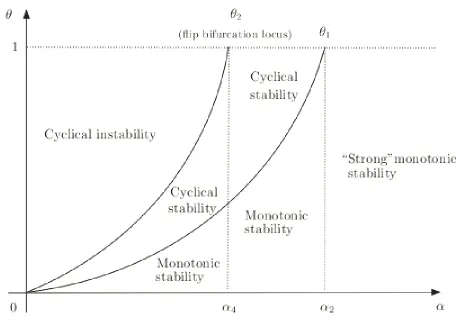
The following Figure 1 illustrates in the space
( )
α,θ and for a given value of the rate oflongevity and the individual subjective discount factor, the locus which discriminates between
monotonic and oscillatory regions (θ1) as well as the period-doubling flip bifurcation locus (θ2),
which, instead, discriminates between stable and unstable regions. The figure clearly shows that the
higher is the distributive capital share the lower is the risk of cyclical instability. Moreover, a rise in
either the individual subjective discount factor or life expectancy, or both, shifts upward both loci
and thus tends to stabilise the economy shrinking the size of the cyclically unstable region.10
10
We recall that α4 <1/3 and α2 <1/2 hold for any π,β∈
( )
0,1 . For the sake of brevity, we do not display hereFigure 1. Stability and instability regions in the space
( )
α,θ .Therefore, countries with a relatively high capital share in production as well as with patient
individuals (that ascribe a large enough importance to the private saving component rather then to
the public pension component and thus prefer to smooth consumption over the retirement period),
may increase the size of the contribution rate paid by the young to fund the benefits to retired
people without generating temporary or permanent oscillations. In these countries large PAYG
systems do not ever constitute a peril for the economic stability. In contrast, countries with a
relatively low distributive capital share and with a low degree of thriftiness (i.e., individuals are
impatient and prefer to consume more today rather than tomorrow) are much more prone to
economic instability when the government rises the contribution rate to finance PAYG pensions.
In the following proposition we clarify the role played by both the degree of individual thriftiness
Proposition 2. Let individuals be myopic foresighted. Then a rise in either life expectancy or the
degree of individual thriftiness, or both, tends to stabilise the economy.
Proof. The proof can easily be derived by differentiating Eqs. (15) and (16) with respect to π and
β, that is
(
1)
2 02
1 >
− = ∂
∂ β
α α π
θ ,
(
1)
2 02
1 >
− = ∂
∂ π
α α β
θ ,
(
)
(
1)
01
2
2 >
− + = ∂
∂ β
αα α π
θ and
(
)
(
1)
01
2
2 >
− + = ∂
∂ π
α α α β θ
. Since the economy is unstable only through oscillations, then a rise in either
life expectancy or in the degree of individual thriftiness increases the value the contribution rate
beyond which the dynamics of capital is displays oscillatory movements as well as the flip
bifurcation value of the payroll tax. This causes a reduction in both the width of the oscillatory
region and the width of the cyclical unstable region. Q.E.D.
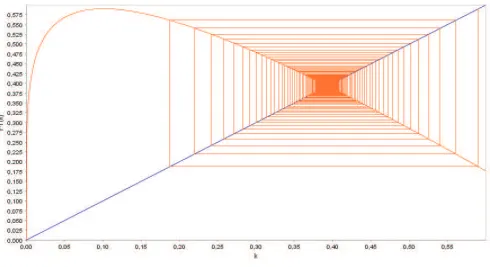
In Figures 2 and 3 we illustrate Proposition 2 showing an example of the different non-monotonic
behaviour when adult mortality is relatively high (Figure 2) and low (Figure 3). As an example, we
take the following parameter values for both figures: A=10, α =0.20, β =0.50. Moreover, we
choose π =0.30 (Figure 2) and π =0.90 (Figure 3). This parameter sets generate the following flip
bifurcation values of the contribution rate: θ2 =0.4312 (when π =0.30) and θ4 =0.5437 (when
90 . 0
=
π ). Then we take θ =0.53. The cobweb depicted in Figure 2 shows the non-monotonic
divergent dynamics of capital when the rate of longevity is relatively low, while the cobweb in
Figure 3 displays the convergent non-monotonic dynamics of capital when the rate of longevity is
Figure 2. Case π =0.30. A pictorial view of cyclical instability (k*=0.1111, k0 =0.108).
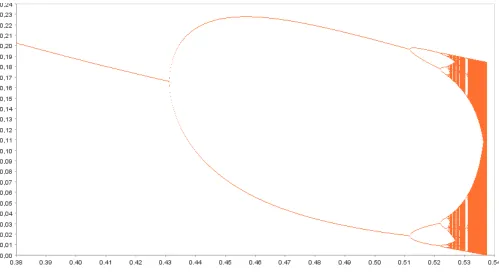
[image:18.595.62.552.429.696.2]This model also shows deterministic chaos. Figure 4 depicts the bifurcation diagram for the
parameter θ (which lies on the horizontal axis). The parameter values are the same as in Figure 2.
On the vertical axis we show the limit points of the equilibrium sequence of capital. When the
contribution rate is relatively low (below 0.4312) a unique limit point exists. When θ =0.4312 a
period doubling bifurcation emerges. Then period doubling bifurcations appear more rapidly after
5125 . 0
=
θ . Finally, a further increase in the contribution rate brings the economy into the chaotic
region. This is an example of the complex dynamics generated by the large PAYG systems in an
[image:19.595.59.558.317.593.2]OLG Cobb-Douglas economy.
Figure 4. Bifurcation diagram for θ.
4. Conclusions
We analysed the dynamics of an OLG economy with PAYG (defined-contribution-typed) pensions
We showed that countries with a relatively capital-oriented technology and a relatively high
degree of parsimony (such as Italy) may support larger public pension systems without perils for the
economic stability than countries where technology is relatively labour-oriented and individuals
have a low degree of parsimony (such as the US).
Our results have a twofold interpretation: (i) constitute a policy warning about the risks of
(cyclical) instability caused by the widespread and generous PAYG pension schemes in presence of
realistic myopia of individuals, and (ii) they represent a further explanation of economic cycles in
OLG economies.
Appendix A
We briefly show here that with perfect foresight the dynamics of a PAYG-based Cobb-Douglas
OLG economy cannot be cyclical.
Proposition A.1. In a Cobb-Douglas PAYG-based economy with perfect foresighted individuals the
dynamics of capital is always monotonic and convergent to k irrespectively of the size of the *
PAYG system.
Proof. Differentiating (9) with respect to kt and using (10) we find:
(
) (
)
(
πβ) (
θ α)
( )
αα
α α θ β π
α α =
− + +
− −
= ∂
∂ −
=
+1 * 1
1 1
1 1
* k
A k
k
k k t t
t
.
Therefore, 0 * 1
1 <
∂ ∂
< + =
k k t t
t
k k
for any 0<θ <1. Q.E.D.
Proof of Proposition 1.
Differentiating Eq. (12) in Section 2.4.2. with respect to kt and evaluating it at the steady-state
gives:
(
)(
)
( )
αα β π θ β π α θ β πα α ⋅ −
+ − + − − = ∂ ∂ − = + 1 1 1 1
1 * 1
1 * k A k k k k t t t
. (B1)
Using Eq. (10) in Section 2.4.1., Eq. (B1) becomes
(
)
αα β π θ α 2 1 1 1 * − ⋅ + − = ∂ ∂ = + k k t t t k k. (B2)
Monotonic and non-monotonic dynamics
The condition * 0
1 < > ∂ ∂ = + k k t t t k k implies
(
)
1 2 0 11 α θ θ
α β
π θ
α ⇔ ><
< > − ⋅ +
− , (B3)
where θ =θ1 (defined by Eq. 15 in Section 3.) represents the value of the contribution rate below
(beyond) which the dynamics of capital is monotonic (oscillatory). In particular, θ1 <1 (θ1 >1) for
any 0<α <α2 (α2 <α <1).
θ1<1 implies α1<α <α2, where
( )
, : 1 1 01 1 < + − − = = β π β π π β α
α , (B4)
( )
, : 1 1 02 2 > + + − = = β π β π π β α
α . (B5)
Since α1 <0 it can be automatically ruled out. Notice also that 0<α2 <1/2 for any β and π.
Now, * 1
(
)
(
πβ)
α α θ αα β π θ α + − − > < − ⋅ + − 1 1 1 1 1 2. (B6)
Therefore, in the case of monotonic behaviour, the dynamics of capital is always convergent to the
stationary state, that is, 0 * 1
1 <
∂ ∂
< + =
k k t t t k k .
Stability and instability analysis in the case of non-monotonic dynamics
The condition * 1
1 − < > ∂ ∂ = + k k t t t k k implies
(
)
2 2 1 11 α θ θ
α β π θ α > < − < > − ⋅ +
− , (B7)
where θ =θ2 >θ1 (defined by Eq. 16 in Section 3.) represents the flip bifurcation value of the
contribution rate, that is, the value of θ below (beyond) which the equilibrium with oscillatory
dynamics is stable (unstable). In particular, θ2 <1 (θ2 >1) for any 0<α <α4 (α4 <α <1), with
2 4 α
α < .
θ2 <1 implies α3<α <α4, where
( )
(
)
02 9 10 3 : , 2 2 3 3 < + + − + − = = β π β π β π β π π β α
α , (B8)
( )
(
)
02 9 10 3 : , 2 2 4 4 > + + + + − = = β π β π β π β π π β α
α . (B9)
Since α3 <0 it can be automatically ruled out. Notice also that 0<α4 <1/3 for any β and π.
Therefore, if 0<α <α4 then θ1 <θ2 <1, and 0 * 1
1 <
∂ ∂
< + =
k k t t t k k
for any 0<θ <θ1,
0 1 * 1 < ∂ ∂ < − + = k k t t t k k
for any θ1<θ <θ2, * 1
1 =−
∂ ∂ = + k k t t t k k
if and only if θ =θ2, and * 1
1 <−
∂ ∂ = + k k t t t k k
If α4<α <α2 then θ1 <1, θ2 >1, and 0 * 1
1 <
∂ ∂
< + =
k k t t
t
k k
for any 0<θ <θ1 and
0
1 *
1 <
∂ ∂ <
− + =
k k t t
t
k k
for any θ1<θ <1.
If α2<α <1 then θ2 >θ1 >1, and 0 * 1
1 <
∂ ∂
< + =
k k t t
t
k k
for any 0<θ <1. Q.E.D.
References
de la Croix, D., and Michel, P., 2002. A Theory of Economic Growth. Dynamics and Policy in
Overlapping Generations. Cambridge University Press, Cambridge.
Diamond, P., 1965. National debt in a neoclassical growth model, American Economic Review 55,
1126–1150.
Fanti, L. Gori, L., 2008. Longevity and PAYG pension systems sustainability, Economics Bulletin
10, 1–8.
Fanti, L., Spataro, L., 2008. Poverty traps and intergenerational transfers, International Tax and
Public Finance 15, 693–711.
Farmer, R.E., 1986. Deficits and cycles, Journal of Economic Theory 40, 77–86.
Grandmont, J.M., 1985. On endogenous business cycles, Econometrica 53, 995–1045.
Groezen, B. van, Leers, T., Meijdam, L., 2003, Social security and endogenous fertility: Pensions
Jones, C.I., 2003. Growth, capital shares, and a new perspective on production functions, U.C.
Berkeley working paper, Department of Economics, available at http://elsa.berkeley.edu/~chad.
Michel, P., de La Croix, D., 2000. Myopic and perfect foresight in the OLG model, Economics
Letters 67, 53–60.
Pecchenino, R.A., Pollard, P.S., 2005. Aging, myopia, and the pay-as-you-go public pension
systems of the G7: A bright future?, Journal of Public Economic Theory 7, 449–470.
Reichlin, P., 1986. Equilibrium cycles in an overlapping generations economy with production,
Journal of Economic Theory 40, 89–102.
Rodriguez, F., Ortega, D., 2006. Are capital shares higher in poor countries? Evidence from
industrial surveys, Wesleyan Economics Working Paper 2006–023.
Wagener, A., 2003. Equilibrium dynamics with different types of pay-as-you-go pension schemes,
Economics Bulletin 8, 1–12.
Zhang, J., Zhang, J., Lee, R., 2001. Mortality decline and long-run economic growth, Journal of
Public Economics 80, 485–507.
Zhang, J., Zhang, J., Lee, R., 2003. Rising longevity, education, savings, and growth. Journal of