Information-Sharing in Academia and
the Industry: A Comparative Study
Haeussler, Carolin
LMU Munich
17 July 2010
Online at
https://mpra.ub.uni-muenchen.de/24415/
Information-Sharing in Academia and the Industry:
A Comparative Study
Carolin Haeussler
Ludwig-Maximilians-Universität München
Institute for Innovation Research, Technology Management and Entrepreneurship Kaulbachstr. 45, D-80539 Munich
Phone: +49 (0)89 2180 5833; Fax: +40 (0)89 2180 6284 E-Mail: [email protected]
forthcoming Research Policy
Abstract
This paper investigates how scientists decide whether to share information with their colleagues or not. Detailed data on the decisions of 1,694 bio-scientists allow to detect similarities and differences between academia-based and industry-based scientists. Arguments from social capital theory are applied to explain why individuals share information even at (temporary) personal cost. In both realms, the results suggest that the likelihood of sharing decreases with the competitive value of the requested information. Factors related to social capital, i.e., expected reciprocity and the extent to which a scientist’s community conforms to the norm of open science, either directly affect information-sharing or moderate competitive interest considerations on information-sharing. The effect depends on the system to which a scientist belongs.
Keywords: information-sharing; social capital; reciprocity; open science; bio-sciences; IP protection mechanisms
1. Introduction
How does science advance? Following Schumpeter (1934), contributors to the scholarly literature on information exchange, point out that new resources, including scientific advances, are created mainly through two generic processes: exchange and combination (Nahapiet and Goshal 1998). When resources are held by different parties, exchange of information and materials is a prerequisite for resource combination. The shared information and materials allow researchers to build on each others’ work and achieve results faster. Thus, scientific progress and its societal benefits hinge on the sharing of information (Thursby et al. 2009). This holds true for science in both the academic and the industrial context. Von Hippel (1987, p. 302) asserts that increasing exchange or information-trading in the industrial realm “can lead to a drop in the cost of a given level of competition,” which results in “a net social gain.” Studying the conduct of science in the 20th century, Shapin (2008, p. 147) emphasizes that the “free flow of technical information, or, at least, the freest flow compatible with broad corporate interests […] was widely acknowledged […] to be a net benefit.” Nevertheless, while the scientific community as a whole may benefit from the free dissemination of knowledge, information-sharing is often challenged by a scientist’s personal interests and, most notably in the case of industrial scientists, constraints stipulated by their employer.
This study’s framework introduces aspects of “social economics,” notably the integration of social forces and rational choice (Coleman 1990; Becker and Murphy 2000), which influence the propensity to share information. In doing so, this paper contributes to the literature on social capital, since reservations prompted by personal interests result in unwillingness to share information, thus limiting the stock of communal knowledge on which scientists draw in the course of their research.
The key notion of social capital is that relationships between individuals constitute a valuable resource for the conduct of social affairs (Bourdieu 1986), whereby much of this capital1 is “embedded within networks of mutual acquaintance and recognition” (Nahapiet and Goshal 1998, p. 243). I put forward that norm-based relationships, i.e., considerations of reciprocity and the extent to which scientists perceive their community to conform to the norm of open science, influence directly the propensity of scientists to share information and also moderate the effect that considerations arising from purely competitive interests have on sharing. While a large number of studies examine the social dimension of the ability of firms to increasingly source and integrate internal and external information,2 only few studies focus on the impact of this social dimension on individual decisions to share or not to share information with another party (Hilgartner and Brandt-Rauf 1994). For example, von Hippel (1987), Schrader (1991), and Bouty (2000) suggest that besides a scientist’s considerations of personal interest, reciprocity is also an important factor of exchange. Analyzing recipe-sharing among French chefs, Fauchart and von Hippel (2008) further corroborate the role of underlying social mechanisms. They find that French chefs are more likely to share their recipes with colleagues who they believe adhere to
1 The term “capital” should be taken somewhat metaphorically. While other forms of capital are based on
individuals or assets, social capital consists in the relationship between individuals, and between an individual and his or her community. In the case of social capital, it is not possible to quantify the effort involved in building the type of social relations described above (Adler and Kwon 2002).
implicit social norms that have been established in the chef community, such as crediting the developer of a recipe as its author. This study complements this literature by exploring how purely competitive aspects and social aspects of information exchange are intertwined.
Furthermore, I contrast the determinants of sharing behavior of academic scientists and of industrial scientists. Dasgupta and David (1994) suggest that there are fundamental differences between academic and industrial science with regard to the goals accepted as legitimate, the features of the reward system and the norms regarding the disclosure of knowledge. According to Merton (1973), scientists working for universities should be guided by the ethos of openly sharing knowledge. In contrast, scientists working for companies are expected to be secretive in order to protect the economic gains of research results (Rosenberg 1990; Dasgupta and David 1994). However, the traditional concept of academic science and industrial science as “separate worlds” seems to be an increasingly inaccurate reflection of the way in which science operates today. The increasing number of cross-institutional ties suggests that the boundary between academic and industrial science is blurred (Powell et al. 2005; Murray forthcoming). Scholars assert that these once separated realms have become more integrated or that there is a higher degree of crossover, whereby science moves from a “binary system of public vs. proprietary science to […] arrangements which combine elements of both” (Rhoten and Powell 2007, p. 346). Also, studies on emerging open-source initiatives in the industry have shown that implementing norms of sharing can result in the development of technologies whose quality standards are comparable to those of proprietary technologies (von Hippel 2005; Lakhani et al. 2007). While previous studies document the changes in scientific roles, rules and relationships in the academic and industrial scientific landscapes, little is known about how these changes spread and influence information-sharing behavior in either area. This study aims to provide insights into the factors that govern information-sharing and the extent to which these are (still) different or (have become) similar in these two realms.
of 1,353 academic3 and 341 industry-based bio-scientists. In this paper “sharing” is understood as responding to requests made by third parties for sharing information or materials which are not publicly available. There is already a body of research dealing with the disclosure of research results, i.e., what gets published or patented. For example, Hagström (1965) presents a gift-exchange model in which scientists disseminate research results in the scientific community and expect to gain recognition in return (see also Latour and Woolgar 1979). My paper differs from these studies in that it concerns one-on-one sharing, as opposed to general sharing (i.e. sharing with the scientific community as a whole), for example, through conference presentations (Haeussler et al. 2009). One-on-one sharing requests mostly concern research-related information or research input (McCain 1991), that is, information that is often not published or cannot be published in a journal, but provides the basis for research findings, e.g. clones, software, databases, descriptions of laboratory processes.
I find that while the likelihood of sharing decreases with the competitive value of the requested information, it increases by the extent to which the scientist perceives that his or her community conforms to the norm of open science and when the inquirer is an academic scientist. These effects are present among both groups. Furthermore, industrial scientists appear to be directly influenced by the expectation of reciprocity. My results suggest that while the expectation of reciprocity does not have a direct effect on information-sharing in the group of academic scientists, it does moderate the effect that the competitive value of the requested information has on the likelihood of sharing in that group. This suggests that reciprocity has a subtle effect on the decision to share information or not, and that this effect depends on the system to which a scientist belongs. As I will go on to show, my results indicate that the extent to which industrial scientists perceive their community to conform to the norm of open science moderates the effect of the competitive value of particular information on sharing behavior. Hence, I find that factors related to social capital, expected reciprocity and the extent to which a scientist perceives his or her community to conform to the norms of open science moderate considerations of competitive interest and
thus greatly increase the likelihood of information with high competitive value being exchanged. I will also show that the effects with regard to academic scientists are robust when I control for the entrepreneurial engagement of scientists, which suggests that the determinants of sharing in academic science hold true even in the cases of academic scientists who pursue commercial activities.
The remainder of the paper is organized as follows: in Section 2, I summarize the literature on differences between the incentives of academic and industrial scientists, and develop my hypotheses. Section 3 presents the field of study, research design and data. In Section 4, I describe the analysis and report the results. Section 5 concludes with a summary and a discussion.
2. Conceptual framework and previous literature
2.1. Academic science and industrial science
Two distinct worlds?
Merton’s work (1973) on the sociology of science has influenced a large body of normative literature on the different missions to which academia and industry are committed, and on how this affects the behavior of scientists employed in either system (Dasgupta and David 1994). According to Merton (1973), the principle of openness, which is manifested in the norm of communalism, is considered an integral component of the scientific ethos. It puts forward that “substantive findings […] constitute a common heritage in which the equity of the individual is severely limited” (Merton 1973, p. 273). In principle, this norm is supported by a priority-based scientific reward system, in which the first person to discover a result contributes his or her finding to the scientific community and in return can expect to receive various forms of recognition (Hagström 1965; McCain 1991; Stephan 1996).
Crossing the boundary
Challenging such stylized concepts, some scholars claim that the view of science as open and communal has been greatly exaggerated and some scholars even point out that public laboratories have always been secure and secretive places (Knorr-Cetina, 1999; Vallas and Kleinman 2008). Moreover, scholars emphasize that there is a long tradition of cross-institutional ties between academia and the industry, which have taken various forms, and that the two areas share many similarities in how research is conducted (Shapin 2008). Further studies suggest that the boundary between academia and the industry is increasingly being blurred (e.g., Rhoten and Powell, 2007). Spurred by the rise of government initiatives to integrate commercial efforts into daily academic work,4 the patenting activity of academic scientists increased dramatically over the past twenty years. Studying mouse geneticists, Murray (forthcoming) asserts that academic scientists recognize patents as a means of expanding the traditional rewards of reputation and prestige and, in addition, that patents inhibit a valuable signaling mechanism to craft exchanges among academic and industrial scientists. Other scholars have shown that the increased patenting activity of academic scientist must not come at the cost of scientific progress as patenting activity is often associated with the most productive scientists (Thursby and Thursby 2003; Azoulay, Ding, and Stuart 2006).
In contrast to the view of industrial science as secretive, some firms, as Hicks (1995) documents, publish research findings, as publications provide a means of signaling the possession of tacit knowledge and building the technical reputation that is necessary for exchanging information with universities. Powell and co-authors have documented that in the life sciences ties between universities and firms have become important for both the operation of universities (Powell and Owen-Smith 1998) and for the performance of firms (Powell et al. 1999). These studies are indicative examples of a strand of literature which suggests that academic science and industrial science do not have distinct roles, but coexist with the links between them going both ways. Scholars therefore assert an intermingling (Rhoten and Powell,
2007; Hicks 1995) and some go so far as to claim that they observe an institutional convergence between academia and the industry (Vallas and Kleinman 2008).
Recent studies have emphasized that this engaging with the “other world” is a non-trivial challenge, as scientists have to struggle with conflicting pressures originating from the specific normative cultures of both sectors. Jain et al. (2009, p. 932) suggest that boundary-spanning academic scientists take active steps to preserve the identity of their academic role, i.e., their self-view in relation to a specific role. This included resolving situations in which the norm of communalism conflicted with requests from the technology transfer office or industrial partner to maintain secrecy regarding their scientific results to ensure patenting. In such situations, scientists adopted practices that favored discussing research findings openly to preserve the identity of their academic role. Scholars emphasize that codes and practices are not simply transferred from the “other” world into one’s “own” (Colyvas 2007). Murray (forthcoming, p. 42) observes that they are often modified to conform to defining features of the sector into which they are imported. She also documents, however, that the community of mouse geneticists defended the boundaries and logic of the academic institution, and that they tend to “push back on industry when it overreaches.”
what extent industrial scientists are influenced by social ties and scientific norms, looking into whether they respond to the same incentives and motivations.
2.2 Hypotheses
I will begin by presenting a basic hypothesis related to considerations of purely competitive interest. Following that, I will introduce the reader to sources of social capital as powerful exchange mechanisms and go on to put forward a set of hypotheses suggesting that certain aspects of social capital moderate the considerations of competitive interest of scientists.
2.2.1 Competitive value of requested information
I propose that strategic considerations affect the information-sharing behavior of academic and industrial scientists. Competition is central to these considerations. The information requested from another scientist may entail a competitive advantage for the holder of this information as long as it is scarce in supply (Hilgartner and Brandt-Rauf 1994). The more valuable the requested information, the greater the competitive edge; conversely, the competitive edge declines when the requested information becomes widely available. For example, a certain laboratory technique can give the scientists who have developed it a competitive edge over their colleagues, and the ability to control its usage (Kleinman 2003). When the laboratory protocol in which the processes are described becomes widely available, the developers of the technique lose their competitive edge, at least to some degree.
sender (Thorn and Connolly 1987). Walsh et al. (2007) report that in the life sciences, scientists working in highly competitive research fields are less likely to reveal knowledge to their peers.
While prior research suggests that competitive interest considerations are present in academic as well as in industrial science, I propose that the reward systems in these institutional frameworks have distinct features, as a result of which industrial scientists put more weight on this factor than academic scientists. In the industry, the protection of commercially valuable information is critical for ensuring profit. Firms therefore often constrain the sharing of information. Industrial scientists who share sensitive information may also risk being dismissed, sued or “blackballed”. In academia, on the other hand, the negative effect of endangering a future publication may compete with another, positive effect: releasing information might translate into being cited more often. For example, in a recent study, Furman and Stern (2008) show that in the field of biology, scientists who give access to their material are cited more frequently in related publications. In view of the above, my first (basic) hypothesis is as follows:
HYPOTHESIS 1. The likelihood that academic and industrial scientists share information decreases
with the competitive value of the requested information. This tendency is stronger in the case of
industrial scientists.
2.2.2 Factors related to social capital
In the context of information-sharing, I investigate to what extent rules or norms that benefit society as a whole are implemented, despite the (temporary) potential cost to the information-sender. This question lies at the heart of the concept of social capital. Social capital is defined as the existence of a certain set of informal values or norms, which are shared among members of a group and permit collaboration and exchange among the group (Fukuyama 1995). Coleman (1990, p. 302) – pioneering the integration of social forces and rational choice – argues that sources of social capital “facilitate certain actions of individuals who are within the structure.” The literature on social capital has offered powerful explanations for the relative success of companies and individuals in a number of areas, such as intra-firm resource exchange (Tsai and Ghoshal 1998), career (Burt 1992; Gabbay and Zuckerman 1998), the creation of intellectual capital (Nahapiet and Goshal 1998) and a variety of pro-social behaviors, such as community involvement and social achievements (Coleman 1990; Wasko and Faraj 2005).
In my study, I focus on three forms of social capital, which the theoretical literature on social capital pinpoints as important with relation to decisions on the exchange of information: norms, i.e., reciprocity,5 experienced conformity to the norm of open science,6 and identification within a group (Nahapiet and Goshal 1998).7
Expected reciprocity
One factor that gains more and more attention with regard to the accumulation and exchange of information is reciprocity. Reciprocity implies that the recipient of a favor from another party is obliged to reciprocate the gesture in order to maintain the balance of benefits and contributions. In the context of information exchange, this mechanism is supported by two elements: (i) the interest in sustaining a good relationship with the provider of the information, which increases the chances of future exchanges and (ii)
5 Whereas in his seminal work Coleman emphasizes that obligations and expectations are important sources of social capital, I took a narrower approach and focused on a specific obligation, namely reciprocity. Obligations with regard to exchange are often related to reciprocity in that receiving a benefit brings with it expectations about future obligations (e.g., Mauss 1950).
6 Coleman (1990, p. 311) argues that “norms are important in overcoming the public-good problem that exists in conjoint collectivities.”
an inherent sense of “quid pro quo,” which induces feelings of guilt and fear of bad reputation to those unwilling to return a favor (Takahashi 2000).
Considerations of reciprocity can be present when individuals are the recipients of a particular benefit and feel obliged to give something back, but also when individuals provide a benefit in the faith that it will be reciprocated. In the latter case, information-sharing is dependent on whether offering a favor to another party increases the chances that the recipient reciprocates the gesture in the future. I put forward that reciprocity is a powerful form of social capital to spur information-sharing, when the inquirer is perceived to be able and also willing to reciprocate in the future. This “quid pro quo” mechanism works well when parties know each other so that trust can be developed quickly (Ostrom 1999) or when parties are social “neighbors,” which increases the probability that the gesture will be repeated in the future (e.g., Boyd and Richerson 2002).
Von Hippel (1987) and Schrader (1991) were among the first to observe that engineers who informally shared information expected the inquirers to reciprocate the move. Similarly, Bouty (2000) concludes from her interviews with industrial scientists working for research and development (R&D) units that a willingness for reciprocity is an important element of mechanisms of information exchange. Statements by interviewees like “[t]he relation must be reciprocal, otherwise it makes no sense” point to reciprocity as an even necessary condition for the disclosure of information (Bouty 2000, p. 60). In contrast, Wasko and Faraj (2005) report that expected reciprocity does not increase the contribution of individuals to computer-mediated discussion forums. This non-significance suggests that considerations of reciprocity may not be necessary for sustaining collective action, which is the focus of their study, however they might be important in one-on-one situations, which is the focus of this study.
systems. I argue that the decision of industrial scientists to exchange information is more strongly determined by the willingness and ability of a peer who requests information to reciprocate such an offer in the future, than that of academic scientists. While the latter are in general less restricted in their sharing behavior, company employees are urged to act in line with their employers’ interest. Therefore, I presume that industrial scientists feel a stronger obligation to “get something” in return when they give something away.
HYPOTHESIS 2. The likelihood that industrial and academic scientists share information increases
with expected reciprocity. The tendency is stronger in the case of industrial scientists.
Conformity to the norm of open science
The second aspect of social capital I investigate is to what extent individual scientists experience their community to conform to the “norm of open science” (Rhoten and Powell 2007, p. 361). Merton (1973) introduced four norms: communalism, universality, disinterestedness, organizational skepticism. Among those, the norm of communalism is considered to be the most important with relation to science and is specifically related to information-sharing. The norm of communalism or the norm of open science should encourage academic scientists to contribute to a common fund of knowledge by openly communicating the results of their research to other scientists. While this norm is certainly not a guiding principle in the commercial context, the increasing intermingling between academic and industrial science and previous studies pointing to open source and open science suggest that open sharing and disclosure indeed play a role in some areas in the industrial realm.
norms (Elster 1989; Azar 2004). Their existence and power become particularly apparent when deviations from a norm are punished (Bendor and Swistak 2001; Henrich and Boyd 2001; Gintis 2003). For example, in their study of stand-up comedy, Oliar and Sprigman (2008) suggest that comedians take action when they detect theft of their ideas, whereby the forms of retaliation range from verbal insults, to refusing to work with the thief, even to physical violence. Studying interbank currency trading, Knorr Cetina and Bruegger (2002) report that market makers are expected to offer deals to other traders even if the deal runs against their current financial interest, because solidarity supports a common goal, that of sustaining the market.
A strand of literature emphasizes that a norm can provide direct implications for personal incentives and motivation. According to Coleman (1990), a norm is a powerful form of social capital when it is reinforced by social support, status, honor and other rewards. In that context, Azar (2001) points out that individuals may be motivated to conform to norms not only by the desire to avoid disapproval and feelings of guilt and shame, but also by the possibility of making a good impression and improving their self-image, e.g. being perceived as generous and kind when giving a larger tip than what is considered “normal.” Hence, norms are sustainable because individuals derive benefits that may outbalance the costs of following them. For example, individuals or firms may comply with external pressures to respect norms, because conformity enhances their legitimacy.
interest to this proposition. It cannot be assumed that scientists in academia and industry belong to two separate but inherently homogenous groups. Instead, there is a strong heterogeneity in both institutional systems probably because of an increasing degree of crossover between academia and the industry.8 For example, an academic bio-scientist working on an international, state-funded project on cell biology and an academic bio-scientist working in clinical medicine on an industry-funded project might be embedded in communities with very different levels of openness. I believe that my argument applies both to scientists employed in academia and the industry and suggest that academic scientists attach greater weight to the level of sharing in their community than industrial scientists. In the industry, commercial constraints, such as the quest for financial rewards, might lower the power of perceived community sharing on individual sharing. On the basis of what I have discussed above, my hypothesis is as follows:
HYPOTHESIS 3. The likelihood of information-sharing increases with the extent to which the
community is perceived to conform to the norm of open science. The tendency is stronger in the
case of academic scientists.
Type of inquirer – Identification and constraints
I further suggest that whether the inquirer is an academic or industrial scientist impacts information-sharing. Nahapiet and Goshal (1998) argue that identification with a group is an important relational dimension of social capital and fosters exchange between members of that group. Individuals see themselves as one with another person or group if they share professional identities and values (Coleman 1990). Identification with a group enhances “associability”, which can be described as “the willingness and ability of individuals to define collective goals that are then enacted collectively” (Leana and van Buren 1999, p. 542). In contrast, where individuals and groups have distinct and contradictory (professional) identities, there are strong barriers for exchange and learning (Child and Rodrigues 1996).
8
I argue that an academic scientist is more willing to respond positively to requests for information when these come from another academic scientist rather than from an industrial scientist. If both scientists work in academia, they probably share more similar values, beliefs, notions about reciprocity, and a shared destiny in pursuing an academic career path than if one is an academic and the other an industrial scientist. An industrial scientist may attach different meanings to the scientific process, rewards for scientific advances, and open sharing of information.
Further, sharing with an industrial scientist might come with higher costs of giving away information for the academic scientist receiving the request as industrial scientists are more likely to restrict the use of their research results to colleagues in the same company, licensing partners, or clients (Kleinman 2003) and might be forced by company rules to keep research results secret.
I also argue that an industrial scientist, on the other hand, is less likely to respond positively to a similar request for information when the request is made by another industrial scientist, rather an academic scientist. Although industrial scientists are members of the same (i.e. the industrial scientific) community and may have “common professional interests” (von Hippel 1987, p. 291), there is often a strong sense of competition among scientists working for rival companies. As a result, competition and contractual constraints reduce the effects of shared professional identity, which would normally be expected to induce information-sharing among industrial scientists.
HYPOTHESIS 4. Academic scientists are more likely to share information when the inquirer is also
an academic scientist than when the inquirer is an industrial scientist. Industrial scientists are less
likely to share information when the inquirer is also an industrial scientist than when the inquirer
is an academic scientist.
Interaction effects
competitive considerations (Azar 2004; Fehr et al. 2002). In doing so, I aim to shed light on how social capital is particularly capable to support the sharing of information with high competitive value.
I argue that two factors related to social capital, the prospect of reciprocity and norm-based behavior in the community, moderate the effect of the competitive value of the requested information on the likelihood of that information being shared. More specifically, I argue that these factors greatly increase the likelihood that information with high competitive value will be exchanged even though giving away implies (at least a temporal) high cost in terms of material self-interest.
For example, in a situation where an inquirer is able and willing to reciprocate an offer of information, the scientist receiving the request might benefit more from sharing information with high competitive value than low-value information. This is because the recipient of information with highly competitive value is probably much more indebted to the provider than a recipient of low-value information. It might even be the case that a request for information is especially attractive for a scientist when the inquirer is prominent in the field, as this could imply that he or she has potentially interesting material to offer in return for the favor. On the contrary, a request for precious information is more likely to be refused than a request for low-value information when the recipient is unlikely to be able or willing to “give something back” in the future. In view of the above, i.e. that, on the whole, industrial scientists feel a stronger obligation to get something back when giving something away, I suggest that the moderating effect of reciprocity is stronger in the case of industrial scientists than academic scientists, and reach the fifth hypothesis:
HYPOTHESIS 5. The expectation of reciprocity moderates the negative impact of high competitive
value on the likelihood of that information being shared. Specifically, the likelihood of sharing
information with high competitive value increases with expected reciprocity. The tendency is
stronger in the case of industrial scientists than academic scientists.
observes that her community is respecting the norm of science, her incentives to share precious information are much stronger, as in those circumstances, sharing increases her reputation without posing a risk to profits from her scientific advancement. Sharing quite valuable information might even lead to greater scientific recognition through an increased number of citations. In view of the above, I suggest that the moderating effect of respecting norms in the community is stronger in the case of academic scientists than industry-based scientists.
HYPOTHESIS 6. The extent to which a scientist perceives his or her community to conform to the
norm of open science moderates the negative impact that the high competitive value of information
has on the likelihood of that information being shared. Specifically, the likelihood of sharing highly
valuable information increases when the community is perceived to conform strongly to the norm
of open science. The tendency is stronger in the case of academic scientists than industrial
scientists.
3. Field of study and data
3.1.Field of study
scientists move to the industry (Kenney 1986). Conversely, commercialization and the standardization of research tools in the biological sciences have an effect on how research is conducted on a day-to-day basis in university laboratories. For example, Kleinman (2003) points out that academic scientists at the bench are frequently dependent on (commercial) suppliers. In view of the above, the bio-sciences, which combine elements of both academic and industrial science, are a particularly interesting field for testing my hypotheses, allowing me to provide insights into whether normative codes and practices are (still) different or (have become) similar, and to what extent they shape the behavior of scientists in these two areas.
3.2.Survey
The empirical approach requires measuring both the extent to which information is shared between individuals and specific characteristics of those individuals that are relevant to information-sharing. This kind of data is unavailable in public databases. I therefore developed and administered a survey in 2007 together with colleagues. The survey population is composed of bio-scientists in Germany and the UK, the two leading countries in the bio-sciences in Europe. The approach to identifying bio-scientists was twofold: first, we sampled bio-scientists that are listed as authors in PubMed, the most prominent database of bio-scientific and medical abstract citations. We identified 9,074 German scientists and 8,189 British scientists who have published an article between 2002 and 2005, using search categories related to the bio-scientific field. Second, we sampled all inventors who filed patents with bio-scientific IPC codes with the European Patent Office between 2002 and 2005. We ended up with 8,265 German and 4,196 British inventors. All identified scientists were invited to participate in an online questionnaire. A total of 2,196 scientists identified through PubMed and 2,452 identified through Epoline filled out the questionnaire.9 This translated into a response rate of 13% of publishing scientists and 20% of inventors.
The search categories we used for identifying scientists in the two databases were very broad. We concluded from discussions with experts and a small telephone survey with non-respondents that about 30% of the scientific authors and about 25% of the inventors caught in our sample were not in fact involved in bio-scientific research. In PubMed, as well as in the European Patent Database (Epoline), there are no search categories or IPC classes that explicitly identify bio-scientific research. When designing the study, we therefore decided to use rather broad categories. In the invitation letter to scientists we pointed out that our target group were scientists involved in the bio-scientific field. Once correcting for the percentage of people who had received an invitation but were not involved in the bio-sciences (30% for publishing scientists and 25% for inventors), the resulting response rate was 17% in the case of publishing scientists and 26% in that of inventors.
For the purposes of this study, I only considered scientists who had received a request for information in the 12 months preceding the survey from a researcher outside their own organization. I excluded questionnaires from scientists who were no longer actively engaged in research and were older than 65 years. I ended up with 1,694 observations that met my criteria and for which I had all necessary variables to conduct the analysis (393 from the sample of British scientists and 1,301 from that of German scientists).
Furthermore, I tested whether scientists who are in general less likely to share information have a lower probability of receiving a request for information. I tested for any correlation between the (binary) variable “request received” (i.e., whether a scientist has received a request for (not publicly available) information or material in the past twelve months from someone from outside their own organization) and another variable in the survey asking to what extent the scientists in my sample agree that they “often withhold crucial parts” when discussing unpublished or yet to be patented research results. I did not find a signification correlation between the two variables.
3.3. Data and descriptives
In the questionnaire, I asked scientists to think back to the last instance in the past 12 months when someone from outside their own organization, with whom they were not currently collaborating, had made a request for information or material that was not publicly available. Instead of asking the respondents to provide information on a conjectural typical decision, I asked them to report on a concrete, specific decision they had to make on information exchange. This approach reduces the problems that may arise from post-rationalization and allows me to ask very detailed questions about a respondent’s most recent decision on information transfer. Moreover, focusing on a specific request for information allowed me to gain in-depth insights into the specific social and economic context in which a particular decision to share or withhold information is embedded.
Factor analysis
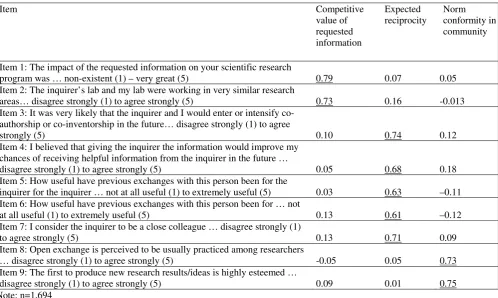
I constructed items for three of my independent variables (competitive value of requested information, expected reciprocity and norm conformity). On the basis of previous literature (Schrader 1991 mainly for items related to reciprocity) and in-depth interviews with ten scientists working in academia and seven scientists working in the industry, I came up with nine items. These items are reported in Table 1.
approached for information (item 2). These two items have helped me form my Hypothesis 1. The second factor depicts expected reciprocity and consists of five items. In line with my argumentation for Hypothesis 2, reciprocity considerations are fed by both rational utility considerations and factors related to embeddedness. Some of my items are related clearly to rational utility considerations, e.g., “likelihood of future co-authorship or co-inventorship” (item 3), while others concern relational aspects between the recipient of the request and the inquirer, e.g., “inquirer is a close colleague” (item 7). My third factor, “norm conformity in community”, consists of two items related to how scientists perceive that open exchange is practiced in their community and whether the first to produce new research results is highly esteemed. It thus includes aspects related to scientific rewards, which, as I mention in my theoretical part, affect conformity to norms. All items were measured on a Likert scale ranging from 1 to 5. Some of these items were derived from previously published studies and have been adjusted to the purposes of my study. The item measuring similarity of research (item 1, Table 1), the degree to which the owner of information characterizes the inquirer as a friend (item 7), and the usefulness of previous exchanges with the inquirer (items 5 and 6) are adapted from Schrader (1991).10 The factor analysis uses principal component analysis and Varimax rotation. The number of factors extracted was determined by the Kaiser criterion (Eigenvalue>1). The factors account for 63% of the total variance and yield good quality measures (KMO: 0.75, p<0.001).
--- Table 1 about here --- Descriptives and definition of variables
Dependent variable.
Table 2 reports summary statistics for the dependent variable % of requested information shared. My sample consists of 341 company-employed and 1,353 university-employed scientists. Thus, about 20% of bio-scientists work in firms. I used the percentage of the required information that has been shared as the dependent variable. The variable % of requested information shared ranges from 0 to 100%. Within my sample, the academic scientists have, on average, provided 85% of the requested information, compared to a lower 58% provided by industrial scientists. The t-test indicates a significant difference between the two samples (t-value: 13.7, p<0.001). Hence, academic scientists share more information than industrial scientists. Whereas other studies on information-sharing measured only whether an individual shared information or not (e.g., Schrader 1991; Walsh et al. 2007), I used metric measurements of how much of the requested information is shared. I learned from interviews with experts that scientists sometimes provide only part of the information requested and withhold crucial parts. Hence, there is much more variety in sharing behavior, which cannot be captured solely by finding out whether a respondent has shared information or not. I find that most observations, however, are at the extremes, e.g., 30% of industrial scientists and 8% of academic scientists did not share any information, while 39% of industrial scientists and 72% of academic scientists fulfilled 100% of the request.
--- Table 2 about here ---
Independent variables.
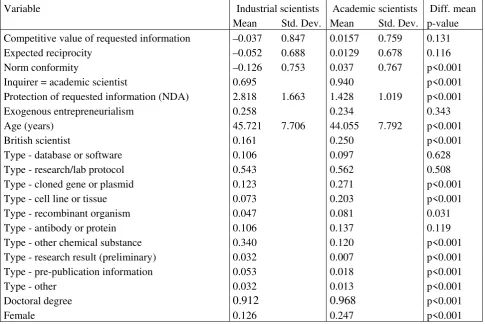
Table 3 presents summary statistics of the independent variables. Columns 2 and 3 list the sample mean and standard deviation of the sample of industrial scientists, Columns 4 and 5 those of the sample of academic scientists. Column 6 depicts the p-value in the test for differences of means among the two groups.
---
The variable competitivevalue of requested information has been extracted from the factor analysis. This factor takes on a high value if the requested information has a high impact on the scientific research program of the recipient of the request and if the inquirer and the recipient work in very similar research areas. All factors were constructed to have a mean of 0 and a variance of 1 for the total sample. The mean of this variable is –0.037 for the sample of industrial scientists, a little bit lower compared to the mean of the sample of academic scientists, which is 0.016.
The second factor, expected reciprocity, is characterized by five items: the likelihood of entering into co-authorship or co-inventorship in the future, the extent to which giving the information might increase the inquirer’s willingness to provide information in the future, how the recipient of the request appraises previous exchanges with the inquirer, and whether the inquirer is considered to be a close colleague from another organization. The mean of the factor is –0.052 for the sample of industrial scientists and significantly lower than the 0.013 for the sample of academic scientists.
test suggests that there is more variance among British scientists with regard to this variable than among German scientists. Thus, compared to the UK higher education sector, the German sector with a low level of competition and only few private universities is presumably more homogenous than the UK sector which might be reflected in a lower level of variance in complying with the norm of science.11
I asked the respondents whether the inquirer was a university-employed or company-employed scientist. The variable type of inquirer=academic scientist is 1 if the inquirer is an academic scientists, 0 otherwise. Interestingly, 70% of the requests received by industrial scientists have come from academic scientists, and 94% of the requests received by academic scientists came also from scientists employed in academia. According to my hypothesis 4, I presume that both groups of scientists are more likely to share information with colleagues who are not employed in the industry and therefore probably do not pursue commercial interests.
I included some variables that are known or expected to influence a scientist’s decision on whether to share information, even though I excluded them from the discussion of the hypotheses. These variables are:
Protection of requested information. The respondents were asked to rate, on a five-point Likert
scale, “to what extent the most recently requested information or material was protected by a non-disclosure agreement” ranging from “not at all” to “yes, very strongly”. In line with Bouty (2000), I expected that when the requested information is to a strong protected by a non-disclosure agreement, scientists are less likely to share that information. Table 3 shows that the requested information is much more likely to be confidential in industrial than in academic science (mean of sample of industrial scientists: 2.8; mean of sample of academic scientists: 1.4).
Exogenous entrepreneurialism. I employ the variable exogenous entrepreneurialism to investigate
whether scientists whose families include an entrepreneur (parent or sibling) are more inclined to withhold information. Previous studies suggest that, among other things, career choice and income are
influenced by the socialization and directed attention experienced in a family (Astebro and Thompson 2007). Haeussler and Colyvas (2010) report that academic scientists who report that one of their family members is an entrepreneur are more likely involved in commercial activities. Aldrich and Cliff (2003, p. 574) even argue that “researchers need to include family dimensions” when they conceptualize and model (entrepreneurial) behavior. I build on these studies and propose that scientists with family members who are entrepreneurs may be more aware of the potential commercial value of their research and thus less likely to share information.
Age. The variable age is included in order to control whether age impacts sharing behavior. In this
sample, industrial scientists are on average 46 years old and academic scientists are 44 years old.
Country. I employ the variable British scientist to control for differences in the sharing behavior
between British and German scientists. Previous research has shown that British and German scientists are parts of very different “ecosystems”, which might result in different sharing behaviors. For example, in a recent study Haeussler (2011) reports that British biotechnology firms rely on market-related criteria to a greater extent when making commercialization decisions than German firms.
Type of requested information or material. I employ a number of variables to distinguish between
program of the recipient of the request” (ranging from 1 “non existent” to 5 “very great”). The correlations are quite low, suggesting that no class of information stands out as especially important for the research programs of scientists (all correlations are below 0.14 for firm scientists and 0.06 for academic scientists).
Academic qualification. The variable Doctoral Degree was included in order to control for
differences associated with the formal academic qualifications of the respondents. The reference group for these two variables in the multivariate analysis consists of scientists holding an academic qualification lower than a doctoral title. Ninety-one percent of industrial scientists have a doctoral degree and 97% of academic scientists.
Gender. The variable female is included to control for differences in the sharing behavior
associated with gender. In my sample, 25% of academic scientists are female compared to only 13% of company-employed scientists. Past research has shown that female scientists are less likely to file for patents than their male counterparts (e.g., Ding et al. 2006).
The bivariate relationships between independent and control variables are reported in the Appendices 1 and 2. Appendix 1 lists the correlations with p<0.1 in the sample of industrial scientists, and Appendix 2 those in the sample of academic scientists. The correlations are rather low.
4. Analysis
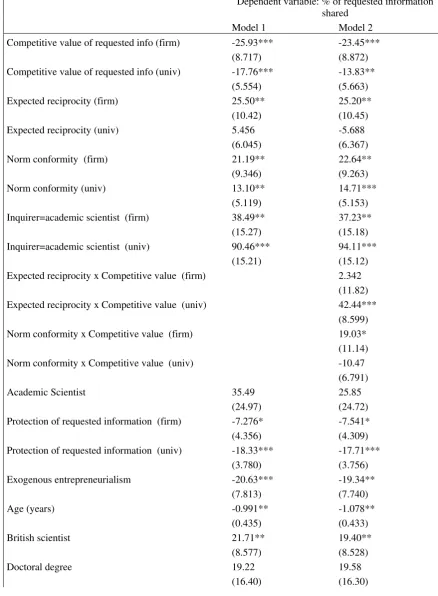
the estimation, given that the constant terms are observed.12 In order to detect differences in the degree to which my respondents take into various factors (see my hypotheses) when they make a decision on whether to share information or not, I ran a pooled regression and interacted all variables for which I presumed that there are differences between the two groups, with dummy variables indicating an industrial scientist or an academic scientist. In Model 2 I added the two interaction variables between the variable related to competitive interest considerations and factors related to social capital.
--- Table 4 about here ---
A main objective of this paper is to investigate how competitive value of requested information and factors related to social capital impact the likelihood of information being shared. In all models, the competitive factor shows a significantly negative coefficient. The willingness to share information decreases with the competitive value of the requested information. Thus, scientists working for companies, as well as those working for the university, are less likely to share information that is important for preserving competitiveness in the field. I performed a Wald test to check whether the coefficients estimated with relation to the group of industrial scientists are equal to the coefficients estimated with relation to the group of academic scientists. The Wald test indicates that industrial scientists are not significantly more influenced by the competitive value of the required information than academic scientists (e.g., model 1: Chi2: 0.64, p=0.42).
With regard to expected reciprocity, my analyses show that it is significantly positively related to the likelihood of information being shared, but only in the case of industrial scientists (at a 1% significance level). The Wald test for differences between the coefficients suggests that the effect of expected reciprocity is significantly stronger in the sample of company-employed scientists (e.g., model
1: Chi2: 2.98, p=0.08). Hence, industrial scientists pay greater attention to whether the inquirer is able and willing to return a favor in the future than academic scientists.
The coefficients of the variable norm conformity, measuring the extent to which scientists experience that their community conforms to the norm of open science, show a positive coefficient for both the samples of industrial (at 5%) and academic scientists (also at 5%). Hence, scientists who perceive that their colleagues conform to the norm of open sharing are more likely to share information. However, I did not find differences in the weight that industrial and academic scientists put on this factor (e.g., model 1: Chi2: 1.17, p=0.28).
The coefficient of the variable type of inquirer, which measures whether the inquirer is an academic scientist as opposed to an industrial scientist, is significantly positively related to the likelihood of sharing in all models. Thus, industrial and academic scientists are more likely to share information if the inquirer is employed in academia, rather than the industry. The Wald test indicates that when the inquirer is employed in the academic system, academic scientists are more likely to share information with him or her than industrial scientists are (e.g., model 1: Chi2: 6.07, p=0.01).
I now turn to the interaction variables in model 213: the interaction effect between expected reciprocity and competitive value of the requested information shows a positive and significant coefficient in the sample of academic scientists (1%), but not in that of industrial scientists. Thus, the former group is more likely to share information that is of high competitive value when there are good chances of the offer being reciprocated in the future. The Wald test indicates that the interaction effect is significantly stronger among academic than among industrial scientists (e.g., model 2: Chi2: 7.51, p<0.01). Analyzing the sample of academic scientists, I was particularly surprised to find that reciprocity has no direct effect on sharing (Models 1) but that the interaction effect has a strong impact (Model 2). The marginal effect is considerable. For example, when expected reciprocity is low (10% quintile), an
13
increase of the competitive value of the requested information by one standard deviation decreases the willingness of academic scientists to share information by about 29%. In contrast, when reciprocity is high (last decile), an increase of the competitive value of the requested information by one standard deviation increases the willingness of academic scientists to share information by 15%.
Finally, I shed light on how the interaction between conformity to norm and the competitive value of a particular piece of information affects sharing behavior. While this has no significant effect in the sample of academic scientists, I found that it has a positive and significant effect among industrial scientists (at 10%). Hence, industrial scientists are more likely to share highly valuable information when their community is strongly committed to the norm of open science. The Wald test for differences in the coefficients suggests that industrial scientists put more weight on the interaction effect than academic scientists (e.g., model 2: Chi2: 5.99, p=0.01). With regard to the marginal effects, I find that when norm conformity is low (10% quintile), an increase of the competitive value of the requested information by one standard deviation decreases the willingness of industrial scientists to share information by about 18%. In contrast, when conformity is high (last decile), an increase of the competitive value of the requested information by one standard deviation increases their willingness to share information by 2%.
However, I did not find significant effects for these variables, nor do I find that the results with regard to my independent variables change. With regard to the type of requested information I employed a large number of controlling variables. Here, I find only a significantly positive effect for cloned gene or plasmid and pre-publication information in the sample of industrial scientists.
Robustness checks and additional specifications14
I performed a number of additional specifications to test the robustness of my results. First, I took into account that local initiatives, such as university policies, or norms regarding technology transfer, might impact the sharing behavior of academic scientists (e.g., Jain et al. 2009). I therefore ran a separate interval-based regression for the sample of academic scientists to test the robustness of my results with regard to the inclusion of a variable measuring university activity aimed at supporting technology transfer. In the questionnaire, I asked my respondents to what extent they agreed with the statement that their “organization performs the patenting process professionally” on a five-point Likert scale ranging from 1 (“disagree strongly”) to 5 (“agree strongly”). This variable should give me an idea about local incentives and practices that spur the integration of commercial efforts into daily academic work. The coefficient of this variable is negative but not significant. Thus, I find no indication that this variable impacts the sharing behavior of scientists. This finding is in line with the conclusions of Vallas and Kleinman (2007, p. 14), who emphasize that “[b]arriers to the flow of information […] seem only weakly related to any licensing or patenting arrangements or to the policies of technology transfer offices.” I further found that the effects related to my hypotheses remain robust with regard to the inclusion of this variable.
Second, I investigated whether the results for academic scientists are also robust when I control for commercial activities of scientists such as being involved in consulting, patenting, and being a founder of a firm. Indeed, 50.41% of the academic scientists are involved in one or more of these activities. I ran an additional specification in which I included dummy variables for consulting, patenting and founding. The
coefficients of all three commercialization variables are negative but not significantly related to the likelihood of sharing. Moreover, the effects related to my independent variables remain robust.
Third, I ran an additional specification in which I included only boundary-spanning academic scientists, i.e., academic scientists who were additionally involved in at least one of the following activities: consulting or patenting, or had founded a firm. I found that my main effects for this subgroup are also robust. Consequently, I conclude that there are differences between academic scientists and industrial scientists, which persist even when academic scientists engage in commercial activities.
5. Discussion and conclusion
5.1. Theoretical implications
Sharing information can be neither supervised nor enforced. In this paper, I aimed to understand the underlying mechanisms that influence the decision of scientists working in academia or the industry whether to share information or not. I applied social capital theory to further the understanding of how scientists decide, why and with whom they share information even at (temporary) personal cost. My analysis suggests that factors related to social capital directly impact information-sharing and, in addition, moderate the effect of competitive interest considerations on a scientist’s willingness to share information. I therefore concluded that social capital is capable of increasing the level of sharing among academic and industrial scientists, supports the exchange and combination of knowledge, and thus promotes the advancement of science.
I found that, the stronger the conviction that the scientific community follows the norm of open science, the higher the likelihood that scientists in either the industry or academia will share information. This finding provides support for the notion that individual and average sharing are quantity complements (Becker and Murphy 2000). As such individual sharing is increasing with social (=mean) sharing.
With regard to reciprocity, I investigated whether individuals are more inclined to do a favor for a colleague when there is the prospect of “quid pro quo” (Hippel 1987; Schrader 1991; Bouty 2000). In the dataset, I found that industrial scientists are more willing to share information when they expect that their gesture will be reciprocated by the inquirer. However, I did not find that reciprocity had a similarly direct effect among academic scientists.
Furthermore, my paper revealed interesting insights when I analyzed the interaction between the competitive value of the requested information and factors related to social capital. My study showed that factors related to social capital influence the impact of the competitive value of the requested information on a scientist’s decision to share or withhold information. I found that while reciprocity has no direct effect on the likelihood of academic scientists’ sharing information, it affects the impact that considerations of competitive interest have on that likelihood. The results suggest that when academic scientists expect the inquirer to be able and willing to return a favor, they are much more likely to share information with high competitive value than low-value information. In other words, the prospect of “quid pro quo” appears to make the sharing of information with high competitive value attractive as the recipient of a request expects to benefit from an offer of highly valuable information, in return for his or her gesture, in the future. This suggests that reciprocity supports significantly sharing of information, as a result, even highly competitive information is shared. The findings challenge the argument of Kim and Mauborgne (1998, p. 329) that “high-quality knowledge sharing will likely be stifled as long as quid pro quo attitudes toward cooperation prevail.”
information with high competitive value. With respect to the sample of industrial scientists, I found that the likelihood of scientists’ sharing information increases with the competitive value of the information, when the community is perceived to follow open sharing of information. In the context of high conformity to norms, industrial scientists might improve their scientific status when they share highly valuable information, without risking the ability to appropriate returns from their scientific advances. This has implications for the study how individual decisions are influenced by social capital but also provides implications for how the social environment itself gets determined by the interaction of individuals. In this respect, the results add a new and important aspect to the findings of Westphal et al. (1997), who have shown that the more certain practices become adopted by companies, the greater the pressure on competitors to adopt the same normative practices, as this affects their status in the community. Building on those findings, I provide a rationale for the power of social capital to enforce conformity. This is evident in the observation that norms are strengthened through social capital or even emerge from social capital.
immediate gains, who will not cooperate to overcome the common dilemmas they face” (Ostrom 1991, p. 493).
In this paper, I find that norms-based mechanisms support the sharing of information. Among industry-based scientists, I found that when the community is experienced to conform to the norm of open science, a scientist’s reluctance to share information in order to protect personal interest is reduced. Conformity to norms in the community might reduce the potential negative effects of sharing and can be viewed as an alternative, informal mechanism of IP protection. Thus, the community acts as a source of authority that credits those who conform, and calls for sanctions on violators (who may suffer e.g. loss of status). In that respect, a norms-based system enables scientists to establish and enforce rights to protect their intellectual property, at least in part, and might work as a complement to the formal IP protection system. Hence, because norms provide incentives for scientists to share information, promoting norms supports the accumulation of knowledge.
when the inquirer is perceived as likely to return the benefit in the future. This implies that among academic scientists “equitable exchange” (Bouty 2000) is particularly important when the requested information carries a high value for the recipient of the request. I also found that these subtle differences in the drivers of sharing between academic and industrial scientists are also present when I control for the commercial activities of academic scientists (e.g., patenting, consulting, or having founded a firm). Thus, my results complement recent studies which emphasize that despite the integration of commercial practices into academic and public institutions, institutional convergence seems to have limits (Jain et al. 2009; Murray forthcoming).
5.2. Practical implications
The findings have implications for both practice and public policy. The results highlight a positive tendency for firm employers, as it appears that industrial scientists take the competitive interest of their employer into account when they decide whether to share information or not. In addition, they base their decision to exchange information on factors related to social capital and choose to share data with colleagues when the danger of it being appropriated is low and the prospect of reciprocity is high. While companies are known to have great concerns about information leakage (Henkel 2008), I promote a company policy that is more open to inter-organizational exchange since on the level of individuals, scientists appear to be making highly strategic decisions on when and with whom they share information.
With regard to the university system, the results imply that there too scientists decide strategically whether to share information or not. I found that university-employed scientists are influenced by competitive interest considerations and norm-based mechanisms. In that respect, the norm of open science conflicts with the personal interests of scientists. Presumably, the decision to disclose information appears to be much more strategic than is commonly assumed. In that respect, my results might call for a critical reconsideration of research management policies that may discourage information-sharing within academia, e.g., promoting practices such as rankings to increase competition between scientists.
Fleming 2004), but has rarely provided action plans or recommendations. From the findings, I conclude that if information-sharing is desired it is important to strengthen the norms. Norms-based mechanisms can act as alternative forms of IP protection that induce scientists to disclose information. Social capital is capable of enforcing conformity to the communitarian norm. The promotion of norms-based behavior should therefore have a direct impact on the propagation and accumulation of knowledge.
5.3. Limitations and future research
As all studies, this one has certain limitations. First, the findings are based on survey data. As with all studies based on survey data, I cannot exclude the possibility that my results suffer from “common method bias” (Podsakoff et al. 2003). However, I completed a large number of pre-tests and validation tests before the questionnaire was submitted to scientists, and I am therefore confident in the data and results. Second, my study is focused on the bio-scientific field. The bio-scientific field is a prominent example of a highly competitive and collaborative industry. It is also a field in which cross-institutional ties between academia and the industry have a long tradition, have even become a dominant feature (Powell et al. 1996; Owen-Smith and Powell 2004) and, as some have argued (Powell and Owen-Smith, 1998), practices that are developed in the bio-scientific field spread over time to other less commercially active domains. I hope that future research will extend my findings, which focused on the bio-sciences, to a larger number of settings.
Furthermore, while I have shown that norms-based mechanisms support information-sharing, I have no data on whether norms-based behavior pays off. Merton (1957, p. 297) stresses that “[l]ike other institutions, the institution of science has developed an elaborate system for allocating rewards to those who variously live up to its norms.” However, so far I have no evidence on whether scientists who openly share information adequately benefit from their scientific advances. In my view, it would be very useful if this would be further investigated.
that are at the heart of the academic and industrial systems: the tension between supporting innovation by sharing information, and thus, promoting the accumulation of collective knowledge on the one hand, and the considerations related to competition on the other.
References
Adler, P.S., Kwon, S., 2002. Social capital: Prospects for a new concept. Academy of Management Review 27(1), 17-40.
Aldrich, H.E., Cliff, J.E., 2003. The pervasive effects of family on entrepreneurship: Toward a family embeddedness perspective. Journal of Business Venturing 19, 573-596.
Armstrong, J.B., Overton, T.S., 1977. Estimating non-response bias in mail surveys. Journal of Marketing Research 14, 396-402.
Astebro, T., Thompson, P., 2007. Entrepreneurs: Jacks of all Trades or Hobos? Working Paper 0705, Florida International University, Department of Economics.
Azar, O.H., 2004. What sustains social norms and how they evolve? The case of tipping. Journal of Economic Behavior & Organization 54, 49-64.
Azoulay, P., Ding, W., Stuart, T. 2006. The impact of academic patenting on the rate, quality and impact of (public) research output. NBER Working Paper No. 11917.
Becker, G.S.; Murphy, K.M. 2000. Social economics – Market behavior in a social environment. The Belknap Press of Harvard University Press: Cambridge, MA.
Bendor, J., Swistak, P., 2001. The evolution of norms. American Journal of Sociology 106(6), 1493-1545. Bourdieu, P., 1986. The forms of capital. In: Richardson, J.G. (ed.), Handbook of theory and research for the sociology of education. New York: Greenwood, 241-258.
Bouty, I., 2000. Interpersonal and interaction influences on informal resource exchanges between R&D researchers across organizational boundaries. Academy of Management Journal 43(1), 50-65.
Boyd, R., Richerson, P.J., 2002. Group beneficial norms can spread rapidly in a structured population. Journal of Theoretical Biology 215, 287-296.
Campbell, E., Weissman, J.S., Causino, N., Blumenthal, D., 2000. Data-withholding in academic medicine: Characteristics of faculty denied access to research results and biomaterials. Research Policy 29, 303-312.
Child, J., Rodrigues, S., 1996. The role of social identity in the international transfer of knowledge through joint ventures. In: Clegg, S.R., Palmer, G., (Eds.). The politics of management knowledge. London: Sage: 46-68.
Cohen, J., Cohen, P., 1983. Applied multiple regression/ correlation analysis for the behavioral sciences. Erlbaum, Hillsdale, NJ.
Cohen, P., Cohen, J., Teresi, J., Marchi, M., Velez, C.N., 1990. Problems in the measurement of latent variables in structural equations causal models. Applied Psychological Measurement 14, 183-196.
Cohen, W.M., Nelson, R.R., Walsh, J.P., 2002. Links and impacts: The influence of public research on industrial R&D. Management Science 48(1), 1-23.
Cohen, W.M., Nelson, R.R., Walsh, J.P., 2000. Protecting their intellectual assets: Appropriability conditions and why U.S. manufacturing firms patent (or not). NBER Working Paper 7552.
Coleman, J.S. 1990. Foundations of social theory. Belknap Press: Cambridge, MA.
Collins, H.M., 1982. The sociology of scientific knowledge: A sourcebook, Bath: Bath University Press.
Coltman, T., Devinney, T.M., Midgley, D.F., Venaik, S., 2008. Formative versus reflective measurement models: Two applications of formative measurement. Journal of Business Research 61, 1250-1262. Colyvas, J. 2007. From divergent meanings to common practices: the early institutionalization of technology transfer in the life sciences at Stanford University. Research Policy 36 (4), 456-476.
Constant, D., Sproull, L., Kiesler, S., 1996. The kindness of strangers: The usefulness of electronic weak ties for technical advice. Organization Science 7(2), 119-135.
Dasgupta, P., David, P.A., 1994. Toward a new economics of science. Research Policy 23, 487-521. David, P.A., 2004. Understanding the emergence of 'open science' institutions: Functionalist economics in historical context. Industrial and Corporate Change 13(4), 571-589.
Ding, W., Murray, F., Stuart, T, 2006. Gender differences in patenting in the academic life sciences. Science 313, No. 5787, 665 - 667.
Eamon, W., 1985. From the Secrets of Nature to Public Knowledge: The Origins of the Concept of Openness in Science. Minerva 23(3), 321-347.