BIROn - Birkbeck Institutional Research Online
Kunc, M. and Mortenson, M. and Vidgen, Richard (2018) A computational
literature review of the field of System Dynamics from 1974 to 2017. Journal
of Simulation 12 (2), pp. 115-127. ISSN 1747-7778.
Downloaded from:
Usage Guidelines:
Please refer to usage guidelines at or alternatively
Workflow: Annotated pdf, CrossRef and tracked changes
PROOF COVER SHEET
Author(s): Martin KuncArticle title: A computational literature review of the field of System Dynamics from 1974 to 2017 Article no: TJSM 1468950
Enclosures: 1) Query sheet 2) Article proofs
Dear Author,
Please find attached the proofs for your article.
1. Please check these proofs carefully. It is the responsibility of the corresponding author to check these and approve or amend them. A second proof is not normally provided. Taylor & Francis cannot be held responsible for uncorrected errors, even if introduced during the production process. Once your corrections have been added to the article, it will be considered ready for publication
Please limit changes at this stage to the correction of errors. You should not make trivial changes, improve prose style, add new material, or delete existing material at this stage. You may be charged if your corrections are excessive (we would not expect corrections to exceed 30 changes).
For detailed guidance on how to check your proofs, please paste this address into a new browser window: http://journal-authors.tandf.co.uk/production/checkingproofs.asp
Your PDF proof file has been enabled so that you can comment on the proof directly using Adobe Acrobat. If you wish to do this, please save the file to your hard disk first. For further information on marking corrections using Acrobat, please paste this address into a new browser window:http://journalauthors.tandf.co.uk/production/acrobat.asp
2. Please review the table of contributors below and confirm that the first and last names are structured correct-ly and that the authors are listed in the correct order of contribution. This check is to ensure that your names will appear correctly online and when the article is indexed.
Sequence Prefix Given name(s) Surname Suffix
1 Martin Kunc
2 Michael J. Mortenson
Content changes made during copy-editing are shown as tracked changes. Inserted text is in red font and revisions have a blue indicatorå. Changes can also be viewed using the list comments function. To correct the proofs, you should insert or delete text following the instructions below, but do not add comments to the existing tracked changes.
AUTHOR QUERIES
General points:
1. Permissions: You have warranted that you have secured the necessary written permission from the appropriate copyright owner for the reproduction of any text, illustration, or other material in your article. For further guidance on this topic please see:
http://journalauthors.tandf.co.uk/copyright/usingThirdPartyMaterial.asp
2. Third-party material: If there is material in your article that is owned by a third party, please check that the necessary details of the copyright/rights owner are shown correctly.
3. Affiliation: The corresponding author is responsible for ensuring that address and email details are correct for all the co-authors. Affiliations given in the article should be the affiliation at the time the research was conducted. For further guidance on this topic please see: http://journalauthors.tandf.co.uk/preparation/writing.asp.
4. Funding: Was your research for this article funded by a funding agency? If so, please insert ‘This work was supported by <insert the name of the funding agency in full>’, followed by the grant number in square brackets ‘[grant number xxxx]’.
5. Supplemental data and underlying research materials: Do you wish to include the location of the underlying re-search materials (e.g. data, samples or models) for your article? If so, please insert this sentence before the reference section: ‘The underlying research materials for this article can be accessed at <full link>/ description of location [author to complete]’. If your article includes supplemental data, the link will also be provided in this paragraph. See <http://journalauthors.tandf.co.uk/preparation/multimedia.asp> for further explanation of supplemental data and underlying research materials.
6. The CrossRef database (www.crossref.org/) has been used to validate the references. Changes resulting from mis-matches are tracked in red font.
AQ1 Please provide the missing department and city for affiliation “c”.
AQ2 The reference “Bornmann and Mutz, 2015” is cited in the text but is not listed in the references list. Please either delete in-text citation or provide full reference details following journal style [http://www.tandf. co.uk/journals/authors/style/reference/tf_APA.pdf].
AQ3 The reference “Deerwester et al., 1990” is cited in the text but is not listed in the references list. Please either delete in-text citation or provide full reference details following journal style [http://www.tandf. co.uk/journals/authors/style/reference/tf_APA.pdf].
AQ4 The disclosure statement has been inserted. Please correct if this is inaccurate.
AQ5 The CrossRef database (www.crossref.org/) has been used to validate the references. Mismatches between the original manuscript and CrossRef are tracked in red font. Please provide a revision if the change is incorrect. Do not comment on correct changes.
AQ6 (As per journal style [http://www.tandf.co.uk/journals/authors/style/reference/tf_APA.pdf], “et al.” is not used in the references list. Please provide the relevant author names in order to complete the reference “Jahangirian, 2011”)
AQ7 If “Mortenson et al., in press” has been published, please give details for references list following journal style [http://www.tandf.co.uk/journals/authors/style/reference/tf_APA.pdf].
How to make corrections to your proofs using Adobe Acrobat/Reader
Taylor & Francis offers you a choice of options to help you make corrections to your proofs. Your PDF proof file has been enabled so that you can mark up the proof directly using Adobe Acrobat/Reader. This is the simplest and best way for you to ensure that your corrections will be incorporated. If you wish to do this, please follow these instructions:
1. Save the file to your hard disk.
2. Check which version of Adobe Acrobat/Reader you have on your computer. You can do this by clicking on the “Help” tab, and then “About”.
If Adobe Reader is not installed, you can get the latest version free from http://get.adobe.com/reader/.
3. If you have Adobe Acrobat/Reader 10 or a later version, click on the “Comment” link at the right-hand side to view the Comments pane.
4. You can then select any text and mark it up for deletion or replacement, or insert new text as needed. Please note that these will clearly be displayed in the Comments pane and secondary annotation is not needed to draw attention to your corrections. If you need to include new sections of text, it is also possible to add a comment to the proofs. To do this, use the Sticky Note tool in the task bar. Please also see our FAQs here: http://journalauthors.tandf.co.uk/ produc-tion/index.asp.
5. Make sure that you save the file when you close the document before uploading it to CATS using the “Upload File” button on the online correction form. If you have more than one file, please zip them together and then upload the zip file.
If you prefer, you can make your corrections using the CATS online correction form.
Troubleshooting
Acrobat help:http://helpx.adobe.com/acrobat.html
Reader help:http://helpx.adobe.com/reader.html
Please note that full user guides for earlier versions of these programs are available from the Adobe Help pages by click-ing on the link “Previous versions” under the “Help and tutorials” headclick-ing from the relevant link above. Commentclick-ing functionality is available from Adobe Reader 8.0 onwards and from Adobe Acrobat 7.0 onwards.
Firefox users: Firefox’s inbuilt PDF Viewer is set to the default; please see the following for instructions on how to use this and download the PDF to your hard drive:
Journal of Simulation, 2018
https://doi.org/10.1080/17477778.2018.1468950
KEYWORDS System Dynamics; computational literature review; healthcare; supply chain; methodology ARTICLE HISTORY received 27 april 2017 revised 19 april 2018 accepted 20 april 2018
© operational research Society 2018
CONTACT martin Kunc [email protected]
ORIGINAL ARTICLE
A computational literature review of the field of System Dynamics from 1974
to 2017
Martin Kunca, Michael J. Mortensonb and Richard Vidgenc
aWarwick Business School, university of Warwick, Coventry, uK; bWarwick manufacturing Group, university of Warwick, Coventry, uK; cuniversity of new South Wales Business School, australia
ABSTRACT
System Dynamics celebrated its 60th anniversary in 2017. While there have been numerous special issues in diverse journals that bring together work by System Dynamics scholars who share similar research interests, there have been no systematic reviews of scholarly activity across the broad field. This paper presents a computational literature review of the field from 1974 to 2017. A CLR automates the analysis of research articles with analysis of content (topic modelling of abstracts) to identify emergent themes in the literature. We performed a broad review of the field by initially searching using the term “System Dynamics” with more than 8000 articles. However, the results obtained were not satisfactory so we decided to restrict our sample to less than 800 articles from recognised journals and proceedings. After evaluation of the results obtained from topic modelling, we decided to use 51 topics covering most of the articles in our sample. A list of 51 topics provides enough granularity to identify relevant patterns of activity within the community of System Dynamics scholars. For each of these 51 topics, we present a commentary on the key insights obtained.
1. Introduction
System Dynamics (SD) celebrated its 60th anniversary in 2017 so it is an appropriate opportunity to review the achievements of the field through systematic reviews of the literature and/or special issues, such as the one in the Journal of Simulation. In terms of systematic reviews, there have been articles evaluating applications of simulation in different fields where SD appeared as one of the top three simulation methods, e.g., health-care (Brailsford, Harper, Patel, & Pitt, 2009) and man-ufacturing (Jahangirian, Eldabi, Naseer, Stergioulas, & Young, 2010). SD scholars have generated a number of special issues highlighting the range of applications in the field, e.g., special issues in System Dynamics Review
in 1997, 1998, 1999, 2001, 2002a,b, 2004, 2005, 2007, 2008 and 2010; Journal of the Operational Research Society, 1999; and European Journal of Operational Research, 1992. While there is a commendable effort by the System Dynamics Society to keep a list of publica-tions where SD is employed, it is a daunting task when scientific production grows at 8–9% per year, so output doubles every nine years (Bornmann & Mutz, 2015).
Interestingly, there have been no broad reviews of the literature trying to uncover trends and themes in the SD field. This paper provides the first computational review of the literature in the SD field, and considers papers published between 1974 and 2017.
A computational literature review (CLR) provides an automated analysis of a set of research outputs in three areas (Mortenson & Vidgen, 2016). Firstly, CLR can measure the impact in terms of citation count for research articles, h-index for authors and journal cita-tion impact metric for journals. Secondly, CLR can structure the scholar community using co-authorship network. Thirdly, CLR identifies themes through under-lying (latent) topics that are discovered performing topic modelling. In this paper, we focused on the third area, theme analysis using topic modelling so researchers, especially from other simulation methods, can have a broad overview of the trends and themes in the SD field.
The structure of the paper consists on a brief discus-sion of reviews of SD field through special issues, a review of the concept of CLR followed by the design of the CLR performed for the SD field and the results obtained.
5
10
15
20
25
30
35
40
45
50
55
60
65
AQ1
TJSM 1468950
25 April 2018 Initial CE: XX QA: XXColl:XX QC:XX
2 M. KUNC ET AL.
2. Reviews of the System Dynamics field
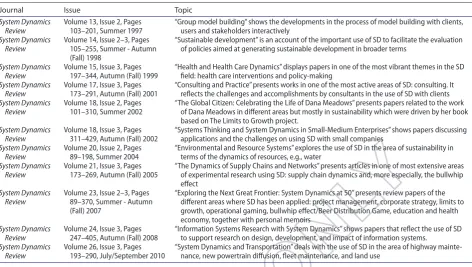
SD researchers have preferred the use of special issues to present the state-of-the-art on the use of SD in spe-cific areas of application. The spectrum of special issues (table included in Appendix A) since 1992 shows the diversity of interests of the broad community and the breadth of the field in terms of themes and areas of application. Unfortunately, there have been no special issues in System Dynamics Review in recent years to account for the development of the field. Interestingly, there have been extensive literature reviews of the SD field in different journals and edited books that show the widespread interest in SD as a simulation method. For example, Brailsford et al. (2009) evaluated the use of SD in healthcare, Jahangirian et al. (2010) discussed the use of simulation in manufacturing where SD is a prominent method, and Tako and Robinson (2012) identified the use of SD in logistics and supply chain. Finally, Brailsford, Churilov, and Dangerfield (2014) in an edited book presented SD as part of a broader port-folio of modelling methods, such as discrete event sim-ulation and agent based modelling (ABM).
After the review of special issues, we concluded there are additional areas that may not have been covered pre-viously. Therefore, it is important to perform a system-atic study of the SD literature to provide an overview of the field. Recently researchers have developed system-atic algorithms to perform computer literature review (CLR) using clustering methods (Park, Kim, Choi, & Kim, 2012). CLR aims to reduce the judgmental biases in literature reviews by selecting, filtering, and analysing large volume of research articles using clustering algo-rithms (Mortenson & Vidgen, 2016).
3. Defining computer literature review
Systematic literature reviews offer obvious value to the research community, particularly with respect to “repeatability” and “objectivity”, which are elements con-sidered key to scientific methodology but are typically absent in most [non-systematic] literature reviews. As White and Schmidt (2005) note, “before reviews became systematic, the writer was free to pick and choose the papers that supported his or her viewpoint […] clearly a biased approach”. Whilst systematic reviews are pref-erable (from a scientific perspective), they are not easy to perform nor completely free from problems. A true systematic review should include all relevant work from across a range of academic publications. Sourcing and reading all such articles is obviously highly time-con-suming. Then, the literature review may be incom-plete and bias can be introduced regarding the articles included in the search phase. Additional subjectivity
may also be introduced with respect to the articles that are excluded from the initial data-set.
CLR belongs to the area of systematic literature review since it follows a set of reproducible steps; and, there-fore, is an algorithm rather than a heuristic (Mortenson & Vidgen, 2016). CLR seeks to maintain the benefits of a systematic review, whilst countering some of the issues mentioned previously. Moreover, attempts to provide support for reviews through automation have been implemented previously in literature related with this review, for instance Larsen, Monarchi, Hovorka, and Bailey (2008) evaluated the Information Systems field and Jahangirian et al. (2011) analysed the Simulation field. CLR is appropriate for this task because it includes a wide range of metrics to analyse academic research and is based upon latent Dirichlet allocation (Blei, Ng, & Jordan, 2003), which has “become the ‘de facto’ standard for topic modelling” (Mortenson & Vidgen, 2016).
Topic modelling is performed when a predefined number of topics, which are groupings of words based on their co-occurrences representing specific subject matters, are populated algorithmically (Mortenson & Vidgen, 2016). The approach is in the same family of algorithms as principal component analysis (PCA) because it finds components (called topics) which can explain variance in the data, though specifically designed for the use of text data (Mortenson & Vidgen, 2016). The two key elements of this design are non-linearity, as the distribution of words in documents is rarely “normal”, and an ability to deal with polysemy (whereby words can have multiple meanings – i.e., have membership of multiple components/topics). With respect to poly-semy, the latent Dirichlet allocation algorithm (Blei et al., 2003) has advantages over approaches such as latent semantic indexing (Deerwester et al., 1990). In latent semantic indexing, words are given in a single position in its projected, low-dimensional space, analogous to each word only having one “meaning”, something rarely true of words in a modern language.
4. The computer literature review process 4.1. Article selection
JOURNAL OF SIMULATION 3
The initial search in Scopus used the term “System Dynamics” in title, abstract and keywords generated more than 8000 documents from more than 5000 journals/conference proceedings. The data-set is then cleaned to remove any articles with missing authors, missing abstracts, and duplicate records. However, the initial results were disappointing in terms of the themes and trends observed in the topics since many concepts and articles were not recognised as SD practice by the author with SD knowledge (MK). We therefore decided to focus on the articles from journals and conference proceedings (in Scopus) recognised for publishing SD. This resulted in 772 usable articles. The data shows an increasing number of articles published per year, as Figure 1 and regression line shows, with important oscillations due to special issues.
Having looked at the publications by year the next stage in the CLR was to analyse the publication venues
(journals and conferences) in which the publications appear. The CLR used the citation data to calculate a local h-index for each of the publication venues. A publication venue with an h-index of 20 has 20 articles that are cited at least 20 times by other articles. Table 1 presents the publication venues in our data-set in order of their h-index, together with the number of articles, the number of citations, and the average citations per article. Unsurprisingly, System Dynamics Review clearly dominates the publication venues, both with regards to quantity (347 articles and 8515 citations) and impact (an
h-index of 46). At the other end of the table there are journals with few articles and little impact: for example the Journal of Simulation has 11 relevant articles and these have only managed to achieve an average of 2.6 citations per article, although of course this journal only started in 2006.
4.2. Topic modelling
A key part of the CLR process was the identification of the topics discussed in each abstract within the lit-erature. In this research, the latent Dirichlet allocation (LDA) algorithm was modified to allow for the use of covariates (Mortenson, Powell and Vidgen, in press; Mortenson & Vidgen, 2016). The modified algorithm, introduced in Roberts, Stewart, Tingley, and Airoldi (2013) and inspired by the correlated topic model (Blei & Lafferty, 2007), was fitted to a logistic-normal dis-tribution as opposed to the Dirichlet disdis-tribution with two key consequences. Firstly, the topics were correlated (impossible in a Dirichlet distribution). Secondly, covar-iates were introduced into the model fit. In this case, the year of publication was included in the modelling so it could have influence on the prevalence of topics across the corpus. In other words, the model recognised that the popularity of topics would change over time and the year of a journal issue would influence the topics included.
[image:7.595.69.282.53.188.2]Selecting the number of topics, K, is a somewhat con-tentious issue, much as it is for related methods such as principal components analysis (PCA) or K-means clustering. As K is unknowable a priori in almost all situations, previous researchers have tended to opt for a value based on convenience (e.g., 30, 50, 100 are pop-ular choices) or through building multiple models with different values of K and selecting K based on visual inspection of results. A procedure called cross-valida-tion, a perplexity-based method, is widely used in topic modelling (Nikita, 2016). Perplexity is a measure of the appropriateness of a probabilistic method to predict a sample, where a low perplexity indicates the distribution Figure 1. Publications per year in the data-set employed for Clr
– 772 articles ranging from 1974 to 2017.
Table 1. analysis of publication venues.
*Predecessor of Systems research and Behavioural Science.
Source title Arti-cles Cites Start year yearEnd Cites per paper h-index System Dynamics
Review 347 8515 1985 2017 24.5 46
European Journal of Operational Research
112 3584 1978 2017 32.0 36
Journal of the Operational Research Society
109 2596 1981 2017 23.8 28
Proceedings - Win-ter Simulation Conference
99 811 1976 2017 8.2 17
Systems Research and Behavioural Science
72 614 2006 2017 8.6 13
Systemic Practice and Action Research
15 173 2004 2017 11.5 8
Behavioural
Science* 7 108 1974 1988 15.4 4
Journal of
Simu-lation 11 29 2010 2017 2.6 4
5 10 15 20 25 30 35 40 45 50 55 60 65 70 75
Mono
for prin
t
[image:7.595.58.293.256.489.2]TJSM 1468950
25 April 2018 Initial CE: XX QA: XXColl:XX QC:XX
4 M. KUNC ET AL.
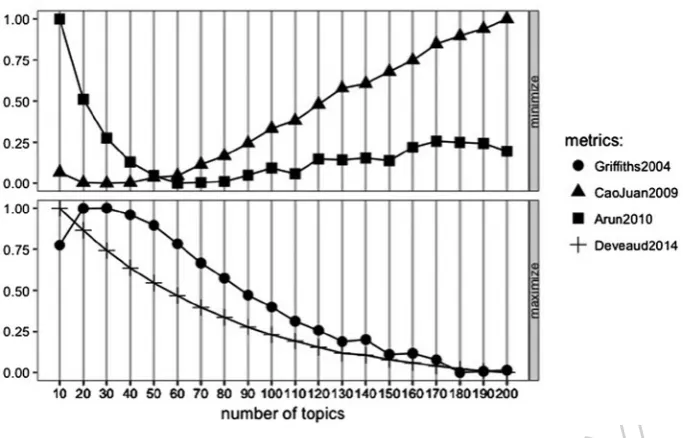
indicates the appropriate number of topics. Two metrics, Griffiths 2004 (Griffiths & Steyvers, 2004) and Deveaud 2014 (Deveaud, SanJuan, & Bellot, 2014) have to be max-imised (bottom graph in Figure 2).
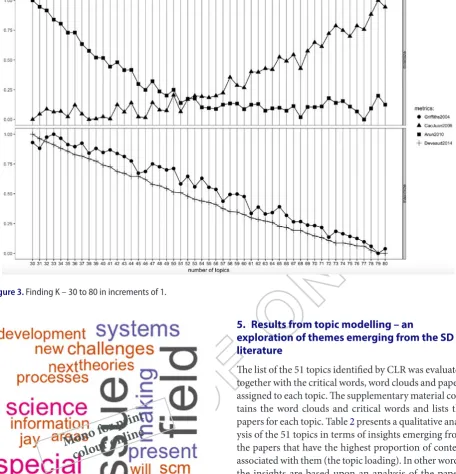
We ran the analysis again for this range but with incre-ments of 1 (Figure 3) and applied the same R package as in Figure 2. The metrics indicated that 51 topics was an appropriate choice. To confirm this value, the SD domain expert reviewed the outcome of the topic model for 51 topics and decided that it was an appropriate set of topics.
Next, we created the word clouds corresponding to each topic. The word clouds show the most likely words in the topics (based on highest probability of occurrence). The words are sized in scale with likelihood (the larger the font, the more likely the word) and grouped by colours into categories (black, blue, red, and green – representing a descending order of likelihood). One of the limitations of this method is the word cloud can contain words that seem to be generic or have little apparent connection with a topic or articles existing in a topic. However, this cannot be avoided as it comes from the process of mod-elling topics from articles that contain heterogeneous information (Blei, 2012). See Figure 4 for an example of a word cloud. All word clouds and their corresponding words are included in the supplementary material. Next, a set of papers for each topic was generated by using the posterior probabilities that a paper is related to a given topic – these are the papers with the highest proportion of content associated with a specific topic. Each topic was allocated 12 papers that are unique to that topic. See supplementary material for the full list of papers in each topic. We used this information to define the theme of a topic and validate the usefulness of the number of topics is adequate at predicting the sample (Griffiths & Steyvers,
2004). As Griffiths and Steyvers (2004, p. 5228) explain “A scientific paper can deal with multiple topics, and the words that appear in that paper reflect the particular set of topics it addresses. In statistical natural language processing, one common way of modelling the contri-butions of different topics to a document is to treat each topic as a probability distribution over words, viewing a document as a probabilistic mixture of these topics. If we have T topics, we can write the probability of the ith word in a given document as [indicated by the equation below], where zi is a latent variable indicating the topic from which the ith word was drawn and P(wlz = j) is the probability of the word wi under the jth topic. P(zi = j) gives the probability of choosing a word from topics j in the current document, which will vary across different documents. Intuitively, P(wlz) indicates which words are important to a topic, whereas P(z) is the prevalence of those topics within a document”.
To fix a value of K, we used the R package ldatuning (Nikita, 2016) and ran the algorithm for values of K
from 10 to 200 in increments of 10 (Figure 2 where the
y-axis indicates the level of perplexity and the x-axis the number of topics). Figure 2 suggests that a value of K in the range 30 to 80 would be appropriate. Two of the metrics, Arun2010 (Arun, Suresh, Veni Madhavan, & Narasimha Murthy, 2010) and CaoJuan2009 (Cao, Xia, Li, Zhang, & Tang, 2009), have to be minimised (top graph in Figure 2) and the point where they intersect
P(wi)=
T
∑
j=1
[image:8.595.127.469.53.272.2]P(wi|zi=j)P(zi=j).
Figure 2. finding K – 10 to 200 in increments of 10.
5
10
15
20
25
30
35
40
45
50
55
60
JOURNAL OF SIMULATION 5
5. Results from topic modelling – an
exploration of themes emerging from the SD literature
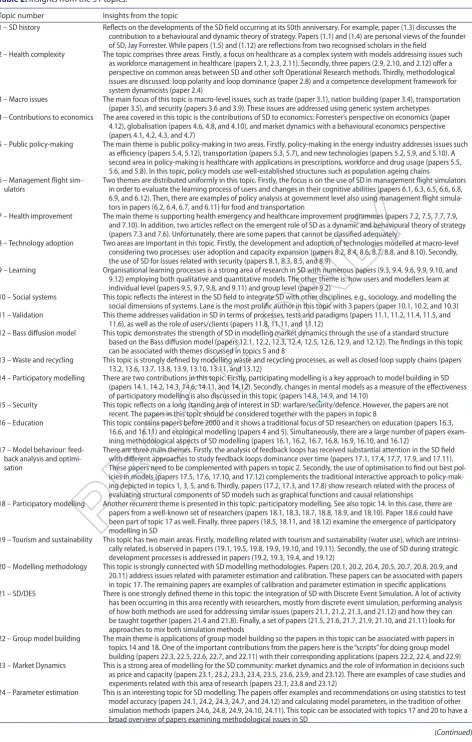
The list of the 51 topics identified by CLR was evaluated together with the critical words, word clouds and papers assigned to each topic. The supplementary material con-tains the word clouds and critical words and lists the papers for each topic. Table 2 presents a qualitative anal-ysis of the 51 topics in terms of insights emerging from the papers that have the highest proportion of content associated with them (the topic loading). In other words, the insights are based upon an analysis of the papers associate with each topic. The numbers in the second column correspond to the paper in each topic which are numbered as X·Y where X = Topic and Y = Order inside the topic. Please refer to the supplementary material for the information about the paper.
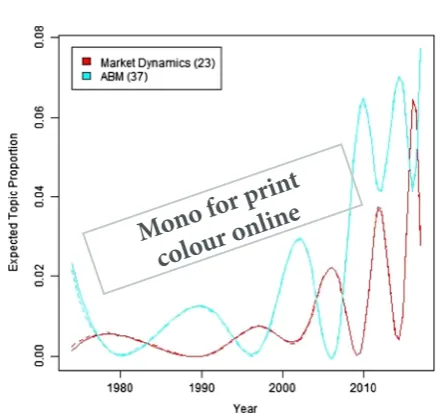
Finally, another function of the CLR is to evaluate the interactions between topics and covariates. Therefore, we can identify and compare the prevalence of topics over time. The following figures present some examples: the complete set of graphs is in Appendix A. Some topics show a clear upward trend in popularity as shown in Figure 5. Others follow a downward trend, exemplified in Figure 6, and some topics do not have a clear pattern, demonstrated in Figure 7.
[image:9.595.69.526.60.535.2](K). However, the papers loaded on a given topic some-times were not clearly associated with a theme but we tried to minimise undefined topics as much as possible through reviewing different values of K.
[image:9.595.63.285.379.615.2]Figure 3. finding K – 30 to 80 in increments of 1.
Figure 4. Example of a word cloud.
5
10
15
20
25
30
35
40
Mono
for prin
t
TJSM 1468950
25 April 2018 Initial CE: XX QA: XXColl:XX QC:XX
[image:10.595.62.535.58.801.2]6 M. KUNC ET AL.
Table 2. insights from the 51 topics.
Topic number Insights from the topic
1 – SD history reflects on the developments of the SD field occurring at its 50th anniversary. for example, paper (1.3) discusses the contribution to a behavioural and dynamic theory of strategy. Papers (1.1) and (1.4) are personal views of the founder of SD, Jay forrester. While papers (1.5) and (1.12) are reflections from two recognised scholars in the field
2 – Health complexity the topic comprises three areas. firstly, a focus on healthcare as a complex system with models addressing issues such as workforce management in healthcare (papers 2.1, 2.3, 2.11). Secondly, three papers (2.9, 2.10, and 2.12) offer a perspective on common areas between SD and other soft operational research methods. thirdly, methodological issues are discussed: loop polarity and loop dominance (paper 2.8) and a competence development framework for system dynamicists (paper 2.4)
3 – macro issues the main focus of this topic is macro-level issues, such as trade (paper 3.1), nation building (paper 3.4), transportation (paper 3.5), and security (papers 3.6 and 3.9). these issues are addressed using generic system archetypes 4 – Contributions to economics the area covered in this topic is the contributions of SD to economics: forrester’s perspective on economics (paper
4.12), globalisation (papers 4.6, 4.8, and 4.10), and market dynamics with a behavioural economics perspective (papers 4.1, 4.2, 4.3, and 4.7)
5 – Public policy-making the main theme is public policy-making in two areas. firstly, policy-making in the energy industry addresses issues such as efficiency (papers 5.4, 5.12), transportation (papers 5.3, 5.7), and new technologies (papers 5.2, 5.9, and 5.10). a second area in policy-making is healthcare with applications in prescriptions, workforce and drug usage (papers 5.5, 5.6, and 5.8). in this topic, policy models use well-established structures such as population ageing chains 6 – management flight
sim-ulators two themes are distributed uniformly in this topic. firstly, the focus is on the use of SD in management flight simulators in order to evaluate the learning process of users and changes in their cognitive abilities (papers 6.1, 6.3, 6.5, 6.6, 6.8, 6.9, and 6.12). then, there are examples of policy analysis at government level also using management flight simula-tors in papers (6.2, 6.4, 6.7, and 6.11) for food and transportation
7 – Health improvement the main theme is supporting health emergency and healthcare improvement programmes (papers 7.2, 7.5, 7.7, 7.9, and 7.10). in addition, two articles reflect on the emergent role of SD as a dynamic and behavioural theory of strategy (papers 7.3 and 7.6). unfortunately, there are some papers that cannot be classified adequately
8 – technology adoption two areas are important in this topic. firstly, the development and adoption of technologies modelled at macro-level considering two processes: user adoption and capacity expansion (papers 8.2, 8.4, 8.6, 8.7, 8.8, and 8.10). Secondly, the use of SD for issues related with security (papers 8.1, 8.3, 8.5, and 8.9)
9 – learning organisational learning processes is a strong area of research in SD with numerous papers (9.3, 9.4, 9.6, 9.9, 9.10, and 9.12) employing both qualitative and quantitative models. the other theme is: how users and modellers learn at individual level (papers 9.5, 9.7, 9.8, and 9.11) and group level (paper 9.2)
10 – Social systems this topic reflects the interest in the SD field to integrate SD with other disciplines, e.g., sociology, and modelling the social dimensions of systems. lane is the most prolific author in this topic with 3 papers (paper 10.1, 10.2, and 10.3) 11 – Validation this theme addresses validation in SD in terms of processes, tests and paradigms (papers 11.1, 11.2, 11.4, 11.5, and
11.6), as well as the role of users/clients (papers 11.8, 11.11, and 11.12)
12 – Bass diffusion model this topic demonstrates the strength of SD in modelling market dynamics through the use of a standard structure based on the Bass diffusion model (papers 12.1, 12.2, 12.3, 12.4, 12.5, 12.6, 12.9, and 12.12). the findings in this topic can be associated with themes discussed in topics 5 and 8
13 – Waste and recycling this topic is strongly defined by modelling waste and recycling processes, as well as closed loop supply chains (papers 13.2, 13.6, 13.7, 13.8, 13.9, 13.10, 13.11, and 13.12)
14 – Participatory modelling there are two contributions in this topic. firstly, participating modelling is a key approach to model building in SD (papers 14.1, 14.2, 14.3, 14.6, 14.11, and 14.12). Secondly, changes in mental models as a measure of the effectiveness of participatory modelling is also discussed in this topic (papers 14.8, 14.9, and 14.10)
15 – Security this topic reflects on a long standing area of interest in SD: warfare/security/defence. However, the papers are not recent. the papers in this topic should be considered together with the papers in topic 8
16 – Education this topic contains papers before 2000 and it shows a traditional focus of SD researchers on education (papers 16.3, 16.6, and 16.11) and ecological modelling (papers 4 and 5). Simultaneously, there are a large number of papers exam-ining methodological aspects of SD modelling (papers 16.1, 16.2, 16.7, 16.8, 16.9, 16.10, and 16.12)
17 – model behaviour: feed-back analysis and optimi-sation
there are three main themes. firstly, the analysis of feedback loops has received substantial attention in the SD field with different approaches to study feedback loops dominance over time (papers 17.1, 17.4, 17.7, 17.9, and 17.11). these papers need to be complemented with papers in topic 2. Secondly, the use of optimisation to find out best pol-icies in models (papers 17.5, 17.6, 17.10, and 17.12) complements the traditional interactive approach to policy-mak-ing depicted in topics 1, 3, 5, and 6. thirdly, papers (17.2, 17.3, and 17.8) show research related with the process of evaluating structural components of SD models such as graphical functions and causal relationships
18 – Participatory modelling another recurrent theme is presented in this topic: participatory modelling. See also topic 14. in this case, there are papers from a well-known set of researchers (papers 18.1, 18.3, 18.7, 18.8, 18.9, and 18.10). Paper 18.6 could have been part of topic 17 as well. finally, three papers (18.5, 18.11, and 18.12) examine the emergence of participatory modelling in SD
19 – tourism and sustainability this topic has two main areas. firstly, modelling related with tourism and sustainability (water use), which are intrinsi-cally related, is observed in papers (19.1, 19.5, 19.8, 19.9, 19.10, and 19.11). Secondly, the use of SD during strategic development processes is addressed in papers (19.2, 19.3, 19.4, and 19.12)
20 – modelling methodology this topic is strongly connected with SD modelling methodologies. Papers (20.1, 20.2, 20.4, 20.5, 20.7, 20.8, 20.9, and 20.11) address issues related with parameter estimation and calibration. these papers can be associated with papers in topic 17. the remaining papers are examples of calibration and parameter estimation in specific applications 21 – SD/DES there is one strongly defined theme in this topic: the integration of SD with Discrete Event Simulation. a lot of activity
has been occurring in this area recently with researchers, mostly from discrete event simulation, performing analysis of how both methods are used for addressing similar issues (papers 21.1, 21.2, 21.3, and 21.12) and how they can be taught together (papers 21.4 and 21.8). finally, a set of papers (21.5, 21.6, 21.7, 21.9, 21.10, and 21.11) looks for approaches to mix both simulation methods
22 – Group model building the main theme is applications of group model building so the papers in this topic can be associated with papers in topics 14 and 18. one of the important contributions from the papers here is the “scripts” for doing group model building (papers 22.3, 22.5, 22.6, 22.7, and 22.11) with their corresponding applications (papers 22.2, 22.4, and 22.9) 23 – market Dynamics this is a strong area of modelling for the SD community: market dynamics and the role of information in decisions such
as price and capacity (papers 23.1, 23.2, 23.3, 23.4, 23.5, 23.6, 23.9, and 23.12). there are examples of case studies and experiments related with this area of research (papers 23.1, 23.8 and 23.12)
24 – Parameter estimation this is an interesting topic for SD modelling. the papers offer examples and recommendations on using statistics to test model accuracy (papers 24.1, 24.2, 24.3, 24.7, and 24.12) and calculating model parameters, in the tradition of other simulation methods (papers 24.6, 24.8, 24.9, 24.10, 24.11). this topic can be associated with topics 17 and 20 to have a broad overview of papers examining methodological issues in SD
JOURNAL OF SIMULATION 7
Table 2. (Continued).
Topic number Insights from the topic
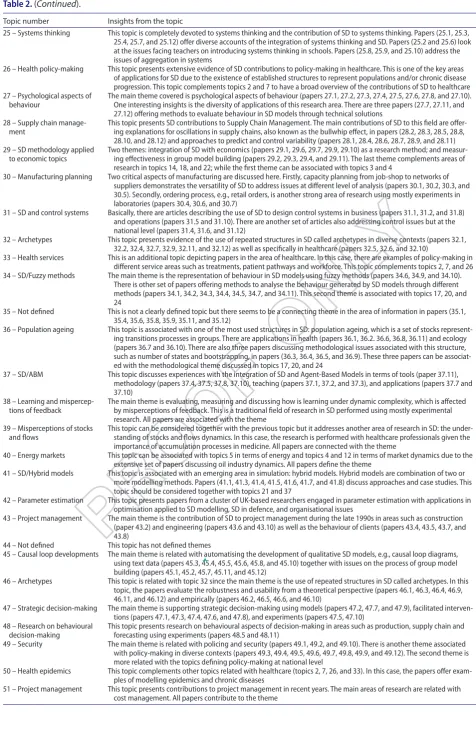
25 – Systems thinking this topic is completely devoted to systems thinking and the contribution of SD to systems thinking. Papers (25.1, 25.3, 25.4, 25.7, and 25.12) offer diverse accounts of the integration of systems thinking and SD. Papers (25.2 and 25.6) look at the issues facing teachers on introducing systems thinking in schools. Papers (25.8, 25.9, and 25.10) address the issues of aggregation in systems
26 – Health policy-making this topic presents extensive evidence of SD contributions to policy-making in healthcare. this is one of the key areas of applications for SD due to the existence of established structures to represent populations and/or chronic disease progression. this topic complements topics 2 and 7 to have a broad overview of the contributions of SD to healthcare 27 – Psychological aspects of
behaviour the main theme covered is psychological aspects of behaviour (papers 27.1, 27.2, 27.3, 27.4, 27.5, 27.6, 27.8, and 27.10). one interesting insights is the diversity of applications of this research area. there are three papers (27.7, 27.11, and 27.12) offering methods to evaluate behaviour in SD models through technical solutions
28 – Supply chain
manage-ment this topic presents SD contributions to Supply Chain management. the main contributions of SD to this field are offer-ing explanations for oscillations in supply chains, also known as the bullwhip effect, in papers (28.2, 28.3, 28.5, 28.8, 28.10, and 28.12) and approaches to predict and control variability (papers 28.1, 28.4, 28.6, 28.7, 28.9, and 28.11) 29 – SD methodology applied
to economic topics two themes: integration of SD with economics (papers 29.1, 29.6, 29.7, 29.9, 29.10) as a research method; and measur-ing effectiveness in group model building (papers 29.2, 29.3, 29.4, and 29.11). the last theme complements areas of research in topics 14, 18, and 22; while the first theme can be associated with topics 3 and 4
30 – manufacturing planning two critical aspects of manufacturing are discussed here. firstly, capacity planning from job-shop to networks of suppliers demonstrates the versatility of SD to address issues at different level of analysis (papers 30.1, 30.2, 30.3, and 30.5). Secondly, ordering process, e.g., retail orders, is another strong area of research using mostly experiments in laboratories (papers 30.4, 30.6, and 30.7)
31 – SD and control systems Basically, there are articles describing the use of SD to design control systems in business (papers 31.1, 31.2, and 31.8) and operations (papers 31.5 and 31.10). there are another set of articles also addressing control issues but at the national level (papers 31.4, 31.6, and 31.12)
32 – archetypes this topic presents evidence of the use of repeated structures in SD called archetypes in diverse contexts (papers 32.1, 32.2, 32.4, 32.7, 32.9, 32.11, and 32.12) as well as specifically in healthcare (papers 32.5, 32.6, and 32.10)
33 – Health services this is an additional topic depicting papers in the area of healthcare. in this case, there are examples of policy-making in different service areas such as treatments, patient pathways and workforce. this topic complements topics 2, 7, and 26 34 – SD/fuzzy methods the main theme is the representation of behaviour in SD models using fuzzy methods (papers 34.6, 34.9, and 34.10).
there is other set of papers offering methods to analyse the behaviour generated by SD models through different methods (papers 34.1, 34.2, 34.3, 34.4, 34.5, 34.7, and 34.11). this second theme is associated with topics 17, 20, and 24
35 – not defined this is not a clearly defined topic but there seems to be a connecting theme in the area of information in papers (35.1, 35.4, 35.6, 35.8, 35.9, 35.11, and 35.12)
36 – Population ageing this topic is associated with one of the most used structures in SD: population ageing, which is a set of stocks represent-ing transitions processes in groups. there are applications in health (papers 36.1, 36.2. 36.6, 36.8, 36.11) and ecology (papers 36.7 and 36.10). there are also three papers discussing methodological issues associated with this structure, such as number of states and bootstrapping, in papers (36.3, 36.4, 36.5, and 36.9). these three papers can be associat-ed with the methodological theme discussassociat-ed in topics 17, 20, and 24
37 – SD/aBm this topic discusses experiences with the integration of SD and agent-Based models in terms of tools (paper 37.11), methodology (papers 37.4, 37.5, 37.8, 37.10), teaching (papers 37.1, 37.2, and 37.3), and applications (papers 37.7 and 37.10)
38 – learning and
mispercep-tions of feedback the main theme is evaluating, measuring and discussing how is learning under dynamic complexity, which is affected by misperceptions of feedback. this is a traditional field of research in SD performed using mostly experimental research. all papers are associated with the theme
39 – misperceptions of stocks
and flows this topic can be considered together with the previous topic but it addresses another area of research in SD: the under-standing of stocks and flows dynamics. in this case, the research is performed with healthcare professionals given the importance of accumulation processes in medicine. all papers are connected with the theme
40 – Energy markets this topic can be associated with topics 5 in terms of energy and topics 4 and 12 in terms of market dynamics due to the extensive set of papers discussing oil industry dynamics. all papers define the theme
41 – SD/Hybrid models this topic is associated with an emerging area in simulation: hybrid models. Hybrid models are combination of two or more modelling methods. Papers (41.1, 41.3, 41.4, 41.5, 41.6, 41.7, and 41.8) discuss approaches and case studies. this topic should be considered together with topics 21 and 37
42 – Parameter estimation this topic presents papers from a cluster of uK-based researchers engaged in parameter estimation with applications in optimisation applied to SD modelling, SD in defence, and organisational issues
43 – Project management the main theme is the contribution of SD to project management during the late 1990s in areas such as construction (paper 43.2) and engineering (papers 43.6 and 43.10) as well as the behaviour of clients (papers 43.4, 43.5, 43.7, and 43.8)
44 – not defined this topic has not defined themes
45 – Causal loop developments the main theme is related with automatising the development of qualitative SD models, e.g., causal loop diagrams, using text data (papers 45.3, 45.4, 45.5, 45.6, 45.8, and 45.10) together with issues on the process of group model building (papers 45.1, 45.2, 45.7, 45.11, and 45.12)
46 – archetypes this topic is related with topic 32 since the main theme is the use of repeated structures in SD called archetypes. in this topic, the papers evaluate the robustness and usability from a theoretical perspective (papers 46.1, 46.3, 46.4, 46.9, 46.11, and 46.12) and empirically (papers 46.2, 46.5, 46.6, and 46.10)
47 – Strategic decision-making the main theme is supporting strategic decision-making using models (papers 47.2, 47.7, and 47.9), facilitated interven-tions (papers 47.1, 47.3, 47.4, 47.6, and 47.8), and experiments (papers 47.5, 47.10)
48 – research on behavioural
decision-making this topic presents research on behavioural aspects of decision-making in areas such as production, supply chain and forecasting using experiments (papers 48.5 and 48.11) 49 – Security the main theme is related with policing and security (papers 49.1, 49.2, and 49.10). there is another theme associated with policy-making in diverse contexts (papers 49.3, 49.4, 49.5, 49.6, 49.7, 49.8, 49.9, and 49.12). the second theme is more related with the topics defining policy-making at national level
50 – Health epidemics this topic complements other topics related with healthcare (topics 2, 7, 26, and 33). in this case, the papers offer exam-ples of modelling epidemics and chronic diseases
[image:11.595.57.534.53.784.2]TJSM 1468950
25 April 2018 Initial CE: XX QA: XXColl:XX QC:XX
8 M. KUNC ET AL.
Figure 5 features topic 23, focused on market dynam-ics, and topic 37, the interface between SD and ABM. In respect to the former, although there is some natural variation, there is an upward trend beginning around 2009/2010 with the processes of boom and bust observed in markets. Topic 37 starts growing in the mid-2000s since ABM, as a field, saw notable growth (e.g., Macal & North, 2014).
At the other end of the scale, topics 5 (public pol-icy-making) and 31 (design control systems) show a declining trend over time in our sample of papers (Figure 6). However, topic 5 only captures a limited view of the SD in its application in energy since a larger, and increas-ing, number of papers is published in specialist journals, e.g., Energy Policy, instead of generalist journals like in our sample. Additionally, there are other energy related topics, such as 4, 12, and 40, which are increasing over time and cover other aspects of the energy industry. Topic 31 reflects the declining interest in the area of control design as a driver of SD modelling.
Finally, we consider topics that have no clear long-term trend, two of which are shown in Figure 7. Topic 12, related to studies using the Bass diffusion model, and topic 24, the use of statistics in the validation of SD mod-els, are good examples. In both cases, research interest seems to come in waves (mostly determined by special issues or group of collaborators publishing a stream of papers), with topic 24 showing two very clear peaks in 1980 and 2000. Topic 12 has an upward trend but it is not constant and oscillates from year to year. Moreover, it shows a step decline in 2017.
6. Discussion
The contribution of the CLR to the field of SD can be considered in three areas. Firstly, there is clear evidence the field of SD has areas of research related to its soft (qualitative) and hard (quantitative) nature (Kunc, 2017). There are multiple areas of research on soft aspects such as facilitated modelling and group model building (top-ics 14, 18 and 22, 29, 45), problem structuring methods (topics 2, 25, and 32) and extraction of causal relation-ships from text data (topic 45). Important developments in evaluating quantitative models also appeared in the literature such as feedback loop dominance analysis (topic 17), validation (topic 12), and optimisation (topic 34). There are also works focusing on model building such as non-linear functions, parameter estimation using statistics (topic 24) and calibration (topic 20). The number of topics reflects clear research areas in SD in the methodological aspects of soft and hard modelling that other modellers can use in the future.
[image:12.595.63.284.40.247.2]Secondly, there is a strong tradition in research in behavioural aspects. For example, a key area of research Figure 5. topics with a positive trend over time.
Figure 6. topics with a declining trend over time.
Figure 7. topics with no clear long term trend.
5
10
15
20
Mono
for prin
t
colou
r onli
ne
Mono
for prin
t
colou
r onli
ne
Mono
for prin
t
[image:12.595.63.289.293.714.2]JOURNAL OF SIMULATION 9
databases where a search query has to be used to extract the relevant articles. For certain topics, including “sys-tem dynamics”, the search term leads to ambiguities because it means different things in different fields, e.g., engineering or computer science. Ultimately there is a trade-off between an exclusive policy, where the journals are limited to ensure relevance to the research topic in question, and an inclusive policy that means a far larger data-set that will also introduce “noise”, and fewer poten-tially valid results. Moreover, an inclusive policy may not capture articles where “System Dynamics” is applied but its name is not used in either abstract or keyword. We decided to take a more conservative approach. Secondly, the word clouds contain words that may not be clearly associated with specific topics but it is very difficult to distil specific language from general papers. Potentially, the application of CLR to highly specific areas can pro-vide better word clouds but the low number of papers will affect the precision of the algorithm. Thirdly, the insights are generic and do not delve into detail of each paper. Unfortunately, it would require a very long paper to address each topic in detail. However, the map of the field presented in this paper is an initial starting point for more in-depth research on each of the topics, as well as providing a greater understanding of the developments of SD over 40 years. The papers in each topic may not be clear contributors to the topic but this is a general limi-tation that only numerous refinements, in our case more than four iterations, can overcome. While a topic with-out trend may not be interesting, graphs in Appendix A present raw data from evaluating the sample of papers so it may show either important changes in the mood of the SD community or lack of sustained effort regarding research in this area. Consequently, it may be a useful piece of information for future research.
Disclosure statement
No potential conflict of interest was reported by the authors.
References
Arun, R., Suresh, V., Veni Madhavan, C. E., & Narasimha Murthy, M. N. (2010). On finding the natural number of topics with latent Dirichlet Allocation: Some Observations. In M. J. Zaki, J. X. Yu, B. Ravindran, & V. Pudi (Eds.), Advances in knowledge discovery and data mining (pp. 391–402). Springer, Berlin Heidelberg. doi:10.1007/978-3-642-13657-3_43
Blei, D. M. (2012). Probabilistic topic models. Communications of the ACM,55(4), 77–84.
Blei, D. M., & Lafferty, J. D. (2007). A correlated topic model of Science. The Annals of Applied Statistics, 17–35.
Blei, D. M., Ng, A. Y., & Jordan, M. I. (2003). Latent Dirichlet allocation. The Journal of Machine Learning Research,3, 993–1022.
Brailsford, S., Churilov, L., & Dangerfield, B. (Eds.). (2014). Discrete-event simulation and system dynamics for management decision making. Chichester: John Wiley & Sons. is decision-making in multiple contexts: strategy, supply
chain, and education. The use of simulators, or man-agement flight simulators, to explore the impact of interventions on mental models (topics 6 and 27) and understand how mental models affect the performance under dynamic complexity (topics 38 and 39) is well established in the field. In the area of biases, the SD field has contributed with extensive research on mispercep-tions of feedback through experiments in lab (topics 38 and 48). Finally, there is a strong area of research in organisational learning (topic 9).
Thirdly, SD has become a strong contributor in dif-ferent areas of application built over the use of stable SD model structures for problems in these areas. For exam-ple, SD has a long tradition in healthcare (topics 2, 7, 26, 33, and 50), specifically in national policies, epidemics and service design; energy policy and markets (topics 4, 5, 12, and 40); and supply chain management and manu-facturing (topics 13, 28, and 31). It is clear there are areas of application where the use of stocks and flows is widely accepted as it fits well with the set of research questions and problem situations, e.g., aggregate, macro-level, and strategic. However, there are increasing use of SD with other modelling methods to provide multi-level solu-tions to problems, e.g., topics (21, 37, and 41), which demonstrates the versatility of SD as a contributor to the simulation field.
7. Conclusion
The study involved a computer literature review of the SD field up to 2017. CLR provides unbiased categorisa-tion of topics and their trends over time in the field. The review of more than 770 papers from significant journals in the field provided 51 topics uncovering diverse aspects of SD research: qualitative modelling, quantitative mod-elling, contributions to behavioural aspects, multiple areas of application, and an increasing integration with other modelling methods. The topics also offer a list of relevant articles associated with each topic that can facil-itate the understanding of an area of research for new comers to the field or existing SD researchers without knowledge of further research opportunities.
TJSM 1468950
25 April 2018 Initial CE: XX QA: XXColl:XX QC:XX
10 M. KUNC ET AL.
Brailsford, S. C., Harper, P. R., Patel, B., & Pitt, M. (2009). An analysis of the academic literature on simulation and modelling in health care. Journal of Simulation,3(3), 130–140. Cao, J., Xia, T., Li, J., Zhang, Y., & Tang, S. (2009). A
density-based method for adaptive LDA model selection. Neurocomputing,72(7–9), 1775–1781.
Deveaud, R., SanJuan, E., & Bellot, P. (2014). Accurate and effective latent concept modeling for ad hoc information retrieval. Document numérique,17(1), 61–84. doi:10.3166/ dn.17.1.61-84
Griffiths, T. L., & Steyvers, M. (2004). Finding scientific topics. Proceedings of the National Academy of Sciences, 101(suppl 1), 5228–5235.
Jahangirian, M., Eldabi, T., Garg, L., Jun, G. T., Naseer, A., Patel, B., et al. (2011). A rapid review method for extremely large corpora of literature: Applications to the domains of modelling, simulation, and management. International Journal of Information Management,31(3), 234–243. Jahangirian, M., Eldabi, T., Naseer, A., Stergioulas, L. K.,
& Young, T. (2010). Simulation in manufacturing and business: A review. European Journal of Operational Research,203(1), 1–13.
Kunc, M. (2017). System dynamics: Hard and soft operational research. London: Palgrave.
Larsen, K. R., Monarchi, D. E., Hovorka, D. S., & Bailey, C. N. (2008). Analyzing unstructured text data: Using latent categorization to identify intellectual communities in information systems. Decision Support Systems,45(4), 884–896.
5
10
15
20
25
30
35
40
45
50
55
60
65
70
Macal, C., & North, M. (2014, December). Introductory tutorial: Agent-based modeling and simulation. In Proceedings of the 2014 Winter Simulation Conference (pp. 6–20). IEEE Press.
Mortenson, M. J., & Vidgen, R. (2016). A computational literature review of the technology acceptance model. International Journal of Information Management,36(6), 1248–1259.
Mortenson, M., Powell, P., & Vidgen, R. (in press). An analysis of The Financial Times 50 (FT50) Journal list.
Nikita, M. (2016). ldatuning. Retrieved from https://cran.r-project.org/web/packages/ldatuning/ldatuning.pdf Park, D. H., Kim, H. K., Choi, I. Y., & Kim, J. K. (2012). A
literature review and classification of recommender systems research. Expert Systems with Applications,39(11), 10059–10072.
Roberts, M. E., Stewart, B. M., Tingley, D., & Airoldi, E. M. (2013). The structural topic model and applied social science. In Advances in Neural Information Processing Systems Workshop on Topic Models: Computation, Application, and Evaluation.
Tako, A. A., & Robinson, S. (2012). The application of discrete event simulation and system dynamics in the logistics and supply chain context. Decision Support Systems, 52(4), 802–815.
White, A., & Schmidt, K. (2005). Systematic literature reviews. Complementary Therapies in Medicine,13(1), 54–60.
AQ6 AQ7
JOURNAL OF SIMULATION 11
[image:15.595.61.534.110.377.2]Appendix
Table A. List of Special Issues devoted to the methodology and applications of SD published in System Dynamics Review.
Journal Issue Topic
System Dynamics
Review Volume 13, issue 2, Pages 103–201, Summer 1997 “Group model building” shows the developments in the process of model building with clients, users and stakeholders interactively
System Dynamics
Review Volume 14, issue 2–3, Pages 105–255, Summer - autumn (fall) 1998
“Sustainable development” is an account of the important use of SD to facilitate the evaluation of policies aimed at generating sustainable development in broader terms
System Dynamics
Review Volume 15, issue 3, Pages 197–344, autumn (fall) 1999 “Health and Health Care Dynamics” displays papers in one of the most vibrant themes in the SD field: health care interventions and policy-making
System Dynamics
Review Volume 17, issue 3, Pages 173–291, autumn (fall) 2001 “Consulting and Practice” presents works in one of the most active areas of SD: consulting. it reflects the challenges and accomplishments by consultants in the use of SD with clients
System Dynamics
Review Volume 18, issue 2, Pages 101–310, Summer 2002 “the Global Citizen: Celebrating the life of Dana meadows” presents papers related to the work of Dana meadows in different areas but mostly in sustainability which were driven by her book based on the limits to Growth project.
System Dynamics
Review Volume 18, issue 3, Pages 311–429, autumn (fall) 2002 “Systems thinking and System Dynamics in Small-medium Enterprises” shows papers discussing applications and the challenges on using SD with small companies
System Dynamics
Review Volume 20, issue 2, Pages 89–198, Summer 2004 “Environmental and resource Systems” explores the use of SD in the area of sustainability in terms of the dynamics of resources, e.g., water
System Dynamics
Review Volume 21, issue 3, Pages 173–269, autumn (fall) 2005 “the Dynamics of Supply Chains and networks” presents articles in one of most extensive areas of experimental research using SD: supply chain dynamics and, more especially, the bullwhip effect
System Dynamics
Review Volume 23, issue 2–3, Pages 89–370, Summer - autumn (fall) 2007
“Exploring the next Great frontier: System Dynamics at 50” presents review papers of the different areas where SD has been applied: project management, corporate strategy, limits to growth, operational gaming, bullwhip effect/Beer Distribution Game, education and health economy, together with personal memoirs
System Dynamics
Review Volume 24, issue 3, Pages 247–405, autumn (fall) 2008 “information Systems research with System Dynamics” shows papers that reflect the use of SD to support research on design, development, and impact of information systems.
System Dynamics
Review Volume 26, issue 3, Pages 193–290, July/September 2010 “System Dynamics and transportation” deals with the use of SD in the area of highway mainte-nance, new powertrain diffusion, fleet maintenance, and land use
TJSM 1468950
25 April 2018 Initial CE: XX QA: XXColl:XX QC:XX
12 M. KUNC ET AL.
5
Mono
for prin
t
JOURNAL OF SIMULATION 13
figures for topics trends – the y-axis represents the probabilistic distribution of the topic over time as explained in the methodology.