BIROn - Birkbeck Institutional Research Online
Gheorghe, C. and Piperca, Sorin (2019) The induction machine in Eastern
Europe: a research agenda. Revue roumaine des sciences techniques:
Série Électrotechnique et Énergétique 63 (4), pp. 371-378. ISSN 0035-4066.
Downloaded from:
Usage Guidelines:
Please refer to usage guidelines at or alternatively
1 Politehnica University of Bucharest, Electrical Engineering Faculty, Romania, [email protected] 2 Birkbeck University of London, UK, [email protected]
THE INDUCTION MACHINE IN EASTERN EUROPE: A RESEARCH
AGENDA
CRISTINA MIHAELA GHEORGHE1, SORIN PIPERCA2
Key words: Eastern European journals, Induction machine, IEC 60034-30 standard, Research trends, Systematic review.
This paper aims to offer an overview of the research on induction machines in Eastern Europe. To this end, it reviews all papers published on the topic between 2010 and 2017, in the six most prestigious Eastern European journals. The main findings show that: (1) researchers focus on the induction machine as used in electrical drives, their major research interest being the torque or speed control improvement; (2) in spite of the International Electrotechnical Committee’s (IEC) new requirements to improve the efficiency of electric machines, this topic is almost inexistent among the studies published in Eastern European journals.
1. INTRODUCTION
The induction machine (IM), and in particular the IM operating as motor is one of the most used equipment in the industry due to its simplicity, robustness, long lifespan, and low manufacturing and maintenance costs. The IM as electric motor is built in a wide range of rated power from hundreds of watts to hundreds of kilowatts and could be found in various applications, such as fans, industrial or agricultural pumps, cranes, and so on. Moreover, along with an inverter power supply, it could be used in the electrical drives where the speed varies over a wide range [1, 2].
There have been attempts to review previous research on this topic, but they all focused on specific functional aspects of the induction machine. Most prior reviews focused on the induction machine faults, analyzing types of IM faults and ways to detect them [3, 4], and emphasizing either the rotor-related faults [5] or the stator-related faults [6]. Some reviewed prior studies that looked at optimizing the efficiency of induction machines [7–12]. However, no previous reviews looked at the overall research on induction machines. Moreover, there are no such studies that looked at Eastern European Journals and at the state of research in this geographical area. With the current research, we seek to fill in this gap.
This paper aims to present the main research trends on the induction machine in Eastern Europe and identify potential areas for future research. We do so by examining all papers published on this topic in six major Eastern European journals (see Table 3). We hope that our research findings will enable editors and researchers better understand the profile of Eastern European journals and their preferred research trends. Eventually, this could lead to identifying new ways to increase journals visibility and ranking performance.
The research idea was inspired by the International Electrotechnical Committee’s (IEC) requirements to improve the efficiency of electric machines. The IEC 60034-30 standards for electric machines manufacturers aim to harmonize IEC’s with US and Canadian normatives and define the efficiency classes for the induction motors (see Table 1). The IEC 60034-30 standards are implemented gradually (see Table 1). Based on the standards implementation agenda, we set to review all papers published on the topic between 2010 and 2017.
Table 1
Induction motor efficiency classes defined by the IEC 60034-30 standard [1, 13 –16]
Symbol Name
IE1 Standard efficiency class
IE2
High efficiency class
- mandatory since 16 June 2011 - In China and EU countries
IE3
Premium efficiency class
- mandatory since 2011 - In USA country - mandatory since 1 January 2015 - In China and EU countries (for motors >=7.5 to 375 kW) - mandatory for all motors by 1 January, 2017 (for motors from 0.75 to 375 kW)
IE4
Super-Premium efficiency class
- is defined in the Technical Specification IEC/TS 60034-31 (not in the 1st Edition of IEC 60034-30) IE5
Ultra-Premium efficiency class
- is defined in the Technical Specification IEC/TS 60034-30-2:2016
The paper is structured as follows. We start with a detailed explanation of the methodology employed to select the journals and papers we further use in this study. We then present the results of our selection and analyze research trends in induction machines based on articles from six prestigious Eastern European journals. We end the paper with a conclusion section that discusses the implication of our review.
2. EASTERN EUROPEAN JOURNALS IN ELECTRICAL ENGINEERING
The purpose of this study was to discuss the research trends on induction machines in Eastern European Journals, so we first aimed to identify the main journals in this area. In this sense, we looked at the three most prestigious rankings: JCR impact factor (Journal Citation Reports – Thomson Reuters), SJR indicator (SCImago Journal Rank) and Eigenfactor score. More precisely, we searched as follows:
JCR (Thomson Reuters/Clarivate); we used the
Science Citation Index Expanded (SCIE) (Web of Science) database and “Engineering, Electrical and Electronic” and “Engineering, Computing and Technology” search words; we then manually selected journals from Eastern European countries.
SCImago Journal Rank: we used the Scopus database;
subject category: “Electrical and Electronic
372 The induction machines in Eastern Europe: A research agenda 2
Eigenfactor score: we searched the ISI Web of
Science database and the ISI category “Engineering, Electrical and Electronic”; we then manually selected journals from Eastern European countries. There were no additional journals listed and all relevant journals had the EF score < 0.001, in consequence, we decided to focus on the other two ranking systems.
In order to ensure a more relevant image at the region level, we aimed to select maximum two journals from each country, those that were better ranked. We also focus on journals that were published over the whole selected period, 2010 – 2017. We ended up with 14 journals, from 10 different countries, as presented in Table 2.
Table 2
The selected journals No Journal Country
Ranking factor (2017) Issues per year Langua ge 1 Revue Roumaine des Sciences Techniques – Electrotechniq ue et Energetique
Romania JCR: 1.114 SJR: 0.240 4
English French German Russian 2 Elektronika ir Elektrotech-nika Lithuani a JCR: 1.088
SJR: 0.258 10 English
3
Advances in Electrical and Computer Engineering
Romania JCR: 0.699 SJR: 0.200 4 English
4 Journal of Electrical Engineering- Elektrotechnic ky Casopis
Slovakia JCR: 0.508 SJR: 0.205 6 English
5 Informacije Midem Journal of microelectroni cs, electronic components and materials
Slovenia JCR: 0.476 SJR: 0.172 4 English Slovene
6 Automatika(1) Croatia JCR: 0.217
SJR: 0.170 4 English
7 Advances in Electrical and Electronic Engineering Czech
Republic SJR: 0.274 5 / 6 English
8
Archives of Electrical Engineering: The Journal of Polish Academy of Sciences
Poland SJR: 0.233 4 English
9
Przeglad Elektrotechnic
zny Poland SJR: 0.209 2
Polish English 10 Periodica Polytechnica, Electrical Engineering and Computer Science
Hungary SJR: 0.170 4 English
10
Elektrotehnisk i Vestnik/ Electrotechnic al Review
Slovenia SJR: 0.130 5 English Slovene
11 Electronic
Bosnia Herzego vina
SJR: 0.120 2 English 13 Microwave Serbia SJR: 0.117 2 English
Review
14 Acta Technica CSAV Czech Republic SJR: 0.110 4 English
(1) Published in Croatia until 2016, in UK starting with 2017
All journals have English as the main language of publication. Four journals (Przeglad Elektrotechniczny, Elektronika ir Elektrotechnika, Electrotechnical Review, and Informacije MIDEM) also publish articles written in the national language. One journal, Revue Roumaine des Sciences Techniques - Series Electrotechnique et Energetique, accepts articles in four international languages (English, French, German and Russian), but not in the national language.
“Archives of Electrical Engineering: The Journal of Polish Academy of Sciences” is the only journal exclusively dedicated to the field of Electrical Engineering. All other journals are multidisciplinary, with two or more equally addressed research fields.
3. THE INDUCTION MACHINE IN EASTERN EUROPEAN JOURNALS
We further sought to have a broad picture of induction machine studies in the Eastern European Journals. We considered relevant articles that contained one of the following key words in their title: induction machine, induction motor, induction generator, asynchronous machine, asynchronous motor and asynchronous generator. We decided upon these key words because, due to its operation principle, the induction motor is also called asynchronous motor and so most authors use induction and asynchronous as synonyms [1, 17, 18].
This article is the preliminary part of an ampler research. Therefore, we focus here our analysis only on the journals that are indexed in the Thomson Reuters ranking, the most prestigious classification system. Among the initial 14 journals, six fulfilled this criterion (see Table 2).
[image:3.595.303.546.49.88.2]We found 131 articles on induction machines (see Appendix), published over eight years, between 2010 and 2017, in the six selected Eastern European journals (see Table 3).
Table 3
Induction machine studies published between 2010 and 2017, in major Eastern European journals
The induction machine articles 2010 – 2017 No Journal
JCR impact factor (2017/ 2018) Issues per year
[number] [ %]
1 Revue Roumaine des Sciences Techniques – Electrotechniqu e et Energetique
1.114 4 36 8.63
2 Elektronika ir Elektrotechnika
1.088 10 29 1.94 3
Advances in Electrical and Computer
Engineering 0.699 4 31 5.30
4 Journal of Electrical Engineering – Elektrotech-nicky Casopis
0.508 6 17 2.87
5
Informacije Midem - Journal of
nics, Electronic Components and Materials
6 Automatika 0.217 4 17 4.76 TOTAL 131 –
4. RESEARCH TRENDS ON INDUCTION MACHINES IN FIVE EASTERN EUROPEAN
JOURNALS
One of the items that we reviewed was the number of research approaches. Out of 131 articles, 94 articles (72.52 %) were based on results obtained by applying two research methods (see Fig. 1). Out of these 95, in 78 articles authors
used analytical considerations (development of a new
[image:4.595.54.295.48.103.2]scheme, a new algorithm, new model, new method, and so on), in 65 articles authors used simulations, and in 47 articles authors did some experimental tests.
Fig. 1 – Distribution of the selected articles based on the number of the research approaches.
In other 27 articles (20.61 %), authors applied only one research method, as follows: five analytical considerations, 20 simulations and just two experimental tests. Only in nine articles (6.87 %), authors resorted to all three research methods in their study (see Fig.1).
This distribution of research methods shows that researchers prefer to develop a more intense laboratory activity as compared to focus on experimental tests.
We identified seven software applications researchers used to study induction machines. Out of these seven, five were commercial software packages, one was developed by a laboratory, and one was a freeware package:
commercial software packages were: Matlab/Simulink
(55.32 %), CedratFLUX2D (2.13 %), ANSYS Maxwell (1.06 %), Mathcad (1.06 %), MotorCAD package software (1.06 %);
ANSIM Simulation Software was developed in the
Department of Electrical Drives and Control, University of Erlangen-Nurnberg [19] – 1.06 %;
the open source software FEMM (Finite Element
Method Magnetics [20]) – 3.20 %;
35.11 % of the articles do not specify the simulation software / environment.
We noticed that the most applied software is the Matlab/Simulink package, 55.32 % of the articles being based on results obtained using simulations in Matlab/Simulink. This might be explained by notoriety, accessibility or simplicity of this software.
Moreover, the software packages CedratFlux2D or CedratFlux3D are more expensive than Matlab/Simulink, request more powerful computers, and their users need to have good knowledge on finite element analysis (FEM). In this sense, the distribution of the software packages used for induction machines studies may also be an indicator of
the researchers’ level of knowledge or of the endowment level of laboratories were these studies were carried on.
Published studied focused predominantly on rotating machines (94.66 % of the studies), only 5.34 % discussing linear induction machines. This gap could be explained by its construction characteristics and, also, by its industrial applications. In most cases, the linear machine is an open equipment with compatibility problems or / and mechanical problems. In terms of industrial applications, the linear machines could be found in applications such as machine tools, robots, electrical tractions (at experimental level) or for military applications (e.g. electromagnetic train guns or electromagnetic coils gun). The scarcity of articles that analyze linear machines might be explained either by a less developed industry that could use them or by the secrecy surrounding military applications.
Regarding the operation mode, 75.57 % of the papers discussed the induction motor and only 22.14 % the induction generator. In 2.29 % of the papers, there is no information about operation mode of machine. As a note, in the last three years, there seem to be a research trend on wind energy production, many articles focusing on the generator operation mode.
On the other hand, in 56.49 % of studies were used the squirrel-cage rotor induction motor and only in 6.87 % of these we found wound rotor induction motors. In 36.64 % of the papers, there is no information about the construction type of the rotor.
In the case of the number of phases, we identified the following distribution of applications: 3.05 % single-phase induction machines; 1.53 % two-phase induction machines, 83.97 % three-phase, 0.76 % five-phase and 7.63 % six-phases induction machine. These findings are in line with the general practice in the industry to predominantly build induction machines as three-phase squirrel-cage induction motor [2, 21].
Another result of this study was the rated power of the induction machines used in simulations or experimental tests. While we found a wide range of the rated power values (from 0.09 kW to 9000 kW), most studies (61.07 %) report on experiments using IM with lower levels of the rated power (up to 10 kW). The higher levels of the rated power (MW) were found in only around 5 % of the papers, and all these analyzed the doubly-fed induction generator (DFIG) based wind energy generation system.
We also looked at the Acknowledgment as a potential indicator of the research funding of the induction machine domain. Only 24.43 % of the studied papers had acknowledgements, which may be associated with a lack of research funding in this domain. Limited funding could further explain the lack of interest and therefore the small number of articles published on the topic.
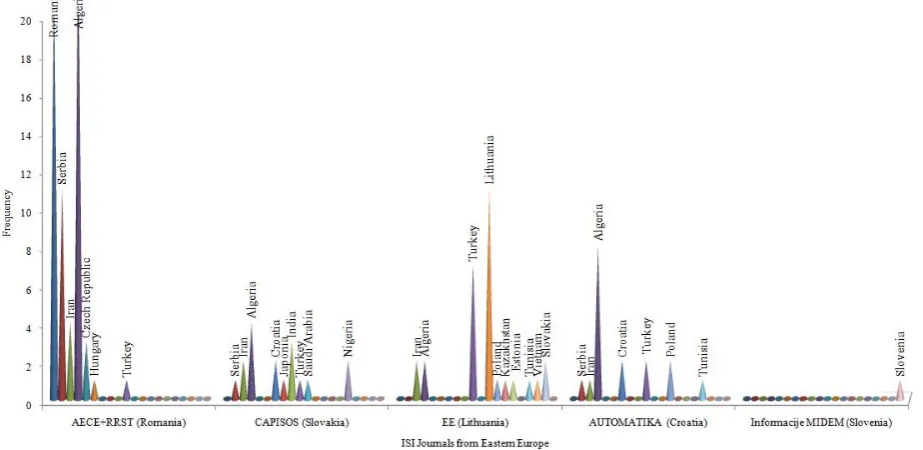
We also aimed to understand the distribution of induction machine studies by country, so we looked at the first author’s country of origin. Only four papers had authors from different countries, all other 127 being elaborated by authors from the same country. This is probably the combined result of several factors, for example, the limited level of international collaboration between researchers from Eastern European countries and the preference to publish the result of international collaborative research in more prestigious Western European and US journals.
374 The induction machines in Eastern Europe: A research agenda 4
authors tending to publish in journals edited in their home country. In the Romanian journals, out of 67 articles, 22 have Romanian authors (interestingly, 24 articles have Algerian authors). In the Lithuanian journal, out of 29 studied papers, 11 have Lithuanian authors. In the other three journals, we did not find any Romanian nor Lithuanian authors. This might be explained through the
higher visibility of the journals among home authors, but also their limited visibility among researchers from other countries.
[image:5.595.72.534.138.363.2]Another aspect might be related to authors tendency to increase the visibility (and so the impact) of their national journals.
Fig. 2. – Articles published and the first author’s country of origin author’s.
It should be noticed the significant presence of Algerian, Turkish and Serbian researchers (Fig. 2 and Fig. 3). At the same time, other countries from Eastern Europe are very poorly represented, probably because their researchers prefer to publish in journals edited in their own countries, although these are not ISI indexed.
Fig. 3 – First author’s country of origin.
5. CONCLUSIONS
Our findings show that studies on induction machines focus on their use in electrical drives, the major research interest being the torque or speed control improvement.
Surprisingly, there is a very small number of articles that focus on the high-efficiency induction motors in terms of IEC 60034-30 standard requirements. This could be explained in several ways. First, the requirements of this standard are highly applied, with strict technological
solutions. For this reason, the electric machines manufacturers might have solved these requirements internally, in their own R&D departments. Moreover, manufacturers might prefer the benefits from keeping the research results secret.
Second, there might be a limited interest or potential for improvements of the induction machines efficiency. This is mostly due to the lack of funding, as in these countries, the industry is generally less developed, or is facing a fierce
competition from Western European (e.g. ABB, Siemens) or
American (e.g. the Brazilian motor manufacturer WEG) companies.
Finally, the very small number of the high-efficiency induction machine articles could be simply explained by the fact that this research domain is saturated, the induction machine being a very well-known product, with limited potential of radical innovations.
This research has some important contributions. First, it offers an overview of research trends in Eastern European journals and highlights main issues approached in the published articles. It also opens the discussion about visibility of these journals, both at the international, but also at regional level. In terms of performance, Eastern European journals are still less popular than Western European or American journals, but their ranking is constantly improving. A better visibility, at least at the regional level, may further help these journals improve their presence in the industry’s main discourse.
[image:5.595.55.294.479.668.2]This would reveal if research on this geographic area follows the common international trends or sets up its own agenda, answering to Eastern European specific issues.
ACKNOWLEDGEMENTS
The work performed by the Cristina Mihaela Gheorghe was supported by Project SOP HRD - PERFORM /159/1.5/S/138963.
Received on September 28, 2018
APPENDIX
Table 1
List of papers included in the analysis No Name
1) Revue Roumaine des Sciences Techniques (RRST)
1
M. Mihalache, Equivalent circuit parameters and operating performances of the three-phase asynchronous motor, Rev. Roum. Sci. Techn. – Electrotechn. et Energ., 55, 1, pp. 32–41 (2010).
2
V. Năvrăpescu et al, Computation methods for space harmonic effects on single-phase induction motor performance, Rev. Roum. Sci. Techn. – Electrotechn. et Energ., 55,3, pp. 278-288 (2010).
3
D. Marcsa, M. Kuczmann, Two-dimensional modeling of the motion in induction motor with ferromagnetic hysteresis, Rev. Roum. Sci. Techn. – Electrotechn. et Energ., 55,4, pp. 351-356 (2010).
4
M. Adjoudj, Sliding mode control of a doubly fed induction generator for wind turbines, Rev. Roum. Sci. Techn. – Electrotechn. et Energ., 56,1, pp. 15–24 (2011).
5
J. Radosavljević et al, A genetic algorithm-based approach for a general steady-state analysis of three-phase self-excited induction generator, Rev. Roum. Sci. Techn. – Electrotechn. et Energ., 57, 1, pp. 10–19 (2012).
6
A.Kerboua, M. Abid, Hybrid fuzzy sliding mode control of a doubly-fed induction generator in wind turbines, Rev. Roum. Sci. Techn.–Electrotechn. et Energ., 57, 4, pp. 412–421 (2012). 7
E. Cazacu, V. Năvrăpescu, I. Nemoianu, On-site efficiency evaluation for in-service induction motors, Rev. Roum. Sci. Techn. – Electrotechn. et Energ., 58, 1, pp. 63–72 (2013). 8
A. Simion et al, Study of the three-phase induction machine under dynamic braking, Rev. Roum. Sci. Techn. – Electrotechn. et Energ., 58, 3, pp. 273-283 (2013).
9
A. Idir, M. Kidouche, RT-lab and dspace: two softwares for real time control of induction motors, Rev. Roum. Sci. Techn. – Electrotechn. et Energ., 59, 2, pp. 205-214 (2014).
10
Ž. Milkić, et al., Rotor voltage influence on the characteristics of a doubly fed induction machine, Rev. Roum. Sci. Techn. – Electrotechn. et Energ., 59, 3, pp. 249-258 (2014).
11
A.H. Boudinar et al., Diagnostic des défauts de roulements d’un moteur asynchrone (bearing fault diagnosis of induction motor), Rev. Roum. Sci. Techn. – Electrotechn. et Energ., 60, 1, pp. 39-48 (2015).
12 C.M. Gheorghe et al., analysis of squirrel-cage induction motor, Numerical modeling approaches for the Rev. Roum. Sci. Techn. – Electrotechn. et Energ., 61, 1, pp. 18-21 (2016). 13 L. Mehdi, L. Barazane,motor drives, Rev. Roum. Sci. Techn. – Electrotechn. et Synergetic speed control of squirrel
Energ., 61, 2, pp. 111-115 (2016). 14
T. Tudorache, I. Ilina, L. Melcescu, Parameters estimation of an induction motor using optimization algorithms, Rev. Roum. Sci. Techn.–Electrotechn. et Energ., 61, 2, pp. 121-125 (2016). 15
K. Iffouzar et al., Behavior analysis of a dual stars induction motor supplied by PWM multilevel inverters, Rev. Roum. Sci. Techn.–Electrotechn. et Energ., 61, 2, pp. 137-141 (2016). 16
A. Aberbour et al., Sliding mode direct torque and rotor flux control of an isolated induction generator including magnetic saturation, Rev. Roum. Sci. Techn.–Electrotechn. et Energ.,
61, 2, pp. 142-146 (2016). 17
A. Azib et al., Robustness of the direct torque control of double star induction motor in fault condition, , Rev. Roum. Sci. Techn.–Electrotechn. et Energ., 61, 2, pp. 147-152 (2016). 18 S. Abdelmalek et al., Fault diagnosis for a doubly fed
induction generator, Rev. Roum. Sci. Techn.–Electrotechn. et Energ., 61, 2, pp. 159-163 (2016).
19
T. Benmiloud, Proportional integrator-neurofuzzy observer of induction motor, Rev. Roum. Sci. Techn.–Electrotechn. et Energ., 61, 3, pp. 233-238 (2016).
20
S. Tamalouzt et al., Direct torque control of wind turbine driven doubly fed induction generator, Rev. Roum. Sci. Techn.–Electrotechn. et Energ., 61, 3, pp. 244-249 (2016). 21
A. Aberbour et al., Adaptable sliding mode control for wind energy application, Rev. Roum. Sci. Techn.–Electrotechn. et Energ., 61, 3, pp. 258-262 (2016).
22
F. Amrane, A. Chaiba, A novel direct power control for grid-connected doubly fed induction generator based on hybrid artificial intelligent control with space vector modulation, Rev. Roum. Sci. Techn.–Electrotechn. et Energ., 61, 3, pp. 263-268 (2016).
23
F. Amrane et al., Design and implementation of high performance field oriented control for grid-connected doubly fed induction generator via hysteresis rotor current controller,
Rev. Roum. Sci. Techn.–Electrotechn. et Energ., 61, 4, pp. 319-324 (2016).
24
A. Maafa et al., Cascaded doubly fed induction generator with variable pitch control system, Rev. Roum. Sci. Techn.– Electrotechn. et Energ., 61, 4, pp. 361-366 (2016).
25
S. Bellarbi et al., Fuzzy robust control of double fed induction generator with parameter uncertainties, Rev. Roum. Sci. Techn.–Electrotechn. et Energ., 61, 4, pp. 367-371 (2016). 26
S. Meddouri et al., Control of autonomous saturated induction generator associated to a flywheel energy storage system, Rev. Roum. Sci. Techn.–Electrotechn. et Energ., 61, 4, pp. 372-377 (2016).
27
V. Manescu (Paltanea) et al., High efficiency electrical motors. State of the art and challenges, Rev. Roum. Sci. Techn.– Electrotechn. et Energ., 62, 1, pp. 14-18 (2017).
28
A. Benachour et al., A new direct torque control of induction machine fed by indirect matrix converter, Rev. Roum. Sci. Techn.–Electrotechn. et Energ., 62, 1, pp. 25-30 (2017). 29 A. Meroufel at al.,control with fuzzy sliding mode speed controller, Double star induction motor direct torque Rev. Roum.
Sci. Techn.–Electrotechn. et Energ., 62, 1, pp. 31-35 (2017). 30
D.R. Abjadi, D. Ghanbari, Direct torque and flux control of asymmetrical six-phase induction motor with zero sequence components elimination, Rev. Roum. Sci. Techn.– Electrotechn. et Energ., 62, 1, pp. 36-41 (2017).
31
K. Iffouzar et al., Direct rotor field oriented control of polyphase induction machine based on fuzzy logic controller,
Rev. Roum. Sci. Techn.–Electrotechn. et Energ., 62, 1, pp. 42-47 (2017).
32
A.F. Aimer et al., Utilisation de la méthode root-auto régréssive dans le diagnostic des défauts mécaniques du moteur asynchrone (Use of the root-AR method in the diagnosis of induction motor’s mechanical faults), Rev. Roum. Sci. Techn.–Electrotechn. et Energ., 62, 2, pp. 134-141 (2017). 33
A. Bouzida et al., Experimental analysis of dynamic eccentricity in the induction machine using motor current signature analisys and discrete wavelet transform, Rev. Roum. Sci. Techn.–Electrotechn. et Energ., 62, 2, pp. 142-147 (2017). 34
O. Aouchenni et al., Wind farm based on doubly fed induction generator entirely interfaced with power grid through multilevel inverter, Rev. Roum. Sci. Techn.–Electrotechn. et Energ., 62, 2, pp. 170-174 (2017).
35
A. Izanlo et al., Comparative study between two sensorless methods for direct power control of doubly fed induction generator, Rev. Roum. Sci. Techn.–Electrotechn. et Energ.,
62, 4, pp. 358-364 (2017). 36
N. Mekkaoui, Mohamed-Saïd Naït-Saïd, Direct s-power control for a doubly fed induction generator, Rev. Roum. Sci. Techn.–Electrotechn. et Energ., 62, 4, pp. 365-370 (2017).
2) Elektronika ir Elektrotechnika (EE)
37
A. J. Poška et al., Control and Adjustment of Linear Induction Motor Starting Force, Elektronika ir Elektrotechnika, 98, 2, pp. 21-24 (2010).
38
A. Petrovas et al., System for Measuring Speed of Induction Motor, Elektronika ir Elektrotechnika, 101, 5, pp. 27-30 (2010).
39
S. Grouni et al., Real Time Rotor Flux Estimation for Induction Machine Drives: an Experimental Approach, Elektronika ir Elektrotechnika, 104, 8, pp. 69-72 (2010).
376 The induction machines in Eastern Europe: A research agenda 6
Motor and Calculation of Its Power Loss by using Lumped-Circuit Model, Elektronika ir Elektrotechnika, 104, 8, pp. 81-84 (2010).
41
S. Taskin, H. Gokozan, Determination of the Spectral Properties and Harmonic Levels for Driving an Induction Motor by an Inverter Driver under the Different Load Conditions, Elektronika ir Elektrotechnika, 108, 2, pp. 75-80 (2011).
42
I. Temiz et al., Analysis of Balanced Three-Phase Induction Motor Performance under Unbalanced Supply using Simulation and Experimental Results, Elektronika ir Elektrotechnika, 109, 3, pp. 41-85 (2011).
43
A. Boudiaf et al., Mechanical Characteristics of Linear Asynchronous Motor, Elektronika ir Elektrotechnika, 110, 4, pp. 21-24 (2011).
44 B. Kundrotas et al.,Elektronika ir Elektrotechnika, Model of Multiphase Induction Motor, 111, 5, pp. 111-114 (2011).
45
J. Buksnaitis, Analytical Determination of Mechanical Characteristics of Asynchronous Motors by Varying the Electric Current Frequency, Elektronika ir Elektrotechnika,
112, 6, pp. 3-6 (2011). 46
R. Figura, E. Szychta, L. Szychta, In-Service Efficiency Estimation with the use Modified Air-Gap Torque Method for Squirrel-Cage Induction Motor, Elektronika ir Elektrotechnika, 114, 8, pp. 51-56 (2011).
47 M. Dogan, M. Dursun,by Heuristic Methods (PSOGA), Reduction of Asynchronous Motor Loss Elektronika ir Elektrotechnika, 117, 1, pp. 53-58 (2012).
48
B. Karaliunas, Study on the Braking Characteristics of Linear Induction Motors, Elektronika ir Elektrotechnika, 118, 2, pp. 49-52 (2012).
49
A. J. Poska, J. Buksnaitis, Research of Cylindrical Linear Induction Motor with Unconventionally Connected Windings,
Elektronika ir Elektrotechnika, 121, 5, pp. 23-26 (2012). 50
S. S. Issenov, I. А. Pyastolova, Mathematical Model of Automatic Control System for Asynchronous Multimotor Drive, Elektronika ir Elektrotechnika, 18, 8, pp. 9-12 (2012). 51
İ. Tarımer, S. Arslan, M. E. Güven, Investigation for Losses of M19 and Amorphous Core Materials Asynchronous Motor by Finite Elements Methods, Elektronika ir Elektrotechnika, 18, 9, pp. 15-18 (2012).
52
B. Karaliunas, E. Matkevicius, The Edge Effects Influence on the Braking Characteristics of the Linear Induction Motor,
Elektronika ir Elektrotechnika, 18, 10, pp. 9-12 (2012). 53
T.V. Mumcu et al., Reducing Moment and Current Fluctuations of Induction Motor System of Electrical Vehicles by using Adaptive Field Oriented Control, Elektronika ir Elektrotechnika, 19, 2, pp. 21-24 (2013).
54
I. Aliskan,et al., Nonlinear Speed Controller Supported by Direct Torque Control Algorithm and Space Vector Modulation for Induction Motors in Electrical Vehicles,
Elektronika ir Elektrotechnika, 19, 6, pp. 41-46 (2013). 55
M. Hosseini Aliabadi et al., Multisided Linear Induction Generator, Analytical Modeling, 3-D Finite Element Analysis and Experimental Test, Elektronika ir Elektrotechnika, 19, 8,
pp. 8-14 (2013). 56
A. Taheri, Efficiency Optimization of Six-phase Induction Motors by Fuzzy Controller, Elektronika ir Elektrotechnika,
19, 10, pp. 49-52 (2013). 57
J. Kriauciunas et al., Self-Tuning Speed Controller of the Induction Motor Drive, Elektronika ir Elektrotechnika, 20, 6,
pp. 24-28 (2014). 58
T. Vaimann et al., Changing of Magnetic Flux Density Distribution in a Squirrel-Cage Induction Motor with Broken Rotor Bars, Elektronika ir Elektrotechnika, 20, 7, pp. 11-14 (2014).
59
A. Zaafouri et al., Robust Observer Design with Pole Placement Constraints for Induction Motor Control,
Elektronika ir Elektrotechnika, 21, 1, pp. 18-22 (2015).
60 T.T. Chuong et al.,Distribution Network Connected Induction Machines, Research of the Voltage Stability of
Elektronika ir Elektrotechnika, 21, 1, pp. 42-47 (2015). 61 J. Buksnaitis,and Six-Phase Cage Motor Energy Parameters, Investigation and Comparison of Three-Phase Elektronika ir
Elektrotechnika, 21, 3, pp. 16-20 (2015). 62
B. Dobrucky et al., A Novel Supply System for Two- Phase Induction Motor by Single Leg Matrix Converter, Elektronika ir Elektrotechnika, 21, 4, pp. 13-16 (2015).
63 P. Smolskas, M. Zmuida, Analysing Torque-slip Characteristic
64
Z. Ferkova, V. Kindl, Influence of Skewed Squirrel Cage Rotor with Intermediate Ring on Magnetic Field of Air Gap in Induction Machine, Elektronika ir Elektrotechnika, 23, 1, pp. 26-30 (2017).
65
Anna Stief et al., Two Stage Data Fusion of Acoustic, Electric and Vibration Signals for Diagnosing Faults in Induction Motors, Elektronika ir Elektrotechnika, 23, 6, pp. 19-24 (2017).
3) Advances in Electrical and Computer Engineering (AECE)
66
A. Simion, Study of the Induction Machine Unsymmetrical Condition Using In Total Fluxes Equations, AECE, 10, 1, pp.34 - 41 (2010).
67
I. Birou et al., Indirect Vector Control of an Induction Motor with Fuzzy-Logic based Speed Controller, AECE, 10, 1, pp. 116-120 (2010).
68
G. Bachir, A. Bendiabdellah, Scalar Control for Six Phase Matrix Converter Fed Double Star Induction Motor, AECE,
10, 1, pp. 121-126 (2010).
69 A. Simion et al., Performances for Electric Trucks. A FEM-Based Analysis, Induction Machine with Improved Operating
AECE, 10, 2, pp. 71-76 (2010).
70 S.I. Deaconu et al.,Analysis of Transients of Induction Motor with Soft Starter Experimental Study and Comparative Startup, AECE, 10, 3, pp. 27-33 (2010).
71
N.R. Buzatu et al., Static Frequency Converter with RNSIC Converter and Double Branch Inverter for Supplying Three-Phase Asynchronous Motors, AECE, 10, 3, pp. 66-70 (2010). 72
P. Brandstetter et al., Direct Torque Control of Induction Motor with Direct Calculation of Voltage Vector, AECE, 10,
4, pp. 17-22 (2010). 73
D. Oros et al., Influence of parameters detuning on induction motor NFO shaft-sensorless scheme, AECE, 10, 4, pp. 121-124 (2010).
74 S. Ivanov, 10, 4, pp. 149-154 (2010).Continuous DTC of the Induction Motor, AECE, 75 F. Kulic et al.,for Induction Motor Speed Control, Optimal Fuzzy Controller Tuned by TV-PSO AECE, 11, 1, pp. 49-54
(2011).
76 G. Craciunas,in Direct Field Oriented Control of Induction Machines, Performances of Gopinath Flux Observer Used
AECE, 11, 1, pp. 73-76 (2011). 77
P. Matic, S.N. Vukosavic, Speed Regulated Continuous DTC Induction Motor Drive in Field Weakening, AECE, 11, 1, pp. 97-102 (2011).
78
T. Pana, O. Stoicuta, Small Speed Asymptotic Stability Study of an Induction Motor Sensorless Speed Control System with Extended Gopinath Observer, AECE, 11, 2, pp. 15-22 (2011). 79
A. Taheri et al., Energy Optimization of Field Oriented Six-Phase Induction Motor Drive, AECE, 11, 2, pp. 107-112 (2011).
80
S. Mihai et al., Induction Motor with Switchable Number of Poles and Toroidal Winding, AECE, 11, 2, pp. 113-118 (2011).
81
V.A. Maraba, A.E. Kuzucuoglu, PID Neural Network Based Speed Control of Asynchronous Motor Using Programmable Logic Controller, AECE, 11, 4, pp. 23-28 (2011).
82 D.M. Stojic,Estimation, AECE, An Algorithm for Induction Motor Stator Flux 12, 3, pp. 47-52 (2012). 83
D. Milicevic et al., New Space Vector Selection Scheme for VSI Supplied Dual Three-Phase Induction Machine, AECE,
13, 1, pp. 59-64 (2013). 84
L. Livadaru et al., Dual Cage High Power Induction Motor with Direct Start-up. Design and FEM Analysis, AECE, 13, 2,
pp. 55-58 (2013). 85
C.P. Ion, C. Marinescu, Autonomous Three-Phase Induction Generator Supplying Unbalanced Loads, AECE, 13, 2, pp. 85-90 (2013).
86
M. V. Terzic et al., Stator Design and Air Gap Optimization of High Speed Drag-Cup Induction Motor using FEM, AECE,
13, 3, pp. 93-100 (2013).
87 I. Vlad et al.,Power Three-Phase Asynchronous Motors, Operation Characteristics Optimization of Low AECE, 14, 1, pp. 87-92 (2014).
(2014). 89
R. Munteanu et al., Quasi-stationary and Transient Regime of Induction Machine Supplied by Two Stator Frequencies,
AECE, 14, 3, pp. 131-136 (2014). 90
R. Campeanu, M. Cernat, Two Speed Single Phase Induction Motor with Electronically Controlled Capacitance, AECE, 14,
3, pp. 137-140 (2014).
91 P. Brandstetter et al.,Control Structure of Induction Motor A.C. Drive, Implementation of Genetic Algorithm in AECE, 14,
4, pp. 15-20 (2014). 92
M.M. Rosic, M.Z. Bebic, Analysis of Torque Ripple Reduction in Induction Motor DTC Drive with Multiple Voltage Vectors,
AECE, 15, 1, pp. 105-114 (2015). 93
P. Hamedani, A. Shoulaie, Modification of The Field-Weakening Control Strategy for Linear Induction Motor Drives Considering The End Effect, AECE, 15, 3, pp. 3-12 (2015).
94
C.G. Nistor et al., Noise and Vibration Monitoring for Premium Efficiency IE 3 Three-Phase Induction Motors,
AECE, 15, 3, pp. 117-122 (2015).
95 D. Reljic et al.,Under No-Load Condition, Broken Bar Fault Detection in IM Operating AECE, 16, 4, pp. 63-70 (2016). 96
D. Matic, Z. Kanovic, Vibration Based Broken Bar Detection in Induction Machine for Low Load Conditions, AECE, 17, 1,
pp. 49-54 (2017).
4) Journal of Electrical Engineering - Elektrotechnicky Casopis
97
K. Takayuki et al., Investigation of measured distributions of local vector magnetic properties in a three-phase induction motor model core,Elektrotechnicky Casopis, 61, 7s, pp. 115-118 (2010).
98
M. Messaoud et al. Vectorial command of induction motor pumping system supplied by a photovoltaic generator,
Elektrotechnicky Casopis, 62, 1, pp. 3-10 (2011). 99
M.B.B Sharifian et al., .A new soft starting method for wound-rotor induction motor, Elektrotechnicky Casopis, 62, 1, pp. 31-36 (2011).
100
D. Vukadinovic, M. Basic, A stand-alone induction generator with improved stator flux oriented control, Elektrotechnicky Casopis, 62, 2, pp. 65-72 (2011).
101
A. Bentaallah et al., Adaptive feedback linearization control for asynchronous machine with nonlinear for natural dynamic complete observer, Elektrotechnicky Casopis, 63, 2, pp. 88-94 (2012).
102
N.K. Mohanty, R. Muthu, Implementation of DSP based cost effective inverter fed induction motor drive with VisSim,
Elektrotechnicky Casopis, 63, 2, pp. 115-119 (2012). 103
J. Radosavljevic et al., Steady-state analysis of parallel-operated self-excited induction generators supplying an unbalanced load, Elektrotechnicky Casopis, 63, 4, pp. 213-223 (2012).
104
H. M. Hasanien, E. A. Al-Ammar, Dynamic response improvement of doubly fed induction generator-based wind farm using fuzzy logic controller, Elektrotechnicky Casopis,
63, 5, pp. 281-288 (2012). 105
S. B. Singh, A. K. Singh, Precise assessment of performance of induction motor under supply imbalance through impedance unbalance factor,Elektrotechnicky Casopis, 64, 1, pp. 31-37 (2013).
106
B. Singh, S. Jain, S. Dwivedi, Enhancement in steady state and dynamic performance of direct torque control induction motor drive, Elektrotechnicky Casopis, 64, 5, pp. 283-290 (2013).
107
A.G. Yetgin, M. Turan, Optimization efficiency of slitted-core induction motor, Elektrotechnicky Casopis, 65, 1, pp. 60-64 (2014).
108
M. Basic et al., Analysis of power converter losses in vector control system of a self-excited induction generator,
Elektrotechnicky Casopis, 65, 2, pp. 65-74 (2014).
109 M. M. Rezaoui et al.,induction machine feeding by a [3 × 5] matrix converter, High performances of five-phase
Elektrotechnicky Casopis, 65, 2, pp. 83-89 (2014). 110
R. Abdollahi et al., Emotional learning based intelligent controllers for rotor flux oriented control of induction motor,
Elektrotechnicky Casopis, 65, 4, pp. 228-234 (2014). 111
B. Mokhtari, M. F. Benkhoris, High ripples reduction in DTC of induction motor by using a new reduced switching table,
Elektrotechnicky Casopis, 67, 3, pp. 206-211 (2016).
112 C. Ogbuka et al.,based on field orientation and hysteresis current comparison, A new high speed induction motor drive
113
C. M. Nwosu et al., Transient and steady state performance analysis of power flow control in a DFIG variable speed wind turbine, Elektrotechnicky Casopis, 68, 1, pp. 31-38 (2017).
5) Informacije MIDEM
114
U. Flisar et al., Voltage SAG independent operation of induction motor based on z-source inverter, Informacije, 40, 3, pp. 218-223 (2010).
6) Automatika
115
A. Mechernene et al., Adaptive Speed Observer using Artificial Neural Network for Sensorless Vector Control of Induction Motor Drive, Automatika, 53, 3, pp. 263-271 (2012).
116 V. Lesic et al.,a Squirrel-cage Induction Generator and Rotor Bar Defects, Fault-tolerant Control of a Wind Turbine with
Automatika,54, 3, pp. 316-328 (2013). 117
E.E. Ozsoy et al., A Novel Current Controller Scheme for Doubly Fed Induction Generators, Automatika,56, 2, pp. 186-195 (2015).
118
P.R. Matic et al., Improved Torque Control of High Speed Shaft-Sensorless Induction Motor Drive, Automatika, 56, 4,
pp. 443-453 (2015). 119
M. Bahloul et al., TS Fuzzy Logic-Based Rotor Resistance Tuning in case of Induction Machine Vector Control,
Automatika,56, 4, pp. 454-465 (2015). 120
CE. Feraga, A. Bouldjedri, Performance of a Photovoltaic Pumping System Driven by a Single Phase Induction Motor Connected to a Photovoltaic Generator, Automatika,57, 1,
pp. 163-172 (2016). 121
S. Chaouch et al., Optimized Torque Control via Backstepping Using Genetic Algorithm of Induction Motor, Automatika,57, 2, pp. 379-386 (2016).
122
P. Sobanski, T. Orlowska-Kowalska, Application of Open-Circuit IGBT Faults Diagnostic Method in DTC-SVM Induction Motor Drive, Automatika, 57, 2, pp. 387-395 (2016).
123
M. Kutija et al., PLL-based Rotor Flux Estimation Method for Sensorless Vector Controlled Squirrel-Cage Induction Generators, Automatika,57, 3, pp. 578-588 (2016).
124
M. Doumi et al, Robust Fuzzy Gains Scheduling of RST Controller for a WECS Based on a Doubly-Fed Induction Generator, Automatika,57, 3, pp. 617-626 (2016).
125 K. Klimkowski, M. Dybkowski,Structure for an Induction Motor Drive System, A Fault Tolerant Control Automatika,
57, 3, pp. 638-647 (2016).
126 Habib ben Zina et al.,Tolerant Tracking Control for Induction Motor Drive, Descriptor Observer Based Fault
Automatika,57, 3, pp. 703-713 (2016). 127
E. Kilic et al., Efficient speed control of induction motor using RBF based model reference adaptive control method,
Automatika,57, 3, pp. 714-723 (2016). 128
T. Roubache et al., Backstepping design for fault detection and FTC of an induction motor drives-based EVs, Automatika,57, 3, pp. 736-748 (2016).
129
K.D. Eddine et al., A comprehensive review of LVRT capability and sliding mode control of grid-connected wind-turbine-driven doubly fed induction generator, Automatika,
57, 4, pp. 922-935 (2016). 130
A. Mabrek, K.E. Hemsas, Induction motor inter-turn fault modeling and simulation using SSFR test for diagnosis purpose, Automatika,57, 4, pp. 948-959 (2016).
131
E. Hosseini, G. Shahgholian, Output power levelling for (doble fed induction generator) DFIG wind turbine system using intelligent pitch angle control, Automatika,58, 4, pp. 363-374 (2017).
REFERENCES
1. A.T. de Almeida, F.J.T.E. Ferreira, G. Baoming, Beyond Induction Motors – Technology Trends to Move up Efficiency, IEEE Transactions on Industry Applications, 50, 3, pp. 2103–2114, (2014). 2. T. Tudorache, O. Craiu, Electrical machines. Laboratory works and
Problems, Politehnica Press, Bucharest, 2013, pp. 77-86.
3. C.J. Verucchie, G.G. Acosta, F.A Benger, A Review on Fault Diagnosis of Induction Machines, Latin American Applied Research, 38, 2, pp. 113–121 (2008).
378 The induction machines in Eastern Europe: A research agenda 8
5. M.R. Mehrjou, N. Mariun, M.H. Marhaban, N. Misron, Rotor Fault Condition Monitoring Techniques for Squirrel-Cage Induction Machine — A Review, Mechanical Systems and Signal Processing,
25, 8, pp. 2827–2848 (2011).
6. A. Siddique, G.S. Yadava, B. Singh, Applications of Artificial Intelligence Techniques for Induction Machine Stator Fault Diagnostics: Review, Symposium on Diagnostics for Electric Machines, Power Electronics and Drives (SDEMPED2003), Atlanta, USA, 24-26 August 2003.
7. A. M. Bazzi, P.T. Krein, Review of Methods for Real-Time Loss Minimization in Induction Machines, IEEE Transactions on Industry Applications, 46, 6, pp. 2319–2328 (2010).
8. S. Manoharan, N. Devarajan, S.M. Deivasahayam, G. Ranganathan,
Review on Efficiency Improvement in Squirrel Cage Induction Motor by Using DCR Technology, Journal of Electrical Engineering, 60, 4, pp. 227–236 (2009).
9. C. Thanga Raj, S. P. Srivastava, P. Agarwal, Energy Efficient Control of Three-Phase Induction Motor – A Review, International Journal of Computer and Electrical Engineering, 1, 1, pp.1793–8198 (2009). 10. Veronica Manescu (Paltanea), G. Paltanea, H. Gavrila, G. Scutaru, I.
Peter, High efficiency electrical motors. State of the art and challenges, Rev. Roum. Sci. Techn. – Electrotechn. et Energ., 62, 1, pp. 14–18 (2017).
11. H. Gavrila, Veronica Manescu (Paltanea), G. Paltanea, G. Scutaru, I. Peter. New Trends in Energy Efficient Electrical Machines, Procedia Engineering, 181, pp. 568–574 (2017).
12. Cristina M. Gheorghe, L.M. Melcescu, T. Tudorache, M. Numerical modeling approaches for the analysis of squirrel cage induction
motor. Rev. Roum. Sci. Techn. – Electrotechn. et Energ., 61, 1, pp. 18–21 (2016).
13. L. Alberti, N. Bianchi, A. Boglietti, A. Cavagnino, Core Axial Lengthening as Effective Solution to Improve the Induction Motor Efficiency Classes, IEEE Transactions on Industry Applications, 50,
1, pp. 218–225 (2014).
14. C.M.L. Parra, E.H.L. Mazo, F.V. Arroyave, Standards of Energy Efficiency of Induction Motors: Latin American Context, in VII Simposio Internacional sobre Calidad de la Energia Electrica (SICEL2013), Medellin, Colombia, 27-29 November 2013. 15. International standard IEC TS 60034-30-2 for variable speed motors.
Online at: https://www.altraliterature.com/.
16. M. Doppelbauer. Update on IEC Motor and Converter Standards. Motor Summit Switzerland 2017, Zurich, 21 November 2017. 17. M. Hadziselimovic, T. Marcic, B. Stumberger, I. Zagradisnik, Winding
Type Influence on Efficiency of an Induction Motor, Przeglad Elektrotechniczny (Electrical Review), 87, 3, pp. 61–64 (2011). 18. A. Moraru, Electric Machines. Theory, Tests and Operation,
Bucharest, AGIR, 2010, pp. 123-214. (in Romanian).
19. I. Birou, V. Maier, S. Pavel, C. Rusu, Indirect Vector Control of an Induction Motor with Fuzzy-Logic based Speed Controller, Advances in Electrical and Computer Engineering, 10, 1, pp.116–120 (2010). 20. K. Baltzis, The finite element method magnetics (FEMM) freeware
package: May it serve as an educational tool in teaching electromagnetics?, Education and Information Technologies, 15, 1, pp. 19–36 (2010).