N A N O E X P R E S S
Open Access
Highly Efficient Method for Preparing
Homogeneous and Stable Colloids
Containing Graphene Oxide
Wei Yu
1, Huaqing Xie
1*, Xinwei Wang
2, Xiaoping Wang
1Abstract
Phase transfer method has been developed for preparing homogeneous and stable graphene oxide colloids. Graphene oxide nanosheets (GONs) were successfully transferred from water ton-octane after modification by oleylamine. Corrugation and scrolling exist dominantly in the modified GONs. GONs were single layered with the maximum solubility inn-octane up to 3.82 mg mL-1. Oleylamine molecules chemically attach onto the GONs. Compared with traditional strategies, the phase transfer method has the features of simplicity and high efficiency.
Introduction
Graphene has attracted considerable attention over the past few years due to its exceptional properties [1-3], such as high electrical conductivity, high mechanical strength, and high thermal conductivity. Graphene has exhibited potential applications in microelectronic devices, sensors, biomedicines, and mechanic resonators. Additionally, graphene oxide and graphene can be used as fillers to enhance the mechanical and electrical or thermal transport properties of polymer nanocompo-sites. The excellent performance of polymer nanocom-posites is achieved, not only by using the inherent properties of the nanofiller, but more importantly by optimizing the dispersion, enhancing the compatibility between nanofiller and matrix. The colloidal suspensions containing graphene oxide and graphene are often used to fabricate the composites [4-6]. One of the aims of preparing colloidal suspensions is to enhance the disper-sion of nanomaterial in polymer, and the other one is to decrease the toxicity of the composite production [7].
Several approaches have been proposed for the pro-duction of aqueous suspensions of graphene oxide and graphene sheets. Exfoliation of graphite oxide either by rapid thermal expansion or by ultrasonic dispersion has been widely adopted to prepare graphene oxide and gra-phene sheets in bulk. Due to the rich hydrophilic
oxygen-containing groups such as carboxyl, hydroxyl, and epoxide, the graphite oxide readily suspends in water and polar organic solvents, such as ethylene gly-col, DMF, NMP, and THF at about 0.5 mg mL-1 [8]. In order to enhance the solubility of graphene oxide nanosheets in water, the graphene oxide nanosheets were functionalized with allylamine [9]. The maximum solubility for graphene oxide–allylamine powders in water were determined to be 1.55 mg mL-1, which was more than twice of that for bare graphene oxide nanosheets. Whenp-phenyl-SO3H groups were intro-duced into the graphene oxide, the resulting reintro-duced product remained soluble in water and did not aggre-gate [10]. Phenylene diamine was a good reducing agent and stabilizer for stable graphene colloid, and the as-made graphene could be dispersed well in ethanol, glycol,N-methyl-2-pyrrolidone (NMP), but not inN,N -dimethylformamide (DMF) [11]. Triblock copolymers (PEO-b-PPOb-PEO) as the solubilizing agent was employed for chemically exfoliated graphite oxide, and graphene formed through in situ reduction by hydrazine [12]. Water-soluble graphene sheets were functionalized by biocompatible poly-l-lysine as a linker through a covalent amide group [13]. KOH could confer a large negative charge through reactions with reactive oxygen-containing groups on the graphene oxide sheets [14], and exfoliated graphite oxide would undergo quickly deoxygenation in strong alkali solutions [15]; therefore, graphene suspension could be prepared by simply
* Correspondence: [email protected]
1
School of Urban Development and Environmental Engineering, Shanghai Second Polytechnic University, 201209, Shanghai, China.
Full list of author information is available at the end of the article
heating an exfoliated graphite oxide suspension under strongly alkaline conditions at moderate temperature.
Most of the reported studies are related to the aqu-eous graphene oxide and graphene suspensions. Organo-philic graphene oxide and graphene nanosheets are important for the application in graphene-based compo-site materials, while only a few papers presented the methods to produce hydrophobic graphene oxide and graphene nanosheets [16]. For example, graphene oxide sheets could be modified by isocyanate [17], which was well dispersed in polar aprotic solvents. The long alkyl chains (such as octadecylamine) [18] were always used as the surface-modified agents and the alkyl-chain-modified graphene sheets that could be dispersed in organic solvents after sonication [19]. Wang et al. [9] reported the synthesis of hydrophobic graphene oxide nanosheets by a solvothermal method, and then they prepared organophilic graphene nanosheets by reacting with octadecylamine [20].
For preparing the suspensions containing graphene or graphene oxide nanosheets (GONs), the traditional strategy is a three-step method. First, graphene or gra-phene oxide nanosheets are prepared and dried, and then they will be modified. Finally, the functionalized graphene will be dispersed in solvents under stir or ultrasonication. The three-step method is used widely, while there are some drawbacks. First of all, during the synthetic and drying process, GONs have the strong trend to conglomerate due to the large surface area. Second, not all the GONs can be modified, and there is always some sediment under the bottom of suspension. The suspension is not homogeneous, which is not desired for preparing even films and composite materi-als. Here, we developed a facile phase-transfer method with high efficiency to prepare stable suspensions of gra-phene oxide in organic solvents. This method is primar-ily based on the strong interaction between GONs and oleylamine.
Experimental Section
Natural graphite was purchased from Qingdao Baichuan Graphite Co., LTd. 98% H2SO4, 30% H2O2, potassium permanganate (KMnO4) and n-octane were obtained from Shanghai Chemical Reagents Company. Oleyla-mine was purchased from Aldrich. All other reagents were used without further purification.
The synthesis process of suspensions of graphene oxide in organic solvents is presented in Scheme 1. At first, nature graphite powder was oxidized to graphite oxide using a modified Hummers method [21,22]. The obtained graphite oxide (0.1 g) was dispersed in 20 mL de-ionized water and exfoliated to generate GONs by ultrasonication for 12 h. The result was a homogeneous dark brown solution (Scheme 1a) of dispersed GONs.
Then 0.5 g oleylamine was added in the colloidal sus-pension. Due to the strong interaction between oleyla-mine and GONs, oleylaoleyla-mine was absorbed on the surface of GONs, and GONs became hydrophobic GONs-OA, and floated in the water (Scheme 1b). Then 20 mL of n-octane was added into the mixture. The phase transfer process occurred spontaneously, and there was a distinct phase interface between the aqueous and octane in 1 day (Scheme 1c). After removing the aqueous phase using a pipette, the stable suspensions of graphene oxide in octane was obtained.
The size and morphology of the GONs were examined by using transmission electron microscopy (TEM, JEOL 2100F). The TEM samples were prepared by dropping the diluted colloid onto a carbon film mesh supported on a copper grid and drying it in air. Atomic force microscopic (AFM) images were taken on a MultiTask AutoProbe CP/MT Scanning Probe Microscope (Veeco Instruments, Woodbury, NY). Imaging was done in tap-ping mode using a V-shaped ‘Ultralever’ probe B and nominal tip radius 10 nm. The diluted GONs colloid was dropped onto a freshly cleaved mica. After the mica was dry, the GONs-OA were imaged. FT-IR spectra were recorded with a Bruker Equinox V70 FT-IR spectrometer in dry KBr pullet in the range of 400– 4,000 cm-1. A thermogravimetric analyzer (TG-DTG, Netzsch STA 449C) was used for thermogravimetric analysis and calculation of the decomposition activation energy (sample mass: about 15.0 mg; atmosphere,
Graphite
Graphite Oxidation
Graphene Oxidation Solution
Graphene Oxidation Modified by Oleylamine
Phase Transfer Method
Two Phase Mixture
Separation
GONs suspension in orgainc solvent
(a)
(b)
(c)
flowing dry nitrogen). The UV–Vis spectra of the octane suspensions containing GONs were measured on a Shimadzu UV2550 UV–Vis spectrometer. In order to determine the concentration of the suspension, the cali-bration line was constructed by measuring UV–Vis spectra absorption intensities of the suspensions at dif-ferent concentrations (0.1–0.5 mg mL-1). The standard solution with 0.5 mg mL-1was prepared through the following process. At first, 20 mL of 0.5 mg mL-1 aqueous solution containing GONs was prepared, then 50 mg oleylamine was added, after that GONs-OA would be transferred to 20 mL octane, and the resulting was the octane suspension containing GONs with the concentration 0.5 mg mL-1. To determine the maximum solubility of the suspension, the supernatant solution of the saturated suspension was diluted several times for the measurement of UV–Vis spectra until the absorbance fit-ting in the range of calibration line. Based on the calibra-tion line, the concentracalibra-tion of the diluted solucalibra-tion could be determined. Finally, the maximum solubility could be obtained based on the times of the dilution.
Results and Discussions
Oleylamine is a typical surface modification agent, and it is often used to prepare enhanced hydrophobic nano-materials [23]. Graphene oxide with rich oxygen-containing groups is expected to be surface-modified by oleylamine easily, and the experimental results validate the idea. The synthesis process of suspensions contain-ing GONs in organic solvents was presented in Scheme 1. At first, the aqueous solution containing GONs was prepared, and then the GONs modified by
oleylamine (GONs-OA) in water would be transferred to the organic phase n-octane. The phase transfer pro-cess of preparing organosol was simple. The GONs modified by oleylamine could be transferred from aqueous solution to organic solvent easily with high effi-ciency. Almost all the GONs could be transferred to octane (Scheme 2). The prepared colloids were homoge-neous, and they remained stable for more than 6 months without any sediment.
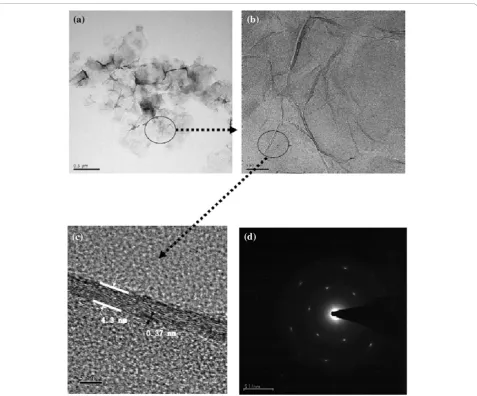
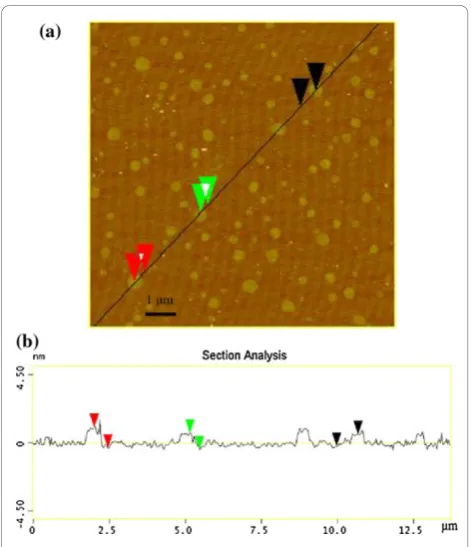
[image:3.595.61.540.488.714.2]Figure 1 shows the typical TEM images of GONs-OA. The sizes of GONs-OA were in the range of 300–800 nm. The 2-D membrane structure will be thermodyna-mically stable via bending; therefore, graphene always exists in the state of corrugation and scrolling [9]. Figure 1b demonstrated the corrugation clearly, and the thickness of the corrugation was 4.3 nm (Figure 1c). The HRTEM image of the corrugated GONs-OA illu-strated the graphitic lattice clearly, and the interplanar distance was measured to be 0.37 nm, corresponding to the spacing of the (002) plane. The diffraction dots were indexed to the hexagonal graphite crystal structure. The cross-sectional view of the typical AFM image of the GONs-OA (Figure 2) indicated that the average thick-ness of GONs-OA was about 1.3 nm, and the thickthick-ness of GONs-OA was very even. In our opinion, almost all the sheets were single-layer graphene oxide. The thick-ness was somewhat larger than that of single-layer GONs (0.8–1.0 nm) [24], attributed to the presence of oleylamine absorbed on both sides of GONs. This is very important because most of the fascinating proper-ties of graphene-based composites are mainly related with their layer numbers of graphene.
Non-polar Solvent
Water Oleylamine
GrapheneOxide Nanosheet
Water
The phase transfer method is based on the strong interaction between GONs and oleylamine, which is confirmed by the FT-IR spectral analysis. Figure 3a shows the typical absorption bands of GONs, such as O–H stretching vibration (3,400 cm-1), C=O stretching of carboxyl groups situated at edges of GONs sheets (1,730 cm-1), epoxide groups and skeletal ring vibrations (1,630 cm-1) and the stretching vibration of C–O–C (1,184 cm-1) [16]. Figure 3b shows the FT-IR spectrum of GONs-OA powders. The asymmetric bands of the alkyl group at 2,850 and 2,921 cm-1 in GONs-OA corre-spond to the C–H stretching vibrations in oleylamine. The amine group (N–H) is also observed with a band 1,458 cm-1 for GONs-OA, which corresponds to 1,465 cm-1 in the FT-IR spectrum of oleylamine (Figure 3c). Compared with GONs, GONs-OA do not show the strong absorption at 1,730 cm-1, and two new bands
appear at 1,656 and 1,438 cm-1, corresponding to νas (COO-) andνs(COO-), respectively. The facts illustrate that the –COOH groups of GONs is ionized to–COO-, and it clearly confirms that oleylamine is attached to GONs through chemical absorption.
[image:4.595.60.538.86.482.2]Kahn prepared soluble oxidized single-walled carbon nanotubes (SWNT) in organic and aqueous solvents through derivatization using 2-aminomethyl-18-crown-6 ether (CE) [25]. They proposed that SWNT and CE formed SWNT-CE adduct, arising from a twitter ionic interaction between a protonated amine on CE and an oxy-anion from a carboxylic acid group, creating a COO-NH3+ionic bond. Li et al. investigated the extrac-tion of maleic acid using trioctylamine, and they found the amine formed 1:1 complexation with maleic acid through ion pairing [26]. Zhou et al. reported the crystal structure of the ethylamine salt of 2-(4-isobutylphenyl) Figure 1a Low magnification of TEM view of GONs-OA, b rippled GONs-OA with waves, c HRTEM image of as-prepared GONs-OA and
propionic acid [27], and the result verified the above proposition. In the paper, there is a strong interaction between oleylamine and GONs, and the interaction is very similar to that between SWNT and CE.
In order to further investigate the interaction of GONs and oleylamine, the decomposition activation energy of GONs-OA was investigated through the thermo-gravimetric analysis under nitrogen atmosphere
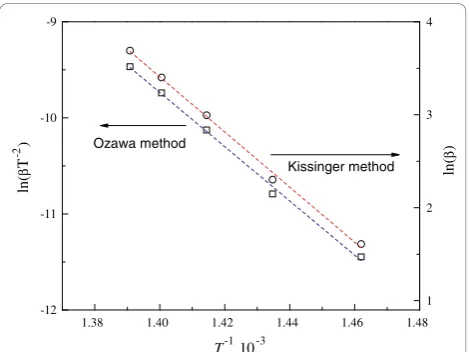
with the heating rate 5, 10, 20, 30, and 40 K min-1. The derivative thermogravimetric plots of GONs-OA at dif-ferent heating rate are shown in Figure 4. The lineariza-tion equalineariza-tions of Ozawa method and Kissinger method are y = -29.64817 × 10³x+ 44.91489 (R2 = 0.997) and y = -28.24605 × 10³x + 29.80937 (R2 = 0.997), respec-tively (Figure 5). The decomposition activation energy calculated through Ozawa and Kissinger methods are 234.31 and 234.84 kJ mol-1, respectively. The decompo-sition activation energy is large, also demonstrating the strong interaction between oleylamine and GONs.
[image:5.595.56.292.87.361.2]Figure 6 shows the thermogravimetric curves of oley-lamine, GONs-OA, and GONs. Graphene oxide is ther-mally unstable, and the thermo-gravimetric analysis of GONs has been investigated in detail by some refer-ences [28]. The initial weight loss of GONs below 100 °C is ascribed to the elimination of adsorbed water. The major mass loss is in the range of 150–220 °C, pre-sumably due to pyrolysis of the labile oxygen-containing functional groups, yielding CO, CO2, and steam. For the TG curve of pure oleylamine, there is an obvious weight loss process with an onset temperature 145 °C, corre-sponding to the boiling point of oleylamine. GONs-OA displays different thermal behaviors. For GONs-OA, below 150 °C there is no weight loss. Because of the hydrophobic property of GONs-OA, polar molecules will not be absorbed on the surface. The onset tempera-ture of GONs-OA is 178 °C, and the main mass loss is in the range of 280–520 °C with the peak at 425 °C. The process is due to the decomposition of the organic functional groups and further carbonization of the gra-phene backbone. The weight loss for GONs-OA from 50 to 800 °C is 71.7%, mainly due to the absorbed oley-lamine molecules. The left 28.3% is graphene oxide. Through a crude calculation, we can obtain the molar Figure 2Tapping mode AFM image of GONs-OA (a) and height
[image:5.595.57.294.517.702.2]profiles in selected location (b).
Figure 3 FT-IR spectra of GONs (a), GONs-OA (b), and
oleylamine (c).
100 200 300 400 500 600 700 800
-25 -20 -15 -10 -5 0 5
Derivative we
ight (% / k)
Temperature °C
5 K/min 10 K/min
20 K/min
30 K/min
40 K/min
Figure 4Derivative thermogravimetric plots of GONs-OA at
[image:5.595.305.539.527.699.2]ratio of graphene carbon and oleylamine, it is 8.8:1. Because GONs-OA were washed by hot ethanol for 5 times, oleylamine molecules would be absorbed on the surface by monolayer absorption. Therefore, it is esti-mated that about 11.4% carbon atoms of GONs is absorbed by oleylamine molecules.
Figure 7 shows UV–Vis absorption spectra of GONs-OA suspensions in n-octane at different weight concen-tration. Due to the absorbed oleylamine molecules, GONs-OA suspensions present the characteristic absorption band at 267 nm, assigned to the C=C of oleylamine. The band of GONs-OA at 267 nm is so strong as to shadow the typical absorption peak at 230 nm of GONs [9]. According to the Beer’s law, there is a linear relationship between the absorbance and con-centration of the solution. The solubility of GONs-OA powders in octane could be quantitatively characterized
by UV–Vis spectroscopy. Due to the existence of free oleylamine in the suspension, we would not obtain the accurate concentration of GONs-OA based on the peak at 267 nm. Oleylamine has no absorption at 400– 800 nm, so we constructed the calibration line by mea-suring UV–Vis spectra of GONs-OA suspensions in n-octane at different concentration at the wavelength of 500 nm. The inserted figure in Figure 7 shows the relationship between the absorbance at 500 nm and the concentration of GONs-OA. Based on the calibration line, the maximum solubility of GONs-OA in octane sol-vent was calculated to be 3.82 mg mL-1. Wang et al. used the same method to obtain the solubility of hydrophobic graphene oxide nanosheets prepared via functionalizing with phenylisocynate through a solvothermal synthesis process, and the maximum solubility of GONs in DMF solution was determined to be 0.56 mg mL-1[9]. Com-paring with the solvothermal synthesis process and the three-step method, phase transfer method is very easy and effective for preparing homogeneous and stable sus-pensions containing graphene oxide in organic solvents.
Conclusion
Optimizing the dispersion of graphene oxide in non-polar solvent is vital for the application and production of graphene-based composites. Synthetic methods for the colloidal suspensions containing graphene and gra-phene oxide are one of research hotspots. In this paper, the phase transfer method was applied to prepare homogeneous and stable suspensions containing GONs in non-polar solvents. Compared with the traditional three-step method, phase transfer strategy is very sim-ple. Due to the strong interaction between oleylamine
100 200 300 400 500 600 700 800
0 20 40 60 80 100 -0.6 -0.4 -0.2 0.0 0.2
TG of GONs DTG of GONs-OA
Weight (%)
Temperature °C
TG of GONs-OA
TG of oleylamine
Figure 6Thermogravimetric curves of oleylamine, GONs-OA,
and GONs.
300 400 500 600 700 800 0.0 0.5 1.0 1.5 2.0 2.5 3.0 3.5 4.0
0.0 0.1 0.2 0.3 0.4 0.5 0.6
[image:6.595.57.292.88.264.2]0.0 0.4 0.8 1.2 1.6 2.0 2.4 Ab so rb a n ce Concentration (mg/ml) 0.05 wt.% 0.04 wt.% 0.03 wt.% 0.02 wt.% Absorba nce Wavelength (nm) 267 nm 0.01 wt.%
Figure 7UV–Vis spectra for GONs-OA suspensions inn-octane
at different weight concentration. Theinsertshows the linear
relationship between the UV–Vis absorbance and the concentration at the wavelength of 500 nm.
1.38 1.40 1.42 1.44 1.46 1.48 -12 -11 -10 -9 ln( β T -2)
T-1 10-3
1 2 3 4 Kissinger method Ozawa method ln( β )
Figure 5Linearization curves of Ozawa method and Kissinger
[image:6.595.57.290.529.699.2]and GONs, almost all the GONs could be transferred to the organic phase with high efficiency. The size of GONs-OA was in the range of 300–800 nm, and GONs-OA always existed in the state of corrugation and scrolling. Almost all the sheets were single-layer graphene oxide, and the thickness of GONs-OA was uniform. Due to the presence of oleylamine absorbed on both sides of the GONs, the average thickness of GONs-OA was about 1.3 nm. The FT-IR spectra clearly confirmed that oleylamine molecules were attached to GONs through chemical absorption. The thermo-gravimetric analysis of GONs-OA illustrated that about 11.4% carbon atoms were absorbed by oleylamine. The decomposition activation energy calculated through Ozawa and Kissinger method were 234.31 and 234.84 kJ mol-1, respectively, indicating the strong interaction between oleylamine and GONs. The solubility of GONs-OA in octane was quantitatively characterized by UV–Vis spectroscopy, and the maximum solubility of GONs-OA in octane solvent was up to 3.82 mg mL-1.
Acknowledgements
The work was supported by Program for New Century Excellent Talents in University (NECT-10-883), Innovation Program of Shanghai Municipal Education Commission (10YZ199), the National Science Foundation of China (50876058), Shanghai Educational Development Foundation and Shanghai Municipal Education Commission (08CG64) and the Program for Professor of Special Appointment (Eastern Scholar) at Shanghai Institutions of Higher Learning.
Author details
1School of Urban Development and Environmental Engineering, Shanghai
Second Polytechnic University, 201209, Shanghai, China.2Department of Mechanical Engineering, Iowa State University, Ames, IA 50011, USA.
Received: 10 June 2010 Accepted: 9 September 2010 Published: 30 September 2010
References
1. Novoselov KS, Geim AK, Morozov SV, Jiang D, Zhang Y, Dubonos SV, Grigorieva IV, Firsov AA:Science2004,306:666.
2. Berger C, Song ZM, Li XB, Wu XS, Brown N, Naud C, Mayou D, Li TB, Hass J, Marchenkov AN, Conrad EH, First PN, de Heer WA:Science2006,12:191. 3. Lee C, Wei X, Kysar JW, Hone J:Science2008,321:385.
4. Ramanathan T, Abdala AA, Stankovich S, Dikin DA, Herrera-Alonso M, Piner RD, Adamson DH, Schniepp HC, Chen X, Ruoff RS, Nguyen ST, Aksay IA, Pru’homme RK, Brinson LC:Nat Nanotechnol2008,3:327. 5. Stankovich S, Dikin DA, Dommett GHB, Kohlhaas KM, Zimney EJ, Stach EA,
Piner RD, Nguyen ST, Ruoff RS:Nature2006,442:282.
6. Yang YG, Chen CM, Wen YF, Yang QH, Wang MZ:New Carbon Mater2008,
23:193.
7. Sinani VA, Gheith MK, Yaroslavov AA, Pakhnyanskaya AA, Sun K, Mamedov AA, Wichsted JP, Kotov NA:J Am Chem Soc2005,127:3463. 8. Paredes JI, Villar-Rodil S, Martinez-Alonso A, Tascon JMD:Langmuir2008,
24:10560.
9. Wang GX, Wang B, Park J, Yang J, Shen XP, Yao J:Carbon2009,47:68. 10. Si YC, Samulski ET:Nano Lett2008,8:1679.
11. Chen Y, Zhang X, Yu P, Ma YW:Chem Commun2009,4527.
12. Zhu SZ, Han BH:J Phys Chem C2009,113:13651.
13. Shan CS, Yang HF, Han DX, Zhang QX, Ivaska A, Niu L:Langmuir2009,
25:12030.
14. Park SJ, An JH, Piner RD, Jung I, Yang DX, Velamakanni A, Nguyen ST, Ruoff RS:Chem Mater2008,20:6592.
15. Fan XB, Peng WC, Li Y, Li XY, Wang SL, Zhang GL, Zhang FB:Adv Mater
2008,20:4490.
16. Xu C, Wu XD, Zhu JW, Wang X:Carbon2008,46:386.
17. Stankovich S, Piner R, Nguyen ST, Ruoff RS:Carbon2006,44:3342. 18. Niyogi S, Bekyarova E, Itkis ME, McWilliams JL, Hamon MA, Haddon RC:
J Am Chem Soc2006,128:7720.
19. Worsley KA, Ramesh P, Mandal SK, Niyogi S, Itkis ME, Haddon RC:Chem Phys Lett2007,445:51.
20. Wang GX, Shen XP, Wang B, Yao J, Park J:Carbon2009,47:1359. 21. Sun L, Zou HF, Wang C:Chin J Appl Chem2007,24:1259. 22. Yu W, Xie HQ, Bao D:Nanotechnology2010,21:055705.
23. Zhang L, Liang J, Huang Y, Ma Y, Wang Y, Chen YS:Carbon2009,47:3365. 24. Kahn MGC, Banerjee K, Wong SS:Nano Lett2002,2:1215.
25. Li ZY, Qin W, Dai YY:J Chem Ind Eng (China)2002,53:729. 26. Zhou JS, Liao CZ, Feng XL, Cai JW:J Instrum Anal2004,23:18. 27. Stankovich S, Dikin DA, Piner RD, Kohlhass KA, Kleinhammes A, Jia YY,
Wu Y, Nguyen ST, Ruoff RS:Carbon2007,45:1558. 28. Hummers WS, Offeman RE:J Am Chem Soc1958,80:1339.
doi:10.1007/s11671-010-9779-7
Cite this article as:Yuet al.:Highly Efficient Method for Preparing
Homogeneous and Stable Colloids Containing Graphene Oxide.
Nanoscale Res Lett20116:47.
Submit your manuscript to a
journal and benefi t from:
7 Convenient online submission 7 Rigorous peer review
7 Immediate publication on acceptance 7 Open access: articles freely available online 7 High visibility within the fi eld
7 Retaining the copyright to your article