BIROn - Birkbeck Institutional Research Online
Nikandrova, Arina and Steinbuks, J. (2017) Contracting for the second best
in dysfunctional electricity markets. Journal of Regulatory Economics 51 (1),
pp. 41-71. ISSN 0922-680X (Print) 1573-0468 (Online).
Downloaded from:
Usage Guidelines:
Please refer to usage guidelines at or alternatively
Contracting for the Second Best in Dysfunctional
Electricity Markets
∗
Arina Nikandrova
†and Jevgenijs Steinbuks
‡Abstract
Power pools constitute a set of sometimes complex institutional arrangements for efficiency-enhancing coordination among power systems. In many developing coun-tries, where such institutional arrangements can’t be established over the short term, there still can be scope for voluntary electricity-sharing agreements among power sys-tems. Using a particular type of efficient risk-sharing model with no commitment we demonstrate that second-best coordination improvements can be achieved with low to moderate risks of participants leaving the agreement. In the absence of an impartial market operator who can observe production fluctuations in connected power sys-tems, establishing quasi-markets for trading excess electricity helps to achieve some cooperation in mutually beneficial electricity sharing.
JEL: C73, L94, O13
Keywords: Electricity Trade, Risk Sharing Arrangements, Self-Enforcing Contracts
∗Acknowledgments: The authors thank Javier Bustos-Salvagno, Deb Chattopadhyay, Avinash Dixit,
Ethan Ligon, Romans Pancs, Paul Preckel, Vladimir Parail, Michael Pollitt, Michael Toman, two anony-mous reviewers and the participants of the International Industrial Organization Annual Conference, the Royal Economic Society Annual Conference, and research seminars at the University of Alicante and the World Bank for their helpful suggestions and comments. Responsibility for the content of the paper is the authors’ alone and does not necessarily reflect the views of their institutions, or member countries of the World Bank. Financial support from the Australian Agency for International Development and from the Partnership for South Asia Regional Integration Programmatic Trust Fund is greatly acknowledged.
†Birkbeck, University of London, [email protected].
‡Development Research Group, The World Bank, 1818 H St NW, Washington DC, 20433. Phone:
1
Introduction
A well known problem of many developing countries is the deficient electric power in-frastructure, characterized by low access to electric grid, unreliable power supply, ineffi-cient generating capacities, poor maintenance, and losses in transmission and distribution (Eberhard et al. 2008, Foster and Steinbuks 2009, Sen and Jamasb 2012). Integration of elec-tricity markets is frequently seen as a low-hanging fruit of improving the performance of these deficient systems, especially in a large number of developing countries, where stan-dard textbook recipes of deregulation, privatization, and gradual creation of fully func-tioning wholesale and retail electricity markets are difficult, if not impossible, to imple-ment in near decades (Besant-Jones 2006, Gratwick and Eberhard 2008, Joskow 2008, Kes-sides 2012). The potential economic benefits from connecting power systems are widely documented (Gately 1974, Gnansounou and Dong 2004, Pierce et al. 2007) and, among others, include the benefits of diversifying generation mix, achieving economies of scale, promoting competition, and reducing the need for new generation capacity. The latter reason for integration is especially compelling. Electricity is a largely non-storable com-modity, with uncertain demand and supply. In particular, demand for electricity varies greatly with factors such as the weather, time of day, and season, while electricity sup-ply can be subject to unexpected failure of generation units and unanticipated changes in the output of intermittent renewable generation such as wind. Consequently, to balance demand and supply of electricity in real time, it is necessary to maintain a large safety mar-gin of flexible generation capacity that remains idle in the vast majority of periods. This capacity is associated with a large economic cost, given by the fixed costs of generation capacity. Connecting different power systems can reduce the need for such idle capacity, and hence realize the economic benefits of trade in electricity, especially in countries with a non-trivial share of intermittent electricity generation capacity.1
1A number of recent studies conducted numerical cost-benefit analysis of interconnecting electricity
trans-Recognizing these potential benefits a number of developing country regions, including Western and Southern Africa, Latin America, and most recently, South Asia, moved in the direction of integrating their electricity systems (Ochoa et al. 2013). Nonetheless, the em-pirical evidence indicates that, unlike in developed countries, regional integration of elec-tricity markets in developing country regions, e.g., in West Africa, Central America, and South Asia, had a limited success. Despite significant potential benefits traded quantities remain extremely small even over existing cross-border transmission links. For instance, the interconnection capacity utilization of the West African Power Pool (WAPP) and the Central American Power Market (MER) was, respectively, 9% and 4% in 2012. Similarly, the share of cross-border trade to consumption in WAPP and MER power pools accounted for mere 5% and 2% (Oseni and Pollitt 2016). A functioning regional power pool in the South Asia is yet to be established despite vast potential gains from cross-border electricity trade in this region (Singh et al. 2015, Timilsina et al. 2015). There are a number of reasons for poor performance of electricity trading arrangements in developing countries, which include (1) high investment and financing costs of developed grid interconnections; (2) in-sufficient generating capacity to meet demand of the pool; (3) absence of functioning legal framework for cross-border electricity exchanges; (4) poor trust and mutual confidence among pool members; and (5) lack of regional regulation and mechanism for dispute res-olution (Eberhard et al. 2008, Pineau 2008, Reinstein et al. 2011, Singh et al. 2015, Oseni and Pollitt 2016).
This study is concerned with the latter three reasons, all of which relate to weak institu-tional arrangements that are not capable of enforcing “contracts” among member states.2 In developed countries electricity trading is facilitated and enforced through complex in-stitutional mechanisms. These arrangements frequently feature an independent system
mission infrastructure expansion for gains from trade and carbon dioxide emissions reduction in the Euro-pean power sector. They find that large scale transmission infrastructure enhancements could deliver gains between 5.8 and 8.7 billion 2011$ per year, corresponding to an 0.06–0.09% increase in annual European welfare. Timilsina et al. (2015) use an electricity planning model to quantify the long-term benefits of un-restricted cross-border electricity trade in the South Asia. They find that the unun-restricted electricity trade provision would save US$226 billion (US$9 billion per year) of electricity supply costs over the period of 2015–40.
2Interestingly enough, the opposite case of excess rigidity in renegotiating contracts was found to be a
operator or independent transmission system operator, which has responsibility for con-trolling the access to and use of the transmission grid by competing generators and retail-ers (Pollitt 2012). Electricity trading could take place in day ahead, hour ahead, and real time energy markets. Other institutions aimed at correcting different market and coordi-nation failures include separate markets for locational marginal pricing, ancillary services, and financial transmission rights (Sioshansi 2008). On the contrary, in developing coun-tries, where establishing effective cross-border institutions conductive to efficient electric-ity trade is a difficult task3 (Maurer and Barroso 2011, Kessides 2012, Nepal and Jamasb 2015), electricity trading is dominated by bilateral contracts. Even in the Southern African Power Pool, the most advanced electricity sharing institution in developing countries, bi-lateral contracts account for more than 90 percent of electricity trade (Musaba 2009). In the absence of functioning legal framework and institutional enforcement mechanisms for cross-border electricity exchanges4, these bilateral electricity trading contracts are sub-jected to a ’limited commitment’ problem (Thomas and Worrall 1988, Kocherlakota 1996, Ligon et al. 2002), where countries may sign, or implicitly agree to, contingent electricity trading contracts but may also renege on these contracts when it is to their advantage. As we demonstrate in this paper, given the lack of mutual confidence between trading par-ties, the limited commitment results in lower and suboptimal volumes of electricity trade. Furthermore, if this problem is serious enough, the mutually beneficial electricity trade may not happen at all.
Given confidentiality provisions governing cross-border electricity trade in developing countries, the evidence of actual reneging on bilateral trading contracts is very difficult, if not impossible, to establish.5 However, the energy policy literature has identified a num-ber of electricity supply risk factors for international partners. One important risk factor is
3This point is particularly relevant for cross-border electricity auctions, where the success of handful
experiences has been mixed at best (Maurer and Barroso 2011, p. 73).
4Oseni and Pollitt (2016) note that there is a need for specific trade agreements and enforcement
mech-anisms to support electricity trade as World Trade Organization rules and arbitration bodies do not ade-quately address trade in electricity.
5These confidentiality provisions frequently extend beyond formal legal operating agreements, which
the presence of frequent internal conflicts among the ruling elites, which make it difficult to reach consensus on many economic policies, including cross-border electricity trade.6 In some electricity trading regions there have also been actual cross-border conflicts in the past (Southern African PowerPool, SAPP) or present (South Asia). These historical ani-mosities create general lack of trust for implementing cross-border electricity trade (Schiff and Winters 2002). As noted by the CEO of the National Electricity Regulator of South Africa (Mkhwanazi 2003, p. 11):
“... the unsatisfactory political climate in many parts of Africa is a serious constraint to greater co-operation in the power sector. It is difficult for normal commercial trading to take place in war zones. There is also often the lack of political will to undertake cross border ventures, and the lack of continuity of economic policies in some of the countries interferes with long-term planning. This lack of trust between some countries is a serious impediment to progress. It is also the case that many countries in Africa are already short of commercial energy themselves, and exporting electricity is obviously not a priority in such circumstances.”
In presence of ongoing political tensions electricity trade is perceived as a threat to na-tional interests and energy security issues are reflected in e.g., very slow progress over power trade between India and its neighbours (Mukherji and Chaturvedi 2013, Ravinder et al. 2016). Another risk factor relates to political economy issues, where politicians (and state-controlled utilities) have incentives to forego electricity export in favor of securing reliable power supply for domestic agricultural or industrial projects. For example, it is documented that in South Asia during election season state- or municipal-run utili-ties may have strong incentives to allocate their excess capaciutili-ties for the needs of local agricultural consumers (who are highly organized, active, and carry significant weight in state elections) instead of selling them across the border (see e.g., Joseph 2010, Sen and Jamasb 2012). Another example is a recent collapse of the planned development of a 5,000 MW hydropower project by Western Power Corridor (Westcor), a venture compris-ing five African countries. Mbirimi (2010, p. 16) argues that “among the reasons given for
6For an overview of internal conflicts among ethnic lines, and their detrimental effects on infrastructure
the collapse is political ‘indecisiveness’ on the part of the government of the Democratic Republic of Congo (DRC). However, it has also been alleged that the DRC government is more interested in a private power development project currently under construction in the country’s western Bas Congo Province, but which is primarily aimed at supplying power to an aluminium smelter being developed by BHP Billiton.”
The outlined reasons for limited commitment are aptly summarized by Woolfrey (2016):
“While the development of regional interconnectors is a necessary requirement for electric power trading, it is not sufficient, and in order for a power pool to successfully bring about its intended benefits, it requires political buy-in from its participants. [...] Trading electricity adds an international political dimen-sion, introducing issues such as national energy security and sovereignty over regulation. A crucial issue for power pools is whether electric power trade is deemed politically acceptable, especially in importing countries. For potential importers, the main concern is security of supply. They need to have con-fidence that exporting countries within a regional power trade arrangement will continue to supply electric power in a predictable and reliable way, or not use it as a political or diplomatic pressure tool. Importing countries also have to accept that, at least in some cases, importing power generated elsewhere means foregoing potential construction jobs at home.”
The aim of this paper is to study the scope for voluntary electricity sharing arrangements among power systems where functioning institutional arrangements for more formal co-operation do not exist. We start with a premise that an interconnector can be a substitute for reserve generation capacity in the connected power systems, provided that stochas-tic variations in demand and supply are not perfectly positively correlated across these systems. A power system that is subject to a negative supply shock (e.g. drought or low wind) can import power from a neighboring system that is not subject to the same shock. Thus connecting power systems could bring welfare gains through reduction in volatility of demand/supply imbalances even without a consistent difference in the timing of peak demand periods.
As a base framework, we adapt the efficient risk sharing model without commitment to electricity sharing arrangements. The model has been developed theoretically, among others, by Thomas et. al, (1988, 2014), Kocherlakota (1996), and Kletzer and Wright (2000), and subsequently applied to understanding informal contracts in developing countries (Foster and Rosenzweig 2001, Albarran and Attanasio 2003, Ligon et al. 2002, Schechter 2007, Dubois et al. 2008). To our knowledge this is the first time this framework is applied to study electricity markets.
We assume that two developing-country power systems invest in an electricity intercon-nector and choose its transmission capacity endogenously. Once connected, the power systems use the installed capacity to barter electricity without using money. The lack of monetary transfers is restrictive insofar as it requires the electricity sharing arrangement to run a ’balanced budget’ over the relevant time horizon (whichinter aliadepends on the degree of mutual trust between the power systems). By relaxing the ’balanced budget’ re-quirement, cross-border electricity trade at scarcity prices could potentially achieve better outcomes, but it would also create a financial burden to local governments or exacerbate financial fragility of power utilities.7
As many developing countries experience power shortages, with their energy demand needs vastly outstripping supply, we assume that each power system operates close to its full generation capacity and the electricity supply is perfectly inelastic. Furthermore,
elec-7Our proposed solution does not disregard scarcity prices, as the electricity exchange is governed by the
tricity supply is subject to random production shocks, which reflect unexpected failures of generation units or unanticipated changes in the output of intermittent renewable gen-eration. By entering a cooperative arrangement, each power system promises to transfer some of the electricity it produces to the other power system, whenever such transfer is required. To capture the need for the electricity contracts to be self-enforcing, the model features forward-looking intertemporal participation constraints. Thereby at any moment of time and for any realization of electricity production shocks, the discounted expected utility from participating in an electricity sharing arrangement is greater than or equal to the autarky payoff. Consistent with game-theoretic literature the implicit assumption in the formulation of the participation constraint is that a deviation from an electricity shar-ing arrangement triggers the most severe punishment, i.e, permanent termination of the arrangement.8
The model’s main insight is that the scope for cooperation, i.e., the amount of electricity traded and the size of transmission capacity crucially, depends on predetermined risks of terminating an ongoing relationship due to, e.g., political economy issues in one or both countries that host the interconnector. As we have discussed above these risks are not trivial in many developing countries. If risks of terminating contractual agreements are small, the intertemporal participation constraints are never binding, and the first-best ef-ficient contracting is self-enforcing. As the likelihood of terminating the ongoing relation-ship increases, the intertemporal participation constraints are binding infinitely often, and the first-best contract is no longer feasible. Nonetheless cooperation yields an improve-ment over autarkic outcome as it allows for some intertemporal smoothing of electricity consumption, and the investment in transmission capacity is desirable. If the expected probability of terminating an ongoing relationship is high (e.g., in cases of very substan-tial political risks), paying for the interconnector is no more optimal and the autarky is the only self-enforcing outcome.
We start with the assumption that implementation of the voluntary electricity sharing ar-rangements is facilitated by an independent system operator, which can perfectly observe production shocks in the connected power systems and on the basis of this information, recommend (in a non-binding manner) the appropriate dispatch. In this setting, the
opti-8This assumption is made for computational convenience, but results would be qualitatively the same
mal electricity sharing arrangement entices a power provider with the binding intertem-poral participation constraint to stay in the arrangement by promising an increase in its current and the future expected electricity consumption. The promised increase is just suf-ficient to prevent the exit of the constrained power system and the new higher expected consumption level remains unchanged as long as there are no other binding participation constraints.
In practice, even in developed countries, establishing an independent system operator is associated with significant costs (Federal Energy Regulatory Commission 2004), and these costs are likely to be even higher in developing countries. We show that if production shocks in the connected power systems are not perfectly observable by all parties, some welfare gains can still be realized through an electricity sharing arrangement, but these gains are lower relative to the previous case of fully observable electricity production. This happens because, to increase domestic electricity consumption, each power system is tempted to understate its current supply conditions. As shown more generally by Her-tel (2004), to create sufficient incentives for truthful revelation of the production shocks, demanding an electricity transfer from the other party in the current period should be punished by lower expected future electricity imports, or, equivalently, exporting electric-ity in the current period should be rewarded by higher expected electricelectric-ity imports in the future.9
We argue that with imperfect monitoring of production shocks, the feasible cooperative arrangements can be implemented via a quasi-market for trading excess electricity. For a quasi-market to operate, the connected power systems need to introduce notional coins (e.g., megawatt chips), which are worthless outside their cooperative arrangement. These chips can be used to keep track of electricity import/export imbalance between the parties to the contract; the party that runs out of chips needs to earn some back through electricity exports before it can receive further imports.
Some form of cooperative arrangements either through establishing an independent sys-tem operator or through quasi-markets enable realizing gains from electricity trade when institutional characteristics of developing countries make establishing more complex
mar-9Atkeson and Lucas (1992) and Thomas and Worrall (1990) also study dynamic contracts in settings with
ket arrangements difficult. Of course, our results should not be interpreted as a substitute for the standard reform model. While in principle, restructuring and deregulation of elec-tricity markets are not pre-requisites for successful international power sector coopera-tion, in many power systems, the processes of deregulation and integration went hand in hand since markets provided a framework within which mutually beneficial arrange-ments could be established without the need for bilateral negotiation. Hence in the longer term, as their institutions strengthen, developing countries may wish to move towards a more market-based approach to organizing their electricity systems in order to realize a greater share of the potential gains from trade in electricity.
The rest of the paper is organized as follows: Section 2 describes the setup; Section 3 considers cooperation that is facilitated by an independent cross-border system operator who observes production shocks in the connected power systems and Section 4 considers cooperation through a quasi-market.
2
Model
Two power systems, or players 1 and 2, are connected via an electricity interconnector with endogenous capacity K. Both systems have identical marginal costs of generation, which are normalized to zero.10 Each power system operates close to full capacity with perfectly inelastic supply, which is subject to random production shocks. These shocks capture fluctuations in electricity production due to unexpected failures of generation units or unanticipated changes in the output of intermittent renewable generation such as wind or solar photovoltaics.11 Thus, at time t, the domestic electricity production in
10This assumption allows focusing on reducing the need for idle capacity as opposed to other potential
benefits from power system integration. In real life situations, one would expect power systems to have different marginal costs of generation. These differences could arise because of idiosyncrasies in generation assets (e.g., fossil fuel fired power plants have higher marginal costs of generation than hydroelectric or nu-clear power plants) or input subsidies, which are not uncommon in many developing countries. Billette de Villemeur and Pineau (2012) have shown that if marginal costs to generation are different, integrating power systems would still achieve the first best outcome absent other market distortions (e.g., environmental ex-ternalities). If one of the industries is regulated, productive inefficiencies could arise.
11The focus of the paper is on intraday exchange of electricity with an interconnector being used as a
power systemi isyi,t = y¯+ei,t, where ¯yis a constant andei,t are random variables with
distribution that is symmetric around zero and has a discrete support
n
e1,e2, ...,eS
o
,
where es < es+1 and ¯y+e1 ≥ 0. Negative values of es represent unexpected outages,
while positive values represent unexpected surges of output of renewable generation. Shocksei,t are i.i.d. across time with ps :=P(ei,t =es).12 The aggregate supplyy1,t+y2,t
is denoted byYt which may or may not be constant over time.
The random variable et = (e1,t,e2,t) captures the state of electricity production in period
t.13 All variables referring to statees,es 0
have a superscripts,s0, wheres, s0 ∈ {1, ...,S}.
Thus, πs,s 0
:= Pe1,t =es∩e2,t =es 0
is the probability that state es,es 0
is realized in period t. We assume that the joint distribution of production shocks is symmetric so that the probability of state (e,e0) is equal to the probability of (e0,e). This formulation
of production shocks is capable of capturing various dependence structures.14 Power systemihas the instantaneous utility functionui(c), which is increasing, strictly concave
and continuously differentiable in domestic electricity consumption with limc→0u0i(c) = +∞.15
trade contract were difficult to establish. For example, in the Southern African Power pool, bilateral trading agreements are long-term and are not flexible enough to accommodate varying demand profiles (Musaba 2009). Nevertheless, our model can also be applied to seasonal electricity exchange between power systems with different generation assets.
12This assumption is reasonable for most idiosyncratic shocks to electricity generation, however the
model can be extended to accommodate for persistent shocks (such as e.g., longer periods of adverse weather conditions or technical failures). Key model propositions would qualitatively remain unchanged.
13We focus on the production side as electricity supply shocks are much more common in the developing
countries. Typical demand side shocks are related to heating and cooling (air conditioning) processes, which are unaffordable for large size of developing country population and firms. The demand-side uncertainty
can be easily incorporated by redefiningetas a net difference between supply and demand shocks.
14It is important, however, that the production shocks in the connected power systems are not perfectly
positively correlated; otherwise whenever one power system experiences relatively low production, the other system also experiences low production and there is no scope for mutually beneficial electricity ex-change. In such case of perfect positive correlation, welfare may be enhanced only through installing addi-tional generation capacity.
15In addition, it is possible to normalize the utility function so thatu
i(y) =¯ 0,ui(c)<0 for allc<y¯and
ui(c) > 0 for allc > y¯, i.e., only consumption that exceeds the level ¯y creates well-being, but when
con-sumption falls below ¯y, the power system experiences disutility due to involuntary demand interruption.
From the perspective of a planner, at timet, the overall utility of a power system from the stream of future electricity consumption is given by
Et
" ∞
∑
τ=0
βτui(ci,t+τ) #
,
where β ∈ (0, 1) is a discount factor and Et[·] is expectation operator conditional on
information publicly available at t. The discount factor β can be viewed as being equal
to 1/(1+r), wherer is the discount rate16 implied by the rate of time preference or by interest rate used to discount investment in the connected power systems. In addition to the usual effect of discounting the future, βcould also capture an exogenous probability
of terminating an ongoing cooperative relationship due to, e.g., political economy reasons in one of the countries that host the connected power systems. In this interpretation, each power system prefers early payoffs due the possibility that the cooperation may end before later payoffs can be collected. Since we view the interconnector as a substitute for peaking generation capacity capable of reacting rapidly to the current supply conditions, each periodt should be viewed as being ’short’ (that is, equivalent to hours, rather than months of the calendar time) and thus the relevant values of the discount factor are close to 1.
We consider a two-stage game where in the first stage, the planner chooses the size of interconnector’s capacity K at cost c(K), and in the second stage, the connected power systems engage in some electricity sharing arrangement. As the investment in large scale infrastructure projects (including interconnectors) in many developing countries becomes increasingly costly due to both institutional and financing constraints (Cavallo and Daude 2011, Majumdar and Chattopadhyay 2011), we assume that the costc(K)is an increasing, strictly convex and continuously differentiable function of K. The planner’s objective is to maximize the long-run welfare resulting from the second-stage electricity sharing ar-rangement; the exact form of the planner’s objective will depend on this second stage of the game.
For electricity sharing in the second-stage, we consider two alternative information
struc-countries cannot produce sufficient amount of electricity to prevent involuntary interruption of demand.
16Thus a high discount factor
tures. First, we assume that there is an independent cross-border system operator who observes and truthfully reveals production shocks in the connected power systems to all interested parties. Under the alternative scenario, each power system’s production shocks are observed exclusively by that power system. This latter assumption is motivated by the fact that in practice, establishing a reliable monitoring institution is associated with sig-nificant costs and may not be feasible.
By entering an electricity sharing arrangement, when the installed interconnection capac-ity isK, the two power systems engage in an electricity exchange game with the following interaction in each periodt. At the beginning of periodt, the state variableet = (e1,t,e2,t)
is realized. Then either the system operator reveals et to both players or in the absence
of the cross-border system operator, both power systems simultaneously announce their production shocks and their announcements result in the revealed state ˆet = (eˆ1,t, ˆe2,t).
Fi-nally, one of the power systems voluntarily transfers some non-negative amount of elec-tricity that it generates to the other system;17 the transfer results in the electricity con-sumption profile(c1,t,c2,t).
Let ht ={eτ}
t
τ=1orh
t ={ˆ eτ}
t
τ=1be the period-thistory of state realizations (in presence
of a system operator capable of monitoring production shocks) or revealed state realiza-tions (when there is no system operator capable of monitoring), respectively. An electric-ity sharing arrangement, or acontract,is a sequence of functions c1 ht
,c2 ht
, where ci ht
is playeri’s electricity consumption after the period-thistoryht. A contract induces
anallocation, which is a stochastic process{(c1,t,c2,t)}∞t=1, whereci,tis period-t
consump-tion of playeri, ci,t = ci ht
. A feasible allocationmust satisfy the resource constraints,
for allt,
c1,t+c2,t ≤Yt, and for alli yi,t+K≥ci,t ≥yi,t−K,
according to which aggregate consumption cannot exceed aggregate production of elec-tricity and elecelec-tricity transfers cannot exceed the interconnector’s capacity.
For a given K, there are two useful benchmarks to consider: autarky allocation and first-best efficient allocation.
17Assuming that one player makes a transfer, while the other player makes no transfer is without loss of
2.1
Autarky Allocation
The autarkic allocation {(y1,t,y2,t)}∞t=1, in which no power system ever makes positive
transfers, results in a payoff of
vi = 1
1−β S
∑
s=1
psui(y¯+es) (1)
to player i. Payoff vi defines the reservation utility of power system i in any voluntary contract.
2.2
The First-Best Efficient Allocation
Consider a planner who, for a given K, aims to maximize the social surplus defined here as the discounted sum of the utilities of two power systems. It is assumed that the planner observes the realization of the state variable et = (e1,t,e2,t) in each period t.18 The
first-best efficient contractis a solution to the following optimization problem:
max {c1,t,c2,t}∞t=0
E0
" ∞
∑
t=0
βt(u1(c1,t) +λ0u2(c2,t))
#
s.t. 2
∑
i=1
ci,t ≤Yt ∀i,t≥0 (2)
yi,t −K ≤ci,t ≤yi,t+K ∀i,t≥0 (3)
E0
∞
∑
t=0
βtui(ci,t)≥vi ∀i. (4)
where 0 ≤ λ0 ≤ ∞ is the relative Pareto weight of player 2 in the planner’s objective. Weight λ0 determines the distribution of payoffs across the two power systems. A util-itarian planner puts equal weight on the well-being of both players and sets λ0 = 1, but asymmetric payoff distributions are also consistent with efficiency. In particular, by
18As we are primarily concerned with finding the first-best efficient contracting solutions, we ignore
changingλ0from 0 to∞it is possible to trace the entire Pareto frontier, with higher values ofλ0corresponding to contracts in which player 2 gets more of the potential surplus from electricity exchange.
In the planner’s problem, constraints (2) and (3) are feasibility constraints and constraint (4) ensures that ex ante each power system (weakly) prefers cooperation to autarky.
The planner’s problem is well-behaved and thus has a solution. The planner can always choose the autarkic allocation, but in general, he can do better than that, because risk-averse players with concave instantaneous utility functions strictly prefer to smooth con-sumption over time as well as over states.
The solution to the planner’s problem can be characterized as follows. Since the utility function of each power system is strictly increasing, the resource constraint (2) must be binding and at the optimum, c1,t +c2,t = Yt in every period. Moreover, since shocksei,t
are i.i.d. across time, the first-best efficient allocation must feature stationary consumption profiles. Then, the first order conditions of the planner’s problem imply that in every period, the state-esˆ,esˆ
0
consumption of player 2,csˆ,ˆs0, satisfies
u01Ysˆ,ˆs0−csˆ,ˆs0
u02 csˆ,ˆs0 =λ0+
µsˆ,ˆs0−µ¯sˆ,ˆs0
u02 csˆ,ˆs0 , (5)
whereµsˆ,ˆs 0
is the Lagrange multiplier associated with constraint
csˆ,ˆs0 ≥y2sˆ,ˆs0 −K (6)
and ¯µsˆ,ˆs 0
is the Lagrange multiplier associated with constraint
csˆ,ˆs0 ≤y2sˆ,ˆs0+K. (7)
con-sumption profile features full-insurance with constant electricity concon-sumption over time and across states. If there is aggregate uncertainty, but the interconnector capacity con-straint is never binding, players smooth their consumption so as to keep the ratio of their marginal utilities constant and equal toλ0over time and across states. If the capacity con-straint of the interconnector between the power systems is binding in some stateesˆ,esˆ0
, keeping the ratio of marginal utilities constant across states is no longer possible. In this case, the first-best efficient consumption profiles are still stationary, but the marginal util-ity ratio satisfies
u01Ysˆ,ˆs0 −csˆ,ˆs0 u02 csˆ,ˆs0 >λ0
whenever the interconnector capacity constraint restricts the electricity flows from player 2 to player 1 (i.e., constraint 6 binds), and
u01Ysˆ,ˆs0 −csˆ,ˆs0 u02 csˆ,ˆs0 <λ0
and whenever the interconnector capacity restricts the flows in the other direction (i.e., constraint 7 binds).
3
Cooperative Outcomes with Perfectly Observable Shocks
This section extends the efficient risk sharing framework with no commitment (among others, Thomas and Worrall (1988) and Kocherlakota (1996)) to model electricity sharing arrangements. To this end, we consider the situation when the implementation of the voluntary electricity sharing arrangements is facilitated by an independent system oper-ator, which can perfectly observe production shocks in the connected power systems and on the basis of this information, recommend (in a non-binding manner) the appropriate dispatch.19
19In our model, the only function of the independent system operator is coordination of cross-border
The two-stage game described in Section 2 is solved in the reverse order, first establishing the equilibrium scope of electricity sharing arrangement, and then choosing the optimal size of interconnector’s transmission capacity.
For a given K, the planer’s problem in Section 2.2 ensures that each power system par-ticipating in an electricity sharing arrangement on average is at least as well off as under autarky. However, the solution to planner’s problem does not guarantee that after every history of production shocks, it is in the interest of each power system to participate in the arrangement, rather than to renege on it. In reality, the scope for cooperation between power systems is limited by the two-sided lack of commitment, as at any moment, each power system may decide to default on its current electricity export obligations.
We assume that, if either party violates the contract, both power systems irrevocably re-vert to autarky. This assumption is consistent with viewing the electricity sharing ar-rangement as a subgame perfect equilibrium of an infinitely repeated game. In a one-shot interaction, making no transfer to the other system is a best response to any transfer choice of the opponent. Thus, the threat of reverting to autarky and never making any transfer is credible for any discount factor β. Moreover, since autarky provides less utility than
any other feasible allocation that does not involve disposing of the produced electricity, reverting to autarky constitutes the most severe punishment that can be imposed on a deviant from an electricity sharing contract, i.e., it constitutes an optimal penal code in the sense of Abreu (1988). Thus, in the context of this paper, only those electricity sharing arrangements aresustainablewhich after any history of production shocks, provide each power system with a lifetime utility at least as high as its lifetime utility under autarky.20
many other functions, such as e.g., maintaining transmission capacity and ensuring non-discriminatory access to the grid for individual generators (Sioshansi 2008, Pollitt 2012).
20In real world situations, it might be difficult or undesirable to commit to irrevocably break off
An allocation is (Pareto) optimal if there exists no other feasible sustainable allocation which offers both power systems at least as much expected utility and one power system strictly more. Equivalently, an allocation is Pareto optimal if among all feasible allocations, it delivers to player 1 the largest expected utility for a given player 2’s expected utility.
After characterizing the optimal sustainable electricity sharing agreement for a given K, we demonstrate that the optimal interconnector’s capacity is increasing in β(Proposition
3). Intuitively, the predetermined risks of terminating the cooperative arrangement should be sufficiently low to justify an investment in interconnection; establishing physical con-nections between power systems does not suffice for establishing successful cross-border cooperation in environments with weak or non-existent contract enforcement institutions.
3.1
The Second Stage: The Optimal Electricity Sharing
We start by characterizing the optimal electricity sharing agreement that could emerge af-ter the inaf-terconnector with capacityK has been installed. Following Thomas and Worrall (1988) approach, letVsˆ,ˆs0(U)be the maximal utility of player 1 when the continuation util-ity promised to player 2 is U. Vsˆ,ˆs0(U)represents the Pareto frontier conditional on state
esˆ,esˆ 0
. To characterize the frontier suppose that after observing the realization of the current-period production shocks, the planner chooses a consumption level c for player 2 and for every possible realization of production shocks in the next period, es,es
0
, a
continuation utilityUs,s0 for player 2. Thus the system enters next period carrying a vec-tor
U1,1,U1,2, ...,U1,S,U2,1,U2,2, ...,US,S
of contingent continuation utilities for player 2. Then the conditional Pareto frontier satisfies the following Bellman equation:
Vsˆ,ˆs0(U) = max
c,{Us,s0}S s,s0=1
(
u1
Ysˆ,ˆs0−c+β S
∑
s=1 S
∑
s0=1 πs,s
0
Vs,s0Us,s0
)
subject to
λ : u2(c) +β S
∑
s=1 S
∑
s0=1 πs,s
0
Us,s0 ≥U (9)
βπs,s 0
ηs,s 0
1 : V
s,s0
Us,s0≥u1
y1s,s0+βv1∀ s,s0
(10)
βπs,s 0
ηs,s 0
2 : Us,s 0
≥u2
ys2,s0+βv2∀ s,s0 (11)
µ : c ≥ysˆ,ˆs 0
2 −K (12)
¯
µ : c ≤ysˆ,ˆs 0
2 +K (13)
The variable to the left of each constraint is the Lagrange multiplier associated with that constraint and will be used at a later stage. Constraint (9) states that the combination of his
current consumption and his state-contingent future utility,
c,nUs,s0oS
s,s0=1
, must
de-liver to player 2 at leastU, the utility level currently promised to him. The constraints (10) and (11) are forward-looking participation constraints for player 1 and 2, respectively. The participation constraints necessarily are forward looking as every time a power system is called upon to transfer electricity to another power system, it weighs the immediate cost of fulfilling this obligation against the future benefit from continuing cooperation. The feasibility constraints (12) and (13) ensure that the flows through the interconnector do not exceed its capacity. By assigning consumptionYsˆ,ˆs0−cto player 1, when player 2 con-sumes c, the specification above implicitly incorporates the binding resource constraint (2).
Using arguments analogous to those of Thomas and Worrall (1988) and Ligon et al. (2002) it can be shown that the dynamic programming problem (8)-(13) is a concave problem for which the first-order conditions are necessary and sufficient.21 In particular, it is easy to establish that the set of sustainable contracts is convex. This implies that in each state
(sˆ, ˆs0), the set of sustainable discounted surpluses for each power system must be an in-terval. Let hVsˆ,ˆs0, ¯Vsˆ,ˆs0i and hUsˆ,ˆs0, ¯Usˆ,ˆs0i denote such an interval for player 1 and player
2, respectively. The participation constraints of players imply thatVsˆ,ˆs0 = u1
ys1ˆ,ˆs0+βv1
and Usˆ,ˆs0 = u2
ys2ˆ,ˆs0+βv2. Furthermore, the fact the total production in every period
is limited and preferences are non-satiated and represented by a strictly concave utility function implies that the Pareto-frontierVsˆ,ˆs0(U) is decreasing, strictly concave and con-tinuously differentiable onhUsˆ,ˆs0, ¯Usˆ,ˆs0i.
The first order conditions in conjunction with the Envelope theorem imply:
u01Ysˆ,ˆs0−c
u02(c) = λ+ µ−µ¯
u02(c) (14)
dVs,s0
dUs,s0 = −
λ+ηs,s 0 2 1+ηs,s
0 1
(15)
dVsˆ,ˆs0
dU = −λ. (16)
According to the envelope condition (16), multiplier λmeasures the rate at which player
1’s utility can be traded off against the utility of player 2, conditional on the current state, i.e.,λis the relative Pareto weight of player 2. Once the next period’s state is realized, the
new value ofλis determined by (15). The current consumption profile of players is pinned
down by equation (14), according to which λ is also equal to the ratio of the marginal
utilities of consumption, subject to the interconnector capacity constraints being satisfied. Thus either there is a unique interior solution with the ratio of the marginal utilities equal toλ, orλlies outside the set of marginal utility ratios which can be generated by feasible
transfers in state es,es 0
. In the latter case, there is a corner solution with the entire interconnector capacity being utilized for transferring the maximal amount of electricity to one of the power systems. Hence, as in Ligon et al. (2002), the optimal contract is fully characterized by the evolution ofλ.
Let λ ht be the value of λ at date t after the history ht. Ligon et al. (2002) shows that λ htsatisfies a simple updating rule.
Proposition 1. The optimal contract is fully characterized as follows: There exist S×S state
dependent intervals hλs,s 0
, ¯λs,s 0i
fol-lowing rule. Let htbe period-t history and letes,es 0
be the state in period t+1, then
λ
ht+1=
λs,s 0
ifλ ht <λs,s 0
λ ht ifλ ht ∈
h
λs,s 0
, ¯λs,s 0i
¯
λs,s 0
ifλ ht >λ¯s,s 0
, (17)
whereλ h0 =λ0is the initial value for the relative Pareto weightλ.
Proof. See proof of Proposition 1 in Ligon et al. (2002)
Note that equation (14) is reminiscent of (5), i.e., ifλwere not changing over time, the
op-timal contract would correspond to the first-best efficient contract. However, (15) shows that whether λ changes over time depends on whether or not the players’ participation
constraints are binding. In particular, every time that the participation constraint for player 2 is binding, his relative Pareto weight λ is increased; every time that the
par-ticipation constraint of player 1 is binding, player 2’s weight is reduced. This ensures that the power system with the binding participation constraint is promised a higher future electricity consumption stream.
The immediate corollary of Proposition 1 is that the distribution of relative Pareto weights,
λ, converges weakly to a distribution that does not depend on the initial weightλ0. This is because the λ-intervals do not vary with time and the probability of each production
state is strictly positive and independent of time. The convergence of the distribution ofλ
implies that the distribution of per-period consumption profiles also converges.
Corollary 1. The distribution ofλand thus also the distribution of per-period consumption
pro-files converge weakly to a unique invariant long-run distribution ϕ.
Proposition 2. (i) There exists a critical0 < β¯ < 1such that for all β ∈ β¯, 1, there is some
first-best efficient contract which is sustainable; (ii) there exists a critical1 > β> 0such that for
all β ∈
0,β
, there is no non-autarkic sustainable contract; (iii) for β ∈
β, ¯β
, the optimal contract improves on autarky, but is not first-best efficient. Moreover, welfare improvement of an optimal contract is continuous in β.
Proof. (i) The critical ¯β <1 exists by the Folk theorem for infinitely repeated games with
varying states.
(ii) It is clear that when β =0, the only sustainable contract is autarkic. Proposition 2 (v)
in Ligon et al. (2002) shows that also for a sufficiently small, but strictly positive β, power
systems make no transfers to each other in an optimal contract.
(iii) Let ζs,s 0
≡ u01(y¯+es)/u02
¯ y+es
0
be the autarkic ratio of marginal utilities in state
es,es 0
, where each power system consumes all electricity it produces. By Proposition
2 (iv) in Ligon et al. (2002), for each state es,es 0
, ζs,s 0
∈ hλs,s 0
, ¯λs,s 0i
, i.e., each λ
inter-val contains the associated autarkic ratio of marginal utilities. Moreover, mins,s0
n
λs,s 0o
=
mins,s0
n
ζs,s 0o
and maxs,s0
n
¯
λs,s 0o
= maxs,s0
n
ζs,s 0o
and, for any state (sˆ, ˆs0) that is not
as-sociated with the extremal marginal utility ratios, mins,s0
n
ζs,s 0o
or maxs,s0
n
ζs,s 0o
, the
au-tarkic marginal utility ratio ζsˆ,ˆs 0
is contained in the interior of theλ interval
h
λsˆ,ˆs 0
, ¯λsˆ,ˆs 0i
. This implies that when ¯β > β > β and theλintervals contain more than a single point,
but do not all overlap, a power system with the binding participation constraint is mak-ing an electricity transfer. In an optimal contract, λfollows updating rule (17) and thus
in the long-run, it takes values only in the setnλs,s 0
, ¯λs,s 0oS
s,s0=1. This implies that partici-pation constraints are binding infinitely often and consequently also electricity transfers are made infinitely often in any optimal contract. Since making no transfers is always possible, the optimal electricity transfers must be weakly improving on autarky. Further-more, by Proposition 2 (vi) in Ligon et al. (2002), each λs,s
0
and ¯λs,s 0
is continuous in β.
Thus also the electricity transfers are continuous in β, leading to a continuous welfare
3.2
The First Stage: The Optimal Interconnector’s Capacity
In this stage, a social planner chooses the size of interconnector’s capacity through maxi-mizing long-run welfare:
max
K
1
1−βEϕ[u˜1(β,K) +u˜2(β,K)]−c(K), (18)
where ˜u1(β,K) and ˜u2(β,K) are the stochastic per-period utilities of player 1 and 2,
re-spectively, in the long-run of sustainable electricity sharing arrangement; expectation is taken with respect to ϕ, the long-run invariant distribution of the per-period utility
lev-els (see Corollary 1). The planner’s objective does not take into account the transition period during which the distribution of per-period consumption profiles converges to ϕ.
This implicitly assumes that βis high and thereby welfare during the transition period is
unimportant relative to the long-run welfare.
The planner’s objective also side-steps the issue of sharing the cost of interconnection by power systems. As long as interconnector capacity Kis chosen to maximize total welfare net of costs, there is a multitude of ways to share the interconnection costs and the ex-act cost sharing agreement may depend on the relative bargaining powers of the parties. For example, ’fair’ division of costs implies that the costs are split proportionally to the derived benefit, that is each power systemicovers proportion
θi ≡ Eϕ
[u˜i(β,K)]−(1−β)vi
Eϕ[u˜1(β,K) +u˜2(β,K)]−(1−β) (v1+v2)
of costs. The denominator of θiis the increase in the expected per period utility of power
system i due to cross-border cooperation; the numerator of θi is the total increase in per
period expected welfare.
Recall that in the sustainable electricity sharing agreement, the current electricity con-sumption profile of players is determined by (14), according to which λ is equal to the
ratio of the marginal utilities of consumption, whenever the interconnector capacity con-straints do not bind. Furthermore, the interconnector’s capacity does not affect the evolu-tion or the long-run distribuevolu-tion ofλ, ϕ. Let ¯K(β)denote the maximal electricity transfer
constraints never bind in the long-run. ¯K(β) is well defined as ϕhas a finite support. It
never pays to expand interconnector’s capacity beyond ¯K(β), and the optimal intercon-nector’s capacityK∗(β)belongs to the interval[0, ¯K(β)].
The interior solution for an optimal interconnector’s capacity satisfies the first order con-dition:
d dK
1
1−βEϕ[u˜1(β,K) +u˜2(β,K)]
=c0(K). (19)
When 0≤K <K¯(β), the left hand side of (19) is strictly positive. This is because the inter-connector transmission constraints sometimes bind and the ratio of the marginal utilities of consumption departs fromλ. Indeed, by the Envelope theorem applied to the Bellman
equation (8),
dVsˆ,ˆs0
dK =µ+µ¯ ≥0,
where inequality is strict when either constraint (12) or constraint (13) binds. This indi-cates that the social surplus generated by an optimal sustainable contract is strictly in-creasing inKwhen interconnector’s capacity constraint binds in some state.
The right hand side of (19) is also strictly positive forK > 0, and nonnegative for K = 0 (by our assumption in Section 2). Ifc0(0) = 0, then the optimal capacity levelK∗(β) > 0 for allβ >β, where βis the critical level ofβdefined in Proposition 2 (ii) such that for all β ≤ βonly the autarkic contract is sustainable; ifc0(0) > 0, K∗(β)may be equal to 0 for
someβ> β.
The discussion above acknowledges that the optimal interconnector’s capacity depends on the discount factor β. The discussion following Proposition 2 highlights that for low
values of β, the binding participation constraints of power systems limit the optimal
sus-tainable electricity transfers, but as β increases, the participation constraints get relaxed
and optimal electricity transfers increase. This suggests that the optimal interconnector’s capacity is also increasing in β. Furthermore, as βapproaches 1, the left hand side of (19)
goes to infinity whenever marginal benefit of additional capacity is positive in at least one state in the support of ϕ. Hence, for sufficiently highβ,K∗(β) = K¯(β).
Proposition 3 summarizes the discussion in this section.
there exists a critical1> βˆ >β˜such that for allβ∈ βˆ, 1,K∗(β) = K¯ (β); (iii) forβ ∈ β˜, ˆβ,
K∗(β)∈ (0, ¯K(β)]and K∗(β)is weakly increasing inβ.
3.3
Numerical Example
To illustrate key properties of the model we consider a simple example, where production shocks of the two power systems are perfectly negatively correlated and there is no ag-gregate uncertainty.22 We assume that the power systems have identical preferences rep-resented by the logarithmic utility functionui(·) =ln(·)fori =1, 2 and that the capacity
constraint of the interconnector is never binding. Suppose that the production shocks of each power system are independent across time and can take three values {−e, 0,e}. In every period, the production of the two power systems sums up toY=2 ¯y, which implies that there are three stateshl,lhandmmwith production levels(y¯+e, ¯y−e),(y¯−e, ¯y+e)
and(y¯, ¯y), respectively. Suppose that stateshlandlhoccur with probabilityp(1−p)each and statemmoccurs with probability 1−2p(1−p), where p ∈ (0, 1).
In this setting the first-best contract results in full insurance for both players with elec-tricity consumption not varying across time and states. Thus, if ex ante the two players have equal weights in the social planner’s objective, i.e., λ0 = 1, the first-best outcome involves electricity consumption of ¯yin every period for every player. This outcome can be achieved through a transfer of e from player 1 to player 2 in state hl and a transfer
of the same magnitude in opposite direction in statelh. Such transfers are self-enforcing if the participation constraint of the power system that is required to make an electricity transfer is satisfied, i.e., if
u(y¯)
1−β ≥u(y¯+e) +βv, (20)
wherevis the autarkic lifetime utility defined in (1).
In terms of characterization of the optimal contract described in Proposition 1, there is an interval of relative Pareto weightsλ corresponding to each statehl, lhand mm. Proof
of Proposition 2 implies that with logarithmic utility λhl = (y¯−e)/(y¯+e) and ¯λlh = (y¯+e)/(y¯−e). Moreover, since the setup is symmetric, it must be the case that ¯λhl =
1/λlh and ¯λmm = 1/λmm. Thus, to obtain the complete characterization of the optimal
contract, we only need to determine λlh and λmm. There are three cases that need to be
considered separately: (1) theλintervals are disjoint; (2) intervals
h
λhl, ¯λhl
i
andhλlh, ¯λlh
i
each overlap with
λmm, ¯λmm, but not with each other; and (3) all three intervals have
some points in common. In each of these cases, (17) determines the evolution ofλ.23
Participation constraint (20) defines a critical discount factor ¯β such that for all β ≥ β¯,
all three λ intervals have at least one point in common. In particular, λ0 = 1 for sure belongs to the overlap region, and thusλnever changes from its initial value and
electric-ity transfers achieve full insurance with each power system consuming ¯yin every period and every state.24 By proposition 2, when β ≤ β, no non-autarkic contract is sustainable.
Hence, in each state each power system consumes what it produces. In the intermediate range of β, the optimal contract is a compromise between the first-best and the autarkic
contract. To see this suppose that β < β < β¯ and continue to assume thatλ0 = 1. In this case, each power system initially consumes ¯y in state (m,m). However, once state hl or statelhis realized, the power system first to receive a bad shock becomes a ’debtor’ who promises the ’creditor’ power system a higher expected electricity consumption stream in future.
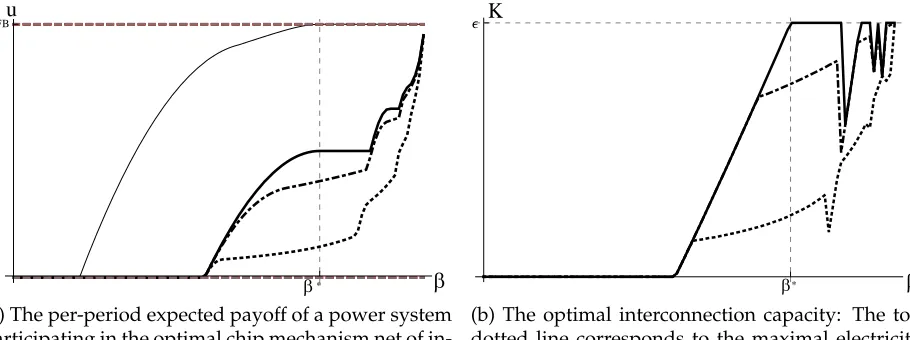
Figure 1a illustrates the scope for the optimal contract to improve on autarky, when ¯y =
100, e = 15 and p = 0.2.25 In the figure, all utilities are expressed in per-period terms
23In each of these cases,
λlhandλmmcan be obtained through the following three-step procedure. First,
starting from an end-point of aλinterval, the evolution ofλdescribed in Proposition 1 allows expressing
the discounted life-time utility of each power system in terms of current period utility and continuation
discounted life-time utilities starting from various end-points of λ intervals. Solving the system of thus
obtained simultaneous equations, it is possible to obtain all relevant discounted life-time utilities in terms of current period utilities in different states. Then the first order condition (14) can be used to express these
current period utilities as functions ofλ’s. Finally, binding participation constraints of power system 2 in
stateslhandmmcan be used to solve forλlhandλmmas required.
24Since in any asymmetric efficient allocation one of the power systems is strictly worse off than in the
symmetric efficient allocation, the participation constraint of the exporting power system is satisfied for the largest set of discount factors whencs1,s0 = c2s,s0 = Ys,s0/2, whereYs,s0 is the aggregate production in state
es,es0
. Hence, whenβ = β¯, the equal-payoff contract is the only sustainable first-best efficient contract.
The set of sustainable first-best efficient electricity sharing arrangements expands asβincreases.
25There is a significant variation in reliability of power supply in developing countries. The numbers
from numerical example are roughly illustrative of the current state of power supply in better developed countries of Sub Saharan Africa (e.g., Kenya), where transmission and distribution losses account for about
through multiplying the corresponding life-time utility by (1−β). The calculations un-derlying the figure show that for β ≤ β = 0.914, the λ intervals are degenerate and
only autarkic outcome is sustainable. Hence, for this range of β, when interconnection
is costless, the per-period expected utility of a power system participating in the optimal contract with λ0 = 1 coincides with the expected per-period utility in autarky (repre-sented by the straight dotted line at the bottom of the figure). For β ≥ β∗ = 0.975, all
three λ intervals have points in common and the first-best symmetric payoff is
sustain-able. So in the figure, the per-period expected utility of a power system in the optimal symmetric contract with costless interconnection coincides with the symmetric first-best per-period utility (represented by the straight dotted line at the top of the figure). For
β ∈ (0.914, 0.975), the optimal contract improves on autarky, but is not first-best
effi-cient. In particular, for β ∈ (0.914, 0.955), the λintervals have non-empty interiors, but
are disjoint and forβ ∈[0.955, 0.975), intervals
h
λhl, ¯λhl
i
andhλlh, ¯λlh
i
each overlap with
λmm, ¯λmm, but not with each other. In the figure, for β ∈ (0.914, 0.975), the expected
utility in the optimal contract is increasing in βand lies between the expected utility in
autarky and the symmetric first-best utility.
Costly interconnection does not affect evolution of the λintervals, but reduces the scope
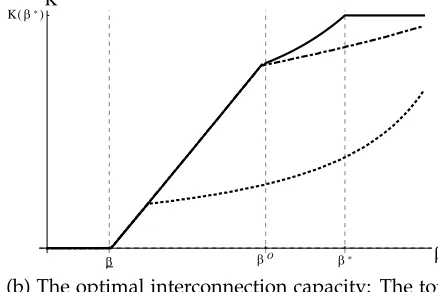
for consumption smoothing. Hence, when interconnection is costly, the long-term welfare in the optimal contract with endogenous capacity is lower than in the optimal contract with costless interconnection. Figure 1b also demonstrates that the optimal interconnec-tor’s capacity increases in the discount factorβ.
4
Cooperative Outcomes with Privately Observable Shocks
In Section 3 we showed that long-term cooperative arrangements can deliver some bene-fits of connecting power systems when power systems are sufficiently patient. However, the analysis relied crucially on the assumption that there is an independent system oper-ator who can perfectly observe production shocks in the connected regions. In practice, establishing such a monitoring institution is associated with significant costs, especially
international/) and occur with about 20% probability (i.e., 6 days in a typical month, based on World
bO
b b* b
uFB
u
(a) The per-period expected payoff of a power system participating in the optimal contract with
λ0=1 net of interconnection costs.
bO
b b* b
KHb*LK
(b) The optimal interconnection capacity: The top mark on vertical axis corresponds to the maxi-mal electricity transfer in the first best contract,
¯
[image:29.612.317.536.255.401.2]K(β∗) =e.
Figure 1: The per-period expected payoff and interconnection capacity in the optimal con-tract as a function of discount factorβ, when ¯y=100,e=15, p=0.2 and interconnection
in developing countries. Moreover, even if such operator exists, it cannot always discover the true nature of production shocks. For instance, it is very difficult to establish whether a decrease in electricity production is due to a genuine outage or is a result of strategic manipulation of generators (Fogelberg and Lazarczyk 2014). This suggests that in reality power system’s production shocks are likely to be observed exclusively by that power system.
If production shocks in the connected power systems are not perfectly observable by all parties, welfare gains that could be realized through an electricity sharing arrangement are lower relative to the case of no information asymmetries. This is because to avoid exporting electricity, each power system is tempted to misreport its supply conditions when current production is relatively high, but this cannot be observed by the other party. To create sufficient incentives for truthful revelation of the production shocks, in addition to participation constraints, also incentive compatibility constraints must be satisfied in every period. These additional constraints should ensure that demanding an electricity transfer from the other party in the current period is punished by lower expected future electricity imports, or, equivalently, exporting electricity in the current period is rewarded by higher expected electricity imports in future.26
The importance of incentive compatibility constraints in models with privately observed random shocks has been long recognized. For example, Atkeson and Lucas (1992) study optimal consumption smoothing in an economy with large number of consumers who pri-vately observe taste shocks affecting their marginal utility of current consumption, while Thomas and Worrall (1990) study optimal lending agreements in a model where a risk averse borrower is privately informed of his income shocks. However, these papers as-sume full commitment, i.e., players are committed to the contract signed at the beginning
26Under perfect monitoring of shocks, a negative production shock also results in a reduction of current
and future electricity consumption, when discount factorβis relatively low and the participation constraint
and cannot walk away from it at the later date. More recently Hertel (2004) characterizes optimal risk sharing in a model with two players, who can opt out of the agreement at any time and where one agent’s stochastic income realizations are his private informa-tion. While Hertel (2004) is relevant for modeling cooperation between connected power systems, deriving full characterization of an electricity sharing contract with unobservable production shocks is beyond the scope of our paper. Instead, we argue that a quasi-market for excess electricity is a simple way to achieve some cooperation when production shocks are privately observed by each power system.
The quasi-market relies on a “chip mechanism”. In this mechanism, the connected power systems are endowed with a certain number of megawatt chips. The chips can only be used to keep track of electricity import/export imbalance between the parties to the con-tract and are worthless outside the cooperative relationship. When power systemiexports electricity to power systemjandjowns some chips,jgives chips toiin exchange for elec-tricity. When one of the power systems has all of the available chips, it stops exporting electricity to the other system until the other system has earned back some chips.27 Note that when the number of chips becomes sufficiently large, their interpretation becomes close to the scarcity prices that are used to clear cross-border electricity markets in devel-oped countries (e.g., Nordpool) when the aggregate supply of electricity is tight. How-ever, a mechanism to provide real-time scarcity prices that can then feed back into spot and contract markets requires a properly incentivized cross-border independent system operator (Newbery 2009). When this institutional setup is not possible to achieve (i.e., the scenario considered in this section) scarcity prices will fail clearing the market due to information asymmetry.
Given the complexity of characterizing equilibria in the electricity sharing contract with unobservable production shocks, we consider a simplified case of the model presented in Section 2, where production shocks are independent across the power systems and across time and can take two values −eand +e withP(et =−e) = p. In this context, suppose that each player is privately informed of the realization of its current production shock
27M ¨obius (2001) and Hauser and Hopenhayn (2008) study chip mechanism in the context of
and the predetermined interconnector’s capacity isK ≤ e. Consider the chip mechanism
withNchips that fully utilizes the interconnector’s capacity, theN-chipK-capacity
mech-anism. In this mechanism, whenever a power system holding some chips experiences a
negative production shock, but the other power system has high production, the power system with low current production receives an electricity transfer ofKin exchange for a chip. Because both power systems can simultaneously experience a positive or a negative production shock, this set up is a generalization of a chip mechanism in the context of favor trading studied by Abdulkadiroglu and Bagwell (2012).
LetVnN, n=0, 1, ...,Ndenote a player’s expected discounted payoff in theN-chip mecha-nism when he holds nchips. Then the N-chip mechanism delivers the following payoffs: forn=1, ...,N−1
VnN = p2u(y¯−e) +βVnN
+p(1−p)u(y¯−e+K) +βVnN−1
+p(1−p)u(y¯+e−K) +βVnN+1
+ (1−p)2u(y¯+e) +βVnN
(21)
and at the boundary
V0N = p2u(y¯−e) +βV0N
+p(1−p)u(y¯−e) +βV0N
+p(1−p)u(y¯+e−K) +βV1N
+ (1−p)2u(y¯+e) +βV0N
(22)
VNN = p2u(y¯−e) +βVNN
+p(1−p)u(y¯−e+K) +βVNN−1
+p(1−p)u(y¯+e) +βVNN
+ (1−p)2u(y¯+e) +βVNN
. (23)
By Lemma 1 in Abdulkadiroglu and Bagwell (2012), this system of equations has a unique solutionVnN
N
n=0, whereV N
n <VnN+1for alln=0, ...,N−1.
Each power system wants to participate in the mechanism if its participation constraint is satisfied, i.e., it must be the case that forn=0, ...,N,
VnN ≥v,