Assumpção, L. and Shi, Z. and Zang, X. and Muller, Hermann J. and Geyer,
T. (2015) Contextual cueing: implicit memory of tactile context facilitates
tactile search. Attention, Perception, & Psychophysics 77 (4), pp.
1212-1222. ISSN 1943-3921.
Downloaded from:
Usage Guidelines:
Please refer to usage guidelines at
or alternatively
Contextual cueing: implicit memory of tactile context facilitates
tactile search
Leonardo Assumpção&Zhuanghua Shi&Xuelian Zang&
Hermann J. Müller&Thomas Geyer
Published online: 4 March 2015
#The Author(s) 2015. This article is published with open access at Springerlink.com
Abstract In visual search, participants detect and subse-quently discriminate targets more rapidly when these are em-bedded in repeatedly encountered distractor arrangements, an effect termedcontextual cueing (Chun & Jiang Cognitive Psychology, 36, 28–71,1998). However, whereas previous studies had explored contextual cueing exclusively invisual search, in the present study we examined the effect intactile search using a novel tactile search paradigm. Participants were equipped with vibrotactile stimulators attached to four fingers on each hand. A given search array consisted of four stimuli (i.e., two items presented to each hand), with the target being an odd-one-out feature singleton that differed in fre-quency (Exps. 1 and 2) or waveform (Exp. 3) from the distractor elements. Participants performed a localization (Exps. 1 and 2) or discrimination (Exp. 3) task, delivering their responses via foot pedals. In all three experiments, reac-tion times were faster when the arrangement of distractor fin-gers predicted the target finger. Furthermore, participants were unable to explicitly discriminate repeated from nonrepeated tactile configurations (Exps. 2 and 3). This indicates that the tactile modality can mediate the formation of configural rep-resentations and use these reprep-resentations to guide tactile search.
Keywords Contextual cueing . Implicit memory . Attention . Tactile search . Haptics . Touch
Humans experience a myriad of events at any given time, presenting an excessive load of information to the brain. However, most events or objects do not occur in isolation; rather, they are embedded in larger, structured environments. Previous work has shown that environmental regularities are permanently retained and facilitate visual perception. For in-stance, in a seminal study by Palmer (1975; see also Biederman, 1972; Biederman, Mezzanotte, & Rabinowitz, 1982; Chun, 2000; Hollingworth, 1998), participants were presented with a scene context (e.g., a kitchen counter) follow-ed by a brief presentation of a target that was either context-appropriate (e.g., a loaf of bread), context-incontext-appropriate but similar in shape to the appropriate object (e.g., a mailbox), or completely context-inappropriate (e.g., a drum). In a subse-quent naming task, participants showed higher performance accuracy in the appropriate than in the two context-inappropriate conditions. Palmer concluded thatvisual object recognitionis modulated by scene context.
The beneficial effect of environmental information on vi-sual selective attentionwas further elucidated by Chun and Jiang (1998), by means of their contextual-cueing paradigm. In this task, participants have to detect and subsequently dis-criminate the orientation (left vs. right) of a targetBT^ embed-ded in a set of distractorBL^s. Unbeknownst to participants, half of the trials contain repeated and the other half nonrepeated target–distractor spatial arrangements. In the re-peated—old—condition, both the target and the distractors are presented at identical display locations across trials. By con-trast, in the nonrepeated—new—condition, only the targets (but not the distractors) appear at identical locations (by keep-ing target locations constant in the old and new displays, one can equate target location repetition effects between the two types of displays and thus isolate the effect of context on reaction time—RT—performance). Chun and Jiang found that participants were faster at detecting the target in old than in new displays, an effect referred to as contextual cueing.
L. Assumpção (*)
:
Z. Shi:
X. Zang:
H. J. Müller:
T. Geyer Department Psychologie, Lehrstuhl für Allgemeine und Experimentelle Psychologie, Ludwig-Maximilians-Universität München, Leopoldstraße 13, 80802 München, Germany e-mail: [email protected]H. J. Müller
Interestingly, when participants were asked to discriminate the repeated from the nonrepeated displays, explicit recognition was only at chance level. This dissociation in direct (recognition) and indirect (RT) measures led Chun and Jiang to surmise that contextual cueing is supported by an implicit memory system.
In recent years, Chun and Jiang’s (1998) basic findings and paradigm have inspired numerous studies. For example, van Asselen and Castelo-Branco (2009) showed that contextual cueing was still obtained in a test session when the training and test sessions were separated by 10 days. Geyer, Müller, Assumpção, and Gais (2013) found that even a short nap relative to an equivalent period of controlled rest separating the learning and test sessions (on the same day) was sufficient to enhance contextual cueing. Other investigations have dem-onstrated that, rather than relying on the entire distractor con-text, contextual cueing is supported by memory for indi-vidual target–distractor (paired) associations formed partic-ularly in the vicinity of the target (Brady & Chun, 2007; Jiang & Wagner, 2004; Shi, Zang, Jia, Geyer, & Müller, 2013), or amongst distractors sharing the target’s color (Conci, Müller, & von Mühlenen, 2013; Geyer, Shi, & Müller, 2010). Additional work has shown that contextual learning (i.e., the acquisition of contextual memory) and expression (i.e., the retrieval of contextual memory) are separate processes (Chaumon, Schwartz, & Tallon-Baudry, 2009) and that an additional (spatial working memory) task interferes with the retrieval, but not the learning, of contextual memory representations (Annac et al., 2013).
Taken together, the by now extensive body of studies on contextual cueing invisualsearch has contributed substantial-ly to our understanding of the processes undersubstantial-lyingimplicit spatial learning. Although sensory modalities other than vi-sion have received considerable interest in recent years (e.g., Klatzky, Lippa, Loomis, & Golledge,2002,2003; Yamamoto & Shelton, 2009), little is known about the roles of these senses for implicit context learning. Concerning the haptic/ tactile sense, a growing, although still modest, number of studies have revealed intricate processing capabilities of this modality. For example, it has been demonstrated that features such as material dimensions and abrupt surface discontinuities are likely to produce low search function slopes, suggesting a parallel search, whereas orientation and 3-D surface contours are likely to yield somewhat steep slopes, suggesting serial search (Lederman & Klatzky,1997). More recently, a study focusing on a manual 3-D search task demonstrated that sa-liency was an important factor in determining what parts of the hand and what strategies would be used to contact the target, suggesting that nonsalient conditions made participants more likely to engage the thumb in a serial strategy, whereas in salient target conditions, parallel strategies such as grasping and shuffling of the items in the hand were applied (van
Polanen, Bergmann Tiest, & Kappers, 2014). With re-spect to spatial learning and representations, it has been claimed that the haptic sense can facilitate (the updating of) visuospatial representations (Shelton & McNamara, 2001), or even that participants are able to form entirely new spatial representations in an explicit learning task on the basis of haptic information alone (Pasqualotto, Finucane, & Newell, 2005). However, whether the tac-tile sense is capable of forming its own implicit spatial representation and the extent to which such representa-tions can be used for attentional guidance remain open questions. This is the issue that we investigated in the present study.
Hitherto, to our knowledge, only one study, by Nabeta, Ono, and Kawahara (2003), has attempted to investigate hap-tic contextual cueing. Nabeta et al. found facilitation of RTs for old relative to new haptic arrangements when the old (haptic) arrangements were learned in a preceding visual search task (i.e., the same arrangements were used in visual and haptic tasks). However, it was not clear whether this hap-tic contextual-cueing effect was driven by haphap-tic or visual representations. That is, they could not rule out that in the haptic task, participants may have continued to operate an essentially visual strategy (see, e.g., Lederman, Klatzky, Chataway, & Summers,1990, for the effects of visual imagery on recognition performance in a haptic discrimination task). For example, participants may have registered the haptically sensed stimuli in a visuospatial representation maintained in working memory, and it may have been this representation that, when critical (context) stimuli had been sampled and recorded, triggered the matching visual context information stored in long-term memory, thus guiding haptic search to the (visually represented) target location. Note that Nabeta et al.’s participants did not see the haptic displays, so search could ultimately only be based on some actively built-up and maintained spatial working memory representation. In other words, the observed haptic contextual cueing might well have been visually mediated. Furthermore, Nabeta et al. did not address the fundamental question: that is, whether contextual regularities can also be acquired in— rather than in one way or another Btransferred^ to—the haptic modality. The present study was designed to exam-ine this question.
Experiment 1
Method
ParticipantsNine naïve participants (eight female, one male, eight right-handed; age range 24 to 41 years) took part in this experiment for either course credit or€8.00/h. All of the par-ticipants reported normal tactile perception and no history of somatosensory disorders. Participants gave informed consent prior to performing the experiment, which was approved by the ethics committee of the Department of Psychology at LMU Munich, in accordance with the Code of Ethics of the World Medical Association (Declaration of Helsinki).
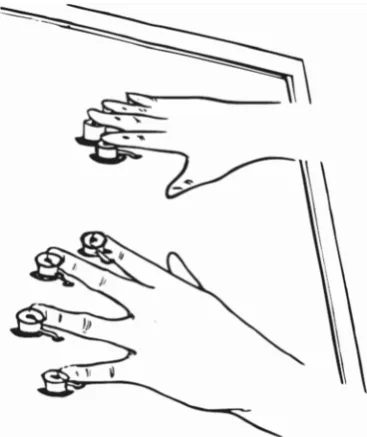
Apparatus and stimuliThe vibrotactile stimuli, 100- and 30-Hz vibrations, were generated by eight solenoid actuators that activated lodged cylinder metal tips when the solenoid coils were magnetized (Heijo Box, Heijo Research Electronics, UK; see Fig.1). The maximum finger contact area was about 2–4 mm. The eight actuators, connected to aBstandard^ PC via parallel port, were controlled by a purpose-written MATL AB program in combination with the Psychophysics Toolbox (Brainard,1997; Pelli, 1997). Participants’ responses were recorded via foot pedals. In the practice phase, visual infor-mation such as instructions, fixation cross, and response feed-back was video-projected onto a semitransparent Plexiglas table (size, 70 × 60 cm; height, 84 cm) by a projector (Sharp
XR-32X-L), and was therefore available for the participants to monitor. In the experimental phase, a blindfold was used to prevent participants from seeing the tactile arrangements (and thus to avoid visual learning of the tactile arrays). Furthermore, the vibrotactile stimulations were masked by white noise (1000 Hz, ~65 dBA, 3,000 ms or until response execution) delivered via cushioned ear shell headphones (Philips SHL4000, 30-mm speaker drive). This was again done in an attempt to rule out confounding factors in the determination of participants’performance, such as auditory learning of the tactile arrays: Note that different vibrotactile stimulations generate different tones, thus potentially offering an additional, auditory source of information for configural learning.
Procedure Following written and verbal instructions, partici-pants were equipped with headphones, and, once they were comfortably seated on a chair with their forearms on the table, gently placed their fingertips (except the thumbs) on the ulators. Prior to the practice session, the positions of the stim-ulators were adjusted to fit the participant’s fingers. In order to maximize comfort, participants chose whether or not they wanted to use a cushion as a wrist-rest throughout the experiment.
Practice session Each trial of the practice session started with a foot press and included stimulations delivered to seven distractor fingers vibrating at 100 Hz and one target finger vibrating at 30 Hz. All stimulators vibrated until a response was made or up to 3,000 ms, whichever came first. In doing so, the target was presented four times at any of the eight fingers, yielding 32 practice trials in total. Note that, given the limited number of tactile configurations available for the experimental session (see below), the practice session used stimulations of all eight fingers. The idea was to familiarize participants with the tactile search task—that is, target-versus-distractor discrimination in general—rather than the learning of specific tactile arrangements. Participants’task was to lo-calize the target, as quickly as possible, on the left or the right hand by pressing the spatially corresponding foot pedal. Following participants’ responses, accuracy feedback was provided by presenting the wordsBcorrect^ orBwrong^ on the Plexiglas plate (duration: 1,000 ms). Participants were instructed to monitor this feedback and use it to improve their tactile search performance. Thus, emphasis was placed on both response speed and accuracy.
Experimental session Following the instructions, participants started the experimental session by a foot press. Both the tactile vibration and white auditory noise were presented si-multaneously until a response was made or up to 3,000 ms. Importantly, unlike in the practice session, in the experimental session participants were wearing a blindfold so that they did
[image:4.595.78.262.402.621.2]not see their fingers, thus preventing concomitant visual learn-ing of the repeated tactile arrangements. Participants were asked to respond to the target side (either the left or the right) as quickly and accurately as possible by pressing the corre-sponding foot pedal. The next trial was automatically initiated following an intertrial interval of 1,000 ms.
Design The design of Experiments 1–3 was adapted from that of Chun and Jiang (1998). On each trial of the experimental session, the tactile configuration consisted of stimulations of one target and three distractor fingers. To balance the vibrotactile stimulations between the two hands, a given tac-tile configuration always involved one hand with two distractors and the other hand with one distractor and one target (see Fig.2). A set of four old configurations was ran-domly generated for each participant. For these old configu-rations, the relationship between the target and distractors was kept constant throughout the entire experiment (a block consisted of a set of four old plus four new configurations). The new configurations, by contrast, were newly generated in each block by distributing the three distractors anew across the remaining fingers of each hand on each new trial. Importantly, in the new condition, too, the four target fingers were held constant throughout the experiment. Thus, four fingers were used for targets in the old configurations (two fingers on each hand), and four fingers for the new configurations (again, two fingers on each hand). In doing so, participants had no bias to search for a target at specific fingers, since each finger was equally likely to contain a target. Performance gains in the old condition could therefore only be attributed to the effects of repeated tactile arrangements, rather than repeated absolute target locations. The latter were equated across the old and new tactile conditions. The experiment consisted of 128 trials, divided into 16 blocks. At the end of every second block, the white noise was interrupted, followed by the presentation of a brief double beep (2 × 200 ms, 1000 Hz, ~72 dBA; separated by an 800-ms silent interval), indicating that the participants could take a short break and resume the experiment (by a foot press) whenever they were ready to continue. The entire ex-perimental session lasted about 30 min.
Results
In order to increase statistical power, the data of two consec-utive blocks were pooled together into one epoch (see Chun & Jiang,1998), resulting in eight experimental epochs. For RTs, trials on which participants made an erroneous response or RTs were below 200 or above 3,000 ms (i.e., when no re-sponse was made) were excluded from the analysis (overall, 10.5 % of trials). The error and RT data were examined in repeated measures analyses of variance (ANOVAs), with any effects Greenhouse–Geisser corrected when sphericity was violated.
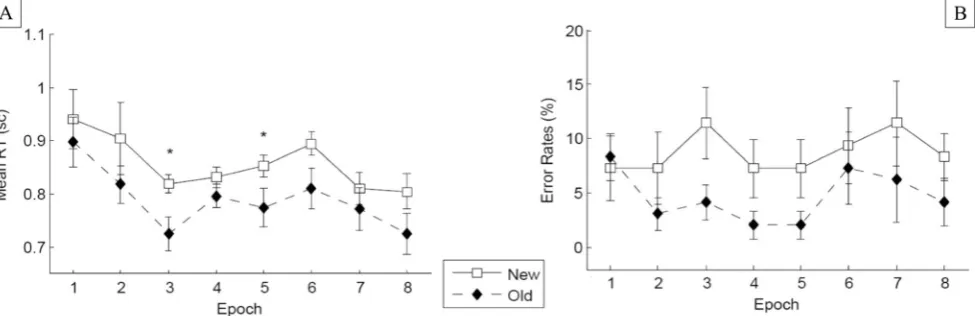
RT performance A 2 × 8 factorial repeated measures ANOVA on the RTs revealed a significant main effect of configuration, F(1, 8) = 8.29,p< .05,ηp2= .509: Targets embedded in old
configurations were detected significantly faster than those embedded in new configurations (849 vs. 952 ms), indicative of a tactile contextual-cueing effect (of 103 ms).1 Furthermore, RTs were relatively constant across experimental epochs [nonsignificant effect of ep-och: F(7, 56) = 0.469, p = .673]. Although the Configuration × Epoch interaction was nonsignificant, F(7, 56) = 0.737, p = .642, additional t tests showed no difference between the RTs for old and new config-urations in Epochs 1 and 2 (both ps > .2; see also Fig. 3). From this, one can conclude that reliable tactile contextual cueing developed over the course of the tac-tile search task.
Error analysis A 2 × 8 factorial repeated measures ANOVA on the error rates with Configuration (old vs. new) and Epoch (1–8) as factors failed to reveal a significant effect of config-uration,F(1, 8) = 3.85,p = .08,ηp2= .325. Because errors
made in new configurations (13.80 %) were almost twice as high as those made in old configurations (7.20 %), we ran an additional (two-tailed)ttest comparing the RTs betweenBold^ andBnew^response error trials in order to identify any possi-ble speed–accuracy trade-off in the data. This test failed to reveal a significant effect of configuration, t(8) = 1.24, p = .247. Furthermore, the ANOVA revealed the effect of epoch to be significant,F(7, 56) = 2.31,p< .05,ηp2= .225,
reflecting a decrease in the number of errors as the experiment progressed. The interaction between config-uration and epoch did not reach statistical significance, F(1, 7) = 0.569, p> .778.
Discussion
Experiment1employed a tactile search task in order to test whether tactile spatial context can be learned under exclusive-ly tactile search conditions. The results provide clear evidence for this hypothesis. First, RTs were faster in old than in new tactile arrangements, an effect that became reliable after three epochs of learning (i.e., after five or six repetitions of each tactile configuration). Second, fewer response errors were made in old than in new tactile configurations (although this
1
In a control analysis, we examined the variability in distractor positions, measured as the standard error (SE) of the RTs in old and new configu-rations. It was possible that at least parts of the RT difference between the two types of configurations could be attributed to greater variability in distractor positions in the new configurations (in addition to contextual cueing of haptic search in the old configurations). However, attest com-paring theSEs between the new and old configurations was nonsignifi-cant:t(8) = 1.39,p= .202. Similar results were obtained for Experiment2
effect was nonsignificant), and the higher error rate in the latter condition was not due to a speed–accuracy trade-off. Nevertheless, response errors in both conditions decreased as the experiment progressed, as we observed in the main effect of epoch on response accuracy. Altogether, Experiment 1 provided evidence for context-dependent tactile learning, reflected by faster RTs in old than in new tactile arrangements and (numerically) fewer response errors to old arrangements. Context-independent procedural learning was also observed, reflected by a general reduction of error rates across experimental epochs.
A highly debatable claim invisual contextual cueing is whether the effect is supported by implicit memory (for a critical discussion, see, e.g., Schlagbauer, Müller, Zehetleitner, & Geyer,2012, or Smyth & Shanks, 2008). Although Experiment 1 provided clear support for contextual cueing of tactile search, it left open the question of the implicit nature of the tactile contextual-cueing effect. To address this issue, in Experiment2we introduced a recognition test at the end of the experimental session to examine whether partici-pants had awareness of the repeated tactile configurations.
Experiment 2
Method
Experiment 2 was a close replication of Experiment 1, w i t h t h e f o l l o w i n g e x c e p t i o n s . I n a d d i t i o n t o implementing a recognition test, in Experiment 2 we implemented a more conservative practice regime, with the aim of reducing the relatively high rates of response errors made by participants in Experiment 1 (new con-figurations, 13.80 %; old concon-figurations, 7.20 %). To this end, in Experiment 2 participants were informed that they would proceed from the practice to the exper-imental session only after having attained a minimum of 80 % correct responses in the practice session.
Participants Fourteen new participants took part in Experiment 2 (seven female, seven male, 13 right-handed; age range 19 to 34 years). The criteria for partic-ipation, payments, and ethical guidelines were the same as in Experiment 1. Two participants were excluded because
Fig. 3 Experiment 1:aMean response times across epochs for old and new configurations, with error bars representing within-participants standard errors of the means (Cousineau,2005).bMean error rates
across epochs, shown separately for old and new configurations, with error bars representing standard errors of the means.*p< .05
Fig. 2 Schematic figure displaying the distribution of items in old and new configurations across search epochs (and the recognition task, for Exps. 2 and 3). In old configurations, the target location is constant and
[image:6.595.78.514.49.206.2] [image:6.595.54.541.537.680.2]they showed unusually large contextucueing effects al-ready in the first experimental epoch. A post-hoc analysis revealed that for these two participants, just by chance, the target fingers in old and new configurations were chosen in such a way that they were symmetrically allocated across hands, with old targets being presented at Fingers 2 and 4 and new targets at Fingers 1 and 3 of the left and right hands, respectively. This may have fostered the cou-pling of targets with specific (old, new) distractor arrange-ments. The percentage of trials excluded due to incorrect responses was 6.70 %. Outliers occurred in 0.06 % of all trials (i.e., RTs below 200 and above 3,000 ms).
ProcedureFor the practice session, in addition to visual feed-back, incorrect responses triggered anBerror warning^ beep (2500 Hz, ~85 dBA, 900 ms), followed by a silent intertrial interval of 2,000 or 2,500 ms. Furthermore, overall accuracy feedback was provided visually by displaying to participants their mean correct response rate after every second practice block (of 16 trials). Participants were asked to aim for a min-imum of 80 % correct in at least three consecutive practice blocks. The experimental session was similar to that of Experiment1, except for the use ofBerror warning^ beeps following response errors. The entire experimental procedure lasted about 30–40 min.
Recognition taskAt the end of the experimental session, participants performed a Byes–no^ recognition task, meant to assess their explicit knowledge of the repeated tactile configurations. The recognition test consisted of 16 trials: 4 × 2 old and 4 × 2 new configurations, presented in randomized order, with the exception that a given display was never shown repeatedly on two consecutive trials. Because each old configuration was presented twice, each new configuration was also pre-sented twice in order to equate the repetition effects across the two types of configurations.
Results
RT performance A 2 × 8 factorial repeated measures ANOVA on the RTs revealed a significant main effect of configuration, F(1, 11) = 6.02,p< .05,ηp2= .354: Targets embedded in old
tactile arrangements were responded to faster than targets in new configurations (775 vs. 885 ms), resulting in a contextual-cueing effect of 110 ms. No other effects reached statistical significance [epoch, F(7, 77) = 2.24, p = .14; Configuration × Epoch interaction, F(7, 77) = 0.853, p = .547]. Regarding the nonsignificant interaction, additionalt tests showed no RT difference between old and new configu-rations in Epochs 1 and 2 (p>.1; see Fig.4). This outcome suggests that, as in Experiment 1, tactile contextual cueing developed as the experiment progressed.
Error analysis As in Experiment1, a 2 × 8 factorial repeated measures ANOVA on response accuracy failed to reveal a significant effect of configuration, F(1, 11) = 3.32,p = .09: Given that participants again made fewer errors when searching for targets in old (2.34 %) than in new (4.36 %) configurations, a further t test comparing the RTs on error trials between old and new configurations was performed. Once again, the ttest failed to reveal a significant effect of configuration,t(8) = 1.75,p= .117, again ruling out a speed– accuracy trade-off. No further effect reached statistical signif-icance [epoch, F(7, 77) = 0.662,p = .703; Configuration × Epoch interaction,F(7, 77) = 0.581,p= .769].
Recognition performance Recognition accuracy was assessed in terms of the signal-detection-theoretic measured'(Green & Swets,1966). For each participant,d'was computed, taking into account participants’hit rates (correct judgments of old configuration as repeated) and false alarm rates (incorrect judgment of new configuration as repeated). An explicit effect would be indicated byd'being significantly greater than zero. However, across all participants,d'was quite low (0.314) and
[image:7.595.56.544.543.701.2]statistically indistinguishable from zero,t(11) = 1.81,p= .09, suggesting that tactile contextual cueing is an implicit effect.
Discussion
Experiment2 replicated the tactile contextual-cueing effect found in Experiment1, thus corroborating the idea that partic-ipants can learn repeated target–distractor arrangements in tac-tile search. Interestingly, the extensive practice reduced drasti-cally the response errors in the experimental session (Exp.2vs. Exp.1: old, 2.34 % vs. 7.20 %; new, 4.36 % vs. 13.80 %). Notably however, even after such a marked reduction of re-sponse errors, fewer error rere-sponses were still made to targets presented in old than in new arrays. Finally, and of the greatest importance, the results of the recognition test suggested that memory for old configurations is implicit, since participants were unable to tell apart old from new configurations.
One objection to Experiment2(and Exp.1) may have been that foot responses were always congruent with the target hand. That is, after detecting an odd-one-out tactile stimulus at the fingers of a given hand (i.e., the target), it is conceivable that the corresponding foot pedal could be pressed Bautomatically.^In other words, the RT benefit for old relative to new tactile arrangements might reflect context-based facil-itation of stimulus- (i.e., hand-) to-response mapping (for the sake of simplicity, we will refer to this as the Bresponse hypothesis^), rather than, or in addition to, contextual cueing of target selection (theBattention hypothesis^). To disentangle these alternative hypotheses, Experiment3introduced a dis-crimination task (as opposed to the localization task in Exps.1 and2), in which participants had to first detect and subse-quently discriminate the waveform of the target signal. That is, the foot pedals were associated with the target waveform, rather than with the target hand. Under these conditions, the response hypothesis would predict no RT advantage for old relative to new tactile contexts, whereas the attention hypoth-esis would still predict a benefit for old arrangements.
Experiment 3
Method
Experiment3was similar to Experiments1and2, except that it used a discrimination task. Furthermore, a new practice session was implemented in order to familiarize participants with the two different target signals.
Participants A group of 14 new participants took part in Experiment3(nine female, five male, 12 right-handed; age range 21 to 30 years). The criteria for participation, payment, and ethical guidelines were the same as in Experiments1and 2. Of all participants, only one did not provide data for the
recognition test, owing to technical issues. The percentage of trials excluded due to incorrect responses was 9.3 %.
Apparatus and stimuli In order to create (three) distinct sig-nals for targets (two sigsig-nals) and distractors (one signal), the solenoid actuators were controlled by a new, 10-channel Tactor Amplifier (Dancer Design) connected to a standard PC equipped with a National Instrument Card (NI PXI-1042Q). The two possible tactile targets, T1 and T2, were defined by a square waveform manipulation of 150-Hz vibra-tions (Fig.5); the distractors, by contrast, were constant 150-Hz vibrations.
Procedure The practice session was divided into two parts. In the first part, participants learned the identities of the two possible targets. One of the targets was presented in isolation per trial in a randomized fashion on each finger of each hand (except the thumbs). Furthermore, because the features of each target were rather technical for written or verbal instruc-tions, in the first 16 trials of the practice participants received a visual cue informing them of the identity of the current target BT1^orBT2,^so they could learn the physical properties and the appropriate foot response. In the second half of the practice session, participants trained on the tactile search task with one target and seven distractors (similar to Exps.1and2; no visual cues as to the target identity were given). Participants were instructed to respond as quickly and accurately as possible, within 3,000 ms. They receivedBerror warning^beeps and the intertrial intervals after erroneous responses. Of note, progress from the first to the second part of the practice session and from the practice to the test session was only possible when participants achieved 80 % accuracy in each of the two prac-tice phases. Target pedal assignments were counterbalanced across participants: Half of participants used the left (vs. right) foot pedal forBT1^(vs. BT2^), and vice versa for the other half. The entire experimental session lasted 30–50 min, de-pending on participants’performance in the training session.
Recognition task At the end of Experiment 3, participants performed a Byes–no^ recognition test similar to that in Experiment2.
Results
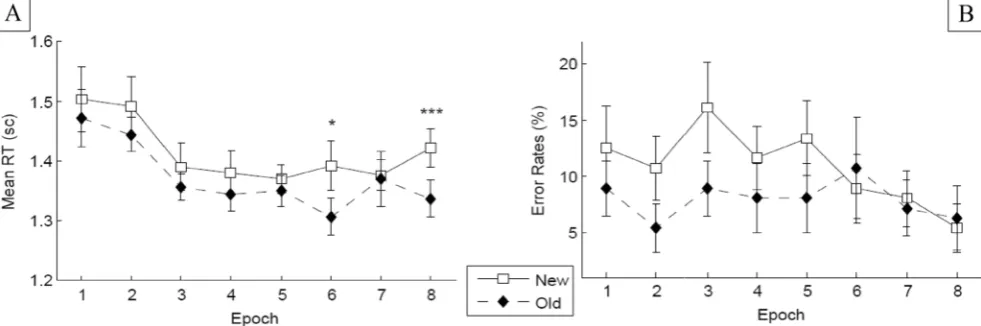
RT performance A 2 × 8 factorial repeated measures ANOVA on the RTs revealed a significant main effect of configuration, F(1, 13) = 5.95,p< .05,ηp2= .314: Discrimination was faster
RT difference between old and new configurations became significant only late in the experiment, at Epoch 6 (p< .05; see Fig.6).
Error analysisA 2 × 8 factorial repeated measures ANOVA on response accuracy failed to reveal a significant effect of configuration,F(1, 13) = 2.49,p = .138. However, because participants made fewer errors when searching in old (3.9 %) than in new (6.36 %) configurations, a furtherttest comparing the error RTs between the two conditions was performed. The analysis failed to reveal a significant effect of configuration, t(11) = 1.61,p = .134, once again ruling out a speed– accuracy trade-off in the determination of the RT re-sults. No further effect was statistically significant [epoch, F(7, 91) = 0.139,p= .251; Configuration × Epoch interaction, F(7, 91) = 0.681,p= .688].
Recognition performance Across all participants,d'was quite low (–0.17) and statistically indistinguishable from zero, t(13) = –1.29, p = .218. This result further supports the findings of Experiment2—namely, that tactile contextual cue-ing is mediated by implicit memory representations.
Discussion
In Experiment3, we examined whether RT benefits for old versus new tactile configurations were due to facilitated (learned) stimulus-to-response mappings or facilitated target selection. Employing a target discrimination task—in which different vibrotactile stimuli (T1 and T2), each of which could occur in either hand, were mapped to the foot responses—RTs were found to be still faster for old tactile arrangements. This largely rules out the possibility that the reduced RTs for
Fig. 5 Waveforms of two tactile targets. The upper panel indicates the waveform of Target 1 (T1), a 5-Hz square wave with a 30 % duty cycle delivered via 150-Hz vibrations. The lower panel shows the waveform of
Target 2 (T2), a burst square wave (mean frequency of 4.17 Hz) with an average 30 % duty cycle delivered via 150-Hz vibrations. The distractors are constant vibrations of 150 Hz
[image:9.595.140.457.52.252.2] [image:9.595.52.543.538.701.2]repeated tactile-search arrangements are attributable to facili-tation of response selection. Instead, the finding of an RT benefit for old arrangements strongly supports the alternative view of tactile contextual cueing facilitating attentional target selection (rather than postselective stimulus-to-response map-ping). The analysis of error rates revealed no significant dif-ferences between old and new configurations. However, as in Experiments1 and 2, if anything, there was a (numerical) accuracy advantage for old over new tactile arrangements in Experiment3—that is, here, greater accuracy in discriminat-ing, rather than localizdiscriminat-ing, the target in old configurations. This further supports the idea that configural learning did aid a t t en t i o n al t arg e t se l ec t i o n, an d t h u s s u b s e q u en t (postselective) processes of focal-attentional target discrimi-nation. Finally, the results of the recognition test corroborate the idea that tactile contextual cueing is supported by an im-plicit memory, since participants were not able to tell apart old from new configurations.
It should be noted that the results of Experiment 3 do not rule out potential contributions of response selection to the RT advantages for old arrangements in Experiments1and2. In fact, in Experiments1and2, contextual cueing was twice as large as in Experiment3(103, 110, and 43 ms in Exps.1,2, and3, respectively). It may well be that the reduction of the effect in Experiment3 reflects the fact that the perfect cou-pling of hands and foot pedals (and learning of the coucou-plings for repeated arrangements) in the previous experiments con-tributed to the overall RT advantage for old arrangements. Given that such a contribution was effectively ruled out in Experiment3(by making the coupling inconsistent), the tac-tileBcontextual-cueing^ effects in Experiments 1and 2 are likely to represent an additive mixture of both facilitation of target selection and facilitation of response selection. This Bhybrid view^would suggest that contextual cueing can exert a boosting influence on both target and response selection, consistent with Kunar, Flusberg, Horowitz, and Wolfe (2007), who argued for such a view in relation to visual con-textual cueing.
Note that, in the present study, we inferred the effect of contextual cueing on attentional selection only indirectly, by comparing the effects of old versus new configurations be-tween discrimination and a localization task. Thus, ideally, this evidence should be followed up in a more direct test, involving a set size manipulation or a direct measure of the brain-electrical (electroencephalographic) activity indexing the allocation of attention. Such direct tests are, however, be-yond the scope of the present study, especially since they would introduce new challenges, such as whether a set size manipulation is an appropriate means for inferring attentional guidance by contextual cueing (see, e.g., Kunar et al.,2007, and Kunar, Flusberg, & Wolfe, 2008, for discussions), or which brain region provides an apt electrophysiological signal for context-based guidance in tactile search (one candidate
area is the somatosensory cortex; cf. Eimer, Maravita, Van Velzen, Husain, & Driver, 2002). In the meantime, though, the important observation remains that tactile contextual cue-ing was reliable in a discrimination task in which there was no consistent hand- (configural-pattern-) to-foot mapping. This strongly suggests that response selection cannot be the sole source of the contextual-cueing effect. Instead, the effect also involves a component of attentional guidance.
General discussion
In the present study, we aimed at answering two questions: First, can contextual cueing arise from repeated exposure to purely tactile search configurations? And second, is tactile contextual cueing an implicit effect? Three experiments were conducted to answer these questions. The aim of Experiment1 was to test whether contextual cueing, an effect hitherto ex-amined almost exclusively in the visual domain, would also operate in tactile search. Experiment2was, additionally, de-signed to assess participants’explicit knowledge of the repeat-ed tactile configurations. And in Experiment3 we aimed at dissociating the effects of old (vs. new) tactile arrangements on attention and response selection. The results were as fol-lows: Response speed and accuracy were improved for old relative to new configurations in all three experiments, indi-cating that memory for repeated tactile configurations is ac-quired and subsequently expressed in tactile search. Furthermore, participants’ability to distinguish the old from the new configurations was only at chance level, indicative of tactile contextual cueing being supported by an implicit mem-ory system (Exps.2and3). Moreover, contextual cueing was observed to be sufficiently strong to aid performance even in a target discrimination (rather than only in a target localization) task (Exp. 3). Taken together, these findings show that the tactile system is able to develop its own context representa-tions and use these representarepresenta-tions to guide tactile search. Furthermore, the build-up of memory for repeated tactile con-figurations is an automatic process, in that it does not require explicit knowledge of any repeated configurations.
whether haptic contextual cues can be learned when repeated target–distractor configurations are presented exclusively to the haptic modality. Concerning this issue, our findings un-equivocally show that contextual cueing develops when sight-ed, but blindfoldsight-ed, participants are required to discriminate the location or identity of a feature singleton target in tactile search.
With the present design endeavored to implement the es-sential features of the visual contextual-cueing paradigm—in particular, the presentation of repeated configurations on half of the trials (Chun,2000; Chun & Jiang,1998; Conci et al., 2013; Geyer et al.,2013; van Asselen & Castelo-Branco, 2009). Nevertheless, some limitations prevent a direct com-parison between the present tactile and theBstandard^visual paradigm. In visual contextual cueing, items are distributed across a relatively large display area with a large number of possible locations—for example, 6 × 8 locations in Chun and Jiang’s study. Moreover, a typical configuration consists of 12 items, one of which is the targetBT,^ and the 11 others, distractorBL^s. A few studies have also used smaller set sizes of four items or larger sizes of 16 items, or have manipulated set size actively in an attempt to investigate the effects of contextual cueing on the efficiency of attentional selection (e.g., Annac et al.,2013; Chun & Jiang,1998; Kunar et al., 2008; Makovski & Jiang,2010). Accordingly, the number of possible item configurations is quite large, ranging up to thou-sands of configurations in a given experiment.
In the present, tactile version of the contextual-cueing par-adigm, by contrast, a manipulation of set size was not possi-ble; instead, this was fixed at four items, comprising one target and three distractors on each trial. The set size and item fea-tures were tightly restricted, owing to a few crucial reasons, including the limited number of possible item locations (eight fingers), low vibrotactile discrimination sensitivity (Lederman & Klatzky,2009), and device limitations. Due to those limit-ing factors, the number of possible tactile configurations was reduced dramatically. In an attempt to make the paradigm more similar to visual contextual cueing, the number of trials in tactile search could, in principle, be increased by producing different vibrotactile patterns to generate different distractors (but, nevertheless, in the same configurations). Arguably, however, this would come at the cost of making the task con-siderably more difficult to perform. Recall that in the present setup, although the target was a feature singleton (rather than a conjunction target, as in the standard visual paradigm), re-sponse errors occurred on a high proportion of trials, even after participants had extensively practiced the task.
Finally, again considering the limitations of implementing a practicable tactile contextual-cueing paradigm, some of the results lacked statistical power, particularly those of the rec-ognition tests: Recall that the test comprised only 16 trials. However, this argument would also apply to almost all visual contextual-cueing studies, since they typically use (visual)
tests that are rather short (even though there are no obstacles to conducting longer tests; see, e.g., Schlagbauer et al.,2012, and Smyth & Shanks, 2008, including their discussion of power problems in explicit tests of contextual cueing). Central to the limitation in the present type of (tactile) setup in tactile search is again the set size problem, which should be addressed in the future.
Despite of the limitations above, our results provide an initial understanding of the independent capacity of the tactile modality that can permit invariant spatial configurations to be extracted and stored in terms of long-term memory represen-tation that may be activated by currently encountered tactile configurations, and thus guide tactile search—quite similar to visual contextual cueing (Chun & Jiang,1998). Consequently, this demonstration lends itself to addressing a number of new important questions concerning tactile contextual cueing. In particular, with reference to cross-modal cognitive processes, it would be of prime importance to investigate whether spatial regularities learned in the tactile modality could also facilitate visual search, and vice versa. Due to the limited evidence that is available on cross-modal implicit spatial learning, it is not yet clear whether configural representations that are formed in specific modalities are also shared across multiple—namely, visual and tactile—sensory domains. For example, Newell, Woods, Mernagh, and Bülthoff (2005) found that both visual and haptic representations (of seven wooden animals present-ed in front of the participant) were dependent on the position of the participant through encoding, suggesting that both rep-resentations are supported by a viewer-centered reference frame. However, when participants had to judge which two of seven objects were in new positions, accuracy performance was higher in the intramodal (e.g., visual–visual) than in the cross-modal (e.g., haptic–visual) conditions. Note that in Newell et al.’s study, the experiments were divided into a training phase (intended for the acquisition of either a visual or a haptic representation) and test phase (intended for the expression of these representations). Their results suggest that encoded representations contain not only information about the orientation of the scene, but also about the encoding mo-dality. That is, objects experienced visually or haptically in an explicit learning task form their own spatial representations. The results of the present experiments support the no-tion that (tactile) contextual cueing can originate from repeated encounters with tactile search configurations, making the question of modalitydependent versus -independent memory representations in contextual cue-ing, and in implicit perceptual learning in general, an interesting issue for future investigations.
information to be retained from the sensory environment and to persist over time. These implicit memory traces contribute to the guidance of attention in the real-time processing of the perceptual array, making processing efficient by reducing the need for capacity-limited, top-down-controlled mechanisms.
Open AccessThis article is distributed under the terms of the Creative Commons Attribution License which permits any use, distribution, and reproduction in any medium, provided the original author(s) and the source are credited.
References
Annac, E., Manginelli, A. A., Pollmann, S., Shi, Z., Müller, H. J., & Geyer, T. (2013). Memory under pressure: Secondary-task effects on contextual-cueing of visual search.Journal of Vision, 13(13), 6. doi:10.1167/13.13.6
Biederman, I. (1972). Perceiving real-world scenes.Science, 177,77–80. doi:10.1126/science.177.4043.77
Biederman, I., Mezzanotte, R. J., & Rabinowitz, J. C. (1982). Scene perception: Detecting and judging objects undergoing relational violations.Cognitive Psychology, 14,143–177. doi:10.1016/0010-0285(82)90007-X
Brady, T. F., & Chun, M. M. (2007). Spatial constraints on learning in visual search: Modeling contextual cuing.Journal of Experimental Psychology: Human Perception and Performance, 33,798–815. doi:10.1037/0096-1523.33.4.798
Brainard, D. H. (1997). The psychophysics toolbox.Spatial Vision, 10,
433–436. doi:10.1163/156856897X00357
Chaumon, M., Schwartz, D., & Tallon-Baudry, C. (2009). Unconscious learning versus visual perception: Dissociable roles for gamma os-cillations revealed in MEG.Journal of Cognitive Neuroscience, 21,
2287–2299. doi:10.1162/jocn.2008.21155
Chun, M. M. (2000). Contextual cueing of visual attention.Trends in Cognitive Sciences, 4,170–178. doi:10.1016/S1364-6613(00)01476-5
Chun, M. M., & Jiang, Y. (1998). Contextual cueing: Implicit learning and memory of visual context guides spatial attention.Cognitive Psychology, 36,28–71. doi:10.1006/cogp.1998.0681
Conci, M., Müller, H. J., & von Mühlenen, A. (2013). Object-based im-plicit learning in visual search: Perceptual segmentation constrains contextual cueing.Journal of Vision, 13(3), 15. doi:10.1167/13.3.15
Cousineau, D. (2005). Confidence intervals in within-subject designs: A simpler solution to Loftus and Masson’s method.Tutorial in Quantitative Methods for Psychology, 1,42–45.
Eimer, M., Maravita, A., Van Velzen, J., Husain, M., & Driver, J. (2002). The electrophysiology of tactile extinction: ERP correlates of uncon-scious somatosensory processing.Neuropsychologia, 40,2438–2447. Geyer, T., Müller, H. J., Assumpção, L., & Gais, S. (2013). Sleep-effects on implicit and explicit memory in repeated visual search.PLoS ONE, 8,e69953. doi:10.1371/journal.pone.0069953
Geyer, T., Shi, Z., & Müller, H. J. (2010). Contextual-cueing in multiconjunction visual search is dependent on color- and configuration-based intertrial contingencies. Journal of Experimental Psychology. Human Perception and Performance, 36,515–532. doi:10.1037/a0017448
Green, D. M., & Swets, J. A. (1966).Signal detection theory and psychophysics. New York: Wiley.
Hollingworth, A. (1998). Does consistent scene context facilitate object perception?Journal of Experimental Psychology: General, 127,
398–415. doi:10.1037/0096-3445.127.4.398
Jiang, Y., & Wagner, L. C. (2004). What is learned in spatial contextual cuing—configuration or individual locations?
Perception & Psychophysics, 66, 454–463. doi:10.3758/ BF03194893
Klatzky, R. L., Lippa, Y., Loomis, J. M., & Golledge, R. G. (2002). Learning directions of objects specified by vision, spatial audition, or auditory spatial language.Learning and Memory, 9,364–367. doi:10.1101/lm.51702
Klatzky, R. L., Lippa, Y., Loomis, J. M., & Golledge, R. G. (2003). Encoding, learning, and spatial updating of multiple object locations specified by 3-D sound, spatial language, and vision.Experimental Brain Research, 149,48–61. doi:10.1007/s00221-002-1334-z
Kunar, M. A., Flusberg, S., Horowitz, T. S., & Wolfe, J. M. (2007). Does contextual cuing guide the deployment of attention?Journal of Experimental Psychology: Human Perception and Performance, 33,816–828. doi:10.1037/0096-1523.33.4.816
Kunar, M. A., Flusberg, S. J., & Wolfe, J. M. (2008). Time to guide: Evidence for delayed attentional guidance in contextual cueing.
Visual Cognition, 16,804–825. doi:10.1080/13506280701751224
Lederman, S. J., & Klatzky, R. L. (1997). Relative availability of surface and object properties during early haptic processing.Journal of Experimental Psychology: Human Perception and Performance, 23,1680–1707. doi:10.1037/0096-1523.23.6.1680
Lederman, S. J., & Klatzky, R. L. (2009). Haptic perception: A tutorial.
Attention, Perception, & Psychophysics, 71,1439–1459. doi:10. 3758/APP.71.7.1439
Lederman, S. J., Klatzky, R. L., Chataway, C., & Summers, C. D. (1990). Visual mediation and the haptic recognition of two-dimensional pic-tures of common objects.Perception & Psychophysics, 47,54–64. Makovski, T., & Jiang, Y. V. (2010). Contextual cost: When a visual-search target is not where it should be.Quarterly Journal of Experimental Psychology, 63,216–225. doi:10.1080/17470210903281590
Nabeta, T., Ono, F., & Kawahara, J. (2003). Transfer of spatial context from visual to haptic search.Perception, 32,1351–1358. doi:10.1068/p5135
Newell, F. N., Woods, A. T., Mernagh, M., & Bülthoff, H. H. (2005). Visual, haptic and crossmodal recognition of scenes.Experimental Brain Research, 161,233–242.
Palmer, S. E. (1975). The effects of contextual scenes on the identification of objects.Memory & Cognition, 3,519–526. doi:10.3758/BF03197524
Pasqualotto, A., Finucane, C. M., & Newell, F. N. (2005). Visual and haptic representations of scenes are updated with participant move-ment.Experimental Brain Research, 166,481–488. doi:10.1007/ s00221-005-2388-5
Pelli, D. G. (1997). The VideoToolbox software for visual psychophysics: Transforming numbers into movies.Spatial Vision, 10,437–442. doi:10.1163/156856897X00366
Schlagbauer, B., Müller, H. J., Zehetleitner, M., & Geyer, T. (2012). Awareness in contextual-cueing of visual search as measured with concurrent access- and phenomenal-consciousness tasks.Journal of Vision, 12(11), 25. doi:10.1167/12.11.25
Shelton, A. L., & McNamara, T. P. (2001). Visual memories from non-visual experiences.Psychological Science, 12,343–347. doi:10. 1111/1467-9280.00363
Shi, Z., Zang, X., Jia, L., Geyer, T., & Müller, H. J. (2013). Transfer of contextual-cueing in full-icon display remapping.Journal of Vision, 13(3), 2. doi:10.1167/13.3.2
Smyth, A. C., & Shanks, D. R. (2008). Awareness in contextual cuing with extended and concurrent explicit tests.Memory & Cognition, 36,403–415. doi:10.3758/MC.36.2.403
van Asselen, M., & Castelo-Branco, M. (2009). The role of peripheral vision in implicit contextual cuing.Attention, Perception, & Psychophysics, 71,76–81. doi:10.3758/APP.71.1.76
van Polanen, V., Bergmann Tiest, W. M., & Kappers, A. M. L. (2014). Target contact and exploration strategies in haptic search.Scientific Reports, 4,6254. doi:10.1038/srep06254