Longo,
Matthew R. (2015) Posture modulates implicit hand maps.
Consciousness and Cognition 36 , pp. 96-102. ISSN 1053-8100.
Downloaded from:
Usage Guidelines:
Please refer to usage guidelines at or alternatively
Posture Modulates Implicit Hand Maps
Matthew R. Longo
Department of Psychological Sciences, Birkbeck, University of London
Address correspondence to:
Matthew R. Longo
Department of Psychological Sciences
Birkbeck, University of London
Malet Street
London WC1E 7HX
United Kingdom
Abstract
Several forms of somatosensation require that afferent signals be informed by stored
representations of body size and shape. Recent results have revealed that position sense relies on
a highly distorted body representation. Changes of internal hand posture produce plastic
alterations of processing in somatosensory cortex. This study therefore investigated how such
postural changes affect implicit body representations underlying position sense. Participants
localized the knuckles and tips of each finger in external space in two postures: the fingers
splayed (Apart posture) or pressed together (Together posture). Comparison of the relative
locations of the judgments of each landmark were used to construct implicit maps of represented
hand structure. Spreading the fingers apart produced increases in the implicit representation of
hand size, with no apparent effect on hand shape. Thus, changes of internal hand posture produce
rapid modulation of how the hand itself is represented, paralleling the known effects on
Several aspects of perception requires that immediate sensory signals be combined with
information about the size and shape of the body, including binocular vision (Banks, 1988), and
auditory localisation (Clifton et al., 1988). This need is especially acute in somatosensation,
given that the primary receptor surface (the skin) is physically co-extensive with the body.
Recent studies have investigated the nature of these body representations underlying
somatosensory abilities such as position sense (e.g., Ferrè, Vagnoni, & Haggard, 2013; Hach &
Schütz-Bosbach, 2010; Longo & Haggard, 2010, 2012a, 2012b; Lopez, Schreyer, Preuss, &
Mast, 2012; Saulton, Dodds, Bülthoff, & de la Rosa, 2015) and tactile size perception (e.g.,
Anema, Wolswijk, Ruis, & Dijkerman, 2008; Canzoneri et al., 2013; Le Cornu Knight, Longo, &
Haggard, 2014; Taylor-Clarke, Jacobsen, & Haggard, 2004; de Vignemont, Ehrsson, & Haggard,
2005; Longo & Haggard, 2011; Longo & Sadibolova, 2013; Tajadura-Jiménez et al., 2012;
Miller, Longo, & Saygin, 2014). A general finding across these studies is that the body
representations mediating somatosensory processing are highly distorted, in ways that appear
related to distortions of somatotopic maps in somatosensory cortex. Other recent studies have
demonstrated that the internal postural configuration of the hand alters somatotopic maps (e.g.,
Hamada & Suzuki, 2003, 2005; Stavrinou et al., 2007). Thus, the present study investigated
whether hand posture also modulates implicit body representations mediating position sense.
Implicit Body Representations
In their classic work, which has set the agenda for the field ever since, Head and Holmes
were two main schemas which Head and Holmes postulated. The first, commonly referred to as
the ‘postural schema’ or ‘body schema’, is a dynamically-updated representation of the
configuration of the limbs, required for perceiving where the limbs were in external space. The
second, commonly referred to as the ‘superficial schema’, serves localisation of stimuli on the
skin surface. Recently, my colleagues and I (Longo, Azañón, & Haggard, 2010) argued that, in
addition to the postural and superficial schemas, a third class of body representation was required
for several types of somatosensory information processing, specifically a ‘body model’ providing
information about the metric properties (i.e., the size and shape) of the body.
For example, consider position sense, the ability to perceive the external spatial location
of body parts. Proprioceptive afferent signals from joints, muscle tendons, and the skin provide
information about the degree of flexion or extension of each joint (Burgess, Wei, Clark, &
Simon, 1982; Proske & Gandevia, 2012), that is about body posture. To determine the absolute
spatial position of a limb, however, information about joint angles (which is specified by
proprioceptive afferent signals) needs to be combined with information about the length of each
body segment between joints (which is not), as a matter of simple trigonometry. Thus, position
sense requires that immediate proprioceptive signals be combined with a stored body model
(Longo et al., 2010). We recently developed a novel method to isolate and measure this body
model (Longo & Haggard, 2010). Participants laid their hands on a table underneath an
occluding board and used a long baton to judge the location of the knuckle and tip of each finger.
By comparing the relative judged location of each landmark, we constructed perceptual maps of
hand structure, which could then be compared with actual hand structure. These maps were
massively distorted, in very consistent ways across people. Specifically, there were three clear
underestimation of finger length, and (3) increasing underestimation of finger length across the
hand from the thumb to little finger. This overall pattern has been replicated in a number of
subsequent studies (e.g., Ferrè et al., 2013; Longo, 2014; Longo & Haggard, 2012a, 2012b;
Longo, Long, & Haggard, 2012; Mattioni & Longo, 2014). In contrast, when participants
selected from an array of hand pictures the one most like their own, responses were generally
accurate (Longo & Haggard, 2010), suggesting that position sense relies on a class of implicit
body representation, distinct from the conscious body image.
Other recent studies have revealed similar effects for tactile size perception. Specifically,
the perceived distance between two touches on the hand dorsum is perceived as bigger when the
two points are oriented medio-laterally (running across the hand) than when they’re oriented
proximo-distally (running along the hand) (e.g., Canzoneri et al., 2013; Le Cornu Knight, Longo,
& Bremner, 2014; Longo & Haggard, 2011; Longo & Sadibolova, 2013; Miller, Longo, &
Saygin, 2014). This pattern suggests that tactile size perception may, like position sense, rely on
a distorted body model, with the hand represented as squatter and fatter than it actually is.
Postural Effects on Somatosensory Processing
Numerous studies have demonstrated that body posture modulates somatosensory
processing in various ways. For example, Medina and Rapp (2008) described a patient with a
condition known as synchiria, in which tactile stimulation of the left hand frequently elicited
bilateral sensations on both the left and right hands. Remarkably, the strength of synchiria was
modulated by the positions of the hands in space, declining as the hands were moved from the
Another clear instance in which posture is critical for somatosensory processing is in
perceiving the external spatial location of touch (tactile spatial remapping), in which information
about the location of touch on the body surface is integrated with proprioceptive information
about the location of the body in external space. Intriguingly, there is some evidence that tactile
remapping may operate differently at different spatial scales. For example, when the hands are
crossed the initial processing of tactile stimuli appears to be based on canonical rather than actual
posture, but is rapidly remapped based on actual posture within 200-300 ms (e.g., Azañón &
Soto-Faraco, 2007; Heed & Röder, 2010; Overvliet, Azañón, & Soto-Faraco, 2011b; Schicke &
Röder, 2006; Yamamoto & Kitazawa, 2001). In contrast, when individual fingers are crossed,
tactile information does not appear to be updated to reflect this, even as long as 700 ms after
stimulation (de Haan, Anema, & Dijkerman, 2012). This can be seen in the well-known Aristotle
illusion in which a single object placed between crossed fingertips is perceived as two distinct
objects (Benedetti, 1985). Indeed, Haggard and colleagues (Haggard, Kitadono, Press, &
Taylor-Clarke, 2006) found that webbing the fingers of the two hands impaired judgments of which
hand had been touched, but not of which finger had been touched, suggesting that hand identity
is coded in external coordinates, while finger identity is coded in somatotopic coordinates (but
for a different interpretation see, Riemer, Trojan, Kleinböhl, & Hölzl, 2010).
Other studies have demonstrated that the internal postural configuration of the hand
modulates processing in primary somatosensory cortex (SI). Hamada and Suzuki (2003, 2005),
for example, used MEG to compare SI activations elicited by electrical stimulation of the index
finger and thumb while the hand was in an ‘open’ posture (with fingers spread apart) and in a
‘closed’ posture (with the fingers close together, without touching, as if to pick up a small
representations of the two fingers, measured by comparing activations elicited by simultaneous
stimulation of both fingers to the sum of activations from stimulation of each finger separately
(Hamada & Suzuki, 2003). More remarkably, in their second study they showed that the distance
between the equivalent current dipoles elicited by stimulation of each finger actually decreased
when the hand was in the closed posture (Hamada & Suzuki, 2005). These findings suggests that
changes in the internal configuration of the hand rapidly stretch and shrink the somatosensory
homunculus, changing the overall configuration of SI maps and the way that representations of
different skin surfaces interact.
More recently, Stavrinou and colleagues (2007) taped the four fingers of participants’
hands together to induce an experimental form of ‘syndactyly’, as has been studied following
surgical interventions in monkeys (Allard, Clark, Jenkins, & Merzenich, 1991). Like Hamada
and Suzuki, Stavrinou and colleagues measured changes in Euclidean distance between MEG
dipoles of two digits (D2 and D5) following electrical stimulation. Unlike the earlier studies,
however, these effects were measured at several time points up to five hours following the onset
of the intervention. In the immediate period following taping the fingers (tested at 30 minutes),
the distance between dipoles was reduced compared to baseline, suggesting that the
representations of the fingers had become less distinct, consistent with the postural effects
reported by Hamada and Suzuki (2005). Over the next two hours, however, this effect reversed,
with the distance between the dipoles increasing over baseline, before reducing towards baseline
towards the end of the intervention period.
Previous studies of distorted body representations underlying position sense (Longo &
Haggard, 2010) and tactile size perception (Longo & Haggard, 2011), have shown that the
distortions are not dependent on the global orientation of the body part (the hand) with respect to
the rest of the body. When the hand is rotated 90° with respect to the rest of the body, the biases
remain unchanged. This demonstrates that the distortions are defined in a hand-centred reference
frame, rather than with respect to, for example, the torso or retina. However, given findings that
the internal posture of the hand modulates somatosensory processing (Hamada & Suzuki, 2003,
2005; Stavrinou et al., 2007), I suspected that it might also affect implicit body representations.
This experiment used the ‘psychomorphometric’ method (Longo & Haggard, 2010) to measure
body representations mediating position sense with the hand in two different internal
configurations. I compared conditions in which the fingers were spread apart (Apart posture) or
pressed together (Together posture).
Methods
Participants
Eighteen individuals (nine female) between 17 and 41 years of age participated after
giving informed consent. All participants but one were right-handed as assessed by the
Edinburgh Inventory (Oldfield, 1971), M: 75.94, range: -27.27 – 100. Procedures were approved
by the local ethics committee.
Procedure
Procedures for this task were similar to those of Longo and Haggard (2010). Participants
pillars (6 cm high) to occlude the hand. A webcam (Logitech Webcam Pro 9000) was suspended
27 cm above the occluding board and captured photographs (1600 x 1200 pixels) under control
of a custom Matlab (Mathworks, Natick, MA) script.
The participant’s task on each trial was to use a long baton (35 cm length; 2 mm
diameter) to indicate the perceived location of a specific landmark on their occluded left hand.
As in my previous studies, ten landmarks were used: the knuckles (i.e., centre of the knuckle at
the base of each finger) and tips (i.e., most distal point) of each finger. On each trial, participants
were verbally instructed which landmark to localise. They were instructed to be precise and
avoid ballistic pointing or strategies such as tracing the outline of the hand. To ensure
independent responses, participants moved the baton to a dot at the edge of the board between
trials. When participants indicated their response, a photograph was taken and stored for offline
coding. Both before and after each block, a photograph was taken without the occluding board to
obtain measures of actual hand size, shape, and posture, and to ensure that the hand had not
moved during the block. A 10 cm ruler on the table appeared in the photographs without the
occluder, allowing conversion between pixels and cm. At the beginning of the experiment, a
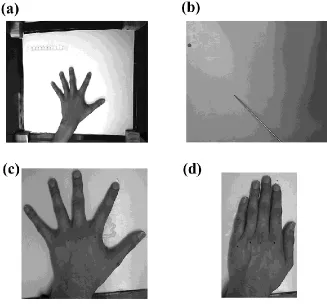
Figure 1: The experimental paradigm and examples of hand postures. Panel (a) shows an example of the photographs taken at the start and end of each block, showing the actual location of the hand. Panel (b) shows an example of a pointing response. Panels (c) and (d) show examples of the Apart (c) and Together (d) postures.
The key experimental manipulation was the posture of the judged left hand. In the
Together posture participants were asked to place their hand with the fingers pressed together,
while in the Apart posture participants were asked to spread their fingers apart as much as they
could hold comfortably for the duration of each block (see Figure 1). There were two
experimental blocks of each posture in ABBA order. The first condition was counterbalanced
across participants.
The posture of the participant’s actual hand in each condition and of implicit hand maps
was quantified by calculating the angle between a line passing between the knuckle and tip of
each finger and a line passing between the knuckles of the index and little fingers. These angles
are shown in Figure 2. An analysis of variance (ANOVA) was used to analyse these data with
repeated-measures factors Modality (Actual, Judged), Posture (Apart, Together), and Finger
(thumb, index, middle, ring, little). Unsurprisingly, there was a clear interaction of posture and
finger, F(4, 68) = 172.23, p < .0001, indicating that the hands were in fact in different postures in
the two conditions, and were judged as such. More interestingly, there was a significant
interaction of modality and finger, F(4, 68) = 14.08, p <.0001, indicating the posture of implicit
hand maps was systematically biased from actual hand posture, and a three-way interaction, F(4,
68) = 8.56, p < .0001, indicating that these biases for the judgment of posture differed between
the apart and together conditions. As is clear from Figure 2, in the together posture participants
judged their fingers as being more widely splayed than they actually were. In the apart posture,
in contrast, there was a bias to judge fingers as rotated slightly towards the radial (i.e., thumb)
Figure 2: The posture of each finger, quantified as the angle between a line connecting the knuckle and tip of each finger and a line connecting the knuckles of the index and little finger. Error bars are +/- SEM.
Previous studies using this paradigm (e.g., Longo & Haggard, 2010, 2012a, 2012b) have
revealed three characteristic distortions of hand shape: (1) overall underestimation of finger
length, (2) increase of finger underestimation from the thumb to the little finger, and (3)
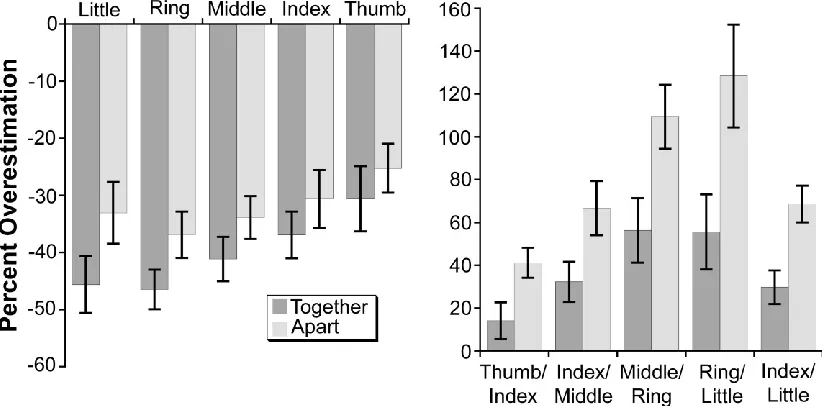
overestimation of hand width. Each of these effects was replicated in the present data in both
postures (see Figure 3). First, collapsing across the five fingers, there was significant
underestimation of finger length in both the apart (31.9% underestimation), t(17) = 8.13, p <
.0001, and together (40.2% underestimation), t(17) = 10.12, p < .0001, postures (Figure 3, left
panel). Second, the gradient of underestimation across fingers was quantified by regressing
percent underestimation on digit number (i.e., thumb = 1, little finger = 5). Underestimation of
finger length increased from the radial to ulnar side of the hand, both in the apart (2.2%
underestimation / finger), t(17) = 3.38, p < .005, and together (4.0% underestimation / finger),
t(17) = 3.91, p < .005, postures. Finally, there was significant overestimation of hand width in
both the apart (86.4% overestimation), t(17) = 9.46, p < .0001, and together (39.6%
overestimation), t(17) = 4.77, p < .0005, postures (Figure 3, right panel). These results replicate
the characteristic set of distortions my colleagues and I have reported previously and
Figure 3: Percent overestimation of finger length (left panel) and knuckle spacing (right panel) for the Together and Apart postures. Error bars are +/- SEM.
While the same basic pattern of distortions was found in both conditions, posture
nevertheless had clear effects on the magnitude of these distortions (Figure 2). First, to
investigate effects on finger length, an analysis of variance (ANOVA) was conducted including
finger (Thumb-Little) and posture (together, apart) as factors. Consistent with the above results,
there was a significant main effect of finger, F(4, 68) = 8.09, p < .0001, revealing that
underestimation increased from the thumb to the little finger. Critically, there was also a clear
effect of posture, F(1, 17) = 45.61, p < .0001, with significantly less underestimation in the apart
than the together posture. There was no significant interaction of finger and posture, F(4, 68) =
0.84, p > .50. Effects for hand width went in the same direction (Figure 2, right panel).
Overestimation of distances between knuckles was significantly greater in the apart than the
together posture. Taking the distance between the knuckles of the index and little fingers as an
Discussion
The internal posture of the hand produces rapidly modulation of implicit hand maps.
When the fingers were splayed, the hand appeared to be represented as larger than when the
fingers were pressed together. This effect is in striking contrast to previous findings showing that
postural rotations of the hand with respect to the rest of the body have no influence on either
position sense (Longo & Haggard, 2010), tactile size perception (Longo & Haggard, 2011), or
tactile localization (Mancini, Longo, Iannetti, & Haggard, 2011). It is thus the configuration of
the hand that drives these effects, not its location or orientation in external space. These findings
add to the growing literature showing that the position of the body in space has important
influences on the processing of somatosensory information (e.g., Azañón & Soto-Faraco, 2007;
Azañón, Longo, Soto-Faraco, & Haggard, 2010; de Haan et al., 2012; Haggard et al., 2006;
Hamada & Suzuki, 2003, 2005; Heed & Röder, 2010; Kim & Cruse, 2001; Medina & Rapp,
2008; Overvliet et al., 2011a, 2011b; Riemer et al., 2010; Sanabria, Soto-Faraco, & Spence,
2005; Schicke & Röder, 2006; Stavrinou et al., 2007; Tamè, Farnè, & Pavani, 2011; Yamamoto
& Kitazawa, 2001; Zampini, Harris, & Spence, 2005).
Do the present results reflect an alteration of the represented size of the hand as a
function of posture, or could they reflect differences in the act of estimating spatial location?
Many studies have shown systematical spatial biases in estimating locations from visual memory
(e.g., Huttenlocher, Hedges, & Duncan, 1991; Huttenlocher, Newcombe, & Sandberg, 1994;
Huttenlocher, Hedges, Corrigan, & Crawford, 2004; Spencer & Hund, 2002). For example,
Huttenlocher and colleagues (1991) showed that estimates of the location in which a stimulus
had appeared within a circular frame were biases towards the centres of the four wedges created
searching for a toy they had previously seen hidden in a long thin sandbox were biased in their
search towards the centre of the box, while more complex biases were found in older children
and adults (Huttenlocher et al., 1994). Huttenlocher and colleagues interpret these effects as
reflecting a Bayesian integration of an imperfect memory trace with information from spatial
categories. To my knowledge, analogous biases have not been described in position sense,
though it seems highly plausible that they might exist. In a recent paper (Mattioni & Longo,
2014), we discussed a form of such bias, namely the possibility that the underestimation of finger
length and overestimation of knuckle spacing might reflect a form of categorical perception. On
this interpretation, landmarks labeled as belong to the same part (e.g., the knuckle and tip of a
single finger) would be perceptually attracted, resulting in underestimation, whereas landmarks
labeled as belonging to different parts (e.g., the knuckles of adjacent fingers) would be
perceptually repulsed.
It is possible that the changes in posture in this experiment might lead to differences in
the spatial categorization of the hand, and thus changes in the estimation of perceived location,
analogous to the effects described in visual memory by Huttenlocher and colleagues. For
example, a rectangular bounding box surrounding the hand would be larger and more square-like
with the fingers in the apart than in the together posture. This could potentially create different
constant error biases, producing effects like those reported. On this interpretation, posture would
not alter the representation of hand size per se, but would influence performance at the level of
location estimation. The present data do not exclude such an interpretation. However, there are
some considerations that weigh against it. First, the present analysis focuses on distances
example, splay dramatically changes the distance between judgments of the knuckles of the
middle and ring fingers. But the distance between these landmarks is constant across conditions.
This bias would predict baseline distortions exactly opposite to those actually found: the spacing
between adjacent knuckles should be underestimated relative to finger length since the knuckles
are very close together compared to the tip and knuckle of each finger.
Previous studies using MEG have revealed that internal hand posture modulates the
organization of primary somatosensory cortex (Hamada & Suzuki, 2003, 2005; Stavrinou et al.,
2007). Specifically, spreading the hand apart appears to increase the distinctiveness of the
different fingers, as reflecting by increases in the distance between representations of different
fingers (Hamada & Suzuki, 2005; Stavrinou et al., 2007). Thus, when the fingers are pressed
together, the hand may be represented more as a single functional unit, whereas with the fingers
splayed it may be represented more as a collection of distinct parts. This difference may reflect a
transition between different functional modes of hand representation corresponding to power
grips, in which the fingers work together collectively, vs. precision grips, in which the fingers
References
Allard, T., Clark, S. A., Jenkins, W. M., & Merzenich, M. M. (1991). Reorganization of
somatosensory area 3b representations in adult owl monkeys after digitial syndactyly.
Journal of Neurophysiology, 66, 1048-1058.
Anema, H. A., Wolswijk, V. W., Ruis, C., & Dijkerman, H. C. (2008). Grasping Weber’s
illusion: The effect of receptor density differences on grasping and matching. Cognitive
Neuropsychology, 25, 951-967.
Azañón, E., & Soto-Faraco, S. (2008). Changing reference frames during the encoding of tactile
events. Current Biology, 18, 1044-1049.
Azañón, E., Longo, M. R., Soto-Faraco, S., & Haggard, P. (2010). The posterior parietal cortex
remaps touch into external space. Current Biology, 20, 1304-1309.
Banks, M. S. (1988). Visual recalibration and the development of contrast and optical flow
perception. In A. Yonas (Ed.), The Minnesota symposia on child psychology (pp. 145–
196). Hillsdale, NJ: Erlbaum.
Benedetti, F. (1985). Processing of tactile spatial information with crossed fingers. Journal of
Experimental Psychology: Human Perception and Performance, 11, 517-525.
Burgess, P. R., Wei, J. Y., Clark, F. J., & Simon, J. (1982). Signaling of kinaesthetic information
by peripheral sensory receptors. Annual Review of Neuroscience, 5, 171-187.
Canzoneri, E., Ubaldi, S., Rastelli, V., Finisguerra, A., Bassolino, M., & Serino, A. (2013).
Tool-use reshapes the boundaries of body and peripersonal space representations.
Experimental Brain Research, 228, 406-411.
head size during infancy: Implications for sound localization. Developmental Psychology,
24, 477-483.
de Haan, A. M., Anema, H. A., & Dijkerman, H. C. (2012). Fingers crossed! An investigation of
somatotopic representations using spatial directional judgements. PLoS One, 7, e45408.
de Vignemont, F., Ehrsson, H. H., & Haggard, P. (2005). Bodily illusions modulate tactile
perception. Current Biology, 15, 1286-1290.
Ferrè, E. R., Vagnoni, E., & Haggard, P. (2013). Vestibular contributions to bodily awareness.
Neuropsychologia, 51, 1445-1452.
Hach, S., & Schütz-Bosbach, S. (2010). Sinistrals’ upper hand: Evidence for handedness
differences in the representation of body space. Experimental Brain Research, 72,
408-418.
Haggard, P., Kitadono, K., Press, C., & Taylor-Clarke, M. (2006). The brain’s fingers and hands.
Experimental Brain Research, 172, 94-102.
Hamada, Y., & Suzuki, R. (2003). Hand posture modulates neuronal interaction in the primary
somatosensory cortex of humans. Clinical Neurophysiology, 114, 1689-1696.
Hamada, Y., & Suzuki, R. (2005). Hand posture modulates cortical finger representation in SII.
NeuroImage, 25, 708-717.
Head, H., & Holmes, G. (1911). Sensory disturbances from cerebral lesions. Brain, 34, 102-254.
Heed, T., & Röder, B. (2010). Common anatomical and external coding for hands and feet in
tactile attention: Evidence from event-related potentials. Journal of Cognitive
Neuroscience, 22, 184-202.
Huttenlocher, J., Hedges, L. V., & Duncan, S. (1991). Categories and particulars: Prototype
Huttenlocher, J., Newcombe, N., & Sandberg, E. H. (1994). The coding of spatial location in
young children. Cognitive Psychology, 27, 115-147.
Huttenlocher, J., Hedges, L. V., Corrigan, B., & Crawford, L. E. (2004). Spatial categories and
the estimation of location. Cognition, 93, 75-97.
Kim, D.-H., & Cruse, H. (2001). Two kinds of body representation are used to control hand
movements following tactile stimulation. Experimental Brain Research, 139, 76-91.
Le Cornu Knight, F., Longo, M. R., & Bremner, A. J. (2014). Categorical perception of tactile
distance. Cognition, 131, 254-262.
Longo, M. R. (2014). The effects of immediate vision on implicit hand maps. Experimental
Brain Research, 232, 1241-1247.
Longo, M. R., & Haggard, P. (2010). An implicit body representation underlying human position
sense. Proceedings of the National Academy of Sciences, USA, 107, 11727-11732.
Longo, M. R., & Haggard, P. (2011). Weber’s illusion and body shape: Anisotropy of tactile size
perception on the hand. Journal of Experimental Psychology: Human Perception and
Performance, 37, 720-726.
Longo, M. R., & Haggard, P. (2012a). A 2.5-D representation of the human hand. Journal of
Experimental Psychology: Human Perception and Performance, 38, 9-13.
Longo, M. R., & Haggard, P. (2012b). Implicit body representations and the conscious body
image. Acta Psychologica, 141, 164-168.
Longo, M. R., & Sadibolova, R. (2013). Seeing the body distorts tactile size perception.
Cognition, 126, 475-481.
Longo, M. R., Long, C., & Haggard, P. (2012). Mapping the invisible hand: A body model of
a phantom limb. Psychological Science, 23, 740-742.
Lopez, C., Schreyer, H. M., Preuss, N., & Mast, F. W. (2012). Vestibular stimulation modifies
the body schema. Neuropsychologia, 50, 1830-1837.
Mancini, F., Longo, M. R., Iannetti, G. D., & Haggard, P. (2011). A supramodal representation
of the body surface. Neuropsychologia, 49, 1194-1201.
Mattioni, S., & Longo, M. R. (2014). The effects of verbal cueing on implicit hand maps. Acta
Psychologica, 153, 60-65.
Medina, J., & Rapp, B. (2008). Phantom tactile sensations modulated by body position. Current
Biology, 18, 1937-1942.
Miller, L. E., Longo, M. R., & Saygin, A. P. (2014). Tool morphology constrains the effects of
tool use on body representations. Journal of Experimental Psychology: Human
Perception and Performance, 40, 2143-2153.
Napier, J. (1956). The prehensile movements of the human hand. Journal of Bone and Joint
Surgery, 38, 902-913.
Oldfield, R. C. (1971). The assessment and analysis of handedness: The Edinburgh inventory.
Neuropsychologia, 9, 97-113.
Overvliet, K. E., Anema, H. A., Brenner, E., Dijkerman, H. C., & Smeets, J. B. (2011a). Relative
finger position influences whether you can localize tactile stimuli. Experimental Brain
Research, 208, 245-255.
Overvliet, K. E., Azañón, E., & Soto-Faraco, S. (2011b). Somatosensory saccades reveal the
timing of tactile spatial remapping. Neuropsychologia, 49, 3046-3052.
shape, body position and movement, and muscle force. Physiological Reviews, 92,
1651-1697.
Riemer, M., Trojan, J., Kleinböhl, D., & Hölzl, R. (2010). Body posture affects tactile
discrimination and identification of fingers and hands. Experimental Brain Research,
206, 47-57.
Sanabria, D., Soto-Faraco, S., & Spence, C. (2005). Spatiotemporal interactions between
audition and touch depend on hand posture. Experimental Brain Research, 165, 505-514.
Saulton, A., Dodds, T. J., Bülthoff, H. H., & de la Rosa, S. (2015). Objects exhibit body model
like shape distortions. Experimental Brain Research, 233, 1471-1479.
Schicke, T., & Röder, B. (2006). Spatial remapping of touch: Confusion of perceived stimulus
order across hand and foot. Proceedings of the National Academy of Sciences, USA, 103,
11808-11813.
Spencer, J. P., & Hund, A. M. (2002). Prototypes and particulars: Geometric and experience-
dependent spatial categories. Journal of Experimental Psychology: General, 131, 16-37.
Stavrinou, M. L., Della Penna, S., Pizzella, V., Torquati, K., Cianflone, F., et al. (2007).
Temporal dynamics of plastic changes in human primary somatosensory cortex after
finger webbing. Cerebral Cortex, 17, 2134-2142.
Tajadura-Jiménez, A., Väljamäe, A., Toshima, I., Kimura, T., Tsakiris, M., & Kitagawa, N.
(2012). Action sounds recalibrate perceived tactile distance. Current Biology, 22,
R516-R517.
double simultaneous stimulation within and between hands. Neuroscience Letters, 487,
78-82.
Taylor-Clarke, M., Jacobsen, P., & Haggard, P. (2004). Keeping the world a constant size:
Object constancy in human touch. Nature Neuroscience, 7, 219-220.
Yamamoto, S., & Kitazawa, S. (2001). Reversal of subjective temporal order due to arm
crossing. Nature Neuroscience, 4, 759-765.
Zampini, M., Harris, C., & Spence, C. (2005). Effect of posture change on tactile perception:
Impaired direction discrimination performance with interleaved fingers. Experimental
Acknowledgments
Thanks to thank Rehana Miah for assistance with data collection. This research was supported by