http://www.scirp.org/journal/apm ISSN Online: 2160-0384
ISSN Print: 2160-0368
Apropos
1+ 2 + 3 + 4 + 5 +
= -
1
12
: Mapping
Infinity in Light of the Number Circle (or Cycle),
in L. Euler’s Footsteps and with the Aid of
Two Dimensional Infinite Series,
and Replacing
Negative Infinity and Positive Infinity with
Just Infinity
Leo Depuydt
Egyptology and Assyriology, Brown University, Providence, RI, USA
Abstract
The number circle—that is, the notion that the largest possible positive bers are followed by infinity and then by the smallest possible negative num-bers—is not new. L. Euler defended it in the eighteenth century and, before him, J. Wallis considered something vaguely similar. However, in the nine-teenth century, the number circle was for the most part abandoned—even if something similar is on occasion accepted in geometry, in the sense that space is circular. The design of the present paper is to present positive proof of the veracity of the number circle and therefore, at the same time, to falsify the number line. Verifying the number circle implies falsifying negative infinity and positive infinity—infinity instead being neither negative nor positive, just like 0. Part of said proof involves showing that infinity can be defined both as 1 1 1 1 1+ + + + + and as − − − − − −1 1 1 1 1 and that the following Equa-tion applies: 1 1 1 1 1+ + + + += − − − − − −1 1 1 1 1 The principal mathe-matical technique that will be used to provide said proof is introduced here for the first time. It is called the two dimensional infinite series. It is an infi-nite series of infiinfi-nite series. Some additional observations regarding the geo-graphy of infinity will be made. A more detailed description of the geogeo-graphy of infinity will be reserved for other papers. The Equation
1 1 2 3 4 5
12
+ + + + += − is discussed in this paper only to the extent that
How to cite this paper: Depuydt, L. (2017) Apropos 1+ 2 + 3 + 4 + 5 += -1
12:
Mapping Infinity in Light of the Number Circle (or Cycle), in L. Euler’s Footsteps and with the Aid of Two Dimensional Infinite Series, and Replacing Negative Infinity and Positive Infinity with Just Infinity. Advances in Pure Mathematics, 7, 75-133.
http://dx.doi.org/10.4236/apm.2017.71007 Received: November 7, 2016
Accepted: January 22, 2017 Published: January 25, 2017 Copyright © 2017 by author and Scientific Research Publishing Inc. This work is licensed under the Creative Commons Attribution International License (CC BY 4.0).
the attention that has been paid to it has necessitated the construction of a theory of infinity that, upon closer inspection, makes the Equation more self-evident and intuitively apparent; a fuller discussion will take place in a later paper.
Keywords
Euler, L., Infinite Series, Infinite Series of Infinite, Infinity, Infinity, Geography of, Negative Infinity, Invalidity of, Number Circle, Veracity of, Number Cycle, Veracity of, Number Line, Invalidity of, Positive Infinity, Invalidity of, Two dimensional Infinite Series, Ramanujan, Rational Human Intelligence, Wallis, J.
1. Anticipating the End Design of the Present Study in
Subsequent Papers: Rendering the
Equation
1+ 2 + 3 + 4 + 5 +
= -
1
12
Intuitively Clear
What triggered this study in the first place is the remarkable Equation1 1 2 3 4 5
12
+ + + + += − .
There is no denying that the Equation does not at first sight—or even upon closer inspection—look intuitively clear in the least to anyone who encounters it. Nor did it look intuitively clear to me when I first encountered it. I am in fact quite confident that there has never been anyone to whom the Equation has been intuitively clear at first sight when they first encountered it.
It should be noted right at the outset that the design of the present paper is not to prove the above Equation, as an anonymous reviewer seemed to suggest. That has been done a long time ago, convincingly and definitively (see below). Nor is the design of the present paper to render this very Equation more intui-tive at this time. The design is rather to establish necessary mathematical foun-dations so that this goal can be achieved in later papers. The matter of infinite series is just too wide-ranging. A principal issue concerns the so-called divergent series and whether they do or do not have sums? It is common to believe that they do not have sums. I personally believe that they do.
The total absence of intuitive clarity evidently pertains to the Equation’s two most striking characteristics.
1) The sum to the left of the Equation sign has every appearance of adding up to infinity. And yet it does not. How on earth is that possible?
2) The sum to the left of the Equation sign consists of numbers that are all positive. In common experience, a sum of positive numbers always produces a positive number as its result. And yet, in the present case, the result is a negative number. How on earth is that possible?
were disregarded or aroused suspicion. The metaphor most commonly used to persuade anyone of the validity of negative numbers has always been the notion of debt. Money has this peculiar way of peaking human attention.
Someone who is in debt has a negative sum of money, as it were. Accordingly, someone who is 100 dollars in debt has 200 dollars less than someone how has 100 dollars. Let us assume, then, that the numbers in the above Equation refer to dollars. How can a person who endlessly keeps accumulating money end up in debt? It boggles the mind.
To be absolutely clear, the design of what follows is not to prove the veracity of the Equation
1 1 2 3 4 5
12
+ + + + += − .
L. Euler and S. Ramanujan have already provided sufficient proof long ago. There is no doubt that the Equation is true.
S. Ramanujan’s mathematical powers were absolutely phenomenal. Then again, in the popular imagination, he has become known as the man “who knew infinity”. The reason is the appearance of this expression in the title of a best-selling novel about his life and a popular movie with the same title derived from the novel.
I do not subscribe to “the man who knew infinity” as a characterization of S. Ramanujan. S. Ramanujan knew an enormous amount. But he did not “know infinity”. He manipulated infinite series in astonishing ways. But he was una-ware, I believe, of certain crucial subtleties of engaging the concept of infinity. Engaging the concept of infinity requires a critical appreciation of exactly what the brain can comprehend and what it cannot comprehend. Again, it seems eminently reasonable that the brain can do certain things and not other things. This distinction is critically relevant when it comes to engaging infinity.
Nor is there any need to prove that sums of all positive numbers can have negative results. The above Equation is one example. There are infinitely many examples. Another example is the following Equation:
3 9 27 81
1 2.
2 4 8 16
+ + + + += −
But that does not take away that anyone studying the Equation might not be tempted to doubt its veracity. And so did the present writer at some point.
One potential advantage of doubting the veracity of the Equation at some point is that one is only much more convinced of its veracity as a result of mov-ing through, and beyond, doubt than when one had never doubted it in the first place. Such has been the experience of the present writer.
In fact, the final design of the present paper is to put an end to the madness by presenting a simple, clear, and natural understanding of the Equation in ques-tion. This understanding perhaps does not make the Equation as intuitively clear as the Equation
1 1+ =2.
But it comes close.
Then again, in order to achieve this pragmatic aim, it will be necessary to ad-dress some issues affecting some of the deepest foundations of number theory and mathematics in general.
To conclude, I wish to express my deep gratitude to two anonymous referees. One was unequivocally positive. The other had concerns and I wish to address them. The reviewer in question saw a lack of “genuine” mathematics in the present paper and repeatedly emphasized the need for rigor in mathematics. The two concerns basically come down to the same thing (see below).
But first, it is true that I am strictly speaking not a mathematician and I have no intention of pretending to be. The reason that I am doing mathematics is that I am in need of mathematics to a certain limited degree in order to formulate a complete theory of rational human intelligence. And hardly anything is more fascinating to the cause of rational human intelligence than how the brain deals with the concept of infinity.
The two concerns of the referee in fact come down to a single concern: lack of rigor implying lack of genuine mathematics is what characterizes the present paper. In reply, I should state that I am not very enthusiastic about the nine-teenth century of efforts by A.-L. Cauchy and others to bring rigor to mathe-matics after the age of L. Euler and J.-L. Lagrange. I also cannot appreciate N. Abel’s suspicion, yes even abhorrence, of divergent series. In fact, there is clear evidence from N. Abel’s writings that he could not deny that divergent series somehow make sense, in spite of everything. And he intended to make sense of it but died too young to ever do anything about it. It is time to catch up with the matter. I will discuss the tortured understanding of divergent series by such lu-minaries as E. Borel, T. J. Bromwich, and G. H. Hardy in later papers. G. W. Leibniz already believed that is possible to evaluate all divergent series. I think that Euler did too. And so do I, but not necessarily in the capacity of a mathema-tician. I quickly add my appreciation for the fact that the referee pointed out the significance of the researches of Terrence Tao on the subject.
2. Core Designs Touching on Some of the Deepest
Foundations of Number Theory and Mathematics:
Elimination of 1) the Number Line and 2) Negative
and Positive Infinity
In order to render the Equation
1 1 2 3 4 5
12
intuitively more transparent, the need will be for first eliminating two interre-lated deeply held beliefs of current mathematics and replacing them.
If that seems audacious, the elimination of the beliefs in question involve in some way nothing less than executing the legacy of the most prolific mathemati-cian of all time, Leonhard Euler (1707-1783). In that regard, the present paper is to some extent a vindication of some of L. Euler’s deeply held beliefs, beliefs that were dismissed after him. The time has come to rectify the record.
What are the two interrelated beliefs?
The first is that there is something like the number line. It is time to eliminate the number line and replace it with the number circle or cycle.
The second belief is that there is such a thing as negative infinity and positive infinity. It is time to eliminate negative infinity and positive infinity and replace it with just infinity. The contrast between negative and positive is irrelevant when one reaches infinity.
What is the number circle? And how does it relate to the irrelevance and eli-mination of negative infinity and positive infinity?
The number circle revolves entirely around the notion that numbers follow one another in the following manner:
If one moves all the way up through the positive numbers to infinity and then proceeds beyond infinity, one ends up at the largest negative numbers.
Conversely, if one moves all the way down through the negative numbers to infinity and then proceeds beyond infinity, one ends up at the largest positive numbers.
In sum, there is no negative infinity and there is no positive infinity because it is one and the same infinity that one encounters at the end and is neither nega-tive nor posinega-tive. Therefore, the symbols +∞ and −∞ can be eliminated.
In the geography of numbers, what lies beyond infinity, as it is approached and reached from the positive numbers, is the negative numbers. Evidently, as one proceeds upward through the negative numbers from infinity, one reaches zero and returns to the positive numbers.
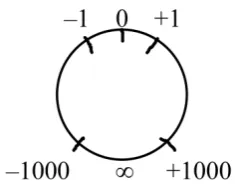
The sequence of all the numbers can be represented by a circle: 0 and infinity are located at both ends of one if its diameters in Figure 1.
As one can see, there is no need for negative infinity and positive infinity in this model.
[image:5.595.314.432.622.716.2]On this circle, there are two (2) points where one crosses from negative num-bers to positive numnum-bers or vice versa. They are
1) zero (0) and
2) infinity (∞), which is neither negative nor positive.
The sequence of numbers is now universally conceptualized as a line, the so-called number line ending to the left in negative infinity (−∞) and to the right in positive infinity (+∞), with 0 located in the middle. The number line is represented in Figure 2.
By contrast, I am convinced that the two ends are connected at infinity, which is neither negative nor positive. Proof of this fact will be provided. For example it will be shown that
1 1 1 1 1+ + + + += − − − − − −1 1 1 1 1
The number circle exhibits a remarkable property that the number line does not. If one keeps moving or rotating in one direction, clockwise, the numbers perpetually increase in quantity. If one moves or rotates in the opposite direction, counterclockwise, they perpetually decrease. The continuity is perfect. Perpetual rising occurs in one direction and perpetual descending in another direction.
In addition to the number circle and infinity, it will also be necessary diver-gent series as a name and as a concept.
3. Excursus: J. Wallis, L. Euler, and the Number Circle
The conception of the sequence of numbers as a number circle rather than as a number line may seem peculiar. And yet, as was said above, I am not the first to accept the veracity of the number circle. L. Euler was absolutely convinced of it. Evidently, I have been deeply influenced and inspired by L. Euler in accepting it myself.
I cannot readily find any reflection of anything like the number circle in more recent mathematics. But the mathematical literature is vast and I have not un-dertaken a large scale search. The number line and the concepts of negative and positive infinity seem so universally accepted that they would presumably in-evitably stand in the way of anyone accepting the conception of the sequence of numbers as a circle rather than as a line. The conception involves completely abandoning the notions of negative infinity and positive infinity.
In order to remove all doubt that L. Euler was firmly convinced that one en-counters the negative numbers after rising to infinity through the positive num-bers, it will be useful to quote him in full. He wrote about the matter in an article written in Latin published in 1760 in the acts of the Saint Petersburg academy when he was still at the Berlin academy [1]. To simplify the bibliographical trail, I take the liberty of simply quoting the English translation of the Latin original presented by E. J. Barbeau and P. J. Leah in a most helpful article [2].
The following statement by L. Euler leaves no doubt about his firm conviction:
However, it seems in accord with the truth if we say that the same quantities which are less than zero can be considered to be greater than infinity. For not only from algebra but also from geometry, we learn that there are two jumps from positive quantities to negative ones, one through nought or zero, the other through infinity, and that quantities whether increasing from zero or decreasing come back on themselves and return to the same destination 0, so that quantities greater than infinity are thereby less than zero and quantities less than infinity coincide with quantities greater than zero.
Dixit Euler. But L. Euler does not provide proof at this juncture. I am not suf-ficiently familiar with L. Euler’s massive output to locate a proof anywhere else in his work. I have not undertaken any systematic search. Perhaps someone else might be able locate one somewhere in his works. I therefore believe that I will do nothing superfluous in presenting further below what I believe to be positive proof that one arrives at the negative numbers after rising to infinity through the positive numbers and leave it to speculation what Euler would have thought of the proof or what proofs he himself had in mind.
The question arises: If someone of the caliber of L. Euler, whose great strengths specifically included number theory, was so convinced that one passes from the negative numbers to the positive numbers and vice versa at infinity, then why is it so difficult to find any reflections of this conviction in later ma-thematics?
The answer seems fairly obvious. There is this universally accepted notion about the history of mathematics that a lot of order and rigor was added to ma-thematics in the nineteenth and early twentieth century. By this notion, up to that time, mathematicians had raced forward headlong making countless disco-veries. But they had never stopped to bring their house in order and provide ri-gorous definitions of all their concepts. By this same notion, there is an impres-sion that L. Euler was sometimes a little methodically loose in how he did ma-thematics and that nineteenth century mathematicians cleaned up after him, as it were. I do not subscribe to this view.
Notions such as infinity and the infinitesimally small came under special scru-tiny in the nineteenth century. The result was the creation of the concept of the limit. I have elsewhere voiced my own opinion about the concept of the limit in calculus [3]. I personally do not see a need for it. I approach the whole matter from an entirely different angle, namely from the angle of rational human intel-ligence.
This is not the place to get into any detail. Suffice it to note that all my efforts directed towards the study of rational human intelligence are entirely subordi-nated to the notion that, as with any mechanical tool, there are certain things that the brain can do and there are certain things that the brain cannot do. Where is the line between the two?
here.
In my understanding of infinity, I find myself completely aligned with L. Eu-ler’s views, as contrasted with dominant modern views—except in one respect. I am constantly explicitly in search of the very real line that separates what the brain can do from what the brain cannot do. It cannot be entirely excluded that L. Euler believed that a certain level of understanding of mathematical reality transcends the abilities of the brain. But he does not give explicit expression to this distinction. The acceptance of the line and any efforts to try to find it and clearly define it make it easier to accept something that may seem perplexing. It seems so easy to accept that there are things that the brain can do and things that the brain cannot do. But where is the line between the two?
Before proceeding to a proof of the number circle, it is useful to note that Eu-ler was not entirely alone in stumbling upon the negative numbers after rising up to infinity through the positive numbers.
Before L. Euler, John Wallis (1616-1703) had already run into negative num-bers when going beyond infinity after passing through the positive numnum-bers. In that regard, he was in my opinion 100% correct. J. Wallis concluded that the negative numbers in question are “greater than infinity (plusquam infinitam)” [4].
But J. Wallis never reconciled this notion with the fact that negative numbers can also be viewed as smaller than positive numbers. Who could possibly disag-ree that –1 is smaller than +1?
Moreover, if there are numbers that are larger than positive infinity, should there not also be numbers that are smaller than negative infinity? Negative numbers are often metaphorically presented as debt, money that is owed. I per-sonally believe that, if one could run up debts that are larger than infinity, one would in fact be impossibly wealthy.
As an indispensable precursor to the works of the mighty I. Newton and so many others, J. Wallis simply does not occupy the place in the history of science that he deserves. Who among the wider public has heard of J. Wallis?
I have not examined the matter in detail, but it is possible that J. Wallis was the first ever to use the representation of the number line, though perhaps only with the positive numbers. This is not the place to investigate the matter in more detail. But it was not R. Descartes who was first.
The most important study of the mathematical work of J. Wallis is, as far as I know, a book by J. F. Scott already referenced in note 4 [5]. I find it symptomatic of the current state of mathematics that J. Wallis’s view that one encounters the negative numbers when rising through the positive numbers to infinity and moving beyond is deemed to be an “error” in this book [6]. This is a clear indi-cation that the view propounded in the present article radically departs from any current mathematical orthodoxy. And yet, it is a view endorsed by L. Euler him-self.
proof is what is next.
In addition, various interesting facets of the geography of infinity and of the number circle will be described. It is these facets that will do much to fulfil the main design of the present paper, that is, to make the Equation
1 1 2 3 4 5
12
+ + + + += −
much more intuitively clear. These facets will involve more than one new critical insight into the sequence of the numbers as it relates to infinity.
From an intuitive perspective, there is a distinct kind of harmony to the number circle that the number line does not have. As one moves in one direc-tion on the circle, one always rises in quantity; in the opposite direction, one al-ways descends in quantity.
Throughout what follows, an effort will be made to carefully distinguish be-tween what is accessible to rational human intelligence and what is not. It is not possible, I believe, to attain an adequate understanding of the concept of infinity and the number line without making this distinction. The distinction is other-wise never made in mathematics. But mathematics is something done by the human brain. The distinction between what the brain can do and what it cannot do means everything to mathematics, I believe. Where exactly is the line between what the brain can do and what it cannot do?
4. The Tool Needed 1) to Prove the Veracity of the
Number Circle and 2) to Eliminate Negative Infinity
and Positive Infinity: Two Dimensional Infinite Series
or Infinite Series of Infinite Series
The need and desire is for a single mathematical tool or technique that demon-strates—not only strictly mathematically but, if possible, also fully intuitive-ly—that as one
1) proceeds upward through the positive numbers, 2) continues all the way to infinity,
and
3) then proceeds onward beyond infinity,
one will end up at the largest possible negative numbers and gradually move up through them to zero and rise again through to the positive numbers to infinity. The progression applies in reverse in the opposite direction.
Demonstrating the veracity of such a progression would also eliminate the need for negative infinity and positive infinity.
As was noted above, this progression can be represented as a circle, the num-ber circle. It may seem awkward that one ends up in negative territory at the end of positive territory. The two seem like opposites. But the opposition vanishes if one considers the following remarkable circumstance, also noted above.
proceeds through the negative numbers after having moved beyond infinity, one just keeps rising.
That is the beauty and consistency of the number circle: the infinite progres-sion of always rising in one direction and the infinite progresprogres-sion of always des-cending in the opposite direction. It makes for a certain kind of remarkable harmony.
But is there a mathematical technique to demonstrate this infinite progression and eliminate the need for negative infinity and positive infinity.
Such a mathematical technique exists and is introduced below. I call it the two dimensional infinite series.
The infinite series is one of the most important mathematical discoveries of all time, dating to the seventeenth century with traces of its use going all the way back to Archimedes and antiquity. In fact, the sum featuring in the title of the present article is an infinite series.
It is not easy to impress Euler when it comes to mathematical inventions. But he was mightily impressed by the potential of infinite series and in a rare expres-sion of genuine admiration for a mathematical phenomenon states the following [7]:
It should be… observed, that, from this branch of mathematics [that is, infi-nite series] inventions of the utmost importance have been derived; on which account the subject deserves to be studied with the greatest attention.
It is infinite series that make it possible to prove the veracity of the number circle. But one has to deploy them in not one, as has been done until now, but in two dimensions.
A two dimensional infinite series is an infinite series of infinite series. Infinite series in one dimension is one thing. Taking them into two dimen-sions is another. How does one take infinite series into two dimendimen-sions? The matter is discussed and clarified next.
In sum, finite series have been exploited with enormous success in all kinds of contexts in the past three to four centuries or so. Euler thought the world of them. However, they have been used in only one dimension. It is time to use them into a second dimension to perform the critically important function of proving the existence and veracity of the number circle and eliminate negative infinity and positive infinity once and for all.
5. The One Dimensional Infinite Series
A well-known example of a one dimensional infinite series is as follows: 1 1 1 1
1 .
2 4 8 16
+ + + + + (1)
In fact, all the infinite series that have ever been studied by mathematicians are one dimensional. What a two dimensional infinite series looks like is clari-fied below.
se-ries amply provides what is needed for the designs of the present paper, which is 1) to prove the existence of the number circle or cycle and
2) eliminate negative infinity and positive infinity in favor of infinity tout court,
all this with the ulterior design of making the Equation 1 1 2 3 4 5
12
+ + + + += −
seem like the most normal thing on earth—or close to it.
There is so much more to infinite series than the little that is exploited here. But none of is needed for the purpose at hand.
The infinite series (1) above is equal to a rational number. The number is 2. It is not all that difficult to establish that the infinite series approaches ever closer to 2 as one keeps adding terms. It is also intuitively clear that one can al-ways keep adding terms. One can alal-ways double 16, 32, 64, and so on. There is no reason to ever stop.
What is not intuitively clear is that the result of the sum is actually 2 if one never stops, or if one stops after having gone on forever as it were. In other words, the following Equation applies:
1 1 1 1
1 2
2 4 8 16
+ + + + += . (2)
Here is where the line is located between what the brain can do and what it cannot do. It can easily imagine never stopping. Why stop if you can just keep going on? But arriving somewhere specific, like at the number 2, and yet going on forever, that is what the brain cannot imagine. As the brain experiences real-ity, arriving somewhere always involves the end of a journey and stopping. But in the case of the infinite series cited above, one arrives somewhere and kind of stops without the journey ever coming to an end. How can one arrive some-where if the journey keeps on going?
In any event, in spite of the inability of the brain to wrap itself around the no-tion of infinity, no one has ever doubted the veracity of Equano-tion (2).
The veracity of Equation (2) can easily be established inductively by adding up a sufficiently large number of terms and seeing the instances of the number 9 accumulating as the number takes on a form such as 1.9999… The absence of any reduction in the instances of the number 9 makes it clear where this is going. Clearly, it is going to 2, even it is impossible to get there by keeping adding terms. It would evidently be possible to get to 2 if one could keep adding forever. That is obvious, even if it is not possible to understand what it means to keep adding up forever.
6. One Way of Proving or Verifying Infinite Series Equal
Rational Numbers: Algebra
A first way is algebraic, namely by means of multiplying and subtracting Equ-ations. It begins by assuming that
1 1 1 1
1 .
2 4 8 16 x
+ + + + += (3)
If one multiplies this Equation by 2, then the result is as follows: 1 1 1 1
2 1 2 .
2 4 8 16 x
+ + + + + += (4)
Evidently, if one subtracts the right-hand side of Equation (3) from the right- hand side of Equation (4), the result is as follows:
2x− =x x.
Moreover, if one subtracts the left-hand side of Equation (3) from the left- hand side of Equation (4), one obtains 2. Consequently, x equals 2. QED.
This technique makes it possible to control, and feel confident about, the exact value of the sum of an infinite series. The technique cannot be applied to all infi-nite series.
For completeness’ sake, I mention here another obvious way of making clear that Equation (1) equals 2. It was noted that the Equation gradually takes on the form 1.9999… The focus is on the component 0.9999… Consider the following sequence:
1
0.1111 9= ;
2
0.2222 9 = ;
… 7
0.7777 9 = ;
8
0.8888 9= ;
9
0.9999 1.
9= =
The sequence suggests an equivalence between 0.9999… and 1 and therefore between 1.9999… and 2.
7. Converting Rational Numbers into One Dimensional
Infinite Series
Another way of proving or verifying that an infinite series is indeed equal to an exact number is by converting a rational number into an infinite series. The re-sulting infinite series is obviously equal to a rational number because it was de-rived from it.
ve-racity of the number circle and finally eliminating negative infinity and positive infinity once and for all from mathematics.
The theory of infinite series has been enormously successful in both mathe-matics and physics, as was already noted above. There is so much more to the theory of infinite series than what is taken from it here, including the resolution of irrational numbers into infinite series involving I. Newton’s binomial theorem. L. Euler really ran with infinite series for the benefit of physics.
For the present purposes, infinite series that can be expressed by rational numbers will suffice to prove the veracity of the number circle and the futility of the concepts of negative infinity and positive infinity. There will be no need for infinite series featuring irrational or even transcendental results.
8. A Well-Known Way of Converting Rational Numbers
into One Dimensional Infinite Series: Infinite
Decimal Fractions
There is in fact more than one way of converting a rational number into an infi-nite series. The best known way has been practiced by all who have even just some notion of elementary division.
An example. It is obvious that dividing 2 by 3 results in 0.6666… This is high school, if not elementary school, arithmetic.
Still, this expression by itself does not readily encourage one to contemplate infinite series. And yet, the following Equation applies:
2 6 6 6 6 . 3=10+100+1000+10000+
Clearly, a rational number is resolved into an infinite series. The series is what L. Euler called “infinite decimal fractions”. He describes “infinite decimal frac-tions” with his usual unsurpassed lucidity in his Elements of Algebra [8].
L. Euler does not make a connection between “infinite decimal fractions” and what he describes elsewhere in his Elements of Algebra as “the resolutions of fractions into infinite series” [9]. I will make the connection explicitly further below.
If one carries on the right-hand side of the Equation without ever stopping, one will arrive at the rational number found at the left-hand side of the Equation. It is safe to assume that elementary school students or high school students are hardly ever invited to reflect on what it means to go on forever without stopping and yet getting somewhere.
9. Other Ways of Representing Rational Numbers by
Means of One Dimensional Infinite Series
infinity and positive infinity. Nor will it be necessary to consider anything else but rational numbers in the present paper.
L. Euler presents a lucid and delightfully concise description of this pheno-menon in the chapter entitled “the resolution of fractions into infinite series” in his Elements of Algebra, which has been described as the second most popular mathematics book of all time, after Euclid’s Elements [10]. It has much inspired the following account. Then again, the following account will approach the phenomenon from a different angle in order to place it in wider context and to clarify what exactly happens when one turns any rational number into an infi-nite number of infiinfi-nite series. I believe, in fact, that L. Euler did not capture the phenomenon in its entire scope from first principles in the afore-mentioned ac-count.
It should be noted that any rational number can be resolved into an infinite series, not only fractions, but also round numbers such as 1, 2, 3, 4, etc. But ac-cording to the technique described by Euler and discovered before him, the round number needs to be represented as a fraction. For example, the integer 2 needs to be in a fractional form such as
1 1
2
1 1
1
2 2
= =
−
in order to be converted into an infinite series. In the previous section, the fraction 2
3 was converted into the infinite series
6 6 6 6 , 10+100+1000+10000+ involving infinite decimal fractions.
In infinite series involving decimal fractions, the numerators evidently do not all need to be the same. For example,
1 1 4 2 8 5 7
, 7=10+100+1000+10000+100000+1000000+ 1, 4, 2, 8, 5, and 7 then repeat themselves in the numerator. Or
1
0.142857. 7=
Infinite series involving decimal fractions result from dividing the numerator directly by the nominator according to the standard basic rules of long division in the decimal notation system. However, there are other ways of converting a rational fraction such as 2
3 into infinite series, an infinite number of other ways in fact.
In order to find other series, one needs to represent 2
1 , 1 1
2
+ (5)
1 , 1 2
2
− (6)
2 ,
1 2+ (7) and
2 .
2 1+ (8) Expression (5) yields the infinite sum
2 1 1 1 1
1 .
3= − + − +2 4 8 16+ (5') Expression (6) yields the infinite sum
2 1 1 1 1 1 .
3= + +2 8 32+128+512+ (6') Expression (7) yields the infinite sum
2
2 4 8 16 32 .
3= − + − + − (7')
Expression (8) yields the infinite sum 2 1 1 1 1
1
3= − + − +2 4 8 16−. (8')
The infinite sum in (7') looks peculiar at first sight. A sum of integers produc-es a fraction. However, it will be shown below that this is altogether expected. After all, the sum featured in this paper’s title is also a sum of integers resulting in a fraction, and a negative one at that.
How are the infinite sums (5'), (6'), (7'), and (8') obtained? L. Euler explains the matter clearly.
Generalized algebraic equivalents of the arithmetic fractions (5), 6), (7), and (8) are as follows:
1 ,
1+a (5'')
1 ,
2−a (6'')
2 ,
1+a (7'') and
2 .
2+a (8'')
1
1+a (5'') and its negative counterpart
1 1−a will be needed.
L. Euler discusses fraction (5'') and its negative counterpart separately. But in what follows, it will be crucial to reduce the two to just one single fraction either by taking (5'') as
( )
11− −a
or by taking its negated counterpart as
( )
1 .1+ −a
The reason is that it will be important to observe what happens when (–)a as-sumes the form of any of the integers, negative or positive, in a continuous se-ries.
Again, there are an infinite number of fractions like (5''). But only (5'') and its negated counterpart will be needed in order to prove what needs to be proven.
The fractions (5'), (6'), (7'), and (8') can be converted into infinite sums as fol-lows:
2 3 4
1
1 ;
1+a= − +a a −a +a − (5''')
2 3 4
1 1
;
2 2 4 8 16 32
a a a a
a= + + + + +
− (6''')
2 3 4
2
2 2 2 2 2 ;
1+a = − a+ a − a + a − (7''')
and
2 3 4
2 1
2 2 4 8 16
a a a a
a= − + − + −
+ ; (8''')
The matter is clarified further below.
Incidentally, the negative counterpart of fraction (5) yields the following re-sult:
2 3 4
1 1
1−a = + +a a +a +a +
The next step is to evaluate the four infinite sums if a has the values listed in fractions (5), (6), (7), and (8). These values of a are as follows.
Fraction (5): 1 2
a= ;
fraction (6): 1 2
fraction (7): a=2; and fraction (8): a=1.
Inserting them into Equations (5'''), (6'''), (7'''), and (8''') yields the following results:
2 3 4
2 1 1 1 1 1 1 1 1 1
1 1 ;
1
3 1 2 2 2 2 2 4 8 16
2
= = − + − + − = − + − + −
+ (5'''')
2 3 4
1 1 1 1
2 1 1 2 2 2 2 1 1 1 1 1 ; 1
3 2 2 4 8 16 32 2 8 32 128 256 2
= = + + + + + = + + + + +
− (6'''')
2 3 4
2 2
2 2 2 2 2 2 2 2 2 2 4 8 16 32 ;
3=1 2+ = − × + × − × + × −= − + − + − (7'''') and
( ) ( ) ( )
2 3 41 1 1
2 2 1 1 1 1 1
1 1
3= 2 1+ = − +2 4 − 8 + 16 −= − + − +2 4 8 16−. (8'''')
Again, Equation (7'''') may at first sight seem peculiar. A sum of integers has a fraction as its result. If one keeps adding up integers, how can one end up with a fraction? This result is in fact normal, all things considered. After all, in the Eq-uation featured in the title of the present article, the sum of all the natural num-bers is also a fraction. How is this possible? Upon closer inspection, it will ap-pear that the result is hardly unexpected, however peculiar it may seem at first sight.
All this leaves Equations (5''''), (6''''), (7''''), and (8'''') without an explanation. How are they obtained?
The manner of dividing a fraction such as 1
, 1+a
in which the divider does not divide the dividend, was presumably discovered some time in the seventeenth century, not too long before Euler. I have not en-gaged in any detailed historical investigations as to its origins.
How does one divide 1 by 1−a? In describing the matter, I will be much more explicit than is usual in a mathematics article, even more explicit than L. Euler’s description of the procedure, in order to make the proof of the number circle and the need for eliminating negative and positive infinity as transparent as possible.
1
great Lagrange.
The general context of the present argument is division.
If the dividend is divisible by the divisor, matters are quite simple. The quo-tient is an integer. An example is as follows:
10 2. 5 =
But there are other ways of making the same division, with an infinite number of infinite sums as the result. L. Euler describes the phenomenon as the “resolu-tion of frac“resolu-tions into infinite series” and he applies it “[w]hen the dividend is not divisible by the divisor” [9]. But this description does not cast the net wide enough. Any rational number can be converted into an infinite sum. That in-cludes all the rational fractions. And it inin-cludes even those fractions in which the divisor is divisible by the dividend, such as
10 . 5
I exclude infinite sums involving irrational numbers and transcendental numbers from the present discussion because they are not needed to meet the core designs of the present article, which are to prove the existence of the num-ber circle, to eliminate negative infinity and positive infinity from mathematics, and to achieve a better appreciation of the nature of what is called divergent se-ries.
I believe that I cannot do anything better than—and will not do anything su-perfluous by—developing the eminently simple fraction
10 2. 5 =
into an infinite sum and demonstrating that this simple fraction can be con-verted into an infinite number of infinite sums. By not taking the conversion of numbers into infinite series down to this most elementary level, L. Euler may have missed an opportunity to evidence the truly vast scope of the phenomenon (even if he attached the highest importance to the theory of infinite series and developed it in unsurpassed fashion). Infinity is everywhere! Presenting the phenomenon in the following way might make it easier to introduce infinite se-ries earlier into the mathematical curriculum.
How does one turn the above fraction into an infinite sum?
The most fundamental principle that underlies the development of rational numbers into an infinite number of infinite sums, not quite identified or articu-lated as such by L. Euler or by anyone else as far as I know, is
to divide the dividend by only PART of the divisor. Consider again the fraction
10 2. 5 =
2 and divided the dividend 10 only by the first partial divisor 5, namely 3? The division can be presented as follows, in line with how divisions are always represented:
10 3 2 x +
In divisions, the quotient multiplied by the divisor yields the dividend. If the dividend is 10 and the divisor is 3, then the quotient is x in the Equation
3 10.
x× =
The result is evidently as follows: 10
. 3 x=
Consequently, the division by just 3 instead of all of 5 may now be presented as follows:
10 3 2 10
3 +
The next step is to multiply the quotient with the divisor to check the resulting dividend. The result is 10, as follows.
10
3 10. 3 × =
The division can now be presented as follows: 10 3 2
10 10
3
0
+
−
The remainder is 0. However, the actual divisor is not 3 but 5; 3 is only the partial divisor. Therefore, whereas it is possible to divide the dividend by a par-tial divisor and obtain a result that multiplied with the divisor yields the divi-dend, one still ought to multiply the quotient by the full divisor in order to eva-luate how the resulting dividend differs from the actual dividend.
10 3 2
20 10
10
3 3
20 0
3
+
+
−
−
The remainder is 20 3
− . As a rule, in divisions, the final quotient is obtained
case negative, to the temporary quotient. The result of dividing the remainder by the divisor is as follows:
20 3 3 2 −
+ . The division now looks as follows:
10 3 2 20 20 10 3 10
3 3 3 2
20 0
3 +
+ −
+ −
−
A more detailed description of how 20
3 3 2 −
+ is obtained is as follows. In order to obtain the dividend of a division, one multiplies the quotient by the divisor. The above division is by 5. In other words, the divisor is 5. However, since the initial quotient 10
3 was obtained by division by 3, multiplying the quotient 10
3 by the divisor 5 does not yield the correct dividend 10. Still, eliminating the ini- tial quotient 10
3 is not an option, since dividing by part of the divisor, namely
by 3, is the whole intent of the operation. Consequently, the initial quotient 10 3 needs to be modified by an additional term. How is this additional term deter-mined?
One first multiplies the initial and incomplete quotient 20
3 by the full divisor
5. The result is an incorrect dividend, namely 50
3 . This result is too large by 20
3 . It is obvious that the correct dividend should be exactly 5 times larger than the correct quotient because the divisor is 5. It is also obvious that the incorrect dividend 50
3 is 5 times larger than the incomplete quotient 10
3 because it was obtained by multiplying the latter by 5.
It follows that the difference between the incorrect dividend and the correct dividend, namely the quotient 20
3 , will be 5 times larger than the difference
between the incomplete quotient and the final quotient. Therefore, 20
3
5 needs to be subtracted from the incomplete quotient to obtain the final quotient.
1) If one stops, the quotient is
(
)
20
10 3 10 20 10 20 10 4 6
2. 3 −3 2+ = 3 −3× +3 2 = 3 −15 = 3 − = =3 3
The result is 2, as it should be.
2) Suppose that one goes on with one additional division and then stops. The need is for dividing 20
3 . If one divides it by 3 + 2 or 5, the result is 4
3 (see 1) above) and one reaches an endpoint. If one divides again by the partial divisor 3, then the result is as follows:
20
3 2 3
40
20 40 20 9
3 9 9 3 2
40 0
9
+
+ −
+ −
−
If one inserts this result for 20
3
3 2+ into the quotient on page 94 top above, the resulting quotient is as follows:
40 40
10 20 9 10 20 9 .
3 9 3 2 3 9 3 2
− − + = − + +
If one stops here, the result is again 2, as follows: 40
10 20 9 30 20 40 10 8 18
2. 3 − 9 +3 2+ = 9 − 9 +45= 9 + =9 9 =
One can keep dividing the remainder in this fashion as long as one wants. Whenever one stops, the result will be 2.
3) There is also the possibility of never stopping dividing by the partial divisor 3. The result is the following infinite sum:
10 20 40 80 160
2. 3 − 9 +27−81+243−=
I agree with Euler that, if one does not stop, there is no need for a final frac-tion. In this connection, L. Euler makes the following statements, which appear to have been universally misunderstood or disregarded:
Were we to continue the series without intermission, the fraction would be no longer considered; but, in that case, the series would still go on. [11]
it is infinitesimal. Therefore, the above-noted objection concerning the addition or subtraction of a remainder after the ultimate term disappears of its own ac-cord. Since, therefore, we never reach the end of an infinite series, we never get besides to such a place where it is necessary to add that remainder; accordingly,
this same remainder not only can be neglected, but also should be, because no-where is a place for it found. [12]
How misunderstood or disregarded? A footnote is added to L. Euler’s Ele-ments, probably by the French translator, and directly contradicts the first statement quoted above.
It may be observed, that no infinite series is in reality equal to the fraction from which it is derived, unless the remainder is considered. [13]
The footnote is not in the original German edition of 1770.
Seeking corroboration, the footnote then refers to the paragraph in which L. Euler makes the first statement quoted above. But L. Euler there states exactly the opposite (see above).
It was noted above that there are an infinite number of ways of converting the fraction
10 5 into infinite sums.
Some of those infinite sums are as follows, all obtained by the method de-scribed above:
10 10 10 10 10 10 ; 4 1+ = 4 −16+64−256+1024−
10 10 30 90 270 810 ; 2 3+ = 2 − 4 + 8 − 16 + 32 − and
10
2 10 40 160 640 2560
1 4+ = = − + − + −
This last Equation provides an interesting definition of the number 2. The number of ways of dividing a positive integer into two positive integers is finite and the subject of indeterminate algebra. In the case of 5, there are only two ways: 1 + 4 and 2 + 3. But since order matters presently, there are four ways: 1 + 4, 2 + 3, 3 + 2, and 4 + 1. All are converted into infinite series above.
It is not necessary to divide the divisor into a sum of two positive integers. One can also use negative integers. There are an infinite number of ways of di-viding a divisor in this manner. Two examples may suffice:
10 10 10 10 10 10
2 ;
6 1− = = 6 +36+216+648+1952+
10
2 10 60 360 2160 12960
1 6= = − − − − − −
− +
sense in a wider context. More on this follows below.
Nor is it necessary to divide the divisor into integers. It may also divided into rational fractions. Again, the ways of division are infinite in number. The fol- lowing example close to 10
3 2+ may suffice:
10 10 10 10 10 10
31 19 4 16 64 256 1024
10 10
= − + − + −
+
And so on into infinity. I refrain from pursuing irrational and transcendental numbers.
In his chapter on the resolution of fractions into infinite series, L. Euler does not use arithmetical examples as has been done above in the present paper. He uses algebraic examples. Except for the number 1, all numbers are represented by symbols such as a, b, c, and x.
Much of his chapter is taken up by what are the two most elementary cases, which he styles as follows:
1 1−a and
1 . 1+a
Indeed, in any scientific endeavor, it is much preferable to move from the simple to the more complex. Beginning with the most simple is therefore by far the preferred modus operandi.
L. Euler does not use the notations 1 1−x and
1 . 1+x
Indeed, the symbols x and y are used for entities whose value is being sought, as derived from an Equation. For example, if
2 1,
ax =
then what is x? The answer is
.
a x
a
=
Then again, in the exercises at the end of L. Euler’s chapter added by someone else and describing the resolution of fractions into infinite series, the student is asked to resolve the fractions
(
)
2 2
2
1
, , , , and 1
ax b a x a
a x a x x b x a x
+
into infinite sums [13]. The following representations would have been prefera-ble:
(
)
22
1
, , , , and . 1
ab a a a a
a b b c b c a a b
+
− + + − +
The gist of L. Euler’s description is that alternative division is still possible whenever ordinary division is not because the dividend cannot be divided by the divisor. L. Euler focuses exclusively on algebraic expressions such as
1 . 1−a
There are three facts to which L. Euler’s account does not draw the attention. First, one should not forget that alternative division is also always possible when ordinary division is as well. Instances have been adduced above.
Second, one should not forget that not only algebraic but also purely arith-metic fractions that cannot be further divided by a divisor can be subjected to alternative division. An example is
1 . 5
As was noted above, a fraction in which the dividend cannot be divided by the divisor can still be divided by part of the divisor, with an infinite sum as the re-sult. The fraction above can be represented as
1 . 2 3+
Division by 2 results in the following infinite sum: 3 9 27 81
1 .
4 8 16 32
− + − + −
Third, one should not forget arithmetic fractions can be subdivided in an infi-nite number of ways. Examples have been adduced above.
Fourth, one should not forget that all rational numbers, that means also in-tegers, and not only rational fractions, can be divided in an infinite number of ways. Quite a few conversions of 2 into infinite sums have been illustrated above.
It will not be superfluous to describe in more detail how one divides the divi-dend by the divisor in the expression
1 . 1−a
L. Euler does not explicitly state that the key concept is to divide a dividend by part, and not all, of a divider. Instead, he simply states that the indivisibility of the dividend by the divisor
does not prevent us from attempting the division according to the rules that have been given, nor from continuing it as far as we please; and we shall not fail thus to find the true quotient, though under different forms.[9]
more explicitly. I believe that using arithmetical examples, as has been done, also promotes clarity.
If the design is to divide the divisor by part of the divisor in the expression 1
, 1−a then there are evidently two options:
1) dividing by just 1; 2) dividing by just −a.
If just 1 is the divisor, the division may be presented as follows. 1 1−a
If –a is the divisor, then the division may be presented as follows. 1 − +a 1
First 1 as divisor. The first step is to find the quotient that, if multiplied by the divisor 1, yields the dividend 1. In other words, the quotient is x in the Equation
1 1.
x× =
The quotient is evidently 1. The result is as follows: 1 1
1 a −
The next step is to multiply the initial quotient by the divisor, with an incor-rect dividend as the result because an initial and incomplete quotient has been used. One next subtracts the resulting incorrect dividend from the correct divi-dend in order to determine the difference between the two, as follows.
1 1 1 1
0
a
a
a − −
− +
The difference between the correct dividend and the incorrect dividend is +a. The difference between the initial temporary coefficient and the final correct coefficient is therefore that very difference of +a divided by the divisor, or
1 a
a − . The matter has been described above in arithmetical fashion in relation to the division of 10 by 5 by the mediation of the partial divisor 3. All it takes is to add
1 a
a
− to the coefficient and the correct coefficient is obtained, as follows:
1 1
1 1
1
0
a a a
a
a
−
− +
− −
To leave no stone unturned and be as explicit as possible, it may be verified that multiplying the coefficient by the divisor indeed produces the dividend. The multiplication of the two is as follows:
(
)
1 1 .
1
a
a a
+ −
−
And therefore also as follows:
(
) (
1)
1 1 .
1
a a a
a
− − +
−
And also as follows:
1− + =a a 1.
In developing sums from a fraction in which the dividend cannot be divided by the divisor one can keep going and stop at any time. But one can also go on forever. In all cases, the result is the same.
Taking the division one step further will need to suffice here. It means to re-solve the division
, 1
a a − which can also be presented as follows: 1
a −a
I refrain from explaining every single step in detail. Suffice it to note that the operation begins with dividing the dividend by part of the divider, in this case 1. The quotient that, if multiplied by 1, yields a is evidently a. The division may therefore be presented as follows:
1
a a
a −
This expression is then readily developed into the following:
2
2 2
2 1
1
0
a a
a a a a
a
a
−
− +
− −
+
The division of 1 by 1 − a produced the result 1 .
1 a
a +
− (9) The division of a by 1 − a produced the result
2
1
a a
a
+
− . (10)
2
1 .
1
a a
a
+ + −
It is quite justified to generalize the division as follows if the design is to stop it at any time:
2 3
1 .
1 n
a a a a
a
+ + + + +
−
If there is no desire to stop it and the division is carried on into all infinity, then the result is as follows:
2 3
1+ +a a +a +.
In dividing 1 by part of the divisor 1 − a, the component 1 has been chosen above. But it is also possible to choose the component −a. The division may then conveniently be represented as follows:
1 − +a 1
All it takes at this point is to ask what needs to be multiplied by −a to yield 1. The answer is evidently 1
a
− , as follows:
1 1 1 a
a − +
−
I refrain from detailing all the steps. The resulting infinite sum is as follows:
2 3 4 5
1 1 1 1 1 .
a a a a a
− − − − − −
10. Taking Infinity into a Second Dimension:
Two Dimensional Infinite Series
Rational fractions can be resolved into infinite sums. And some of these infinite sums can be converted into an infinite series in a second, additional, dimension.
Consider, for example, the expression 1
1−a. One way of converting this frac- tion into an infinite sum is as follows:
2 3 4
1
1 .
1−a= + +a a +a +a + Let us assume that
1 . 2
a=
The result is as follows:
1 1 1 1
2 1 .
2 4 8 16
= + + + + +
1 ; 2 a= 2 1 1 ; 4 2
a= =
3
1 1 ; 8 2
a= =
4
1 1 ; 16 2
a= =
5
1 1 ; 32 2
a= =
and so on.
Accordingly, the value of
1 1−a successively becomes as follows:
1 2; 1 1 2 = − 1 4 ; 1 3 1 4 = − 1 8 ; 1 7 1 8 = − 1 16 ; 1 15 1 16 = − 1 32 ; 1 31 1 32 = −
and so on.
Let us see where this is going. Take for example
20
1 1 1048576
.
1 1 1048575
1 1
1048576 2
= =
− −
It is easy to see that the value is tending towards 1. The fact is that x in the ex-pression 1 1 1 x −
is becoming ever larger.
In the end, the expression becomes 1
. 1 1−
It is now common in mathematics to describe the expression 1
∞
as undefined. But L. Euler had no difficulty in simply declaring 1
0.
=
∞ (11)
I definitely side with L. Euler. And I do so by bringing into the picture the critical dimension of rational human intelligence. After L. Euler, in the nine-teenth century, mathematicians were uncomfortable with never stopping when it comes to making x in Equation (11) bigger. This discomfort implies the assump-tion that everything should be intelligible to human reason. I firmly believe that it is not and that it is imperative to establish where the line is located between what is intelligible and what is not. In other words, I do not accept the notion of “undefined” in mathematics. The discussion of “undefined” needs to be taken to a whole different level, that of rational human intelligence. The critical distinc-tion ought not to be between what is defined and what is not defined. It ought to be between what is accessible to rational human intelligence and what is not ac-cessible.
Where to begin? All mathematicians accept that, if one carries on the infinite sum
1 1 1 1
1 ,
2 4 8 16
+ + + + +
one will end at 2. This acceptance implies acceptance of something else, at least two matters, that is as a rule left unsaid. First, nobody ever mentions stopping. The unspoken implication seems to be that one goes on forever. Second, if one wants to reach 2, one has to stop adding. To stop adding means the same as adding zero. This is never said, but it is clearly implied.
There is something totally inevitable about the following desired scenario. It needs to include two critical facts:
1) one never stops;
2) one ends up by adding nothing (how can one not overshoot 2 if one keeps adding?).
The concept of infinity perfectly takes care of these two conditions at the same time. If one never stops, one will definitely end up adding
1 .
∞
After all, never stopping brings one to infinity. What else could infinity be? Then again, after never stopping, one also wants to end up by adding nothing or zero. Defining the expression
1
∞
has), makes full allowance for the remarkable dual requirement that 1) one has to keep increasing the denominator forever and 2) end up by adding nothing.
Indeed, 1), the expression ∞ fully guarantees that one has gone on forever. And, 2), dividing 1 by the infinitely large ∞ guarantees that one has reached 0.
From about the nineteenth century onward, mathematicians generally felt very uncomfortable with all this. I impute this discomfort to the desire of ma-thematicians to consider nothing off limits to rational human intelligence. There was this implied hope—so it seems to me—that, if one thought about the matter a little harder, one would understand it a little better. And if one kept doing this, one would reach a complete understanding. I personally believe that there are certain matters that, however hard one thinks about them, remain completely inaccessible to rational human intelligence. The alternative is to assume that there are no limits to what the brain can do. How could anyone think that this alternative conclusion is acceptable?
The following inductive procedure is usually applied to infinite sums such as 1 1 1 1
1 .
2 4 8 16
+ + + + +
As one adds ever more terms, it soon becomes very apparent that the infinite sum assumes the value
1.99999
It is then only a small step—a key step universally accepted by all—to con-clude that the result must be 2.
A welcome confirmation of this fact is that the fraction 1
, 1 1
2
−
from which the above infinite sum was derived in the first place, is equivalent to 2, as follows:
1 1
2.
1 1
1
2 2
= =
−
Since 1.9999… and 2 result from equivalent mathematical expressions, they too must be equivalent. It remains a fact that there is something inaccessible to rational human intelligence about this equivalence. The reason is that one can never stop the infinite sum in order to arrive at 2. The notion of not stopping is accessible to rational human intelligence. Why stop if you can go on? But what does it mean to never ever stop? One thing is certain, if one never ever stops, one definitely arrives at 2. What is more, the denominator of the fractions keeps ris-ing. When the denominator becomes infinitely large, the fraction becomes zero and one stops adding.
Equa-tion resolving a fracEqua-tion into an infinite series of the first dimension, as follows:
1 1 1 1 1
2 1 ;
1 2 4 8 16
1 2
= = + + + + +
−
1 4 1 1 1 1
1 ;
1 3 4 16 64 1024
1 4
= = + + + + +
−
1 8 1 1 1 1
1 ;
1 7 8 64 512 4096
1 8
= = + + + + +
−
1 16 1 1 1 1
1 ;
1 15 16 256 4096 65536
1 16
= = + + + + +
−
1 32 1 1 1 1
1 ;
1 31 32 1024 32768 1048576
1 32 = = + + + + + − .... 20
2 3 4 5
1 1 1048576 1 1 1048575 1 1
1048576 2
1 1 1 1 1
1 .
1048575 1048575 1048575 1048575 1048575
= =
− −
= + + + + + +
And so on.
And finally, when one reaches infinity.
2 3 4 5
1 1 1 1 1 1
1 . 1 1 = + + + + + + ∞ ∞ ∞ ∞ ∞ − ∞
This infinite series does not end at 2 like the one dimensional infinite sum from which it is derived, but rather at 1.
I personally have no problems with rewriting 1 1 1− ∞ as 1 1. 1 0− =
One might look at it this way. There is no doubt that the two dimensional in-finite series ends in 1 if one goes on forever. But the fraction at hand can only turn to 1 if one accepts the following Equation as real:
1 0.
= ∞
ra-tional human intelligence can know about infinity and what it cannot know.
11. J. Wallis, L. Euler, and Infinity
It seems to me that there is so much more to be known about the constitution of infinity in a systematic way than is generally assumed to be the case in the field of mathematics. Then again, at the same time, there is no doubt that infinity is in some fundamental way inaccessible to human intelligence. The quest of the hu-man brain that is endowed with rational intelligence must therefore always be to be aware of the line that separates what can be known about infinity and what cannot be known about infinity and explicitly keep pointing to the distinction between the two in order to gain a proper appreciation of the phenomenon.
The design of this paper is to definitively prove a number of facts all relating to infinity. The present section is concerned with what may well concern the most important fact about infinity, that is, the abolishment of the number line once and for all in favor of the number circle.
It needs to be demonstrated that there is an undeniable undisrupted continui-ty that runs from infinitely large positive numbers to infinitely large negative numbers through infinity and vice versa. If this is the case, then it is impossible to characterize infinity as either negative or positive because it can be demon-strated that the very same infinity is undoubtedly bordered on one side by ex-tremely large positive numbers and on the other side by exex-tremely large negative numbers.
In this conviction, I am hardly alone. L. Euler, the most prolific mathemati-cian of all time, subscribed to the same view. And the ideas of J. Wallis, without whose work the epochal achievements of I. Newton would have been impossible, lead to the same conclusion. However, all kinds of discomfort regarding dealing with infinity led mathematicians of the nineteenth century to reject, if not con-demn, such concepts as divergent series with a precise result, and therefore the notion that there is no such thing as positive and negative infinity.
To be sure, J. Wallis himself had not quite abandoned the notions of positive infinity and negative infinity. That is why he believed that there are numbers that are larger than infinity. How can anything be larger than infinity? Nothing is larger than infinity. That is why it is infinity. In fact, if one moves from ex-tremely large positive numbers to infinity itself and then goes on, one ends up in extremely large negative numbers. How can extremely large negative numbers be larger than infinity? J. Wallis does not provide an answer to this question. But L. Euler did, more or less along the following lines.
The key notion is that of rising in quantity if one moves to extremely large positive numbers to infinity and beyond. There is no doubt that, if extremely large negative numbers lie beyond infinity, then—as one continues from ever larger positive numbers to infinity to the largest possible negative numbers and moves towards zero through the negative numbers—one just keeps rising in quantity.