2-D Seismic Reflection Method Using Iso Velocity
Method of Mianwali Area
Nasir Khan1, Peimin Zhu2, Shahid Nadeem Qureshi3
1Department of Geophysics, China University of Geosciences at Wuhan, Wuhan, China 2Institute of Geophysics and Geomatics, China University of Geosciences (Wuhan), Wuhan, China
3Department of Earth Science, Qauid-i-Azam University, Islamabad, Pakistan Email: [email protected]
Received May 28, 2013; revised July 1, 2013; accepted August 4, 2013
Copyright © 2013 Nasir Khan et al. This is an open access article distributed under the Creative Commons Attribution License, which permits unrestricted use, distribution, and reproduction in any medium, provided the original work is properly cited.
ABSTRACT
A seismic reflection of Line 12-B belonging to Mianwali Re-entrant was acquired and processed for 2-D interpretation. The line orients itself NNE-SSW direction. Thesections have the shot points from VP-199 to VP-1044. Eleven Reflec- tors R1, R2, R3, Base Miocene, Pinchout P1, P2, P3, P4, P5P6 (Pinchout) are marked and a basement has been marked and interpreted. All the reflectors above the basement show a downward bending at the center. The depth of each re- flector was calculated by iso velocity contour map method. The depth section obtained by this method shows strati- graphic features like Pinchouts. The reflectors are then correlated with the subsurface structures and stratigraphy of the area.
Keywords: Seismic Reflection Method Using Iso Velocity Methods; Formation Evaluations; Seismic Processing &
Interpretation
1. Introduction
A 2-D seismic reflection line for shallow targets in Upper Indus basin was acquired. The data was acquired and processed along the line in Mianwali East area. The basic purpose of study is to analyze the structural and strati- graphic traps using the time section and depth section and to get the idea about the lithology of reflector and thus to determine their probable ages. We thus calculated the depth of the marked interfaces using the iso velocity method and thus have constructed a model of the subsur- face to establish an effort to planned 3-D survey. The FK-Migrated Filtered Stacked section is along line 904-MWI-12B. The line extends 81 km approximately in the NNF-SSW direction. Vibroseis being used as a source shows points VP-199 to VP-1044. It is a 30-fold data representing 17 CDP-windows. Each window shows the two-way travel time of the waves, their RMS and INT velocities. The datum lies 150 m above sea level and the time data is of 4 seconds.
2. Geology and Strategraphic Setting of the
Area
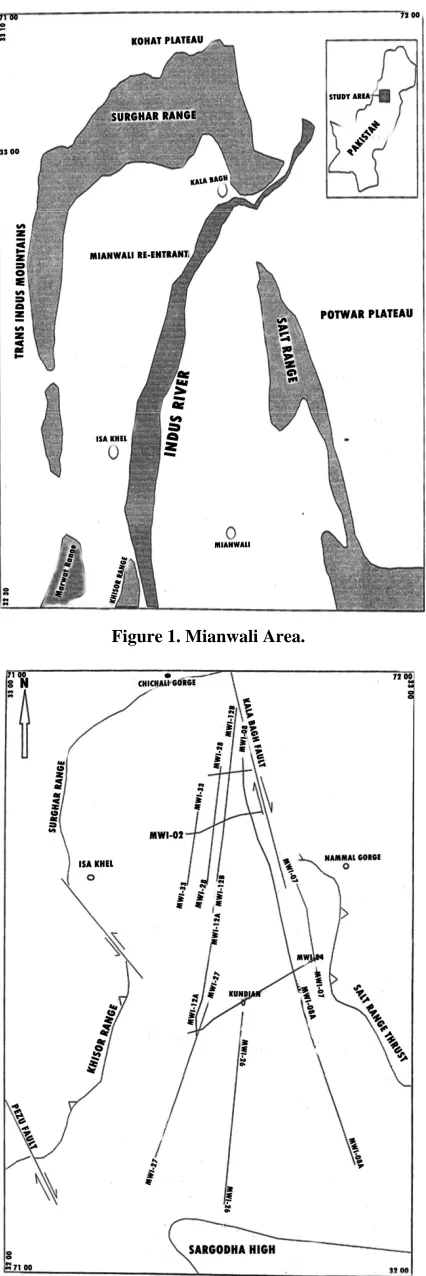
The location of the area is shown in Figure 1. It is
obliquely traversed by the river Indus; this area covers the
northern part of Mianwali district. The coordinates that bound the area are Latitude = 32˚ to 33˚ and Longitude 71˚ to 72˚. It covers an area of 4000 Km2. The base map
(Figure 2) is showing the orientation of seismic profiles
including the 904-MNW-12B with Well locations is shown in the figure while Figure 3 shows the section
showing stratigraphic sequence of salt range and trans- indus ranges as depicted by [1].
The area of Mianwali reentrant/depression lies within the North West Himalayan fold and Thrust belt [2]. We can say it lies within salt range and kohat-potwar fold belt. This east-west trending fold belt comprises the low rolling hills and valleys of the uplifted Kahat-Potwar Plateaue, the Salt Range and its westward extensions . It is about 85 km wide and extends for about 200 km. It is a discrete structural zone bounded in the north by the north-dipping Main Boundary Thrust [3-5]. and the Salt Range Thrust, Kalabagh Fault and the Surghar Thrust form its southern boundary. West and eastward it is terminated by the N-S oriented Kurram Thrust.
Figure 1. Mianwali Area.
Figure 2. Base map of Mianwali Area.
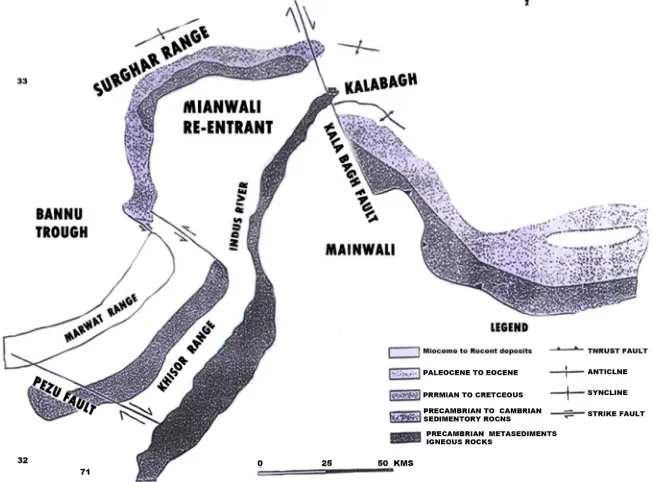
up thrusted western salt range, Sarghar and Khisor Ranges surrounded the area on three sides exposing rock as old as infra Cambrian [6] as shown in geologic map (Figure 4).
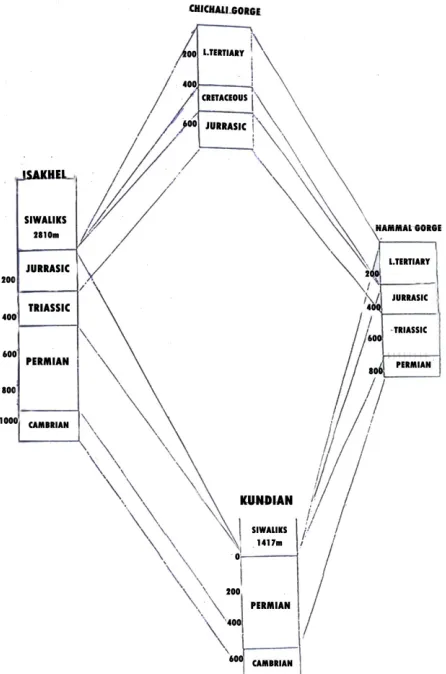
A stratigraphic correlation has been done in line of cross section from Nammal and Chichali gorges and on the basis of formation tops from well kundian, Isakhel. Location and line of section shown in Figure 5 and Fence
diagram is shown in Figure 6. The Lower tertiary strata is
present in Nammal and Chichali gorge while it is absent in Isakhel and kundian well i.e. lower tertiary strata is absent
in reentrant. In Isakhel well Jurassic is overlain by Siwalikhs in which cretaceous and lower tertiary strata is absent. In Nammal gorge section cretaceous strata is absent. In Chichali gorge section, Strata older than Mesozoic is not exposed. In Kundian well Permian strata is overlain by Siwalikhs. This shows that as we go towards southward. We find the strata towards lower tertary to permain become gradually absent. Source rocks rich in genetic potential and thermally mature exists in Triassic, Cretaceous and Paleocene sequences. Significant oil seeps occurs in surrounding ranges.
A sedimentary sequence ranging from Eocambrian to Recent is exposed in the Miawali Area. All the rocks ex- posed in the area are of sedimentary in origin. These comprise of Eocambrian evaporates (Salt Range Forma- tion) and shallow marine to non-marine Lower to Middle Cambrian sequence of dolomites, shales and sandstones (Jhelum Group) which are unconformably overlain by a thick Permian clastic and carbonate succession (Nilawa- han and Zaluch Groups). The stratigraphic sequence in Mianwali area is highly fossiliferous
Figure 3. Stratigraphic sequence of salt range and trans-indus ranges.
Figure 4. Map showing geology and tectonics of Mianwali Area.
structural trends change from east trending in the western part of the area to northeast trending in the eastern part of the area. The Paleozoic, Mesozoic, and Cenozoic se- quence exposed in the Area underlies the alluvial cover of the Jhelum and Indus Plains south of the study area [5]. Exploratory drilling immediately south of the area has shown that pre-Miocene erosion has removed Cambrian to Eocene rocks in that area [7]. The details study shows that area is the thrust-related tectonics .The porosity pin-chouts and lithofacie variation traps likely to exist in this
area.
[image:3.595.139.465.347.588.2]of shear zones in claystones/siltstone renders a great dif- ference in the intact and residual strength parameters [10].
3. Field Data Acquisition and Seismic Data
Processing
The base map of the Location area is shown in Figure 2
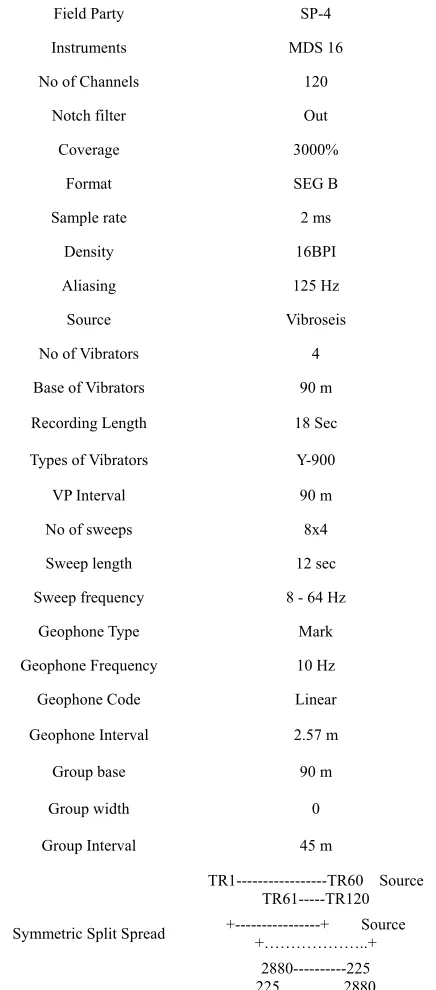
and the field data acquisition and recorded parametrs are given in the table below.
Field Party SP-4
Instruments MDS 16
No of Channels 120
Notch filter Out
Coverage 3000%
Format SEG B
Sample rate 2 ms
Density 16BPI
Aliasing 125 Hz
Source Vibroseis
No of Vibrators 4
Base of Vibrators 90 m
Recording Length 18 Sec
Types of Vibrators Y-900
VP Interval 90 m
No of sweeps 8x4
Sweep length 12 sec
Sweep frequency 8 - 64 Hz
Geophone Type Mark
Geophone Frequency 10 Hz
Geophone Code Linear
Geophone Interval 2.57 m
Group base 90 m
Group width 0
Group Interval 45 m
Symmetric Split Spread
TR1---TR60 Source TR61---TR120
+---+ Source +………..+
2880---225 225…………2880
[image:4.595.306.531.86.707.2]All the data is processed by the same basic steps of seismic data processing [11,12].
[image:4.595.64.282.213.708.2]Figure 6. The fence diagram.
4. Seismic Interpretation
Seismic interpretation revels the subsurface geological nature of earth, a fruitful interpretation of geophysical data and proving their geological significance by check- ing as well as integrating them with all types of geologi- cal information the influence of varying geological con- ditions is eliminated along the profile to transform the irregular recorded travel times into acceptable subsurface model, this is important for the confident for depth ge- ometry of bed rock or target horizons [13].
The seismic data could be interpretated into modes. In the area of subs tensional well control in which well in-formation is tight to the seismic inin-formation and then this seismic interpretation are applied to the zone of intrest. In the second mode when the area has no well control the seismic velocity data provide both definition of structures and estimates of depositional environment. There are two approaches for interpretation of seismic section i.e.
Stratigraphic and Structure analysis. [14,15]. The appli-cation of structural analysis of seismic is in the search of structural traps containing hydrocarbons. The strati-graphic analysis involves the subdivision of Seismic sec-tion into sequence of reflecsec-tion that are interpretated as
seismic expression of genetically related sedimentary sequence
4.1. Geological Model of Mianwali Area
The regional and localized geologic setting in and around the Mianwali re-entrant is already discussed in above geology section [16] keeping that in view the geological data including surface geologic sections and well data has been incorporated to understand the geological Frame work of the area and to develop an imaginary model based on geological information. In this prospec- tive two cross section have been made on the basis of surface geology and well data.
4.2. Cross Section X
We have been made Cross-Section X from Chichali gorge section located in Surgahar range to well kundian, Isakhel, well. The orientation of cross section is N-S. In the Chichali gorge strata, of Eocene to Jurassic Level are exposed while in the kundian well Siwaliks directly overlies the Permian strata. Strata younger than Permian is absent in kundian well which may be due to erosion and cross section shows that strata from Eocene to Per- mian is being truncated against unconformity based Miocene.
4.3. Cross Section Y
This Cross Section Y is E-W orientated and it has been made on the basis of Nammal gorge section and kundian and Isakhel Well. The well data has formation tops and thichness. In the Nammal section Eocene to Cambrian strata is exposed while is the kundian well Siwaliks di- rectly overlie the Permian strata. In Ehsa Khel Well Si- walik overlies the Jurassic strata. In Ehsa Khel Well strata from Jurassic to Cambrian has been encountered while in the strata lower tertiary is absent on the basis on this cross section. It can be said that older strata is being truncated against base Miocene and younger strata has been eroded while in the southern part near kundian there has been more Erosion, which has eroded all starta younger than Permian.
Eocene to Cambrian has been deposited in the area but eroded later on.
4.4. Seismic Interpretation
The foremost and major step in seismic interpretation to is mark or identifies the reflections. On the seismic sec- tions, this can be drawn with the help of
depth of formation from tops from the well;
Using average velocities and interval velocities de- rived during Processing of Seismic data;
Geologic and Seismic Character of Different Lithol- ogy.
So for the Identification and correlation purpose of each reflection on seismic section, average thickness of starta should be used, these average thickness has been calculated by using thickness of sedimentary strata from the well (kundian, Isakhel, well) and surface geologic section(Nammal and Chichali)
In the given seismic section, numbers of prominent re- flectors are present. Out of these eleven reflectors has been marked and interpretated in time domain by calcu- lating their velocities and converting these velocities into depth, for this purpose lithological well data of Isakhel located east of seismic lines has also been used since the well is located at some distance from the lines we cannot solely rely upon it has been used to roughly estimate the thickness of different formations.
4.6. Dix Isovelocity Contour Map
[image:6.595.309.537.84.730.2]The given seismic section is provided with root mean square interval and average velocities at selected CDP,s. An average velocity contour map, which is shown in
Figure 7, is obtained by time verses CDP,s the axis
showing the CDP,s are then converted to vibroseis point interval for same velocity interval. The countour are passed at 100 m per second interval, the average velocity on time t = 0, t = 5 sec vary from 1500 m/s to 4600 m/s
4.7. Time Section
A seismic section with displays reflection arrival time variation along the profile is called a time section. The position of reflection on time section of course depends on velocity difference as well as on layer thickness. The undulation of dips of deeper reflectors is not clearly dis- played on the time sections. The time section has been prepared by observing the time of reflection under each VP then by plotting VP,s value along horizontal axis and time along vertical. We get the time section as it is shown in Figure 8.
4.8. Depth Section
[image:6.595.312.534.86.383.2]A seismic section that displays the reflectors depth is
Figure 7. Iso velocity map.
called the depth sections the depth sections clearly dis-plays the undulations and dips of deeper reflectors. The wavelet positions depend only on layer thickness. and depth section by isovelocity methods is prepared by su-perimposing the time sections over isovelocity maps and then measuring the velocity of the reflectors by methods of interpolations under the Vibroseis Point, then the time of reflectors is multipled with the velocity of reflectors and then dividing it by two we get the depth value. This Procedure is applied for all reflectors.
Mathematically, Depth = (V) * (T/2)
If datum lies above MSL, it is to be subtracted from all depth value which then gives the true depth. The depth value reflector varying between the different time inter-vals as below:
R1 lies between time interval t = 1.25 sec to 1.435 sec it depth calculated by isovelocity method is vary as 1146.8 m to 1464.3 m.
R2 lies between time interval t = 1.471 sec to 1.467 sec it depth calculated by isovelocity method is vary as 1877.025 m to 1518.8 m.
R3 lies between time interval t = 1.62 sec to 1.825 sec it depth calculated by isovelocity method is 2126 m.
R4 lies between time interval t = 2.385 sec to 2.485sec it depth calculated by isovelocity method is vary as 3442 m.
R5 lies between time interval t = 2.47 sec to 2.52sec it depth calculated by isovelocity method is vary as 3543.3 m.
R6 lies between time interval t = 2.45 sec to 2.56 sec it depth calculated by isovelocity method is vary as 3526.65 m.
R7 lies between time interval t = 2.44 sec to 2.6 sec it depth calculated by isovelocity method is vary as 3710 m.
R8 lies between time interval t = 2.48 sec to 2.65 sec it depth calculated by isovelocity method is vary as 3690.13 m.
R9 lies between time interval t = 2.525 sec to 2.7sec it depth calculated by isovelocity method is vary as 3919.6 m.
R10 lies between time interval t = 2.575 sec to 2.725 sec it depth calculated by isovelocity method is vary as 4039.7 m.
R11 lies between time interval t = 2.93 sec to 3.08 sec it depth calculated by isovelocity method is vary as 4996.9 m.
4.9. Correlation of the Data with Stratigraphy of the Area
Precise correlation of the reflectors in terms of their depths with stratigraphy of the concerned area required a lot of experience, knowledge and details information of
the area. For the interpretation of the given seismic sec-tion, two well data and two exposed sections have been incorporated a no of prominent reflectors are visible in the given seismic section
The amount of reflectors coming in the range of vi- broseis point (VP) 199 to 620, are nine including base- ments, the reflector 4 could be the base Miocene uncon- formity as the result of depth correlated with Isha Kel1 well match significantly. The depth from the Isakhel well is correlated with average depth of reflector 4 from is- ovelocity method also the unconformity usually gives very strong reflection on seismic data. These can be identified by observing truncations against the reflectors. The horizon has also been correlated with horizons base, siwaliks from Khundiyan well. Here the base siwaliks has been identified as Base of Miocence.
4.9.1. Siwaliks
The Rawalpindi Group has been encountered in kundian and Isakhel, well, so the sediments above base Miocene are considered siwaliks
4.9.2. Mesozoic Strata
Whole of the Mesozoic starta is absent is kundian well While in Isakhel well Triassic and Jurassic strata is pre- sent. Hence as we go and move toward northern part of the area the Triassic and Jurassic strata shows its pres- ence. The interpretation of seismic lines near Khundiyan indicates the presence of Permiam starta below the Mio- cene.
However towards North reflections between base Mio- cene and top Permian strata appears truncating against base Miocene, these reflections has been interpretated as Mesozoic data.
4.9.3. Salt Range Formations
The reflections below the Cambrian starta and above basement have been interpreted as salt range formations because it shows white zone due to Presence of salt.
4.9.4. Basements
Basement shows very strong reflections on the seismic sections also the absence of any reflectors below the Identified basement confirms its Presence.
4.9.5. Note
In the Northern part of seismic section there lies a fault the reasons for it could be plunge of Khisor range as a result the data seems to be uplifted in the northern por- tion of seismic section. The data could not be interpreted further due to poor quality.
4.10. Structural Interpretation
one can be deduce the following conclusions:
All the sedimentary strata and basement is dipping towards north;
Basement is rising towards south east and exposed near Sargodha high. It is dipping towards north.
4.11. Stratigraphic Interpretation
By analyzing the seismic data countour map and depth section the following can be deduced:
The mianwali reentrant represent a depression and so very thick accumulation of Molasses up 3000 m;
Due to upward movement of basement towards south- east the sediments has eroded as erosion is more pro- minent toward Sargodha high;
Due to erosional unconformity the sedimentary strata from the Jurassic to Precambrian is being truncated gradually towards South;
The base Miocence is regional unconformity at the base of molasses and all truncations are against it;
There is no evidence of presence of Rawalpindi Group in this area.
5. Well-Used Reflector
The well used as references are Isakhel and the kundian on the basis of Isakheil-1, following are the formations shown on the Depth Section. Reflector r1 may be Dhok Pathan formation of Pliocene age, reflector, r2 may be the Nagri formations of Pliocene age, Reflector r3 may be Chinji formation of Pliocene reflector r4 marked the base Miocene unconformity reflector r5 is the Datta for- mation of Jurassic age reflector r6 is Tredian formation of Triassic age, reflector r7 is Amb formation of Permian age, reflector r8 is Sardhai formation of Early-Permian age, reflector r9 denotes the Khisor formation, reflector r 10 is Khewra formation and reflector r11 is basement both of Cambrian age.
6. Discussion
Summary and Discussion
Seismic attributes are the measure of seismic data that enables us to exaggerate the geological feature for inter- pretation, Using seismic survey we can map geological structures and which tells us the most appropriate drilling location [14,15], we use seismic data to configure the geometry of reflectors and about their depth This is only due to Seismic waves reflect at interfaces between mate- rials of different acoustic properties The amplitude of returned Wave Changes due to reflection, these changes at interfaces is due to impedance contrast (product of density and velocity).
The information of seismic amplitude can be used to blackout or invert for, relative impedance On the both
side of Interface when these seismic property is corre- lated with the measurement in the bore hole we may be able to extend well info through whole seismic volume, This Process is called seismic inversion for reservoir characterization which fill the gap in the knowledge of formation properties between wells. In forward modeling we start with model of earth properties, then mathemati- cal simulation of a physical experiment or processes like electromagnetic, acoustics on the earth model and finally output a model response. If our model and assumptions are accurate, the model will look like real data like as we did in above, and we can use the above depth section and iso velocity map data to backout. As in inversion, we start with actual measurement data, apply operations which are steps back to the physical experiment and de- liver earth model. If we do inversion properly, the earth model will look like real earth. Most measurements in Exploration and Production industry depend on inversion for the interpretation.
There is no equation for interpretations problems with which all multiple measurements directly related includ- ing noise, losses and other Inaccuracies answered in unique answer. Inversion is the mathematical way for estimating answer, checking it against observations and until acceptable solutions comes.
7. Conclusion
We can conclude by studying and analyzing seismic data, contour maps and depth section. The following can be deduced: Mianwali re-entrant represents a depression and very thick accumulation of molasses up to 3000 m. Due to upward movement of basement towards southeast, the sediments have eroded and the erosion is more prominent towards Sargodha High. Due to erosion unconformity the sedimentary, strata from Jurassic to Precambrian is being truncated gradually southwards. Base Miocene is the re- gional unconformity at the base of molasses and all.
REFERENCES
[1] A. H. Kazmi and M. Q. Jan, “Geology and Tectonics of Pakistan,” Graphic Publishers, Karachi, 1997, 133p. [2] A. N. Fatmi, M. Akthar, G. S. Alam and I. Hussain,
“Geological Society of Salt Range,” Pakistan Geological Congress (GSP),Islamabad, 1984.
[3] M. P. Coward and R. W. H. Butler, “Thrust Tectonics and the Deep Structure of the Pakistan Himalaya,” Geology, Vol. 13, No. 6, 1985, pp. 247-265.
doi:10.1130/0091-7613(1985)13<417:TTATDS>2.0.CO; 2
[4] G. Sarwar and K. A. DeJong, “Arcs, Oroclines, Syntaxis: the Curvatures of Mountain Belts in Pakistan,” In: Geo- dynamics of Pakistan, Geological Survey of Pakistan, Quetta, 1979, pp. 342-349.
layan Thrust Belt in northern Pakistan,” Marine Geology and Oceanography of Arabian Sea and Coastal Pakistan, Van Nostrand Reinhold Co., New York, 1984, pp. 177- 200.
[6] A. Kemal, “Geology and New Trends for Hydrocarbon exploration in Pakistan,” Proceedings of International Petroleum Seminar, 22-24 November 1991, Islamabad, 1992, pp. 16-57.
[7] D. M. Baker, “Balanced Structural Cross Section of the Central Salt Range and Potwar Plateau of Pakistan— Shortening and over Thrust Deformation,” M.S. Thesis, Oregon State University, Corvallis, 1988, 120p.
[8] Kalabagh Consultants, III, “Geology and Geotechnical Assessment,” Project Planning Report, 1984, 12p. [9] E. William, “Understanding the Effects of Structure and
Bonding in the Bringelly Shale,” In: K. Alshibli, H. Mal- kawi and M. Alsaleh, Eds., Geo Jordan 2004: Advances in Geotechnical Engineering with Emphasis on Dams, Highway Materials, and Soil Improvement, American Society of Civil Engineers, Irbid, 2004, pp. 194-201. [10] M. H. Malik and S. Farooq, “Geotechnical Aspects of the
Dhoke Pathan Formation at the Kalabagh Dam Site,” The Geological Bulletin of the Punjab University, Vol. 23,
1998, pp. 117-127.
[11] O. Yilmaz, “Seismic Data Processing,” Society of Explo- ration Geophysicsts, Tulsa, 1987, 523p.
[12] H.-N. Al-Sadi, “Seismic Exploration Technique and Proc- essing,” Birkhauser, Boston, 1980, 259p.
[13] L. Y. Faust, “Seismic Velocity as Function of Depth and Geologic Time,” Geophysics, Vol. 16, No. 2, 1951, pp. 206.
[14] E. S. Robinson and C. Coruh, “Basic Exploration Geo- physics,” John Wiley & Sons, New York, 1988, 562p. [15] M. B. Dobrin and C. H. Savit, “Introduction to Geo-
physical Prospecting,” 4th Edition, McGraw-Hill, New York, 1988, 867p.
Appendix
Well sheet summary well isakhel-01
Concession: Mianwali Reentrant (EL-Revised)
Latitude: 32˚38'N - 50.34N
KB Elevation
(m): 236.1(AMSL)
Longitude: 71˚12'E - 46.52 E
Ground
Elevation: 228.1m
Formations Depth from
KB(m)
Depth from
subsea(m) Thickness(m)
Alluvium+soan - - +326
Dhok Pattan −326 −90 717
Nagri 1043 −807 1353
Chinji 2396 −2160 414
Sammana Suk 2810 −2574 130
Shinwari 2940 −2704 −138
Datta 3078 −2842 208
Kingriali 3282 −3050 114
Tredian 3400 −3164 91
Mianwali 3491 −3255 101
Chhidru 3592 −3356 76
Wargal 3668 −3432 109
AMB 3777 −3541 76
Sardhai 3853 −3617 72
Warchha 3952 −3689 132
Dandot 4057 −3821 85
Tobra 4142 −3906 73
Khisor 51
Jutana 4266 −4033 54
Kussak 4320 −4084 34
Khewra 4354 −4118 326
TD 4680 −4444
Objectives
To detect the Presence of the following formations: Lamshiwal, Samanasuk, Datta (Primary) Tredian, Wargal, Tobra, Jutana, Khewra
(Secon-dary)
Well Status Dry and Abandoned
Test Result No Production Testing carried out at this well
Well sheet summary kundian.
Concession: Mianwali Reentrant (EL-Revised)
Latitude: 32027’06 KB Elevation
(m): 236.1(AMSL)
Longitude: 71035’06
Depth: 2160 m
K.B.C: 208.0
Province: Punjab
Formation: Khwera Sandstone
Formations Age Tops (m) Thickness (m)
Nagri Pliocene 0.0 1204
Chinji Miocene 1204.0 213.0
AMB Permian Late 1417.0 82.4
Sardhai Permain Early 1627.6 189
Warchha Permain Early 1710.0 52.3
Dandot Permain Early 1899.0 52.3
Tobra Permain Early 1951.3 7.3
Baghanwala Cambrian Middle 1959.0 52.6
Jutana Cambrian Middle 2011.0 148.2