EUR 5236 e
COMMISSION OF THE EUROPEAN COMMUNITIES
THE PRESENT STATE OF RESEARCH INTO
PLASMA HEATING AND INJECTION METHODS
1974
Report prepared by the Euratom Advisory Group on
LEGAL NOTICE
This document was prepared under the sponsorship of the Commission of the European Communities.
Neither the Commission of the European Communities, its contractors nor any person acting on their behalf:
make any warranty or representation, express or implied, with respect to the accuracy, completeness, or usefulness of the information contained in this document, or that the use of any information, apparatus, method or process disclosed in this document may not infringe privately owned rights; or
assume any liability with respect to the use of, or for damages resulting from the use of any information, apparatus, method or process disclosed in this document.
This report is on sale at the addresses listed on cover page 4
Π
at the price of B.Fr. 200,
Commission of the European Communities D.G. XIII - C.I.D. 29, rue Aldringen
L u x e m b o u r g December 1975
EUR 5236 e
THE PRESENT STATE OF RESEARCH INTO PLASMA HEATING AND INJECTION METHODS
Commission of the European Communities Report prepared by the
Euratom Advisory Group on Heating and Injection
Luxembourg, December 1975 - 130 Pages - 4 Figures - B.Fr.
200,-The advantages and disadvantages recognized by the Advisory Group on Heating and Injection for twelve Plasma Heating and Injection methods currently under investigation in Europe are related.
The heating and injection requirements of four reference reactor designs are previously defined. The problems which arise when one attempts to extrapolate existing work towards the reactor goal are emphasized.
Two refuelling methods not directly linked with the heating problem are discussed. The experiments in operation or under construction in Europe in which each method is investigated are listed.
Sixteen working papers which served as a basis for the Advisory Group discus-sion and which cover all the heating and injection methods examined are included.
EUR 5236 e
THE PRESENT STATE OF RESEARCH INTO PLASMA HEATING AND INJECTION METHODS
Commission of the European Communities Report prepared by the
Euratom Advisory Group on Heating and Injection
Luxembourg, December 1975 - 130 Pages - 4 Figures - B.Fr.
200,-The advantages and disadvantages recognized by the Advisory Group on Heating and Injection for twelve Plasma Heating and Injection methods currently under investigation in Europe are related.
The heating and injection requirements of four reference reactor designs are previously defined. The problems which arise when one attempts to extrapolate existing work towards the reactor goal are emphasized.
Two refuelling methods not directly linked with the heating problem are discussed. The experiments in operation or under construction in Europe in which each method is investigated are listed.
Sixteen working papers which served as a basis for the Advisory Group discus-sion and which cover all the heating and injection methods examined are included.
EUR 5236 e
THE PRESENT STATE OF RESEARCH INTO PLASMA HEATING AND INJECTION METHODS
Commission of the European Communities Report prepared by the
Euratom Advisory Group on Heating and Injection
Luxembourg, December 1975 - 130 Pages - 4 Figures - B.Fr.
200,-The advantages and disadvantages recognized by the Advisory Group on Heating and Injection for twelve Plasma Heating and Injection methods currently under investigation in Europe are related.
The heating and injection requirements of four reference reactor designs are previously defined. The problems which arise when one attempts to extrapolate existing work towards the reactor goal are emphasized.
Two refuelling methods not directly linked with the heating problem are discussed. The experiments in operation or under construction in Europe in which each method is investigated are listed.
LEGAL NOTICE
This document was prepared under the sponsorship of the Commission of the European Communities.
Neither the Commission of the European Communities, its contractors nor any person acting on their behalf:
make any warranty or representation, express or implied, with respect to the accuracy, completeness, or usefulness of the information contained in this document, or that the use of any information, apparatus, method or process disclosed in this document may not infringe privately owned rights; or
assume any liability with respect to the use of, or for damages resulting from the use of any information, apparatus, method or process disclosed in this document.
This report is on sale at the addresses listed on cover page 4
at the price of B.Fr.
200,-C o m m i s s i o n of the European C o m m u n i t i e s D.G. XIII - C.I.D.
29, rue Aldringen L u x e m b o u r g December 1975
EUR 5236 e
COMMISSION OF THE EUROPEAN COMMUNITIES
THE PRESENT STATE OF RESEARCH INTO
PLASMA HEATING AND INJECTION METHODS
1974
Report prepared by the Euratom Advisory Group on
ABSTRACT
The advantages and disadvantages recognized by the Advisory Group on Heating and Injection for twelve Plasma Heating and Injection methods currently under investigation in Europe are related.
The heating and injection requirements of four reference reactor designs are previously defined. The problems which arise when one attempts to extrapolate existing work towards the reactor goal are emphasized.
Two refuelling methods not directly linked with the heating problem are discussed. The experiments in operation or under construction in Europe in which each method is investigated are listed.
S E C T I O N
CONTENTS Page List of Members of Heating and Injection Advisory Group,
and of Experts Consulted (iii) SECTION A
The present state of research into Plasma Heating and Injection methods
1. Introduction 9 2. The heating and injection requirements of the four reference
reactor designs
(a) Tokamak 11 (b) Stellarator 11 (c) Mirror 1 1
(d) Toroidal Pinch 12 3. The advantages and disadvantages of proposed heating and
injection methods
(a) Heating methods which rely upon quasi-stationary plasma currents
(i) 'Turbulent' heating 13 (ii) 'Shock' heating 13 (iii) 'Adiabatic' compression 14
(b) Heating methods based on the absorption of electro- 14 magnetic energy
(i) Ion transit time magnetic pumping 15 (ii) Electron transit time magnetic pumping 15
(iii) Ion cyclotron heating 16 (iv) Lower hybrid resonance heating 17
(v) Laser plasma heating 18 (c) Heating methods based on the injection of energetic
particles
(i) Neutral atom injection 19 (ii) Cluster injection 20 (iii) Gun plasma injection 21
(iv) Relativistic electron beam heating 22
4. The reactor refuelling problem 23
5. Conclusions 25 SECTION Β
Working papers submitted to the Advisory Group
1. Terms of reference of the working groups 30 2. The heating requirements of various fusion reactor
concepts 32 3. Constraints upon plasma heating and refuelling concepts
imposed by the reactor environment 37 4. Heating methods which rely upon quasi-stationary plasma
currents
(a) Ohmic and anomously enhanced ohmic heating 43 (b) 'Turbulent' heating (j parallel to B) 47 (c) 'Shock' heating (j perpendicular to B) 52
(d) Adiabatic compression 58 5. Heating methods based on the absorption of electromagnetic
energy
(a) Ion TTMP 65 (b) Natural resonance heating 70
(c) Laser-plasma heating 81
Page 6. Heating methods based on injection of energetic particles
(a) Neutral atom injection 89 (b) Cluster injection 97 (c) Gun plasma injection 102 (d) Relativistic electron beam injection 108
7. Reactor refuelling methods
(a) Pellet injection 115 (b) Gas blanket 119 Appendix: Questionnaire - extract from Section B.l. Pull-out supplement
The membership of the Euratom Heating & Injection Advisory Group
(including alternate members) during the two years within which this report was prepared was as follows:
Chairman: C.J.H. Watson UKAEA Culham Laboratory, Abingdon, Berks., U.K. Members EURAECRE EURCEA EURCNEN EURCNR EUREB EURFOM EURIPP EURKFA EURUKAEA EURJET EURBRU 1973 F. Øster A. Samain Μ. Brambilla M. Haegi R. Luppi 1974 F. Øster C.T.Chang V.Jensen Address
Research Establishment, Riso 4000 Roskilde, Denmark
A. Samain DPH PFC CENFAR, Boite Postale No.6 F.P.G.Valckx 92260 FontenayauxRoses, France E.Canobbio P.P.Lallia M. M. Haegi Martone
M. Fontanes! M.Fontenesi
DPH PFC CENG, Cedex 85, Centre de Tri, 38400 Grenoble, France
Laboratorio Gas Ionizzati, EURATOMCNEN, Casella Postale No.65, 00044 Frascati, Roma (Rome) Italy.
Laboratorio di Fisica del Plasma ed Elettronica Quantistica, Instituto
Scienze Fisica, Via Celoria 16, Milano,Italy. A.Messiaen A.Messiaen Ecole Royale Militaire, Laboratoire de
P.Vandenpias P.Vandenpias Physique des Plasmas, Avenue de la
R.R.Weynants R.R.Weynants Renaissance 30, 1040 Bruxelles, Belgium. H.W. Piekaar H.deKluiver
H.J. Hopman H.J.Hopman
M. Tutter J. Junker J, S. Junker Puri M.Keilhacker G.Schilling
M. Salvat K.N. Dippel
H. Tuezek
K.N. Dippel H. Tuczek
FOMInstituut voor Plasma Fysica, Rijnhuizen, Postbus 7, Jutphaas, The Netherlands
FOMInstituut voor Atoom en Molecuulfysica Kruislaan 407, Amsterdam, The Netherlands. MaxPlanckInstitut für Plasmaphysik
Garching bei Munchen, West Germany
EURATOMKFA, Institut für Plasmaphysik 517 Jülich 1, Postfach 365, Germany. H.C. Cole H.C. Cole
A.C. Riviere S.S.Spalding Berks T.S.Green
J. Sheffield "
UKAEA Culham Laboratory, Abingdon, U.K.
M. Geiger U. Finzi Commission des Communautés Europeennes DG III/Fusion, 200 Rue de la Loi
1040 Bruxelles, Belgium
The main work of preparation of the report was carried out in 1973: however the final revisions, and the conclusions reached, are the responsibility of the 1974 membership.
In addition, a large number of experts on the various methods of heating and injection participated in the work. The following experts contributed to working papers submitted to the Advisory Group during 1973.
EURATOMCEA, FontenayauxRoses
EURATOMCNEN, Frascati
Drs J. Adam, R.A. DeiCas, J.P. Girard, F. Bottiglioni, J. Coûtant, M. Fois.
Prof. B. Coppi, Drs A. Cavaliere, F. Engelmann, L. Enriques, F. Santini
EURATOMFOM, Jutphaas EURATOMIPP, Garching EURATOMKFA, Jülich, EURATOMUKAEA, Culham
Drs H. deKluiver, Β. Brandt
Drs S. Puri, G. Schilling, C. Andelfinger Dr W. Bieger
Drs D.R. Sweetman, P. Davenport, D. Robinson, S.M. Hamberger, W. Millar, C.N. LashmoreDavies, I.J. Spalding, J.G. Cordey, J. Sheffield
Kernforschungszentrum, Karlsruhe Drs R. Klingelhöfer, W. Henkes
In addition, we benefited from correspondence or discussions at our meetings with: Drs. J.G. Wegrowe, M. Kaufman and C.B. Wharton of EURATOMIPP, Garching, J.C. Martin of AWRE, Aldermaston, and Drs A. Gibson and R. Hancox of EURATOMUKAEA, Culham Laboratory.
We would like to acknowledge here our gratitude to all these experts for the (often considerable) time which they put at our disposal, and also to Mr J.L. Hall and the members of the staff of Culham Laboratory who undertook the task of the editing and publishing of the final text.
— 9 —
THE PRESENT STATE OF RESEARCH INTO PLASMA HEATING AND INJECTION METHODS 1. INTRODUCTION
During this decade, the mean energy content of the plasmas in fusion containment experiments will again rise by an order of magnitude. In the largest of the experiments now being designed, the contained energy will be only one order of magnitude short of that required in a fusion reactor: in the Joint European Tokamak, for example, the plasma will have a total energy of 20 MJ. The provision of such large amounts of energy within one containment time implies high power levels, and hence technologically sophisticated equipment. The rising energy requirement will therefore be matched by an increase in expenditure. The rate of investment in research
on plasma heating and injection in Europe, which has for some years been at a level of 1 - 2 MUC per annum, will probably have to be increased to meet the needs of JET, and certainly to meet the needs of a fusion reactor programme. There will have to be more coordination of this research, and possibly more concentration on the most promising lines, if the requirements of the next generation of containment devices are to be met.
Against this background, the Euratom Heating and Injection Advisory Group decided that it was opportune to prepare a report on the present state of research in this area, with a special emphasis on the problems which arise when one attempts to extrapolate existing work towards the reactor goal. The present Report is the outcome of that decision. We have attempted to make the discussion as complete as possible: we have considered all the heating and injection methods which are currently under investigation in Europe, we have examined them in relation to four different fusion reactor designs, and we have taken into account not only the energy requirements of a reactor but also its need for some means of refuelling and (in some cases) for some means of maintaining a toroidal current within the plasma.
Our method of work is described in Section B.l: in essence, a small working group of experts was set up for each heating and injection method,
and these groups prepared in draft form the various sections of this report. These were discussed at four meetings of the Advisory Group, and revised and approved versions of them appear as Sections B.4-B.6. In addition, working groups were set up to examine the heating and injection requirements
— 10
appear as Sections B.2-B.3. Finally, for completeness, we asked experts on the reactor refuelling problem to prepare papers on the two refuelling methods which are not directly linked with the heating problem and these appear in Section B.7.
In the light of the evidence submitted to the Advisory Group by these working groups, we have attempted in the following pages to assess the heating and injection requirements of each of the four reference reactor designs, and to sum up the case for and against each method (bearing in mind the rather differing requirements and constraints of the reference reactor designs) and to give the overall judgement of the Group on its prospects. In the first instance, we sought to express this judgement by assigning a letter to each method, using the scheme of classification proposed in Section B.l, and traces of this procedure can still be found in the papers in section B. However in the end we decided that it was more useful to give a very brief
summary of the principal advantages and disadvantages of each method, as they now appear to us, and these 'assessments' will be found at the foot of each section of part 3 below and are collected together in the Conclusions on
— 11 —
2. THE HEATING AND INJECTION REQUIREMENTS OF THE FOUR REFERENCE REACTOR DESIGNS
2(a) TOKAMAK
This was taken as an example of a low β toroidal reactor with a plasma
initially heated by an ohmic heating pulse and then raised to ignition (and possibly sustained in a steady state) by some supplementary heating or
injection method. The supplementary heating requirement is highly controversial, and ranges from zero to 100 MJ depending on the assumptions made. Among the uncertainties are the enhancement of the classical resistivity by neoclassical effects, high Ζ impurities and anomalous resistivity, the enhancement of the energy loss rate above the neoclassical value (for which there is experimental evidence which is not understood), and the scope for low-density start up, which may be limited by synchroton radiation or by the particle containment
time. As regards the enhancement of the resistivity, only a substantial anomalous resistivity would permit ignition at full density, and this brings risks of both enhanced diffusional losses and of a strong skin effect leading to MHD instability. As regards low-density start up,the implied containment time (some tens of seconds) is at the upper limit of credibility. Our assess ment is therefore that it would be unwise at this time to rely upon the parti cular combination of favourable assumptions which lead to a small (< 10 MJ) heating requirement. We have in consequence arbitrarily fixed the requirement at 100 MJ, to be supplied within one second.
2(b) STELLARATOR
This was taken as an example of a low β steady state toroidal reactor,
in which the reaction is self-sustaining after ignition. The ignition
requirements of this system depend upon the extent to which provision is made for ohmic heating during start-up. If ohmic heating currents at the Tokamak reactor level are assumed to be acceptable, the supplementary heating required is of the same order as that required by the Tokamak reactor, and is subject to
the same uncertainties. If for some reason, such large currents are unacceptable, the supplementary heating requirement would be proportionately increased.
2(c) MIRROR
— 12 —
at present, and the requirement may be as large as 3400 A equivalent at
500 keV or as small as 1000 A equivalent at 100 keV depending on assumptions. 2(d) TOROIDAL PINCH
This was taken as an example of a high β fast pulsed reactor. There
13 —
3. THE ADVANTAGES AND DISADVANTAGES OF PROPOSED HEATING AND INJECTION METHODS 3(a) HEATING METHODS WHICH RELY UPON QUASI-STATIONARY PLASMA CURRENTS
3(a)(i) 'TURBULENT HEATING (j parallel to B) The case for
The required energy can be provided by a credible extrapolation of existing condenser technology.
The transfer of energy to a plasma by this means has been demonstrated: the energy will probably penetrate the whole plasma and the final state of the plasma can be stable. The case against
The overall energy efficiency is likely to be ~ 30% with little prospect of recovering the losses. The cost of the energy storage system could be high (~ 1000 MUC).
The vacuum wall of the reactor must have insulating gaps capable of withstanding fields of ~ 7 kV/cm.
There may be highly anomalous plasma losses during the brief heating pulse.
There may be a problem in maintaining MHD equilibrium during the pulse.
Assessment
Existing experiments work on rather short time scales and have been successful in producing interesting plasma densities and temperatures: however for economic and technological reasons
it is necessary to move towards substantially longer time scales and lower loop voltages, and there remain unsolved problems of
losses during the heating. Existing European Experiments
Turbulently heated Tokamaks at Frascati and Jutphaas; turbulently heated Torsatron at Culham.
3(a) (ii) 'SHOCK' HEATING (j* perpendicular to B) The case for
The required energy can be provided by a credible extrapolation of existing condenser technology.
The method is the only one presently available for filling
large high β toroidal devices.
The case against
The overall energy efficiency is likely to be ~ 10%: there is some scope for recovering magnetic field energy. The cost of the energy storage could be high (~ 1000 MUC).
The vacuum wall of the reactor must have insulating gaps capable of withstanding ~ 10 kV/cm.
— 14 —
Assessment
This method has been successful in producing fusion plasma conditions and has strong advantages as the means of heating the next generation of high|3 experiments: however it is only applicable to a few rather specialised reactor concepts and requires either a major breakthrough in the economic fast storage of energy or for it to play a complementary role in some combined heating system.
Existing European Experiments
Shock heated high β tori at Culham, Garching, Jülich; shock heated mirror at FontenayauxRoses.
3(a)(iii) 'ADIABATIC' COMPRESSION The case for
The required energy can be provided by existing flywheel generator technology (or cryogenic energy storage in the future) at very modest cost (~ 10"^ UC/J).
The method has been shown to work in a large number of
experiments, some of which have approached fusion conditions (4 keV at 10'·^ cm~^), and it is theoretically capable of closing the ohmic heating gap in Tokamaks, provided that Bremsstrahlung cooling is dominant.
The slow heating rate minimises the risk of streaming insta bilities and the fields can enhance kink stability.
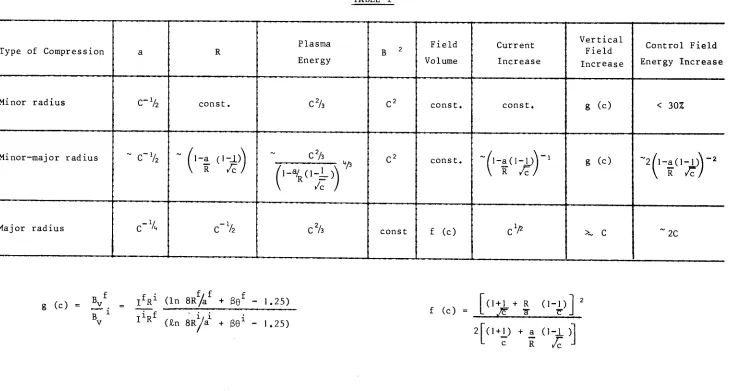
No hardware is required inside the vacuum wall. The case against
The method requires a large (46 fold) increase in the
magnetic field energy of the containment system over a reactor heated in some other way. The implicit cost per Joule delivered to the plasma is ~ 1 UC/J, although this figure could be reduced to 0.2 UC/J if the plasma can be reexpanded after ignition. The energy efficiency of the method is only 25% due to leakage inductance and resistive losses.
The method is of little value if the reactor relies upon wall effects for stabilisation thus high β configurations are effectively excluded.
Assessment
This method is applicable to a few specialised reactor concepts in which it has considerable promise, possibly in combination with other methods: however from an economic standpoint it
depends critically on the reexpansion of the plasma column after ignition to fill the containment vessel.
Existing European Experiments
— 15 —
3(b) HEATING METHODS BASED ON THE ABSORPTION OF ELECTROMAGNETIC ENERGY 3(b)(i) ION TRANSIT TIME MAGNETIC PUMPING
The case for
The method requires RF power at a frequency below 1 MHz : the required power is almost available and certainly credible, with high efficiency.
The losses between RF generator and plasma can in principle be made very small (< 10%).
The modulation of the confining magnetic field need not exceed 0.1%, so theoretically there should be a negligible effect on equilibrium.
The rate of heating is low and uniformly distributed within
the plasma and it should not adversely affect the plasma stability. There is a possibility that a version of TTMP might be used to solve the refuelling problem.
The case against
The only toroidal TTMP experiment to date has encountered a major problem of enhanced plasma loss. Some preliminary
theoretical considerations suggest that this problem may become less serious in larger machines.
The method requires a number (2-10) of coils, probably associated with electrostatic screening, situated inside the first wall of
the reactor and at an adequate distance (~ 20 cm) from it. There are two major problems: insulation across the terminals (~ 100 kV if there is only one gap) and cooling the coils (possibly requiring heat pipe technology).
Assessment
This method has the advantage over other RF heating methods in that its efficiency increases with plasma density and radius: however heating without pumpout has still to be demonstrated and serious technological problems are raised by the need for coils within the vacuum chamber.
Existing European Experiments TTMP on stellarator at Culham. TTMP on Tokamak at Grenoble
TTMP on stellarator at Grenoble/Garching. 3(b)(ii) ELECTRON TRANSIT TIME MAGNETIC PUMPING
The case for
The required frequency k ν is in the range 1-10 MHz. The required power is almost available and certainly credible, with high efficiency at (-0.2 UC/Watt). As in ion TTMP
the losses between RF generator and plasma can in principle be made small (~ 25%).
The interest of the method lies in the fact that at the frequency ω = k ν for which strong collisionless damping exists, one of
the first magnetosonic resonances (k±a = 2.4), which is a reson
— 16 —
enhanced field inside the plasma. The rf power absorption is thereby maximised and, for a given absorption of power by the plasma, the power losses in the wall are reduced with
respect to ion TTMP by a factor N/V./V .
Heating is uniformly distributed within the plasma and it should not adversely affect the plasma stability (see existing experiments using magnetosonic resonances on Tokamaks, in which however, at present parameters, the heating mechanism is a non-linear one;.
The case against
It has not yet been tried experimentally with electron TTMP
as damping mechanism. Like ion TTMP,the method requires a number (2 to 10) of coils (or, possibly, of retractable loops) situated inside the first wall of the reactor.
Assessment
This recently proposed method has the advantage that the magneto-acoustic resonance of the plasma toroidal cavity system strongly enhances the wave within the plasma, and the wave is strongly
damped when ω =* kMv ; however there are again serious technological
problems due to the need for coils within the vacuum chamber. 3(b)(iii) ION CYCLOTRON HEATING (including harmonics of the ion cyclotron
frequency)
Note The following discussion refers to heating at twice the ion cyclotron frequency as this is considered to be the most credible heating method for a reactor in this frequency range.
The case for
The method has been used at low power level in a Tokamak and no additional losses were observed.
The acquired RF power (in the 1 metre waveband) is nearly available and certainly credible: the overall efficiency with which it can be produced is ~ 50%.
The power could be fed into the reactor by means of large waveguides, and a partially-plasma-filled torus could act as a resonant cavity in a rather high radial mode number.
According to theory, at these frequencies even linear damping gives an adequate heating rate and the required field strengths are
~ 100 V/cm. (At higher harmonics the waveguide size can be reduced but the cavity resonance condition is less readily fulfilled and it is necessaary to invoke non-linear damping, with a higher threshold field strength.
The case against
The required waveguide has a minimum size of order 1 metre (unless this could be reduced by dielectric loading or shaped waveguide cross section).
The field strength within the waveguide (~ 2 kV/cm) may exceed the breakdown fields under ambient reactor conditions, especially near
its junction with the torus.
— 17 —
The RF generating and frequency tracking equipment is likely to be expensive (~ 1 UC/watt).
The method preferentially heats ions in the transverse direction, and may enhance banana diffusion.
At the required field strengths, parametric instabilities might decrease the containment time.
Assessment
In reactor designs which permit 1 meter access ports, this method has the attractive feature that it is possible to supply the power through unloaded wave guides which could also be used for pumping: however, there may be breakdown problems associated with the high electric fields and there may be a difficulty over dynamic frequency tracking and matching.
Existing European Experiments
Ion cyclotron heating on stellarator at Grenoble/Garching. Ion cyclotron harmonic heating on linear θ-pinch and toroidal screw pinch at Jülich.
3(b)(iv) LOWER HYBRID RESONANCE HEATING The case for
The method has been tested at low power levels with no observed increase in diffusion and an efficiency of 50%.
RF power sources at the required level could be developed,on a credible extrapolation of existing technology, at a cost of ~ 0.4 UC/watt. It is possible to use waveguides of moderate (~ 20 cm) dimensions to launch the waves and these could be
bent outside the neutron blanket. For credible reactor parameters (ne ~ 1 0 ^ cm"3, B = 100 kG) the matching problem may not be
difficult.
The case against
According to present theory (which is still rather preliminary) the situation on the accessibility and matching problem is as follows :
For axial fields below 100 kG, the maximum accessible density, with no mismatch problems,is restricted to 1 χ l O ^ cm~3, if the grazing incidence approach is used. The energy efficiency of this scheme is ~ 50%, the losses being uniformly distributed over the torus walls.
Higher densities are accessible, but with possible matching
problems, using a phased array of waveguides acting as a slow-wave-structure. If a mismatch exists, the losses (~ 40%) will occur within the waveguides.
Both matching and density limit problems can simultaneously be solved by using a passive slow-wave structure but this has
difficulties of mechanical construction and cooling and may cause impurity problems.
Assessment
This method fully exploits the advantages of waveguide launching:
however its viability depends critically on the accessibility of
— 18
theoretical predictions indicated that this is just possible, but there is only a small margin and there is as yet no
experimental evidence.
Existing European Experiments LHRH on linear machine at Brussels LHRH on mirror at Garching
LHRH on stellarator at Grenoble/Garching LHRH on mirror machine at Milan.
3(b)(v) LASER PLASMA HEATING The case for
The method has already been used to fill a mirror machine
with a high β 100 eV plasma and a stellarator with a plasma.
Toroidal reactor power requirements represent a credible
extrapolation of existing laser technology: the overall energy efficiency might eventually be 10 - 40%.
No internal hardware is required. Access holes into the reactor could be of ~ 10 cm diameter and could (by contrast with neutral beam heating) incorporate neutron traps.
The method might perhaps be used to accelerate small hydrogen pellets into a steady state reactor for refuelling purposes. The cost might eventually be low - the figure of ~ 37 MUC per
100 MW delivered to the plasma has been estimated, assuming a 10% heating efficiency. (This corresponds to a cost of
~ 0.025 uc/W(E) of power generated). The case against
The plasma created initially is far from MHD equilibrium (β » 1) and the dynamics of the resulting expansion are at present a matter for speculation. Polarisation fields or streaming instabilities might lead to rapid plasma loss.
Incomplete ionisation of the pellet, or β > 1 expansion followed
by wall contact, could greatly enhance the background gas pressure. The present cost calculations assume both a low repetition rate (~ 100 per second) for the laser and heating near the critical density: it is not clear that these assumptions are compatible unless either laser acceleration of pellets (to ensure penetration) or some combination of low density/small radius start-up is
feasible. It is not obvious that the energy requirement is only 100 MJ, unless the method can in some way be combined with ohmic heating. (One possibility is to adapt the 'moving limiter' concept). Assessment
The attractive feature of this method is the small access requirement and the potentially low cost: however there are major uncertanties about the penetration of the pellets into the plasma and the
expansion of the heated pellet. Existing European Experiments
— 19
3(c) HEATING METHODS BASED ON THE INJECTION OF ENERGETIC PARTICLES 3(c)(i) NEUTRAL ATOM INJECTION
The case for
Neutral beams with either the current or the voltage required are already available, but not both together, and not yet for very long pulses. The power already available in single units is 200 kW for pulses of 20 ms. The extrapolation to high power units operating quasi-continuously is credible.
The method has already been used to create and maintain a 10 keV plasma at a density of 10 in a mirror machine and to increase the ion temperature in Tokamaks by ~ 20% without evident signs of enhanced losses. This increase is approxi-mately what would be expected theoretically.
The energy efficiency could in principle be high if either negative ion sources or efficient direct conversion of the un-neutralised portion of the ion beam prove to be practical. No internal hardware is required: ten holes of ~ 30 cm diameter through the blanket would probably suffice, and would have a negligible effect on neutronics.
Beams of 3 MeV (parallel injection) or 1 MeV (perpendicular injection) should suffice to penetrate a reactor plasma with n = 3.10·^: these energies are reduced by a factor of 4 if n = IO14.
Theoretically parallel injection should not lead to dangerous instabilities, though perpendicular injection might enhance the loss rate due to the large banana orbits or to trapped particle instabilities.
There is a theoretical possibility that parallel neutral injection might be used to maintain a steady state Tokamak equilibrium, especially if the current is enhanced by the theoretical bootstrap effect.
In mirror reactors, neutral injection solves the refuelling as well as the heating problem.
The case against
The energy (3 MeV) required for penetration in the case of parallel injection (which is favoured on stability grounds, and for maintaining toroidal currents) may be technologically difficult (and hence expensive) to achieve at the high current levels required. The possibility of working at lower energies is still speculative. It is suggested that plasma impurities would reduce the penetration depth at a given energy.
The energy efficiency of 1 MeV beams of positive molecular ions without direct convertors is only 20%: the feasibility of high-efficiency direct convertors of acceptable cost has not been demonstrated.
— 20
The straight-line trajectories of the neutrals create a
difficulty in screening out fusion neutrons without enclosing the entire hardware (including direct convertors) within a thick biological shield.
The slow gas current associated with the beam represents .03% of the total plasma content appearing at the plasma surface.
The consequences are uncertain.
In mirror devices, the plasma is less stable than theoretically predicted during injection: in toroidal devices the injected power has hitherto been a small fraction of the ohmic power. Even at 1 MeV, the total cost of 100 MW could be ~ 50 MUC: no estimate is available for the extra cost of 3 MeV operation. Assessment
This method has been operated successfully at the 100 kW level in existing experiments and the extrapolation to reactor power levels is credible: however it is necessary either to develop an acceptable means of penetrating the plasma at ~ 100 keV
(e.g. by low density or small radius startup) or to achieve a sufficiently high efficiency when operating at 1 MeV.
Existing European Experiments
Neutral beam development at Fontenay-aux-Roses, Garching,
Culham; neutral injection into Levitron, Stellarator and Tokamak at Culham, into Tokamak at Fontenay-aux-Roses, and into
Stellarator and Tokamak at Garching. 3(c)(ii) CLUSTER INJECTION
The case for
Generally the same as for neutral injection. However clusters have some specific advantages:
Space charge is less important in the accelerator design because of the 100 fold greater mass/charge ratio.
There is no difficulty in achieving DC operation.
There is no difficulty in neutralising an accelerated cluster with high efficiency.
The associated slow gas flow should be less than from an ion beam neutraliser.
The beam has a naturally spread velocity distribution, which should minimise instabilities.
For a given energy per atom, clusters have a somewhat enhanced ability to penetrate a plasma.
As regards the availability of power at present a 1 MV, 10 keV/atom
10 A equivalent cluster ion acceleration is under construction. The power already available in single unit rectifiers is 500 kW at 2.5 MV steady state.
— 21 —
The case against
In general the same as for neutral injection, except that cluster beams have not yet been injected into a plasma, and so far the power available in cluster beams has been much less than that in neutral atom beams.
There is no immediate prospect of going beyond 100 keV per atom, and even this requires a 10 MV accelerator. Thus the method is only credible, as applied to toroidal reactors, if the penetra tion problem can somehow be circumvented (e.g. by plasma build-up with a growing plasma radius), and only credible in relation to mirror reactors if 100 keV operation is feasible. The feasibility
of 10 MV, 1 Amp equivalent accelerators needs to be established. Assessment
Unlike neutral injection, this method has not been tested experimentally on a plasma, but it potentially has several advantages (spread velocity distribution, enhanced penetration, possibly higher neutralisation efficiency): however it is limited to 100 keV/atom (10 MV acceleration) and even with two fold
enhanced penetration it is tied to a low density or small radius start up.
Existing European Experiments
Cluster source development at Fontenay-aux-Roses, Karlsruhe. Cluster injection into Tokamak at Fontenay-aux-Roses
Cluster injection into Stellarator at Garching/Karlsruhe. 3(c)(iii) GUN PLASMA INJECTION
The case for
The method has been shown to work in present generation containment devices.
There is a doubtful prospect that the compressed flow device might be developed to meet the reactor energy requirement. The case against
There is a major problem in transporting the gun plasma into the containment field. Cross field injection leads to polarisa tion field losses: longitudinal guide fields need to be pulsed in ~ 25 με and do not solve the problem of access to the centre of the reactor.
The overall energy efficiency is likely to be low.
The cost per joule delivered is likely to be extremely high. Assessment
This method is not applicable to a reactor unless some unexpected development allows the efficient transport of the injected plasma across the magnetic field.
— 22 —
3(c)(iv) RELATIVISTIC ELECTRON BEAM HEATING The case for
The power requirement represents a credible extension of existing technology.
Theoretically and experimentally, turbulence generated by the return current is an effective plasma heating method.
It is conceivable that an injected relativistic beam might be used to maintain a steady state toroidal or multiple mirror configuration (Yoshikawa, Budker).
The case against
Existing technology is already very advanced (military applications) and even the proposed two-fold increase in voltage would be a
major step. It is not obvious that further economies of scale are obtainable and existing costs (~ 10 UC/Joule) are discouragingly high. The proposed value of the anode-cathode spacing (a factor of 2 smaller than Aurora) is controversial.
The energy efficiency of REB production is currently about 50% and heavy losses are normally experienced in transporting the beam over a few metres.
Unless a solution can be found to the beam transport problem, the diodes might have to be placed within the reactor vessel. It is doubtful whether 100 cm holes would suffice to feed the diodes, (the 12 MV coaxial feed of Aurora is 3k feet in diameter) and the neutronic implications of the hardware might be serious. The dynamics of the REB within a toroidal plasma are not under-stood: some elementary arguments suggest that the beam should ignore the magnetic field, but experimentally this does not appear to be the case. For the method to work as proposed, the beam must be confined within the plasma for - 100 circuits of the torus. Assessment
This method is not applicable unless some unexpected development permits both the use of low energy beams (~ 1 MeV) at high power and the efficient transport of the beam across the magnetic field on the relevant time scale (~ 10 nsec).
— 23 —
4. THE REACTOR REFUELLING PROBLEM
Of the four reactor concepts considered here, one (the Toroidal Pinch) avoids the refuelling problem by arranging for the plasma burn-up time to be of the same order as the overall pulse length, and one (the Mirror) solves the problem by operating at a density and mean energy such that the same neutral beam can be used both to heat and refuel it. The other two (Tokamak and
Stellarator; and indeed any steady state or quasi-steady state reactor concept in which the temperature of operation is too low for neutral atoms at that energy to penetrate the plasma) have a major refuelling problem. Four outline solutions to be problem are currently being investigated:
(i) Pellet injection
(ii) Large cluster -injection (iii) Gas blanket refuelling
(iv) TTMP pump-in
4(i) The pellet injection approach has the advantage that there is no
difficulty in meeting the material flux requirement: its principal disadvantage is that there is an upper limit to the velocity with which such pellets might
3 4
credibly be injected (10 - 10 m/s) and at such velocities the pellet would not penetrate to the centre of a reactor plasma unless it were shielded from plasma ablation by a neutral gas layer, plus either electrostatic or magnetic
effects. The best available experimental evidence (which is still very preliminary) suggests that the shielding by a neutral gas layer may not be effective. However, the loss rates observed may be affected strongly by the radial electric field
present. The experiment does not allow any conclusions to be drawn about electro-static or magnetic shielding. On existing theory, magnetic shielding should only be effective if the reactor operates at a ,6-value which is somewhat (~ twice) higher than the expected value for steady-state toroidal reactors. However, more work is urgently needed to obtain a definitive assessment of this method.
Q
4(ii) The large cluster approach is based on the fact that clusters of ~ 10 atoms can simultaneously be opaque to 10 keV electrons and transparent to recombination radiation. Such clusters could probably be accelerated electrostatically to 10 m/s, and at this velocity might pepetrate a reactor plasma provided that the reduced energy transfer sufficiently decreases the ablation rate. Such clusters can be produced, but so far there has been almost no work on this acceleration or on their penetrating power.
4(iii) The gas blanket approach is based on the argument that even if the probability that a neutral atom will penetrate to the centre of the reactor is
— 24 —
The principal problem is to establish that there exist parameters for which the transport of energy out of the plasma, which is enhanced by BremsStrahlung and collisions with the (necessarily high) helium component of the plasma, remains compatible with a favourable reactor energy balance. Existing theoretical
studies suggest that such a regime does exist, at least in an infinite cylindrical plasma with classical transport coefficients. The required magnetic field is
reasonable; the β value is high, but perhaps achievable. It remains uncertain
whether toroidal regimes also exist, in view of the enhancement of the transport coefficients due to toroidal effects. Existing experiments are still rather far from a reactor regime.
4(iv) The TTMP pump-in approach is based on the concept that a net inward
25 —
5. CONCLUSIONS
The present state of research into plasma heating and injection methods does not permit any very definite conclusions to be drawn. Of the twelve
methods which are currently under investigation in Europe, the assessment of the Advisory Group is that no method is so well established that it is clearly in principle applicable to the heating of a reactor, and has no foreseeable
difficulties; nor can any method be ruled out as completely hopeless. This is not to say that all twelve methods are equally placed, and in this report we have tried to identify both the particular advantages of each method, and the most serious problems which remain to be solved, if it is to be applicable to
the heating of a reactor. Naturally, this involves judgement, and in some measure the assessments which we have made are influenced by the particular
composition of the Advisory Group; nevertheless we believe that it is useful to present the assessment of a group of 27 physicists, who have examined the best evidence available to them in February 1974. Our assessments are to be found above: for ease of reference we collect them here.
Turbulent Heating. Existing experiments work on rather short time scales and have been successful in producing interesting plasma densities and temperatures: however for economic and technological reasons it is necessary to move towards substantially longer time scales and lower loop voltages, and there remain unsolved problems of losses during the heating.
Shock Heating. This method has been successful in producing fusion plasma
conditions and has strong advantages as the means of heating the next generation of high-ß experiments: however it is only applicable to a few rather specialised reactor concepts and requires either a major break-through in the economic fast storage of energy or for it to play a complementary role in some combined heating system.
Adiabatic Heating. This method is applicable to a few specialised reactor concepts in which it has considerable promise, possibly in combination with other methods: however from an economic standpoint it depends critically on the re-expansion of the plasma column after ignition to fill the containment vessel.
Ion TTMP. This method has the advantage over other RF heating methods in that its efficiency increases with plasma density and radius: however heating without pumpout has still to be demonstrated and serious technological problems are raised by the need for coils within the vacuum chamber.
Electron TTMP. This recently proposed method has the advantage that the
26 —
the wave within the plasma, and the wave is strongly damped when ω - k v ; however there are again serious technological problems due to the need for coils within the vacuum chamber.
ICRH (multiplesof r^). In reactor designs which permit 1 meter access ports, this method has the attractive feature that it is possible to supply the
power through unloaded wave guides which could also be used for pumping: however, there may be breakdown problems associated with the high electric fields and there may be a difficulty over dynamic frequency tracking and matching.
LHRH. This method fully exploits the advantages of wave guide launching: however its viability depends critically on the accessibility of the resonant surface in plasmas of reactor density. Existing theoretical predictions indicate that this is just possible, but there is only a small margin and there is as yet no experimental evidence.
Laser Heating. The attractive feature of this method is the small access
requirement and the potentially low cost: however there are major uncertainties about the penetration of the pellets into the plasma and the expansion of the heated pellet.
Neutral Injection. This method has been operated successfully at the 100 kW level in existing experiments and the extrapolation to reactor power levels is credible: however it is necessary either to develop an acceptable means of penetrating the plasma at ~ 100 keV (e.g. by low density or small radius
startup) or to achieve a sufficiently high efficiency when operating at 1 MeV. Cluster Heating. Unlike neutral injection, this method has not been tested experimentally on a plasma, but it potentially has several advantages (spread velocity distribution, enhanced penetration, possibly higher neutralisation efficiency): however it is limited to 100 keV/atom (10 MV acceleration) and even with two-fold enhanced penetration it is tied to a low density or small radius start up.
Plasma Gun Injection. This method is not applicable to a reactor unless some unexpected development allows the efficient transport of the injected plasma across the magnetic field.
Relativistic Electron Beams. This method is not applicable unless some un expected development permits both the use of low energy beams (« 1 MeV) at high power and the efficient transport of the beam across the magnetic field on the
relevant time scale (~ 10 nsec).
27
its clarification by the fusion community. Of the four methods considered here, only two are currently being investigated experimentally within Europe, and in neither case will the existing experiments provide the basis for a firm
decision on the applicability of the method. Because of the possible link between heating and refuelling methods, we do not believe that it is premature
S E C T I O N Β
S e c t i o n B.l — 30 —
TERMS OF REFERENCE GIVEN TO THE WORKING GROUPS
At the meeting of the Heating and injection Advisory Group held at
Brussels on 5-6 March 1973 it was agreed that the t i m e was ripe for the
production of a European Status Report on the physical aspects of plasma
heating and injection methods on the grounds that:
( i ) I t was a necessary preliminary to the formulation of an overall
European research programme on Heating and Injection that the
members of the Advisory Group should have a coherent view of
the f i e l d , especial ly .of the questions which remained unanswered
and the gaps in the existing programme.
( i i ) There was an urgent need for the assembly of the best available
information on the methods which were likely to be applicable to
the next generation of containment devices (for example the Joint
European Tokamak) , because of the constraints which heating and
injection methods might impose upon their d e s i g n .
( i i i ) There was a growing pressure within the Controlled Fusion programme
to show that methods used on existing experimental devices could
be extrapolated to the conditions which would obtain in a fusion reactor.
It was therefore decided that a Status Report should be compiled which
would reflect the present state of informed European opinion on all the heating
and injection methods which are now under investigation. For each method,one
expert was assigned the task of coordinating by correspondence the work of a
s m a l l working group, which would produce an agreed draft of one section of
the Status Report. These draft reports were then circulated to all members of
the Advisory Group and to a number of other experts. The present report
consists of these sections, as modified in the light of discussions held at
subsequent meetings of the Advisory Group.
In order that due emphasis should be put on the large experiment/
reactor orientation of the report, each working group was asked to bear in
— 31
Criteria and Questionnaire for the Comparison of Heating and Injection Methods (drawn up by C.J.H. Watson)
In order to make a fair comparison between the various proposed methods for plasma heating and injection in large experiments and fusion reactors, it is important to have a standard set of ground rules to apply and an agreed framework for expressing the results of the comparison. Since the latter is inevitably somewhat subjective, the following set of categories seems to be as precise as is useful at this stage. The method might be judged to be: A) Clearly in principle applicable: no foreseeable difficulties
B) Applicable provided that a few physical or technical difficulties can be overcome
C) Difficult to assess in the light of present knowledge D) Inapplicable unless some unexpected breakthrough occurs E) Clearly hopeless
To place each of the various methods in one of these categories, the following
n (For ease of use, repeated as pull-out
general questionnaire seems relevant. . , N
ö M supplement at end.)
1) Is the required heating power available in this form, or at least credible? 2) How efficiently can power be created in this form?
3) How small can one make the losses in transit between source and plasma?
4) Are the consequences of the unavoidable losses acceptable (e.g. wall heating, degassing, sputtering)?
5) Is there an associated gas load problem?
6) What holes are required in the vacuum wall and are they compatible with neutronic requirements.
7) What hardware is required within the vacuum chamber; will it function in a reactor environment and what are its neutronic implications?
8) How does one ensure that the power permeates the whole plasma?
9) What fraction of the incident power is absorbed by the plasma and what happens to the remainder?
10) Do any electric or magnetic fields associated with the method affect particle containment directly?
11) What plasma distribution function results: is it stable, and if not do the instabilities affect plasma containment?
12) Can one estimate in order of magnitude the capital cost of all the hardware required per kW delivered to the plasma?
13) To which reactor concepts is the heating method applicable?
14) If none, is there nevertheless a case for using the method in the next generation of experiments?
15) Does the method also solve the reactor refuelling problem?
— 3 2 — Section Β.2
HEATING REQUIREMENTS OF VARIOUS REACTOR CONCEPTS by
J. Adam, D. Sweetman, C.J.H. Watson
1. CLOSED CONFIGURATIONS
A closed configuration reactor of the TokamakStellarator type will be operated at a mean plasma density of ~ 3.1014 cm3 and a mean temperature around 20 keV, corresponding to a total energy content of about 500 MJ. However, thanks to efficient heating by a particles above a temperature of a
few keV, the problem of supplying power from outside is simply to raise the plasma to ignition temperature during the initial phase of operation.
Various authors have considered the consequences of the power balance equation in this case, in which the power supply is due to ohmic heating,
a particles and a supplementary heating, the losses resulting from thermal conduction, Bremsstrahlung and synchrotron radiation.^ ^
Although slight differences appear in the results, due to different assumptions in the codes used, the conclusions can be summarised as follows:
On the basis of optimistic assumptions on the behaviour of the plasma, (thermal losses < 4 times neoclassical, Zejf = 1 ) and provided the plasma dimensions are large enough (R ~ 1,000 cm) ohmic heating alone seems marginally capable of bringing about ignition if the plasma
density is lower than ~ 3 . 1 01 3 cm3, which is an order of magnitude lower than what is required for economic operation of the DT reactor.
However in this case, the additional heating power required to achieve ignition at a density of 3.1014 cm3 is only 100 MW (~0.1 W/cm3), a rather modest value as compared to the 5000 MWe produced by such a reactor.
If Zgff = 2, a supplementary heating is required at any density of operation, due to the increased Bremsstrahlung radiation. A small amount of additional power, however, brings about impressive changes in the evolution of plasma parameters at low density. As shown in Fig.l (from Stix), ignition can be attained at 3.1013 cm3 if an external power supply of ~ 10 MW is available.
— 33 —
If those conclusions are accepted, the problem of reaching the conditions appropriate to ignition at low density appears as a relatively easy one. However, four remarks have to be added:
The temperature achieved at low density is mainly limited by synchrotron radiation and should thus be viewed with caution, as pointed out by Sweetman'^, because of the limitation in the present synchrotron calcula tions .
The energy containment times implied in those calculations are inversely proportional to the density and become rather long at low density
(several tens of seconds). The contribution of any anomalous losses (impurities, turbulence) would require working at larger density, the necessary supplementary heating power being correspondingly larger. Moreover, if the reactor is pulsed, the duty cycle of course sets an upper limit to the time during which the additional heating power needs to be supplied.
Assuming low density ignition has been achieved, an appropriate way of raising the density would be required, in order to reach the conditions for reactor operation. One way of overcoming that problem has been suggested by Girard et a P ' using neutral injection in a plasma limited by a limiter of expanding radius.
Stellarators are only equivalent to Tokamaks if it is assumed that in both cases the same level of ohmic heating is employed. If for some reason (e.g. stability) it were necessary to limit the ohmic heating current in a
stellarator, the supplementary heating requirement would be increased correspondingly.
ffi ■ 'i r — ι 1 1 1—
F *su!PTCiT¡c rEUPía«
FOR
KEOCUSS.'CAl CtülC HE4TING PLUS
SUPPLEUEKURY MSJIIHG I P I
liKV UK)
III)
LK.· I j t, 5 6 7 8 9 IO II 12 13 14
KKW. UUPtPAT'JRÍ. n UV
Fig.l Effect of supplementary heating on reactor size Tokamak for Zeff = 2
— 34 —
2. MIRROR CONFIGURATIONS
A reactor based on the mirror concept has to be operated at a plasma temperature an order of magnitude higher than in a closed configuration.
Since heating by a particles is inefficient, the reactor cannot be self sustained and a continuous flow of power has to be provided from outside to compensate the particles and energy losses. Neutral injection appears as the most appropriate way of supplying the density and energy.
Computation by Cordey et al'6'' of optimized mirror reactors based on the principle of energy recovery suggested by Post''), assuming that the direct convertor has a fixed cost per kW handled, shows that the optimum injection energy is around 100 keV. However, more recent work'°) has shown that the cost of the direct convertor is a rather steep function of the injection energy, so that the true optimum energy for such a system is likely to be closer to 500 keV. The power handled by the injector in such systems is of the same order as the power output of the reactor: 8700 A at 100 keV or 3400 A at 500 keV for a DT 1000 MWe unit. This study assumed that the Q value of the mirror was given by Q = 2 log10R, where R is the mirror ratio. This may be an underestimate'°), a n¿ the injector power requirements fall rapidly with increasing Q.
A number of schemes have been proposed to reduce the end losses which lead to this large injector requirement. One such scheme is the "auto injection" mirror suggested by Cordey et al(6). Others are the "toroidally linked" mirrordO) and the wetwood burner'^·"'. All these schemes lead to a significant enhancement of Q and a corresponding reduction in the injector current (1000 A) and a relaxation in the required energy (down to 100 keV). 3. HIGH β FAST PULSED REACTORS
As compared to steady state or long pulsed reactors, a fast pulsed system differs considerably: the instantaneous heating power provided by adiabatic compression is several orders of magnitude larger than the power obtainable from other methods (ion injection, RF) and brings the plasma at a density of 1 01 6 cm3 to thermonuclear temperature in ~ 10 ms.
/ • i n)
35
4. CONCLUSIONS
(a) If the full density of 3.IO14 cm"3 is required to ignite a
Tokamak-Stellarator plasma, the heating power required in addition to the Joule
heating is ~ 100 MW if Zeff ~ 1 for a 5 GWe reactor. This power could how
ever be substantially lowered if the problems associated with low density ignition can be solved.
(b) In the case of mirror devices, most of the power generated has to be recirculated through the reactor. At first sight, it seems that the work
should be handled by powerful neutral injectors. Several schemes exist, however, which would lower the power injected from outside down to ~ 107» of the power output.
(c) High β reactors require high energies during short pulses. In a typical
36
R e f e r e n c e s
(1) R e p o r t of the Culham Study Group on Heating and Injection (1970),
See CLM R - 1 1 2 (1971)
(2) S w e e t m a n , R i v i e r e , Cole, T h o m p s o n , H a m m o n d , Hugill, Mc C r a c k e n ,
P r o c . IVth Conference on P l a s m a P h y s i c s and Controlled N u c l e a r
F u s i o n R e s e a r c h , III, 393(1971)
(3) T. H. Stix, MATT 928(1972)
(4) D. Sweetman, N u c l e a r F u s i o n , 13, 157 (19 73)
(5) J. P . G i r a r d , M. Khelladi, D. M a r t y , R e p o r t E U R - C E A - F C - 6 8 6 (1973)
(G) C o r d e y , M a r c u s , Sweetman, Watson, P r o c . IVth Conference on P l a s m a
P h y s i c s and Controlled N u c l e a r F u s i o n R e s e a r c h , III, 353 (1971)
(7) P o s t , N u c l e a r F u s i o n R e a c t o r C o n f e r e n c e , Culham L a b o r a t o r y , (1969)
(8) M a r c u s and Watson, Vlth E u r o p e a n Conf. on Contr. F u s i o n
and P l a s m a P h y s i c s , 239 (1973)
(9) Reports of the Euratom C o n t r o l l e d Fusion Advisory Group on Open A d i a b a t i c C o n f i g u r a t i o n s and Radio Frequency Plugging. F i r s t Report, EUR-CEA-FC-628-AG, December 1971. Second R e p o r t , (unnumbered), March 1973.
(10) C o r d e y a n d W a t s o n , Vth European Conf. on Contr. Fusion and Plasma P h y s i c s , 98 (1972)
(11) P o s t et al. , P h y s . Rev. L e t t e r s , 3 1 , 5, 280 (1973)
Section Β.3 — 37 —
CONSTRAINTS UPON PLASMA HEATING AND REFUELLING CONCEPTS IMPOSED BY THE REACTOR ENVIRONMENT
by Ρ A Davenport
1. INTRODUCTION
The most important constraints arise from the fact, often underemphasised, that the reactor environment comprises several nested zones in which the
ambient conditions become increasingly hostile and unfamiliar as one moves towards the reacting plasma. In summary:
ZONE
Enclosure
(inside bioshield)
Magnet
Magnet shield
Blanket
Vacuum chamber
TEMPERATURE
290
4
350850
109
NEUTRON FLUX n/cm^ sec
1 08
1θ8
2 χ 1 01 3 -> 1 08
2 χ 1 01 5 -*■ 2 χ I O1 3
3.6 χ I O1 5
All apparatus for plasma heating and refuelling must be capable of long term reliable operation in the ambient conditions of the zones it spans, and this without human intervention there.
In addition to these general constraints, which are applicable to most reactor concepts, these are a number of more specific constraints arising from environmental aspects which can be closely quantified on economic and engineering considerations. As an example, the minimum linear dimensions of a reactor are largely dictated by economics. This has repercussions on the feasible values of such parameters as neutral injection energies and rf heating wavelengths. Furthermore, the choice of the first wall material and its constructional form is likely to be dominated by mechanical, thermal and neutronic considerations. This imposes constraints on rf heating schemes because the effective resistivity of the wall may result in unwelcome power
losses. Thirdly we may cite the required thickness of the blanket and shield which is determined by considerations of tritium breeding and mechanical
integrity. All power transmitted to the plasma must penetrate this thickness, which places weak upper limits on hole dimensions and power transfer
efficiencies.
— 38
of plasma heating and refuelling for typical examples of four reactor concepts: (a) Stellarator (steady state)
(b) Tokamak (slow pulse) (c) Mirror (steady state) (d) Closed highß (fast pulse) 2. CONSTRAINTS DUE TO LINEAR DIMENSIONS
2.1 Neutral Injection
The plasma radius is one factor governing the optimum energy for neutral injection, for both heating and refuelling the plasma. Riviere^1' has cal
culated the depth of penetration of fast hydrogen atoms into a fusion reactor plasma. He concludes that for a toroidal reactor with n = 3 χ I O1 4 cm ,
Te = 20 keV and a plasma radius of 125 cm, a deuteron energy of 1 MeV is re
quired. This constraint, and the possibility of easing it by operating at a lower starting density, are examined in detail in sections B.2 and B.6(a).
These figures represent upper limits; should it prove possible to exploit anomalous transport processes, resulting for example from turbulence, then they could be significantly reduced.
2.2 Coupling rf power to the plasma
It has been suggested that the vacuum vessel and plasma could themselves be matched to an rf generator, thus avoiding the use of internal coils.
(See section B.5(b))The problem is that of the efficient coupling of the gene rator to the load constituted by the plasma surrounded by the outer wall. In principle any load may be matched to the generator using an external network matching system which (i) neutralises the reactance presented by the load and
(ii) adjusts the coupling to the load in order for the feeder to be matched at its characteristic impedance; but if the mismatch is large, the losses in the
tuning network are high due to large standing waves in the tuning system. Dr A Messiaen points out that tuning and coupling would be greatly eased if one were to use a frequency near an eigenmode of the system constituted by plasma, vacuum and outer wall. In practice, such resonances exist:
ι ι ^
(a) In the domain of the Alf vén waves |k(. V^| <: ω < u)L H where they may coincide
with cjci or η GOCÍ
(b) When coaxial modes are excited for kQ £· | k^ |; then the plasma plays the
39
RF LOSSES IN THE FIRST WALL 3.1 Material
The choice of material for the first wall is likely to be dominated by mechanical, thermal and neutronic considerations. Its electrical resistance at operating temperature may give rise to significant rf losses. For example, niobium - 1% zirconium alloy, a preferred wall material, has a conductivity of
2.7 χ IO6 mho/metre at 500°C (ie about twenty times less than that of copper
at 20°C), and a skin depth δ of 3.1 χ 10~3 cm at λ = 3 metres. The maximum Q
value of a vacuum chamber of this material considered as a toroidal resonator
is approximately rw an/26, ie of the order of 104. This figure could be much
reduced by access holes in the wall. 3.2 Cellular construction(2)
The rf losses in such a resonator would be further increased if, as seems likely, the wall were constructed of cellular modules. Current path lengths in the wall would be increased by a factor of about five. These losses could be reduced if the interstices between the cellular modules were effectively λ/2 deep, a suggestion due to D J Η Wort. The importance of these losses is that they increase the rf power requirements; they do not constitute a heat transport problem providing that a heating efficiency of at least 10% is achieved.
4. CONSTRAINTS DUE TO THE BLANKET AND SHIELD DESIGN 4.1 Access to the plasma
The interplay of tritium breeding and engineering requirements gives rise to two restrictions in a realistic reactor design, a lower limit on the thick ness of the blanket and shield and an upper limit on the area available for access to the vacuum vessel for pipe work, injection and pumping ports etc, termed the access fraction (3). Typical values of these quantities are 2 metres and 0.1 respectively, and since many access holes are required, their maximum allowable diameter will here be assumed to be 50 cm. This is a weak upper limit; more stringent constraints arise from the presence of lumped field coils
(see Para 5 below). Some consequences of the need to transmit all power to the plasma through the blanket and shield without interference with its integrity or breeding follow.
4.2 Transmission of rf power through the blanket
—
40—
Power at centimetre wavelengths can be fed through circular wave guides. For λ = 10 cm and a maximum electric field of 104V/cm, a 7.5 cm copper tube
will handle 1.6 MW with a loss 10 kW/metre length, or 5 W / c m2, providing close
matching is achieved. Thus the power loss in the guide will cause no heat removal problems. The electric field of 104 V/cm is a working value for dry
air at atmospheric pressure; the breakdown strength in the partial vacuum at the exit of the guide may be much lower and could give rise to a serious design problem at megawatt power levels.
4.3 Internal rf structures
The presence of rf structures (coils, screens etc) within the vacuum wall can only be tolerated provided:
(a) they are cooled to preserve their mechanical integrity,
(b) their contamination of the plasma by sputtering is acceptable,
(c) their effect on the neutron economy is compensated for,
(d) they are located outside the diverted flux surface and so do not act as limiters,
(e) they do not necessitate such an increase in first wall radius as would lead to either an economically unacceptable increase in blanket and magnet dimensions or a technically intolerable increase in plasma-wall distance.
All these factors are calculable; (c) is effectively an additional drain on the access fraction and (e) might be mitigated by having local bulges in the wall.
In addition, electrical insulation is required which is capable of with standing the environment at the first wall. The electrical conductivity of flame sprayed AI2 O3 has been measured as a function of neutron dose and tem perature in a TRIGA reactor(4', and linear extrapolation of these results
suggest that it would be a reasonably good insulator in a fusion reactor environment.
If the sole function of the internal rf structures is to ignite a