ISSN Online: 2327-6053 ISSN Print: 2327-6045
Preparation Process and Optimization Design
for Composites Rudderpost in the Long-Time
High Temperature Environment
Li Jing, Changwan Min, Geliang Sun, Bin Fu, Min Chen, Zhanwei Cao
Science and Technology on Space Physics Laboratory, Beijing, China
Abstract
Rudder is an important part for the glider aircraft. In order to satisfy the long- time high-velocity for the near-space vehicle in the atmosphere, the light- weight, high-stiffness and high-strength all-composites rudderpost is required urgently to be prepared. The all-composites rudderpost can keep high rudder efficiency in the high temperature environment. Based on the technique re-quirement of high-performance composites rudder, a 3D C/SiC rudderpost was manufactured by the CVI-CMC-SiC [1] processes. It was found during rudderpost testing that the high-temperature mechanical properties decreased and had large discretization. The analysis of the failure mechanisms was con-ducted by FTA method to recognize the failure modes and main reasons for rudderpost abnormal fracture and to reproduce the fracture phenomenon, which could guide production company to modify their preparation process control. Then the modified processes were proved to be validated. And the stability and reliability of the production performances were improved.
Keywords
Rudderpost, Preparation Process, FTA, Optimization Design, Optimization Manufacture
1. Introduction
The rudder is an important part of the aircraft. In order to meet the require-ments of long-time high-speed aircraft in the atmosphere, the development of light, high strength rudderpost, which can still maintain high efficiency and high stiffness under high temperature conditions, is urgently needed.
Finally, complete content and organizational editing before formatting. Please
How to cite this paper: Jing, L., Min, C.W., Sun, G.L., Fu, B., Chen, M. and Cao, Z.W. (2017) Preparation Process and Op-timization Design for Composites Rudder-post in the Long-Time High Temperature Environment. Journal of Materials Science and Chemical Engineering, 5, 69-75. http://dx.doi.org/10.4236/msce.2017.51010
take note of the following items when proofreading spelling and grammar: The requirement of high performance composite rudder is proposed accord-ing to productor designer’s requests (includaccord-ing the maximum load, the workaccord-ing temperature, the torsion angle, dimension, CVI-CMC-SiC) and the manufac-turing technology at present [2]. The production test of rudderpost is carried out after adopting 3D preform, CVI-SiC densification, on-line rough machining, molten silicon leaching the infiltration process, and high density CVI-SiC [3].
2. Problem Description
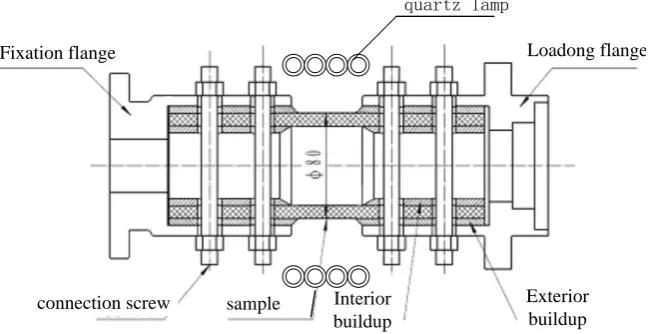
To study the force and heat of the rudderpost, 1#, 2# and 3# rudderpost samples were prepared, and the test parts installation is shown in Figure 1 [4].
The specific conditions of the experiment are as follows:
1) 1# rudderpost was tested for static strength at room temperature. The maximum torque load reached the required value, but rudderpost was not dam-aged. After that, the 1# rudderpost was used for the pre-testing of quartz lamp heating experiments. So 1# rudderpost had experienced a high temperature en-vironment for a long time.
2) 2# rudderpost was used for the force and thermal test. The load of the test sample didn’t reach the required values at high temperature, which showed some problems with the sample.
3) 1# rudderpost was used again. Firstly the 1# rudderpost was loaded to tor-que value at room temperature static test requirements, and it was not destroyed. Then thermo-mechanical test, temperature curve was same with that of 2# rud-derpost. The load of 1# sample didn’t reach the required value, either.
[image:2.595.215.540.548.715.2]4) 3# rudderpost was tested. In the room temperature static test, the torque was not loaded to the required value and 3# rudderpost fractured; the failure an-gle was also larger than the required value. Results show 3 fracture cracks: 2 cracks are 45˚ to the axis and 1 crack is 0˚ to the axis. There are 3 pieces of frac-tured parts and a crack at fixed points goes through 2 pin holes with a 0˚ angle to the axis.
Figure 1. Schematic diagram of the test parts installation.
quartz lamp
Loadong flange
Exterior buildup Interior
buildup sample
3. Production Quality Defect Analysis
3.1. Problem LocationThe issues of quality control of the rudderpost test parts are located at 2 aspects: one is the decreasing of mechanical properties at high temperature; the second is the large discretization of the mechanical properties of the rudderpost.
3.2. Quality Defect Fault Tree
As to the FTA method, the C/SiC rudderpost production quality defects are con-sidered as the top event, the fault tree is established for detailed investigation and analysis of failure. If production equipment and production documents are well and completed, the recording of processes are reliable and accurate (in-cluding the process cards, production records, performance test report). Sup-posed the vapor deposition layer of C/C interface is thin, this layer cannot block carbon fiber oxidation or other reactions which injury in the process of SiC in subsequent vapor deposition.
[image:3.595.60.537.349.720.2]Fault tree of rudderpost quality defect is shown in Figure 2, and the following conclusions are obtained:
Figure 2. Fault tree of rudderpost quality.
Quality defects in rudderpost
+
Quality defects in substrate
Defects of interface between reinforcement
and matrix
+
Quality defects in raw materials and preform
Quality defects in the composite
process Quality defects
in enhanced body
T
A1 A2 A3
A11 A12 + Improper ratio of matrix Defects in matrix structure The total amount of the substrate is small + Low local content + +
Defects in SiC structural
Defects
in Si structural
+
Defects in SiC
crystal
Defects in SiC
Micro structural + X12331 X12221 + X12232 Composite stress damage in molten silicon infiltration
process A1234
+
Defects in Si
crystal structure
Defects in Si
Micro structural
+ +
X12331
Composite stress damage in molten silicon infiltration
process A1234
A21 X22 A23
A211
A231 A232
A2311 A2312 A2321 A2322
X23221 The total amount of the substrate is small X1231211 The total amount of the substrate is small Preform density inequality Improper location of the product in the
furnace
X1231211 X11322 X123121 23 Temperature, pressure control density during CVI-SiC Temperature, pressure control density during molten silicon infiltration process
Heating rate control during CVI-SiC Temperature, pressure control density during molten silicon infiltration process Si infiltration is little Quality defects in
the process of
CVI-SiC forming
Quality defects in the process of molten silicon
infiltration forming
A121 A122
Cy interface layer damage
1) The bottom events “The total amount of the substrate is small”, “Preform density inequality”, “Improper location of the products in the furnace for CVI- Cy and CVI-SiC processes”, appear several times in the fault tree. They are im-portant events to control the quality of the rudderpost;
2) The bottom event “Silicon infiltration amount is too large for molten sili-con infiltration process [5]” is found in the fault tree. This event may be the key issue of product quality defects, and it appears many times and is of a certain possibility. It is needed to confirm the impact and take some control measure-ments.
3.3. Mechanism Analysis
Based the analysis above, that causes and mechanism for C/SiC rudderpost poor mechanical properties under high temperature conditions are: post densification of rudderpost by molten silicon infiltration process, the rudderpost material compound containing too much silicon, whose melting point is only 1410˚C and result in the vicinity of modulus rapid decreasing for the low melting point of material, and thus a decreasing in mechanical properties of the material.
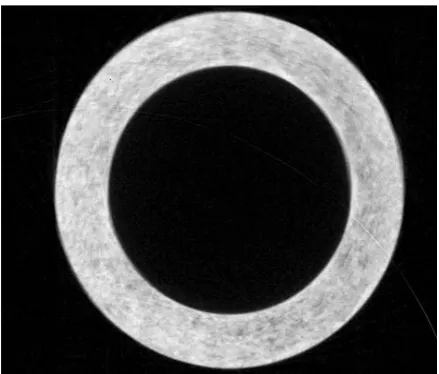
The reasons for rudderpost’s targe dispersion in mechanical properties are very complex: first, raw materials into the factory weren’t performed detection and products’ CT test shown obvious uneven density, showed as Figure 3; second, due to product density, different structure size and position in the fur-nace, the amount of CVI-Cy should be different in test. Electron microscopy showed that the fiber and the matrix fracture flush phenomenon (Figure 4), and the fiber damaging in the composite. Products’ deposition positions in furnace were different, but the placements weren’t recorded. Finally, the rudderposts were of lower density than the samples made from the same preform, and me-chanical properties of the final product were low and scattered. In addition, be-cause the final product density unchanged, resulting in much Si infiltration, me-tallographic pictures show the erosion carbon fiber by Si (Figure 4).
[image:4.595.264.484.518.705.2]Figure 4. Metallographic scanning results of the rudderpost test specimens.
3.4. The Problem of Repetition
The production cycle of the rudderpost is long and it is difficult to repeat the production process. So the residual stress test is used to simulate replication in-stead. Two batches of test samples’ size and raw materials are same, comparative test results are shown in Table 1. The rudderpost’s surface quality has problems and the shear strength and three-point-bending strength are low. The results are consistent with the abnormal phenomenon of comparative samples and process state differences are the main factors leading to abnormal fracture.
4. Measures and Verification
4.1. Improvement MeasuresMajor process improvements are as follows, and have been cleared in the pro-duction instruments.
1) Introduce the non-destructive testing for the raw materials;
2) With the virtual simulations of the flow in the furnace, ensure that the fur-nace flow field be uniform, and the products’ positions be recorded;
3) The product’s density should be measured after CVI/SiC deposition process and before molten silicon infiltration process;
4) Temperature and pressure in the procedure has a great impact to the prod-uct quality and should be controlled carefully.
4.2. Validation of the Improvement
Three test samples were made under improved procedure, and the similar expe-riments were carried out again.
The mechanical properties were tested at room temperature, shown in Table 2. It proves that three-point-bending strength is improved more than 63%.
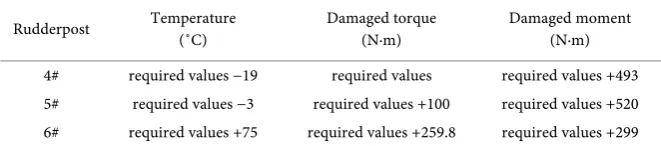
All three improved rudderpost were not damaged, which show their excellent properties, shown in Table 3.
According to the design requirements of the rudderpost bending moment (L = required value), three test data samples mean x and sample standard
Table 1. Comparison of three-point-bending test results of test pieces.
Test items rudderposts The
The density after CVI-SiC
(g/cm3)
Sampling quantity
Intensity mean value (MPa)
Dispersion coefficient
(%)
Surface shear
contrast
rudderpost prescriptive value 6 required value +2.34 10
rudderpost prescriptive value −1 6
required value
−35.82 33
Three -point -bending
contrast
rudderpost prescriptive value 6 required value +7.45 11
rudderpost prescriptive value −1 6
required value
[image:6.595.208.538.282.375.2]−28.07 27
Table 2. Strength results of the improved rudderpost test.
Rudderpost Sample 1 (MPa) Sample 2 (MPa) Sample 3 (MPa) Sample 4 (MPa) Sample 5 (MPa) Mean value (MPa)
Dispersion coefficient
(%)
1# value +14.8 required value +26.5 required value −5.8 required value +34.5 required value +29.2 required value +19.8 required 15
2# value +39.8 required value +58.3 required value +12.7 required value +37.1 required value +26.5 required value +34.9 required 14
Table 3. Experimental results of the bending torsion heat of the rudderpost after the process improvement.
Rudderpost Temperature (˚C) Damaged torque (N·m) Damaged moment (N·m)
4# required values −19 required values required values +493 5# required values −3 required values +100 required values +520 6# required values +75 required values +259.8 required values +299
The corresponding coefficient can K x L s −
= , be got K = 3.63.
According to γ = 0.7, n = 3, check GB/T 4885-2009 appendix A available:
L
R = 0.95, that is, the rudderpost products at the confidence level γ = 0.7, the
lower confidence limit for the reliability of 0.95.
5. Conclusion
Due to C/SiC rudderpost abnormal fracture problems, much work for investiga-tion and analysis were done to improve the product quality, several improve-ments on the procedure were suggested and the samples under improved pro-cedures show much better properties than the samples under traditional proce-dures.
References
[image:6.595.207.538.423.496.2]Infiltra-tion (LSI-Process). Ceram Eng Sci Proc, 22, 443-454.
https://doi.org/10.1002/9780470294680.ch52
[2] Zhang, L.-T., Cheng, L.-F. and Xu, Y.-D. (2003) Progress in Research Work of New CMC-SiC. Aeronautical Manufacturing Technology, 1, 24-32.
[3] Ran, L.-P., Yi, M.-Z. and Chen, B. (2005) Influence of Different C/C Performs on Microstructure of C/C-SiC Composites Fabricated by RMI C/C. The Chinese Jour-nal of Nonferrous Metals, 15, 1208-1213.
[4] Kim, B.G., Choi, Y., Lee, J.W., et al. (2000) Characterization of a Silicon Carbide Thin Layer Prepared by a Self-Propagation High Temperature Synthesis Reaction.
Thin Solid Films, 375, 82-86.https://doi.org/10.1016/S0040-6090(00)01266-9
[5] Yan, Z.-Q., Xiong, X., Xiao, P., Jiang, S.-Z. and Huang, B.-Y. (2007) Non-Isothermal Oxidation Behavior of C/SiC Composites Rapidly Prepared by Molten Silicon Infil-tration Technique. The Chinese Journal of Nonferrous Metals, 17, 1597-1603.
Submit or recommend next manuscript to SCIRP and we will provide best service for you:
Accepting pre-submission inquiries through Email, Facebook, LinkedIn, Twitter, etc. A wide selection of journals (inclusive of 9 subjects, more than 200 journals)
Providing 24-hour high-quality service User-friendly online submission system Fair and swift peer-review system
Efficient typesetting and proofreading procedure
Display of the result of downloads and visits, as well as the number of cited articles Maximum dissemination of your research work
Submit your manuscript at: http://papersubmission.scirp.org/