Munich Personal RePEc Archive
Does a change of occupation lead to
higher earnings?
Liberda, Barbara and Peczkowski, Marek
University of Warsaw, University of Warsaw
2011
Online at
https://mpra.ub.uni-muenchen.de/52532/
Does a change of occupation lead to higher earnings?*
Barbara Liberda
University of Warsaw, Faculty of Economic Sciences
Marek Pęczkowski [email protected]
University of Warsaw, Faculty of Economic Sciences
Abstract
The aim of this paper is to identify how the mobility between different types of broadly defined occupation (hired work, self-employment in industry, services and agriculture or social security beneficiaries) changes personal income of individuals. We apply the Markov matrices to the panel data on 30540 individuals for 2007-2008 from the Polish Household Budget Surveys. Our hypothesis is that a change of occupation affects individual capability to earn income, controlling for the occupation a person quits and the occupation a person starts, as well as age, education level and a permanent or temporary character of work. We test our hypothesis using the regression analysis. Our results show that the inter-occupational mobility matters mostly for those quitting hired work for self-employment, for the better educated, as well as for respondents above 60 years of age.
Keywords: income, earning, mobility, occupation, hired work, self-employment JEL: D11, D12, D14
1. Introduction
Earning capability of an individual depends on the level and quality of human capital and the occupation a person performs as well as social and cultural relations in which the process of earning takes place. The hidden individual and social capabilities of earning can be measured by their influence on manifest variables like education or occupation.
In the neoclassical economics the consumer is rational and maximizing utility. The standard consumption theory of life cycle and the permanent income theory (Modigliani 1986; Friedman 1957) assume that income is earned to smooth consumption during the life cycle or in conceivably long periods when consumers can assume that their income will be relatively stable. The type and place of work or occupation affect income uncertainty, f. ex. income earned in agriculture is treated as less stable than income earned in industry or services.
The human capital theories (Becker 1994; Arrow 1962; Mincer 1974; Schultz1971; Ben Porath 1967) view earnings as the outcome of utilization of skills and capabilities accumulated in individuals during the period of education, training and learning by doing in the process of production. The human capital earning function of Mincer (1974) shows the positive correlation of earnings and the level of human capital expressed in years of schooling and years of experience or age (if training and experience cannot be fully observed in age groups). Earnings are also dependent on the signaling value of a school or university diploma which is treated at the labor market as a pure signal independent from skills that it should prove (Spence, 1973).
Gary Becker (1994, third edition) points to the importance of on-the-job training for increasing human capital of employees and hence their productivity and earnings. Training can be of general character or specific to a particular firm, but in both cases it is strongly connected to the work place. Particular skills gained from education and training may be utilized differently in occupations that are performed by individuals. This may lead to earning differences of workers (with similar human capital and age) who are economically active in different sectors and occupations. Thus, earnings are a function not only of education, experience and age, but also of the type of economic activity in which the person acts as employee, self-employed (in industry, services, agriculture), unemployed or retiree.
The earning capability depends also on individual expectations or desires of a preferred income (Liberda 2007). If a person perceives personal income as insufficient for individual and family needs she or he may make a decision to increase earning by a change of occupation or a place of work within a country or between countries (Milanovic 2008).
In this paper we analyze the inter-occupational mobility of individuals and the change of personal income when they quit one type of broadly defined occupation and enter another occupation. The analysis is based on the panel data for 30,540 respondents from the 2007-2008 Polish Household Budget Surveys. We apply the Markov mobility matrices and the regression analysis to account for the increase or decrease of personal income when the occupation is changed by individuals grouped by age, education level, as well as the permanent or temporary character of work.
2. Data
Since 2001 the same households have been surveyed only for two consecutive years. In 2007, the following two independent subsamples selected in 2005 were surveyed:
- subsample 1 for the surveys in 2006-2007,
- subsample 2 for the surveys in 2007-2008.
It means that, during one year, half of surveyed households are exchanged. Currently, during one year, over 30 000 households are surveyed, which is about 0.25% of the population. In selected households all persons included in the household participate in the survey. The person at the age of 16 and over who gains the highest income of all the household members is a reference person.
Household’s net disposable income is defined as a sum of all household members’ current incomes from various sources reduced by prepayments on personal income tax and by social security and health insurance contributions. The household disposable income covers also an estimated value of income in kind (e.g. natural consumption) as well as goods and services received free of charge, e.g. social security benefits and gifts received from other households. The main sources of income are:
- income from hired work,
- income from a private farm in agriculture,
- income from self-employment (outside a private farm in agriculture or from free profession),
- income from property or from rental of a property or land,
- social security benefits (old age pension, disability pension or family pension),
- other social benefits,
- other income (including gifts and alimonies).
The main source of maintenance is defined as the only or prevailing source of maintenance. A person who does not have her/his own source of maintenance (either earned or unearned) and is maintained by other members of the household is a dependent.
The panel of households created in 2007-2008 consists of 15,853 households (unweighted sample).
To analyze incomes of households’ members, we created a panel of persons included in surveyed
households. The panel of individuals included the persons who were members of the households in 2007 as well as in 2008, and were at the age of 19 or more in 2007.
The 2007-2008 Panel of individuals (members of households) consists of 30,540 persons.
For this research we used the net personal income of individuals measured in nominal terms in the same month in 2007 and 2008. Occupation of a person was defined by her/his main source of income which was the main source of maintenance for this person.
3. Markov mobility matrices
Table 1 shows the structure of a surveyed panel by persons’ main source of maintenance in 2007 and 2008, respectively. We see that among persons 19 years old or more the dominating source of maintenance is hired work (40% of the total number of respondents in the sample) and old age or disability pension (one third of the sample). The rate of persons being dependent is about 10% of the 2007-2008 sample. Principally, they are pupils or students.
Table 1. Structure of respondents by a source of incomein a panel of individuals2007-2008
Source of income 2007 2008 Employment
hired permanently 38,3 40,3 hired occasionally 1,4 1,1
Farm 5,8 5,6
Self-employment 4,8 4,8
Pensions 32,0 33,0
Other social benefits 5,1 4,2
Other income 1,2 1,1
Dependents 11,5 9,9
Total 100,0 100,0
Source: Household Budget Surveys, 2007-2008, Panel of individuals, Poland, Central Statistical Office, Warsaw.
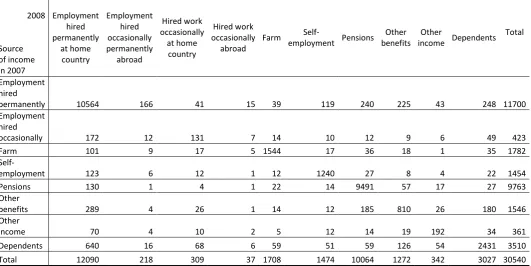
In 2008, 1.5% out of permanent workers worked abroad. In a much smaller group of part-time workers, one fourth of them worked abroad (Table 2).
Table 2. Mobility of respondents between different occupations (source of income) in a panel of individuals 2007-2008 2008 Source of income in 2007 Employment hired permanently at home country Employment hired occasionally permanently abroad Hired work occasionally at home country Hired work occasionally abroad
Farm Self-
employment Pensions Other benefits
Other
income Dependents Total
Employment hired
permanently 10564 166 41 15 39 119 240 225 43 248 11700
Employment hired
occasionally 172 12 131 7 14 10 12 9 6 49 423
Farm 101 9 17 5 1544 17 36 18 1 35 1782
Self-employment 123 6 12 1 12 1240 27 8 4 22 1454
Pensions 130 1 4 1 22 14 9491 57 17 27 9763
Other
benefits 289 4 26 1 14 12 185 810 26 180 1546
Other
income 70 4 10 2 5 12 14 19 192 34 361
Dependents 640 16 68 6 59 51 59 126 54 2431 3510
Total 12090 218 309 37 1708 1474 10064 1272 342 3027 30540
Source: Household Budget Surveys, 2007-2008 Panel of individuals, Poland, Central Statistical Office, Warsaw.
Most of the respondents are maintained from hired work and old-age/disability pensions. For persons for whom hired work was the main source of income in 2007, this source of maintenance remains unchanged in 90% of cases in 2008.
[image:5.595.35.567.355.621.2]self-employed in 2007. They constituted 10% of the total number of self-employed in 2008 (Tables 2 and 4).
Table 3. Mobility of respondents from hired work to other occupations in a panel of individuals 2007-2008 (in %)
2008 Hired Farm Self- Pensions Other Other Dependents Total Source 2007 work employment benefits income Hired work 91,6 0,4 1,1 2,1 1,9 0,4 2,4 100,0
Source: Household Budget Surveys, 2007-2008 Panel of individuals, Poland, Central Statistical Office, Warsaw.
Table 4. Mobility of respondents from other occupations to hired work in a panel of individuals 2007-2008 (in %)
2007 Hired Farm Self- Pensions Other Other Dependents Total Source 2008 work employment benefits income
Hired work 87,8 1,0 1,1 1,1 2,5 0,7 5,8 100,0
Source: Household Budget Surveys, 2007-2008 Panel of individuals, Poland, Central Statistical Office, Warsaw.
Working abroad gives permanent workers 50% more income than income earned in their home country. Part-time workers earn more than twice as much abroad as at home. However, moving to another country is related to a higher risk of becoming unemployed and other risks related to unknown labor market institutions and rules, including language requirements (Figure 1).
Figure 1. Average monthly personal income by occupation in a panel of individuals 2007-2008 (in zlotys)
0 500 1000 1500 2000 2500 3000 3500
Hired permanently
Hired permanently home country
Hired permanently abroad
Hired occasionally
Hired occasionally home country Hired occasionallyabroad
Farm
Self-employment
Pensions
Other benefits
Other income
Dependents
2007
2008
[image:6.595.72.522.482.681.2]The highest increase in personal income was observed when respondents switched from hired work in 2007 to a self-employment activity in 2008. It says that a risky decision to start one’s own business proved to be profitable, although only for a very small group of respondents (Table 5).
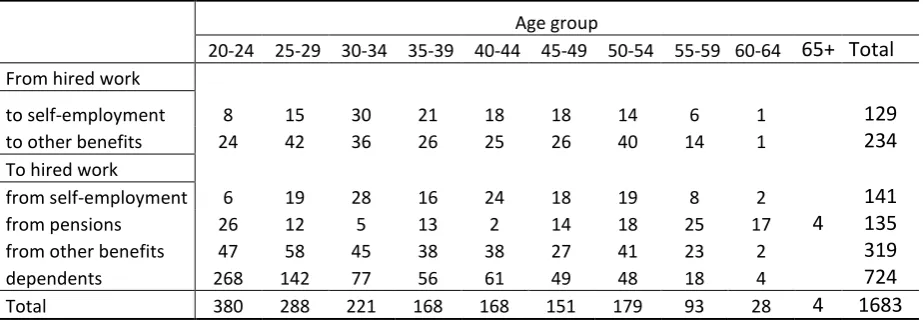
[image:7.595.77.506.229.358.2]Young people in the age group of 30-39 are those mainly involved in switching from hired work to self-employment. Older respondents (50-54) more often benefit from the social security system than from self-employment. When hired employment is discontinued, due to either individual reasons or due to structural unemployment, it is more difficult to start one’s own activity at an older age than at a young age (Tables 6 and 7).
Table 5. Increase in personal income by a change of occupation in a panel of individuals 2007-2008 (in zlotys)
Increase in personal income
Source of income in 2008 (to) Source of income in
2007 (from)
Hired
work Farm
Self-employment Pensions
Other
benefits Dependents
Hired work 290 -139 594 126 -481 -414
Farm 486 145 9 -527 -96 -352
Self-employment 270 762 255 -396 -491 -298
Pensions 695 627 1053 93 -238 -508
Other benefits 497 -38 552 355 19 -111
Dependents 794 521 594 657 237 71
Source: Household Budget Surveys, 2007-2008 Panel of individuals, Poland, Central Statistical Office, Warsaw.
Table 6. Mobility of respondents from hired work to other occupations and from other occupations to hired work, by age groups, in a panel of individuals 2007-2008
Age group
20-24 25-29 30-34 35-39 40-44 45-49 50-54 55-59 60-64 65+ Total
From hired work
to self-employment 8 15 30 21 18 18 14 6 1 129
to other benefits 24 42 36 26 25 26 40 14 1 234
To hired work
from self-employment 6 19 28 16 24 18 19 8 2 141
from pensions 26 12 5 13 2 14 18 25 17 4 135
from other benefits 47 58 45 38 38 27 41 23 2 319
dependents 268 142 77 56 61 49 48 18 4 724
Total 380 288 221 168 168 151 179 93 28 4 1683 Source: Household Budget Surveys, 2007-2008 Panel of individuals, Poland, Central Statistical Office, Warsaw.
When mobility from other occupations (types of economic activity) to hired work is concerned, the picture is more diversified. When available, hired work is attractive for young respondents at the age of 30-34 and 40-44, who tried a self-employment activity but decided to switch to hired work due to either lack of profits or a will to reduce risk – a disadvantage of such an activity.
[image:7.595.68.530.440.600.2]below the limits. Many people benefit from the pension system and work extra, either legally or illegally.
Table 7. Increase in personal income by mobility from hired work to other occupations and from other occupations to hired work, by age groups, in a panel of individuals 2007-2008 (in zlotys)
Age group
20-24 25-29 30-34 35-39 40-44 45-49 50-54 55-59 60-64 65+ Total From hired work
to self-employment 804 522 1240 1358 30 261 -468 36 594
to other benefits -387 -364 -1305 -320 -402 -206 -299 -386 -481 To hired work
from self-employment 269 381 359 406 49 236 189 250 558 270 from pensions 781 472 516 789 -109 585 934 327 1090 1038 695 from other benefits 552 518 444 490 480 353 492 702 19 497
dependents 651 938 877 709 585 1263 554 794
Total 444 330 208 491 164 300 195 279 847 1038 315
Source: Household Budget Surveys, 2007-2008 Panel of individuals, Poland, Central Statistical Office, Warsaw.
Legal employment of early retired persons is allowed in Poland up to some limits of earned income. The data show that for many respondents such a solution was profitable, and they earned more from wage employment than from a pension or they could postpone their pensions for some time.
Looking at the mobility by respondents’ educational levels, we see that two groups of respondents:
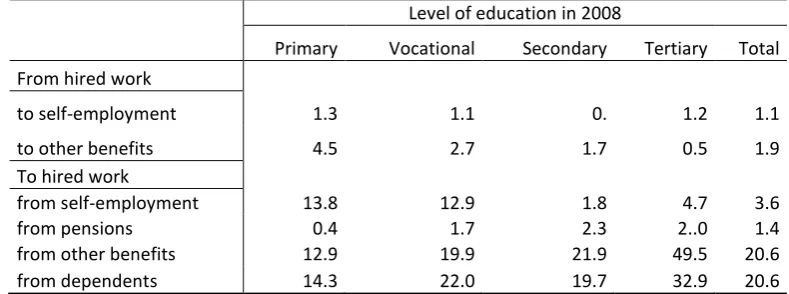
[image:8.595.69.530.142.296.2]those with primary and with vocational education were prone to moving from hired work to self-employment. They took risks and earned mainly from their own business in 2008, as opposed to wage employment in 2007. Respondents with secondary education are not mobile (Table 8).
Table 8. Mobility of respondents from hired work to other occupations and from other occupations to hired work, by educational levels, in a panel of individuals 2007-2008 (% of persons working)
Level of education in 2008
Primary Vocational Secondary Tertiary Total
From hired work
to self-employment 1.3 1.1 0. 1.2 1.1
to other benefits 4.5 2.7 1.7 0.5 1.9
To hired work
from self-employment 13.8 12.9 1.8 4.7 3.6
from pensions 0.4 1.7 2.3 2..0 1.4
from other benefits 12.9 19.9 21.9 49.5 20.6
from dependents 14.3 22.0 19.7 32.9 20.6
Source: Household Budget Surveys, 2007-2008 Panel of individuals, Poland, Central Statistical Office, Warsaw.
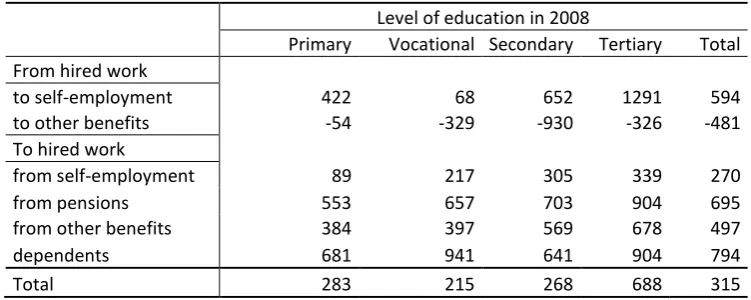
[image:8.595.102.497.487.634.2]loss in 2008 moving in the same direction. It seems that starting one’s own business may be more risky for older than for younger persons (Table 9).
Table 9. Increase in personal income by mobility from hired work to other occupations and from other occupations to hired work, by educational levels, in a panel of individuals 2007-2008 (in zlotys)
Level of education in 2008
Primary Vocational Secondary Tertiary Total
From hired work
to self-employment 422 68 652 1291 594
to other benefits -54 -329 -930 -326 -481
To hired work
from self-employment 89 217 305 339 270
from pensions 553 657 703 904 695
from other benefits 384 397 569 678 497
dependents 681 941 641 904 794
Total 283 215 268 688 315
Source: Household Budget Surveys, 2007-2008 Panel of individuals, Poland, Central Statistical Office, Warsaw.
A move in the opposite direction to hired work seems to be the most beneficial for persons at the age of more than 60 or even more than 65, when they undertook the wage employment in 2008, having lived previously (in 2007) off a pension. Here, the experience and competence would matter. However, the increase in income caused by mobility from wage employment to self-employment was the highest in a group of persons with tertiary education. It proves that highly educated persons start activities that pay the most. Respondents with secondary education moving from hired work to own business increased their income by the half of the increase of those with tertiary education. And those with vocational education earned only slightly by switching from wage to self-employment. When shifting to hired work from other activities, similar trends were observed with tertiary-educated respondents, earning the most when they switched from pension or from self-employment to wage employment. But the persons with secondary and vocational education also benefited relatively well by moving in the same direction (Table 9). Again, it proves that it is profitable to work
even when one has the right to obtain a pension. And when one’s own business is not profitable
enough, it is better to move to wage employment than to experience losses. Mobility matters. And mobility of the more educated matters more.
4. Regression analysis
For a calculation of a model we have chosen a panel of 3095 individuals who changed their occupation (and their main source of maintenance) between 2007 and 2008. We have omitted persons who became dependents because of insignificant number of persons in some subgroups by age and education.
In the linear regression model, a dependent variable dincome is an increase in net personal income of individuals who changed their occupation. Incomes are counted nominally in the same month of the survey in 2007 as well as in 2008. An increase in income is a difference of personal net income between 2008 and 2007.
Independent variables consist of indicator (binary) variables describing:
- change of the main source of maintenance,
[image:9.595.104.480.142.292.2]Apart from that, one continuous variable income enters the set of independent variables – a net personal income of individuals (members of the households) in 2007.
Variables agr_hw,soc_hw, pen_hw, mt_hw, hw_sem, hw_pen, hw_soc, sem_agr, sem_hw are equal to 1 when the respondent has changed her/his main source of maintenance:
agr_hw from work in a rural farm to hired work,
soc_hw from social security to hired work,
pen_hw from pension to hired work,
mt_hw from maintenance as dependent to hired work,
hw_ sem from hired work to self-employment,
hw_ pen from hired work to a pension,
hw_ soc from hired work to another type of social security, respectively.
sem_agr from self-employment to work in a rural farm,
sem_hw from self-employment hired work.
Otherwise these above mentioned variables are equal to 0.
Variables edu_ter, edu_sec, edu_voc are equal to 1 when a person reports higher, secondary or basic vocational education, respectively. Primary education is a reference category. In this case, for a person with primary education variables edu_ter, edu_sec, edu_vocare set to 0.
Variables concerning age are equal to 1, when (respectively)
age35_49, for age 35-49
age50_59, for age 50-59
age60plus, for age 60 and more
The age group 20-34 is a reference category.
[image:10.595.108.308.475.709.2]There were 3095 observations taken into account in the estimated model. The determination coefficient is equal to R2 = 0.533. The variable edu_voc, is not significant at the significance level α = 0.1. The rest of explanatory variables are significant at the level α = 0.02.
Table 10. Results of the regression of an increase in personal income on a change of occupation of individuals between 2007 and 2008
Dependent variable: dincome is an increase in net personal income in a panel of 3095 persons who changed their occupation between 2007 and 2008.
Source: Household Budget Surveys, 2007-2008 Panelof individuals, Poland, Central Statistical Office, Warsaw. Variable B Std. Error p-value
agr_hw 648.58 137.95 < 0,001
soc_hw 305.04 85.79 < 0,001
pen_hw 811.39 113.37 < 0,001
mt_hw 310.16 130,18 0.017
hw_sem 1241.28 124.20 < 0,001
hw_soc -221.26 94.27 < 0,001
hw_pen 439.96 93.55 0.019
sem_agr 990.98 414.28 0.017
sem_hw 517.66 117.62 < 0,001
edu_ter 862.74 105.57 < 0,001
edu_sec 310.65 82.84 < 0,001
edu_voc 117.35 81.96 0,152
age35-49 279.71 70.12 < 0,001
age50_59 254.88 74.72 0.001
age60plus 838.75 106.30 < 0,001
income -0,78 0,02 < 0,001
We interpret regression coefficients as changes of binary variables of the increase in net personal income of given categories in comparison to a reference category.
Mobility in all directions, e.g. to different occupations, increases income, except for quitting a job for the social security benefit which is lower than former wage. The highest increase in income is gained by those who changed the hired work for self-employment in industry or services. The second highest gain in income was observed by a move from self-employment to an activity in agriculture. In this case mobility concerns a move between similar types of activity.
A passage from pension to hired work and from an activity in agriculture to hired work as well as from self-employment in industry or services to hired work brought the relatively lower but still significant increases in earnings.
5. Conclusions
In this paper we have analyzed how a change of occupation affects individual capability to earn income. The analysis concerns the mobility of individuals between broadly defined types of occupation such as: hired work, self-employment in industry, services or agriculture and social security. The change of occupation was examined in groups of individuals according to: age, level of education and a permanent or temporary character of work.
The Markov matrices were applied to the panel data on 30,540 individuals for 2007-2008 from the Polish Household Budget Surveys. Then the regression analysis was conducted for a group of 3095 persons who changed their occupation and their main source of maintenance between 2007 and 2008.
Our results show that in most cases a change of broadly defined occupation increases income, except for quitting a job for the social security benefit. The mobility matters mostly for those who changed hired work for self-employment in industry or services. A shift from self-employment to an activity in agriculture brought the second highest gain in personal income. Other changes of occupation, e.g. from self-employment in agriculture, industry or services to hired work lead to relatively lower but still significant increases in earnings.
Respondents with tertiary education who were mobile in different directions reported the highest increase in income and those with secondary education benefited from changing occupation as well. The inter-occupational mobility matters mostly for persons in the age group of 60 and more. Persons in the age of 35-59 also noted a sizable increase in income in comparison with the age group of 20-34 years.
6. References
Arrow Kenneth J., 1962, The Economic Implications of Learning by Doing, The Review of Economic Studies, Vol. 29, No. 3, 155-173.
Becker Gary S., 1994, Human Capital: A Theoretical and Empirical Analysis with Special Reference to Education, Third Edition, New York, National Bureau of Economic Research.
Ben Porath, Yoram, 1967, The Production of Human Capital and the Life Cycle of Earnings, Journal of Political Economy, 75(4), part 1, 352-365.
Friedman Milton, 1957, A Theory of the Consumption Function, Princeton: Princeton University Press.
Household Budget Surveys, 2007-2008 Panel of individuals, Poland, Central Statistical Office, Warsaw.
Liberda Barbara, 2007, Income Preferences and Household Savings, Gospodarka Narodowa, No 9, pp. 19-30.
Milanovic Branko, 2008, Where in the World Are You? Assessing the Importance of Circumstance and Effort in a World of Different Mean Country Incomes and (almost) No Migration, Policy Research Working Paper Series 4493, The World Bank.
Mincer Jacob, 1974, Schooling, Experience and Earnings, New York: National Bureau of Economic Research.
Modigliani Franco, 1986, Life Cycle, Individual Thrift, and the Wealth of Nations, American Economic Review, Vol. 76, No. 3, pp. 297-313.