Development of an Efficient Tapered Slip-Form
System Applying BIM Technology
Hyejin Yoon1, Won Jong Chin1, Hee Seok Kim1, Young Jin Kim2
1
Structural Engineering Research Division, Korea Institute of Construction Technology, Goyang, South Korea
2
Global Technology Cooperation Center, Korea Institute of Construction Technology, Goyang, South Korea Email: [email protected]
Received July 13, 2013; revised August 13, 2013; accepted August 20, 2013
Copyright © 2013 Hyejin Yoon et al. This is an open access article distributed under the Creative Commons Attribution License, which permits unrestricted use, distribution, and reproduction in any medium, provided the original work is properly cited.
ABSTRACT
Slip-form system constitutes the latest technology for the erection of elevated concrete pylons. This paper investigates the design of slip-form system applying BIM technology for the efficient development of the slip-form system. The considered pylon has a height of 10 m and presents the rectangular hollow section generally adopted in cable-supported bridges. The slip-form was thus designed to accommodate the tapered cross-section and changing thickness considering the continuous placing of concrete. In addition, the safety of the system was examined with regard to the various loads applied on the slip form along the construction. The design results could be verified visually through BIM and the ap-plicability of the designed slip-form was validated in advance through virtual assembly and construction.
Keywords: Slip Form System; Construction of Concrete Pylons; BIM
1. Introduction
The recent increase in the span length of cable-supported bridge has resulted in record-breaking heights of the py- lons. The height of the concrete pylons of Russky Bridge in Russia, the longest cable-stayed bridge in the world, has reached 320.9 m allowing us to forecast that concrete pylons higher than 400 m will be erected in a near future. Even if the forms for the erection of concrete pylons are very diversified according to their purposes, shapes and operational methods, these forms can be subdivided into ordinary forms and system forms. The system form com- bines monolithically the form and the supporting struc- ture strengthening the form. This system form is particu- larly adapted for securing the workability and safety during the erection of elevated structures like elevated pylons by modularization and enlargement of the system. The system forms applied for the construction of ele- vated concrete pylons are the Auto Climbing Form Sys- tem (ACS) and the slip-form system. Here, slip-forming can be considered as the latest method enabling to shorten effectively the construction period owing to the automated lifting of the form and continuous 24-hour placing.
Because the slip-form system was recognized as a temporary facility, systematic research on this topic has not been conducted to date and the system remains still designed upon two-dimensional drawings. However, the
lack of precision of the numerical indications in the 2D drawings often results in repetitive redesigns due to the numerous design errors occurring in the fabrication and erection stages leading to additional costs, time delay and loss of data. Moreover, the 2-dimensional representation of a 3-dimensional structure is usually degrading the un- derstanding and sharing of the data related to the shape.
This paper presents the study carried out to achieve ef- ficient design of the tapered slip-form system by adopt- ing BIM (Building Information Modeling) technology. To that goal, the elements composing the slip-form are examined, and the technologies accommodating the ta- pered section of the members to be constructed are de- rived. Based on the developed element technologies, a slip-form system for the erection of a 10 m-high concrete tapered pylon is designed. The structural safety of the slip-form is verified considering the various loads acting on the slip-form during the erection of the concrete pylon. In addition, 4D virtual construction is conducted based on the 3D models of the components combined with time data so as to predict the erection process and identify eventual interference between the members during the construction.
2. Tapered Slip-Forming
loads. The hydraulic jacks are installed at the centers of the yokes and the rods pass through the jacks and are embedded in concrete. The platform has 3 levels com- posed respectively by a top deck, working deck and hanging deck.
3. Design of Slip-Form Accommodating
Tapered Section
3.1. Composition of the System
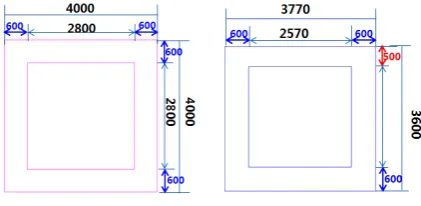
The slip-form system is composed of the forms shaping concrete, the hydraulic jacks providing the lifting force necessary for the slip-up and the yokes sustaining the whole system. The yokes sustain the whole system in- cluding the forms and working platform and lift up the whole system by means of the lifting force transmitted from the hydraulic jacks. Accordingly, the design of the slip-form shall start by arranging the yokes and deter- mining the capacity and number of jacks considering the scale and shape of the pylon. For the design, it is as- sumed that a 10 m-high pylon will be erected. The pylon is tapered vertically with a rectangular hollow cross sec- tion as generally adopted in cable-supported bridges. Moreover, one side of the pylon is planned to have a thickness varying with the height. Figure 1 describes the details of the pylon.
A total of 10 yokes are arranged considering the size of the pylon’s section. Twelve hydraulic jacks with ca- pacity of 60 kN are used (Figure 2). The forms have a
[image:2.595.309.535.84.281.2][image:2.595.66.277.623.726.2]
Figure 1. Cross sectional shape of the pylon.
Figure 2. Arrangement of yoke channels and hydraulic jacks.
height of 1.25 m based on previous erection examples and to ease the assemblage of the rebars. Traditional steel panels and lightweight GFRP panels are applied for the forms [1]. The walers playing the role of stiffener of the forms are disposed in two rows in each side. The plat- form has 3 levels composed respectively by a top deck, working deck and hanging deck (Figure 3).
3.2. Design of Members Adaptable to Tapered Sections
The conventional erection of concrete pylons proceeds successively by placing the concrete batch up to the height of the forms, removing the forms after completion of curing and lifting of the forms. In slip-forming, plac- ing of concrete and lifting of the forms are conducted continuously. For the construction of a tapered section, this implies that the members should be designed so as to enable continuous modification of the forms. Accord- ingly, this study investigates the design of the slip-form members accommodating continuously the sectional di- mensions and thickness varying with the height of the pylon.
Figure 3. Three-level working platform.
Figure 4. Arrangement of spindles.
The forms are composed of panels in modularized structure to ease their accommodation to the sectional change. Steel panels are used for the internal form and lightweight GFRP panels are used for the external form. In this study, since the dimensional changes are planned to occur at the corners, the corner panels and ordinary panels overlap when the spindles are adjusted. When the panels overlap completely, the corresponding panels are removed to control the size of the forms.
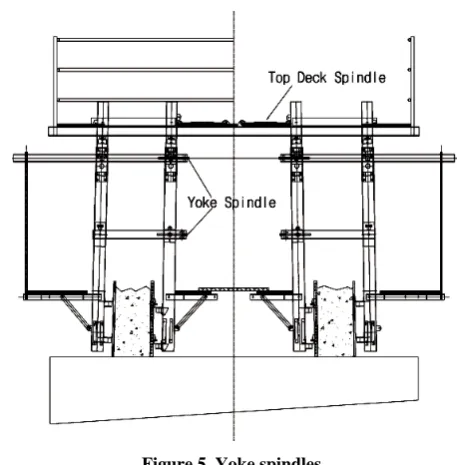
One side among the 4 sides of the pylon is planned to have a thickness varying with the height. In order to change the thickness of the pylon, the yoke should have a structure enabling to adjust freely their spacing. There- fore, bolts are inserted in the yoke channels so as to regulate the spacing between the yoke legs by adjusting the length of the bolts. Moreover, additional spindles are installed in the top deck to supplement these bolts (Fig- ure 5).
3.3. Design Verification
[image:3.595.306.535.80.313.2]The slip-form shall be design to resist all the loads and
Figure 5. Yoke spindles.
environments that may occur during the erection of the pylon. In this study, the yoke constituting the frame structure of the slip-form is analyzed. The stress of the yoke and capacity of the hydraulic jacks are verified for the loads under normal operational condition and sus- pended operational condition of the slip-form due to ul- timate wind loads.
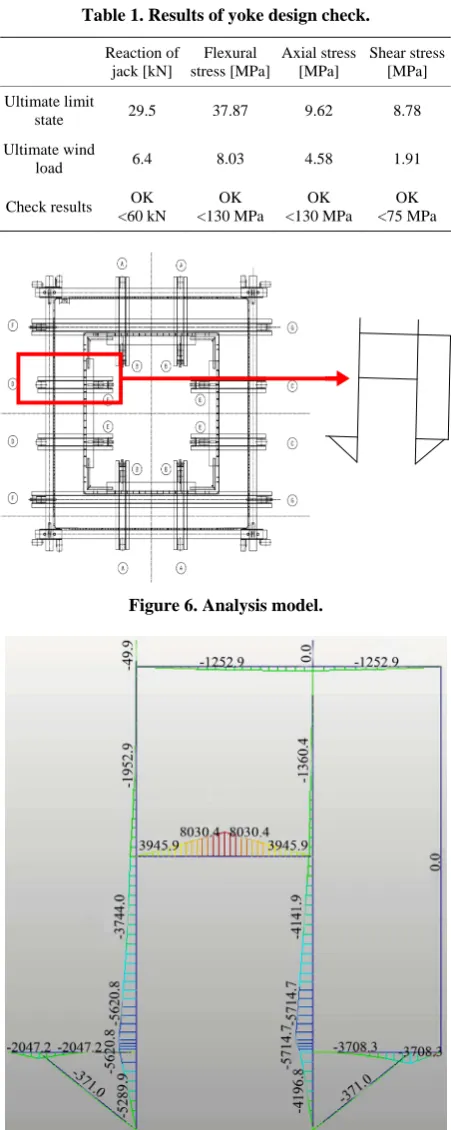
The modeling of the yoke adopts beam elements (Fig- ure 6). Its material is SS400 steel in accordance with KS D 3503 [2] with an elastic modulus of 210,000 MPa. For the accuracy of the analysis, the characteristics of the members linked to the yoke are reflected in the model. The hydraulic jacks installed at the center of the yoke channels are connected to the rods embedded in concrete and sustain all the vertical loads acting on the slip-form. Therefore, springs with large stiffness (2000 kN/m) are disposed at the nodes located at the emplacement of the jacks. Moreover, the nodes at the emplacement of the walers have their horizontal displacement restrained to consider the walers sustaining the lateral pressure of concrete.
During the structural stability check, the vertical loads due to the members located at the top of the yokes in- cluding the weight, the live loads applied on the working platform, the lateral pressure of concrete and the wind loads, and the frictional loads provoked by slip-up are considered. The verification is conducted through the allowable stress method in accordance with Standard specification for temporary works [3]. The structural ve- rification is performed using the commercial software MIDAS CIVIL 2012. Figure 7 shows the moment dia- gram of the yoke subjected to the permanent loads.
Figure 6. Analysis model.
Figure 7. Moment diagram under permanent loads (unit: kN/m2).
binations. Note that the hydraulic jacks in the slip-form system sustain all the loads acting in the vertical direc- tion. Considering that the reaction of the jacks at the ul- timate limit state reaches 29.5 kN and that the capacity of
tive advantage of BIM is undoubtedly the visualization since BIM gathers the 3D-based shape and data of the structure. Moreover, BIM enables to visualize data by simulating the construction and operation processes in 4D, 5D, n-dimension by combining features like time and cost to the 3D model. Table 2 lists the exploitation of 3D-4D-BIM. At the international level, public authori- ties are pouring efforts to establish dedicated guidelines for the exploitation of BIM. In USA, the GSA (General Service Administration) is operating a national 3D-4D- BIM program established by the OCA (Office of Chief Architecture) of the PBS (Public Building Service) in 2003. Efforts are made worldwide in many countries for the application and exploitation of BIM technology [5]. In Korea, the Public Procurement Service has enacted compulsory BIM design for the turnkey and design ten- dering of public buildings of more than 50 billion KRW since 2012 and plans to introduce BIM design in every public design tendering by 2016.
4.2. BIM-Based Slip-Form Design
[image:4.595.59.285.83.649.2]Table 2. Exploitation of 3D-4D-BIM.
Technology Scope of project Expected objective
3D laser scanning As-built drawings, construction documents
3D shape model Site, equipment, architecture, finishing, structure
Improved quality
Design, construction cooperation
Cooperation and understanding of regulatory disputes
4D model
Process sequence from project viewpoint Material ordering check from
secondary viewpoint
Improved precision
BIM model
Site, structure, mechanical equipment, architecture (space,
zoning/flow path), goods data, management schedule
BIM analysis application
Planning/assets management, sound/noise, GIS, cost estimation, energy analysis, goods in stock, CFD
analysis, facility management
Improved efficiency
Table 3. Modifications of the 2D drawings through BIM 3D modeling.
No. Modification Remarks
1 Rearrangement of yoke legs Figure 8
2 Connection modification of the members of the top
deck considering assemblage Figure 9
3 Size modification of the members of hanging deck
considering assemblage Figure 10
4 Length modification of bolt for thickness adjustment Figure 11
The pylon to be erected is planned to one of its 4 sides to have a thickness varying with the height. In order to realize such construction, the arrangement of the yoke legs is modified as shown in Figure 8. In addition, the errors that may occur during the assembling of the mem- bers were checked through virtual assembling using 3D modeling and resulted in the modifications described in Figure 9 and Figure 10. Figure 11 illustrates the modi- fication of the bolt length for the adjustment of the sec- tional thickness based on the BIM check. No problem was detected for the original bolt length during the vir- tual assembling but this length appeared to be too short when considering the height of 10 m to be erected. Moreover, the virtual assembling process made it possi- ble to verify the interference between the members (Fig- ure 12) and verify the position of the spindles (Figure 13).
Virtual assembling was also conducted by reflecting the site conditions with the designed members(Figure 14). This enabled to verify the position of each member as well as eventual interference between the members during the assembling or installation. Figure 15 shows
(a)
(b)
Figure 8. Modification of the arrangement of the yoke legs. (a) Drawing before BIM check; (b) Modified drawing after BIM check.
the fully assembled slip-form. Moreover, 4D simulation was conducted by adding the time data to evaluate the state of the slip-form system according to the construc- tion stages of the pylon. To that goal, virtual construction of the pylon was implemented from the ground up to the final height of 10 m by steps of 2 m (Figure 16).
5. Conclusion
(a)
[image:6.595.66.279.85.499.2](b)
Figure 9. Modification of the members of the top deck. (a) Drawing before BIM check; (b) Modified drawing after BIM check.
[image:6.595.325.526.85.133.2](a) (b)
[image:6.595.319.528.182.325.2]Figure 10. Error check of 2D drawing for the assembling of the hanging deck. (a) Drawing before BIM check; (b) Modi-fied drawing after BIM check.
Figure 12. Check of interference between members.
Figure 13. Check of position of spindles.
[image:6.595.308.538.328.706.2] [image:6.595.60.284.557.697.2]during the fabrication and assembling stages. The appli- cability of the slip-form system was demonstrated by means of virtual construction.
6. Acknowledgements
This paper was supported by the “Development of Ac- celerated Construction Technologies for High Pylons” project of the Super Long Span Bridge R&D Program. The authors express their gratitude for support.
REFERENCES
[image:7.595.59.271.82.426.2][1] H. Kim, “Mechanical Characteristics of GFRP Slip Form for In-Situ Application,” Ph.D. Thesis, Hanyang Univer- sity, Seoul, 2012.
Figure 15. Fully assembled slip-form.
[2] Korea Standards Association, “KS D 3503Rolled Steels for General Structure,” Korea Agency for Technology and Standards, Ministry of Knowledge Economy, Gwa- cheon, 2008
[3] Ministry of Construction and Transportation, “Standard Specification for Temporary Works,” Ministry of Con- struction and Transportation, Seoul, 2006.
[4] Korea Road & Transportation Association, “Korean High- way Bridge Design Code,” Ministry of Construction Trans- portation, Seoul, 2005.
[5] C. Eastman and P. Teicholz, “BIM Handbook,” 2nd Edi- tion, John Wiley & Sons, New York, 2011.
(a) (b)