Human choice and computers : an ever
more intimate relationship
Kreps, DGP, Fletcher, G and Griffiths, M
http://dx.doi.org/10.1007/9783319448053
Title
Human choice and computers : an ever more intimate relationship
Authors
Kreps, DGP, Fletcher, G and Griffiths, M
Type
Article
URL
This version is available at: http://usir.salford.ac.uk/id/eprint/40571/
Published Date
2016
USIR is a digital collection of the research output of the University of Salford. Where copyright
permits, full text material held in the repository is made freely available online and can be read,
downloaded and copied for noncommercial private study or research purposes. Please check the
manuscript for any further copyright restrictions.
IFIP Advances in Information
and Communication Technology
474
Editor-in-Chief
Kai Rannenberg, Goethe University Frankfurt, Germany
Editorial Board
Foundation of Computer Science
Jacques Sakarovitch, Télécom ParisTech, France
Software: Theory and Practice
Michael Goedicke, University of Duisburg-Essen, Germany
Education
Arthur Tatnall, Victoria University, Melbourne, Australia
Information Technology Applications
Erich J. Neuhold, University of Vienna, Austria
Communication Systems
Aiko Pras, University of Twente, Enschede, The Netherlands
System Modeling and Optimization
Fredi Tröltzsch, TU Berlin, Germany
Information Systems
Jan Pries-Heje, Roskilde University, Denmark
ICT and Society
Diane Whitehouse, The Castlegate Consultancy, Malton, UK
Computer Systems Technology
Ricardo Reis, Federal University of Rio Grande do Sul, Porto Alegre, Brazil
Security and Privacy Protection in Information Processing Systems
Stephen Furnell, Plymouth University, UK
Artificial Intelligence
Ulrich Furbach, University of Koblenz-Landau, Germany
Human-Computer Interaction
Jan Gulliksen, KTH Royal Institute of Technology, Stockholm, Sweden
Entertainment Computing
IFIP
–
The International Federation for Information Processing
IFIP was founded in 1960 under the auspices of UNESCO, following the first World Computer Congress held in Paris the previous year. A federation for societies working in information processing, IFIP’s aim is two-fold: to support information processing in the countries of its members and to encourage technology transfer to developing na-tions. As its mission statement clearly states:
IFIP is the global non-profit federation of societies of ICT professionals that aims at achieving a worldwide professional and socially responsible development and application of information and communication technologies.
IFIP is a non-profit-making organization, run almost solely by 2500 volunteers. It operates through a number of technical committees and working groups, which organize events and publications. IFIP’s events range from large international open conferences to working conferences and local seminars.
Theflagship event is the IFIP World Computer Congress, at which both invited and contributed papers are presented. Contributed papers are rigorously refereed and the rejection rate is high.
As with the Congress, participation in the open conferences is open to all and papers may be invited or submitted. Again, submitted papers are stringently refereed.
The working conferences are structured differently. They are usually run by a work-ing group and attendance is generally smaller and occasionally by invitation only. Their purpose is to create an atmosphere conducive to innovation and development. Referee-ing is also rigorous and papers are subjected to extensive group discussion.
Publications arising from IFIP events vary. The papers presented at the IFIP World Computer Congress and at open conferences are published as conference proceedings, while the results of the working conferences are often published as collections of se-lected and edited papers.
IFIP distinguishes three types of institutional membership: Country Representative Members, Members at Large, and Associate Members. The type of organization that can apply for membership is a wide variety and includes national or international so-cieties of individual computer scientists/ICT professionals, associations or federations of such societies, government institutions/government related organizations, national or international research institutes or consortia, universities, academies of sciences, com-panies, national or international associations or federations of companies.
David Kreps
•Gordon Fletcher
Marie Grif
fi
ths (Eds.)
Technology and Intimacy:
Choice or Coercion
12th IFIP TC 9 International Conference
on Human Choice and Computers, HCC12 2016
Salford, UK, September 7
–
9, 2016
Proceedings
Editors David Kreps University of Salford Salford
UK
Gordon Fletcher University of Salford Salford
UK
Marie Griffiths University of Salford Salford
UK
ISSN 1868-4238 ISSN 1868-422X (electronic) IFIP Advances in Information and Communication Technology ISBN 978-3-319-44804-6 ISBN 978-3-319-44805-3 (eBook) DOI 10.1007/978-3-319-44805-3
Library of Congress Control Number: 2016948250
©IFIP International Federation for Information Processing 2016
This work is subject to copyright. All rights are reserved by the Publisher, whether the whole or part of the material is concerned, specifically the rights of translation, reprinting, reuse of illustrations, recitation, broadcasting, reproduction on microfilms or in any other physical way, and transmission or information storage and retrieval, electronic adaptation, computer software, or by similar or dissimilar methodology now known or hereafter developed.
The use of general descriptive names, registered names, trademarks, service marks, etc. in this publication does not imply, even in the absence of a specific statement, that such names are exempt from the relevant protective laws and regulations and therefore free for general use.
The publisher, the authors and the editors are safe to assume that the advice and information in this book are believed to be true and accurate at the date of publication. Neither the publisher nor the authors or the editors give a warranty, express or implied, with respect to the material contained herein or for any errors or omissions that may have been made.
Printed on acid-free paper
This Springer imprint is published by Springer Nature
Preface
This book contains the proceedings of the 12th International Human Choice and Computers (HCC12) Conference, held at MediaCityUK, Salford, Greater Manchester, UK, on September 7–9, 2016. The conference was held by the International Federation of Information Processing (IFIP) Technical Committee 9 (TC9): Information and Communication Technology (ICT) and Society.
The conference Chairs, David Kreps (Chair of TC9 Working Group 9.5: Virtuality and Society), Gordon Fletcher, Marie Griffiths (Vice-chair WG9.5), and Diane Whitehouse (TC9 Chair), chose the theme for this year’s conference: Technology and Intimacy: Choice or Coercion. Whilst encouraging contributions from across the subject fields of the working groups of TC9, this theme has coalesced into three principle strands of focus: ethics, communication, and futures.
The papers selected for this book are based on both academic research and the professional experience of information systems practitioners working in thefield. It is the continued intention of the TC9 that academics, practitioners, governments, and international organizations alike will benefit from the contribution of these proceedings.
The volume editors have, in addition, contributed an introductory paper “Human Choice and Computers: An Ever More Intimate Relationship,”which is divided into two principle parts: thefirst looking back at the history of the conference series, and the second, subdivided into the three sections, ethics, communication, and futures, intro-ducing each individual paper in the volume.
Organization
Conference Chair
David Kreps University of Salford, UK
HCC12 Program Chairs
David Kreps University of Salford, UK Gordon Fletcher University of Salford, UK Marie Griffiths University of Salford, UK Diane Whitehouse Castlegate Consultancy, UK
HCC12 Program Committee
Oliver Burmeister Charles Sturt University, Australia Petros Chamakiotis University of Sussex, UK
Sisse Finken IT University of Copenhagen, Denmark Vic Grout Glyndwr University, UK
Olli Heimo University of Turku, Finland Magda Hercheui UCL, UK
Sue Hessey BT Plc, UK
Kai Kimppa University of Turku, Finland
Ela Klecun London School of Economics and Political Science, UK Jani Koskinen University of Turku, Finland
Louise Leenen CSIR, South Africa
Brad McKenna University of East Anglia, UK
António Moniz Universidade Nova de Lisboa, Portugal Christina Mörtberg Linnæus University, Sweden
Denise Oram Glyndwr University, UK
Niki Panteli Royal Holloway, University of London, UK Norberto Patrignani Catholic University of Sacro Cuore, Italy Jackie Phahlamohlaka CSIR, South Africa
Introduction
Human Choice and Computers:
An Ever More Intimate Relationship
1
The Context for HCC12
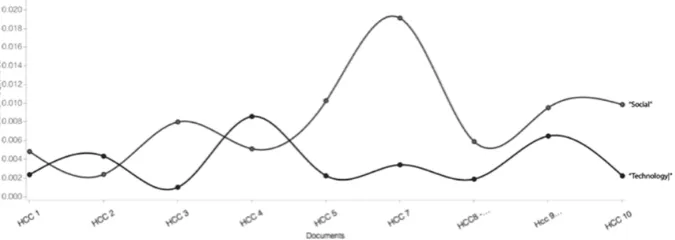
Since 1974, the Human Choice and Computers (HCC) conference series has firmly remained at the cutting edge of innovative thinking about the interface between the social and technology (Fig. 1). This observation should not be a surprising statement given that the central remit of IFIP’s Technical Committee 9 (TC9) is the relationship between computers and society. As Jacques Berleur, Magda Herschui and Lorenz Hilty related in their Introduction to the Proceedings of HCC9,“The success of HCC1 was such that IFIP-TC9 henceforth considered it the TC’s founding event, if not birthplace. TC9 was conceived in 1976, two years after HCC1.”[4]
This founding focus has been repeatedly explored throughout the forty-two year journey of HCC even surviving the difficult period documented by the third HCC conference proceedings [14]. The emerging distinctiveness of HCC conferences is highlighted by the fact that in 1986 it was the very nature, scope and purpose of the relationship between technology and people that was at the heart of an intensely critical and heated debate. In his introduction to HCC3, Sackman1 chooses to remind an increasingly diverse readership of the ranked list of objectives for TC9 as:
1. Protection of Individual Rights 2. Employment and the Quality of Life 3. International Problem Solving
4. International Studies on Social Impacts 5. Professional Social Accountability 6. Universal Social Benefits
7. Protection of Group and Collective Rights 8. International Planning and Cooperation 9. International Education
Clearly, what has set HCC conferences apart is the critical perspective that is its hallmark. HCC12 continues this tradition. Cecez-Kecmanovic [7] identifies critical
information systems research as being defined by a socially critical point of view, or, as Myers and Klein put it, IS research“can be classified as critical if the main task is seen as being one of social critique, whereby the restrictive and alienating conditions of the status quo are brought to light”2This view is revealed in Sackman’s 1986 list which places the objective most likely to initiate“transformative social change”[7] at the head of the list.
To explore this history the editors of these proceedings used a contemporary textual analysis tool to examine the existing corpus of HCC texts: the prologue, introductions or key introductory chapters were analysed for identifiable trends. HCC6 was not included as it could not be located through the UK’s interlibrary loan system and HCC11 was not included due to its relatively brief prologue. Using optical character recognition to include the earlier conference introductions, the corpus was then pro-cessed through the voyant-tools website3to visualise the resulting trends. Figures 1–6 were produced in this way.
[image:9.439.46.384.244.364.2]McGrath [10] confirmed the distinctiveness of HCC when she cited the proceedings of thefirst conference in 1974 as a watershed moment in the development of critical information systems thinking. The proceedings, she said, included an encouragement by editors Mumford and Sackman“to engage with the way that computer applications were being developed and deployed, and to make the human choices necessary to ensure that democratic values and ideals were preserved for the benefit of everyone”.4 While Mumford and Sackman probably did not set out consciously to create this theoretical position, the critical focus and variety of challenges presented in thefirst conference were certainly a product of their time. An almost continuous concern with the position of labour, pressing union issues and the prevailing social theories of the time are peppered throughout the early proceedings of HCC.
Fig. 1. The intertwined focus of technology and the social in HCC.
2 [9, p. 69].
3 http://www.voyant-tools.org/. 4 [10, p. 87].
Worker orientation is also possible, and a lot should and will be done. From a certain point on, however, too much adaptation will result in overspecialization and this will rebound back onto the worker in the form of career and position difficulties. Flexibility is a human virtue and should be cultivated.5
Our subject, therefore, is a matter far beyond computer sciences. It has to do with sociology, psychology, physiology, with the art of management and government, with democratic decision making as well as legal decision making and even creation of law. It must deal with the large
field of problems with which the trade unions are faced. And it extends even into philosophy and religion - if Europe and America do not teach this, Islam certainly does these days.6
The various threads of what are now recognisable critical thinking in IS are developed more fully in later conference proceedings. In many cases, it is the small and offhand points made by earlier authors that became the pressing focus for later dis-cussions. For example, Zemanek in 1979 [15] observed,“today we begin to realize how inseparable scientific and human development are.”and Margulies’final footnote in 19797 struggled with, “whether we could leave out home computers from our discussions or not - they will probably affect our attitudes towards computers and thereby affect our professional life.”Margulies [16] started thefirst formalising of the critical thinking perspective of HCC by provocatively entitling his contribution - in a rare moment of editorial reflexivity for any conference - as“Why‘HCC’again?”and by then stating:
...technology must not become an end in itself, but has to be seen in the context of man. Throughout history man has developed new means of production in his unceasing endeavour to make work easier and life better, thus at the same time creating new ways of human cooperation and societal organisation. The technology of today also can only be justified by its service to man, by its contribution in improving the quality of life, in providing the chance of self-realisation.
In all of these early statements, with the benefit of hindsight, it is apparent that, with rapid evolution, adoption and popularisation, information technology was pressing nearer and nearer and becoming ever more intimately tied with the human condition. In 1986 Sackman working amidst the disruption of a fundamental ontological debate, identified major new forthcoming areas of concern for research that included - some-what prophetically -“home information systems and social networking”and“robotics and artificial intelligence”8. While Barnes [2] is regarded as the originator of the term
‘social network’this must be one of thefirst published instances of the term in relation to computers and information technology. This is an even more extraordinary statement when it is placed in the historical context of Dell Computers, the NSFNET (the first major TCP/IP network) and the WELL (thefirst digital community) all being only one year old in 1986.
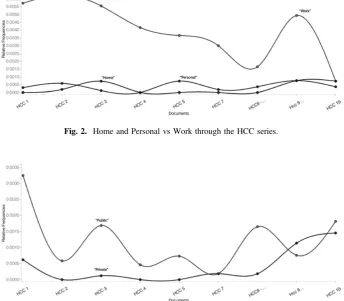
With the increasing ubiquity and everyday presence of information technology, more recent HCC conferences have become less focused on work and more concerned
5 [15, pp. 16–17].
6 [16, p. 6].
7 [16, p. 16].
8 [14, p. 16].
with the general human situation including aspects of the personal and of the home (Fig. 2). This does not mean the original concerns of HCC have now somehow dis-appeared but rather that they have now become supplemented and richer, to incorporate the fuller interplay of public and private (Fig. 3) in ways that were not imagined or possible in the 1970s or 1980s.
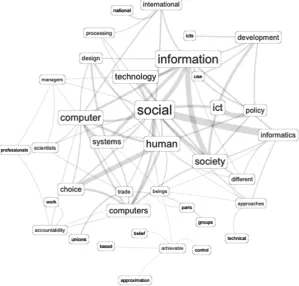
The spirit of HCC is consequently evident in the link tree of connected terms from thefirst HCC through to HCC10 held in 2012 (Fig. 4). The juxtaposition and mediating terms are themselves revealing of the intimate relationships between technology and people. “Information”, “Human” and “Social”sit at the centre of the diagram inter-linking all the other concepts. Both “human systems” and “computer systems” are represented as is the classic“man machine”combination.“Human”and“Technology” are only sometimes mediated by the use of“policy”while“society”,“technology”and
[image:11.439.44.385.142.272.2]“people” sit in a triangular relationship revealing an interdependence that is acknowledged by many HCC papers through the years.
[image:11.439.41.386.154.455.2]Fig. 2. Home and Personal vs Work through the HCC series.
Fig. 3. Public vs Private through the HCC series.
The ever closer intimacy of technology has generated a shift in attention from the rare and expensive hardware of processing in the form of“computers”to the more central object of the relationship between technology and people in the form of “ in-formation”(Fig. 5). With multiple devices constantly“near us”and“on us”(and soon
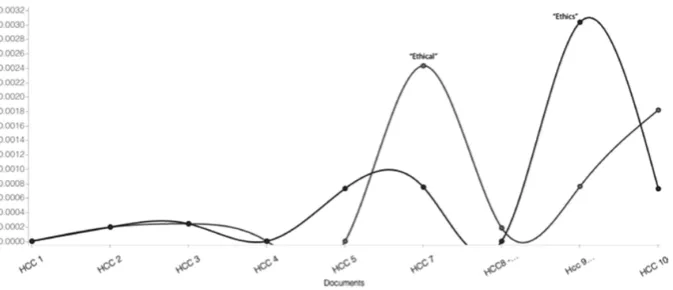
[image:12.439.78.378.62.348.2]“in us”) the question of what any single computer is doing or how it will be deployed becomes less significant than what“we”will do with the consequent information that is being generated by the many devices now available for us to access, interpret and use. The rise of the importance of information at HCC also parallels an‘ethical’turn to the proceedings with rising attention commencing from HCC5. What Constantinides et al. [8] might describe as progress towards the “ends” of Information Systems research. The patterns of critical research, as Richardson and Robertson point out, seem broadly to have settled into a three part format: insight, critique and transformative redefinition. Insight, “helps to highlight hidden or less obvious aspects of social real-ity;”critique,“challenges many of the taken-for-granted assumptions, beliefs, ideolo-gies, discourses;” and transformative redefinition, “is the development of critical, relevant knowledge and practical understanding to facilitate emancipatory change”9.
Fig. 4. Link tree of related terms generated from the entire HCC 1 to 10 corpus.
9 [13, p. 255].
This ethical turn over the course of the HCC series, then, is in keeping with the transformative redefinition such critical research engenders. As people are brought into closer constant communication with technology the issues of ethics and the ethical boundaries between“what can be done”and“what should be done”becomes a more pressing and more evident challenge to researchers. As the number of interfaces increases so too do the ethical challenges. As a long-standing conference series dedi-cated to critical information systems research, HCC is rightly staying true to its heritage by charting this increasing tension between the many possibilities that technology now enables, in contrast to what“we”as a society should be doing with these capabilities. The final chapter of the first HCC proceedings, “reviews basic agreements, dis-agreements and recommendations generated by the papers”10. We now continue in the spirit of this tradition by taking a look towards the imminent future.
Fig. 5. Timeline of HCC1 to HCC10 proceedings with computers declining over time and infor-mation rising in significance (HCC 7 was dedicated to Rob Kling and this introduction is particularly rich in the use of the terms‘information’and‘informatics’).
Fig. 6. The rise of ethical and ethics consideration in HCC.
10 [11, p. vi].
[image:13.439.48.385.255.400.2]In the tradition of the previous HCC conferences, there is, in HCC12, an interna-tional spread of attendees, with authors representing South Africa, Germany, Slovenia, Australia, Norway, Britain, Japan, Canada, Italy, Denmark, Malaysia, Greece, Sweden, Ireland, and, interestingly, a large Finnish contingent.
2
HCC12: Technology and Intimacy
The theme for HCC12 is“Technology and Intimacy: Choice or coercion?”. A theme that came about when the editors recognised how often, during discussions about the conference, that each was using some form of mobile device to check a point of fact, ask questions of colleagues who were not in the room, to format a document or look up the details of a previous HCC conference. The immediacy and intimacy of this rela-tionship with technology provided all the inspiration that was required.
Intimate technologies are now manifest in so many ways in the workplace, domestic envi-ronments, in transport, in defence, and through entertainment opportunities, with both similar and distinct impacts in the developed and in the developing world. (HCC12 Call For Papers)
From this statement came the inspiration for a series of prospective themes to prompt prospective authors. These were developed by the editors based on existing discussions found in a range of disciplines around technology and intimacy.
• Intimacy – Location – Personal/Social – Wearables – Implantables – Data Manipulation
• Personalisation– Identity–Digital Footprint –Gender
• Marketing– User Experience– Human Computer Interaction & Design– Search and Social Media
• Customisation–Material Culture –Innovation– Kit–Microchipping
• Generations –Histories– Enabling Technologies
• Geographies–Urban Technologies –Wayfaring
• ICT for Development–Global Mobility–Developing Economies–Sustainability Of course, while editors might speculate on what“their”conference will look like it is ultimately the authors who structure and shape thefinal experience and who now lay down the next layer in the historical record of HCC. The HCC12 papers present a number of common themes that all sit comfortably within the HCC tradition while also reflecting the impact of a changing digital landscape. A quick glance around any bus or train offers a fair indication of the extent to which society has overwhelmingly embraced an increasing myriad of devices for their information and entertainment consumption. The increasing range of venues and purposes for juxtaposing technology and people will continue to pose new dilemmas that require further theorised investigation.
The structure of the HCC12 proceedings endeavours to capture the essence of the themes that have been raised. Three broad themes emerged. Two of these themes reflect the current priorities of human computer interaction in the form of ethics and
communications. The ethical questions being raised reflect the human aspects of human computer interaction while the communications discussions focus more heavily upon the technology side of the relationship.
The tradition of HCC is also preserved in the third theme of the conference in the form of consideration for the future and the recognition of emerging technologies that will present further new challenges to the intimacy of the human computer relationship. As with any conference these themes are not mutually exclusive, or the sole set of concerns being expressed. There is, for example, a strong presence of theory with many authors explicitly positioning their work within the context of a recognisable intel-lectual tradition. Authors in this spirit include Koskinen and Kimppa (2016), Pan and Finken (2016), Padua (2016) and McKenna (2016). Many others also continue the HCC tradition of critical thinking with their strongly theorised work.
3
Ethics
The particularly sensitive area of healthcare information systems is examined by Koskinen and Kimppa (2016) in relation to the ownership of the voluminous and intimate information that these systems contain. Their theorised approach to the ethical issues raised by healthcare system enables them to provocatively propose an alternative solution that is labelled as Datenherrschaft.
Heimo et al. (2016) continue this ethical attention to healthcare by considering the relatively new coupling of the potentially vulnerable and elderly with healthcare technologies and the gaming sector. The paper takes up the challenge of understanding the ethical issues of using a device - the Jumppatikku - that encourages activity in the elderly while also potentially exposing personally identifiable data to third parties. The nexus of data privacy and ensuring the security of the senior citizens provides a broad platform from which to interrogate the main ethical implications that are drawn out with new technologies.
Harvie et al. (2016) continue this focus upon the elderly by looking at the use of assistive technology devices more broadly. Their discussion is positioned within the context of a generally aging population but is humanised through the use of a vignette of 85 year old Rose and her personal experiences with technology. Age, or rather generational difference, in the experience of technology is another recognisable theme through many of the conference’s papers.
The use of potentially beneficial technologies by the elderly is continued with Kwee-Meier et al. (2016) who consider the very specific use-case of tracking wearables on a cruise ship. Their survey shows that the concerns for data privacy associated with the use of wearables is weighed against their perceived safety benefits by many users of these devices. Kwee-Meier et al. (2016) also point to age as an important variable in determining these attitudes.
The importance of addressing the social isolation amongst the elderly is taken up by Hessey et al. (2016) who discuss a specific assistive technology for the elderly that was trialled in Cornwall. The project brought Skype to the elderly through their existing televisions and endeavoured to alleviate some of the issues associated with being older.
The project reveals the importance of user-informed design and the need for consid-eration of the many intersecting attitudinal issues associated with the use of technology. The issues associated with the elderly and people with dementia are also taken up by Kreps et al. (2016) with a more conscious design perspective. The paper utilises the concept of skeuomorphic reassurance to present necessary design principles to inform the creation of technological artefacts for older users and for those with cognitive decline. The key principle employed in this paper is the need to reference antecedent designs in the creation of new and innovative technology products. Without this consideration the intended users are potentially left unable to access the benefits of technologies intended for them.
Botha et al. (2016) also offer a solution in their paper to deal with the problem of leaking personal data. Drawing upon a South African legal situation to set their context they examine the issue of unintentionally revealing personally identifiable information. The work moves towards the development of a preventative solution that endeavours to prevent leakages of this type before they occur. A technological solution is required in order to manage the volume of information that must befiltered and for its accuracy in determining the leakage of“small”bits of data that are meaningful to a hacker but can be regularly missed with humanfiltering.
Ishii and Komukai (2016) also take the up ethical considerations for data through a legal perspective by comparing the situation in the US, UK and Japan regarding data breaches. Although framed within the legal context for dealing with these breaches the paper also reveals the extent to which social values, norms and perspectives are reflected in the experience and responses.
Iredale and Heinze (2016) examine the issues surrounding the professionalisation of Search Engine Optimisation. They consider how - or when - a move to professionalisation will occur. The paper takes the position that ethical consideration must be at the core of SEO work and that without this self-awareness and guiding set of principles associated with ethical behaviour the industry itself cannot become professional.
Vartiainen et al. (2016) also look at the ethical issues in the professional world when they consider the sometimes fraught client-vendor relationship. Their survey identifies the competing series of variables that traditionally shape this type of rela-tionship and they argue for the need to deploy new approaches. As with many of the papers that take up this ethical consideration for people and computers, Vartiainen et al. (2016) advocate participatory design as a key ingredient in shaping an ethical and productive relationship.
Reijers et al. (2016) round out the ethical theme by making the case for alisation. Utilising the work of Ricoeur they argue to what extent the act of person-alisation is itself an act of personhood and that in this act is an aggregation and shaping of the personal itself.
4
Communications
Kljun and Pucihar (2016) complement the paper offered by Hessey et al. (2016) to take on the criticisms that technology can be a socially isolating experience to examine the prospects for using mobile technologies to initiate communications in public settings.
As with so many of these conference papers, Kljun and Pucihar’s (2016) discussion also raises many ethical questions and points towards the clear value of participatory design.
Phahlamohlaka et al. (2016) explore the value of secure ICT in the context of marginalised and developing economies. Particular attention is given to the role of ICTs as a mechanism for enabling economic activities. This is a complex problem within economies where many individuals do not have access to conventional banking mechanisms. However, success with this form of communications has the prospect of empowering individuals and entire communities.
Aligning with Phahlamohlaka et al’s (2016) argument and building a more specific focus, Pathirana and Khin (2016) also explore the relationship of communications in the form of the value of social media within the banking sector. The context for this work is the Sri Lankan situation. This paper also reflects the underlying theorised positioning of many papers by drawing on both the work of classic economists and the Technology Acceptance Model. This work also tackles the equally contested area of generational difference and the varying engagement between age groups of technology andfinancial services.
Pan and Finken (2016) offer a unique insight into the specialist area of marine technology by drawing upon Actor Network Theory and Computer Support Cooper-ative Work. Not only is a heavily theorised perspective again evident but so too does the argument for the use of participatory design emerge that can be found in the work of Kreps et al. (2016) and Hessey et al. (2016).
Haugsbakken (2016) looks at the role of“betas”in extending and legitimating the use of social media within organisation and professional life. The work is based around a theorised approach towards reflection and reflective practice that assists in shaping the framework that is outlined in this paper. Shaping the discussion around the role of
“betas”also hints at the changing roles that people have within their professional life and offers a counterbalance to the discussion of professionalisation offered by Iredale and Heinze (2016).
The social networking and social media focus is narrowed down to Facebook by Pirli et al. (2016) in a phenomenological study of the individual user’s connections. Their examination of this particular social network also takes up the issue of genera-tional differences in the use of technology by focusing on‘adult Facebookers’and their consociate connections.
The issues associated with privacy and ethical practices are reintroduced by Tarkkanen and Harkke (2016) in their examination of social networking sites. In contrast to the legal starting point of Ishii and Komukai (2016) and Botha et al. (2016), the positioning for this paper is very much based around the traditions and practices of usability testing and human-computer interaction design.
The link with the ethical questions raised by personally identifying information is further addressed by Chutikulrungsee et al. (2016). The focus in this work is upon
“other-generated content” and the issues of disclosure that become possible through this use of social media. The work presents the challenges that are raised by using the concept of interdependent privacy and takes the position that this situation is inevitable. In engaging this challenge, Chutikulrungsee et al. (2016) present the need for recon-sidering how we perceive privacy through social networking sites.
Padua (2016) adheres closely to the overall theme for the conference by examining intimacy and the nearness of technology. In a wide arc that encompasses augmented reality, economics, recent political history and situational context theory the paper looks at the ever more intimate relationship that humans have with technology. This then opens up the opportunity to articulate a call for digital corporate social responsibility.
Augmented reality is then also the focus for Seppälä et al. (2016) which they position within the context of cultural heritage and serious gaming. This development around a specific context draws upon the themes found in many of the conference papers. The design and user experience of the application is examined in a range of ways including the reception by different age groups and the opportunities for further participatory development.
Moving from cultural heritage to thefine arts, Pucihar et al. (2016) take a different tack in their examination of communications technology by exploring the potential and prospects for virtual tracing using mobile devices. Their primary research shows the value and benefits to this specific task and points to a range of potential use-cases and applications.
5
Futures
Perhaps somewhat perversely we incorporate Tatnall’s (2016) historical examination of the State Computer Education Centre of Victoria within the Futures theme. The paper acts as a cautious tale for attempting to predict the future. The history related by Tatnall (2016) echoes the trajectory of development that can also be discerned within the context and history of the HCC conferences, and reinforces the need for recent technological development to not be regarded ahistorically. Equally significant is the reminder built into the paper that attempts to foster a digitally literate society are by no means a new phenomenon.
Grbac et al. (2016), in contrast, document a potential system for bringing together the virtual and the digital worlds into an intimate combination. Complementing the discussion offered by Pucihar et al. (2016), a specific process for combining physical and digital annotations is proposed and unpicked to document and explain a very specific use-case for augmented reality.
Feiten et al. (2016) also propose a system that complements the discussions of Heimo et al. (2016), Botha et al. (2016) and Reijers et al. (2016). The outlined revo-cable anonymity approach rethinks much of the current views on online security and
“other-generated content” (Chutikulrungsee et al. 2016). The system proposed by Feiten et al. (2016) is scrutinised from a range of perspectives including ethical, eco-nomic and legal points of view.
McKenna (2016) rounds out the collection with a rich description of a near present / near future city that is rich in human computer interfaces and “edges”. As Phahlam-ohlaka et al. (2016) also point out, the interaction of technology and people is primarily an urban one and all current indications are that new developments in this area will continue to emerge from these spaces.
Of course, this is the editorial post hoc rationalisation of these many diverse papers. We encourage readers to explore alternative routes through these proceedings and to discover other new themes that are also contained inside.
References
(references marked with * were used in the corpus analysis of HCC conferences)
1. *Avgerou, C., Smith, M., van den Besselaar, P.: Human choice and ICT policy policy: introduction to the HCC8 conference proceedings. In: Avgerou, C., Smith, M., van den Besselaar, P. (eds) Social Dimensions of Information And Communication Technology Policy, Proceedings of the Eighth International Conference on Human Choice and Com-puters (HCC8), IFIP TC 9, Pretoria, South Africa, September 25–26, 2008. Springer (2008) 2. Barnes, J.A.: Class and committees in a Norwegian Island Parish, Hum. Relat.7(1), 39–58
(1954)
3. *Beardon, C., Munari, S., Rasmussen, L.: Prologue. In: Rasmussen, L., Beardon, C., Munari, S. (eds.) Computers and Networks in the Age of Globalization, Proceedings of the 5th IFIP-HCC (Human Choice and Computers) International Conference, HCC-5, Kluwer Academic Publishers, Boston (2000)
4. *Berleur, J., Hercheui, M.D., Hilty, L.M.: What kind of information society? introduction to the HCC9 conference proceedings. In: Berleur, J., Hercheui, M.D., Hilty, L.M. (eds.) What Kind of Information Society? Governance, Virtuality, Surveillance, Sustainability, Resi-lience, 9th IFIP TC 9 International Conference, HCC9 2010 and 1st IFIP TC 11 International Conference, CIP 2010. Held as Part of WCC 2010, Brisbane, Australia, 20–23 September 2010
5. Brunnstein, K., Berleur, J. (eds): Human Choice and Computers, Issues of Choice and Quality of Life in the Information Society, Proceedings of the IFIP-TC9 HCC-6 Conference, 17th World Computer Congress, Montreal, August 2002, Kluwer Academic Publishers (2002)
6. *Bryant, T.: The Myth of Information Society. In: Berleur, J., Drumm, J. (eds.) Information Technology Assessment: Human Choice and Computers, 4, Proceedings of the Fourth IFIP-TC9 International Conference on Human Choice and Computers (HCC-4), Dublin, July 8–12, 1990, Elsevier, North-Holland, Amsterdam (1991)
7. Cecez-Kecmanovic, D.: Doing critical information systems research – arguments for a critical research methodology, Eur. J. Info. Syst.20(4), 440–455 (2011)
8. Constantinides, P., Chaisson, M., Introna, L.: The ends of information system research: a pragmatic framework, MIS Q.36(1), 1–19 (2012)
9. Klein, H.K., Myers, M.D.: A set of principles for conducting and evaluating interpretivefield studies in information systems. MIS Q.23(1), 67–93 (1999)
10. McGrath, K.: Doing critical research in information systems: a case of theory and practice not informing each other, Info. Syst. J.15, 85–101 (2005)
11. *Mumford, E., Sackman, H.: International human choice and computers: conference retro-spect and proretro-spect. In: Mumford, E., Sackman, H. (eds) Human Choice and Computers, Proceedings of the Conference on Human Choice and Computers (HCC-1), Vienna, Austria, April 1–5, 1974, Elsevier, North-Holland, Amsterdam (1975)
Conference on Human Choice and Computers (HCC7), IFIP TC 9, Maribor, Slovenia, 21–23 September 2006
13. Richardson, H., Robinson, B.: The mysterious case of the missing paradigm: a review of critical information systems research. Info. Syst. J.17(3), 251–270 (2007)
14. *Sackman, H.: Historical critique of IFIP TC 9: computer relationships with society, In: Sackman, H. (ed) Comparative Worldwide National Computer Policies, Proceedings of the 3rd IFIP-TC9 Conference on Human Choice and Computers, Stockholm (HCC-3), Sweden, 2–5 September 1985, Elsevier, North-Holland, Amsterdam (1986)
15. *Zemanek, H.: Human choice - a subject of increasing general interest. In: Mowshowitz, A. (ed) Human Choice and Computers 2, Proceedings of the Second IFIP-TC9 Human Choice and Computers Conference (HCC-2), Baden, Austria, 4–8 June, 1979, Elsevier, North-Holland, Amsterdam (1980)
16. Margulies, F.: Why‘HCC’again? In: Zemanek, H.: Human Choice - A subject of increasing general interest, In: Mowshowitz, A. (ed.) Human Choice and Computers 2, Proceedings of the Second IFIP-TC9 Human Choice and Computers Conference (HCC-2), Baden, Austria, 4–8 June, 1979, Elsevier, North-Holland, Amsterdam (1980)
Contents
Ethics
An Unclear Question: Who Owns Patient Information? A Kantian Take
on the Concept of Datenherrschaft. . . 3
Jani Koskinen and Kai K. Kimppa
Ethical Gathering of Exercise Metrics from Elderly: Case Jumppatikku . . . 14
Olli I. Heimo, Tapani N. Liukkonen, Miika Oja-Nisula, Julius Rajala, Anne Paavolainen, Kai K. Kimppa, and Tuomas Mäkilä
Assistive Technology Devices for the Oldest-Old: Maintaining
Independence for the Fourth Age . . . 25
Gillian Harvie, Kenneth Eustace, and Oliver K. Burmeister
Safety-Enhancing Locating Wearables on Passenger Ships: Privacy
and Security Perceptions by the Elderly . . . 34
Sonja Th. Kwee-Meier, Eugen Altendorf, Alexander Mertens, and Christopher M. Schlick
Balancing Act or Compromise? A Case Study Highlighting the Challenges
of Trialling IT Services with the Elderly . . . 49
Sue Hessey, Hazel Lacohee, and Rob Collingridge
Skeuomorphic Reassurance: Personhood and Dementia . . . 61
David Kreps, Oliver K. Burmeister, and Jessica Blaynee
Ethical and Legal Issues Involved in the Pro-active Collection of Personal
Information with the Aim of Reducing Online Disclosure . . . 72
Johnny Botha, Mariki Eloff, and Marthie Grobler
A Comparative Legal Study on Data Breaches in Japan, the U.S.,
and the U.K. . . 86
Kaori Ishii and Taro Komukai
Ethics and Professional Intimacy Within the Search Engine Optimisation
(SEO) Industry . . . 106
Sophie Iredale and Aleksej Heinze
A Participatory Design Program for Making Ethical Choices
in Client Vendor Relations in ISD. . . 116
Narrative Ethics of Personalisation Technologies. . . 130
Wessel Reijers, Bert Gordijn, and Declan O’Sullivan
Communications
“Break the Ice”: The Use of Technology to Initiate Communication
in Public Spaces . . . 143
MatjažKljun and KlenČopičPucihar
Enabling Socio-Economic Activities: Opening Global Markets
for the Marginalized Through Secure ICT Use . . . 150
Jackie Phahlamohlaka, David Kepaletwe, Vusi Ndala, and Lebogang Phahlamohlaka
Adoption of Social Media for the Banking Sector in Sri Lanka. . . 166
Parakum Pathirana and Aye Aye Khin
Visualising Actor Network for Cooperative Systems in Marine Technology . . . 178
Yushan Pan and Sisse Finken
“To Listen, Share, and to Be Relevant”- Learning Netiquette
by Reflective Practice . . . 191
Halvdan Haugsbakken
The Embodiment of Relationships of Adult Facebookers . . . 204
Myrto Pirli, Sisse Finken, and Christina Mörtberg
Manifestations of Users’Privacy Concerns in a Formative Usability Test
of Social Networking Site . . . 215
Kimmo Tarkkanen and Ville Harkke
Denial of Choice: Group Level Disclosure of Private Information . . . 229
Tharntip Tawnie Chutikulrungsee, Oliver K. Burmeister, Yeslam Al-Saggaf, and Maumita Bhattacharya
From Caravaggio to Braque: Digital Technology and the Illusion
of Augmented Responsibility . . . 241
Donatella Padua
Examining User Experience in an Augmented Reality Adventure Game:
Case Luostarinmäki Handicrafts Museum . . . 257
Kaapo Seppälä, Olli I. Heimo, Timo Korkalainen, Juho Pääkylä, Jussi Latvala, Seppo Helle, Lauri Härkänen, Sami Jokela,
Lauri Järvenpää, Frans Saukko, Lauri Viinikkala, Tuomas Mäkilä, and Teijo Lehtonen
Using a Mobile Phone as a 2D Virtual Tracing Tool: Static Peephole
vs. Magic Lens . . . 277
KlenČopičPucihar, MatjažKljun, and Paul Coulton
Futures
The Beginnings of Government Support for Computers
in Schools–The State Computer Education Centre of Victoria in the 1980s . . . . 291
Arthur Tatnall
Collaborative Annotation Sharing in Physical and Digital Worlds . . . 303
Jan Grbac, MatjažKljun, KlenČopičPucihar, and Leo Gombač
Revocable Anonymisation in Video Surveillance: A“Digital Cloak
of Invisibility” . . . 314
Linus Feiten, Sebastian Sester, Christian Zimmermann, Sebastian Volkmann, Laura Wehle, and Bernd Becker
Edges, Surfaces, and Spaces of Action in 21st Century Urban
Environments– Connectivities and Awareness in the City . . . 328
H. Patricia McKenna
Author Index . . . 345