ModuleMiner - improved computational detection of
cis
-regulatory
modules: are there different modes of gene regulation in embryonic
development and adult tissues?
Peter Van Loo
*†‡
, Stein Aerts
*†
, Bernard Thienpont
†
, Bart De Moor
‡
,
Yves Moreau
‡
and Peter Marynen
*†
Addresses: *Department of Molecular and Developmental Genetics, VIB, Herestraat 49, B-3000 Leuven, Belgium. †Department of Human
Genetics, University of Leuven, Herestraat 49, B-3000 Leuven, Belgium. ‡Bioinformatics group, Department of Electrical Engineering
(ESAT-SCD), University of Leuven, Kasteelpark Arenberg, B-3001 Heverlee, Belgium.
Correspondence: Peter Van Loo. Email: [email protected]
© 2008 Van Loo et al.; licensee BioMed Central Ltd.
This is an open access article distributed under the terms of the Creative Commons Attribution License (http://creativecommons.org/licenses/by/2.0), which permits unrestricted use, distribution, and reproduction in any medium, provided the original work is properly cited.
Abstract
We present ModuleMiner, a novel algorithm for computationally detecting cis-regulatory modules (CRMs) in a set of co-expressed genes. ModuleMiner outperforms other methods for CRM detection on benchmark data, and successfully detects CRMs in tissue-specific microarray clusters and in embryonic development gene sets. Interestingly, CRM predictions for differentiated tissues exhibit strong enrichment close to the transcription start site, whereas CRM predictions for embryonic development gene sets are depleted in this region.
Background
The identification and functional annotation of transcrip-tional regulatory sequences in the human genome is lagging far behind the rapidly increasing knowledge of protein-encoding genes. These transcriptional regulatory sequences are often build up in a modular manner and exert their func-tion in cis through the concerted binding of multiple tran-scription factors (and co-factors), resulting in the formation of protein complexes that interact with RNA polymerase II [1,2]. These sequences are called cis-regulatory modules (CRMs). In theory, these CRMs can be detected by the pres-ence of multiple transcription factor binding sites (TFBSs). In practice, however, reliable detection of functional TFBSs is difficult and results in many false positives, partly because these binding sites are too short and too degenerate [3]. Hence, the computational detection of functional regulatory sequences in the human genome remains a formidable challenge.
Multiple methods have been developed that aim to detect reg-ulatory sequences computationally [4-8]. Promising and val-idated results have been delivered mostly in model organisms with relatively compact genomes (for example, Drosophila
melanogaster) [9-11]. In the larger human genome, deep
sequence conservation (for instance, up to zebrafish) or extreme sequence conservation (for example, perfect conser-vation in mouse over 200 base pairs), irrespective of TFBS detection, remains the method of choice for approaches vali-dating regulatory sequences in vitro or in vivo [12-14]. Although these conservation approaches are quite successful in predicting which regions have a regulatory function, they provide no information regarding what expression pattern these regions produce and by which transcription factors they are targeted.
When several similar CRMs have been characterized, and the regulatory factors and binding sites have been elucidated, one
Published: 7 April 2008
Genome Biology 2008, 9:R66 (doi:10.1186/gb-2008-9-4-r66)
Received: 30 December 2007 Revised: 7 March 2008 Accepted: 7 April 2008 The electronic version of this article is the complete one and can be
can use this knowledge to find new examples of similar CRMs that direct the transcription of other genes that are involved in the same process. A number of computational methods have been described that apply this approach [15-17]. These methods have been highly successful [10,11,18], but in prac-tice - apart from in Drosophila embryonic development - the lack of available data often precludes the application of these approaches.
When this knowledge is not available, the detection of tissue-specific or process-tissue-specific CRMs can be tackled by looking for recurring combinations of TFBSs in putative regulatory regions of a set of co-expressed genes. A few methods apply-ing this approach have been developed [19-22]. However, partly because this is a more complex problem, these methods have only been applied on a limited scale and few successful predictions have been reported. To our knowledge, our Mod-uleSearcher method [20] is the only one to have yielded results that have undergone experimental validation [23].
Here, we develop ModuleMiner, a novel algorithm designed to detect similar CRMs in a set of co-expressed genes, focused on the human genome. ModuleMiner does not require prior knowledge of regulating transcription factors or annotated binding sites, but uses only a library of position weight matri-ces (PWMs). Contrary to existing algorithms, which require a
priori knowledge of CRM properties (such as the length of the
CRMs or the number of binding sites) as input parameters, ModuleMiner requires no parameters. In addition, Modu-leMiner differs from existing similar approaches in that it implements a whole-genome optimization strategy to look specifically for signals that discriminate the given co-expressed genes from all other genes in the genome. By leave-one-out cross-validation on benchmark data, we show that ModuleMiner outperforms other methods that computation-ally detect CRMs. Fincomputation-ally, we demonstrate that ModuleMiner can successfully detect similar CRMs in microarray clusters with a tissue-specific expression profile, as well as in custom-build gene sets related to specific embryonic developmental processes. In total, ModuleMiner predicted 257 CRMs near to the genes studied, as well as an additional 1,400 CRM predic-tions resulting from full genome scans for new target genes. We further analyze these CRM predictions to elucidate differ-ences between CRMs directing transcription in differentiated tissues and CRMs directing transcription during embryonic development.
Results
ModuleMiner: detection of similar CRMs in a set of co-expressed genes
We developed ModuleMiner, a novel algorithm to detect sim-ilar CRMs in a set of co-expressed genes. ModuleMiner mod-els similar CRMs as a combination of motifs (represented by PWMs) in the same way as in the report by Aerts and cowork-ers [20]. These models are called 'transcriptional regulatory
models' (TRMs) [24]. We postulate that a good TRM can retrieve targets in the genome. Therefore, we express the fit-ness of a TRM in terms of its target gene recovery and we select the TRM that has maximum specificity for the given set of co-expressed genes, using a whole-genome optimization strategy. To determine the fitness of a TRM, each gene's search space is first scored with the TRM, where we define a gene's search space as the collection of all conserved noncod-ing sequences within 10 kilobases (kb) 5' of the transcription start site (TSS; see Materials and methods, below). These scores are then used to rank all genes in the genome. Finally, the ranks of the given co-expressed genes are determined, and the probability of observing this collection of ranks by chance is calculated using order statistics (see Materials and methods, below). If a large part of the co-expressed genes are ranked high, then the order statistic is highly significant, and hence the TRM is considered to have a high fitness for mode-ling similar CRMs that regulate these genes. ModuleMiner searches the TRM with the most significant order statistic (the best fitness) using a genetic algorithm (detailed in Mate-rials and methods, below).
We introduce ModuleMiner and its rigorous validation proce-dure using an example case study. We constructed a high-quality set of 12 smooth muscle marker genes [25], and per-formed leave-one-out cross-validation (LOOCV). In each val-idation run, one gene was left out and ModuleMiner constructed a TRM using the remaining 11 genes. This TRM was then used to rank all genes in the genome and the posi-tion of the left-out gene was determined. The set of 12 ranks obtained in this way was used to calculate sensitivity/specifi-city pairs, which were subsequently plotted on a receiver operating characteristic (ROC) curve. We used the area under the ROC curve (AUC) as a measure of ModuleMiner's per-formance on this set of co-expressed genes.
We observed that similar TRMs have similar fitness and sim-ilar order statistic. The TRM that is selected by ModuleMiner (the one that has the lowest order statistic) is surrounded by similar TRMs with order statistics that are only slightly
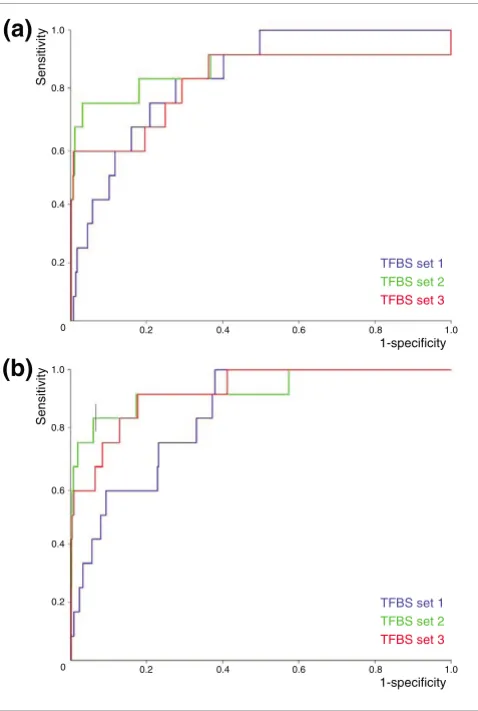
larger. The selection of one TRM out of these similar TRMs is inherently arbitrary and depends only marginally on the true regulatory signals. To make ModuleMiner more robust to this 'noise', we cluster the top-scoring TRMs and select the most prominent cluster instead of the single optimal TRM. We call this cluster of TRMs a 'transcriptional regulatory global model' (TRGM). The results of a LOOCV when using these TRGMs (Figure 1b) show that this indeed has a positive effect on ModuleMiner's performance: the AUCs increased by 6% on average. Furthermore, these TRGMs provide additional information compared with singular TRMs, because they allow an estimate of the relative importance of each PWM involved, as discussed below.
When comparing the performance of ModuleMiner (using TRGMs) on the three sets of candidate binding sites, a large difference between selecting all detected binding sites (set 1: AUC value 84.6%) and restricting to preserved sites only (set 2: AUC value 92.8%) is apparent. Correcting for TSS differ-ences in human and mouse (set 3: AUC value 92.5%) did not increase this performance further. Thus, for this high-quality set of co-expressed genes, the preservation of binding sites is highly beneficial for efficient detection of CRMs. This strongly suggests that for this gene set the trans-acting factors are con-served between human and mouse.
We next applied the ModuleMiner algorithm to the full set of 12 smooth muscle marker genes, using the site preservation measure (set 2). The resulting TRGM identifies SRF, SMAD4, SP1, and ATF3 as the main transcription factors involved in the co-regulation of these genes (detailed ModuleMiner out-put is reported on our website [26]). Importantly, ModuleM-iner implicates SRF as the most important smooth muscle regulator, and suggests that smooth muscle specific regula-tion often entails two or more SRF binding sites, which is in agreement with the literature [27].
[image:3.612.55.556.126.201.2]To verify the added value of the resulting combination of PWMs over SRF alone, we manually generated a TRGM con-taining only PWMs for SRF, and compared the performance of this model with that of ModuleMiner. When we applied this 'SRF only' TRGM to rank the genome, we obtained an AUC of 79.9%, which is significantly smaller than the 92.8% AUC of ModuleMiner (obtained in an LOOCV setting).
Table 1
Genome-wide databases of candidate transcription factor binding sites
Number Database properties Number of genes Number of regions Number of binding sites
1 Human-mouse conserved regions, 10 kilobases 5' of TSS 8,759 22,582 1,858,800
2 (1) + limited to binding sites occurring both in the human and mouse
CNS
8,759 22,582 878,338
3 (2) + correct for possible mouse TSS differences (add 100 kilobases
of mouse sequence 5' and 3')
11,653 35,021 1,316,927
CNS, conserved noncoding sequence; TSS, transcription start site.
Performance of ModuleMiner
Figure 1
Performance of ModuleMiner. Illustrated is the performance of ModuleMiner on a set of smooth muscle marker genes, using the three different sets of candidate transcription factor binding sites (TFBSs). Receiver operating characteristic curves are shown, representing results for leave-one-out cross-validations on the set of smooth muscle markers, (a) using singular transcriptional regulatory models and (b) using transcriptional regulatory global models.
TFBS set 1 TFBS set 2
TFBS set 3
(a)
1.00.8
0.6
0.4
0.2
0 0.2 0.4 0.6 0.8 1.0
Sensitiv
ity
1-specificity
TFBS set 1 TFBS set 2
TFBS set 3
(b)
1.00.8
0.6
0.4
0.2
0 0.2 0.4 0.6 0.8 1.0
Sensitiv
ity
[image:3.612.56.295.292.648.2]Sensitivity to noise
To assess the performance of ModuleMiner as a function of the composition of the input set of co-expressed genes, we performed LOOCV on input sets that contain a varying per-centage of genuinely co-regulated genes ('true positives'). As true positive genes, we selected the set of ten smooth muscle markers that share similar CRMs that can be identified by ModuleMiner (these ten genes all are ranked within the top 7% of the genome by a LOOCV, as shown in Figure 1b). We approximated negative genes (genes that do not contain the smooth muscle CRM) by random genes.
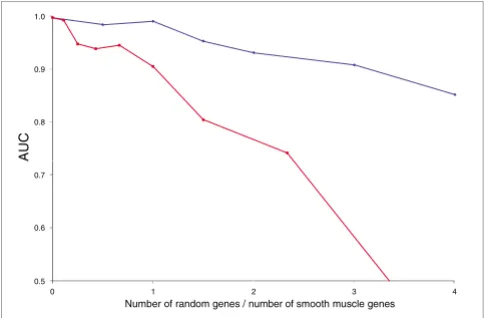
[image:4.612.54.296.87.246.2]In a first analysis, we kept the number of true positive genes constant at ten, and we added a varying number of negative genes. The decrease in performance as a function of an increasing number of negative genes was surprisingly small (Figure 2). Even when only 10 out of 50 genes contained the smooth muscle CRM, ModuleMiner was able to pick up this signal (the AUC was 85.2%, and SRF and SP1 were still iden-tified as key factors).
In a second analysis, we kept the total number of genes con-stant at ten, and we varied the percentage of negative genes. We now observed a steep decrease in ModuleMiner perform-ance as a function of an increasing percentage of negative genes (Figure 2).
We conclude from these experiments that ModuleMiner requires a critical mass of true positive genes for successful detection of similar CRMs. However, when this critical mass is present, ModuleMiner is highly robust to false-positive genes.
Comparison with other CRM detection algorithms
We next compared ModuleMiner with other in silico
approaches for CRM detection on benchmark data. From PAZAR [28], we selected all 'boutiques' containing annotated regulatory regions directing expression in a particular sys-tem: M02, muscle; M03, liver; M08, ORegAnno Stat1; and M09, ORegAnno Erythroid. As a fifth benchmark set, we used the 12 smooth muscle genes described above. On each of these five sets, we compared the performance of ModuleMiner with that of four state-of-the-art publicly available algorithms designed to detect similar CRMs in co-expressed genes: Mod-uleSearcher [29], CREME [19], CisModule [22], and EMC-MODULE [30]. We also included the Clover algorithm [31], which looks for individual over-represented TFBSs in puta-tive regulatory sequences of a set of co-expressed genes. We note that our analysis does not focus specifically on the known enhancers, but in contrast we consider all CNSs in the entire 10 kb 5' of the TSS (which may or may not contain the known enhancer, as well as other sequences). This effectively mimics a real-life situation, where the exact location of the regulatory sequences is not known a priori.
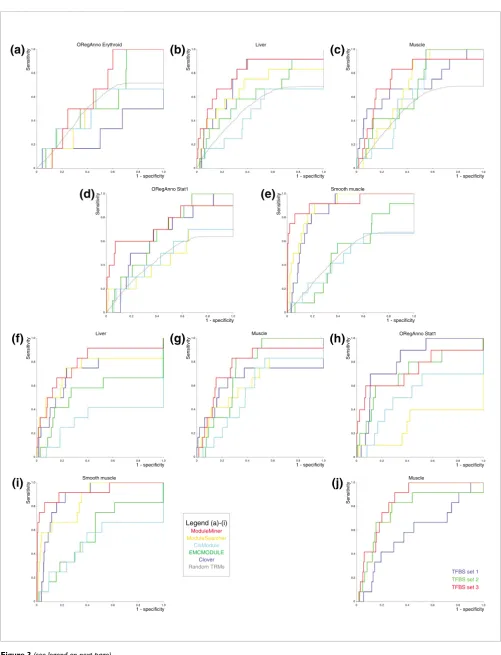
The CREME algorithm was unable to identify similar CRMs in any of the five benchmark sets, most likely in part because of its focus on larger sets of more loosely co-expressed genes [19]. Using the remaining algorithms, we performed LOOCV on each of the five benchmark sets. For this LOOCV, we used each algorithm to train a TRM or TRGM using gene sets in which one gene is left out (see Materials and methods, below, for details). Hence, as training data, we used all CNSs in the 10 kb 5' of the TSS of the benchmark set, except for the left-out gene. For CisModule and EMCMODULE, the inputs were the sequences of the CNSs; for Clover, the inputs where the sequences of the CNSs as well as all TRANSFAC and JASPAR vertebrate PWMs; for ModuleSearcher, the inputs were the predicted binding sites within those CNSs, using all TRANS-FAC and JASPAR vertebrate PWMs. The combination of PWMs that each algorithm provided as output was used to build a TRM or TRGM. We subsequently used the ModuleS-canner algorithm to rank all genes in the genome based on the predicted TRM/TRGM, and we used the results to construct ROC curves. We used the site preservation measure (candi-date TFBS set 2) for the ModuleMiner runs (because this was the set in which we obtained the best results for the smooth muscle genes). Because the other algorithms do not use site preservation in the discovery step, we used candidate TFBS set 1 (without preservation) also in their genome ranking step. We also constructed random ROC curves based on genome ranking using random TRMs (see Materials and methods, below, for details).
Sensitivity of ModuleMiner's performance to the quality of the input genes
Figure 2
Sensitivity of ModuleMiner's performance to the quality of the input genes. The ratio of true positive genes (containing the smooth muscle cis -regulatory module [CRM]) to negative genes (approximated by random genes) was varied. Each time, a leave-one-out cross-validation was performed, a receiver operating characteristic (ROC) curve was constructed, and the area under the ROC curve (AUC) was calculated. These AUCs were plotted as a function of the ratio negative genes/ positive genes. Because an AUC of 50% signifies random ordering of the left-out genes (and hence indicates that no CRMs can be detected), this value was taken as the origin on the y-axis. Blue: the number of positive genes was kept constant at ten, and the number of negative genes was varied. Red: the total number of genes was kept constant at ten, and the ratio negative genes/positive genes was varied.
AUC
Number of random genes / number of smooth muscle genes
1.0
0.9
0.8
0.7
0.6
0.5
4 3
2 1
On the OregAnno Erythroid benchmark set neither Modu-leMiner nor any of the other algorithms appear to perform better than random (Figure 3a). Because this is the smallest set, containing only six genes with human-mouse CNSs, this is consistent with the results we obtained in the previous sec-tion, in which we concluded that a critical number of co-reg-ulated genes is required for CRM detection. In contrast, on each of the four other benchmark sets, ModuleMiner per-forms better than random TRMs, as do some of the other algorithms (Figure 3b-e). Comparing the performance of all CRM detection algorithms, ModuleMiner appears to exhibit the best performance in all four cases. Interestingly, only ModuleMiner can compete with 'simple' TFBS over-represen-tation in this setup, emulating a real-life situation in which the regulatory sequences are not known. Indeed, only Modu-leMiner outperforms Clover on four of the five benchmark sets. On the fifth benchmark set (muscle), Clover and Modu-leMiner seem to be closely matched, with the Clover method showing a steeper start of the ROC curve.
The performance of the other CRM detection algorithms can be improved by using site preservation (TFBS set 2) in the genome ranking step (Figure 3f-i), although ModuleMiner outperforms all other CRM detection algorithms here also, which suggests that the TRMs predicted by ModuleMiner are more informative or more specific than those suggested by other methods. Candidate TFBS set 2 was not in all cases the optimal choice for ModuleMiner; on the muscle benchmark set, candidate TFBS set 3 performed better (Figure 3j).
We noticed that the CRM predictions ModuleMiner made on the muscle, liver, and ORegAnno Stat1 sets correspond well with the known regulatory elements. The TRGMs ModuleM-iner contructed contain PWMs for SRF, MEF2, Myf and MyoD (muscle), HNF1, HNF3, HNF4 and CEBP (liver), and STAT (ORegAnno Stat1), even though we used all CNSs in the 10 kb upstream region. In addition, the CRM predictions mostly overlap the true enhancer, when the real regulatory sequence was in our CNS collection. Indeed, for the muscle set, in 9 of the 11 cases in which the known enhancer was in our CNS set, ModuleMiner was ably to identify this region. For the liver set, ModuleMiner identified seven out of eight regulatory elements (data not shown).
Detection of CRMs in microarray clusters
Realizing that clustering of microarray data provides a rich source of large co-expressed gene sets, in which robustness to genes that are not co-regulated ('false positive genes') is criti-cal, our sensitivity to noise analysis above encouraged us to apply ModuleMiner to microarray clusters on a larger scale. The GNF SymAtlas [32] contains expression profiles of 140 human and mouse tissues. Nelander and coworkers [33] obtained gene clusters by hierarchically clustering this data-set, followed by a Pearson's correlation coefficient cut-off. From this clustering, we selected all clusters with at least 25 genes in our dataset (genes with at least one CNS within 10 kb
5' of the TSS). This results in ten clusters with sizes ranging from 26 to 214 genes. Large clusters were randomly divided in a training set of 50 genes, and a test set containing the remaining genes.
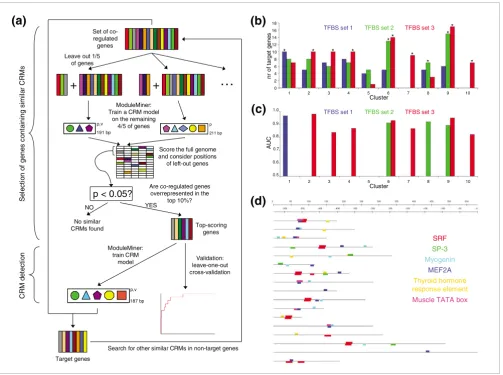
Because it was our goal here to identify similar CRMs within a subset of the genes in each microarray cluster, we used a two-step procedure. First we detected which subset of genes potentially share CRMs, and next we detected the actual CRMs in their upstream regions (Figure 4a). The first step consisted of a fivefold cross-validation, where in each valida-tion run we used ModuleMiner to train a TRGM on four-fifths of the genes in a cluster, and next we determined which of the other one-fifth of left-out genes were targets of the TRGM. If the total number of true target genes among left-out genes was not significantly higher than random, then we concluded that ModuleMiner is unable to detect similar CRMs within this cluster. If on the other hand there was a significant enrichment of these true target genes, then we concluded that ModuleMiner can detect similar CRMs, and we used these high scoring genes in the second step. In this second step, ModuleMiner was applied to this focused subcluster, identifying similar CRMs that regulate these genes. As an extra validation, LOOCV was used to confirm the presence of similar CRMs, as done previously on the smooth muscle and other benchmark sets.
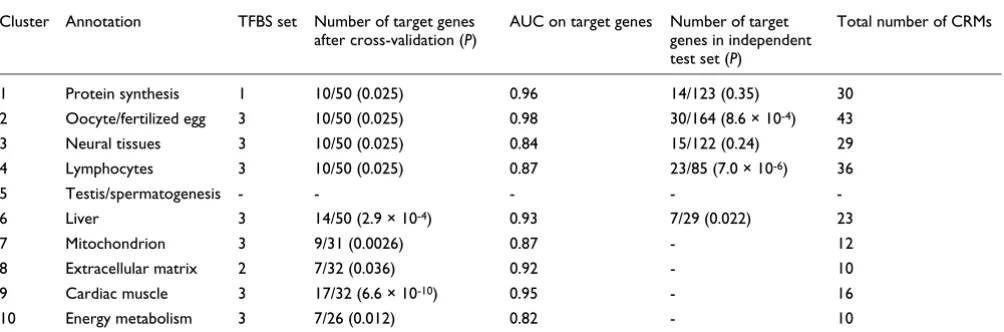
Application of this procedure to the microarray clusters described above resulted in successful CRM detection in nine out of the ten clusters (Table 2 and Figure 4b). In each case, this success was confirmed by a LOOCV on the selected sub-cluster (all AUCs were significantly above 50%, with an aver-age AUC of 90.3%; Figure 4c). For the TRGMs obtained for clusters containing more than 50 genes, the number of targets in the independent test set was determined. This was signifi-cantly higher than random in three of the five cases (Table 2). In total, we predicted 209 CRMs. These ModuleMiner predic-tions can be viewed in detail on our website [26].
Detection of CRMs in embryonic development gene sets
In the previous section we detected CRMs in microarray clus-ters expressed in different adult tissues. Next, we aimed to predict CRMs involved in embryonic development processes.
Figure 3 (see legend on next page)
(a)
ORegAnno Erythroid1 - specificity
Se
nsit
ivity
1.0
0.8
0.6
0.4
0.2
0
0 0.2 0.4 0.6 0.8 1.0
(b)
Liver1 - specificity
Se
nsit
ivity
1.0
0.8
0.6
0.4
0.2
0
0 0.2 0.4 0.6 0.8 1.0
(c)
Muscle1 - specificity
Se
nsit
ivity
1.0
0.8
0.6
0.4
0.2
0
0 0.2 0.4 0.6 0.8 1.0
(d)
ORegAnno Stat11 - specificity
Se
nsitivity
1.0
0.8
0.6
0.4
0.2
0
0 0.2 0.4 0.6 0.8 1.0
(e)
Smooth muscle1 - specificity
Se
nsit
ivity
1.0
0.8
0.6
0.4
0.2
0
0 0.2 0.4 0.6 0.8 1.0
(f)
Liver1 - specificity
Se
nsit
ivit
y1.0
0.8
0.6
0.4
0.2
0
0 0.2 0.4 0.6 0.8 1.0
(g)
Muscle1 - specificity
Se
nsitivity
1.0
0.8
0.6
0.4
0.2
0
0 0.2 0.4 0.6 0.8 1.0
(h)
ORegAnno Stat11 - specificity
Se
nsitivit
y1.0
0.8
0.6
0.4
0.2
0
0 0.2 0.4 0.6 0.8 1.0
(i)
Smooth muscle1 - specificity
Se
nsitivit
y1.0
0.8
0.6
0.4
0.2
0
0 0.2 0.4 0.6 0.8 1.0
(j)
Muscle1 - specificity
Se
nsitivit
y1.0
0.8
0.6
0.4
0.2
0
0 0.2 0.4 0.6 0.8 1.0
Legend (a)-(i) ModuleMiner ModuleSearcher
CisModule EMCMODULE
Clover Random TRMs
Characterization of the CRMs
The TRGMs that were predicted by ModuleMiner in each of the ten microarray clusters and each of the five embryonic development gene sets are summarized in Tables 4 and 5. Apart from this TRGM, ModuleMiner also provides addi-tional information characterizing the CRMs. We shall discuss here the results we obtained in cluster 9, which contains genes related to cardiac muscle function.
First, ModuleMiner characterizes the given input genes, retrieving descriptions and commonly used identifiers (for example, HGNC) from the Ensembl database. In addition, the Gene Ontology (GO) terms annotated to the input genes are retrieved, and the over-represented GO terms are reported. For the cardiac muscle subcluster 'muscle contraction' (GO:0006936), 'muscle development' (GO:0007517), 'orga-nogenesis' (GO:0009887), 'contractile fiber' (GO:0043292), and 'regulation of heart contraction rate' (GO:0008016) were among the over-represented GO terms.
Next, ModuleMiner determines the weight of each PWM in the TRGM (see Materials and methods, below). By grouping similar PWMs, the weight of each trans-factor involved is determined. The cardiac muscle TRGM contains PWMs for SRF, MEF2A, myogenin, SP3, a thyroid hormone response element (all with weights of approximately 1), and a muscle TATA box (with weight approximately 0.5). ModuleMiner also displays the CRMs that it identifies on the input genes. Figure 4d shows this for the heart muscle genes.
Because our approach uses only human and mouse sequences to model CRMs, sequenced genomes of other species can be used as validation data. ModuleMiner employs the rat and dog genomes for this purpose, by checking for CRMs that fit the obtained TRGM in rat-dog CNSs. For the cardiac muscle genes, 11 orthologs were present in our rat-dog TFBS data-base, seven of which were ranked within the top 10% of the genome (P = 2.28 × 10⁻⁵).
Finally, ModuleMiner selects putative new target genes of the TRGM from the complete genome. We aim to minimize noise in these target gene predictions by using network level con-servation [34], particularly through phylogenetic fusion of target gene rankings. To this end, first all genes in the human-mouse TFBS database (excluding the input genes) and all (noninput) genes in the dog-rat TFBS database are ranked separately. ModuleMiner then fuses these two rankings into
one global ranking using order statistics (similar to the approach used by Aerts and coworkers [23,35]). Among the 100 top ranking new target genes of the cardiac muscle TRGM were MYL3 ('cardiac myosin light chain 1'), MYOD1 ('myoblast determination protein 1'), TNNI1 ('troponin I'), and MYH3 ('myosin heavy chain, embryonic skeletal muscle').
The results we obtained on all sets of co-expressed genes dis-cussed in this work can be viewed on our website [26].
Where are the CRM predictions located?
ModuleMiner successfully detected nine sets of similar CRMs in the ten microarray clusters and five sets of similar CRMs in the five embryonic development gene sets. In total, 257 CRMs were predicted. In addition to this, ModuleMiner predicted 100 new target genes of each TRGM. We next used this com-pendium of 1,657 CRMs to examine their positions relative to the TSSs of the genes that they regulate.
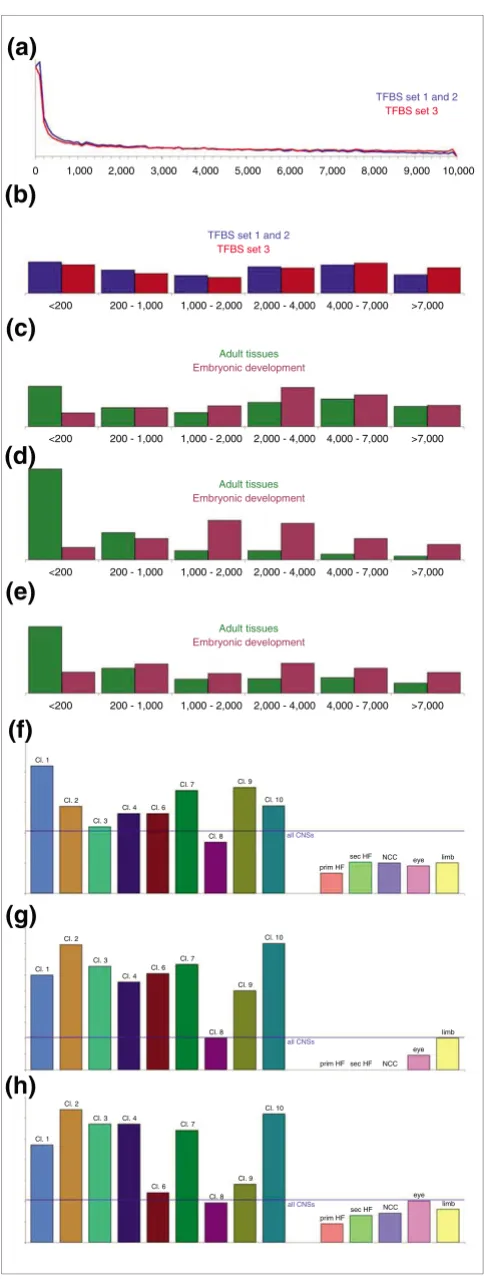
Because a gene's search space was defined as all CNSs within 10 kb 5' of the TSS, we first examined the distributions of CNS locations, because these represent the background distribu-tion to which the CRM locadistribu-tions will be compared. A first important observation is that the CNSs are highly over-repre-sented close to the TSS, as shown in Figure 5a,b. The type of gene set, namely adult tissue versus embryonic development, introduces a second CNS location bias (Figure 5c). Indeed, the adult tissue CNS set is enriched in sequences close to the TSS (<200 base pairs; P = 7.6 × 10⁻¹⁶ by a Wilcoxon rank sum
test), whereas the embryonic development CNS set is depleted in sequences close to the TSS and enriched in sequences further from the TSS (2,000 to 4,000 base pairs; P
= 5.6 × 10⁻⁷). When evaluating each of the gene sets separately
(Figure 5f), eight of the nine adult tissue CNS sets are enriched in sequences less than 200 base pairs from the TSS (in six cases, this was statistically significant by a χ2 test),
whereas all five embryonic development CNS sets are depleted in sequences less then 200 base pairs from the TSS (in three cases, this was statistically significant).
Next, we examine the location distribution of the CRMs that were identified by ModuleMiner. For adult tissue genes, CRMs are strongly over-represented close to the TSS (Figure 5d). Of these CRMs, 63% are within 200 base pairs of the TSS. In contrast, the CRMs that ModuleMiner identified near to the embryonic development genes are depleted close to the
Comparison with other CRM detection algorithms
Figure 3 (see previous page)
TSS and enriched further away (1,000 to 2,000 base pairs). These conclusions remain valid even when controlling for both biases mentioned above; comparing Figure 5d to Figure 5c (the predicted CRMs in Figure 5d can be considered a selection from the CNS sets in Figure 5c), the enrichment of predicted CRMs directing expression in adult tissues close to the TSS persisted (P = 2.6 × 10⁻²⁷). (This was calculated as
fol-lows; the distances to the TSS of the predicted CRMs and all CNSs of the genes in the microarray clusters were ranked and the Wilcoxon rank sum test was applied.) For the CRMs
directing expression in embryonic development, no statisti-cally significant deviation from random selection from the embryonic development CNS sets could be identified (P = 0.18). When considering the gene sets separately, in eight microarray clusters expressed in adult tissues CRMs are enriched in sequences close to the TSS (Figure 5g; this was statistically significant when controlling for bias in six cases). In contrast, in four embryonic development gene sets, CRMs are depleted close to the TSS (markedly, for three of these
[image:8.612.55.558.85.459.2]Application of ModuleMiner to microarray clusters
Figure 4
Application of ModuleMiner to microarray clusters. (a) The two-step procedure used to detect similar cis-regulatory modules (CRMs) in a subset of genes within a given microarray cluster. In the first step, a fivefold cross-validation is performed, and the number of left-out genes considered as target genes is counted. If this number is significantly more than expected under a random distribution of the ranks, then these genes are transferred to the second step. In this second step, ModuleMiner is used to model the similar CRMs regulating the genes in this focused subcluster. (b) Results of the first step of the procedure in panel (a) for the ten microarray clusters and the three different sets of candidate transcription factor binding sites (TFBSs). Significantly higher numbers of target genes among the left-out genes than randomly expected are depicted by an asterisk. Clusters 7 and 10 only contained sufficient genes (≥ 25) in TFBS set 3 and therefore are omitted for the other two sets. (c) Leave-one-out cross-validation results on the subclusters with a significant enrichment of target genes from panel (b). Each left-out gene was ranked using the transcriptional regulatory global model (TRGM) obtained on the remaining genes. Next, sensitivity/specificity pairs where calculated for different detection thresholds, and these were used to construct receiver operating characteristic (ROC) curves. The areas under these ROC curves (AUCs) were calculated and are depicted here. The colors are as in panel (b). (d) Presented is an example of a set of similar CRMs identified by ModuleMiner. These results were obtained on the cardiac muscle genes by the procedure depicted in panel (a). Each horizontal line represents a human-mouse conserved noncoding sequence (CNS) upstream of a gene within the cluster. The different colored boxes represent binding sites of different transcription factors. Detailed results, including descriptions of the genes shown, and the exact positions of the CNSs are available on our website [26].
…
Set of co-regulated genes Leave out 1/5
of genes
ModuleMiner: Train a CRM model
on the remaining 4/5 of genes
Score the full genome and consider positions
of left-out genes
191 bp p,v
211 bp p
Are co-regulated genes overrepresented in the
top 10%? p < 0.05?
NO YES
No similar
CRMs found Top-scoring genes
187 bp p,v ModuleMiner: train CRM model
+
+
S e le c ti o n o f ge ne s c o nt a ini ng s imi la r C R M s CRM d e te ct io n Validation: leave-one-out cross-validation Target genesSearch for other similar CRMs in non-target genes
(a)
(b)
(c)
(d)
TFBS set 1 TFBS set 2 TFBS set 3
TFBS set 1 TFBS set 2 TFBS set 3
Cluster Cluster nr of t a rge t g e ne s AU C 0 2 4 6 8 10 12 14 16 18
1 2 3 4 5 6 7 8 9 10
1 2 3 4 5 6 7 8 9 10
SRF SP-3 Myogenin MEF2A Thyroid hormone response element Muscle TATA box
sets, no CRMs were predicted within 200 base pairs of the TSS).
A similar difference in TSS distance distribution was also observed for the new target genes (Figure 5e). Here as well, the distances to the TSS of the CRMs predicted to direct expression in adult tissues were clearly nonrandomly distrib-uted compared with all CNSs (P = 3.6 × 10-74 by Wilcoxon
rank sum test). For the CRMs predicted to direct expression in embryonic development, no statistically significant differ-ence was observed (by Wilcoxon rank sum test). However, these sequences appear to be (slightly) depleted within 200 base pairs of the TSS (P = 1.5 × 10⁻⁴ by a χ2 test). Considering
each of the gene sets separately (Figure 5h), in seven adult tis-sue microarray clusters, CRMs were significantly enriched within 200 base pairs of the TSSs, whereas for two embryonic development gene sets CRMs were significantly depleted close to the TSS. Although in six cases this effect was highly significant (P < 10-9), it was smaller than the effect within the
clusters (compare Figures 5d and 5e).
In summary, the CRMs that ModuleMiner detected were non-randomly positioned in the genome. CRMs predicted to direct expression in adult tissues were highly enriched very close to the TSS, whereas CRMs predicted to direct expression in embryonic development were depleted very close to the TSS.
Discussion
Although the sequence of the human genome has been avail-able for a consideravail-able time now, our ability to chart the regions that control gene expression is still limited. The
situ-ation appears to improve as a function of smaller genome size. Indeed, in the Drosophila early segmentation network, CRMs can be predicted based on known examples [10,11]. In the yeast Saccharomyces cerevisiae, with a much smaller genome, it is possible to go one step further and predict the expression of genes based only on upstream sequences [36]. Here, we focus on the computational detection of CRMs in the human genome, and hence this work makes a contribution toward bridging this gap.
ModuleMiner detects CRMs by taking as input a set of co-expressed genes, under the assumption that a subset of these are co-regulated, and looking for a recurrent pattern of (com-putationally predicted) TFBSs. The advantages of this approach are that it does not require known examples and that it allows prediction of a probable function for the detected CRMs.
[image:9.612.55.557.121.287.2]ModuleMiner is similar in scope to ModuleSearcher [20,29] and CREME [19]. It differs from these previous approaches in that ModuleMiner maximizes specificity for the given set of co-expressed genes by performing a whole-genome optimiza-tion. Indeed, ModuleMiner optimizes the combined rankings of the given gene set in a ranking of the complete genome. In addition, this approach allows comparison between TRMs with different parameters (for example, maximum CRM length, and number of PWMs in the TRM). Therefore, Modu-leMiner can optimize over these parameters, and hence our approach effectively eliminates the need for parameters required by previous approaches.
Table 2
Summary of ModuleMiner's results for the ten microarray clusters
Cluster Annotation TFBS set Number of target genes
after cross-validation (P)
AUC on target genes Number of target
genes in independent test set (P)
Total number of CRMs
1 Protein synthesis 1 10/50 (0.025) 0.96 14/123 (0.35) 30
2 Oocyte/fertilized egg 3 10/50 (0.025) 0.98 30/164 (8.6 × 10⁻⁴) 43
3 Neural tissues 3 10/50 (0.025) 0.84 15/122 (0.24) 29
4 Lymphocytes 3 10/50 (0.025) 0.87 23/85 (7.0 × 10⁻⁶) 36
5 Testis/spermatogenesis - - - -
-6 Liver 3 14/50 (2.9 × 10⁻⁴) 0.93 7/29 (0.022) 23
7 Mitochondrion 3 9/31 (0.0026) 0.87 - 12
8 Extracellular matrix 2 7/32 (0.036) 0.92 - 10
9 Cardiac muscle 3 17/32 (6.6 × 10⁻¹⁰) 0.95 - 16
10 Energy metabolism 3 7/26 (0.012) 0.82 - 10
Transcription factor binding site (TFBS) sets: set 1 includes human-mouse conserved noncoding sequences (CNSs) 10 kilobases 5' of the
transcription start site (TSS); set 2 includes set 1 + binding site preservation; and set 3 includes set 2 + correction for TSS differences. For clusters in
which multiple TFBS sets resulted in successful cis-regulatory module (CRM) detection, only the result showing the best cross-validation
Other algorithms have been developed that aim to detect sim-ilar CRMs in a set of co-expressed genes that (contrary to the approaches described above) do not use a library of PWMs [21,22,30,37]. Instead, and in addition to optimizing the combination of motifs, these algorithms optimize the motifs themselves. Hence, these methods attempt to solve a problem with considerably greater complexity, resulting in lower per-formance, as confirmed by our comparison on benchmark data. Given the extremely poor performance of motif detection methods in organisms other than yeast [38], we have opted to circumvent motif optimization by using exper-imentally determined PWMs. Note that this decision does not necessarily limit the search to known PWMs, because librar-ies of computationally predicted PWMs are also available (for example, the phylofacts PWM library [39]). In addition, we believe that with the emergence of the protein binding micro-array technology [40], high quality PWMs will soon become available for a large fraction of the human transcription factor repertoire. Even though the currently available libraries of experimental PWMs exhibit high redundancy and may con-tain low quality PWMs, our new approach of clustering similar TRMs is able to group redundant PWMs, and our val-idations show that in many cases a combination of five exper-imental PWMs can capture enough information of a CRM to yield acceptable genome-wide specificity levels.
ModuleMiner outputs the predicted CRMs and a TRGM. This TRGM can be considered a bag of PWMs (selected from TRANSFAC and JASPAR), with a weight associated to each PWM. Therefore, this TRGM not only predicts the transcrip-tion factors that functranscrip-tion in the process under study, but it also allows an assessment of the relative importance of each of these transcription factors.
TRGMs do not contain spatial relations between TFBSs (except for the total size of the CRMs and a Boolean parame-ter indicating whether different binding sites can overlap). Although certain spatial relations between transcription fac-tors working in concert are known to exist (for example
[41,42]), we did not find any reports indicating that this is the rule rather then the exception. Therefore, we reasoned that any such relationships should not be hard-coded into the TRGMs, but rather would become apparent by inspection of the predicted CRMs. Upon inspection of the predicted CRMs presented above, no such spatial relationships surfaced.
Our method for scoring a sequence using a TRM or TRGM (see Materials and methods, below) does not take homotypic clustering of TFBSs into account (like hidden Markov model based methods do [15,17,43]). However, this cooperative binding of one transcription factor can nevertheless be mod-eled in our framework by the construction of a TRM or TRGM that contains multiple instances of the same PWM. Therefore, if multiple instances of a specific transcription factor are important for the regulation of a set of co-regulated genes, then this is represented accordingly in the optimal model. For example, when applying ModuleMiner to the tightly co-expressed set of smooth muscle markers, the transcription factor SRF occurs two or three times in each of the TRMs in the resulting TRGM, suggesting an extensive cooperation between SRF binding sites for smooth muscle specific tran-scription regulation. In contrast, the SMAD4, SP1, and ATF3 PWMs occur exactly once in 97.5% of the TRMs (SMAD4 and SP1 occur twice in 1.5% and 1% of the TRMs, respectively).
ModuleMiner takes the genomic background sequence into account in two ways. First, a third order background model is used in the process of annotating putative TFBSs. Second, our optimization strategy selects the TRM (or TRGM) that opti-mally separates the given genes (sequences) from all other genes in the genome. Hence, our system corrects both for local sequence properties (by the third order background model) as for more global sequence properties (by selecting against combinations of TFBSs that occur independently of the given sequences).
[image:10.612.51.559.119.216.2]We included all CNSs up to 10 kb 5' of the TSS in our pipeline. Although this choice is inherently arbitrary, it is motivated by
Table 3
Summary of ModuleMiner's results for the five embryonic development gene sets
Embryonic development process TFBS set Number of target genes after
LOOCV (P)
AUC
Primary heart field [50] 1 6/7 (6.4 × 10⁻⁶) 0.92
Secondary heart field [50] 1 6/9 (6.4 × 10⁻⁵) 0.79
Neural crest cells [51] 2 6/10 (1.5 × 10⁻⁴) 0.86
Eye development [52] 1 10/15 (1.9 × 10⁻⁷) 0.79
Limb development [53] 1 10/24 (5.2 × 10⁻⁵) 0.77
A key review or book used as a basis for construction of the development gene set is given in the first column. The genes in each set as well as the detailed results can be viewed at our website [26]. Transcription factor binding site (TFBS) sets: set 1 includes the human-mouse conserved noncoding sequences (CNSs) 10 kilobases 5' of the transcription start site (TSS); set 2 includes set 1 + binding site preservation; and set 3 includes
set 2 + correction for TSS differences. For clusters where multiple TFBS sets resulted in successful cis-regulatory module (CRM) detection, only the
the following arguments. First, sequences 3' of the TSS might harbor translational regulatory signals, which we do not wish to model here. Second, potential regulatory sequences far upstream can be difficult to assign to a target gene. Third, selecting 10 kb 5' of the TSS has proven to be valuable in our previous study [20], and others have made similar choices as well [44]. In a previous study, in which CRMs were predicted in an unbiased way across the complete human genome [8], it was shown that CRMs are highly depleted between 10 kb and 30 kb 5' of the TSS.
The validation framework that we use, combining genome-wide ranking with LOOCV, could also be useful in evaluating or comparing hypotheses regarding the working principles of transcription regulation, and in this regard can be considered similar in scope to CodeFinder [24]. In this work, two such tests are implicitly performed: CRMs driving a tissue-specific expression pattern are compared with CRMs driving an embryonic development expression pattern; and by compar-ing the three sets of putative TFBSs (for example, Figures 1, 3j, and 4b) the importance of binding site preservation is
evaluated, as well as the impact of a correction for differences in TSSs between human and mouse.
[image:11.612.52.557.126.290.2]Construction of a high-quality set of co-regulated genes involved in a certain process under study is not always straightforward. In this regard, robustness to noise in a set of putative co-expressed genes is highly desirable in an algo-rithm to detect similar CRMs. We found ModuleMiner to be highly robust to the quality of this input gene set. Indeed, in our experiments with smooth muscle marker genes we observed that ModuleMiner was able to pick up the correct signal even when only 10 out of 50 given genes are really co-regulated (Figure 2). These properties of ModuleMiner prompted us to apply the algorithm to gene sets obtained from clustering microarray data. In nine out of ten microarray clus-ters, ModuleMiner succeeded in finding similar CRMs in a sub-set of the genes. Perhaps unsurprisingly, a critical mass of co-regulated genes is required for ModuleMiner to detect similar CRMs. However, this minimum required number of co-regu-lated genes is sufficiently small so as not to preclude applica-tion of the algorithm. This is illustrated both by our results obtained on the smooth muscle genes (Figure 2) and by the
Table 4
Transcriptional regulatory global models constructed for the ten microarray clusters
Cluster Key transcription factors and binding sites in TRGM (weight)
Protein synthesis NF-Y (1.59), DEC (1.13), HIC1 (1.09), general initiator sequence (0.47), CCAAT box (0.44), TCF-4 (0.32)
Oocyte/fertilized egg T3R (1.00), NF-Y (1.00), ETS/PEA3 (0.99), MAZ (0.92), AP2α (0.78), SP1 (0.30)
Neural tissues UF1-H3β (1.13), CRE-BP/CJUN/ATF-1 (1.00), AP-2 (0.87), ETF (0.55), AP-1/NF-E2 (0.33)
Lymphocytes STAT6 (1.00), PU.1 (0.99), ETS (0.96), STAT5/STAT (0.95), SP1 (0.89)
Testis/spermatogenesis
-Liver TCF1/HNF-1 (1.00), NF-1 (1.00), C/EBP (0.99), HNF-4/COUP (0.99), PPAR/HNF-4/COUP/RAR (0.66), MYC-MAX (0.58),
PPAR (0.33)
Mitochondrion c-ETS (1.35), VDR (1.00), GATA-1/GATA-2 (1.00), ZID (0.82), AR (0.43), ROAZ (0.34)
Extracellular matrix AP-1/NF-E2/BACH1 (2.00), FOXD1 (1.00), BLIMP1 (1.00), SRF (0.70), MEF-2/RSRFC4 (0.51), STAT5/STAT6 (0.35)
Cardiac muscle SP-3 (1.00), myogenin (1.00), MEF2A (1.00), SRF (1.00), tyroid hormone receptor/RAR/RXR (0.91), muscle TATA box
(0.48)
Energy metabolism CREB/ATF/HLF (1.01), WHN (1.00), SPIB (0.71), PPARγ/RXRα (0.65), general initiator sequence (0.51), RFX (0.31)
TRGM, transcriptional regulatory global model.
Table 5
Transcriptional regulatory global models constructed for the five embryonic development sets
Development process
Key transcription factors and binding sites in TRGM (weight)
Primary heart field D type LTRs (1.12), HAND1/TCF3 (1.01), STAT3 (0.92), STAT5A (0.89), GATA1/GATA2 (0.63), ELK1 (0.32)
Secondary heart field HNF3α (1.56), STAT5A/STAT5B (1.00), GATA2 (0.56), NFAT (0.56), GATA/GATA3 (0.48), WHN (0.35)
Neural crest cells FREAC-7 (1.00), Poly A (1.00), TBX5 (1.00), HSF (0.89), FREAC-2 (0.30)
Eye development RREB1 (1.00), IRF (0.96), POU3F2 (0.92), ZF5 (0.80), GATA/GATA1 (0.46), LMO2 (0.39), NKX6-1 (0.32)
Limb development TEF (1.00), PLZF (1.00), PAX4 (0.96), EGR (0.87), AP-2 (0.65), PBX (0.63), Ikaros 1 (0.37)
[image:11.612.53.554.618.715.2]successful CRM detection in two small heart development gene sets (Table 3).
Application of ModuleMiner to the smooth muscle marker genes resulted in CRMs with multiple binding sites for SRF, and with single binding sites for SMAD4, SP1, and ATF3. Both SRF and SP1 have been shown to play a role in regulat-ing smooth muscle specific expression [27]. Furthermore, SMADs are effectors of the transforming growth factor-β sig-naling pathway, and have been shown to work in concert with SRF to control smooth muscle cell differentiation [45]. Mod-uleMiner identified transcription factors known to play a key role in other co-expressed gene sets as well. Examples are GATA factors, NFATs and HAND1 in heart development; HNF-1 and HNF-4 in liver-specific gene expression; PU.1 in lymphocyte specific gene expression; and myogenin, SRF, the thyroid hormone receptor, and MEF2 in heart-specific gene expression.
Imposing trans-factor conservation by motif preservation between human and mouse sequences of a CNS significantly improved the performance of ModuleMiner on the set of smooth muscle marker genes. A similar approach has also been shown to improve CRM detection performance in the
Drosophila early segmentation gene network [10]. When we
[image:12.612.54.296.80.724.2]applied ModuleMiner to the microarray clusters and the embryonic development gene sets, in some cases this trans-factor conservation also increased performance (microarray clusters 6, 7 and 9, and the neural crest cell gene set), but in other cases it did not.
Figure 5
TFBS set 1 and 2
TFBS set 3
(a)
(b)
(c)
(d)
(e)
(f)
(g)
(h)
0 1,000 2,000 3,000 4,000 5,000 6,000 7,000 8,000 9,000 10,000
TFBS set 1 and 2
TFBS set 3
<200 200 - 1,000 1,000 - 2,000 2,000 - 4,000 4,000 - 7,000 >7,000
<200 200 - 1,000 1,000 - 2,000 2,000 - 4,000 4,000 - 7,000 >7,000
<200 200 - 1,000 1,000 - 2,000 2,000 - 4,000 4,000 - 7,000 >7,000
<200 200 - 1,000 1,000 - 2,000 2,000 - 4,000 4,000 - 7,000 >7,000
Adult tissues
Embryonic development
Adult tissues
Embryonic development
Adult tissues
Embryonic development
Cl. 1
Cl. 2 Cl. 3
Cl. 4 Cl. 6 Cl. 7
Cl. 8 Cl. 9
Cl. 10
prim HF
sec HF NCC eye limb
all CNSs
all CNSs
all CNSs
Cl. 1 Cl. 2
Cl. 3 Cl. 4
Cl. 6 Cl. 7
Cl. 8 Cl. 9
Cl. 10
prim HF sec HF NCC eye
limb
Cl. 1 Cl. 2
Cl. 3 Cl. 4
Cl. 6 Cl. 7
Cl. 8 Cl. 9
Cl. 10
prim HF sec HF NCC
eye limb
Distribution of distance to transcription start site for CNSs and predicted CRMs
Figure 5
Correcting for possible differences in TSS in human and mouse by a three-step alignment procedure (see Materials and methods, below) resulted in increased performance for most of the microarray clusters, but not for the development gene sets. This marked difference may be related to the differ-ent locations of the detected CRMs in these two differdiffer-ent systems.
We observed a significant difference in the locations of the CRMs ModuleMiner predicted to direct expression in adult tissues and the CRMs ModuleMiner predicted to direct expression in embryonic development. CRMs driving tissue-specific expression are highly over-represented within 200 base pairs of the TSS. In contrast, CRMs driving expression in embryonic development are more evenly distributed in the 10 kb sequences we considered, and appear to be under-repre-sented within 200 base pairs of the TSS. These results suggest that transcription regulation of tissue-specific expression is mainly exerted by proximal promoters, whereas transcription regulation of expression during embryonic development appear mainly to be exerted by more distal enhancers.
ModuleMiner can be applied to three conceptually different tasks: prediction of transcription factors that play a role in regulating a set of co-regulated genes; prediction of regula-tory regions; and predictions of new target genes of a TRGM. It is important to appreciate that the accuracy of predictions differs between those tasks. Although exact performance sta-tistics can only be obtained through careful experimental testing of our predictions, which is outside the scope of the present study, the results we obtained in this work can be used to provide rough estimates of the predictive accuracy. When we applied ModuleMiner to the two well studied benchmark sets, we obtained HNF1, CEBP, HNF3, GATA1, PAX6 and HNF4 for the liver benchmark set; and MZF1, PPARγ, SRF, MEF2, the Epstein-Barr virus transcription factor R, MYF, and MYOD for the muscle benchmark set. Comparing this with the literature [4,46] and with the PWM libraries we use, we obtain a sensitivity of 70% (7/10 known PWMs are recovered), a specificity of 99.6% (630/633 [liver] and 619/621 [muscle] probably incorrect PWMs are rejected), and a positive predictive power of 62% (8/13 total predicted PWMs are correct). These values need to be regarded with some reservations when extrapolating to other cases, because both liver and muscle are well studied systems for which high-quality PWMs are available. Nevertheless, we can conclude that ModuleMiner is quite accurate in selecting PWMs/tran-scription factors that play a key role in regulating the genes under study.
Regarding detection of regulatory sequences, ModuleMiner was able to detect 16 out of 24 known muscle/liver enhancers, when a total of 24 predictions were made. This repesents a sensitivity of 67% and a positive predictive power of 67%, although we emphasize that this last value is an underesti-mate because some of our predictions may be yet unknown
enhancers. Notwithstanding some reservations on extrapo-lating these data, we conclude that the predictive accuracy of ModuleMiner for detection of regulatory regions (CRMs) near to a set of co-regulated genes is quite high.
Regarding the predictive accuracy of ModuleMiner for the detection of new target genes given a TRGM, the results of our LOOCV procedure can provide some estimates. From the resulting ROC curves, one can see that for a sensitivity of 50%, the specificity is about 90%, and for a sensitivity of 80% the specificity is about 80%, although the differences between different gene sets can be large. However, typically only a few dozen new target genes can be tested, and thus specificity may not be high enough to select the right targets from the com-plete genome. In our previous study [23] we confirmed that the predictive accuracy of new target genes is quite low, although we showed it to be detectably present. We note that in that study we used our previous ModuleSearcher algo-rithm, which was shown here to have lower performance than ModuleMiner. In addition, ModuleMiner's use of network level conservation between human-mouse and rat-dog pre-dictions of new target genes might increase performance. Finally, the results we obtained in the TSS distribution of the CRMs predicted near to the new target genes are consistent with these performance predictions; Figures 5e and 5h show a similar trend to that in Figures 5d and 5g but to a lesser extent, hence pointing to a substantial amount of noise, but also indicating that a signal can be picked up even in a whole-genome scan.
Conclusion
We present ModuleMiner, the first algorithm to detect CRMs in the human genome that is based on whole-genome optimi-zation. ModuleMiner is generally applicable and outperforms other similar approaches to detecting CRMs on benchmark data. In addition, ModuleMiner can detect similar CRMs in noisy sets of co-expressed genes, such as microarray clusters. We successfully applied the algorithm to sets of genes expressed in adult tissues and sets of genes expressed in embryonic development processes. We show that CRMs pre-dicted to regulate genes expressed in adult tissues are highly over-represented within 200 base pairs of the TSS, whereas CRMs predicted to regulate genes involved in embryonic development processes are depleted within this region. These findings suggest that expression in adult tissues is mainly directed by proximal promoters, whereas expression in embryonic development is more often regulated by distal enhancers.
Materials and methods
Construction of three sets of candidate TFBSs
3') of the TSS of all human genes and their mouse orthologs were obtained from Ensembl (version 36). When another gene was encountered, only the sequence up to that gene was included. CNSs were selected by LAGAN alignments [47]. Thresholds were set at 75% conservation over at least 100 base pairs. TFBS predictions were performed using MotifS-canner [48], with the prior set at 0.2. Both TRANSFAC [49] (version 9.4) and JASPAR [39] were used as PWM libraries.
The second set aims to restrict the candidate binding sites by enforcing that the regulatory factors should be conserved. This is achieved by selecting only binding sites in each human region for transcription factors for which we also detect bind-ing sites in the orthologous mouse region (preserved sites). We note that this constraint does not require the binding sites to be conserved or that they should align.
In the construction of the third set we aimed to correct for dif-ferences in human and mouse TSSs, and for possible annota-tion errors of TSSs. To this end, we extended the mouse sequences used in the alignments by 100 kb in both direc-tions. Alignment errors were kept in check by applying a multi-step alignment procedure. The human 10 kb sequence was aligned to the 10 kb mouse sequence (alignment A), the mouse sequence extended by 10 kb in both directions (alignment B), and the mouse sequence extended by 100 kb in both directions (alignment C). If CNSs were predicted in alignment A, then we assumed that the correct orthologous region in the mouse is not off by more then 10 kb, and hence we used the CNSs from alignment A supplemented by all additional CNSs from alignment B. CNSs that were truncated in alignment A because they extended over the sequence bor-ders were replaced by their counterpart from alignment B. If no CNSs were predicted in alignment A, then we reasoned that the correct orthologous region in the mouse might be off by more then 10 kb, and we used the CNSs from alignment C. Here also, for each CNS (in human) we selected only pre-served binding sites.
The same procedure was used with the dog and rat sequences to create sets of candidate TFBSs corresponding to the three human-mouse sets. Because neither dog nor rat could serve as a reference species, we did not extend the sequences in the dog-rat candidate TFBS set that corresponds to human-mouse set 3.
Transcriptional regulatory models
We model similar CRMs in a set of co-expressed genes by TRMs. These TRMs are parameterized as in the report by Aerts and coworkers [20]. A TRM is a combination of PWM instances (up to six), supplemented by three parameters: the maximum length of CRMs; a Boolean parameter stating whether different binding sites can overlap or not; and a Boolean parameter that indicates whether incomplete mod-ules will be penalized. Given a TRM and a sequence, a score Sseq can be calculated, as detailed in the report by Aerts and
coworkers [20]. A TRM may contain multiple instances of one specific PWM. In the calculation of Sseq, each PWM in the TRM is matched to at most one binding site; thus, if a PWM occurs twice, up to two binding sites for the corresponding transcription factor can be taken into account. We assign a score Sg to a gene by taking the maximum of Sseq for all CNSs of that gene. The Sg scores for the given set of co-regulated genes are used to determine a 'fitness score' of a TRM. This fitness score of a TRM for a given set of co-expressed genes is determined by the positions of the co-expressed genes in a ranking of Sg for all genes in the genome. We use order statis-tics to assign a probability to the combination of ranks of the given co-expressed genes (using the numerical approach detailed in the report by Aerts and coworkers [23]). Hence, the resulting P value represents how well that TRM models the given set of co-expressed genes, compared with all other genes in the genome. We use 1 minus that P value as the fit-ness score for the TRM.
The ModuleMiner algorithm
speed to these parameter settings is also limited (data not shown).
Transcriptional regulatory global models
Aiming to minimize the sensitivity of our models of similar CRMs to noise in TFBS predictions, we constructed compos-ite models (TRGMs) from multiple high-scoring TRMs. To this end, similar TRMs are clustered, and the largest cluster is returned as resulting TRGM. TRMs were clustered when the CRMs they predict near to the high scoring genes (out of the given set of co-expressed genes) occur in the same CNS. As a cut-off for determining which genes are among the 'high scor-ing genes', we used the top 2.5% in a rankscor-ing of the complete genome.
Scoring a sequence with a TRGM is performed by scoring this sequence for each TRM within the TRGM, subsequently nor-malizing this score (maximum CNS score = 1), and finally adding the normalized TRM scores.
Because a TRGM is a collection of TRMs and TRMs each con-tain a collection of PWM instances, TRGMs are also collec-tions of PWMs. In addition, a weight can be assigned to each PWM in the TRGM, quantifying the significance of the PWM for the process under study. This weight of a PWM is calcu-lated as follows: for each TRM in the TRGM, the number of instances of that PWM is counted, and this number is aver-aged over all of the TRMs in the TRGM.
Performance comparison on benchmark data
Four benchmark datasets containing annotated regulatory regions directing expression in a particular system were selected from PAZAR [28]. We selected all human genes (or human orthologs) from each of these 'boutiques'. The regula-tory sequence search space was defined as all CNSs within 10 kb 5' of the TSS (as throughout our study). We used this search space for all algorithms, except CREME [19], for which only the online version was available that by default uses one CNS within 1.5 kb of the TSS. Because the other CRM detec-tion algorithms had multiple parameters (absent in Modu-leMiner), these parameters were set to default options. For the ModuleSearcher algorithm [29], we used the same parameters as in the cell cycle case study reported [20]. For CisModule [22] and EMCMODULE [30] we used the default parameter settings. We used Clover [31] as follows; for each PWM found to be over-represented, we constructed a TRM (with parameters; no overlap between binding sites, no penalization, and a maximum distance of 1,000 base pairs), and this way we constructed TRGMs containing enriched PWMs reported by Clover. We also generated 100 random TRMs (combinations of three to six PWMs with randomly generated parameters) and we used these to rank the genes of each benchmark set, as a proxy for a method unable to detect similar CRMs.
Availability
ModuleMiner can be accessed at our website [26]. A stand-alone version is available upon request.
Abbreviations
AUC, area under the ROC curve; CNS, conserved noncoding sequence; CRM, cis-regulatory module; GO, Gene Ontology; kb, kilobases; LOOCV, leave-one-out cross-validation; PWM, position weight matrix; ROC, receiver operator characteris-tic; TFBS, transcription factor binding site; TRGM, transcrip-tional regulatory global model; TRM, transcriptranscrip-tional regulatory model; TSS, transcription start site.
Authors' contributions
PVL, SA, and PM conceived and designed the experiments. PVL performed the experiments. PVL and SA analyzed the data. PVL, SA, BT, BDM, and YM contributed reagents/mate-rials/analysis tools. PVL wrote the paper. All authors read and approved the final manuscript.
Acknowledgements
PVL is supported by a PhD fellowship and SA by a postdoctoral fellowship of the Research Foundation - Flanders (FWO). BT is supported by a PhD fellowship of the IWT. Research performed by YM and BDM is supported by the following: (i) Research Council KUL: GOA AMBioRICS, CoE EF/05/ 007 SymBioSys, several PhD/postdoctoral and fellow grants; (ii) Flemish Government: FWO: PhD/postdoctoral grants, projects G.0241.04 (Func-tional Genomics), G.0499.04 (Statistics), G.0232.05 (Cardiovascular), G.0318.05 (subfunctionalization), G.0553.06 (VitamineD), G.0302.07 (SVM/ Kernel), research communities (ICCoS, ANMMM, MLDM); IWT: PhD Grants, McKnow-E (Knowledge management algorithms), GBOU-ANA (biosensors), TAD-BioScope-IT, Silicos; SBO-BioFrame; Belgian Fed-eral Science Policy Office: IUAP P6/25 (BioMaGNet, Bioinformatics and Modeling: from Genomes to Networks, 2007-2011); EU-RTD: ERNSI: European Research Network on System Identification; FP6-NoE Biopat-tern; FP6-IP e-Tumours, FP6-MC-EST Bioptrain, FP6-STREP Strokemap. This research was conducted utilizing high-performance computational resources provided by the University of Leuven.
We are grateful to Irina Balikova, Boyan Dimitrov, and Koen Devriendt for help with the construction of the development gene sets. The authors declare no competing financial interests.
References
1. Davidson EH: Genomic Regulatory Systems: Development and Evolution San Diego, CA: Academic Press; 2001.
2. Balmer JE, Blomhoff R: Anecdotes, data and regulatory modules. Biol Lett 2006, 2:431-434.
3. Wasserman WW, Sandelin A: Applied bioinformatics for the identification of regulatory elements. Nat Rev Genet 2004, 5:276-287.
4. Wasserman WW, Fickett JW: Identification of regulatory regions which confer muscle-specific gene expression. J Mol Biol 1998, 278:167-181.
5. Elnitski L, Hardison RC, Li J, Yang S, Kolbe D, Eswara P, O'Connor MJ, Schwartz S, Miller W, Chiaromonte F: Distinguishing regula-tory DNA from neutral sites. Genome Res 2003, 13:64-72. 6. Siepel A, Bejerano G, Pedersen JS, Hinrichs AS, Hou M, Rosenbloom