International Journal of Emerging Technology and Advanced Engineering
Website: www.ijetae.com (ISSN 2250-2459, ISO 9001:2008 Certified Journal, Volume 6, Issue 7, July 2016)
13
The Method of Polynomial Approximation to Determine the
"Optimal" Coefficients of the Mathematical Models of
Corrosive Destruction. Algorithm 1
George Filatov
Professor, Doctor of Techn. Sciences, Dnepropetrovsk State Agrarian-Economic University, Ukraine
Abstract − The use of method of polynomial approximation for the determination of the “optimal” coefficients of influence of SSS of the design on the rate of corrosion at its optimal designing is offered. The proposed method is analytical, allowing to extrapolate the research process and to determine the process parameters with high accuracy.
Keywords — Corrosive destruction, Evolution Theory, Identification, Mathematical Models, Optimal Designing, Polynomial Approximation.
I. INTRODUCTION
In the articles [1]-[4] is given the theoretical basis of evolutionary theory, identification of mathematical models of corrosion destruction of structures under their optimal design, taking into account the influence of the stress-strain state (SSS) of structure on the rate of corrosive process and is demonstrated the results of a numerical experiment across multiple optimization objects to confirm this theory. As a result of the research it was concluded that exists the dependence of the coefficient of the influence of the SSS on the rate of corrosive process from starting stiffness of optimization objects. It has been shown that proper account of this dependence can save up to 12% of the mass of the objects at their optimization.
With the help of an iterative procedure has been set the "optimal" coefficient of the influence of SSS on the rate of corrosive destruction. It is shown that the search for the optimal solution by using such "optimal" coefficient of the influence of SSS on the corrosion rate is independent of the starting point and always lead to the optimal design. It is found that the presence of the above-noted patterns in the behavior of the coefficient of influence of SSS on the corrosion rate allows to manage the procedure of strategy search at the optimization of structures. In the work [3], two empirical methods for determining the "optimal" coefficients of the influence of SSS on the rate of corrosion process have been described.
This paper presents first analytical method for determining the optimal coefficient mathematical model of corrosive destruction of construction.
The method consists in applying the procedure of polynomial approximation of the experimental curve of the dependence of the coefficients of influence SSS on the rate of corrosion from the values of the objective function of optimized object.
The proposed method consists of several steps. At the initial stage is carried a preliminary study of the field of search of optimal solutions. We select any point in the field of parameters to be optimized and execute for this point identification of the mathematical model describing the process of corrosive destruction of construction. Next, from the selected point as from the starting point, the search of optimal design is carried out and the intermediate 5-6 points are memorized. For each of these points are carried out the identifications of mathematical model and is building the "experimental" curve of the dependence of SSS influence on the rate of corrosive destruction from the stiffness of optimized design. The next step the "experimental" curve is approximated by some polynomial. The result we get an analytical function of the relationship between the influence of SSS and stiffness of construction to be optimized. The "optimal" values of the coefficients of influence of SSS on the rate of corrosive destruction with the help of the obtained dependence are calculated and specified by the iterative procedure of the specifying identifications, described in the works [1-3].
International Journal of Emerging Technology and Advanced Engineering
Website: www.ijetae.com (ISSN 2250-2459, ISO 9001:2008 Certified Journal, Volume 6, Issue 7, July 2016)
[image:2.595.171.421.148.245.2]14
Fig.1 The thin-walled shell
II. ILLUSTRATION OF THE METHOD OF POLYNOMIAL APPROXIMATION
Let's use the results of the baseline selection (Table 2) [1]. We choose from the table arbitrarily 6 intermediate points in descending order of the objective function and are listed in Table 1.
We formulate two methods of determining "optimal" coefficient of a mathematical model using the procedure of polynomial approximation .
[image:2.595.55.541.384.529.2]Method 1. The polynomial approximation of the dependence of stiffness of design upon the coefficient of influence of SSS on the rate of corrosive destruction.
Table 1
Selective identification results when optimally designing a thin-walled shell
№ п/п
Selective arbitrary points The coefficients of model
A
(sm2)
(sm)
R
(sm)
0
1 2309,34 3,643 100,89 0,3258 18,650 10,374 0,1667274 2 1976,50 3,088 101,85 0,3297 18,605 10,223 0,1061461 3 1646,78 2,615 100,21 0,3271 18,605 10,311 0,0844576 4 1307,56 2,075 100,24 0,3226 18,614 10,497 0,0588444 5 1134,58 1,783 101,25 0,3224 18,621 10,510 0,0423870 6 1065,51 1,696 100,00 0,3222 18,621 10,621 0,0396290
Analyzing the graph of the dependence of stiffness of the cross-section of shell's wall upon the coefficient
, built on a core sample (Fig. 3) [1], we note that this relationship can be approximated by a polynomial. Let'scall this relationship as "base" and denote
y
. Approximating polynomial can be written as:
mm
a
a
a
a
0
1
2 2
....
(1)Let us take as a deviation
fromA
on themultitude of points
1,
2,...,
m the next square approximation:
ni
i
i
A
S
1
2
(2)The coefficients
a
0,
a
1,....,
a
m are selected so that the value of S was the lowest.Search coefficients approximating polynomial (1) is performed using the method of random search SGEF [ ]. We consider the approximation of a selective ("experimental") curve using third-order polynomial in the form of:
33 2 2 1
0
a
a
a
a
, (3)Introducing the notation
3 4 2 3 1 2 0
1
a
;
x
a
;
x
a
;
x
a
x
, formulatemathematical programming problem: find a vector
x
1,
x
2,
x
3,
x
4
International Journal of Emerging Technology and Advanced Engineering
Website: www.ijetae.com (ISSN 2250-2459, ISO 9001:2008 Certified Journal, Volume 6, Issue 7, July 2016)
15
ni
A
x
x
x
x
S
1
2 3
3 2 2 2
1
X
(4)
at the performance of restrictions:
x
x
x
;
i
1
,
2
,...,
4
;
j
1
,
2
,...,
8
g
jX
i i i.
(5) [image:3.595.54.544.264.429.2]approximation results are shown in Table 2.
Table 2
The coefficients of the approximating polynomial and the designed stiffness of the cross-section the shell
№
The starting points The coefficients of approximating polynomial
The designed values of
parameters The relative error
A
(sm2)opt
A
(sm2)
(%)1 2309,34 2310,82 0,064
2 1976,50
0
a
849,7853 1959,50 0,8603 1646,78
1
a
198,9385 1667,95 1,2854 1307,56
2
a
182041,9 1311,65 0,3125 1134,58
3
a
769458,4 1109,82 2,1826 1065,51 1079,90 1,351
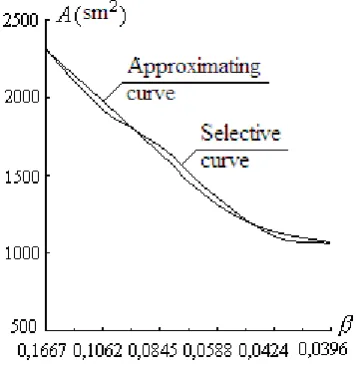
The graphs of selective and approximating dependences on the function of SSS influence on the rate of corrosion are shown in Fig. 2.
The proximity of selective and approximating curves allows replace the selective curve of the dependence of stiffness of shell from SSS influence on the rate of corrosion on the analytic dependence in form of the polynomial (3).
Researching the expression (3) on extremum, we obtain:
2 3 2 03 2
1
a a
a d
d . (6)
Substituting in equation (3) the values coefficients
3 2 1
,
a
,
a
a
and solving it with respect, we find0005483
,
0
. [image:3.595.192.409.558.715.2]International Journal of Emerging Technology and Advanced Engineering
Website: www.ijetae.com (ISSN 2250-2459, ISO 9001:2008 Certified Journal, Volume 6, Issue 7, July 2016)
16
We calculate the estimated value of the stiffness of cross section of the shell (3):
A
a
0
a
1
a
2
2
a
3
3
849
,
5873
198
,
9385
0
,
0005483
182041
,
9
0
,
0005483
2
796458
,
4
0
,
0005483
3
849
,
53
см
2.
The thickness of the wall
of the shell at100
R
sm find from the expression:352
,
1
100
14
,
3
2
53
,
849
2
R
A
sm.This solution can be obtained with another method, by the putting the problem of minimizing the function (3) as a problem of mathematical programming.
Using the notation
x
1
, formulate mathematical programming problem: find a minimum of the function:
31 3 2 1 2 1 1
0
a
x
a
x
a
x
a
X
(7)at the restrictions:
1 10
;
2
1 10
1
x
x
g
x
x
g
X
X
. (8)The problem (7)-(8) was solved by random search SGEF at the following initial data:
0
,
0
;
1
,
0
11
x
x
. The coefficients of the polynomial (7) were taken from the Table 2. Output solution:
0
,
000546892
. The value of the function
X
849
,
53
is close to the minimum ofmathematical functions (7) and is almost identical with the analytic solution given above.
For the point with coordinates
1
,
352
sm and100
[image:4.595.56.542.456.571.2]R
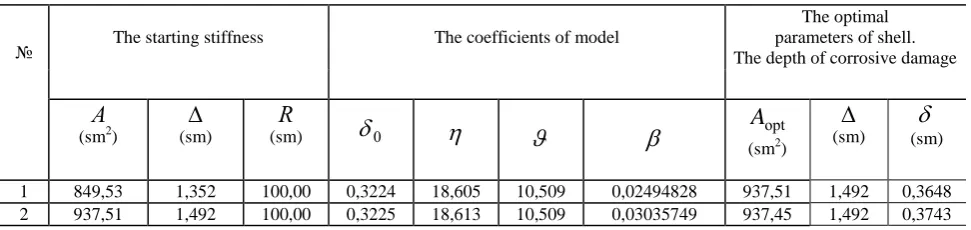
sm we carry out some specifying identification and optimization, in order to determine the value of the coefficient of mathematical model of corrosive damage that adequately describe the corrosive process. The calculation results are shown in the Table 3.Table 3
The results of specifying identification and optimal parameters of the shell
№ The starting stiffness The coefficients of model
The optimal parameters of shell. The depth of corrosive damage
A
(sm2) (sm)
(sm)R
0
A
оpt(sm2)
(sm)
(sm)
1 849,53 1,352 100,00 0,3224 18,605 10,509 0,02494828 937,51 1,492 0,3648 2 937,51 1,492 100,00 0,3225 18,613 10,509 0,03035749 937,45 1,492 0,3743
The process has converged in just two iterations. The coefficients adduced in the last row of Table 3 allow to satisfactory describe the experimental data shown in Table 3 in the paper [4].
We can offer another method of determining of "optimal" coefficient of the influence of SSS on the rate of the corrosion by the extrapolation of polynomial dependence. The proposed method can be called the method of successive approximations. Let us illustrate this method as an example of optimum designing discussed above thin membrane shell loaded by internal pressure.
We will extrapolate the analytic relationship (3), by determining the values of stiffness of shell for the different coefficients of the influence of SSS on the rate of corrosion
and then checking the strength of shell.The graph 2 shows that the approximating curve falls continuously with decreasing the coefficient of the influence of SSS on the rate of corrosion
. We will setthe values of coefficient below
0
,
039629
. Let theInternational Journal of Emerging Technology and Advanced Engineering
Website: www.ijetae.com (ISSN 2250-2459, ISO 9001:2008 Certified Journal, Volume 6, Issue 7, July 2016)
17
Then, the stiffness of cross-section of membrane, being simultaneously both the objective function, wecalculate according to the formula (3), using the coefficients given in the Table 2:
2 3 2 3 3 2 2 1 0sm
8795
,
986
03
,
0
4
,
769458
03
,
0
9
,
182041
03
,
0
9385
,
198
7853
,
849
a
a
a
a
A
Taking into account that for considered shell the lower limit values for the radius of the middle surface and that this value corresponds to the value of the optimal solution, we define the thickness of the shell wall from the expression:
A
2
R
,Where the shell’s wall thickness is equal:
571
,
1
100
14
,
3
2
8795
,
986
2
R
A
sm. [image:5.595.51.547.319.423.2]Then we carry out the checks of shell strength. The results are recorded in Table 4.
Table 4
The results of successive approximations to the "optimal" value of the coefficient of the influence of SSS on the rate of thecorrosion
№
A
(sm2)
(sm)R
(sm)
(МПа)P
r
t(sm)
(sm)
(sm) 1 986,88 1,571 100,00 144,03 0,94564 0,3222 0,0463 0,3684 2 945,39 1,505 100,00 151,82 0,98954 0,3222 0,0429 0,3641 3 912,47 1,452 100,00 158,34 1,02609 0,3222 0,0360 0,3581 4 925,22 1,472 100,00 155,86 1,01220 0,3222 0,0385 0,3607 5 932,15 1,483 100,00 154,49 1,00460 0,3222 0,0397 0,3619 6 939,23 1,494 100,00 153,15 0,99700 0,3222 0,0409 0,3630 7 938,71 1,494 100,00 154,70 1,00000 0,3223 0,0521 0,3744Analyzing the data in the Table 4, it can be concluded that the shell has a reserve by the measure of damage
1
max
rP
[6] as well as by normal stresses
max(
max
162
МPа).Therefore, once again reduce the coefficient of the influence of SSS on the rate of corrosion and take
025
,
0
. Then we calculate the stiffness of the shell:
2 3 2 3 3 2 2 1 0s
3965
,
945
025
,
0
4
,
769458
025
,
0
9
,
182041
025
,
0
9385
,
198
7853
,
849
m
a
a
a
a
A
The thickness of the shell wall
505
,
1
100
14
,
3
2
3965
,
945
2
R
A
sm.The results of second verification of shell strength are shown in the Table 4 (line 2). The strength of the shell is provided. We continue to extrapolate the approximating curve. Accept
0
,
02
and calculate the stiffness of the cross-sections of the shell:
2 3 2 3 3 2 2 1 0sm
467
,
912
02
,
0
4
,
769458
02
,
0
9
,
182041
02
,
0
9385
,
198
7853
,
849
a
a
a
a
A
452
,
1
100
14
,
3
2
467
,
912
2
R
A
sm.We check the strength of the shell. The results are recorded in Table 4 (line 3).
International Journal of Emerging Technology and Advanced Engineering
Website: www.ijetae.com (ISSN 2250-2459, ISO 9001:2008 Certified Journal, Volume 6, Issue 7, July 2016)
18
2 3 2 3 3 2 2 1 0sm
32
,
925
022
,
0
4
,
769458
022
,
0
9
,
182041
022
,
0
9385
,
198
7853
,
849
a
a
a
a
A
472
,
1
100
14
,
3
2
22
,
925
2
R
A
sm.We produce the verification of shell strength. The results are given in Table4 in row №4.
The shell does not pass by strength, as a measure of damage exceeded the limit value Prmax 1. Consequently, the "optimal" value of the coefficient of influence of impact of SSS on the rate of corrosion in the range 0,022
0,025. Assume the coefficient023 , 0
. Perform the necessary calculations:
2 3 2 3 3 2 2 1 0s
148
,
932
023
,
0
4
,
769458
023
,
0
9
,
182041
023
,
0
9385
,
198
7853
,
849
m
a
a
a
a
A
483
,
1
100
14
,
3
2
148
,
932
2
R
A
см.We carry out the check the shell strength. The calculation results are shown in Table 4 in row №5. The project does not pass, as the measure of damage exceeded the limit value. We accept
0
,
024
.
2 3 2 3 3 2 2 1 0s
229
,
939
024
,
0
4
,
769458
024
,
0
9
,
182041
024
,
0
9385
,
198
7853
,
849
m
a
a
a
a
A
494
,
1
100
14
,
3
2
229
,
939
2
R
A
sm.We produce verification of the shell strength. The results of verification are given in the Table 4 in row №6. This project takes place, as the strength of the shell, as at the plastic and in brittle fracture is not broken. Thus, we are taking as an "optimal" coefficient of influence of SSS on the rate of corrosion process
0
,
024
.The resulting point is taking as a starting, perform for it identification of the mathematical model of corrosive damage and produce the optimization. The optimization results are recorded in the last term of the Table 4.
This example shows that the procedure of the polynomial approximation, adduced above, is possible only, if all sizes of optimized construction can be determined by use the stiffness of this construction for the further control of the bearing ability of structure.
In the case, if this impossible, it is necessary to use the directly approximation of the curves of the changing of optimized parameters of structure. We show this technique on the example of optimizing the parameters of the shell above, loaded with internal pressure. There are two variable parameters in the shell: the wall thickness
and the radius of the middle surfaceR
.We introduce the polynomial approximation with the help of the coefficient of the influence of SSS on the rate of corrosion
for each of these parameters:
33 2 2 1
0
a
a
a
a
(9)
33 2 2 1
0
b
b
b
b
R
(10)The approximating expression for the cross-sectional area of the shell wall (shell’s stiffness) takes the form:
3
3 2 2 1 0 3 3 2 2 1 0
2
2
R
a
a
a
a
b
b
b
b
(11)
Let’s search the roots of polynomials (9)-(10 performed using the method of global random search global SGEF [7]. To do this, we introduce the notation:
0
1
a
x
;x
2
a
1;x
3
a
2;x
4
a
3;x
5
b
0;1
6
b
x
;x
7
b
2;x
8
b
3 and we formulate two mathematical programming problems: to find two vectors
1 2 3 4
1
x
,
x
,
x
,
x
X
andX
2
x
5,
x
6,
x
7,
x
8
, that deliver the minimal values of functional:
n ix
x
x
x
S
1 2 3 4 2 3 2 11
min
International Journal of Emerging Technology and Advanced Engineering
Website: www.ijetae.com (ISSN 2250-2459, ISO 9001:2008 Certified Journal, Volume 6, Issue 7, July 2016)
19
ni
R
x
x
x
x
S
1
2 3
8 2 7 6 5
2
min
X
(13)
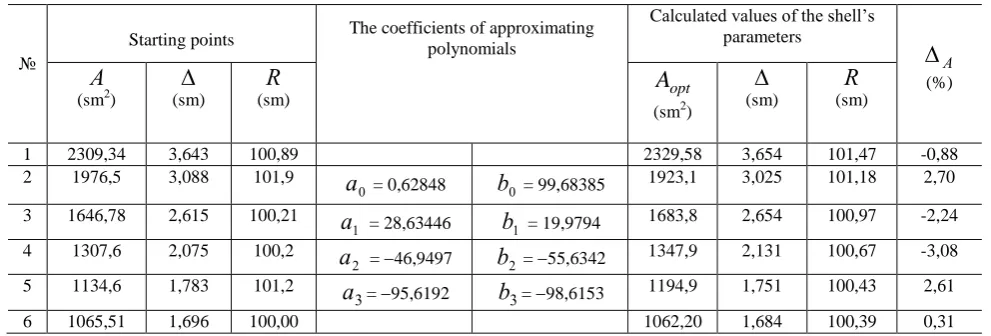
The Table 5 consists the values of the thickness of shell’s wall and the radius of the middle surface of shell's wall for the 6 sampled starting points from (Table 2) [1], the values of the coefficients of approximating polynomials coefficients (9)-(10) and the calculated values of the shell parameters.
The calculated shell’s stiffness at selected points defined by the expression (13). The coefficients of the approximating polynomials (9)-(10), determined by the solving the mathematical programming problem (12)-(14) by the random search method SGEF under
[image:7.595.50.546.283.451.2]restrictions:
1
10
6
x
i
1
10
6,
i
1
,
2
,...,
6
.Table 5
The coefficients of the approximating polynomials and calculated values of the shell parameters
№
Starting points The coefficients of approximating polynomials
Calculated values of the shell’s
parameters A
(%)
A
(sm2)
(sm)
R
(sm) opt
A
(sm2)
(sm)
R
(sm)
1 2309,34 3,643 100,89 2329,58 3,654 101,47 -0,88 2 1976,5 3,088 101,9
0
a
= 0,62848b
0 = 99,68385 1923,1 3,025 101,18 2,70 3 1646,78 2,615 100,211
a
= 28,63446b
1 = 19,9794 1683,8 2,654 100,97 -2,244 1307,6 2,075 100,2
2
a
= 46,9497b
2 = 55,6342 1347,9 2,131 100,67 -3,085 1134,6 1,783 101,2
3
a
= 95,6192b
3= 98,6153 1194,9 1,751 100,43 2,61 6 1065,51 1,696 100,00 1062,20 1,684 100,39 0,31We pose the problem of determining the coefficient of influence of SSS on the rate of corrosion as the
mathematical programming problem: find a minimum of function:
3
1 3 2 1 2 1 1 0 3 1 3 2 1 2 1 1 0
2
2
R
a
a
x
a
x
a
x
b
b
x
b
x
b
x
X
X
X
(
15)under restrictions:
1 10
;
2
1 10
1
x
x
g
x
x
g
X
X
. (16)
x
1X
vector of control variables (the control variablex
1
).The problem (15)-(16) was solved by the random search method SGEF under the following initial data:
0
,
0
;
05
,
0
11
x
x
. The coefficients of the polynomial (15),a
0,
a
1,
a
2,
a
3 иb
0,
b
1,
b
2,
b
3 were taken from Table 2.Output solution was:
0
,
0247999
. The value ofthe function
X
824
,
12
is near the minimum of mathematical functions (7) and is near the analytical solution, adduced above.The wall thickness of the shell, and the radius of the middle surface we find, respectively, using the equations (9) and (10):
0
,
62848
28
,
63446
0
,
0247999
46
,
9497
0
,
0247999
295
,
6192
0
,
0247999
3
1
,
308
sm;
International Journal of Emerging Technology and Advanced Engineering
Website: www.ijetae.com (ISSN 2250-2459, ISO 9001:2008 Certified Journal, Volume 6, Issue 7, July 2016)
20
The shell of this size does not pass by strength(
186
,
53
МPа;P
r
1
,
18184
). [image:8.595.209.388.507.693.2]Therefore, from this point we perform several specifying identifications and optimizations. The results are recorded in Table 5.
Table 6
The results of specifying identification and optimal parameters of the shell
№ п/п
Starting stiffness The coefficients of model
The optimal parameters of the shell,
the thickness of damage
A
(sm2) (sm)
(sm)R
0
A
оpt(sm 2)
(sm)
(sm)
1 824,12 1,308 100,14 0,3219 18,595 10,527 0,02347457 935,95 1,490 0,3625 2 935,95 1,490 100,00 0,3224 18,603 10,511 0,03028718 936,19 1,490 0,3743
Let's solve the problem of finding an optimal design by the method of successive approximations described above. By replacing the selective curve by approximating curve, we will gradually reduce the value of the coefficient of influence of SSS on the rate of corrosion to the stabilization of the solution.
The latter value is the coefficient of influence of SSS, given in Table 1, is 0,0396629. Since the approximating curve tends to decrease, on the first step we set 0,035 and calculate using the
approximating polynomials (9) and (10) the values of the wall thickness of shell and the radius of the middle surface:
3 23 2 2 1
0
0
,
62848
28
,
63446
0
,
035
46
,
9497
0
,
035
a
a
a
a
95
,
6162
0
,
035
3
1
,
569
sm;
3
2
3 2 2 1
0
99
,
68385
19
,
9794
0
,
035
55
,
6342
0
,
035
b
b
b
b
R
98
,
6153
0
,
035
3
100
,
31
sm.Fig. 3. Approximation of selective curve by a polynomial of the third degree
The value of cross-sectional area of the central part of the shell is equal:
2
R
2
3
,
1416
1
,
569
100
,
31
988
,
88
International Journal of Emerging Technology and Advanced Engineering
Website: www.ijetae.com (ISSN 2250-2459, ISO 9001:2008 Certified Journal, Volume 6, Issue 7, July 2016)
21
Let's verify the strength of the shell. Test results are listed in table 6.12. The strength of the shell is provided.We make the next step and is calculated using the polynomials (9), (10) the coordinates of the next starting point and stiffness of the cross section of the shell:
3 23 2 2 1
0
0
,
62848
28
,
63446
0
,
03
46
,
9497
0
,
03
a
a
a
a
95
,
6162
0
,
03
3
1
,
442
sm;
3
2
3 2 2 1
0
99
,
68385
19
,
9794
0
,
03
55
,
6342
0
,
03
b
b
b
b
R
98
,
6153
0
,
03
3
100
,
23
sm.The value of cross-sectional area of the central part of the shell is equal:
A
2
R
2
3
,
1416
1
,
442
100
,
23
908
,
12
sm
2.
We perform the checking of shell strength at approximated parameters and at the approximated coefficient of influence of SSS on the rate of corrosion
03
,
0
. The results are listed in table 7.Analyzing the results, we conclude that the condition of the shell strength is not ensured.
Hence, the coefficient of influence of SSS on the rate of corrosion should be selected within
035
,
0
03
,
0
. We set
0
,
032
and perform calculations. The results are listed in table 7.
3 23 2 2 1
0
0
,
62848
28
,
63446
0
,
032
46
,
9497
0
,
032
a
a
a
a
95
,
6162
0
,
032
3
1
,
493
sm;
3
2
3 2 2 1
0
99
,
68385
19
,
9794
0
,
032
55
,
6342
0
,
032
b
b
b
b
R
98
,
6153
0
,
032
3
100
,
27
sm;
A
2
R
2
3
,
1416
1
,
493
100
,
27
940
,
97
sm2.The strength of the shell is not ensured. We accept
033
,
0
and perform the necessary calculations. [image:9.595.53.546.558.647.2]The results are given in Table 7 on line №3.
Table 7
The results of successive approximations to the "optimal" value of the coefficient of influence of SSS on the rate of corrosion
№
A
(sm2)
( sm)R
( sm)
(МПа)P
r
t( sm)
(sm)
(sm) 1 0,035 988,88 1,569 100,31 145,75 0,95538 0,3223 0,0547 0,3770 2 0,030 908,12 1,442 100,23 163,14 1,05284 0,3223 0,0556 0,3779 3 0,032 940,97 1,493 100,27 155,70 1,01131 0,3223 0,0553 0,3776 4 0,033 957,09 1,519 100,28 152,14 0,99133 0,3223 0,0551 0,3773 5 0,0325 948,12 1,506 100,27 153,89 1,00116 0,3223 0,0552 0,3775 6 0,0326 950,09 1,508 100,27 153,62 0,99965 0,3223 0,0552 0,3775The strength of the shell is not ensured. We accept and perform the necessary calculations.
The results are given in Table 7 on line №4.
3 23 2 2 1
0
0
,
62848
28
,
63446
0
,
033
46
,
9497
0
,
033
a
a
a
a
95
,
6162
0
,
033
3
1
,
519
sm;
3
2
3 2 2 1
0
99
,
68385
19
,
9794
0
,
033
55
,
6342
0
,
033
b
b
b
b
R
International Journal of Emerging Technology and Advanced Engineering
Website: www.ijetae.com (ISSN 2250-2459, ISO 9001:2008 Certified Journal, Volume 6, Issue 7, July 2016)
22
A
2
R
2
3
,
1416
1
,
493
100
,
27
957
,
09
sm2.We carry out the checking shell strength. The strength of the shell is not ensured. Obviously, the solution lies in the range
0
,
032
0
,
033
.Therefore, we accept
0
,
0325
and perform the calculations again.
3 23 2 2 1
0
0
,
62848
28
,
63446
0
,
0325
46
,
9497
0
,
0325
a
a
a
a
95
,
6162
0
,
03253
3
1
,
506
sm;
3
2
3 2 2 1
0
99
,
68385
19
,
9794
0
,
0325
55
,
6342
0
,
0325
b
b
b
b
R
98
,
6153
0
,
0325
3
100
,
27
sm;A
2
R
2
3
,
1416
1
,
493
100
,
27
948
,
12
sm2.The strength of the shell is not ensured
(
P
r
1
,
00116
).Obviously, the solution lies within
033
,
0
0325
,
0
. Accept
0
,
0326
.
3 23 2 2 1
0
0
,
62848
28
,
63446
0
,
0326
46
,
9497
0
,
0326
a
a
a
a
95
,
6162
0
,
0326
3
1
,
508
sm;
3
2
3 2 2 1
0
99
,
68385
19
,
9794
0
,
0326
55
,
6342
0
,
0326
b
b
b
b
R
98
,
6153
0
,
0326
3
100
,
27
sm;
A
2
R
2
3
,
1416
1
,
508
100
,
27
950
,
09
sm2.The strength of the shell is ensured (line 6 in the Table 7). We specify the resulting solution with the help of additional identification of corrosive model and additional optimizations.
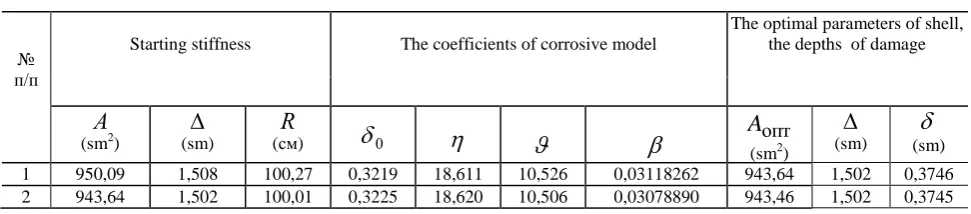
[image:10.595.55.541.527.634.2]The results of the iterative procedure specifying identifications are shown in the Table 8.
Table 8
The results of specifying identification and optimal parameters of the shell
№ п/п
Starting stiffness The coefficients of corrosive model
The optimal parameters of shell, the depths of damage
A
(sm2)
(sm)
R
(см)
0
A
опт(sm2)
(sm)
(sm) 1 950,09 1,508 100,27 0,3219 18,611 10,526 0,03118262 943,64 1,502 0,3746 2 943,64 1,502 100,01 0,3225 18,620 10,506 0,03078890 943,46 1,502 0,3745
As follows from the adduced calculations, both of the approach to the definition of "optimal" coefficient of the influence of SSS on the rate of corrosion give similar results. However, the second approach using a polynomial approximation of the optimized parameters, is preferable, as it allows to calculate the design parameters by which then can calculate the geometrical characteristics of the design and test its strength, stiffness and stability.
International Journal of Emerging Technology and Advanced Engineering
Website: www.ijetae.com (ISSN 2250-2459, ISO 9001:2008 Certified Journal, Volume 6, Issue 7, July 2016)
23
In the next article will be consider an another method of polynomial approximation, which will be able to solve this problem.REFERENCES
[1] Filatov G.V. The Foundations of the Evolution Theory of Identification of Mathematical Models of Corrosion Destruction at the Optimal Planning of Constructions [Text] // G.V. Filatov / − International Journal of Emerging Technology & Advanced Engineering, Volume 6, Issue 3, March 2016, p.p.166-180. [2] Filatov G.V. The Numerical Experimental Verification of
Evolutional Theory of Identification of Mathematical Models of Corrosive Destruction under Stress. Compressed Shell [Text] // G.V. Filatov / − International Journal of Emerging Technology & Advanced Engineering, Volume 6, Issue 4, April 2016, p.p.1-9. [3] Filatov G.V. Application of Evolutional Theory of Identification
of Mathematical Models of Corrosive Destruction at Optimum Designing of Weld-fabricated I-beam [Text] // G.V. Filatov / − International Journal of Emerging Technology & Advanced Engineering, Volume 6, Issue 5, May 2016, p.p.222-236.
[4] Filatov G.V. Optimal design of structures by the combined use of mathematical models of corrosion destruction [Text] // G.V. Filatov / − International Journal of Emerging Technology & Advanced Engineering, Volume 6, Issue 5, May 2016, p.p.6-15. [5] Petrov, V.V Calculation of structural elements, interacting with
aggressive media [Text]: monograph / I.G.Ovchinnikov, Yu.M.Shihov. − Saratov: Saratov State University. 1987. − 288 p. [6] Novozhilov V.V. Prospects for the Construction of the Strength
Criterion under Complex Loading [Text] // V.V. Novozhilov, O.G. Rybakina / − Proceedings of the Academy of Sciences of the USSR, meh. solid , "Nauka", − 1966, − №5, p.p. 101-111. [7] Filatov G.V. The Stochastic Method of Search of Global Extreme