International Journal of Emerging Technology and Advanced Engineering
Website: www.ijetae.com (ISSN 2250-2459,ISO 9001:2008 Certified Journal, Volume 4, Issue 7, July 2014)
483
Modified I-Leach An Efficient Routing Algorithm Using NN
(Neural Networks)
Gagandeep kaur
1, Mandeep Singh
21M.Tech (CSE), 2Assistant Professor, RIMT-IET, Mandi Gobindgarh
Abstract - WSN is major field among researches to get better and enhanced life time for network, one of the main fields is to calculate CH more precisely and accurately to get better results. Now researchers are moving towards election of cluster heads as taking more and more parameters like residual energy, distance from base station etc. in recent works researches are using the no of sensors present for the particular sensor node to elect as a cluster head node is used. Here we are proposing modified algorithm which uses NN to get CH election optimized and fast.
Keywords - WSN, Cluster Head, Neural Network.
I. INTRODUCTION
A WSN can be defined as a network of devices, denoted as nodes, which can sense the environment and communicate the information gathered from the monitored field (e.g., an area or volume) through wireless links [1–9]. The data is forwarded, possibly via multiple hops, to a sink (sometimes denoted as controller or monitor) that can use it locally or is connected to other networks (e.g., the Internet) through a gateway. The nodes can be stationary or moving. They can be aware of their location or not. They can be homogeneous or not. Wireless Sensor Network is a self-configuring network of small sensor nodes communicating among themselves using radio signals, and deployed in quantity to sense, monitor and understand the physical world. Wireless Sensor nodes are called motes.
The recent developments in making energy efficient Wireless Sensor Network is giving new direction to deploy these networks in applications like surveillance, industrial monitoring, traffic monitoring, habitat monitoring, cropping monitoring, crowd counting etc. The growing use of these networks is making engineers to evolve innovative and efficient ideas in this field. A lot of research in data routing, data compression and in-network aggregation has been proposed in recent years. A wireless sensor network consists of a large number of nodes spread over a specific area where we want to look after at the changes going on there. A sensor node generally consists of sensors, actuators, memory, a processor and they do have communication ability.
All the sensor nodes are allowed to communicate through a wireless medium. The wireless medium may either of radio frequencies, infrared or any other medium, of course, having no wired connection. These nodes are deployed in a random fashion and they can communicate among themselves to make an ad-hoc network.
If the node is not able to communicate with other through direct link, i.e. they are out of coverage area of each other, the data can be send to the other node by using the nodes in between them. This property is referred as multi-hoping. All sensor nodes work cooperatively to serve the requests. Generally WSNs are not centralized one as there is peer-to-peer communication between the nodes. So there is no requirement of prior established infrastructure to deploy the network. WSN gives flexibility of adding nodes and removing the nodes as required. But this gives rise to many drastic changes to deal with in the network topology such as updating the path, or the network tree, etc. In a WSN the node that gathers the data information refers to sink. The sink may be connected to the outside world through internet where the information can be utilized within time constraints.
The well known problem in using these networks is limited battery life. This is due to fact that the size of a sensor node is expected to be small and this leads to constraints on size of its components i.e. battery size, processors, data storing memory, all are needed to be small. So any optimization in these networks should focus on optimizing energy consumption. In WSN a lot of sensed data and routing information has to be sent which often have some time constraints so that the information can be utilized before any mishap occurs, e.g. industrial monitoring, machinery monitoring, etc. The energy power consumption is much higher in data communication than internal processing. So energy conservation in WSN is needs to be addressed.
International Journal of Emerging Technology and Advanced Engineering
Website: www.ijetae.com (ISSN 2250-2459,ISO 9001:2008 Certified Journal, Volume 4, Issue 7, July 2014)
484
The traffic in Wireless Sensor Network depends on number of queries generated per mean time. As stated before the sink injects the query into the Wireless Sensor Network and sensor nodes responds to the query accordingly. They either respond as a query reply or further floods the query to the downstream nodes. Ultimately the sensor node having the result of the injected query will reply to the sink node through some routing protocol. A sensor node also aggregates the replies to a single response which saves the number of packets to send back to the sink node.A Wireless Sensor Network may consist of multiple sinks. Consider a scenario where more than one sink generates the same query into the Wireless Sensor Network. For such a scene each sink will have its own path developed to the source node which is somehow not required or there can be a way which avoids this. For handling such issues caching comes into picture. To realize the helpfulness of the using caching consider a tree of multiple levels and think of there leaf nodes are communicating to a common child internal node rather than the root node. Means we can cache the results in some intermediate nodes such that each sink will not have to communicate directly to the source node. This obviously saves time and avoids obsolete data traffic in the network. Caching could reduce a lot of data traffic and hence helps in saving response time and energy consumption.
Wireless Sensor Networks are prone to node failure due to power loss. In order to provide reliable service through the network, the network should be self adjusting and must have adaptable properties as required from time to time. A bottleneck node may encounter failure due to limited battery life. In such case the network protocol should be intelligent enough to handle such failures and keeps the network operational.
Usually sensor nodes rely on a battery with limited lifetime, and their replacement is not possible due to physical constraints. Moreover the architecture and protocol of sensor networks must be able to scale up any number of sensor nodes. Since the battery lifetime can be extended if we manage to reduce the amount of communication, caching the useful data for each sensor either in its local store or in the neighborhood nodes can prolong the network lifetime.
Several works has been proposed by the authors exploiting caching the data either in some intermediate nodes or at a location nearer to the multiple sink in the Wireless Sensor Networks.
Indeed providing solutions to optimally caching the data has been a big area to be focus on, several proposed schemes performs well. Nowadays Wireless Sensor Network is being used for application level services like Multimedia application. Moreover caching multimedia data is giving new direction to the saga. Caching has been used for number of applications like fault tolerance, improving the TCP over Wireless Sensor Network, multicasting applications, and improving the performance
.
II.WSNANATOMY
These motes are highly constrained in terms of Physical size
1. CPU power
2. Memory (few tens of kilobytes)
3. Bandwidth (Maximum of 250 KB/s, lower rates the norm)
Power consumption is critical
1. If battery powered then energy efficiency is Paramount
May operate in harsh environments
1. Challenging physical environment (heat, dust, moisture, interference)
III. APPLICATIONS OF WSNS
Intelligent buildings (or bridges)
1. Reduce energy wastage by proper Humidity, ventilation, air Conditioning (HVAC) control 2. Needs measurements about room occupancy,
temperature, air flow[10-12]
3. Monitor mechanical stress after earthquakes
Disaster relief operations
1. Drop sensor nodes from an aircraft over a wildfire 2. Each node measures temperature
3. Derive a “temperature map”
Biodiversity mapping
1 .Use sensor nodes to observe wildlife
IV. NEURAL NETWORK
International Journal of Emerging Technology and Advanced Engineering
Website: www.ijetae.com (ISSN 2250-2459,ISO 9001:2008 Certified Journal, Volume 4, Issue 7, July 2014)
485
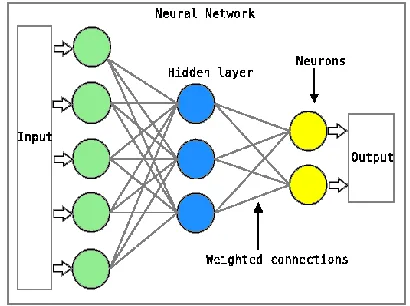
Each hidden unit, j, typically uses the logistic function1 to map its total input from the layer below, xj , to the scalar state, yj that it sends to the layer [13].yj= logistic(xj) =1/1 + e−xj , xj = bj +∑yi w ij
[image:3.612.65.270.256.409.2]Where bj is the bias of unit j, i is an index over units in the layer below, and wij is a the weight on a connection to unit j from unit i in the layer below. For multiclass classification, output unit j converts its total input, xj , into a class probability, pj.[14-15]
Figure 1: The general architecture of the neural network
V. PROPOSED WORK
In our proposed work sensor nodes are first deployed randomly in a given area. For optimized cluster head election we use Neural Network fitting tool and then we train the neural network for a given area. Given set of values has been stored as a data set which has to be provided as an input to the Neural Network. The second input of the Neural Network becomes the file which has to be uploaded to be tested for its category. Five Sensor Nodes in an area of 10*10 has been taken to be tested. Our research work has mainly following points of problems
A)Our problem definition also includes cluster head election in each cluster manually.
B)Our problem definition Results of the simulations show that the proposed routing algorithm has been improved the WSN performance, reduces the energy consumption of the WSN, and improves the successfully delivered packet ratio as compared to the previous routing algorithm.
VI. SIMULATIONS
The simulations have been done in MATLAB 2010 which involves the following steps. The multilayer feed forward neural network is the workhorse of the Neural Network Toolbox software. It can be used for both function fitting and pattern recognition problems. With the addition of a tapped delay line, it can also be used for prediction problems, as discussed in “Design Time Series Time-Delay Neural Networks”. This topic shows how you can use a multilayer network. It also illustrates the basic procedures for designing any neural network.
The work flow for the general neural network design process has seven
Primary steps:
1 Collect data 2 Create the network 3 Configure the network
4 Initialize the weights and biases 5 Train the network
6 Validate the network (post-training analysis) 7 Use the network
[image:3.612.324.561.313.598.2]
International Journal of Emerging Technology and Advanced Engineering
Website: www.ijetae.com (ISSN 2250-2459,ISO 9001:2008 Certified Journal, Volume 4, Issue 7, July 2014)
486
[image:4.612.52.288.111.279.2]
Figure 3: Training neural network
The Neural Network matches the data set accordingly and identifies the best possible cluster head in each cluster.
VII. IMPLEMENTATION
A)Random Deployment of sensor nodes
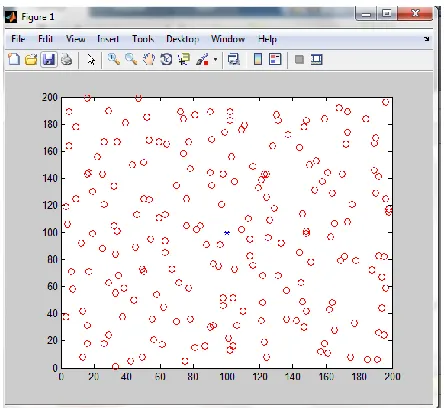
In the first stage all the sensor nodes (200 sensor nodes) is randomly deployed in a given area of 200m*200m. Base station in placed in the center.
Figure 4: Randomly deployment of sensor nodes in a given area
B) Training the NNfitting tool
The parameters of the trained samples are trained using the Levenberg-Marquardt back propagation algorithm. Neural fitting app will help to select data, create and train a network and evaluate its performance using mean square error and regression analysis.
C) Recognizing Trained network and Evaluation of the optimal cluster head in each cluster
The trained network is recognized and implemented on a given network for optimal and fast cluster head election. Sensor nodes in each cluster then transmit sensed data to their cluster head and further Cluster head from each cluster transmits its own data and data from other sensor nodes to Base Station.[16]
VIII. METHODOLOGY
A)Random deployment of sensor nodes in a given area.
B)Base station is placed in the center.
C)Training of the network is done using Levenberg-Marquardt back propagation algorithm in nnfitting tool.
D)Creation of the feature vector which consists of features (Properties of the files ). More number of feature extraction will lead to a better matching algorithm formation.
E)Cluster Head is elected from each cluster
F)Neural network would be used at the time of the testing. The neural network would take two input :
1. The network to be tested by the user
2. The database of feature vector which has been created using Levenberg-Marquardt back propagation algorithm.
G)Compute and compare the results with the base paper.
IX. RESULTS AND DISCUSSIONS
The results of the proposed work include WSN Performance, reduced energy consumption of the WSN, and successfully delivered packet Ratio is improved when compared with the previous work.
X.FUTURE SCOPE
The current work opens a lot of future possibilities. The current work involves Levenberg-Marquardt Back Propagation only where as several other methods of Neural like Bacterial Forging Optimization are present which can be implemented instead of Neural Network fitting tool which may produce some more effective results.
REFERENCES
[1] Petros Spachos, Periklis Chatzimisios and Dimitrios Hatzinakos
“Energy Efficient Cognitive Unicast Routing for Wireless Sensor Networks” IEEE 2013
[2] Chandni, Kanika Sharma ,Himanshu Monga “Improved Termite Hill
[image:4.612.57.279.390.594.2]International Journal of Emerging Technology and Advanced Engineering
Website: www.ijetae.com (ISSN 2250-2459,ISO 9001:2008 Certified Journal, Volume 4, Issue 7, July 2014)
487
[3] Hamzeh Aljawawdeh, Iman Almomani “Dynamic Load Balancing
Protocol (DLBP) for Wireless Sensor Networks” IEEE 2013
[4] Ravi Kishore Kudali , Prof. Narasimha Sarma, NVS “Energy
Efficient Routing Protocols for WSN's” IEEE 2013
[5] Degan Zhang, Guang Li, Ke Zheng, Xuechao Ming and Zhao-Hua
Pan “An Energy-Balanced Routing Method Based on Forward-Aware Factor for Wireless Sensor Networks” IEEE 2013
[6] Rana Azeem M. Khan and Holger Karl “MAC Protocols for
Cooperative Diversity in Wireless LANs and Wireless Sensor Networks” IEEE 2013
[7] Maged S. Soliman, Hossam M. A. Fahmy, Ashraf E. Salem
“ABRM: In-Network Aggregation Based Routing Protocolfor Mobile Sensor Networks with Multiple Mobile Sinks” IEEE 2013
[8] Juhi R Srivastava, Dr. T. S. B. Sudarshan “ZEEP: Zone based
Energy Efficient Routing.
[9] Protocol for Mobile Sensor Networks” IEEE 2013
[10] Lucchi, M.; Giorgetti, A.; Chiani, M. Cooperative Diversity in
Wireless Sensor Networks. Proceedings of WPMC’05, Aalborg, Denmark, 2005; pp. 1738–1742
[11] Quek, T.; Dardari, D.; Win, M.Z. Energy efficiency of wireless sensor networks: IEEE
[12] Toriumi, S.; Sei, Y.; Shinichi, H. Energy-efficient Event
Detection in 3D Wireless Sensor Networks. Proceedings of IEEE 2008.
[13] “ Neural Network Applications”, A. Waibel and J. Hampshire, in:
Neural Networks, Concepts, Applications and Applications, Vol. 1, Antognetti and Milutinovic, Editors, Prentice Hall Publishers, Englewood Cliffs, NJ, 1991
[14] “Learning the Architecture of Neural Networks”, U. Bodenhausen,
A. Waibel, Proceedings of the International Conference on Acoustics, Speech and Signal Processing, Toronto, May, 1991.
[15] Sakthidevi , E. Srievidhyajanani “Secured Fuzzy Based Routing
Framework for Dynamic Wireless Sensor Networks” IEEE 2013
[16] T. Jiang,W. Zang, C. Zhao, and J. Shi., An Energy Consumption