BIROn - Birkbeck Institutional Research Online
Thomas, Michael S.C. and Purser, H.R.M. and Mareschal, Denis (2012)
Is the mystery of thought demystified by context-dependent dategorisation?
Towards a new relation between language and thought. Mind & Language
27 (5), pp. 595-618. ISSN 0268-1064.
Downloaded from:
Usage Guidelines:
Please refer to usage guidelines at or alternatively
1
The mystery of thought: demystified by context-dependent categorisation?
Michael S. C. Thomas1, Harry R. M. Purser1, & Denis Mareschal2
1
Developmental Neurocognition Lab, Birkbeck, University of London, UK
2
Centre for Brain and Child Development, School of Psychology, Birkbeck College, London, UK
Running head: Metaphorical and literal comprehension
Word count: 7,000
Address for correspondence:
Dr. Harry Purser
Developmental Neurocognition Lab School of Psychology
Birkbeck College Malet Street
London WC1E 7HX, UK Email: [email protected]
Web: http://www.psyc.bbk.ac.uk/research/DNL/ Tel.: +44 (0)20 7631 6386
2
Abstract
Although much of cognitive science assumes that literal categories are central to cognition,
there is scant evidence for a psychologically meaningful distinction between the literal and
nonliteral. We advance the idea that there is, in fact, no principled difference between literal
and nonliteral comparisons; each is a different type of contextual modulation of semantic
knowledge. Generally, the context specificity of human thought is viewed by some as
‘mysterious’ under current models of cognition (e.g. Fodor, 2000). Using connectionist
modelling, we demonstrate a simple computational principle by which this contextual
modulation might be achieved, beginning with a simple five-unit network, then showing how
the principle scales to more complex models of semantic memory and metaphor
comprehension, establishing that the similarity structure of semantic knowledge can be
fluidly manipulated by context within a structurally fixed processing structure. The theory of
metaphor suggested by this computational view prompts a particular view of the relation
between language and thought, namely that language affords the strategic control of context
on semantic knowledge, allowing information to be brought to bear in a given situation that
might otherwise not be available to influence processing. The implications of such a view for
3
Introduction
Much of cognitive science is premised on the assumption that the discovery of literal
categories (i.e., pre-existing groups of related kinds in the world) is crucial to human
cognition (e.g., Murphy, 2003). Intrinsic to the idea of literal categories is literal similarity,
most obviously used to identify the category to which a given entity belongs. However,
high-level human cognition is also characterized by the use of non-literal similarity, exemplified
by metaphor and analogy, which rely on the non-literal similarity between categories. If there
is a fundamental divide between literal and figurative similarity, the production and
comprehension of metaphorical and analogical comparisons would seem to imply the
existence of additional, special cognitive mechanisms.
In fact, there is very little evidence to suggest that the distinction between literal and
nonliteral similarity has any psychological validity. It may be unsurprising that the figurative
meanings of well-known idioms, such as “chew the fat” and “kick the bucket”, are
comprehended more quickly than their literal interpretations (Gibbs, Nayak, & Cutting,
1989); it seems plausible that they are lexicalised as specialist vocabulary. However, given
enough context, people are no slower at reading familiar metaphorical sentences than
comparable literal ones (Gibbs & Nagaoka, 1985; Ortony, Schallert, Reynolds, & Antos,
1978). Inhoff, Lima and Carroll (1984) confirmed this finding with an eye-tracking study and
also replicated it with shorter contexts. This implies either that the metaphors were not
interpreted figuratively, or, if they were, then the process required no additional computation
to that required by literal processing. Furthermore, even novel metaphors may be
comprehended as rapidly as comparable literal sentences, provided that the metaphors are apt
4
Any difference between literal and nonliteral processing might be expected to be seen in
differential activation of brain areas for each type of processing. However, neuroimaging
studies also support the idea that literal-nonliteral may be an uninformative dichotomy. Rapp
and colleagues (Rapp et al., 2007) failed to find differences in laterality between
metaphorical and nonmetaphorical sentences, either when the task involved judging a
statement’s metaphoricity, or whether it had positive or negative connotations. In another
fMRI study, Stringaris and colleagues (Stringaris et al., 2007) found that the left inferior
frontal gyrus (LIFG) was more activated when judging metaphorical and anomalous
sentences than when judging comparable literal statements. The LIFG has been hypothesised
to mediate retrieval of semantic knowledge (e.g. Fiez et al., 1992; Thompson-Schill et al.,
1997) and the authors suggested that additional semantic processing capacities were required
for metaphorical processing. However, their task involved explicit judgement of the
meaningfulness of statements, so it is not clear whether this recruitment of additional
resources would take place in passive comprehension. Furthermore, the LIFG was also more
active when judging anomalous statements, so whatever the region was doing, there was no
suggestion that it was specific to nonliterality.
Other imaging techniques have also failed to find evidence in favour of a literal-nonliteral
distinction. Pynte and colleagues (Pynte et al., 1996) recorded ERPs and found that the
terminal word of metaphors elicited larger N400 components than did the terminal word of
literal sentences, suggesting that the (incongruous) literal meaning of the metaphors was
accessed during metaphor comprehension. However, the stimuli in that experiment were
unfamiliar metaphors. In a further experiment, it was found that preceding the metaphorical
statement with a sentence that provided relevant context for the metaphor strongly reduced
5
metaphorical meaning is the only one accessed. In other words, with sufficient context,
metaphors appear to be processed in the same way as literal statements.
In this article, we advance the idea that there is, in fact, no principled difference between
literal and nonliteral comparisons; each is a different type of contextual modulation of
semantic knowledge. Metaphor, on this view, is a process of utilising language as a strategic
control mechanism to manipulate context, bringing to bear particular knowledge in
processing a given semantic token. This knowledge may not have been available without this
manipulation of context.
Contextual effects on semantic knowledge are well established. Barsalou (1993) noted that
when participants are asked to provide definitions for categories, such as bird, on average,
more features differed across two participants’ definitions than were shared by those
participants, suggesting that considerable representational flexibility exists between
individuals. However, there may also be marked flexibility within individual participants: if
different supporting contexts are provided for the same category label, the prototypicality (or
representativeness) of particular exemplars may differ wildly (e.g., Glucksberg & Estes,
2000; Murphy, 1988; Roth & Shoben, 1983). For example, from the imagined perspective of
a Chinese person, swan and peacock may be highly representative, whereas from the
perspective of an American, robin and eagle may be prototypical. Such flexibility cannot
reflect differences in underlying knowledge, because the same participants were involved in
each context. Even across participants, the knowledge base may be quite uniform: Barsalou
(1993) reported that when all the features produced by participants for bird were pooled and
presented to a new group of participants, and that new group asked to judge whether each
6
differences in features listed for a definition and differences in prototypicality of category
exemplars do not owe primarily to differences in knowledge, but to those of context.
The idea that categories are context-specific is certainly not new: William James, in The
Principles of Psychology’s chapter on “Reasoning” (James, 1890/1999), articulated the view
that categories are goal-directed and context-specific: “Now that I am writing, it is essential
that I conceive my paper as a surface for inscription... But if I wished to light a fire, and no
other materials were by, the essential way of conceiving the paper would be as combustible
material” (pp.959). Wittgenstein, too, in his Investigations, states that “how we group words
into kinds depends on the aim of our classification, – and on our own inclination”
(Wittgenstein, 1953). Wittgenstein famously demonstrated the difficulties of defining the
word “game”, not to show that to do so is impossible, but to point out that a rigid definition is
not necessary for people to use the term successfully – people clearly do use and comprehend
the word without apparent difficulty.
If categories are specific to contexts, then what is it that binds categories together? Quine
(1977) made the point that simply invoking similarity as mental glue raises the very problem
that it is intended to answer: things may seem similar simply because they belong to the same
category. Murphy and Medin (1985) have criticised the prevalent focus on similarity and the
associated tendency to break down concepts into constituent attributes or components, noting
that such practice ignores human goals, needs and theories. An alternative account, then, is
that categories with exemplars connected by structure-function relationships, or by causal
schemata of some kind, will be more coherent than categories with exemplars that are not.
One might have a goal-state that could connect (to some degree) objects that appear to share
very few features: Barsalou (1983) investigated the properties of ad hoc categories, which are
7
examples are “Ways to escape being killed by the Mafia”, “vegetarian dishes to accompany
melanzane alla parmigiana”. For ad hoc categories, typicality cannot be determined by
similarity to a category concept, but must be driven by dimensions relevant to the goal that
the category serves. Even so, ad hoc categories were found to show typicality gradients (i.e.
some exemplars being more representative than others) as salient as those associated with
‘common’ categories (such as fruit or birds): ad hoc categories varied as much in typicality as
common categories and participants showed similar levels of agreement in typicality
judgements of exemplars from each. These findings are consistent with the notion that the
same kind of mental processes underlie both ad hoc and common categories, with each being
context-dependent and fluid.
Fodor (2000) has endorsed the view that high-level human cognition (or ‘thinking’) is
characterized by context-sensitivity and globality. Although Fodor argues that low-level
sensory and motor functions are subserved by modular systems, the ‘central system’ is
conceived as having access to the entirety of an individual’s knowledge, in order that it might
guide behaviour; Fodor refers to this complete access as globality. Centrality and simplicity
are viewed as illustrative of globality. Centrality refers to the notion that an individual item of
information may be central to one idea but peripheral to another (cf. Barsalou, 1982); the
centrality of the information is context-specific inasmuch as it is dependent on the particular
idea under consideration and is therefore not intrinsic to the item of information itself.
Simplicity refers to the idea that two different explanations drawn from the same set of
representations may differ in their degree of complexity; simplicity is a property at the level
of the explanation, but not of the constituent representations. Fodor (2000) has expressed
scepticism that current computational theories of mind are sufficient to explain the context
8
approaches to cognition, the causal properties of reasoning systems are driven by local rather
than global properties of representations (the syntactic structure and the connectivity matrix,
respectively).
Thus, Fodor’s comments highlight that context-sensitivity appears mysterious under current
conceptions of the mind. How could context-sensitivity operate in real representational
systems with fixed causal structures? Can context sensitivity emerge from cognitive
development? It is difficult to address such questions unless they can be precisely formulated.
The contribution of the current article is to show how it can be done: context-sensitivity may
not be particularly mysterious, but rather straightforward. This demonstration will utilise
computational (and specifically connectionist) modelling: we will begin by describing a very
simple five-unit neural network in which the similarity structure of the internal
representations is altered by context. This model will serve as a ‘teaching example’ to plainly
demonstrate the computational mechanism we propose for context-sensitivity. We will then
illustrate this mechanism in two more complex models of human cognition to show how
semantic memory could demonstrate context dependence and then to argue that metaphor can
be viewed as merely a variety of contextual modulation. Computational models have proved
useful to cognitive science because they demonstrate how complex theoretical notions can
work in practice. For example, Oakes, Newcombe and Plumert (2009) have argued that
modelling has made a significant contribution to advancing our understanding of the concepts
of interaction and emergence, even though these ideas were already present in the theories of
Piaget, Gibson, and Vygotsky. In the same way, the intention here is to show that very simple
computational architectures can nevertheless show complex patterns of context-sensitive
processing, and also to show that this property enables similar models to account for
9
A mechanism for contextual modulation
The exclusive-or (XOR) logical problem was used in the early exploration of the
computational properties of connectionist networks because solving it requires internal
representations (Rumelhart, Hinton, & Williams, 1986) (i.e. it cannot be solved by a
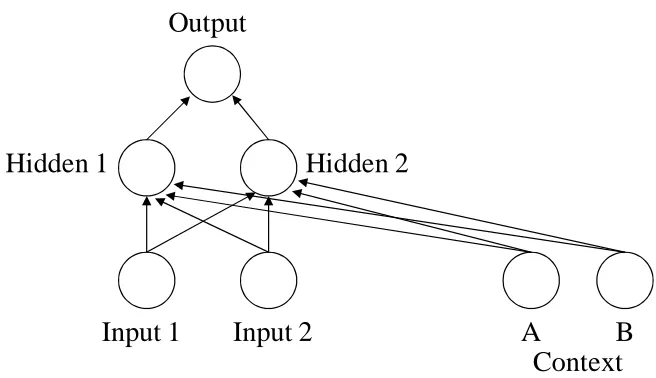
two-layer network). The network traditionally used to solve the problem has only five units: two
input units, two ‘hidden’ (i.e. internal) units, and one output unit (Figure 2). This network is
both well-known and very simple, so it is ideally suited to introducing the computational
principle of context-sensitivity that is the focus of this article.
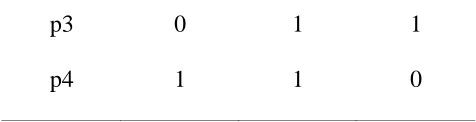
The XOR problem is specified over two inputs and one output (see Table 1). Figure 1a shows
the four patterns comprising the problem represented in a two-dimensional ‘input space’. The
computational complexity arises because the output unit of a network can only make a single
categorization in input space, equivalent to drawing a ‘decision line’ through input space and
responding positively to inputs falling on one side and negatively to units falling on the other.
However, the two inputs that must be classified positively, namely [1,0] and [0,1], cannot be
separated with a straight line from those to which it must respond negatively, [0,0] and [1,1].
Hence, the problem is termed ‘linearly inseparable’. A network with a layer of hidden units
can learn to re-represent the similarity structure of the problem over these hidden units, so
that the problem becomes linearly separable for the output unit.
======== insert Table 1 about here =========
The following is an example of such a five-unit network learning the internal representations
10
internal representations develops to solve the categorisation problem: The network was
trained for 2500 presentations of the complete training set, using the back-propagation
learning algorithm. The learning rate and momentum were set to 0.1 and 0.0, respectively.
Figure 1b shows how the similarity structure of the input space has been re-represented over
the hidden units, for one sample run of the XOR network. The figure includes the decision
line employed by the output unit, which is determined by its threshold and the two weights
connecting the hidden units to the output unit. It is evident that the patterns [1,0] and [0,1]
now fall on one side of the decision line and [0,0] and [1,1] fall on the other.
======== insert Figure 1 about here =========
======== insert Figure 2 about here =========
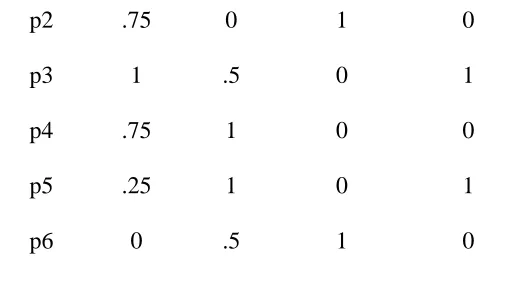
We now introduce a new problem whose solution requires contextual modulation of the
internal similarity structure. The Hexagon problem shown in Table 2 is a slightly modified
version of the XOR problem. There are now six input patterns, in the shape of a hexagon in
input space (Figure 3a and 3b). However, the network is now required to learn two different
categorisations of these input patterns, depending on the context. The categorisations are
both linearly inseparable and are partly mutually exclusive (that is, two of the input patterns
that must be classified positively in one context must be classified negatively in the other and
vice versa, while two must be classified negatively in both). The current context is provided
to the network by two additional input units (Figure 4).
11
Again, we can examine the similarity structure of internal representations that are developed
when the network is trained on the Hexagon problem. The network was trained for 8000
presentations of the training set, with backpropagation, a learning rate of 0.1, and a
momentum of 0.0. Figure 3c and 3d show the similarity structure of the internal
representations under the two contexts, for a sample network. Both cases resemble the
solution for the XOR network: the input space has been represented over the two hidden units
in such a way that patterns to be classified positively lie on one side of the output unit’s
decision line, while those to be classified negatively lie on the other side. The crucial point to
note here is that, although the decision line learned by the output unit is itself insensitive to
context, the similarity structure of the internal representations shifts dynamically underneath
this line in a manner that depends on context. Some patterns that fall on one side of the
decision line in one context, fall on the other side of the decision line in the other context.
Note that the network has a fixed architecture (the connection weights and thresholds are the
same for each context), which is the attribute that Fodor, for example, considers to be the
causally efficacious property of connectionist networks. How, then, does the network manage
to alter the similarity structure of its internal representations depending on the context?
Figure 5 shows sample solutions adopted by the XOR and Hexagon networks, in terms of
their connection weights and unit thresholds.
======== insert Figure 3 about here =========
======== insert Figure 4 about here =========
12
Note that in the Hexagon diagram in Figure 5, we have included the contribution of each
context unit in terms of the effective thresholds that they produce in the respective hidden
units.This means that if a context unit serves to excite a hidden unit, it is lowering the hidden
unit’s effective threshold. If it inhibits the hidden unit, it is raising the effective threshold,
because less excitation is now necessary for the input units to push the hidden unit over its
threshold. For example, if the actual threshold of a hidden unit is 5 (i.e., the value of the
incoming activation that must be exceeded for the hidden unit to turn itself on), context unit
A connects to this unit with a weight of -4, and context unit B connects to the unit with a
weight of +1, then the effective threshold of the hidden unit is [5 - (-4) = 9] in context A and
[5 - (+1) = 4] in context B. In other words, input from A makes the hidden unit more likely to
turn on, while input from B makes it less likely to turn on.
The notion of threshold used in this example is a slight simplification, since the activation of
a processing unit in a typical connectionist network is, in fact, determined by passing the
summed input through a smoother sigmoid activation function, rather than through a binary
step function. Nevertheless, it should be clear here how context succeeds in modulating the
similarity structure of the internal representations: it does so by producing different effective
thresholds in the hidden units. The activation arriving from the input units is the same in each
case, because the weights between inputs and hidden units are fixed. The decision line of the
output unit is the same in each case because, again, its connections to the hidden units are
fixed and it receives no direct input from the context units. In contrast, the computational
properties of the internal representations with respect to the input are defined with respect to
the activity of the context units.
Importantly, then, this simple model demonstrates that it is quite feasible for context to
13
units to achieve different categorizations of the input. The fluidity of the internal
representations occurs by virtue of the activation dynamics in the network, even though the
weight matrix of the network is fixed. Contra Fodor, then, it is the permissible activation
dynamics of a connectionist network that define its causal properties, not its connection
weights alone (although it should be noted that the two are, of course, very closely linked).
With this demonstration in place, we can now move on to more complex models that
illustrate the contextual modulation of semantic knowledge. These models will demonstrate
how the similarity structure of semantic knowledge can be fluidly manipulated by context.
Two models of context-dependent categorization
1. The development of semantic knowledge
Rogers and McClelland (2004) explored a model of the development of semantic knowledge.
Extending initial work by Hinton (1981) and Rumelhart and Todd (1993), the authors
construed semantic knowledge in terms of sets of propositions linking items and features
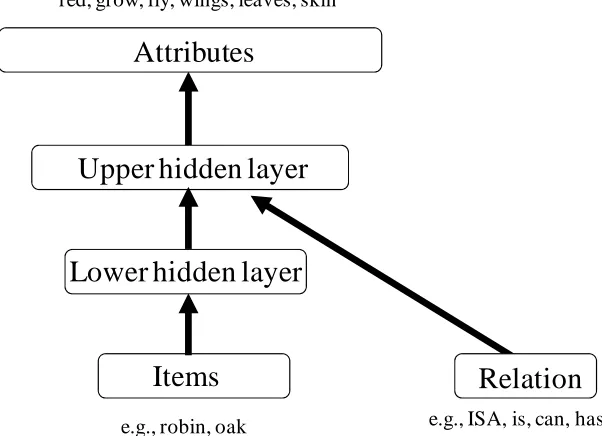
(e.g., a robin is a bird, a robin can fly, a robin has wings). The architecture of the model is
shown in Figure 6. The individual nodes in the network’s input and output layers correspond
to the constituents of these propositions: items (e.g. pine, rose, robin, salmon), relations (IS
A, is, can, has), and attributes (e.g. living thing, plant, animal, bird, red, grow, fly, wings,
leaves, skin). When presented with a particular pair of items and relations at input, the
network attempts to switch on the attribute units in the output layer that correspond to valid
completions of the proposition. For example, when the units corresponding to salmon and
can are activated at input, the network must learn to activate the nodes that represent grow,
move and swim. Although localist representations are used at the model’s input and output,
14
have this atomic character. This conceptual knowledge, stored across distributed
representations, gradually differentiates across development.
This model is important because the authors argued that the model exhibits many of the
behaviours that other researchers had taken to indicate the presence of naïve, domain-specific
theories guiding children’s semantic cognition (e.g., one might have a theory about the
differences between plants and animals, involving facts such as that the latter tend to move
around a lot more.) In the theory theory, knowledge of a concept consists not in a static list of
features, but in its relation to a set of theories of how entities of various types tend to behave
(e.g., this object is a living thing, it is an animal, and it is a bird; it therefore inherits a series
of properties of living things, a more restricted set of properties for animals, and more
restricted still for birds, and so forth).
One behaviour used to measure the structure of semantic knowledge is inductive projection.
Children and adults are told that a given item has a novel property (e.g., it can queem, or it
has a queem, or it is a queem). They are then asked which other items (objects, animals, etc.)
might also have this novel property. In a series of experiments, Carey (1985) showed that
children’s answers to these kinds of questions change in systematic ways over development.
Because abstraction and induction are key functions of the semantic system, these patterns
provide important evidence about developmental change in the structure of semantic
representations. Rogers and McClelland (2004) presented a series of simulations aimed at
explaining two of these empirical effects: patterns of inductive property attribution can be
different for different kinds of object properties; and patterns of inductive projection change
over development, generally becoming more specific.
15
In order to simulate inductive projection, Rogers and McClelland took models at different
stages of training and added a new attribute feature. The model was then trained to associate
this attribute to the existing representation in the upper hidden layer in the context of a
particular relation (e.g., learning that an oak can queem). The authors then explored which
other items also activated the new attribute, as a measure of inductive generalization. Could
pines also queem? What about tulips, or canaries?
Importantly, Rogers and McClelland viewed the representations in the upper hidden layer as
being context-dependent, exhibiting different similarity structure depending on the relation
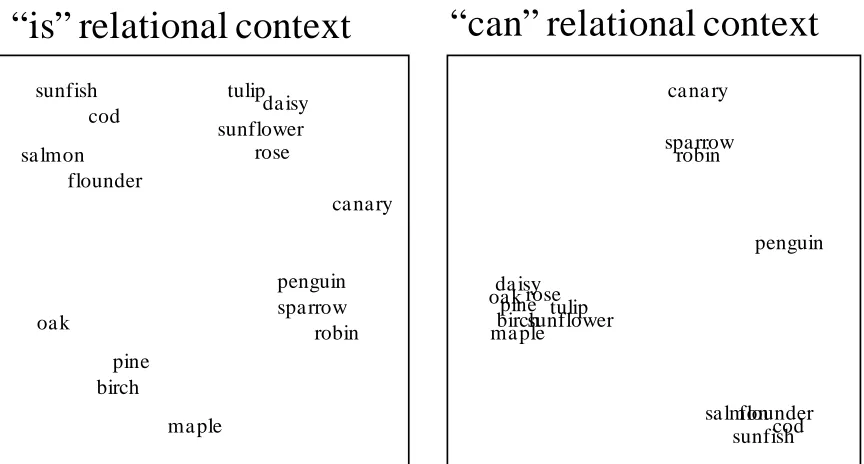
that was specified, and as a consequence, different generalization properties. Figure 7 depicts
the similarity structure of the representations in the upper hidden layer for two different
contexts, the is relation and the can relation (adapted from Rogers & McClelland, 2004, Fig.
8.2). Items that share many is or can properties generate similar patterns of activity across
units in the upper hidden layer when that relation unit is activated. The model’s behaviour
reflects the acquisition of knowledge that different kinds of properties extend across different
sets of objects.
Similar to the results of Carey’s (1985) studies, this knowledge undergoes a gradual
developmental change, whereby the model learns that different kinds of properties should be
extended in different ways. The is context produces representations that are more delineated,
because in the network’s world, there are few properties shared among objects of the same
kind. It therefore differentiates items in this context and as a result shows less of a tendency
to generalize newly learned is context properties across categories. By contrast, in the can
context, the items show less differentiated representations. For example, plants are collapsed
into a single clump. This is because in the can context, all plants are associated with very
16
behaviours: in the network’s world, the only thing a plant can do is grow. Novel properties
associated to any given plant in the can context are therefore more likely to be generalized to
other plants.
In this model, then, the context of the relation fluidly shifted the similarity structure within
semantic knowledge. The shift altered inductive behaviour in such a way that the network’s
behaviour seemed to be shaped by implicit conceptual theories. In fact, these theories
consisted of statistical regularities learned in a given context. Rogers and McClelland’s
model shows us that the computational principle of context-sensitivity expostulated here
(arising from activation dynamics) scales to a larger and more complex connectionist
network, altering the ‘meaning’ of semantic tokens. Having demonstrated this principle in
inductive projection, we will now do the same in a model of metaphor comprehension.
Metaphor comprehension is sensitive to context (e.g. Gibbs & Nagaoka, 1985; Inhoff, Lima,
& Carroll, 1984), rendering it a particularly appropriate area to illustrate the computational
principle under consideration.
======== insert Figure 7 about here =========
2. Metaphor comprehension
Thomas and Mareschal (2001) investigated the proposal that metaphor may be viewed as a
form of categorization (Glucksberg & Keysar, 1990). That is, when I say my job is a jail, I
am indicating that my job falls within the abstract category of jails, i.e., the category of
constraining things. Thomas and Mareschal (2001; see also Purser et al., in press) used an
autoassociative model of semantic memory to explore the hypothesis that metaphor
comprehension may involve a form of strategic misclassification (see McClelland &
17
the process of classification that transfers certain attributes from the B term (e.g., constraining
things) to the A term (my job). In order to test whether A is a member of B, A is transformed
by B knowledge. If it is little changed, it is likely a member of B. Reproduction as a means of
assessing category membership is a widely used mechanism in connectionist models of
memory (see Mareschal & Thomas, 2007).
======== insert Figure 8 about here =========
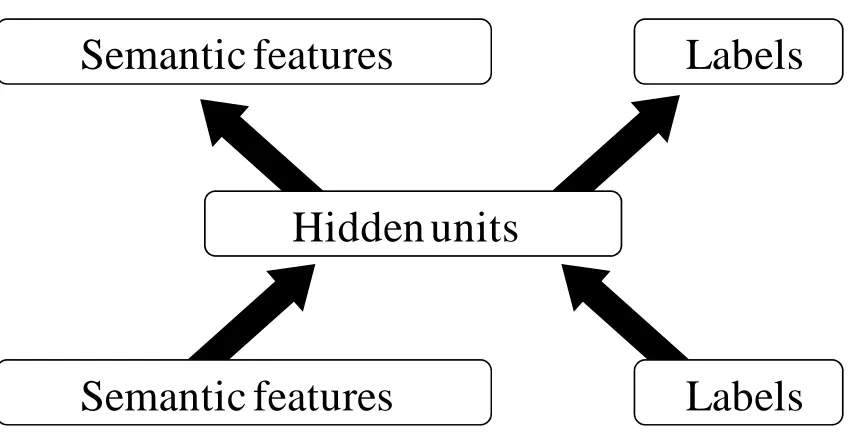
One version of this model is shown in Figure 8. The network has distributed representations
at all layers. For an illustrative example, the model was given a restricted semantic
knowledge base covering just three concepts: apples, balls, and forks. Training involved
learning to reproduce the semantic features for individual exemplars of each category in the
presence of the labels for that category (see Purser et al., in press). Once trained, a token is
presented to the network, let us say an instance of a particular green apple. The system is now
required to assess literal, metaphorical, or anomalous comparisons relating to this token. The
sentence this apple is an apple would be viewed as a literal comparison; the sentence this
apple is a ball would be viewed as a metaphorical comparison, perhaps emphasizing that this
apple is particularly round and that you are more likely to hit, kick or throw it than eat it; and
the sentence this apple is a fork would be viewed as an anomalous comparison.
Each sentence is applied to the model in the following manner. The semantic features for the
A term, the green apple, are applied to the input units across a semantic feature set, while the
label for the B term (apple, ball, or fork) is also activated. The semantic output represents a
version of the A term transformed by the comparison, while the activation of the output label
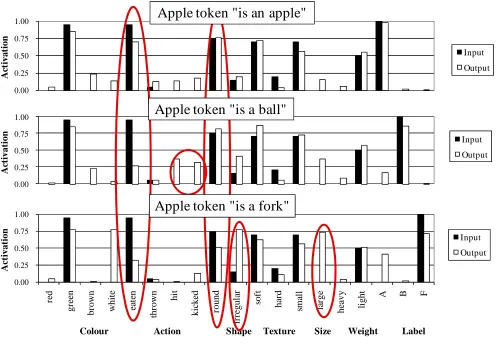
tests membership of the category. Figure 9 shows the inputs and outputs for these
18
features accurately and indicates high confidence that the token is indeed an apple. The
metaphorical comparison produces lower confidence that the apple is a member of the
category ball, but produces a transformed representation of the apple that attenuates the
‘eaten’ feature, and exaggerates both the ‘roundness’ of the apple and that it will be ‘kicked’
or ‘hit’. The anomalous comparison produces the lowest confidence that the apple is a
member of the category fork, and imposes properties of the central features of the fork
category on the transformed representation: ‘white’, ‘irregular’, and ‘large’.
======== insert Figure 9 about here =========
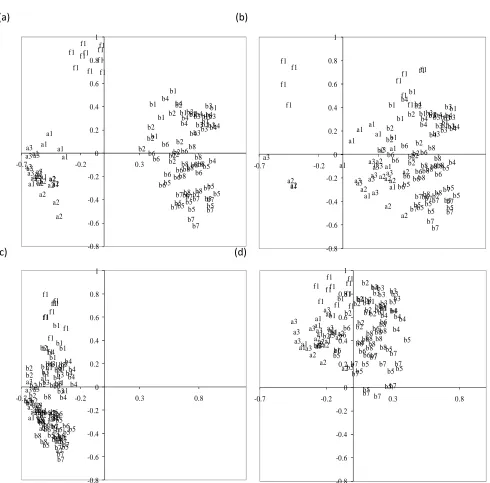
The model functions by using the context of the label to alter the similarity structure of the
internal representations. The similarity structure serves to apply a different transformation to
the semantic feature input, in a way that partly depends on the identity of that input. Figure
10 depicts the similarity structure of the internal representations under four contexts: (a) with
each training exemplar for apples, balls, and forks presented in the context of its correct
category label; (b) each exemplar presented in the context of the apple label; (c) each
exemplar presented in the context of the ball label; (d) each label presented in the context of
the fork label. The figure indicates the extent to which the similarity structure is warped by
each label. This model can also be viewed as exploiting the globality of knowledge
characterized by Fodor (2000). For example, one may view the output labels as testing the
respective simplicity of the theory that the A term is a member of the B category: here, the
simplest theory is that the green apple is indeed a member of the category apple. And the
semantic transformation caused by activating different labels may be seen as exaggerating the
19
knowledge, in this case, is achieved by the full connectivity between features, internal
representations, and labels.
======== insert Figure 10 about here =========
The model constitutes the following theory of metaphor: all semantic knowledge is stored
across a global representational system (as in Rogers and McClelland’s model). Language
labels are used as part of a strategic mechanism to manipulate context, bringing to bear
different knowledge in the processing of a given semantic token than would normally be
available when that token is met (e.g., ball knowledge would not normally be brought to mind
when presented with apple tokens). This altered context serves to exaggerate or attenuate
particular features of the token (depending on whether they are covariant with those same
features in the ‘ball’ knowledge base, in this example), in the service of facilitating a
particular communicative goal appropriate to the current discourse context (e.g., that this
token of an apple is markedly round, or it may be thrown). However, within this framework,
there is no principled difference between literal, metaphorical, or anomalous comparisons:
they are just different forms of contextual modulation of semantic knowledge (see Leech,
Mareschal, & Cooper, 2008, for a related model applied to analogy).
Discussion
The aim of this article was to demonstrate a computational mechanism by which both
metaphorical and literal comparisons can be achieved, showing that context-dependent
cognitive flexibility can be implemented in a connectionist network. Implementation
demonstrates the viability of the theoretical proposal contra, for example, arguments by
Fodor that context-dependent processing in connectionist networks is not possible because
20
on context. This view is erroneous because it omits alterations in the effective thresholds of
processing units. These change the computations that a layer of units can perform, even while
the connectivity matrix is fixed. (It should be noted that Fodor has other reasons for not
preferring connectionist architectures; see Fodor, 2000). Thus, context sensitivity may not be
a mysterious aspect of cognition, since it can be instantiated with a simple computational
principle.
Implementation also clarifies the assumptions of a theoretical proposal. In this case, the
assumptions are that: (1) categorisation behaviour nevertheless relies on feature-based
representations that are meaningful to the task at hand (even if these features may in practice
be sub-lexical; see Thomas & Mareschal, 2001). These features are flexibly combined in
different ways according to context; and (2) globality, where it occurs, is achieved by
multiple connectivity. In other words, all bits of information can in principle influence the
processing of all other bits of information because their representations are physically
connected (directly or indirectly). Furthermore, implementation demonstrates that the
representations required for context-dependent categorisation are learnable – all three models
considered acquired their processing properties via exposure to a training set.
This computational principle was initially demonstrated using a simple five-unit
connectionist network, affording a clear example. Following this, it was shown that the
principle scaled up to larger and more complex models of semantic memory. In Rogers and
McClelland’s (2004) model, context specified the ‘theory’ (i.e. the thing can or the thing is)
that was brought to bear by the network in its inductive projection behaviour. Finally, a
model of metaphor comprehension was outlined, in which the context of verbal labels served
21
This last model demonstrated a new view of metaphor: namely that metaphorical statements
are, at bottom, no different from literal ones. Each achieves its communicative purpose by
strategically modulating context, in order to bring to bear particular information in the
processing of a given semantic token. In the case of metaphor, this information would not
normally be active in the current discourse context; if the statement is literal, this information
would typically be active. If there is no meaningful difference between literal and nonliteral
similarity, then metaphor may be said not to exist, because all comparisons are simply
context-specific coalescences of particular semantic features and dimensions. It is worth
pointing out that ‘nonliteral comparison’ is a potentially confusing notion: the features that
are highlighted by a nonliteral (metaphorical) comparison literally are shared (e.g. “The apple
is a ball”: the apple really is small, round and throwable). Of course, this reflects the central
message of the current article: literal and nonliteral comparisons are really the same kind of
thing; the literal version of a category is its similarity structure in the most commonly
encountered context of usage.
This theory of metaphor supports a particular view of the relation between language and
thought, namely that language affords the strategic control of context on semantic knowledge,
allowing information to be brought to bear that might otherwise not be available for
processing. In other words, language is a strategic tool to manipulate the context of thought.
Within this framework, the similarity structure of language representations is orthogonal to
the function that they perform. Hence, in the models described in this article, language
consists of atomic labels, whereas it is semantic features that have a similarity structure. In
the absence of language, on this view, the availability of semantic knowledge would be
22
animals that do not have language will be unable to bring to bear knowledge that is not
determined by the current situation.
In order to put this view of language in context, it is worth briefly describing two well-known
alternatives. One is the Sapir-Whorf hypothesis (Sapir, 1929/1958; Whorf, 1940), the strong
form of which states that our thinking is determined by language, and that linguistic form and
meaning are inseparable. In contrast, the notion of ‘verbal report’ in psychology, which
entails that language is (or, at least, can be) determined by thought. A more formal account is
Karmiloff-Smith’s (1992) Representational Redescription model, which also holds that the
language system can ‘read off’ mental representations (i.e. thoughts) in a direct manner. This
view seems uncontroversial, in essence. We suggest that both language and thought influence
each other: if we want to say that an apple is throwable, this thought of throwing might bring
to mind the word ball, which, in turn, would influence the features of apple that were brought
to mind. On this view, then, language allows us to control thought and this control is fluid,
goal-directed and adaptive. In contrast, according to the Sapir-Whorf hypothesis, language
influences thought through some deterministic inseparability of language and meaning; a
critical difference between these conceptions, then, is that the similarity structure of language
representations is not orthogonal to the function that they perform in the Sapir-Whorf view.
If language affords the strategic control of thought, then something that is generally
considered rather mysterious might ‘come for free’, namely creativity (at least according to
some definitions): while some other, verbal, accounts of metaphor allude vaguely to notions
of conceptual recombination and the like, the account of metaphor expounded here
demonstrates how particular features or dimensions of a metaphor topic may be exaggerated
and attenuated, depending on context, allowing concepts to be modified online. Thus, after
23
such a way that the small, round and throwable aspects of the concept will have been
exaggerated. Mareschal and colleagues have argued that human categorization behavior is
often driven by partial representations, so that only some dimensions of knowledge are
activated by a given situation, and different aspects of a category are activated by different
situations (Mareschal et al., 2007; Mareschal & Tan, 2007). Synthesising Mareschal’s
position with our view that metaphor is not principally different from the literal, we suggest
that creativity is not some esoteric notion requiring esoteric mechanisms: it is just a
consequence of how the mind works, because cognition is intrinsically context-dependent and
therefore is creative to the extent that context changes (and can be manipulated). Creativity,
then, may be considered a tool to manipulate the salience of different features of a given
object or situation, where exaggerated features trigger associations or task schemas that were
previously unnoticed.
Murphy and Medin (1985) make the point that mental chemistry is a more apt metaphor for
understanding concepts than mental composition, emphasising relations, operations and
transformations, as opposed to viewing features as inert and independent entities. John Stuart
Mill (1843/1965) had the following to say on the matter:
...when the seven prismatic colors are presented to the eye in rapid succession, the sensation produced is that of
white. But in this last case it is correct to say that the seven colors when they rapidly follow one another
generate white, but not that they actually are white; so it appears to me that the Complex Idea, formed by the blending together of several simpler ones, should, when it really appears simple, (that is when the separate
elements are not consciously distinguishable in it) be said to result from, or be generated by the simple ideas,
not to consist of them. . . . These are cases of mental chemistry: in which it is possible to say that the simple
ideas generate, rather than that they compose, the complex ones. (p. 29)
The idea of partial representations interacting to produce new concepts, then, is
24
1988; for interim development of the idea). To reiterate, the contribution of the current article
is to demonstrate a mechanism by which this can be achieved.
What exactly are categories, if they are not lists of features stored in long-term memory?
Harnad (2005) has argued that “categorization is any systematic differential interaction
between an autonomous, adaptive sensorimotor system and its world (p.21)”. In his view,
categories only exist to the extent that we behave differently to different kinds of entities: a
hard-line commitment to context-specificity and goal-direction. The other side of the coin of
context-specific categories is incomplete content of definitions of those categories: it is
almost always possible to think of additional ways of describing and defining a category, e.g.
birds do not have fur, they tend to drink water, they are descended from dinosaurs. Linguistic
descriptions may be recursive, or nested, such that any given level of description can be
further explicated in terms of another. This potentially limitless aspect of description renders
the possibility of complete content rather remote. Part of this problem of incomplete content
stems from the difference between stored and inferred knowledge (Barsalou, 1993), because
many of the linguistic descriptions that people offer for categories are likely to be formulated
spontaneously rather than retrieved from long-term memory. Semioticians have used the
problem of incomplete content to argue that linguistic labels (i.e. words) have no ultimate
determinable meaning: Derrida (1976, 1978) coined the term ‘différance’ to allude to the way
in which (in his view) meaning is endlessly deferred, a notion earlier offered by Peirce
(1931-1958): "The meaning of a representation can be nothing but a representation ... the
interpretant is nothing but another representation ... and as representation, it has its
interpretant again. Lo, another infinite series". However, the view that categories are
context-specific deftly avoids this problem: the meaning of a label is constrained by context and
25
category in every possible context. In neuroconstructivist terms, Sirois and colleagues (Sirois
et al., 2008) suggest that “For a representation to become full, the individual must integrate
the partial representations across the entire range of contexts in which the concept is used.”
What is context? In the various models demonstrated, context took different guises, but in
each case it represented an additional input to the model. One could therefore argue that
“context-dependent processing” is an artefact of our definitions. We call one part of the input
layer “The Input” and another part “The Context” and show how the activity of one part of
the input layer influences computations carried out over another part of the input layer. But in
reality, there is only a pattern of activation over an input layer. ‘Context’ is therefore just
another form of knowledge. The response to this argument is simply to ask, what else could
context be but another source of information? The challenge is to identify experimentally the
information sources that drive contextual effects in human categorization. Of course, the
division of input layers into Input and Context is, to some extent, arbitrary. In reality, all
inputs serve as the context for all other inputs. This is an intrinsic property of connectionist
networks, which makes them advantageous architectures for capturing the fluidity with which
humans apply their knowledge to guiding their behaviour.
Acknowledgements
This work was supported by European Commission grant NEST-029088(ANALOGY) and
MRC grant G0300188.
References
26
Barsalou, L. (1993). Flexibility, structure, and linguistic vagary in concepts. In A. Collins, S.
Gathercole, & M. Conway (Eds.), Theories of memory (pp. 29-101). London: LEA.
Blasko, D. M. & Connine, C. M. (1993). Effects of familiarity and aptness on the
comprehension of metaphor. Journal of Experimental Psychology: Learning, Memory
and Cognition, 19, 295-308.
Chalmers, D., French, R. & Hofstadter, D. (1992). High-level perception, representation, and
analogy. Journal of Experimental & Theoretical AI, 4, 185-211.
Derrida, J. (1976). Of Grammatology (trans. Gayatri Chakravorty Spivak). Baltimore, MD:
Johns Hopkins University Press.
Derrida, J. (1978). Writing and Difference (trans. Alan Bass). London: Routledge & Kegan
Paul.
Fiez, J. A., Peterson, S. E., Cheney, M. K., & Raichle, M. E. (1992). Impaired non-motor
learning and error detection associated with cerebellar damage. A single-case study.
Brain, 115, 155–178.
Fodor, J. (2000). The mind doesn’t work that way. Cambridge, MA: MIT Press.
Gibbs, R. W. & Nagaoka, N. (1985). Getting the hang of American slang: Studies on
understanding and remembering slang metaphors. Language & Speech, 28, 177-194.
Gibbs, R. W., Nayak, N. P., & Cutting. C. (1989). How to kick the bucket and not
decompose: Analyzability and idiom processing. Journal of Memory and Language,
27
Glucksberg, S. & Estes, Z. (2000). Feature accessibility in conceptual combination: Effects of
context-induced relevance. Psychonomic Bulletin & Review, 7, 510-515.
Glucksberg, S. & Keysar, B. (1990). Understanding metaphorical comparisons: Beyond
similarity. Psychological Review, 97, 3-18.
Harnad, S. (2005) To cognize is to categorize: Cognition is categorization. In C. Lefebvre &
H. Cohen (Eds.). Handbook of categorization in cognitive science (pp. 20-42).
London: Elsevier.
Hinton, G. E. (1981). Implementing semantic networks in parallel hardware. In G. E. Hinton
& J. A. Anderson (Eds.) Parallel models of associative memory (p. 161-187).
Hillsdale, NJ: Erlbaum.
Inhoff, A. W., Lima, S. D., & Carroll, P. J. (1984). Contextual effects on metaphor
comprehension. Memory and Cognition, 12, 558-567.
James, W. (1890). The Principles of Psychology (2 vols.). New York: Henry Holt (Reprinted
Bristol: Thoemmes Press, 1999).
Leech, R., Mareschal, D. & Cooper, R. (2008). Analogy as relational priming: A
developmental and computational perspective on the origins of a complex cognitive
skill. Behavioral & Brain Sciences, 31, 357-414.
Mareschal, D., Johnson, M. H., Sirois, S., Spratling, M., Thomas, M. S. C., & Westermann,
G. (2007). Neuroconstructivism, Vol. I: How the brain constructs cognition. Oxford,
28
Mareschal, D. & Tan, S. (2007). Flexible and context-dependent categorisation by
eighteen-month-olds. Child Development 78, 19-37
Mareschal, D. & Thomas, M. S. C. (2007). Computational modeling in developmental
psychology. IEEE Transactions on Evolutionary Computation (Special Issue on
Autonomous Mental Development), 11, 137-150.
Mill, J. S. (1965). On the logic of the moral sciences. New York: Bobbs-Merrill. (Originally
published 1843).
Murphy, G. L. (2003) The big book of concepts. Cambridge, MA: MIT Press.
Murphy, G. L. & Medin, D. L. (1985): The role of theories in conceptual coherence.
Psychological Review, 92, 289-316
Oakes, L., Newcombe, N., & Plumert, J. (2009). Are dynamic systems and connectionist
approaches an alternative to Good Old Fashioned Cognitive Development? In J.
Spencer, M. S. C. Thomas, & J. McClelland (Eds.), Toward a new unified theory of
development (pp. 279-294). Oxford: OUP.
Ortony, A., Schallert, D. L., Reynolds, R. E., & Antos, S. J. (1978). Interpreting metaphors
and idioms: Some effects of context on comprehension. Journal of Verbal Learning &
Verbal Behavior, 17, 465-477.
Peirce, C. S. (1931-58). Collected Writings (8 Vols.). Cambridge, MA: Harvard University
29
Purser, H. R. M., Thomas, M. S. C., Snoxall, S., & Mareschal, D. (in press). The
development of similarity: Testing the prediction of a computational model of
metaphor comprehension. Language & Cognitive Processes.
Pynte, J., Besson, M., Robichon, F. H., & Poli, J. (1996). The time-course of metaphor
comprehension: An event-related potential study. Brain & Language, 55, 293-316.
Quine, W. V. O. (1977). Natural kinds. In S. P. Schwartz (Ed.), Naming, necessity, and
natural kinds (pp. 155-175). Ithaca, NY: Cornell University Press.
Rapp, A. M., Leube, D. T., Erb, M., Grodd, W., & Kircher, T. T. J. (2007). Laterality in
metaphor processing: Lack of evidence from functional magnetic resonance imaging
for the right hemisphere theory. Brain & language, 100, 142-149.
Rogers, T., & McClelland, J. (2004). Semantic cognition. Cambridge, MA: MIT Press.
Rumelhart, D., Hinton, G., & Williams, R. (1986). Learning internal representations by error
propagation. In D. Rumelhart, J. McClelland & the PDP research group (Eds.)
Parallel Distributed Processing Vol. 1, (pp.318-362). Cambridge, MA: MIT Press.
Rumelhart, D., & Todd, P. (1993). Learning and connectionist representations. In D. Meyer
& S. Kornblum (Eds.), Attention and performance XIV (pp. 3-30). Cambridge, MA:
MIT Press.
Sapir, E. (1929). The status of linguistics as a science. In E. Sapir (1958): Culture, Language
and Personality (Ed. D. G. Mandelbaum). Berkeley, CA: University of California
30
Sirois, S., Spratling, M., Thomas, M. S. C., Westermann, G., Mareschal, D., & Johnson, M.
H. (2008). Precis of Neuroconstructivism: How the Brain Constructs Cognition.
Behavioral and Brain Sciences, 31, 321-356.
Smolensky, P. (1988). On the proper treatment of connectionism. Behavioral and Brain
Sciences, 11, 1-74.
Stringaris, A. K., Medford, N. C., Giampietro, V. C., Brammer, M. J., & David, A. S. (2007).
Deriving meaning: Distinct neural mechanisms for metaphoric, literal, and
non-meaningful sentences. Brain & language, 100, 150-162.
Thomas, M. S. C. & Mareschal, D. (2001). Metaphor as categorisation: A connectionist
implementation. Metaphor & Symbol, 16, 5-27.
Thompson-Schill, S. L., D’Esposito, M., Aguirre, G. K., & Farah, M. J. (1997) Role of left
inferior prefrontal cortex in retrieval of semantic knowledge: a reevaluation.
Proceedings of the National Academy of Sciences, USA, 94, 14792–14797.
Whorf, B. L. (1940). Science and linguistics. Technology Review 42, 229-31, 247-8.
Wittgenstein, L. (1953). Philosophical investigations. Oxford, UK: Blackwell.
Tables
Table 1: The XOR mapping problem.
Pattern Input 1 Input 2 Output
p1 0 0 0
31
p3 0 1 1
[image:32.595.106.344.67.128.2]p4 1 1 0
Table 2: The Hexagon mapping problem.
Pattern Input 1 Input 2 Output
Context A Context B
32
p2 .75 0 1 0
p3 1 .5 0 1
p4 .75 1 0 0
p5 .25 1 0 1
p6 0 .5 1 0
Figure Captions
Figure 1: Geometric representation of the XOR input space and a sample hidden unit space
[image:33.595.82.346.69.210.2]33 Figure 2: Exclusive-or (XOR) network.
Figure 3: Input and sample hidden unit spaces for the Hexagon network, for categorizations
in two different contexts.
Figure 4: Hexagon network.
Figure 5: Network solutions for XOR and Hexagon problems (numbers inside units show
effective thresholds).
Figure 6: Model of the development of semantic knowledge (Rogers & McClelland, 2004).
Figure 7: Similarity structure of hidden unit representations in the upper layer using
multi-dimensional scaling, under two different ‘relational’ contexts.
Figure 8: Model of metaphor comprehension (Thomas & Mareschal, 2001); labels of the B
term in the metaphor ‘an A is a B’ serve as the context for reproducing the features of A.
Figure 9: Transformations of the meaning of the A term (a particular token of apple) by
comparison to three B domains for the metaphor an A is a B. Ellipses indicate semantic
features showing particular modulation (see text).
Figure 10: The similarity structure of the internal representations (1st and 2nd principal
components) under four contexts: (a) semantic feature vectors accompanied by their correct
label; (b) all vectors labelled as balls; (c) all vectors labelled as apples; (d) all vectors labelled
as forks.
Figure 1
1
In
p
u
t 2
1
H
id
d
en
2
(a) Categorization required
in input space
(b) Learned similarity structure of
internal representations
34 Figure 2
35 Figure 3
1 1
H
id
d
en
2
p1 p2
p5 p4 p6
(a) Categorization required in
input space (Context A)
36
1
0
1
0 Input 1
In
p
u
t 2
1
0
1 0 Hidden 1
H
id
d
en
2
p1 p2
p1
p4 p2
p3
p3
p5 p4
p6
p5 p6
(b) Categorization required in
input space (Context B)
37 Figure 4
Input 1
Input 2
Hidden 1
Hidden 2
Output
Context
38 Figure 5
Thresholds:
Thresholds
Context A:
Context B:
> 4
> 4
-7
7
6
-7
12
12
> 6
> 9
> -14
8
-7
12
-10
12
12
> 17
39 Figure 6
Items
Upper hidden layer
Relation
Attributes
Lower hidden layer
e.g., living thing, plant, animal, bird, red, grow, fly, wings, leaves, skin
40 Figure 7
“is” relational context
“can” relational context
sunfish
sa lmon flounder
tulip sunflower
rose da isy
ca na ry
penguin spa rrow robin cod
oa k
pine
ma ple birch
sunfish sa lmonflounder tulip
sunflower rose da isy
ca na ry
penguin spa rrow
robin
cod oa kpine
41 Figure 8
Semantic features
Hidden units
Labels
42 0.00 0.25 0.50 0.75 1.00 A ct iv a ti o n Input Output 0.00 0.25 0.50 0.75 1.00 re d g re en b ro w n w h it e ea te n th ro w n h it k ic k ed ro u n d ir re g u la r so ft h ar d sm al l la rg e h ea v y li g h
t A B F
A ct iv a ti o n
Colour Action Shape Texture Size Weight Label
Input Output 0.00 0.25 0.50 0.75 1.00 A ct iv a ti o n Input Output
Apple token "is an apple"
Apple token "is a ball"
[image:43.595.64.560.333.697.2]43 b1 b1 b1 b1 b1 b1 b1 b1 b1 b1 b2 b2 b2 b2b2 b2 b2 b2 b2 b2 b3 b3 b3 b3b3 b3b3 b3 b3 b3 b4 b4 b4 b4 b4 b4 b4 b4 b4 b4 b5 b5 b5 b5 b5 b5 b5 b5 b5 b5 b6 b6 b6 b6 b6 b6 b6 b6 b6 b6 b7 b7 b7 b7 b7 b7 b7 b7 b7 b7 b8 b8 b8 b8 b8 b8 b8 b8 b8 b8 a1 a1a1 a1 a1 a1 a1 a1 a1 a1 a2 a2 a2 a2 a2 a2 a2 a2 a2 a2 a3 a3 a3 a3 a3 a3 a3 a3 a3 a3 f1 f1 f1 f1 f1 f1 f1 f1 f1 f1 -0.8 -0.6 -0.4 -0.2 0 0.2 0.4 0.6 0.8 1
-0.7 -0.2 0.3 0.8
b1 b1 b1 b1 b1 b1 b1 b1 b1 b1 b2 b2 b2 b2b2 b2 b2 b2 b2 b2 b3 b3 b3 b3 b3 b3 b3 b3 b3 b3 b4 b4 b4 b4 b4 b4 b4 b4 b4 b4 b5 b5 b5 b5 b5 b5 b5 b5 b5 b5 b6 b6 b6 b6 b6 b6 b6 b6 b6 b6 b7 b7 b7 b7 b7 b7 b7 b7 b7 b7 b8 b8 b8 b8 b8 b8 b8 b8 b8 b8 a1 a1a1 a1 a1 a1 a1 a1 a1 a1 a2 a2 a2 a2 a2 a2 a2 a2 a2 a2 a3 a3 a3 a3 a3 a3 a3 a3 a3 a3 f1 f1 f1 f1 f1 f1 f1 f1 f1 f1 -0.8 -0.6 -0.4 -0.2 0 0.2 0.4 0.6 0.8 1
-0.7 -0.2 0.3 0.8
b1 b1 b1 b1 b1 b1 b1 b1 b1 b1 b2 b2 b2 b2 b2 b2 b2 b2 b2 b2 b3 b3 b3 b3b3 b3b3 b3 b3 b3 b4 b4 b4 b4 b4 b4 b4 b4 b4 b4 b5 b5 b5 b5 b5 b5 b5 b5 b5 b5 b6b6 b6 b6 b6 b6 b6 b6 b6 b6 b7 b7 b7 b7 b7 b7 b7 b7 b7 b7 b8 b8 b8 b8 b8 b8 b8 b8 b8 b8 a1 a1 a1 a1 a1 a1 a1 a1 a1 a1 a2 a2 a2 a2 a2 a2 a2 a2a2 a2 a3 a3 a3 a3 a3 a3 a3 a3 a3 a3 f1 f1 f1 f1 f1 f1 f1 f1 f1 f1 -0.8 -0.6 -0.4 -0.2 0 0.2 0.4 0.6 0.8 1
-0.7 -0.2 0.3 0.8
b1 b1 b1 b1 b1 b1b1 b1 b1 b1 b2 b2 b2 b2 b2 b2 b2 b2 b2 b2 b3 b3b3 b3b3 b3 b3 b3 b3 b3 b4 b4 b4 b4b4 b4 b4 b4 b4 b4 b5 b5 b5 b5 b5 b5 b5 b5 b5 b5 b6 b6 b6 b6 b6 b6 b6 b6 b6 b6 b7 b7 b7 b7 b7 b7 b7 b7 b7 b7 b8 b8 b8 b8b8b8
b8 b8 b8 b8 a1 a1 a1 a1 a1 a1 a1 a1 a1a1 a2 a2 a2 a2 a2 a2 a2 a2 a2a2 a3 a3 a3 a3 a3 a3 a3 a3 a3 a3 f1 f1 f1 f1 f1 f1 f1 f1 f1 f1 -0.8 -0.6 -0.4 -0.2 0 0.2 0.4 0.6 0.8 1
-0.7 -0.2 0.3 0.8
(a) (b)
[image:44.595.53.543.325.808.2](c) (d)