RESEARCH ARTICLE STEM CELLS AND REGENERATION
Precise control of plant stem cell activity through parallel
regulatory inputs
Tom Bennett1,*,‡, Albert van den Toorn1,2,‡, Viola Willemsen1,2and Ben Scheres1,2,§
ABSTRACT
The regulation of columella stem cell activity in theArabidopsisroot cap by a nearby organizing centre, the quiescent centre, has been a key example of the stem cell niche paradigm in plants. Here, we investigate interactions between transcription factors that have been shown to regulate columella stem cells using a simple quantification method for stem cell activity in the root cap. Genetic and expression analyses reveal that the RETINOBLASTOMA-RELATED protein, the FEZ and SOMBRERO NAC-domain transcription factors, the ARF10 and ARF16 auxin response factors and the quiescent centre-expressed WOX5 homeodomain protein each provide independent inputs to regulate the number of columella stem cells. Given the tight control of columella development, we found that these inputs act in a surprisingly parallel manner. Nevertheless, important points of interaction exist; for example, we demonstrate the repression of SMB activity by non-autonomous action of WOX5. Our results suggest that the developmental progression of columella stem cells may be quantitatively regulated by several more broadly acting transcription factors rather than by a single intrinsic stem cell factor, which raises questions about the special nature of the stem cell state in plants.
KEY WORDS: Stem cell, Stem cell niche, Root cap, Plant development
INTRODUCTION
The regenerative capacity of stem cells (SCs) in animal systems has generated immense attention. SC activity has predominantly been conceptualised as resulting from intrinsic and extrinsic‘stemness’ factors that are necessary and sufficient to confer SC fate (Morrison et al., 1997). However, it has proved difficult to identify a firm molecular basis for SC identity that goes beyond the operational definition of SCs, and SC behaviour may be best understood as a property of whole-tissue systems (Lander, 2009). SCs have also been described in plants, generally located within the proliferative zones (meristems) located at growing shoot and root apices. Clonal analysis has identified ‘initial’ cells that continuously produce daughter cells while remaining undifferentiated themselves–which are therefore operationally defined SCs–but there are few of these truly long-lived SCs in plant meristems (Stewart and Derman, 1970; Scheres et al., 1994). Intrinsic stemness factors have not been described in plants (Aichinger et al., 2012), and plant SCs
have mostly been discussed in the framework of ‘stem cell niches’(SCN), where SCs are‘protected’from differentiation by ‘organizing’cells (Scheres, 2007).
In seedling root meristems of Arabidopsis thaliana, approximately four cells located near the root apex divide infrequently (‘quiescent centre’, QC; Fig. 1A) (Dolan et al., 1993). Cells surrounding the QC act as initials for one or more cell files that form the root (Fig. 1A), and clonal analysis confirms that these cells behave as SCs (Dolan et al., 1994; Scheres et al., 1994). The main root ‘meristem zone’lies on the proximal (shootward) side of the QC, and spans∼30 cells within each file. The root cap (RC), a specialized structure (reviewed by Barlow, 2003), resides on the distal side of the QC. The RC consists of a central‘columella’ region, and the larger and more-complex lateral root cap (LRC). Ablation of QC cells leads to differentiation of adjacent columella stem cells (CSCs), suggesting that the QC signals to the SCs to prevent their differentiation (van den Berg et al., 1997) as in a classical SCN (Scheres, 2007). The QC-expressed transcription factor WUSCHEL-RELATED HOMEOBOX5 (WOX5) might be or control this signal, as CSCs differentiate prematurely inwox5 mutants (Sarkar et al., 2007). WOX5 is closely related to WUSCHEL (WUS), which is expressed in the shoot meristem organizing centre and moves into over-lying cells (Yadav et al., 2011, 2013). As WUS and WOX5 are functionally interchangeable (Sarkar et al., 2007), WOX5 may also be a mobile QC-derived signal. Other transcription factors acting in RC development have been identified; the NAC-domain protein FEZ is required for CSC activity (Willemsen et al., 2008), whereas another NAC domain protein, SOMBRERO (SMB) drives cell-cycle exit and differentiation in CSC daughter cells (Willemsen et al., 2008; Bennett et al., 2010; Fendrych et al., 2014). The cell cycle and differentiation regulator RETINOBLASTOMA-RELATED (RBR) also drives cell cycle exit in CSC daughters and promotes differentiation (Wildwater et al., 2005). In addition, two negatively acting auxin response factor (ARF) proteins, ARF10 and ARF16, that do not appear to directly interact with auxin signalling (Vernoux et al., 2011) influence the number and location of SC divisions in the RC (Wang et al., 2005).
The columella allows the analysis of higher-level coordination of division and differentiation, as it contains four apparently distinct cells types (including the QC) in a regular and stable arrangement (Fig. 1A,B). The QC undergoes periodic periclinal divisions (Ortega-Martínez et al., 2007), in which rootward daughters replenish existing CSCs, which in turn differentiate (Cruz-Ramirez et al., 2013). It is important to note that cell position, behaviour (e.g. division/ differentiation) and identity are separable concepts in columella development, even though in wild-type roots there is usually a highly predictable relationship between the three. Columella development has previously been described through changes in cell identity and differentiation state: QC→CSC→differentiated cells (DC)→ border-like cells (BC). However, no factors that confer distinct cell identities
Received 14 March 2014; Accepted 25 August 2014
1
Department of Molecular Genetics, University of Utrecht, Padualaan 8, Utrecht 3584 CH, The Netherlands.2Plant Developmental Biology, Wageningen University Research, Wageningen 6708 PB, The Netherlands.
*Present address: Sainsbury Laboratory, University of Cambridge, Bateman Street, Cambridge CB2 1LR, UK.
‡
These authors contributed equally to this work
§
Author for correspondence ([email protected])
DEVEL
O
have been identified so far in the columella, and in various developmental mutants, correlations between position, behaviour and apparent cell identity breakdown. It is not yet clear whether CSCs are defined intrinsically at a molecular level, or whether their behaviour is maintained through a combination of cues from a highly regular cellular environment. To address this issue, we assessed or re-assessed the functions and interactions of the known RC transcription factors FEZ, SMB, RBR, ARF10/ARF16 and WOX5. We demonstrate that none of these regulatory factors fully dictates CSC state. Instead, CSC-like behaviour emerges by modulation of division and differentiation through mostly parallel pathways. We show that WOX5 controls CSC-activity by non-cell autonomously repressing expression of SMB–providing a genetic entry into a long-known interaction between organizer and SCs.
RESULTS
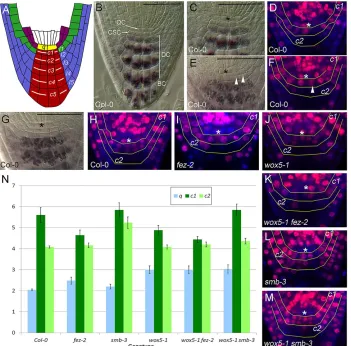
[image:2.612.133.484.58.404.2]A coordinate system to monitor columella development Depending on the exact phase of the cell cycle when imaged, the wild-type columella contains a single layer of CSCs (Fig. 1C), a partially divided set of CSCs (Fig. 1E) or two layers of cells that resemble CSCs (Fig. 1G). In the latter, the rootward cells are not CSCs or mitotically active, but are incompletely differentiated DCs that rarely divide again, and will shortly expand and accumulate starch (Fig. 1C). The static observation of two tiers of CSC-like cells does therefore not necessarily imply either extra division, failure to differentiate or more cells with CSC-like identity. Live-imaging of root development is also not an optimal solution to monitor CSC activity, due to the experimental duration, small sample sizes and growth and movement in all dimensions (Campilho et al., 2006). Fig. 1. Quantitative analysis of root cap development.(A) Diagrammatic representation of the wild-typeArabidopsisroot cap. The columella is the central region indicated in red; the lateral root cap is in blue. Cell positions described in this study are labelled:q(yellow), contiguous with the cortical/endodermal cell layers ( purple);c1, contiguous with the epidermal/lateral root cap stem cell (l1) and epidermis (green);c2, contiguous with the first lateral root cap layer (l2);
c3, contiguous with the second lateral root cap layer (l3), etc. (B) DCIM image showing the appearance of wild-type roots stained with Lugol’s stain. Below the quiescent centre (QC) cells atq, a single tier of small unstained columella stem cells (CSCs) are present atc1. Differentiated cells (DCs) in older columella tiers (c2,c3, etc.) are heavily stained for starch, while the outer layer of border cells (BCs) has started to detach from the root. (C-H) Temporal changes in thec1/c2
area in Col-0 roots. DCIM images show initially undivided CSCs atc1(C; taken from B), which non-synchronously divide (E) until there are two layers of small unstained‘CSC-like’cells atc1(G). The lower tier of cells are not CSCs and will accumulate starch and begin to expand, and become displaced to thec2position (B). The same process can be observed by monitoring S-phase progression using incorporation and detection of the thymidine homologue F-ara-EdU (D,F,H). Incorporated F-ara-EdU is indicated in red, while all nuclei are counterstained with DAPI (blue); nuclei containing DNA that has replicated during a 24 h treatment period are thus coloured magenta. (I-M) F-ara-EdU staining showing characteristic changes in distribution and level of S-phase progression in mutant genotypesfez-2(I),wox5-1(J),wox5-1 fez-2(K),smb-3(L) andwox5-1 smb-3(M). These changes can also be detected by quantitative analysis of cell numbers (N). (N) Analysis of cell numbers in root caps of Col-0,fez-2,smb-3,wox5-1,wox5-1 fez-2andwox5-1 smb-3at the positionsq,c1andc2. The total number of cells visible in each position in median sections was counted,n=25 per genotype, bars indicate s.e.m. Asterisks mark the position ofq. Arrowheads indicate recently divided cells. Scale bars: 50μm.
DEVEL
O
The use of molecular markers relies on an absolute correlation between cell identity/behaviour and the expression of the marker gene, and we know of no examples in the RC where this is the case. Indeed, the behaviour of many characterised RC marker genes changes in various mutant backgrounds (e.g. Wang et al., 2005; Sarkar et al., 2007).
To permit analysis of columella development in multiple genetic backgrounds, we have taken a simple approach that separates the effects of position, cell identity and cell behaviour. We defined the positions in the columella region as follows. The tier of cells that is contiguous with the cortical/endodermal cell layers (‘q’) forms a distinct location that normally contains QC cells. Even if QC-like behaviour is lost, q position remains clearly defined (Fig. 1A). Similarly, thec1position is contiguous with the epidermal cell layer (including the nascent lateral root cap layerl1if present), while each subsequent columella cell tier (c2,c3, etc.) is contiguous with one layer of LRC cells (l2,l3, etc.), and these positions can be defined irrespective of the identity and behaviour of the residing cells (Fig. 1A). For example, ectopic divisions in columella tiers can be easily identified, because more cells will be bracketed by a single LRC layer. Using this positional framework, we quantified cell numbers in different positions (c1,c2, etc.) from median optical sections through the columella. We combined this information with a qualitative assessment of differentiation based on cell shape, presence/absence of starch granules and the presence/absence of divisions – cells at qand c1 in wild type have a typical ‘ brick-shaped’ morphology and no starch accumulation, whereas other columella cells are square/elongated in shape and accumulate starch. In wild-type roots, cells at each position display stereotyped behaviour, and on this basis have been attributed different identities. Atq, cells are undifferentiated and divide infrequently, and as such are described as QC cells; in wild type there are on average two cells at this position in a median longitudinal section (Fig. 1B,N). Atc1, cells are undifferentiated and divide frequently, and as such are described as CSCs (Fig. 1B). The CSCs undergo quasi-synchronous periclinal divisions, such that on average∼5.5 cells are observed at this position in wild type (Fig. 1N). These divisions regenerate CSCs and produce a new tier of daughter cells. Each round of division atc1thus intercalates a newc2tier of cells into the root cap, accompanied by a newl2layer of LRC, resulting from periclinal division of Epi/LRC SCs. The cells in the newc2tier undergo rapid differentiation, marked by the accumulation of dense starch granules (Fig. 1B), and a lack of further cell divisions; there are usually four cells visible in thec2position (Fig. 1N). These cells, and the cells in the 3-5 pre-existing columella tiers rarely divide again and are considered as differentiated cells (DCs). The outer layer of the columella consists of terminally differentiated border-like cells (BCs; Fig. 1B), which become detached (reviewed by Driouich et al., 2007). The rate of detachment of BCs is matched by divisions in the CSCs, and the size of the columella does not appreciably change early in development.
Rapid quantification of columella stem cell activity in mutants
To assess whether our quantification method can capture changes in cell division and differentiation, we described known root cap developmental mutants using this method. If CSC cell division rate is altered, we should observe a change in the average number of cells atc1, and this can indeed be observed infez-2(Fig. 1N), which has previously been characterised as causing a reduction in SC activity (Willemsen et al., 2008). Conversely, if differentiation is impaired, we would anticipate observing increased cell division and
undifferentiated morphology at the c2 position. This can be observed at c2 in smb-3 (Fig. 1N), which we have previously characterised as causing increased SC activity (Willemsen et al., 2008). It should be noted that the number of cells atc1and c2is approximately the same as atc1in Col-0 (Fig. 1N), suggesting that SMB primarily regulates differentiation and not the rate of cell division. If differentiation is accelerated, we would anticipate decreased cell division and altered morphology at thec1position, and this is indeed the case in wox5-1 (Fig. 1N), which has previously been characterised as promoting differentiation of CSCs (Sarkar et al., 2007).
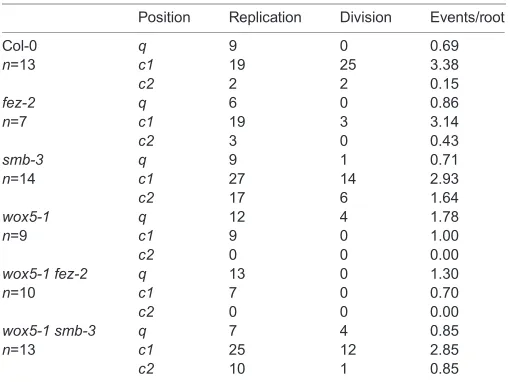
Our analysis indicates that these mutant phenotypes cannot be described in absolute terms; for example, we still observed apparent cell divisions atc1inwox5-1andfez-2, albeit at a reduced rate. Our method thus seems able to provide a more nuanced view of previously described phenotypes. To further validate our method, we assessed whether these apparent cell divisions represent recent cell division activity by incorporation and subsequent detection of the thymidine analogue F-ara-EdU. After 24 h, we detected S-phase progression in Col-0 roots that correspond to different patterns of cell numbers observed atc1, indicating that visual quantification of cell numbers detects recent cell divisions (Fig. 1C-H). Furthermore, patterns of F-ara-EdU incorporation in fez-2, smb-3 and wox5-1 correspond to the changes in cell division inferred from cell number analysis, including reduced but not absent cell-cycle progression atc1 in fez-2 and wox5-1, and increased S-phase progression at c2 in smb-3 (Fig. 1I-K; Table 1). We thus conclude that our method provides a reasonable assessment of dynamic developmental processes in the columella.
The columella stem cell state is not solely determined by FEZ-like proteins
[image:3.612.311.566.498.689.2]We have previously shown that FEZ is a regulator of CSC activity, and it might be proposed that presence of FEZ (together with absence of SOMBRERO, see below), characterizes the CSC state. However, our current analysis demonstrates that CSC-like activity is not completely lost infez-2 (Fig. 1N). This might be caused by
Table 1. Quantification of F-ara-EdU incorporation in root cap mutants
Position Replication Division Events/root
Col-0 q 9 0 0.69
n=13 c1 19 25 3.38
c2 2 2 0.15
fez-2 q 6 0 0.86
n=7 c1 19 3 3.14
c2 3 0 0.43
smb-3 q 9 1 0.71
n=14 c1 27 14 2.93
c2 17 6 1.64
wox5-1 q 12 4 1.78
n=9 c1 9 0 1.00
c2 0 0 0.00
wox5-1 fez-2 q 13 0 1.30
n=10 c1 7 0 0.70
c2 0 0 0.00
wox5-1 smb-3 q 7 4 0.85
n=13 c1 25 12 2.85
c2 10 1 0.85
Seedlings of the listed genotypes were treated with F-ara-EdU for 24 h and then visualized. The number of DNA replication or cell division events that were visible in median confocal sections at theq,c1andc2positions was quantified. The figure in the final column is the total number of either type of event, divided by the number of roots assessed.
DEVEL
O
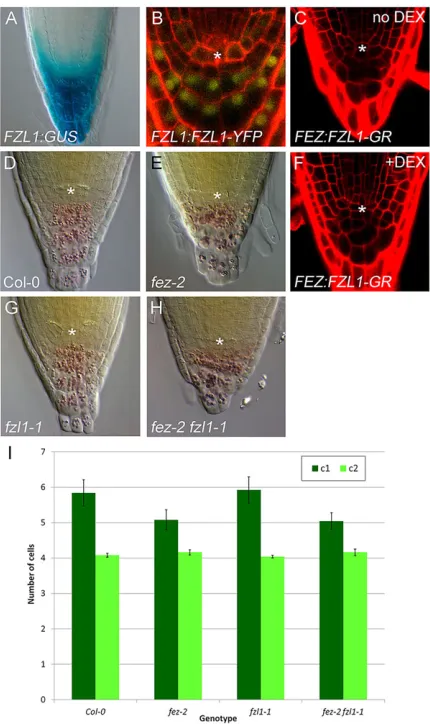
biochemical redundancy of the FEZ protein, a member of the large NAC-domain family, with close relatives, thus masking effects of FEZ-like proteins on CSC activity. To investigate whether such NAC-domain proteins might be required for CSC activity, we investigated three close FEZ relatives inArabidopsis,FEZ-LIKE1 (FZL1/ANAC094, At5g39820), FZL2 (At3g12910) and FZL3/ JUB1/ANAC042(At2g43000), which are also represented in other Brassicaceae genomes (supplementary material Fig. S1). According to publically available data,FZL1has significant expression in the root cap (http://bar.utoronto.ca/efp; Birnbaum et al., 2003; Brady et al., 2007), butFZL2andFZL3do not, which we confirmed by constructing FZL2:GUS and FZL3:GUS reporter lines (supplementary material Fig. S2A-D). Although we could detect FZL2andFZL3transcripts in the root meristems of Col-0, we did not observe any upregulation ofFZL2orFZL3infez-2that might mask the lack of FEZ activity (supplementary material Fig. S2E). Furthermore, FZL3/JUB1/ANAC042 has recently been identified as a factor controlling stress responses by regulating hydrogen peroxide homeostasis (Saga et al., 2012; Wu et al., 2012). We thus focussed our attention on FZL1, which has high identity with FEZ across the N-terminal NAC domain, but is highly divergent from and much shorter than FEZ in the in the C-terminal domain (supplementary material Fig. S1). In all other eurosid genomes examined, we identified sequences with the FEZ C-terminal structure, but no sequences corresponding to FZL1, suggesting that theFEZ-FZL1 pair has arisen by duplication of an ancestral FEZgene in the Brassicaceae, followed by divergence in theFZL1 lineage. FZL1:GUS and FZL1:FZL1-YFP lines confirmed that FZL1is expressed in columella DCs–but not CSCs (Fig. 2A,B). We obtained an insertion line (fzl1-1) in theFZL1gene and found by sequencing that the T-DNA lies 64 bp into the first exon, eliminating the production of full-length FZL1 transcript (supplementary material Fig. S3E). fzl1-1 has no root cap phenotype by itself, and when combined with fez-2 there is no enhancement in thefez-2phenotype (Fig. 2E-I). We also made a FEZ:FZL1-GR transgenic line to test whether FZL1 can trans-complementfez-2if expressed in SCs, but upon induction with the steroid hormone dexamethasone (DEX), we only observed no rescue of thefez-2phenotype (Fig. 2C,D). This failure does not arise from a lack of activity in the FZL1-GR protein, as demonstrated by the very strong phenotypes seen in35S:FZL1-GRseedlings treated with DEX (supplementary material Fig. S3A-D). We thus conclude that FZL1 does not act redundantly with FEZ in regulating CSC activity under our growth conditions. As FZL1 is structurally divergent protein that does not act redundantly with FEZ, but represents a well-conserved protein family within the Brassica family, we hypothesise that it has an as yet unidentified, neo-functional role in the RC. Our findings suggest that parallel inputs not mediated by FEZ-like proteins are required for CSC activity.
RBR and ARF10/ARF16 have FEZ-independent roles in columella stem cell activity
Increased numbers of CSC-like cells are present in the arf10-2 arf16-2double mutant, which is thought to be null for ARF10 and ARF16, and in lines lackingARF10andARF16transcript due to overexpression of miR160C, which endogenously regulates their expression (Wang et al., 2005). Similarly, the transgenic RCH1: RBR RNAi line (rRBR), which reduces RBR levels in the root meristem, and lines expressing artificial miRNAs targeted to RBR have more tiers of CSC-like cells (Wildwater et al., 2005; Cruz-Ramirez et al., 2013). We therefore questioned whether these factors might act through FEZ to reduce CSC-like activity or promote
differentiation. We observed partial rescue of therRBRphenotype in afez-2background (Fig. 3A,B,D,E), with fewer apparent layers of small unstained cells with CSC-like morphology, showing that FEZ activity contributes to the increased CSC activity observed upon RBR reduction, but is not absolutely required for it. The disorganised nature of rRBR root caps makes counting cell numbers in these lines impractical, so we only assessed this qualitatively. We did not observe any alteration inFEZexpression levels inrRBR, other than that more cells expressFEZ,probably because the number of CSC-like cells is increased (Fig. 3C,F,J). In summary, our data reveal that FEZ activity contributes to the division-promoting effect of a reduction in RBR activity in the CSCs, but we have no evidence that RBR regulates FEZ.
[image:4.612.330.545.56.418.2]Similarly, we established thatFEZcontributes to thearf10 arf16 phenotype but is not absolutely required for it (Fig. 3G,H); again, the massive and disorganized root cap inarf10-2 arf16-2makes it to accurately quantify cell numbers, so we only assessed this qualitatively.FEZ is expressed in an enlarged domain inarf10-2 arf16-2, but only at a slightly increased level of expression per cell, Fig. 2. The role of FEZ and FZL1 in stem cell divisions.Asterisks indicate the position ofq. (A) DCIM image showing expression ofFZL1:GUS. (B) PI-stained roots showing expression ofFZL1:FZL1-YFP. (C,D) PI stained roots showing slight rescue offez-2by expression ofFEZ:FZL1-GRafter germination on control media (C) or 10 µM dexamethasone (D). (E-H) DCIM images showing root cap morphology at 7 dpg in Col-0,fez-2,fzl1-1andfez-2 fzl1-1. (I) Analysis of cell numbers in root caps of Col-0,fez-2,fzl1-1andfez-2 fzl1-1at the positionsc1andc2. The total number of cells visible in each position in median sections was counted,n=25 per genotype, bars indicate s.e.m.
DEVEL
O
indicating that ARF10/ARF16 is not a major regulator of FEZ expression (Fig. 3C,I,J). As RBR and ARF10/ARF16 have FEZ-independent roles and largely do not alter FEZ expression at a cellular level, they are not likely to be upstream regulators ofFEZ. Taken together with the lack of redundancy between FEZ and FZL1, the most parsimonious explanation for FEZ function is that it is not necessary for CSC-like cell divisions per se, but it increases their frequency, and therefore contributes to the increase in CSC-like cell numbers in any mutant combinations that delay CSC differentiation.
SMB regulates differentiation of stem cell daughters in parallel to RBR, ARF10 and ARF16
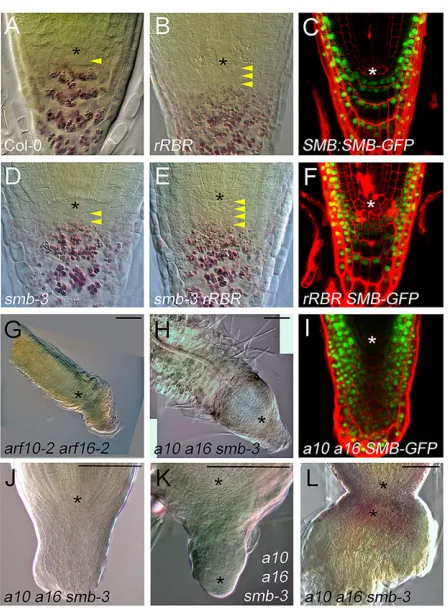
RBR and ARF10/ARF16 do not act primarily through FEZ in controlling CSC activity, so we tested whether they function by promoting differentiation through SMB activity. We first tested genetic interactions between SMB and RBR; SMB is correctly expressed in rRBR, suggesting that RBR does not regulate SMB expression (Fig. 4C,F). The smb-3 rRBR double mutant has an additive phenotype with more tiers of small, unstained cells with CSC-like morphology than either parent, suggesting that SMB acts in parallel with RBR in driving differentiation (Fig. 4A,B,D,E). We next examined SMB-GFP expression inarf10-2 arf16-2, and found that it
[image:5.612.61.288.52.391.2]is expressed in the correct domain (i.e. in the outermost cells of the RC), suggesting that lack of SMB protein does not explain thearf10 arf16phenotype (Fig. 4C,I). We further tested this by making the arf10-2 arf16-2 smb-3triple mutant; if ARF10 and ARF16 operate through SMB, the phenotype should be no more severe thanarf10-2 arf16-2. However, the triple mutant phenotype was the most severe that we observed in this study. In all 7 dpg seedlings, the primary root is short and increasingly wide towards the root tip, which harbours a thick mass of cells (Fig. 4G). Instead of the extra CSC-like cells in arf10-2 arf16-2, we observed many complete layers of RC that resulted in swollen root meristems (Fig. 4G,H,J). The cells in the LRC layers are cytoplasmically dense, indicating that they have not differentiated (Bennett et al., 2010). In 12/45 seedlings, even more severe phenotypes were observed, whereby the mass of cells accumulating in the columella position organised a new root meristem, growing out of the old root. In most cases, the new root is in the same orientation as the old root (Fig. 4J), but in some cases, it grows as a tip-to-tip mirror image (Fig. 4K). Although this quasi-root meristem has no regular cellular organization comparable to wild type, there are in most cases clearly identifiable files of cells along the proximal-distal axis and root hair differentiation in distal cells, and sometimes there is an identifiable second QC. These very strong phenotypes indicate that ARF10/ARF16 and SMB act in parallel to constrain CSC-like activity and to promote differentiation in the root cap meristem. Furthermore, they indicate that columella cells retain Fig. 3. FEZ-independent roles of RBR and ARF10 ARF16 in the root cap.
Asterisks indicate the position ofq. Yellow arrowheads indicate tiers of cells with CSC-like morphology. (A,B,D,E) DCIM images showing root cap morphology at 7 dpg in Col-0 (A),rRBR(B),fez-2(D) andfez-2 rRBR(E). (G,H) DCIM images showing reduction in phenotype inarf10-2 arf16-2 fez-2
[image:5.612.327.551.53.357.2]relative toarf10-2 arf16-2in 3 dpg seedlings. (C,F,I) PI-stained root caps showing expression ofFEZ:FEZ-GFPin wild type (C),rRBR(F) andarf10-2 arf16-3(I). (J) Quantification of FEZ-GFP fluorescence inrRBRandarf10-2 arf16-2, relative to wild type (100%);n=40-50 nuclei, bars indicate s.e.m.
Fig. 4. Parallel pathways control stem cell differentiation in the root cap.
Asterisks indicate the position ofq. Yellow arrowheads indicate tiers of cells with CSC-like morphology. (A,B,D,E) DCIM images showing root cap morphology at 7 dpg in Col-0 (A),rRBR(B),smb-3(D) andsmb-3 rRBR(E). (C,F,I) PI-stained root caps showing expression ofSMB:SMB-GFPin wild type (C),rRBR(F) andarf10-2 arf16-2(I). Brightness has been increased in S to show expression in the centre of the cell mass more clearly. (G,J-L) DCIM images showing phenotypes present inarf10-2 arf16-2(G) andarf10-2 arf16-2 smb-3(H,J-L) mutants at 7 dpg. Scale bars: 100μm.
DEVEL
O
multipotency, which becomes unconstrained if a combination of factors, including ARF10, ARF16 and SMB are removed.
WOX5 and ARF10/ARF16 act in parallel in root cap development
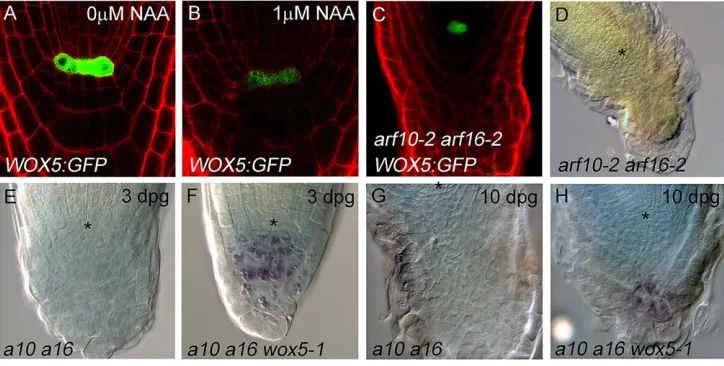
It has previously been suggested that the extremearf10-2 arf16-2 phenotype (Fig. 5D) arises through ectopic expression of WOX5, because in the absence of these ARFs, auxin can no longer downregulate WOX5 (Ding and Friml, 2010). However,WOX5is not quickly downregulated in response to auxin treatment (Ding and Friml, 2010), and whileWOX5expression is diminished after 24 h of 1μM NAA treatment (Ding and Friml, 2010) (Fig. 5A,B) it is conceivable that this effect is part of the general collapse of the root meristem that occurs under such treatments. We also did not observe any alteration in the domain ofWOX5promoter activity in thearf10-2 arf16-2background (Fig. 5C) that would be consistent withWOX5 being repressed by ARF10 and ARF16 in the columella. It was also previously suggested thearf10-2 arf16-2phenotype is rescued by the nullwox5-1allele (Ding and Friml, 2010). However, although we confirmed that thearf10-2 arf16-2 wox5-1phenotype is less severe thanarf10-2 arf16-2at 3 dpg (though not wild type) (Fig. 5E,F), we detected a much more severe phenotype in the triple mutant at later time points (Fig. 5G,H), showing that although WOX5 activity contributes to the severity of thearf10-2 arf16-2phenotype,wox5-1 is not epistatic toarf10-2 arf16-2. Taken together, these data show that ARF10/ARF16-mediated repression of WOX5 is not an important feature of CSCs, and that these factors also act in parallel to regulate RC development.
WOX5 cell-autonomously restricts SC-like activity in the QC Deficiency in WOX5 results in differentiation of the CSCs at c1 (Sarkar et al., 2007), but we also observed that the cells atqare frequently divided in wox5-1(Figs 1N and 6B), suggesting that WOX5 cell-autonomously represses QC divisions, which occur at low frequency in wild-type roots to replenish differentiating CSCs (Cruz-Ramirez et al., 2013). Since the size of thewox5-1RC does not appreciably decrease over time, these ectopic divisions atqmust also re-generate the CSCs that are lost through ectopic differentiation. We have previously shown that FEZ drives CSC activity in the columella, so we examined whetherFEZ:FEZ-GFP expression is increased atqin thewox5-1mutant background, and this is indeed the case (Fig. 6E,F). We then tested whether FEZ was responsible for the increased divisions atqinwox5-1, but observed thatwox5-1 fez-2has on average the same number of cells aswox5-1
(Figs 1N and 6A-D). This suggests that FEZ does not contribute to these ectopic divisions inwox5, and that other genes are the targets of WOX5 in the QC. We tested whether FEZ was likely to be a direct target of WOX5 activity using the inducible 35S:WOX5-GRline (Sarkar et al., 2007). Upon DEX treatment,FEZ-GFPexpression is gradually lost fromc1over the course of 48 h (Fig. 6G-L), but even accounting for fusion protein stability, it seems unlikely that reduction in FEZ is a direct response, and FEZ is therefore likely an indirect target of WOX5. The most parsimonious explanation for these data is that FEZ becomes expressed in wox5-1 as a consequence of the activation of CSC-regenerating divisions atq. These divisions at q in wox5-1 also indicate that WOX5 is not absolutely required for cell division in the RC per se, but rather for the correct timing or positioning of those divisions.
WOX5 non-cell-autonomously promotes stem cell activity by regulating SMB expression in the columella
[image:6.612.49.411.557.740.2]To gain further insight into the role of WOX5 in regulating CSC activity, we re-analysed the35S:WOX5-GRphenotype (Sarkar et al., 2007). Treatment of 7 dpg roots with DEX for 48 h results in the grossly expanded columella phenotype previously described (Fig. 6I,L). As there is only a slight increase in the numbers of LRC layers produced during this time (−DEX: 4.17±0.11; +DEX:4.67±0.18; n=12) (Fig. 6L), and no obvious phenotype in the proximal root meristem, it seemed that WOX5 has a particularly specific role in the columella. To assess this further, we followed the establishment of the35S:WOX5-GRphenotype in a time course after induction; after 8 h, we detected ectopic divisions in the differentiated parts of the columella (supplementary material Fig. S4A,F), and by 16 h, the majority of cells in the columella undergo ectopic divisions (Fig. 6J). By 24 h, much of the starch is lost from previously differentiated columella cells (Fig. 6K), and a second round of ectopic divisions is initiated in each tissue layer; both these phenotypes become more severe by 48 h (Fig. 6L). Overexpression of WOX5 thus results in de-differentiation of columella cells with concomitant divisions across the whole columella. The phenotype is therefore not only caused by failure of CSC daughters atc1to differentiate, but by re-entry of previously differentiated cells fromc2and beyond into the cell cycle. We examined whether the positive effects of WOX5 on CSC-like activity were mediated by regulation ofFEZactivity.FEZis still expressed in thec1position inwox5-1mutants (Fig. 6F), and wox5-1 and fez-2 mutants have a slightly additive effect on the reduction in cell numbers at c1 (Fig. 1N). Furthermore, FEZ expression does not mark all CSC-like cells in 35S:WOX5-GR,
Fig. 5. Auxin and WOX5 regulate root cap development in parallel.Asterisks indicate the position ofq. (A-C) Expression ofWOX5: GFPin PI-stained wild-type roots treated with control solution (A) or 1 µM NAA for 24 h (B), and in thearf10-2 arf16-2background (C). (D) Root meristem morphology inarf10-2 arf16-2at 7 dpg. (E-H) Root cap morphology inarf10-2 arf16-2(E,G) andarf10-2 arf16-2 wox5-1(F,H) at 3 dpg (E,F) and 10 dpg (G,H).
DEVEL
O
instead becoming progressively restricted to the outer columella layers (Fig. 6I,J,L). The phenotype of fez-2 35S:WOX5-GR after DEX induction shows that, although FEZ contributes to the severity of the WOX5 overexpression phenotype, it is not required for it (Fig. 6G,H). Taken together, these data show that WOX5 and FEZ act in parallel to regulate columella development. These data also suggest that WOX5 does not simply prevent premature differentiation of CSCs, but may also promote their division.
We have previously reported that SMB limits cell divisions and drives differentiation in the RC, both processes that have been shown here to be affected by WOX5 overexpression. We thus tested whether SMB might be a target of WOX5 activity in the columella, by analysingSMB:SMB-GFPexpression in thewox5-1and 35S:WOX5-GRbackgrounds. As observed withFEZ,SMBexpression moves up one layer in the wox5-1 mutant, such that it is expressed at c1 (Fig. 7A,B). Furthermore, after induction with DEX,SMBexpression in the 35S:WOX5-GR columella is greatly reduced within 4 h (Fig. 7C,D) and is completely absent by 24 h after induction
[image:7.612.48.409.57.325.2](supplementary material Fig. S4E-H). However, WOX5 overexpression has no effect on SMB expression in the LRC, consistent with the phenotype of35S:WOX5-GR. We therefore tested whether thewox5CSC differentiation phenotype is suppressed in wox5-1 smb-3double mutants, which is indeed the case; a wild-type level of cells is present atc1(Fig. 1N), corresponding to increased S-phase progression (Fig. 1J,M; supplementary material Fig. S5E-H) and a more wild-type cellular appearance (Fig. 7E-H; supplementary material Fig. S5A-D). However,wox5-like divisions still occur atqin this double mutant (Fig. 1N), so we conclude that CSC differentiation inwox5-1 is not simply caused by loss of QC integrity, and that divisions at q in wox5-1 are not simply a feedback response to reduced CSC activity atc1. Taken together with the effect of 35S: WOX5-GRonSMBexpression and de-differentiation of DCs in the columella, we believe that the most parsimonious explanation for the wox5-1 smb-3phenotype is that WOX5 specifies the position of SC-like activity in the columella by restricting SMB expression, and excluding it from thec1position. The wild-type level of CSC-like Fig. 6. WOX5 restricts SC-like activity at the qposition.Asterisks indicate the position ofq. (A-D) PI stained root caps, showing disruption of QC and CSC integrity inwox5-1(B) and
wox5-1 fez-2(D). (E,F) PI-stained root caps showing expression ofFEZ:FEZ-GFPatqin
wox5-1. (G,H) DCIM images showing reduction in phenotype infez-2 35S:WOX5-GR(+48 h dexamethasone) versus35S: WOX5:GR(+48 h dexamethasone). (I-L) Induction timecourse for35S:WOX5-GR
with 10 µM dexamethasone, also showing alterations inFEZ:FEZ-GFPexpression during this period (I-K). Ectopic divisions in the root cap from∼16 h onwards (most clearly seen in L) coincide with reduction inFEZ
[image:7.612.50.402.563.739.2]expression atc1(J) and loss of starch staining from mature cells (K).
Fig. 7. WOX5 promotes SC-like activity in the c1position through SMB3 repression.
(A,B) PI-stained root caps showing ectopic
SMB:SMB-GFPexpression inc1position in the
wox5-1mutant (B) relative to wild type (A). (C, D) PI-stained root caps showing rapid reduction inSMB:SMB-GFPexpression in the columella in35S:WOX5-GRafter 4 h induction with 10 µM dexamethasone. (E-H) DCIM images showing rescue of thewox5-1stem cell phenotype (E,G) inwox5-1 smb-3(H), and partial rescue of thesmb-3excess stem cell phenotype (E,F) inwox5-1 smb-3(H). Asterisks indicate the position of q, arrowheads indicate tiers of CSC-like cells.
DEVEL
O
divisions atc1inwox5-1 smb-3again demonstrates that WOX5 is not absolutely required for CSC activity. It is also noteworthy that wox5-1 smb-3 does not have as many CSC-like cells at c2 as smb-3 (Fig. 1L-N, Table 1, Fig. 7G,H, supplementary material Fig. S5), suggesting that WOX5 actively contributes to the ectopic CSC activity seen at c2 in smb-3. WOX5 promoter activity appeared unaltered in the smb-3 background (supplementary material Fig. S4C,D). Therefore, it is unlikely that ectopic WOX5 activity is directly responsible for thesmbphenotype, which would imply that SMB in turn restricts the expression of WOX5 from DCs. However, due to difficulties in detecting WOX5 protein (Sarkar et al., 2007), we cannot rule out the possibility that WOX5 protein moves and that SMB limits this process.
DISCUSSION
Precise developmental control from parallel regulatory elements
Our results show surprisingly few epistatic interactions among characterised regulatory factors that influence SC activity in the RC; instead, these factors seem to regulate development mainly in parallel to each other (Fig. 8). This is exemplified by FEZ, which promotes, but is not strictly necessary for, cell division in the RC, such thatfezmutations result in fewer divisions irrespective of the background – but never complete suppression of cell division. Indeed, we found no single decisive factor for CSC-like behaviour; neither WOX5 nor FEZ is required for cell division, although both promote it. Equally, we did not identify a unified differentiation pathway that prevents CSC-like activity, but rather at least three independent inputs that promote differentiation. Despite our failure
to detect coordination between transcription factor inputs, RC development is very robust in wild-type plants (Fig. 1E). We suggest that these transcription factors may provide distinct quantitative inputs to control division and/or differentiation by interacting indirectly on the promoters of shared target genes. However, it is also possible that they each have distinct targets that converge further downstream to drive division or differentiation; equally, as yet uncharacterized factors may mediate interaction between these regulators. Further understanding of the quantitative control of RC development requires identification of the ultimate ‘effector’genes downstream of these transcription factors.
The role of WOX5 in columella root cap development
The close evolutionary relationship of WUSand WOX5, together with their analogous expression in different organizing centres (Sarkar et al., 2007), and their proposed negative-feedback regulation by peptide signalling may indicate that a directly conserved regulatory system operates in both meristems (Brand et al., 2000; Stahl et al., 2009). However, several observations suggest that these systems are actually quite different from each other. The proposed feedback regulation of WOX5 by the CLE40 peptide, acting through ACR4/CLV1 receptor kinases, acts in a different way to the CLV3-WUS feedback, forming a loop between DCs and SCs, rather than a loop between organizer cells and SCs (Stahl et al., 2009, 2013). Furthermore, we show that much of the effect of WOX5 is mediated through SMB, and neither SMB nor its close relative are expressed in the shoot meristem, nor are they reported WUS targets (Yadav et al., 2013). However, one interpretation of thewox5 smbdouble mutant is that SMB restricts WOX5 activity in the RC; and SMB might therefore regulate WOX5 through the CLE40-ACR4 signalling module. Althoughacr4andclv1mutants are reported to have mild effects on CSC daughter differentiation (Stahl et al., 2009, 2013), quantification of their genetic interactions with the transcription factors discussed here is needed to assess the validity of this idea.
The stem cell concept in plant meristems
[image:8.612.73.278.397.617.2]The dependency of CSC activity on the QC‘organizer’has been used as an example of the SCN concept in plants (Scheres, 2007). We demonstrate the specific validity of this idea in the RC, and show that QC-derived WOX5 does indeed protect CSCs from the differentiation promoted by SMB. However, WOX5 and SMB only interact in the columella context and, aswox5 smbdouble mutants have CSC-like cells, neither of them appears to serve as an intrinsic SC factor. Do intrinsic SC factors exist in the RC? In the RC, with a single layer of long-lived mitotic cells, it is relatively easy to assert that there are distinct SCs. However, in other meristems, it is currently rather more difficult to argue that SCs are fundamentally different from other meristematic cells – except by operational definitions based on clonal analysis. We have previously argued that SCs in plant meristems might not need to be actively specified, because they will emerge as an inevitable consequence of the rigid arrangement of plant cells in relation to each other, coupled with a broad specification of cell division activity (Bennett and Scheres, 2010). Essentially, cells located at the point of origin of a meristem cell file must behave like SCs, while all other cells will gradually be displaced from the meristem by new daughter cells of the apical-most cells and so cannot act as long-term SCs. Interestingly, recent analyses of individual SC fates in mammalian SCNs provides evidence for the existence of a pool of equipotent cells, among which spatial competition determines which cells act as long-term SCs (Ritsma et al., 2014; Rompalas et al., 2013). As plant SCs cannot be transplanted, it is difficult to distinguish potential from Fig. 8. Summary model for the control of columella development in
Arabidopsis.Combinations of parallel factors drive different behaviours at different positions within the columella (indicated in italics on the left-hand side). In wild type, these parallel factors generate stereotyped combinations of cell behaviour, which give the appearance of distinct cell types (QC, quiescent centre; SC, stem cells; DC, differentiated cells; BC, border cells). Whether these cell types are also more directly specified by as yet unknown components is unclear. Direct genetic interactions are shown in red. Hypothetical protein movement is shown in purple. Effects on downstream processes are indicated by thin arrows. Grey text and arrows indicate low levels of factors or processes at those positions, while black text and arrows indicate
high levels.
DEVEL
O
actual SCs. Nevertheless, operationally defined SCs in plants might simply express a property present in all meristem cells because they are at the right position (Bennett and Scheres, 2010). However, SCs do have measurable properties that are different from neighbouring mitotic cells, such as their cell cycle rate (Campilho et al., 2006; Mähönen et al., 2014). The identification and study of the target genes of the parallel-acting regulatory inputs analysed in this study– which might include either truly intrinsic SC factors specific to CSCs or general meristematic factors – will help to distinguish between intrinsically programmed and positionally selected SCs.
MATERIALS AND METHODS Plant materials
Thefez-2,smb-3, FEZ:FEZ-GFP,SMB:SMB-GFP(Willemsen et al., 2008), wox5-1, WOX5:GFP, 35S:WOX5-GR (Sarkar et al., 2007), RCH1:RBR
RNAi (rRBR; Wildwater et al., 2005),arf10-2 arf16-2(Wang et al., 2005)
lines have all been described previously. Thefzl1-1(GABI-KAT O27D08)
insertion line was provided by the Nottingham Arabidopsis Stock Centre (NASC). Primers used for genotyping mutant combinations are shown in supplementary material Table S1.
Plant constructs and transformations
Primers used in this study are listed in supplementary material Table S1. For FEZ:GUS, the previously described 4 kb promoter (Willemsen et al., 2008)
was amplified from Col-0 genomic DNA, and fused to theβ-glucuronidase
coding sequence, in a pGREEN II vector. FZL1:GUS, FZL2:GUS and
FZL3:GUSconstructs were constructed in the same manner using 1486 bp
upstream from the FZL1 start codon, 3304 bp upstream of FZL2 and
2504 bp upstream ofFZL3. For FZL1:FZL1:YFPthe FZL1 cDNA was
amplified from Col-0 seedling cDNA, then fused between the FZL1
promoter described above and the YFP tag in a pGREEN II vector. Transgenic plants were created by Agrobacterium floral dipping using these constructs, into the appropriate genetic background (Clough and Bent, 1998).
RT-PCR
RNA extraction, cDNA synthesis and RT-PCR were performed as described by Bennett et al. (2010); RNA was extracted from the distal 5 mm of roots.
F-ara-EdU staining
4 dpg seedlings were transferred to plates containing 3 µM F-ara-EdU
[(2′S)-2′-deoxy-2′-fluoro-5-ethynyluridine] for 24 h, and were then fixed in
4% paraformaldehyde. Detection of F-ara-EdU was performed using a Click-iT EdU Alexa Fluor 555 Imaging Kit (Life Technologies) according
to the manufacturer’s instructions. Seedlings were counterstained with
0.1 µg/ml DAPI (4′,6-diamidino-2-phenylindole) and F-ara-EdU
incorporation was assessed by confocal microscopy.
Microscopy
Staining for starch granules andβ-glucuronidase activity were performed as
described by Willemsen et al. (1998). Differential contrast interference microscopy was performed on a Zeiss Axio Imager, using 20× lenses or 40× lenses. Confocal microscopy was performed using either a Leica SP5 or Zeiss LSM700 imaging system using 20× lenses. For GFP/YFP imaging,
roots were stained in 10μg/ml propidium iodide (PI) for at least 1 min before
imaging. Excitation was performed using 488 nm (∼15% laser power) and
555 nm (∼6%) lasers. PI fluorescence was detected above 600 nm, and
GFP/YFP fluorescence below 555 nm. Identical settings for GFP/YFP detection were used within experiments; PI detection was varied according to the staining of individual roots. For F-ara-EdU imaging, excitation was
performed using 405 nm (∼10% laser power) and 555 nm (∼8%) lasers;
Alexa Fluor 555 fluorescence was detected above 555 nm and DAPI fluorescence below 500 nm. Nuclear GFP quantification was performed on
non-saturated images, using Zeiss‘ZEN’software. Fluorescence intensity in
the GFP channel was measured in five widely spaced nuclei per root, in at least eight roots per genotype.
Image processing
Images were processed and assembled using Adobe Photoshop. Raw images were rotated as necessary. If blank corners were created by rotation,
they were‘filled’in a colour matching the background of the image. The
images were then cropped to the region of interest. All further image processing was applied across the whole image. For confocal images, the brightness and contrast of the green/yellow channel and red channel were altered independently to produce clear images and reduce noise. Images from the same experiment were processed in the same manner. For DCIM
images, the‘lighten shadows/darken highlights’function was used to reduce
the cross-image glare caused by optical sectioning. Where necessary,
images were processed using the‘sharpen’tool at a setting of 150%, to
produce clearer images of cellular organization. Alterations to brightness/ contrast, hue/saturation and white balance were also performed to make images consistent in their appearance.
Acknowledgements
We thank Yvonne Stahl and Ruediger Simon for valuable comments on the manuscript.
Competing interests
The authors declare no competing financial interests.
Author contributions
T.B., A.v.d.T., V.W. and B.S. conceived and designed the experiments. T.B., A.v.d.T. and V.W. performed the experiments and analysed the data. T.B., A.v.d.T., V.W. and B.S. wrote the paper.
Funding
T.B. and A.v.d.T. were financed by European Research Council (ERC) Advanced Investigator Grant SysArc and a Spinoza grant from the Dutch Science Organization (NWO) to B.S. V.W. was financed by an NWO-VENI grant.
Supplementary material
Supplementary material available online at
http://dev.biologists.org/lookup/suppl/doi:10.1242/dev.110148/-/DC1
References
Aichinger, E., Kornet, N., Friedrich, T. and Laux, T.(2012). Plant stem cell niches.
Annu. Rev. Plant Biol.63, 615-636.
Barlow, P. W.(2003). The root cap: cell dynamics, cell differentiation and cap
function.J. Plant Growth Regul.21, 261-286.
Bennett, T. and Scheres, B.(2010). Root development-two meristems for the price
of one?Curr. Top. Dev. Biol.91, 67-102.
Bennett, T., van den Toorn, A., Sanchez-Perez, G. F., Campilho, A., Willemsen,
V., Snel, B. and Scheres, B. (2010). SOMBRERO, BEARSKIN1, and
BEARSKIN2 regulate root cap maturation in Arabidopsis.Plant Cell22, 640-654.
Birnbaum, K., Shasha, D. E., Wang, J. Y., Jung, J. W., Lambert, G. M., Galbraith,
D. W. and Benfey, P. N.(2003). A gene expression map of theArabidopsisroot.
Science302, 1956-1960.
Brady, S. M., Orlando, D. A., Lee, J.-Y., Wang, J. Y., Koch, J., Dinneny, J. R.,
Mace, D., Ohler, U. and Benfey, P. N. (2007). A high-resolution root
spatiotemporal map reveals dominant expression patterns. Science 318, 801-806.
Brand, U., Fletcher, J. C., Hobe, M., Meyerowitz, E. M. and Simon, R.(2000).
Dependence of stem cell fate in Arabidopsis on a feedback loop regulated by CLV3 activity.Science289, 617-619.
Campilho, A., Garcia, B., van den Toorn, H., van Wijk, H., Campilho, A. and
Scheres, B.(2006). Time-lapse analysis of stem-cell divisions in the Arabidopsis
thaliana root meristem.Plant J.48, 619-627.
Clough, S. J. and Bent, A. F. (1998). Floral dip: a simplified method for
Agrobacterium-mediated transformation of Arabidopsis thaliana.Plant J. 16, 735-743.
Cruz-Ramırez, A., D́ ı́az-Triviño, S., Wachsman, G., Du, Y., Arteága-Vázquez, M.,
Zhang, H., Benjamins, R., Blilou, I., Neef, A. B., Chandler, V. et al.(2013). A
SCARECROW-RETINOBLASTOMA protein network controls protective quiescence in the Arabidopsis root stem cell organizer.PLoS Biol.11, e1001724.
Ding, Z. and Friml, J.(2010). Auxin regulates distal stem cell differentiation in
Arabidopsis roots.Proc. Natl. Acad. Sci. USA107, 12046-12051.
Dolan, L., Janmaat, K., Willemsen, V., Linstead, P., Poethig, S., Roberts, K. and
Scheres, B. (1993). Cellular organisation of the Arabidopsis thaliana root.
Development119, 71-84.
Dolan, L., Duckett, C. M., Grierson, C., Linstead, P. Schneider, K., Lawson, E.,
Dean, C. Poethig, S. and Roberts, K.(1994). Clonal relationships and cell
patterning in the root epidermis of Arabidopsis.Development120, 2465-2474.
DEVEL
O
Driouich, A., Durand, C. and Vicré-Gibouin, M.(2007). Formation and separation of root border cells.Trends Plant Sci.12, 14-19.
Fendrych, M., Van Hautegem, T., Van Durme, M., Olvera-Carillo, Y., Huysmans,
M., Karimi, M., Lippens, S., Guérin, C. J., Krebes, M., Schumacher, K. et al.
(2014). Programmed cell death controlled by ANAC033/SOMBRERO determines root cap organ size in Arabidopsis.Curr. Biol.24, 931-940.
Lander, A. D.(2009). The‘stem cell’concept: is it holding us back?J. Biol.8, 70.
Mähönen, A. P., ten Tusscher, K., Siligato, R., Smetana, O., Dı́az-Triviño, S.,
Salojärvi, J., Wachsman, G., Prasad, K., Heidstra, R. and Scheres, B.(2014).
PLETHORA gradient formation mechanism separates auxin responses.Nature
(in press).
Morrison, S. J., Shah, N. M. and Anderson, D. J.(1997). Regulatory mechanisms
in stem cell biology.Cell88, 287-298.
Ortega-Martı́nez, O., Pernas, M., Carol, R. J. and Dolan, L.(2007). Ethylene
modulates stem cell division in the Arabidopsis thaliana root. Science 317, 507-510.
Ritsma, L., Ellenbroek, S. I. J., Zomer, A., Snippert, H. J., de Sauvage, F. J.
Simons, B. D., Clevers, H. and van Rheenen, J. (2014). Intestinal crypt
homeostasis revealed at single-stem-cell level byin vivolive imaging.Nature507, 362-365.
Rompalas, P., Mesa, K. R. and Greco, V.(2013). Spatial organization within a
niche as a determinant of stem-cell fate.Nature502, 513-518.
Saga, H., Ogawa, T., Kai, K., Suzuki, H., Ogata, Y., Sakurai, N., Shibata, D. and
Ohta, D.(2012). Identification and characterization of ANAC042, a transcription
factor family gene involved in the regulation of Camalexin biosynthesis in arabidopsis.Mol. Plant Microbe Interact.25, 684-696.
Sarkar, A. K., Luijten, M., Miyashima, S., Lenhard, M., Hashimoto, T., Nakajima,
K., Scheres, B., Heidstra, R. and Laux, T.(2007). Conserved factors regulate
signalling in Arabidopsis thaliana shoot and root stem cell organizers.Nature446, 811-814.
Scheres, B.(2007). Stem-cell niches: nursery rhymes across kingdoms.Nat. Rev.
Mol. Cell Biol.8, 345-354.
Scheres, B., Wolkenfelt, H., Willemsen, V., Terlouw, M., Lawson, E., Dean, C.
and Weisbeek, P.(1994). Embryonic origin of the Arabidopsis primary root and
root meristem initials.Development120, 2475-2487.
Stahl, Y., Wink, R. H., Ingram, G. C. and Simon, R.(2009). A signaling module
controlling the stem cell niche in Arabidopsis root meristems.Curr. Biol. 19, 909-914.
Stahl, Y., Grabowski, S., Bleckmann, A., Kühnemuth, R., Weidtkamp-Peters, S.,
Pinto, K. G., Kirschner, G. K., Schmid, J. B., Wink, R. H., Hülsewede, A. et al.
(2013). Moderation of Arabidopsis root stemness by CLAVATA1 and ARABIDOPSIS CRINKLY4 receptor kinase complexes.Curr. Biol.23, 362-371.
Stewart, R. N. and Derman, H.(1970). Determination of number and mitotic activity
of shoot apical initial cells by analysis of mericlinal chimeras.Am. J. Bot.57, 816-826.
van den Berg, C., Willemsen, V., Hendriks, G., Weisbeek, P. and Scheres, B.
(1997). Short-range control of cell differentiation in the Arabidopsis root meristem.
Nature390, 287-289.
Vernoux, T., Brunoud, G., Farcot, E., Morin, V., Van den Daele, H., Legrand, J.,
Oliva, M., Das, P., Larrieu, A., Wells, D. et al.(2011). The auxin signalling
network translates dynamic input into robust patterning at the shoot apex.Mol. Syst. Biol.7, 508.
Wang, J.-W., Wang, L.-J., Mao, Y.-B., Cai, W.-J., Xue, H.-W. and Chen, X.-Y.
(2005). Control of root cap formation by MicroRNA-targeted auxin response factors in Arabidopsis.Plant Cell17, 2204-2216.
Wildwater, M., Campilho, A., Perez-Perez, J. M., Heidstra, R., Blilou, I., Korthout, H., Chatterjee, J., Mariconti, L., Gruissem, W. and Scheres, B.
(2005). The RETINOBLASTOMA-RELATED gene regulates stem cell maintenance in Arabidopsis roots.Cell123, 1337-1349.
Willemsen, V., Wolkenfelt, H., de Vrieze, G., Weisbeek, P. and Scheres, B.
(1998). TheHOBBITgene is required for formation of the root meristem in the Arabidopsis embryo.Development125, 521-531.
Willemsen, V., Bauch, M., Bennett, T., Campilho, A., Wolkenfelt, H., Xu, J.,
Haseloff, J. and Scheres, B.(2008). The NAC domain transcription factors FEZ
and SOMBRERO control the orientation of cell division plane in Arabidopsis root stem cells.Dev. Cell15, 913-922.
Wu, A., Allu, A. D., Garapati, P., Siddiqui, H., Dortay, H., Zanor, M.-I.,
Asensi-Fabado, M. A., Munné-Bosch, S., Antonio, C., Tohge, T. et al. (2012).
JUNGBRUNNEN1, a reactive oxygen species-responsive NAC transcription factor, regulates longevity in Arabidopsis.Plant Cell24, 482-506.
Yadav, R. K., Perales, M., Gruel, J., Girke, T., Jönsson, H. and Reddy, G. V.
(2011). WUSCHEL protein movement mediates stem cell homeostasis in the Arabidopsis shoot apex.Genes Dev.25, 2025-2030.
Yadav, R. K., Perales, M., Gruel, J., Ohno, C., Heisler, M., Girke, T., Jönsson, H.
and Reddy, G. V. (2013). Plant stem cell maintenance involves direct
transcriptional repression of differentiation program.Mol. Syst. Biol.9, 654.