ORIGINAL RESEARCH ARTICLE
ADVANCED TECHNOLOGIES INVOLVED IN NETWORK
CONVERGENCE: SDN & NFV
*Shaikh Abdul Azeem and Dr. Satyendra Kumar Sharma
Department of Computer Science, Pacific Academy of Higher Education & Research University,
Udaipur, Rajasthan, India
ARTICLE INFO ABSTRACT
The “anywhere and anytime connectivity” have been increasingly delivered by the recent developments in wireless communications. Wireless networks refer to any type of computer network that is not connected by any kind of cables. The convergence of technological advancements has a great impact on the success of the modernization of information systems as well as with the telecommunications systems. Nowadays, the trend is moving towards a fully virtualised environment in which even storage and networks are controlled by means of software. New concepts came into the scenario like SDS Defined Storage), SDN (Software-Defined Networking) and SDDC (Software-(Software-Defined Datacentre)/HCI. In IT networking, siloed legacy infrastructure that takes time to manage, requires multiple teams to provision and deploy, and eats up too much power, sunk costs and scarce budgets. Virtualization and automation were supposed to relieve some of this burden. This paper discusses about how SDN & NFV technologies are becoming a building block for network convergence & helpful to manage traffic problems in converged network.
*Corresponding author
Copyright ©2017,Shaikh Abdul Azeem and Dr. Satyendra Kumar Sharma. This is an open access article distributed under the Creative Commons Attribution
License, which permits unrestricted use, distribution, and reproduction in any medium, provided the original work is properly cited.
INTRODUCTION
Tremendous development is going on, and we are now a days using WiFi, 4G and RFID tags, these technologies are enabling us anytime anywhere access to digital data and communication. Implementation of information and telecommunication systems is enabled because of these developments in wireless computing and networking. Home users and businesses are using these wireless technologies for their day to day work. Virtualization and cloud were going to accomplish much of the same thing. Private clouds are often isolated into single racks by hardwired data center infrastructures. CI seems to solve many provisioning problems and act as little islands of capability for ERP, SharePoint or VDI. With CI & HCI the functions are by definition all made in software and build a scale out architecture based on commodity hardware. This is a key trend in the datacenters and described as software defined datacenters.
SDN - Software Defined Networking
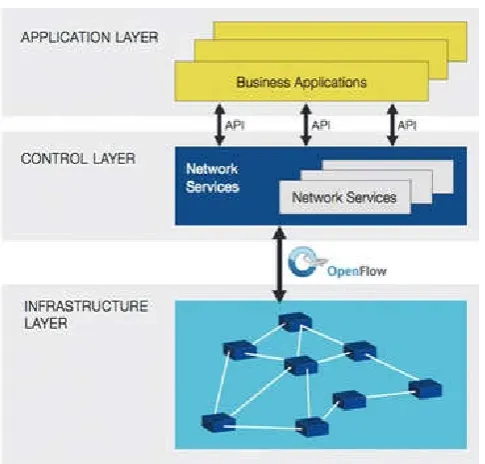
The goal of SDN is to allow network engineers and administrators to respond quickly to changing business requirements. In a traditional network different type of control and different type of expertise is required for different devices; SDN enables same type of control for different networking devices. SDN play its role by splitting the switching function between control plane and data plane. With SDN data plane will only do the job of packet forwarding, while control plane perform the job route designing, setting routing policy parameters and priority to achieve QoE and QoS requirements and to manage traffic problems. Open interfaces are defined so that the switching hardware presents a uniform interface regardless of the details of internal implementation. Similarly, open interfaces are defined to enable networking applications to communicate with the SDN controllers (Software defined networking).
ISSN: 2230-9926
International Journal of Development Research
Vol. 07, Issue, 07, pp.14146-14150, July,2017
Article History:
Received 17th April, 2017 Received in revised form 28th May, 2017 Accepted 26th June, 2017 Published online 31st July, 2017
Citation: Shaikh Abdul Azeem and Dr. Satyendra Kumar Sharma, 2017. “Site characterization through soil sample of different Ghats of Allahabad for
Forensic consideration”, International Journal of Development Research, 7, (07), 14146-14150.
ORIGINAL RESEARCH ARTICLE Open Access
Keywords:
SDN, NFV,
Network Convergence, QoS, QoE,
The data plane consists of physical switches and virtual switches. In both cases, the switches are responsible for forwarding packets. The internal implementation of buffers, priority parameters, and other data structures related to forwarding can be vendor dependent. However, each switch must implement a model, or abstraction, of packet forwarding that is uniform and open to the SDN controllers. This model is defined in terms of an open application programming interface (API) between the control plane and the data plane (southbound API). The most prominent example of such an open API is OpenFlow, “SDN Data Plane and OpenFlow.” The OpenFlow specification defines both a protocol between the control and data planes and an API by which the control plane can invoke the OpenFlow protocol. SDN controllers can be implemented directly on a server or on a virtual server. OpenFlow or some other open API is used to control the switches in the data plane. In addition, controllers use information about capacity and demand obtained from the networking equipment through which the traffic flows. At the application plane are a variety of applications that interact with SDN controllers. SDN applications are programs that may use an abstract view of the network for their decision-making goals (William Stallings, 2015).
These applications convey their network requirements and desired network behavior to the SDN controller via a northbound API. Examples of applications are energy-efficient networking, security monitoring, access control, and network management. Characteristics of Software-Defined Networking putting it all together, the key characteristics of SDN are as follows:
The control plane is separated from the data plane. Data plane devices become simple packet-forwarding devices. The control plan is implemented in a centralized controller or set of coordinated centralized controllers. The SDN controller has a centralized view of the network or networks under its control. The controller is portable software that can run on commodity servers and is capable of programming the forwarding devices based on a centralized view of the network. Open interfaces are defined between the devices in the control plane (controllers) and those in the data plane. The network is programmable by applications running on top of the SDN controllers. The SDN controllers present an abstract view of network resources to the applications.
The SDN architecture is:
Directly programmable
Agile
Centrally managed
Programmatically configured
Open standards-based and vendor-neutral
SDN focused solely on separation of the control plane of the network, which makes decisions about how packets should flow through the network from the data plane of the network, which actually moves packets from place to place (Margaret Rouse, 2015). When a packet arrives at a switch in the network, rules built into the switch's proprietary firmware tell the switch where to forward the packet. The switch sends every packet going to the same destination along the same path, and treats all the packets the exact same way (Software Defined IT).
Traditional Network & SDN
The explosion of mobile devices and content, server virtualization, and advent of cloud services are among the trends driving the networking industry to re-examine traditional network architectures.Many conventional networks are hierarchical, built with tiers of Ethernet switches arranged in a tree structure. A traditional network use specialized appliances such as a firewall or link-load balancer while SDN deploys an application that uses the controller to manage data plane behavior. SDN addresses the fact that the static architecture of conventional networks is ill-suited to the dynamic computing and storage needs of today’s data centers, campuses, and carrier environments. The key computing trends driving the need for new network architecture include:
“Big data” means more bandwidth
Service provider dependence
Fluctuating traffic paradigm
The “consumerization of IT”
Emergence of cloud services
Non ability to scale
The players
Open Networking Foundation (ONF) is a user-driven organization dedicated to the promotion and adoption of SDN. ONF is developing open standards such as the OpenFlow® Standard and the OpenFlow® Configuration and Management Protocol Standard (Software-Defined Networking (SDN)).
SDN Architectural components
The following list defines and explains the architectural components:
SDN Application
SDN Controller
SDN Datapath
SDN Control to Data-Plane Interface (CDPI)
SDN Northbound Interfaces (NBI)
SDN Control Plane (Centralized - Hierarchical – Distributed)
Applications of SDN
Software-defined mobile networking (SDMN)
SD-WAN
SD-LAN
Security using the SDN paradigm: SDN architecture may enable, facilitate or enhance network-related security applications due to the controller's central view of the network, and its capacity to reprogram the data plane at any time.
The SDN Framework
Fig. 1. Software Defined Networking (SDN) Framework
NFV – Network Functions Virtualization
Network functions virtualization (NFV) offers a new way to design, deploy and manage networking services. NFV decouples the network functions, such as network address translation (NAT), firewalling, intrusion detection, domain name service (DNS), and caching, to name a few, from proprietary hardware appliances so they can run in software. It’s designed to consolidate and deliver the networking components needed to support a fully virtualized infrastructure – including virtual servers, storage, and even other networks. It utilizes standard IT virtualization technologies that run on high-volume service, switch and storage hardware to virtualize network functions. It is applicable to any data plane processing or control plane function in both wired and wireless network infrastructures.
Fig. 2. Sample Network Functions Virtualization NFV deployment
Benefits of NFV
NFV virtualizes network services via software to enable operators to (Software-Defined Networking (SDN)):
Reducing the need to purchase purpose-built hardware and supporting pay-as-you-grow models to eliminate wasteful over-provisioning.
Reducing space, power and cooling requirements of equipment and simplifying the roll out and management of network services.
Reducing the time to deploy new networking services to support changing business requirements, seize new market opportunities and improve return on investment of new services.
Lowers the risks associated with rolling out new services, allowing providers to easily trial and evolve services to determine what best meets the needs of customers.
Quickly scale up or down services to address changing demands; support innovation by enabling services to be delivered via software on any industry-standard server hardware.SDN Vs NFV
Let us discuss how SDN is some way differs from NFV (Sanjay Kaul, 2015):
SDN got its start on campus networks. As researchers were experimenting with new protocols they were frustrated the need to change the software in the network devices each time they wanted to try a new approach. They came up with the idea of making the behavior of the network devices programmable, and allowing them to be controlled by a central element. This lead to a formalization of the principle elements that define SDN today:
Separation of control and forwarding functions
Centralization of control
Ability to program the behavior of the network using well-defined interfaces.
The next area of success for SDN was in cloud data centers. As the size and scope of these data centers expanded it became clear that a better way was needed to connect and control the explosion of virtual machines. The principles of SDN soon showed promise in improving how data centers could be controlled.
OpenFlow – Driving Towards Standards
OpenFlow defines both a model for how traffic is organized into flows, and how those flows can be controlled as needed. This was a big step forward in realizing the benefits of SDN. Network Operators’ networks are populated with a large and increasing variety of proprietary hardware appliances.
[image:3.595.43.285.540.695.2]SDN and NFV – Working Together?
NFV is able to support SDN by providing the infrastructure upon which the SDN software can be run. NFV aligns closely with the SDN objectives to use commodity servers and switches. NFV can be applied by virtualizing the router function. Finally, SDN is introduced to separate the control and data. Now, the data packets are forwarded by an optimized data plane, while the routing (control plane) function is running in a virtual machine running in a rack mount server (NFV and SDN: What’s the Difference?).
The combination of SDN and NFV provides an optimum solution as follows (Prayson Pate, 2013):
An expensive and dedicated appliance is replaced by generic hardware and advanced software.
The software control plane is moved from an expensive location (in dedicated platform) to an optimized location (server in a data center or POP).
The control of the data plane has been abstracted and standardized, allowing for network and application evolution without the need for upgrades of network devices.
Why SDN or NFV Now?
Problems which we are facing in traditional networking are
The network has become too complex.
Implementing new technology features too often requires new hardware.
Innovation of new technologies and features takes too long.
Networking hardware is too often proprietary or closed.
Networking hardware is too static.
The network often holds other efforts back or slows them down.
SDN & NFV are giving us new ways to design, build and operate networks. Over the past two decades, we have seen tons of innovation in the devices we use to access the network, the applications and services we depend on to run our lives, and the computing and storage solutions we rely on to hold all that “big data” for us. This is why SDN and NFV are happening today. SDN, NFV, network virtualization, and white box networking are all complementary approaches. They each offer a new way to design deploy and manage the network and its services. SDN and NFV have become the key to building networks that can, enable innovation, Offer New Services, Reduce CapEx, Reduce OpEX & Deliver Agility and Flexibility.
New Trends
Converged infrastructure (CI)
Because of CI a layer of complexity is removed when technology providers abstract data center configuration by pre-assembling the components so businesses don’t have to deal with the pieces. Those interested in getting things up and running quickly may go to the most converged infrastructure available, while those interested in open and dynamic networks that can leverage new innovations faster will look to SDN. In transitioning to a SDN, the key challenge involves changing traditional practices on the plant floor. The typical factory includes specialists in areas ranging from robotics, to welding, to conveyor control.
Software-Defined Infrastructure
Software-defined infrastructure – the integration of software-defined networking and software-software-defined network security.
SDN & HCI
SDN provides enhanced capabilities for the data center, primarily with its ability to provide policy, and security into the networking platform along with the automation and programmability that has been sorely lacking in legacy physical networking platforms. Hyperconverged platforms provide the same programmability, scalability, and predictability that are perfectly placed alongside the new management and operations methodology with SDN. The development of SDN and NFV NFV will bring big changes in the Central Office.
Conclusion
[image:4.595.38.557.76.159.2]SDN & NFV facilitate network convergence. Traditionally dedicated access networks for wireless and wireline coexist as they each require dedicated appliances to run different protocols and services. Today, SDN and NFV allow a single access network to hook up to a single pool of compute/ storage equipment to execute virtualized network functions. This gives the ability to run different services over single access networks, maximizing the RoI. SDN is a new approach to IP switching and routing architectures used in data centers and now increasingly being applied to carrier networks. SDN radically changes the network architecture by introducing concepts of centrally orchestrated networking, enabling agile traffic rerouting depending on network conditions, and making optimized use of the available capacity. Combined with NFV, this is driving a major transformation within service providers. Optimize the use of your hardware NFV is a new approach to the deployment of services and applications in carrier networks.
Table 1. Difference between SDN & NFV
Sr. Category SDN NFV
1. Initiation Born on the Campus, developed in the Data Center. Comes into existence by collective efforts of service providers. 2. Reason for Being Separation of control and data, centralization of
control and programmability of network.
Relocation of network functions from dedicated appliances to generic servers.
3. Target Location Campus, data center / cloud Service provider network 4. Target Devices Commodity servers and switches Commodity servers and switches
REFERENCES
Margaret Rouse, 2015. “Software-defined networking (SDN)”,
http://searchsdn.techtarget.com/definition/software-defined-networking-SDN
NFV and SDN: What’s the Difference?, http://www.chinasdn. org/en/sdn.asp
Prayson Pate, “NFV and SDN: What’s the Difference?”, https://www.sdxcentral.com/articles/contributed/nfv-and-sdn-whats-the-difference/2013/03/
Sanjay Kaul, 2015. “SDN and NFV - Opportunity for SPs to Tap”, http://www.cisco.com/c/en_in/about/thought-leadership/et-telecom.html
Software Defined IT, http://www.terasky.com/solutions/ software-defined-it/software-defined-network/
Software defined networking, https://www.netari.com/sd-wan Software-Defined Networking (SDN), https://www.open
networking.org/sdn-resources/sdn-definition
William Stallings, 2015. Foundations of Modern Networking: Background and Motivation of Software-Defined Networks (SDN), http://www.informit.com/articles/article. aspx