ORIGINAL RESEARCH ARTICLE
DESIGN AND IMPLEMENTATION OF MLEARNING FOR CALCULUS IN TERTIARY EDUCATION
*
MAK, Kai-Long, LOH, Anthony Wai-keung, L.O. and Kenneth Chi-hang
Division of Science and Technology, Hong Kong Community College, The Hong Kong
Polytechnic University, China
ARTICLE INFO ABSTRACT
Using IT in education has become prevalent worldwide. It is believed that IT not only motivates students to learn in class, but also encourages students to take the initiative to explore and inquire subject matters outside classroom by themselves (i.e. independent learning). The Hong Kong Education Bureau offered a series of professional development programmes to principals, vice principals, middle managers as well as teachers who have joined the "Support Scheme for e-Learning in Schools" since April 2014 to 2016/17 school year to further equip schools to implement e-learning. In primary and secondary education, for example, the HKSAR Government (2004) has been giving support to schools for using e-textbooks and e-learning resources during lessons. At tertiary level, other e-learning platforms such as MOODLE and BLACKBOARD have been widely used in different institutions. In recent years, the rapid development of mobile apps has been provided learners with ample opportunities to learn independently. There are various learning apps such as Math Tricks, Complete Mathematics, Mathematics Dictionary, IXL Maths Practice, etc on the market for primary and secondary education; nonetheless, the use of mobile apps in students’ learning of disciplinary subject seems to be new in tertiary level, and its effectiveness in students’ learning is worth investigation. Through this study, the project team hopes to a) explore whether a disciplinary-specific mobile app can help learners to acquire and apply disciplinary knowledge in and beyond classroom, b) identify elements to be included in a mobile app to helps students to learn outside classroom.
Copyright © 2018,MAK, Kai-Long et al. This is an open access article distributed under the Creative Commons Attribution License, which permits unrestricted
use, distribution, and reproduction in any medium, provided the original work is properly cited.
INTRODUCTION
It has been suggested that mobile learning (mLearning) can have more advantages than e-learning platforms in education (Keegan, 2001). Since mLearning does not require a specific location, learners can enhance the learning experience by accessing information at anytime anywhere and learning on demand. MLearning, in this sense, can be used to support traditional learning (Isamn, 2006). Over the past few years, researchers have looked into the use of mLearning in education. For example, in Turkey, Korucu and Alkan (2011) found that that the usage of mLearning technologies in education could offer learning and data accession opportunities for learners notwithstanding time and place.
*Corresponding author: MAK, Kai-Long,
Division of Science and Technology, Hong Kong Community College, The Hong Kong Polytechnic University, China.
In recent years, many various technologies have been developed for mobile environments in terms of redounding opportunities of data transfer, and therefore, it can be an opportunity to start introducing mLearning to support traditional learning.
Background of Hong Kong Mathematics Education: In Hong Kong, student enrolment in advanced mathematics (HKDSE Mathematics Extended Part Modules 1, 2) dropped from 23% in 2012 to 14% in 2016 (The Academy of Sciences of Hong Kong, 2016). Compared with other countries, the students’ participation rate in advanced mathematics in Hong Kong is much lower than that in Singapore and New Zealand (40%), and in Japan, Korea and Taiwan (varying from 57 to 80%). The advanced mathematics, however, is crucial for students to advance their studies in science and technology, especially IT.
ISSN: 2230-9926
International Journal of Development Research
Vol. 08, Issue, 10, pp. 23496-23500, October,2018
Article History: Received 27th July, 2018 Received in revised form 13th August, 2018
Accepted 11th September, 2018 Published online 30th October, 2018
Key Words: Mobile App, IT in Education.
Citation: MAK, Kai-Long, LOH, Anthony Wai-keung, L.O. and Kenneth Chi-hang. 2018. “Design and Implementation of mLearning for calculus in tertiary education”, International Journal of Development Research, 8, (10), 23496-23500.
In the IT field, calculus is one of the most important subjects, and the knowledge learnt in advanced mathematics helps students to acquire Calculus more easily as well as providing a smooth transition from secondary to tertiary education. With the low enrolment in and insufficient knowledge about advanced mathematics, students encounter problems in learning calculus at post-secondary level. This project aims to design and implement a m Learning curriculum for calculus, and then examine the effectiveness of this m Leanring tool as a supplement to normal teaching in enhancing students’ academic performance in calculus and calculus-related subjects.
METHODOLOGY
Design and implementation of mLearning curriculum for calculus: Identify seventeen essential calculus topics from
previous students’ performance in mid-term tests,
examinations as well as comments from subject SFQs to develop the mobile app. Only authorized students (controlled by a login system) are able to use the app. Each calculus topic has a 3-5 minutes video with both Chinese and English subtitles for students to refresh their knowledge. Students can self-evaluate their performance by attempting relevant calculus questions in the app.
Examine the effectiveness of the developed mobile app: The project consists of two phases. In Phase 1, an experimental approach is adopted to investigate the effectiveness of the mobile app in a calculus subject. In Phase 2, student participants who have used the mobile app was interviewed to explore whether the tool has helped them to acquire disciplinary knowledge in other calculus-related subjects. In this project, both quantitative and qualitative data was collected in the study period. Quantitative data was collected through students’ scores of a written test in a calculus subject at the end of the semester (Phase 1), and qualitative data was solicited by individual, semi-structured interviews (Phase 2).
Phase 1: Students from AD scheme of IT, which must take the compulsory subject of calculus, are invited to take part in this research. Students are then assigned into two groups (experimental and controls). The experimental group is required to use the app and also answer the questions as listed in each chapter throughout the semester according to a scheduled plan. At the end of the semester, the result of the exam was further used as dependent variable and applied for analysis. Statistical analysis of covariance, ANCOVA, was be carried out to identify if there was significant differences between control group and experimental group. ANCOVA is a general linear model which blends ANOVA and regression. ANCOVA evaluates whether population means of a dependent variable are equal across levels of a categorical independent variable, while statistically controlling the effects of other continuous variables that are not of primary interest (such as block effect between classes).
Phase 2: Approximately fifteen students from AD scheme of IT were invited for face-to-face, one-to-one interviews. These interviewees must have used the mobile app in their learning of calculus and calculus-related subjects. All interviews were conducted in a semi-structured way. Each interviewee was asked the same pre-determined questions; however, additional questions may be asked based on students’ responses. The interviews aim to solicit students’ perceptions of the usefulness
and effectiveness of the mobile app in their learning of subjects which require students to have prior knowledge of calculus.
RESULTS
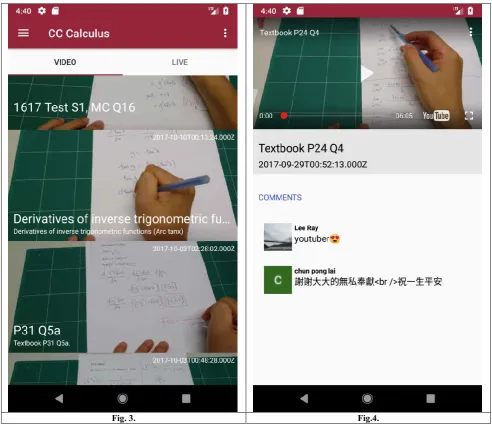
[image:2.595.308.557.220.261.2]A calculus mobile app was successfully developed based on the subject of Calculus. In the mobile app, four main functions were covered a) Tutorial, b) Question bank, c) Media, and d) Social.
Table 1. Eigenvalues and percentage of variance represented by corresponding components
Component Eigenvalues % of Variance
1 2.681 66.625
2 1.125 27.957
3 0.218 5.418
Table 2. Result of principal components analysis
Component
1 2
DSE result of Math 0.103 0.826* Take Part in DSE M1 0.664* -0.009 Take Part in DSE M2 0.843* 0.108 *. Coefficient is significant at the 0.05 level.
The mobile app is user-friendly and visually engaging to students. The specific learning outcomes corresponding to each question are shown explicitly, so that students are aware of what they have learnt. For each of the chapter, notes were covered in the ‘Tutorial’ function. Videos were covered in the ‘Media’ function in order to show the step and also the way to solve specific question. By watching the recorded video demonstrations of a variety of examples, students are able to learn independently outside the classroom. These videos and examples present the solutions in a step-by-step approach, which illustrates the underlying concepts and theories transparently. Upon watching the videos, students are rendered practice exercise instantly to apply the knowledge. Throughout the whole learning process, students can understand how much they have achieved in each learning outcome from the percentage calculated on the basis of their performance in the practice.
[image:2.595.310.555.301.353.2]Analysis of covariance: A statistical analysis of covariance, ANCOVA, was carried out to identify if there were significant differences between groups. ANCOVA is a general linear model which blends ANOVA and regression. ANCOVA evaluates whether population means of a dependent variable are equal across levels of a categorical independent variable, while statistically controlling for the effects of other continuous variables that are not of primary interest, known as covariates. Therefore, when performing ANCOVA, the dependent variable means are adjusted to what they would be if all groups were equal on the covariates. For performing ANCOVA analysis, we need to define covariates. Principal component analysis was carried out on interested confounding factors and the scores from principal component analysis will apply for covariate.
Analysis of covariance: It is obvious that the pervious public examination result from DSE, and also their study background of studying M1/M2 should affect the calculus exam result. In order to isolate the bias from these three well know factors,
these three factors were included for principal factor analysis. Therefore, these three factors were also included for principal factor analysis and then derive results that have been adjusted for all the other factors when examining one factor by ANCOVA. As mentioned in last paragraph, for performing ANCOVA analysis, we need to define covariates. For performing ANCOVA analysis, we need to define covariates. Principal component analysis was used on three interested confounding factors.
DSE result of Math,
Take Part in DSE M1,
Take Part in DSE M2,
The scores from principal component analysis were applied for the covariate of ANCOVA. The principal component analysis was carried out on the data set, and the eigenvalues and percentage of variance represented by corresponding components are shown in Table 1. The result showed that two components had eigenvalues greater than one, so these three
Table 3. ANCOVA result of different factors
Dependent variable Factor Levene Statistical test (Significant value)
[image:3.595.55.547.74.563.2]ANOVA (Significant value) Calculus Exam Result Control and Experimental group 0.753 0.002*
[image:3.595.63.545.81.564.2]components were selected as the principal factors in our data set. Varimax with Kaiser normalization was applied for rotation methods of extracting the principal components. The corresponding components are shown in Table 2. After Varimax rotation, two components were extracted by the principal component analysis. The first component had two significant coefficients, which was Take Part in DSE M1 and Take Part in DSE M2, it can represent 66.625% of the overall variation. The second component had one significant coefficient, which was DSE result of Math. The second component represented 27.957% of the overall variation. A statistical analysis, ANCOVA, was carried out to identify if there were significant differences among different factors. Before performing ANCOVA, Levene Statistical test was preformed, in order to confirm the equal variance assumption of ANCOVA. A value of larger than 0.05 for significant value reflects the equal variance assumption is valid. Significant differences were obtained between the experimental and controls group. The result was showed in Table 3. Significant differences were obtained between the control and experimental group. In terms of the exam mean experimental groups has higher marks in terms of mean than control groups. In phase 2, fifteen students from AD scheme of IT was invited for face-to-face, one-to-one interviews. Fourteen students accepted the invitation and fulfill the requirement of used the used the mobile app in their learning of calculus and calculus-related subjects and took part in the interview.
All interviews were conducted in a semi-structured way. Each interviewee was asked the same pre-determined questions; however, additional questions were also asked based on students’ responses. Over 80% of students had positive comments on the mobile app. More than 70% of students suggested that the mobile app successfully fill the knowledge gap between secondary school mathematics and post-secondary school mathematics. It is noticeable that students admitted to tertiary studies, especially those of science disciplines, are generally neither furnished with sufficient mathematical knowledge nor trained to analyze problems quantitatively. In light of this, various ‘bridging’ courses and workshops on basic mathematics concepts have been offered to students without taking M1/M2. Given the tight teaching schedule, however, the performance of these students is less satisfactory. This subsequently has a far-reaching impact when the students proceed to higher level mathematics subjects and other discipline-specific subjects relying on heavy use of more sophisticated mathematics.
Conclusion
[image:4.595.45.538.50.475.2]A calculus mobile app was successfully developed based on the subject of Calculus. It provided an extra learning platform for students to learn mathematics. AD scheme of IT were assigned into two groups (experimental and controls). 103 students were randomly assigned to the experimental group
and they were required to use the app and also answered the questions as listed in each chapter throughout the semester according to a scheduled plan. 102 students were assigned to the control to group, and they were required to attend regular lecture and tutorial. A statistical analysis of covariance, ANCOVA, was carried out to identify if there were significant differences between groups based on the exam result. Significant difference was obtained and found that experimental group had better performance than control. By the founding of this project, we would like to encourage cross-subjects teachers to share the effectiveness of mobile app in teaching. By the comments of our sampled students, we can now understand how mobile app can facilitate students.
Acknowledgment
The work described in this conference paper was fully funded by a grant from the College of Professional and Continuing Education, an affiliate of The Hong Kong Polytechnic University.
REFERENCES
Beres, A., Aspirot, A., Paris, C., Berube, D., Bouchard, S., Laberge, J.M., Lands, L.C., Puligandla, P. 2011. A contemporary evaluation of pulmonary function in children undergoing lung resection in infancy. Journal of Pediatric
Surgery, 46, 829-832.
Isman, A. 2006. Computer and education, Sakarya University
Journal of Education, Volume: 2 Web Site:
http://www.ef.sakarya.edu.tr/dergi/efdergisayi1.pdf, 24.11.2006.
Keegan, D. 2002. The future of learning: ZIFF papiere 119:
From eLearning to mLearning, Web Site:
http://www.fernunihagen.de/ZIFF/ZP_119.pdf., 19.08.2010.
Korucu, T.K. and Alkan, A. 2011. Differences between
m-learning (mobile learning) and e-learning, basic
terminology and usage of m-learning in education, Procedia Social and Behavioral Sciences 15, 1925–1930.