ORIGINAL RESEARCH ARTICLE
INTELLIGENT TECHNOLOGIES FOR AUTOMATIC INTERPRETATION OF INTERACTIONS
BETWEEN APPRENTICE AND VIRTUAL LEARNING ENVIRONMENT
*Nelson Missaglia, Ivanir Costa and Sidnei Alves de Araújo
Informatics and Knowledge Management Graduate Program– Universidade Nove de Julho (UNINOVE)
Rua Vergueiro, 235/249, Liberdade – São Paulo(SP) – Brasil
ARTICLE INFO ABSTRACT
Nowadays there has been a significant increase in the use of Information Technologies (IT) in education, especially in distance education (DE), in which the use of Virtual Learning Environments (VLE) is very common. However, in such environments it is difficult the teacher to observe the state of attention as well as the satisfaction of an apprentice with respect to the content presented to him, unlike what occurs in face-to-face teaching.In view of this, many researchers have invested in the development ofintelligent technologies that can help in this task. In this context, the purpose of this paper is to present, based on a literature review, a discussion about the computational technologies developed to enable the automatic interpretation of the interactions between apprentice and VLE, presenting the possibilities of application, as well as necessary requirements for a VLE to employ such technologies.
Copyright © 2018, Nelson Missaglia et al. This is an open access article distributed under the Creative Commons Attribution License, which permits unrestricted use, distribution, and reproduction in any medium, provided the original work is properly cited.
INTRODUCTION
The constant evolution of Information Technology (IT) makes the use of computers and mobile devices more and more viable by ordinary citizens (Meneses and Mominó, 2010). Nonetheless, the large-scale use of these technologies in education, especially in distance education (DE), has been providing universal access to education (Stephens, 2008). However, in order to achieve quality in DE, it is necessary to use a Virtual Learning Environment (VLE), which allows teachers, tutors and apprentices to access texts, videos, chats, simulations; prepare papers, theses and enables then to be involved in discussions regarding the course of interest. These multimedia resources supported by technologies accessed in a VLE, in addition to other elements (digital or not) that can be used, reused or referenced during the learning are called Learning Objects (LO)(Kafai and Resnick, 2012). According to Arkorfuk and Abaidoo (2015), this way of studying has grown significantly due to the great number of advantages it
*Corresponding author:Nelson Missaaglia
Informatics and knowledge Management Graduate Program– Universidade Nove de Julho (UNINOVE) Rua Vergueiro, 235/249, Liberdade – São Paulo(SP) – Brasil
offers to apprentices, especially concerning the possibility of studying without the need of going to the educational institution. In addition to this, there is also the possibility of choosing the best suitable period of the day for studying.On the other hand, it is the apprentice’s responsibility the managing of the time dedicated to monitoring the content directed to them(Motteram and Forrester, 2005). Also, the apprentices should be responsible for the sincerity in admittingand considering the steps that were misunderstood during the learning process in addition to engaging with other apprentices through chats and forums, when available, in order to solve their doubts and facilitate their learning process
(Ramos et al.,2015). If, on the one hand, the DE brings many
advantages and provides universal access to education, on the other hand, it presents the difficulty of the teacher/tutor's observation of the attention, interest and satisfaction of the apprentice with respect to the contents presented during apprenticeship through a VLE as a disadvantage. In contrast, in face-to-face teachingthe teacher/tutor can observe and consequently assess allapprentices throughout the class. In this context, researches have sought for solutions and tried to create computational tools/instruments that allow the mapping of interactions between apprentices and between apprentices
ISSN: 2230-9926
International Journal of Development Research
Vol. 08, Issue, 09, pp.22675-22680, September,2018
Article History: Received 20th June, 2018
Received in revised form 17th July, 2018
Accepted 24th August, 2018 Published online 29th September,2018
Available online at http://www.journalijdr.com
Key Words: Distance Learning,
Virtual Learning Environment, Interaction, Computer Vision, Artificial Inteligence.
Citation: Nelson Missaglia, Ivanir Costa and Sidnei Alves de Araújo. 2018. “Intelligent technologies for automatic interpretation of interactions between
apprentice and virtual learning environment”, International Journal of Development Research, 8, (09), 22675-22680.
and VLE in real time. Bassani and Behar (2005), for example, proposed a tool to analyze the interactions between apprenticesfrom messages posted/exchanged through the communication tools available in VLE. Frozza
addition, proposed virtual pedagogical agents to identify the apprentices’ learning characteristics to provide assistance and encouragement in their interactions with VLE. However, such tools do not allow us to evaluate whether the apprentices are indeed attentive and satisfied with the content presented to them during their study process. Thus, during the last decade many researches have invested in the development of intelligent technologies (mechanisms that employ artificial intelligence and computer vision techniques) to automat interpret the interactions between apprentice and the VLE. Most of them take advantage of the front-end cameras, common in today’s computers and mobile devices (Nedic, Machotka and Nafalski, 2008). These mechanisms have allowed, for example, the assessment of the state of attention and the satisfaction of the apprentices during the use of VLE by means of the trace of their eyes and the analysis of their facial expressions. Although these advances allow improving the learning condition in DE environment, the effective use of such mechanisms in VLE is not yet a reality. It is in this context that the present work is inserted, with the objective is to present a discussion about the intelligent mechanisms proposed in the last decade that aim to assist in the automatic interpretation of the interactions between apprentice and VLE. In this way, we intend to discuss the possibilities of application and challenges that continue to exist for the effective use of these mechanisms in an VLE environment.
MATERIALS AND METHODS
The databases searched to obtain support in the literature for the elaboration of this work were: IEEE, Google Scholar and ProQuest, considering the last ten years. The search terms used, both individually and combined were: "distance learning", "virtual learning environment", "facial detection", "facial expression" and "eye tracking". From the performed survey, We obtained 15 papers dealing specifically with computational mechanisms for automatic interpretation interactions between apprentice and VLE. The goals of found works, as well as possibilities of using the proposed mechanisms, the means to map apprentice/VLE interactions and the form of acquisition data are described in the next section. It should be noted that in this study, t
[image:2.595.64.531.54.210.2]corporal expressions of the apprentices were considered as interactions through which it is possible to evaluate their state of attention and satisfaction during the study using a VLE.
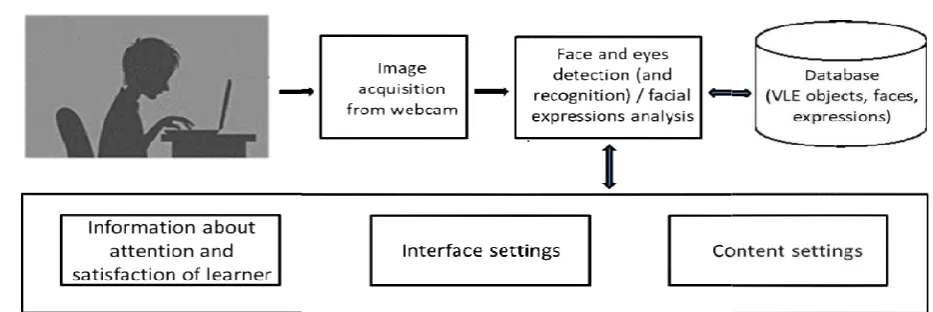
Figure 1. Scheme of a typical mechanism to map interactions between apprentice and VLE
and VLE in real time. Bassani and Behar (2005), for example, proposed a tool to analyze the interactions between apprenticesfrom messages posted/exchanged through the
communication tools available in VLE. Frozza et al. (2011), in
pedagogical agents to identify the apprentices’ learning characteristics to provide assistance and encouragement in their interactions with VLE. However, such tools do not allow us to evaluate whether the apprentices are h the content presented to Thus, during the last decade many researches have invested in the development of intelligent technologies (mechanisms that employ artificial intelligence and computer vision techniques) to automatically interpret the interactions between apprentice and the VLE. end cameras, very common in today’s computers and mobile devices (Nedic, Machotka and Nafalski, 2008). These mechanisms have the assessment of the state of attention and the satisfaction of the apprentices during the use of VLE by means of the trace of their eyes and the analysis of their Although these advances allow improving vironment, the effective use of such mechanisms in VLE is not yet a reality. It is in this context that the present work is inserted, with the objective is to present a discussion about the intelligent mechanisms ist in the automatic interpretation of the interactions between apprentice and VLE. In this way, we intend to discuss the possibilities of application and challenges that continue to exist for the effective use of
The databases searched to obtain support in the literature for the elaboration of this work were: IEEE, Google Scholar and The search terms used, both individually and combined were: "distance learning", "virtual learning environment", "facial detection", "facial expression" and "eye tracking". From the performed We obtained 15 papers dealing specifically with computational mechanisms for automatic interpretation The goals of found works, as well as possibilities of using the proposed mechanisms, the means to map apprentice/VLE interactions and the form of acquisition data are described in the next It should be noted that in this study, the facial and corporal expressions of the apprentices were considered as interactions through which it is possible to evaluate their state of attention and satisfaction during the study using a VLE.
Intelligent technologies for automatic in interactions between apprentice and vle
decade, some intelligent technologies for automatic
interpretation of apprentice/VLEinteractions have been developed. In general, these mechanisms employ computer vision and artificial intelligence techniques to process and analyze learner images obtained during the use of VLE through front-end cameras of computers and mobile devices in order to detect face, track eyes and interpret facial expression, as illustrated in Figure 1. This all
creation of indicators of attention and/or concentration, satisfaction and ergonomic factors.
is using a VLE, and has allowed access to the computer camera or mobile device camera, it is possible to collect d about their interactions and use it to issue alerts (ifinattention is detected), besides allowing dynamic adaptations of interface and contents. These possibilities clearly enrich the learning environment and promote improvements in the learning of apprentices. A brief description of each of the works found in the literature is presented below.
(2008) dealt with two forms of facial expression analysis during reading of academic material in a DE environment. The goal was to motivate apprentices through reading activity. Two experiments were carried out, the first dealt with a comparison between lecturers’ expression and apprentice’s reaction during a virtual lecture.
The second experiment focused on the effectiveness of a simple facial expression (smile) in reading activity. Both experiments involved virtual reading with virtual readers teaching real apprentices. The experiments were performed in a quiet room, using a personal computer (PC) to attend the virtual room, and the readings were pre
reproduced by software capable of displaying three dimensional images. The authors concluded that the use of facial expressions by virtual readers leads students to become more enthusiastic about their reading objects, which ben
their learning. Rolim et al. (2009) presented an automatic face
recognition system for VLE use with modules that monitor apprentices through a webcam. This recognition obtained a success rate of 97.12%. The work does not address recognition of emotions, but recognition of the face of those who use the VLE. The authors focus their interest in ensuring student participation in academic activities.
dealt with a mechanism that compiles feedbacks of user behavior through a webcam, tracking positioning of the head, eyes, and hand movements. The study was done with children between 8 and 10 years old, with dyslexia, resulting in 100% correctness for those who were attentive and 72% correct for
Scheme of a typical mechanism to map interactions between apprentice and VLE
Intelligent technologies for automatic interpretation of interactions between apprentice and vle: Over the last
decade, some intelligent technologies for automatic
interpretation of apprentice/VLEinteractions have been developed. In general, these mechanisms employ computer intelligence techniques to process and analyze learner images obtained during the use of VLE end cameras of computers and mobile devices in order to detect face, track eyes and interpret facial expression, as illustrated in Figure 1. This allows, for example, the creation of indicators of attention and/or concentration, satisfaction and ergonomic factors. Thus, once the apprentice has allowed access to the computer camera or mobile device camera, it is possible to collect data about their interactions and use it to issue alerts (ifinattention is detected), besides allowing dynamic adaptations of interface These possibilities clearly enrich the learning environment and promote improvements in the learning of A brief description of each of the works found in the literature is presented below. Theonas, Hobbs and Rigas (2008) dealt with two forms of facial expression analysis during reading of academic material in a DE environment. The ate apprentices through reading activity. Two experiments were carried out, the first dealt with a comparison between lecturers’ expression and apprentice’s reaction during
The second experiment focused on the effectiveness of a facial expression (smile) in reading activity. Both experiments involved virtual reading with virtual readers teaching real apprentices. The experiments were performed in a quiet room, using a personal computer (PC) to attend the dings were pre-recorded and reproduced by software capable of displaying three-dimensional images. The authors concluded that the use of facial expressions by virtual readers leads students to become more enthusiastic about their reading objects, which benefits . (2009) presented an automatic face recognition system for VLE use with modules that monitor apprentices through a webcam. This recognition obtained a success rate of 97.12%. The work does not address recognition ns, but recognition of the face of those who use the VLE. The authors focus their interest in ensuring student
participation in academic activities. Asteriads et al. (2009)
dealt with a mechanism that compiles feedbacks of user racking positioning of the head, eyes, and hand movements. The study was done with children between 8 and 10 years old, with dyslexia, resulting in 100% correctness for those who were attentive and 72% correct for
those who were not. Tichon (2010) has shown a tool capable of evaluating the impacts of a person's affective states on the effectiveness of their performance in a state of stress. The objective was to examine the relationship between affective intensity and learning, assessing the impact of affective states on facial expression, perception process, psychological response and electromyographic activity. The work is amide on the design of a human performance model, based on how a thinking or physical ability contributes to successful task accomplishment in a high stress situation. The experiments were performed in a controlled simulator with a person operating it. Chen (2012) developed a computer system for automatically recognizing student facial expressions during study through online video capture. In his experiments, participated 46 students from the second year of the IT course at the University of Taiwan. The results showed that there was an improvement in the level of student concentration with the use of the developed system. According to the authors, the system also served to alert the student when he was not focused.
Amorim (2012) presented an investigation of how computervision techniques can be used to identify apprentices’ interest in DE environments. To support the realization of experiments mechanisms were built:a framework, an image capture tool and a learning object (LO). Results were presented in terms of interested and bored apprentices when in contact with an LO. The work also presents a scheme to identify the interest of the student. The tests involved two children in an environment containing a notebook with a webcam, a mouse
and an external camera. Happy et al. (2013) presented a
mechanism for automatic recognition of the state of the apprentice with respect to his basic emotions such as happiness, surprise, anger, sadness and fear, from images of his face acquired by a webcam. This mechanism also counts the closing percentage of the eyes for issuing a voice alarm. However, this work does not describe the results achieved nor discusses the tests performed to measure the performance of
the proposed mechanism. Matlovic et al. (2016) considered
two approaches in their work: detection of emotions using the
recognition of facial expressions and detection of
electroencephalography signals. They also evaluated two market solutions for recognizing facial expressions: Noldus c Face Reader and Shore. They then proposed their own method of detecting emotions using electroencephalography (EEG) sensors. Experiments to evaluate the proposed approaches involved two participants. The results showed an overall precision of 58%, being: joy 47%, sadness 88%, disgust 59%, anger 75%, fear 57%, surprise 27% and neutral 41%. The authors used electroencephalography for the recognition of emotions in a very controlled process, which allowed to confront the market solutions with the proposed method.
Chen et al. (2016) proposed a computer system that recognizes
the affectivity of the learner using multimodal information, through approaches that involved head posture, eye tracking, recognition of facial expressions and processing of physiological signals (skin conductivity). This system provides online interventions and adapts the material for the apprentice, based on pedagogical strategies. Experimental results were presented show that the system performed well, and that interest and confusion are very frequent when a student is learning a second language. Lakshimi and Ponnusamy (2016) addressed a new multimodal information extraction agent that
infers and aggregates apprentice-generated affectivity
information in e-learning contexts. The authors also stated that the computer could learn user preferences through their emotions, being helpedon the monitoring of the level of human stress. The author’s conclusion points to the miniaturization of hardware as the future of the development of human-computer
interaction. Gupta et al. (2016) highlighted the
human-computer interface. They developed a set of data, called DAiSEE (Dataset for Affective States in E-learning Environments), which is freely available and includes a set of configurations for e-learning environments, as well as information on affectivity-type interpretability problems human. To simulate the e-learning environment they developed an application that shows two videos. The tests were performed with 95 users, aged between 18 and 30 years, who generated 7338 video clips which served as the basis for the training set. These videos were processed by the "Viola-Jones face detector" method. The tests for the recognition of affectivity presented the levels of engagement, frustration, confusion and boredom.
Simul et al. (2016) described a robot (Ribo), which was
designed to be an assistant and communicate with humans in Bangla, the language spoken in Bengali. The authors addressed the real-time recognition of the human genre, facial expressions and face gestures. Regarding the results on the recognition of facial expressions, the percentages of 100%, 100%, 91.30%, 81.25% and 90%, respectively, were presented for normal, smile, sadness, irritation and surprise. Although the robot was not originally built to work with DE, its computational system could be used in this context as it is capable to do real-time image analysis to recognize and mimic
expressions on the human face. Mukeshimana et al. (2017)
presented a work on recognition of emotions, which is oriented to interpret automatically human interactions with the computer being useful, for example, to map the interactions between an apprentice and an VLE. The authors conclude with a presentation of steps for the design of a system capable of recognizing emotions. Garcia, Penichet and Lozano (2017) dealt with the recognition of emotion in terms of: emotion of speech, text, facial expressions, gestures and body movements, and physiological states. For recognition of emotion of speech, the voice is presented as a recognition element. For the facial expressions, they were considered lips, nose, mouth and facial muscles. According to the authors, the recognition of emotion in terms of the text was the most difficult part, because there is no face-to-face communication. As for the emotions from the body movements, the body reveals what the person feels, in the same way as the voice. For all these ways of recognizing emotions, a software reference was presented in terms of the Application Programming Interface (API). The authors conclude by saying that there are hundreds of companies working with this and that there are still many aspects to be
implemented on the subject in the coming years. Mencattini et
al. (2017) presented a new computer system based on voice for
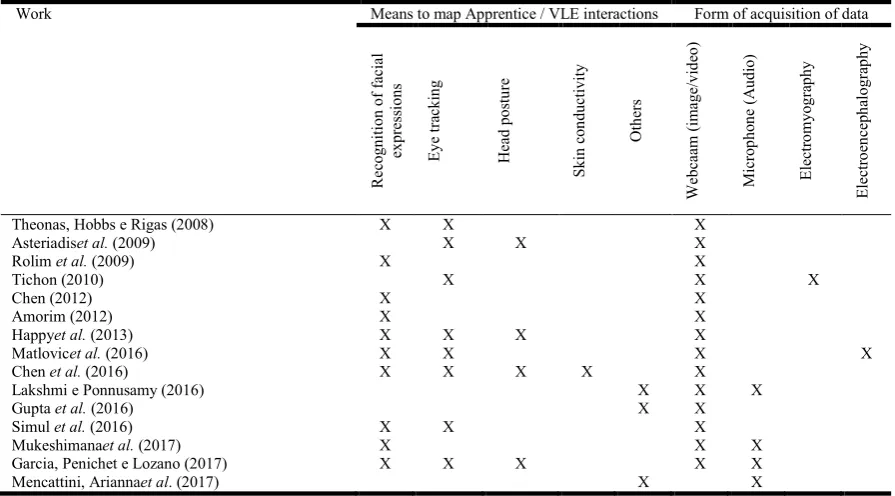
recognition of emotions. The authors report the potential implications of the proposed method in real-life scenarios and, in particular, web-based applications. Table 1 summarizes the works described in this section. The authors' proposals are classified according to the means used to map the interactions, as well as the way the acquisition of the input data is done. We can observe that, in general, these works are related to the detection of the level of attention and satisfaction of the
user/apprentice. All works except Mencattini and Ariana et al.
(2017), uses cameras to obtain the input data. Some works
such as Tichon (2010) and Matlovic et al. (2016) present the
use of more sophisticated equipment than those that accompany the basic configuration of a commercial computer. Some authors focused their research on the recognition of facial expressions in a controlled environment, with proposals for use in DE environments, such as Theonas, Hobbs and
Rigas (2008), Rolim et al. (2009), Chen (2012), Amorim
(2012), Happy et al. (2013), Chen et al. (2016), Gupta et al.
(2016) and Garcia, Penichet and Lozano (2017). It is emphasized that the automatic interpretation of apprentices’ facial expressions is essential to automatically assess their satisfaction during VLE use. Finnaly, Table 1 also shows that most of the proposed technologies are feasible in terms of the required equipment, which have a direct impact on cost, and that most of these technologies are minimally invasive.
Considerations and Conclusions
When it comes to distant apprentice, it is possible to consider a scenario where the current equipment is used, which allows the acquisition of apprentice’s images during study. These images can be used to fill the absence of the teacher in the personal monitoring of students' progress in their studies and to identify their satisfaction and attention to the material presented to them. From these considerations, this work revealed the absence in the literature of a guide that allows the use of such mechanisms within VLE, which would bring the possibility of improving the quality of teaching. In this context it is possible to observe the table in Table 1 and to extract the works that use no invasive means to map the interactions apprentice/VLE and do not require the addition of elements to the computer, depending only on the consent of the student to its use. As an
example, it is possible to consider the work of Simul et al.
(2016) where it is observed that the facial expression of the student is identified using only the computer camera. Clearly, in terms of pedagogical work, it is expected that the student is demonstrating a normal state or smiling while studying, but Simul's work also identifies states of sadness, irritation, and surprise. With this information it is possible to describe the process by which the VLE can treat the state of attention as well as the student's satisfaction.
To do so, it is necessary to supply data related to the time the student accesses the LO. On the other hand, the mechanism used, for example, to recognize facial expression should also record, in addition to facial expression, the moment when a particular facial expression appears for a particular student. Thus, joining both information it is possible to determine which student presented which facial expression when studying with a particular LO. Considering that the learning processes in DE depend on information technology resources, especially computers and other mobile devices, which are usually equipped with cameras that allow the acquisition of images of the apprentice (with prior authorization) during the use of VLE, one can imagine that the use of the intelligent technologies presented in section 3 tends to minimize the disadvantages of DEwith respect to the perception, by teachers/tutors, of the attention and satisfaction of the apprentices in relation to the learning objects and other contents presented to them in the VLE. Nevertheless, from these considerations it can still be inferred that such technologies coupled with VLE will improve the quality of DE, since besides to be able of mapping apprentices/VLE interactions, in a non-invasive manner, they can be used to suggest adaptive interfaces and contents according to a pedagogical strategy focused on different learning styles and needs. As an example, we can mention the approach proposed
by Simul et al. (2016) for real-time recognition of the
apprentices' facial expression, using only the computer camera, which would be used to identify their emotional state in a virtual classroom.
In addition, one can observe that the intelligent mechanisms described in Table 1 that are able to perform eye tracking(most of them) could be very useful for detection of omission and commission errors which can be defined, respectively, as the execution of a procedure that should not be executed and the omission of a procedure that should be
executed and it was not (Galler et al., 2012). These types of
[image:4.595.77.525.80.328.2]errors are closely related to the lack of attention and are widely investigated in studies, games, and VLEs addressed to individuals with Attention Deficit Hyperactivity Disorder
Table 1. Literature works and the proposed mechanisms to interpret the apprentice / VLE interactions
Work Means to map Apprentice / VLE interactions Form of acquisition of data
Re
co
gnition
of fa
cial
express
ions
Ey
e t
ra
cki
n
g
Head p
os
tu
re
Skin
co
n
d
ucti
v
ity
Oth
ers
Webcaa
m (im
age/
v
id
eo
)
Micro
p
ho
n
e
(A
udi
o
)
Electr
o
my
o
g
ra
p
h
y
Electr
o
en
cep
h
alogra
p
h
y
Theonas, Hobbs e Rigas (2008) X X X
Asteriadiset al. (2009) X X X
Rolim et al. (2009) X X
Tichon (2010) X X X
Chen (2012) X X
Amorim (2012) X X
Happyet al. (2013) X X X X
Matlovicet al. (2016) X X X X
Chen et al. (2016) X X X X X
Lakshmi e Ponnusamy (2016) X X X
Gupta et al. (2016) X X
Simul et al. (2016) X X X
Mukeshimanaet al. (2017) X X X
Garcia, Penichet e Lozano (2017) X X X X X
(ADHD). For instance, the detection of actions taken by a student (for example, clicking the mouse button) during periods of lack of attention are commission errors while the lack of actions during periods in which the student appears to be attentive are omission errors. Although there are several papers describing mechanisms that can be used to interpret the interactions between apprentice and VLE in the literature, there is an absence of studies that address how to use such mechanisms in an VLE. In this sense, this work clarifies that for an VLE to make effective and full use of the intelligent technologies, object of this work, it is essential that it maintain records about all LO executed by each apprentice, as well as the initial and final time of the access to LO. Such records shall also include information regarding the settings of the environment with regard to the arrangement of objects on the screen, colors, font size, etc. Such records allow correlating the states of attention and satisfaction of the apprentice with the contents presented to him and with the characteristics of the interface. In this way, it is possible to provide configurations and contents that adapt to the apprentice, taking into account the pedagogical strategy adopted. In addition, some aspects are very important for automatic interpretation of the attention status of the apprentice during the learning process in an VEL. These aspects refer to the frontal position of the apprentice's face in relation to the monitor and his / her angle of vision, which may indicate a glance at the monitor or computer keyboard, both denoting that the learner is attentive. Finally, the Institute of Electrical and Electronics Engineers (IEEE) "Standard for Learning Object Metadata (IEEE-LOM)"(IMS, 2018), which has been widely used in the development of learning objects,it is very likely not considering the existence of the intelligent technologies addressed in this work and may be enriched from a more in-depth analysis on thematical approach.
REFERENCES
Amorim, M.J.V. 2012. Visualização Computacional como apoio à identificação do interesse do aluno em ambientes de EaD.Ph. D. Thesis. UFRGS, Rio Grande do Sul, Brazil. Arkorfuk, V.; Abaidoo, N. 2015. The role of e-learning,
advantages and disadvantages of its adoption in higher
education. International Journal of Instructional
Technology and Distance Learning, v. 12, n. 1, p. 29-42.
Asteriads, S.; Tzouveli, P.; Karpouzis, K. 2009. Estimation of behavioral user state based on eye gaze and head pose application in an e-learning environment. Multimedia Tools andApplications, v. 41, n. 3, p. 469-493.
Bassani, P. S.; Behar, P. A. 2005. interROODA: mapeamento
das interações individuais e interindividuais no ambiente virtual de aprendizagem ROODA.RENOTE, v. 3, n. 2. Chen, H. R. 2012. Assessment of learners' attention to
e-learning by monitoring facial expressions for computer
network courses. Journal of Educational Computing
Research, v. 47, n. 4, p. 371-385.
Chen, N.L; Liu, Y.; Liu, L.; Zang, K.; Kolodziej, J. 2016. A hybrid Intelligence aided approach to affect sensitive
e-learning, Computing,v. 98, n. 1-2, p. 215-233.
Frozza, R. et al. 2011 Agentes pedagógicos emocionais
atuando em um ambiente virtual de aprendizagem. RENOTE, v. 9, n. 1.
Galler, J. R.; Bryce, C. P.; Zichlin, M. L.; Fitzmaurice, G.; Eaglesfield, G. D.; Waber, D. P. 2012. Infant Malnutrition Is Associated with Persisting Attention Deficits in Middle
Adulthood–3. The Journal of nutrition, v. 142, n. 4, p.
788-794.
Garcia, J.M.; Penichet, V. M.R; Lozano, M.D. 2017. Emotion detection: a technology review. In: XVIII International Conference on Human Computer Interaction. ACM, p. 8. Gupta, A.; Jaiswal R.; Adhikari S.; Balasubramanian V.N.
2016. DAISEE: Dataset for Affective States in E-Learning Environments. arXiv, p. 1-22.
Happy, S.L.; Dasgupta, A.; Patnaik, P. 2013. Automated alertness and emotion detection for empathic feedback
during e-Learning. In: International Conference on
Technology for Education (T4E)p. 47-50.
IMS Global Learning Consortium 2018. Meta-data Best Practice Guide for IEEE 1484.12.1-2002 Standard for Learning Object Metadata. Available onlineat https://www. imsglobal.org/metadata/mdv1p3 /imsmd_bestv1p3.html
Kafai, Y.B.; Resnick, M. 2012. Introduction. In:
Constructionism in practice. Routledge, p. 13-20.
Lakshimi, D.; Ponnusamy, R. A review study of human-affection knowledge on usability engineering. In:
International Conference on Advances in Human Machine
Interaction (HMI), p. 1-7.
Matlovic, T.; Gaspar, P.; Moro, R.; Simko, J. 2016. Emotions detection using facial expressions recognition and EEG. In: 11th International Workshop on Semantic and Social
Media Adaptation and Personalization (SMAP), p. 18-23.
Mclaughlin, J.E.; White, P.J.; Khanova, J. 2014. The flipped classroom: a course redesign to foster learning and engagement in a health professions school. Academic Medicine, v. 89, n. 2, p. 236-243.
Mencattini, A.; Martinelli, E.; Ringeval, F. 2017. Continuous estimation of emotions in speech by dynamic cooperative speaker models. IEEE transactions on affective computing, v. 8, n. 3, p. 314-327.
Meneses, J.; Mominó, J.M. 2010. Putting digital literacy in practice: How schools contribute to digital inclusion in the network society. The Information Society, v. 26, n. 3, p. 197-208.
Motteram, G.; Forrester, G. 2005. Becoming an online distance learner: What can be learned from students’ experiences of induction to distance programmes? Distance education, v. 26, n. 3, p. 281-298.
Mukeshimana, M.; Ban, X.; Karani, N.; Liu, R. 2017. Multimodal Emotion Recognition for Human-Computer Interaction: A Survey. System. v. 8, n. 4, p. 1289–1301. Nedic, Z.; Machotka, J.; Nafalski, A. 2008. Remote laboratory
netlab for effective interaction with real equipment over the internet. In: ConferenceonHuman System Interactions, p. 846-851.
Ramos, D.; Oliveira, E.; Monteverde, I. 2015. Trilhas de Aprendizagem em Ambientes Virtuais de Ensino-aprendizagem: Uma Revisão Sistemática da Literatura. In: BrazilianSymposiumonComputers in Education (Simpósio Brasileiro de Informática na Educação-SBIE). p. 338. Rolim, A.L. 2009. Um Sistema de Identificação Automática de
Faces para Ambientes Virtuais de Aprendizagem. Dissertation 89p, UFPB,Paraiba, Brazil.
Schneider, E.I.; Suhr, I.R.F.; Rolon, V.E.C.; Almeida, C.M. 2013. Sala de Aula Invertida em EAD: uma proposta de Blended Learning. RevistaIntersaberes, v. 8, n. 16, p. 68-81.
Simul, N.S.; Ara, N.M.; Islam, M.S. 2016. A support vector machine approach for real time vision based human robot interaction. In: 19th International Conference on Computer and Information Technology (ICCIT), p. 496-500.
Stephens, J.C.; Hernandez, M.E.; Román, M. 2008. Higher education as a change agent for sustainability in different
cultures and contexts. International Journal of
Sustainability in Higher Education, v. 9, n. 3, p. 317-338.
Tichon, J. 2010. Affective Intensity and its Effects. QUEENSAND UNIV ST LUCIA, Australia.
Theonas, G.; Hobbs, D.; Rigas, D. 2008. Employing Virtual Lecturers' Facial Expressions in Virtual Educational
Environments. International Journal of Virtual Reality, v.
7, n. 1, p. 31-44.