8324
FORMULATION AND IMPLEMENTATION OF SOCIAL
MEDIA STRATEGY FRAMEWORK: A CASE STUDY OF
JORDANIAN GOVERNMENT ORGANIZATION
1YACOUB NASEREDDIN, 2MOHAMMED ALMAIAH, 3SARA NASEREDDIN
1Chairman Board of Trustees, Middle East University, Amman, 11831 Jordan
2Assistant Professor, Department of Computer Science, King Faisal University, Saudi Arabia
3PhD Student, Department of Media, Eastern Mediterranean University,Famagusta, North Cyprus, Turkey
E-mail: 1[email protected], 2[email protected], 3[email protected]
ABSTRACT
This study aims to formulate a social media strategy framework that appropriate in government organization that has a low interaction rate with public through their social media accounts. The research methods used was qualitative and quantitative on a government organization which has already use social media however the utilization was still low. The process of data collection was done by interview, observation and documents studies. The social media strategy was formulated using framework developed by Karl Werder combined with SWOT analysis, PEST analysis and 7s model. The strategy priority was determined by using AHP analysis. Three stages of social media framework formulation have been identified and the implementation results suggest that the organization need to prioritize the strategies that have the objective to improve the complaint handling and then followed by the strategies related to engagement and awareness.
Keywords: Social Media Strategy, Social Media Framework, SWOT, AHP
1. INTRODUCTION
Social media has become an important part of the daily lives of millions of people around the world (Sobaci, 2016). Social media has greatly affected the way people communicate with each other and affect their activity in daily basis. In fact, the number of social media users has reached a very large number. The number of Facebook users established in 2004 has now reached 1.86 billion monthly active users as of December 31, 2016 (Facebook, 2017) and Twitter which has been operating since 2007 has a monthly active users number reached 313 million as of June 30, 2016 (Twitter, 2017). Meanwhile, YouTube's largest video sharing site already has more than 1 billion users (YouTube, 2017).
Social media is also used by government institutions to increase their interaction with public. This is in line with Open Government Directive, initiated by the U.S. federal government, which has three pillar goals of transparency, participation, and collaboration (Nam, 2012). Governments adopted social media to: improve efficiency and productivity, improve public services, improve
policy making, strengthen democratic culture, and collaborate and share knowledge (Sobaci, 2016). Furthermore, various government services through social media can be achieved such as community services, disaster management, disaster resilience, transportation, policy and planning, government transformation, and government campaigns activity (Nepal, Paris, & Georgakopoulos, 2015). This suggests, social media can be an economical and powerful solution in increasing the range of services to the community.
8325 Instead of sharing positive experiences, customers begin to share their negative experiences and force McDonalds to act in order to prevent damage to their reputation. These risks may also arise when a company is not active in social media, so that even the consequences may get worse because the negative content or rumours may be unknown to the company. Thus, social media need to be managed to maximize its benefit and minimise the risk.
The high number of internet users in Jordan shows information has become a necessity for every citizen in supporting their activities. The government as a public servant has an obligation to provide quality public information. In relation to government, the internet has become an important instrument in the management of public services. According to Lamersdorf, Tschammer, & Amarger (2004), since the mid-1990s, governments from around the world have had the initiative to adopt the potential use of the internet to improve public services. The main objective of the initiative is to accommodate public opinion, namely reducing public spending and improving public services.
Currently, no framework has been developed specifically for the social media utilization in government sector. The Third Wave framework developed by Third Wave Consulting, 2013 is a common framework that can be used in various areas. This framework consists of people, platform, and content strategy. Meanwhile, Oliveira & Figueira (2015) developed a social media framework for educational institutions where the framework relies on communication strategies to support the activities of educational organizations. In harmony with that, Werder, Helms, & Slinger
(2014) developed a more comprehensive
framework. Organizational social media
management deals not only with marketing strategies but must be aligned with the organization's own business strategy. This framework consists of three strategic components for social media: (1) Scope consists of decisions about actors, platforms and interactions, whereas (2) Capabilities refer to objectives and activity and (3) Governance is a need for value, resources and risk. However, this framework did not cover the assessment of current organization conditions.
This study aims to define the framework for social media implementation especially in government sector in their early phase of adopting the social media or has a low rate of public interaction through their social media accounts. The past studies of social media framework have not been comprehensively described the stages of
framework implementation. We will use a case study from a government organization in Jordan where the utilization of its social media has not been effectively managed regardless its urgency.
2. THEORETICAL BACKGROUND
2.1 Social Media
Social media is a collection of applications that include blogs, social networking sites, multimedia sharing sites, collaborative project and others (Werder, Helms, & Slinger, 2014). Social media also defined as an internet platform used to disseminate information through social interaction that provides content with decentralized user levels, social interaction and general membership (Schniederjans, Cao, & Schniederjans, 2013). Social media as an online communication tool that enables people to create, share, interact, collaborate and exchange multimedia information with others in a virtual community (Nepal, Paris, & Georgakopoulos, 2015).
From a public-sector perspective, social media as a group of internet-based technologies that, using the Web 2.0 philosophy, enable public institutions to engage with citizens and other stakeholders (Sobaci, 2016). In the field of public administration, social media differently from previous generations of e-government (Sobaci, 2016). The differences are:
1. Social media applications provided by third
parties, so that technology features are hosted outside the direct control of public institutions.
2. Compared with e-government practices, such
as static websites, social media is more interactive.
3. Content created by both parties, ie public
institutions and citizens.
4. Social media applications cannot replace
offline services and e-government services; this application is a communication mechanism that has been available.
2.2 Social Media Use in Jordanian Government
8326 public services and policy making, strengthen local
democracy, collaboration and knowledge
management (Nepal, Paris, & Georgakopoulos, 2015). Risks and constraints that can occur in the management of social media in government
include: resources, legal issues, security,
information and content concerns, reputation management (Sobaci, 2016).
In Jordan the utilization of social media has been improved significantly in latest years. A survey conducted by Jordanian Department of Statistics in 2016, the number of internet user in Jordan has reached 132,7 million people and 97,4% of them access the social media and 91,6 of the internet user has accessed the information related to
public services (Statistic Jordan, 2016).
Government has seen this opportunity and utilised the social media to engage more to the public. Government initiatives in using the internet technology in their activities are monitored and evaluated by The Ministry of Communication and Informatics based on some criteria such as policy,
organization, infrastructure and application.
However, there are a diverse rate of performance in each government organization. Even if the government has already set up the account of various social media platform, the management of the account has not been properly done by some government organization.
2.3 Strategy Development
Social media management in government requires strategy planning to run it well and reduce the negative side that would arises. Strategy is the establishment of unique and valuable positions, and involves a set of different activities (Porter, 1996). One of the objectives of strategy formation is to improve operational effectiveness, which is how to conduct an activity better to provide greater value, greater efficiency, at lower cost (Porter, 1996). Strategy as an important mission statement of an organization, the objectives to be achieved, and the main way in which resources are available will be used (Werder, Helms, & Slinger, 2014). It also defines as a set of choices that determines the organization's chances of pursuing market potential and assessing those opportunities (Applegate, Austin, & Soule, 2009). From above description, it can be formulated that the strategy is a preparation of ways to achieve organizational goals based on the direction and scope of business organizations using the resources available to improve organizational performance.
SWOT analysis is one of the most commonly used methods of organization to
formulate strategies to take advantage of existing opportunities and reduce threats that may arise from the external side of the organization with reference to the strengths and weaknesses of the organization (Chaffey, 2009). SWOT analysis consists of Strengths (S) and Weaknesses (W) of the organization's internal conditions as well as Opportunities (O) and Threats (S) from external organizations (Ritson, 2011). The main purpose of the SWOT analysis is to identify strategies that are aligned or appropriate to the organization's resources and capabilities to respond to environmental demands that the organization competing against (Ritson, 2011). The external environment could be analysed using PEST (Political, Economy, Social and Technology) approach (Ward & Peppard, 2002). Cautious monitoring of these factors may lead the organization to significant business opportunities or identify potential threats in time to act to mitigate its impact.
One of the comprehensive approaches used to implement this strategy was developed by Peterson & Waterman at McKinsey & Company in the early 80s. This model is based on seven internal factors that must be harmonized together for the successful implementation of strategy in the company (Mišanková & Koèišová, 2013). The 7S model can be applied to assist with useful alignment for: improve organizational performance, analyse the possible impacts of future changes in an organization, aligning departments and processes existing during the merger or acquisition period, and determine how the best solution to implement the proposed strategy (Mišanková & Koèišová, 2013). 7S model consists of hard and soft factor. Hard elements are easier to determine, and leadership can directly affect these elements. The three hard elements of this 7S model are: strategy, structure, and system. Soft elements are difficult to define because they are not specific and influenced by organizational culture. However, soft elements are as important as hard elements for an organization to achieve success. Soft elements are: style, staff, skills, and shared values.
2.4 Social Media Strategy Framework
8327 implementation. The purpose of social media strategy can be derived from business goals which can be achieved through social media and finally contribute to accomplish organizational goals. Developing the strategy involves people, platform, and content strategy. The setup is the stage of
implementation, evaluation and continuous
improvement. Activities that can be done to achieve it such as: monitoring, analytics, and reporting. It also considered the internal side of organizations such as: the actor of each activities, the team formation, the needed processes and the service providers required.
Meanwhile, Oliveira & Figueira (2015) developed a social media framework for educational institutions where the framework relies on communication strategies to support the activities of educational organizations. The concept of social media strategy needs to be aligned and
managed in organizational communication
management. The communication strategy should provide a clear indication of the overall direction, objectives and desired outcomes. like all other functional strategies, social media strategies need to be aligned and support the organization's higher strategic management.
Werder, Helms, & Slinger (2014) developed a more comprehensive framework. Organizational social media management deals not only with marketing strategies but must be aligned with the organization's own business strategy. This framework consists of three strategic components for social media: (1) Scope consists of decisions about actors, platforms and interactions, whereas (2) Capabilities refer to objectives and activity and (3) Governance is a need for value, resources and risk. The aspects covered by this framework are more structured and complete than the previous framework.
3 PROPOSED FRAMEWORK
[image:4.612.318.522.88.212.2]The theoretical framework of this research is represented in Figure 1 which consists of three steps including assessment of current condition, social media strategy development and social media strategy prioritization.
Figure 1: Proposed Social Media Strategy Framework in Government.
3.1 Assessment of Current Condition
Preparation of the concept of this research framework starts from analysing the internal and external conditions of the organization. Analysis of internal organizational conditions adopted the SWOT model and 7S McKinsey, while for external conditions analysis using the PEST model. The formulation of these internal social conditions also identifies the current state of information quality and service quality. Thus, the implementation
objectives can be formulated based on
organization’s goals so that the implementations will align with business processes and business objectives of the organization.
Information services within the scope of the information system deal with several aspects that support the service. DeLone & McLean (2003) formulated that the quality of the system, the quality of information, and the quality of service had an influence on the desire to use information systems and user satisfaction. Utilization and user satisfaction are interrelated, a positive utilization experience will increase user satisfaction. Because of these two aspects, it will benefit the success of the information system. In social media, majority of systems have been provided and managed by social media corporations, so the quality of system is less important for the owner of social media accounts. Thus, quality of information and services will take the best part of the successful information services from social media utilization.
8328
3.2 Social Media Strategy Development
This step elaborates the SWOT Analysis using TOWS Matrix and social media strategy define by Werder, Helms, & Slinger (2014). Organizational social media management deals not only with marketing strategies but has to be aligned with the organization's own business strategy. Three strategic components for social media: (1) Scope consists of decisions about actors, platforms and interactions, whereas (2) Capabilities refer to objectives and activity and (3) Governance is a need for value, resources and risk.
Scope dimension is the results of the analysis of the internal conditions determined the scope of social media organizations, namely: actors who play a role, platform, and interaction type (Werder, Helms, & Slinger, 2014) (Nepal, Paris, & Georgakopoulos, 2015). Social media capabilities should help organizations to gain organizational competitiveness (Werder, Helms, & Slinger, 2014). This dimension consists social media objectives, where social media goals should be defined by and support the organization's business objectives. The other component is social media activities, which connecting social media activities with each line of organization associated with the actor.
Governance dimension is conducted to formulate value or Key Performance Indicator (KPI) from social media management in organization. Key Performance Indicator (KPI) of social media consists of insights, exposure, reach, engagement (low), engagement (medium), and engagement (high) (Neiger, et al., 2012). In harmony with that, Thomas & Barlow (2011) proposed KPI of social media consists of exposure, influence, engagement, action/ conversion, and retention. Correspondingly, Lovett (2011) lists the social media matrix based on the type of social media used. Beside formulating the KPI, social media governance needs resources and risk management to utilised effectively. Subsequently resource planning and risk assessment of identified threats refers to the eight essential elements of policy-makers and social media guidelines proposed by Nepal, Paris, & Georgakopoulos (2015) which consists of employee access, account management, acceptable use, employee conduct, content, security, legal issues, and citizen conduct. In line with that, Bertot, Jaeger, & Hansen (2012) finds set of key policy and research questions related to social media and policy objectives, which are: social media policy; access and social inclusion; privacy, security, accuracy, and archiving; governing and governance; and new democratic models.
3.3 Social Media Strategy Prioritization
The design of a social media roadmap is conducted by assessing stakeholders and experts to determine strategic priorities using the AHP method (Saaty & Vargas, 2012).The results of the priority ranking resulted in a social media roadmap. The results will be discussed and validated by stakeholders to make sure the emerging strategies are aligned with organization’s business.
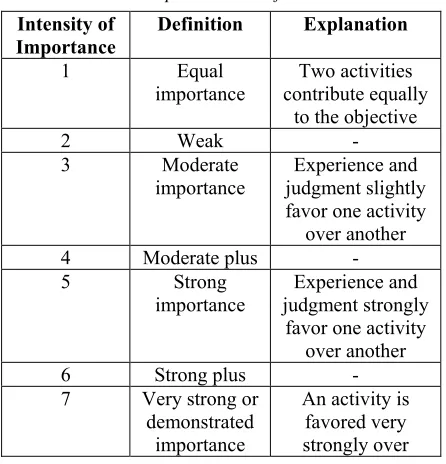
[image:5.612.307.530.448.680.2]Analytic Hierarchy Process (AHP) is the basic approach to decision making (Saaty & Vargas, 2012). It is designed to tackle between the rational and intuitive side to select the best of several alternatives evaluated in relation to several criteria. In this process, the decision maker performs a simple pair wise assessment that is then used to develop overall priorities for alternative rankings. AHP is useful in inconsistent assessments and provides the means to improve consistency. The basic scale of values to represent the intensity of the assessment as shown in Table 1. In terms of strategy formulation, AHP can be used with SWOT to determine priorities for established strategies. Göroner, Toker, & Uluçay (2012) in his research combined SWOT with AHP in formulating a strategy. In harmony with that, Şeker & Özgűrler (2012) also combine SWOT with AHP to determine the priority scale of the strategy that has been formulated.
Table 1 : Comparison scale of AHP Method Intensity of
Importance
Definition Explanation
1 Equal
importance contribute equally Two activities to the objective
2 Weak -
3 Moderate
importance judgment slightly Experience and favor one activity
over another
4 Moderate plus -
5 Strong
importance judgment strongly Experience and favor one activity
over another
6 Strong plus -
7 Very strong or
demonstrated importance
An activity is favored very strongly over
3.4 Case Study
8329 the public institution in Jordan providing information to the public, it has the responsibility to carry out the mandate of the law. In this case, the information managed by JDS is spatial based information thus it has to organise the dissemination of data and information related to it. Therefore, social media can be used by the organization to support the improvement of geospatial information services for the community.
Centre for Research, Promotion and Cooperation is one of the unit in JDS which has the responsibility to manage the publication of geospatial information products and services. As the publication of geospatial information, this unit has made several efforts to improve the utilization of geospatial information for the community. One of them is using information technology to support geospatial information service. Currently, it has utilized internet network to provide service to the public. In addition to the corporate web (https://jordan.gov.jo) used to provide information and news related to the organization, the unit also provides a portal for digital map service. To improve relationships with the community, social media accounts has been created such as: Facebook (www.facebook.com/jordan.gov.jo?_rdc=1&_rdr), Twitter (@jordanegov), YouTube and Instagram.
In JDS, social media management conditions are still not managed. Social media is only used for sharing news, but still less utilised for interaction with users. The number of follower @jordanegov has reached 7,199 per May 20, 2018. However, the number of follower is not followed by the number of interactions with the follower. Based on Twitter @jordanegov statistics retrieved in May 2, 2018, it appears that engagement rate is very small, below 5%. This indicates not many people are interested in the presence of content @jordanegov. The statistics also shows that the number of replies is small for 988 within a year. Not much different with the number of retweets and likes, each of which only amounted to 255 and 238. This shows less interactive @jordanegov twitter to its follower. From the above information, the management of social media in JDS still need to be improved. Therefore, it takes social media management measures to be used to improve services to users of geospatial information.
4 RESEARCH METHODOLOGY
In this study, the methods of data collection were interviews, document studies and field observations related to actual conditions in the organization. Interviews with respondents are processed by some instrument consist of statements
indicating current conditions and expectations. The interviews were carried out to the internal stakeholders of the institution with links to the management of social media and services at JDS. The first respondent is the Head of Research, Promotion and Cooperation Centre to find out the complete internal condition of the geospatial information service at JDS. The second respondent is Head of Promotion and Cooperation to find out more about the current state of social media management in JDS. We also conducted interviews with two experts in the field of social media to get more comprehensive feedback on the conditions in the organization and to identify opportunities, threats from external organizations related to social media management. The method of collecting strategic priority assessment data is questionnaires dissemination and filled by the respondents. Then, AHP analysis was used to priorities the strategies. The tools used for data processing are Super Decision software and Microsoft Excel.
4.1 Respondents
Interviews were conducted with two interviewees from the organization and two interviewees from external organizations in March and April 2017. The selection of interviewee is based on the relevance of their work to the research. The profiles of the respondents are:
1. Interviewee 1, Head of Research, Promotion
and Cooperation Centre. This centre has the role as a service provider of geospatial information products and services to the community. Interviewee 1 has served the last two years so that it is quite familiar with the internal condition of the organization related to geospatial information services.
2. Interviewee 2, Head of Promotion and
Cooperation. This unit is under the Research,
Promotion and Cooperation Centre.
Interviewee 2 has served for the last five years in this work unit. So far, the agency's social media management is under this work unit so that interviewee 2 understands the internal conditions related to the management of JDS social media.
3. Interviewee 3, Social Media Practitioner.
8330
4. Interviewee 4, Lecturer. Interviewee 4 is a
lecturer at the Centre for Training and
Employment of the Ministry of
Communications and Informatics. He also serves as a lecturer in the Education and Functional Training of Public Relations Institutions with a material focus in the field of social media.
4.2 Methods
The methods used in every steps of this research are described as follow;
a. Identification of internal factors: This step
collects data on the strengths and weaknesses of the organization and the factors that support the implementation plan of social media strategies. The main data obtained through
interviews with stakeholders in JDS.
Supporting data is obtained by conducting studies on relevant documents related to the management of social media. The result of this step is a list of strengths and weaknesses related to social media management at JDS.
b. Identification of external factors: This step
collects data on opportunities and threats from outside the organization. The main data obtained through interviews with stakeholders in JDS. Supporting data were obtained by conducting literature studies from related references and PEST analysis (Political, Economic, Social, Technological) for external factors. The outcome of this step is a list of
opportunities, threats and external
environmental conditions related to social media management.
c. Identification social media implementation
goals: the purpose of this step is to identify social media management implementation objectives. The analysis was conducted by asking expert opinion and stakeholders regarding social media management objectives in JDS with reference related to social media management goals. The result of this step is the implementation goal of social media strategy at JDS.
d. Formulation of social media strategy: this step
contains the process of formulating a strategy that refers to the results of analysis of internal and external conditions, and implementation goals. The result of this step is the prototype of JDS 's social media strategy of TOWS matrix
which contains strength-opportunity,
weakness-opportunity, strength-threat,
weakness-threat strategies. The strategies formed are then grouped according to Karl Werder's social media framework, scope, capabilities, governance.
e. Prioritization of social media strategies: this
step aims to provide guidelines for the implementation of social media strategies. Priorities are formulated by ranking by stakeholders by the AHP comparison method. In addition, this step also contains the determination of value or Key Performance Indicator (KPI) to measure the success of strategy implementation. The results of this step are the priorities of social media strategies and the list of KPIs on social media management. The stages are 1) Respondents did pair comparison between each of strategic goals. 2) Respondents did pair comparison between each strategy within each strategic goal groups. 3) Combine the data respondents answer by averaging each value of the answer pair of each strategy using the GEOMEAN function in Microsoft Excel. The output of this stage is the geometric mean value of the respondent’s answers. 4) Enter the result data from stage 3 into the model in Super Decision software for AHP analysis.
f. Determine the roadmap of social media
strategies: this step contains a process of defining the implementation of social media strategies based on a priority list of social media strategy implementations. The result of this step is the roadmap of social media strategy at JDS.
g. Review of the action: this step aims to validate
the results of the previous steps. The review is done by re-verifying the results of social media strategy planning to stakeholders in JDS.
5 RESULTS AND DISCUSSION
5.1 SWOT and Strategic Goals
The first stage interviews with interviewee 1 and 2 was conducted to determine the internal
condition of the organization and the
implementation goals of organizational social media management. We also conducted the observations of the Geospatial Information Agency Strategic Plan 2016 - 2019 and the 2016 Product
Satisfaction Assessment and Satisfaction
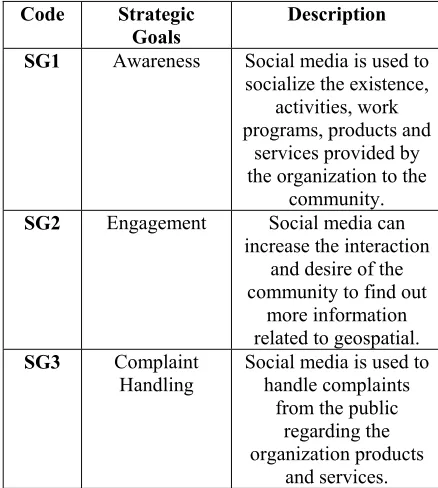
8331 The second phase is an interview with interviewee 3 and 4 to define the external condition of the organization related to the management of social media. External conditions analysis is based on the PEST model to identify opportunities and threats from outside the organization. At this stage, the respondents also provide inputs to the weaknesses, strengths, and implementation targets identified in the previous stages. The results of this stage are the draft of opportunities, threats, and inputs related to implementation goals and internal organizational conditions. We also conduct a discussion with stakeholders to set implementation goals, strengths, weaknesses, opportunities and threats that will be used to formulate strategies. The result of this steps are the lists of strength, weakness, opportunity, threat that shows in Table 2 and the implementation goals of social media shows in Table 2.
Table 2: Strategic Goals Social Media Management
Code Strategic
Goals Description
SG1 Awareness Social media is used to
socialize the existence, activities, work programs, products and
services provided by the organization to the
community.
SG2 Engagement Social media can
increase the interaction and desire of the community to find out
more information related to geospatial.
SG3 Complaint
Handling Social media is used to handle complaints from the public
regarding the organization products
and services.
5.2 Social Media Strategy Development
Strategy formulation is done by using TOWS matrix tool based on analysis result of internal and external condition of organization in previous stage consist of strength (S), weakness (W), opportunity (O) and threat (T). This matrix contains a strategy formula derived from a combination quadrant between strength-opportunity factors (SO), strength-threat factors (ST),
weaknesses-opportunity factors (WO), and
weakness-threat factors (WT). The process of strategy formulation refers to the recommendations
of experts at the stage of interviews and discussions with stakeholders. The grouping of strengths and weaknesses based on the McKinsey 7S framework is used as a tool when coupling between strengths and weaknesses into a strategy. Grouping opportunities and threats based on PEST is used as a tool when pairing between opportunity or threat factors into one strategy. The McKinsey and PEST 7S grouping is also used when finding several
similar strategy solutions from different
[image:8.612.83.302.338.582.2]combinations of quadrants. The strategy choice of which combination quadrant selected is done by considering the McKinsey 7S group and PEST which form the strategy. The results of the TOWS matrix strategy formulation are shown in Table 3.
Table 3: Results of formulation of TOWS Matrix of Strategy
Opportunities (O)
O1 Social media technology is widely used by the community O2 Geospatial information has its own
audience segment
O3 Availability of
social media monitoring
media O4 actual events related
to geospatial information
O5 The presence of social media
agents (buzzers) O6 Existence
of offline community
Threats (T)
T1 Public critical in choosing T2 Not many
people know JDS yet T3 Hacking T4 Counterfeit
accounts T5 Negative voice from the
public
Strengths (S)
S1 JDS leader is very concerned with
social media organizations
S2 Has a variety of
SO1. S2, O1: Open new social media
channels to increase outreach to the
community SO2. S2, S4,
ST1. S2, T2: Increase social
8332 information
delivery media S3 Has a validation mechanism for
website news S4 Has a means of handling complaints by
phone and email. S5 JDS has accurate and
accountable geospatial data
and information S6 JDS has an
interesting work program
S7 JDS has connections with the academic community
S8 Quality service in term
of empathy is good S9 Quality service in terms of customer support and complaint is good S10 Information quality in terms
of ease of understanding, and accuracy is
good
O3: build an integrated social media
monitoring tool with phone & email
complaint handling SO3. S7, O6:
Increase the number of offline communities related to geospatial information as an organization's extension SO4. S6, O5: Utilize agents (buzzers) to accelerate the dissemination of work program information SO5. S2, S5,
O4: Publish information quickly regarding actual events related to geospatial information SO6. S1, O5:
Use leaders and employees as agents (buzzers) to speed up information dissemination
T5: Create a listening mechanism of
social media content from the community
ST3. S5, T2: Provide continuous dissemination of the benefits
of JDS products ST4. S3, T1, T5: Integrate of news validation mechanisms on websites with
social media ST5. S6, T1, T2: Share information
about interesting events in the implementation
of the work program ST6. S8, S9, S10, T1, T2, T5: Provide empathetic, supportive, and easy-to-understand services in interaction with the community through social media Weaknesses (W) W1 Do not
have a dedicated unit
that manages social media W2 There are no related rules
for social media
WO1. W1, W5, W6, W8,
O3: Establish a dedicated social media management unit WO2. W4, O4: Establish
a team to validate
WT1. W1, W3, T3: Create a
password management mechanism for social media manager administrators WT2. W2, W3,
W5, T3, T4: Create social
management W3 There is no monitoring and reporting mechanism related to social media management W4 The delivery of information through JDS social media is less controlled W5 Technical resources of website system is less W6 Social media management is not integrated with other centres W7 There is no
complaints handling through social
media W8 Limitations
of the number of human resources in
managing social media W9 The ability
of JDS human resources in social media management is uneven W10 Information dissemination is based solely on activities, not much related to product and service W11 Technical language in JDS activities
is difficult to understand
content WO3. W9, W15, O1, O3,
O4: Improve human resource competencies for service and
interaction to the community through social media WO4. W3, O3: Implement monitoring and reporting mechanisms with the use of
monitoring tools WO5. W6, W8, W10, O1,
O4, O5: Synergize main account with other central accounts in social media management WO6. W7, W14, O1: Create a mechanism for handling complaints through social media to improve responsiveness WO7. W4, W6, W10, O2: Create specific contents for different segments of society WO8. W11, O1, O2, O4: Use popular scientific language in social media content media management guidelines WT3. W9, T3,
T4: Increase the awareness of IT security
for social media administrators
WT4. W16, T4: Verifies the
account of any official social media account
of the organization WT5. W1, W3,
W7, T5: Establish a team for handling negative voice from public WT6. W3, W5,
W8, T3, T4: Increase the number of technical personnel for managing website and social media security WT7. W9, T1:
Improve the ability of popular scientific writing in social media content WT8. W10, W12, T1, T2:
Increase the amount of content that has
value and relevance to the
8333 W12
Information quality of
product/ service in completeness and relevancy
are less W13 Service quality in term
of customization
is less W14 Service quality in terms
of responsiveness,
deadline compliance,
processing speed is less W15 Service quality in term of assurance is
less W16 JDS social media accounts have
not been verified
WO9. W10, O3: Utilize monitoring tools to calculate
various categorization
of content WO10. W10, O6: Leverage
offline community as
a contributor to JDS service
/ product reviews
in provide service and
respond to negative voice through social
media
5.3 Social Media Strategy Framework
The strategy formulation that has been formed in the TOWS matrix is then grouped according to the scope, capability, and governance framework. The process of grouping strategies is conducted through discussions with stakeholders. Furthermore, initiatives are established to implement these strategies. The capability dimension is a key component of the framework that contains the objectives of social media management. The formulation of social media strategy related to social media activity is shown in Table 4.
Table 4: Strategy in Capability Dimension
Strategy TOWS
Items Description
S1 WO7 Create specific
contents for different segments of society
S2 ST5 Share information
about interesting events in the implementation of the
work program
S3 WO8 Use popular scientific
language in social media content
S4 WT8 Increase the amount of
content that has value and relevance to the
needs of the community
S5 SO5 Publish information
quickly regarding actual events related
to geospatial information
S6 ST3 Provide continuous
dissemination of the benefits of JDS
products
The scope dimension is a component that contains the scope of social media management. This dimension consists of actor, platform, and interaction and the strategies are shown in Table 5.
Table 5: Strategy in Scope Dimension Strategy TOWS
Items Dimension Description
S7 WO1 Actor Establish a
dedicated social media management
unit
S8 WO2 Actor Establish team
to validate content
S9 WT5 Actor Establish a
team for handling negative voice
from public
S10 SO4 Actor Utilize agents
(buzzers) to accelerate the dissemination
of work program information
S11 SO6 Actor Use leaders
and employees as agents (buzzers) to
8334
S12 SO1 Platform Open new
social media channels to
increase outreach to the
community
S13 ST1 Platform Increase social
media activity by prioritizing social media platform with highest traffic
S14 SO3 Interaction Increase the
number of offline communities
related to geospatial information as
an organization's
extension
S15 WO10 Interaction Leverage
offline community as
a contributor to organization
service / product reviews
S16 WT2 Interaction Create a
listening mechanism of
social media content from
the community
S17 WO6 Interaction Create a
mechanism for handling complaints through social
media to improve responsiveness
S18 ST6 Interaction Provide
empathetic, supportive, and easy-to-understand services in interaction with the community
through social media
S19 WT6 Interaction Prioritize the
public's desire in provide service and
respond to negative voice through social
media
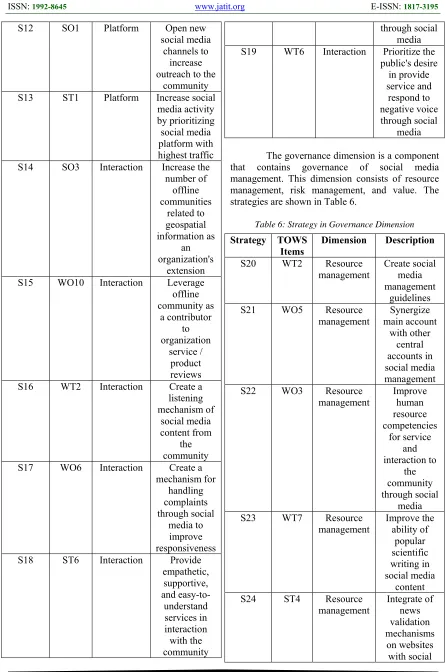
[image:11.612.83.528.72.744.2]The governance dimension is a component that contains governance of social media management. This dimension consists of resource management, risk management, and value. The strategies are shown in Table 6.
Table 6: Strategy in Governance Dimension Strategy TOWS
Items
Dimension Description
S20 WT2 Resource
management Create social media
management guidelines
S21 WO5 Resource
management
Synergize main account
with other central accounts in social media management
S22 WO3 Resource
management Improve human
resource competencies
for service and interaction to
the community through social
media
S23 WT7 Resource
management Improve the ability of popular scientific writing in social media
content
S24 ST4 Resource
management Integrate of news
validation mechanisms
8335 media
S25 SO2 Resource
management
Build an integrated social media
monitoring tool with phone & email complaint
handling
S26 WO9 Resource
management monitoring Utilize
tools to calculate
various categorization
of content
S27 WO4 Resource
management monitoring Implement and reporting
mechanisms with the use of monitoring
tools
S28 WT4 Risk
management
Verifies the account of any official social media account of the
organization
S29 WT6 Risk
management Increase the number of technical personnel for
managing website and social media security
S30 WT1 Risk
management
Create a password management
mechanism for social
media manager administrators
S31 WT3 Risk
management awareness of Increase the IT security for
social media administrators
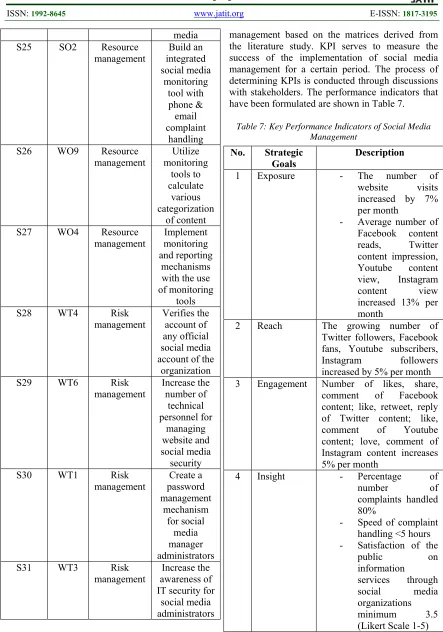
The last aspect of the governance dimension is the value. This aspect consists of the Key Performance Indicator (KPI) of social media
[image:12.612.84.527.65.697.2]management based on the matrices derived from the literature study. KPI serves to measure the success of the implementation of social media management for a certain period. The process of determining KPIs is conducted through discussions with stakeholders. The performance indicators that have been formulated are shown in Table 7.
Table 7: Key Performance Indicators of Social Media Management
No. Strategic
Goals Description
1 Exposure - The number of
website visits
increased by 7% per month
- Average number of
Facebook content
reads, Twitter
content impression,
Youtube content
view, Instagram
content view
increased 13% per month
2 Reach The growing number of
Twitter followers, Facebook fans, Youtube subscribers,
Instagram followers
increased by 5% per month
3 Engagement Number of likes, share,
comment of Facebook
content; like, retweet, reply of Twitter content; like,
comment of Youtube
content; love, comment of Instagram content increases 5% per month
4 Insight - Percentage of
number of
complaints handled 80%
- Speed of complaint
handling <5 hours
- Satisfaction of the
public on
information
services through
social media
organizations
minimum 3.5
8336
5.4 Social Media Strategy Prioritization and
Road Map
This stage aims to determine the roadmap of the implementation of the strategies that have been formulated. Road map determination is based on the priority value of each strategic objective, and each strategy within a strategic target group. In order to determine implementation priorities based on strategic objectives, the strategic formulation that has been established within the framework is mapped according to their strategic objectives.
[image:13.612.309.528.136.736.2]The strategic priority assessment analyses the importance of the strategies which divided into 3 strategic objectives that have been formulated, namely: awareness, engagement, and complaint handling. Priority assessment uses the intensity scale of interest from Saaty & Vargas (2012). Figure 2 shows the structure of the AHP hierarchy and grouping of strategies according to the strategic objectives applied in data processing to obtain the priority value of the strategy.
Figure 2: Hierarchical Structure of Social Media Strategies Priority
Table 8 shows the priority level of the strategy presented in several columns. The greater value of the analysis results, mean that the element has a high priority level. The value of inconsistency below 0.1 means there is no need for improvement in the assessment of pair comparison. The strategic goal group hierarchy has an inconsistency value of 0.00477. In the next hierarchy, SG1 Group: Awareness have inconsistency: 0.05008, SG2 Group: Engagement has inconsistency: 0.03527, and SG3: Complaint Handling has inconsistency: 0.07579. Overall and groups hierarchies showing
[image:13.612.307.528.147.749.2]an inconsistency value below 0.1 which means it can be said the assessment results are valid.
Table 8: Results of Strategies Prioritization
Strategic Goal Group
Group Priority
Strate gy
Strateg y Priority
Within the Group
Overall Strateg
y Priority
SG1: Awarenes
s
0.2383 76
S2 0.0856
64
0.0204 2
S5 0.0735
44
0.0175 32
S6 0.0524
34
0.0125
S7 0.0709
14
0.0169 04 S10 0.1336
03
0.0318 48 S11 0.1107
55
0.0264 02 S12 0.0166
83
0.0039 76 S13 0.0734
82
0.0175 16 S20 0.1012
28
0.0241 3 S21 0.0542
63
0.0129 36 S24 0.0652
17
0.0155 46 S28 0.0368
57
0.0087 86 S29 0.0436
98
0.0104 16 S30 0.0379
38
0.0090 44 S31 0.0437
2
0.0104 22 Inconsistency: 0.05008
SG2: Engagem
ent
0.3129 24
S1 0.1292
55
0.0404 46
S3 0.0671
17
0.0210 02
S4 0.1411
5
0.0441 7 S08 0.0969
81
0.0303 48 S14 0.0613
66
[image:13.612.108.294.349.568.2]8337
S15 0.0403
51
0.0126 26
S18 0.1260
03
0.0394 3
S22 0.1580
66
0.0494 62
S23 0.0600
21
0.0187 82
S26 0.0763
25
0.0238 84
S27 0.0433
64
0.0135 7 Inconsistency: 0.03527
SG3: Complaint
Handling
0.4487 S9 0.1725 63
0.0774 3
S16 0.2017
46
0.0905 24
S17 0.1687
05
0.0756 98
S19 0.2891
82
0.1297 56
S25 0.1678
04
0.0752 94 Inconsistency: 0.07579
From the column of Strategic Goal Group shows that the strategic objectives of complaint handling get the highest priority of importance, followed by engagement in the second rank and the awareness in the last rank. This result can be interpreted that complaint handling has the higher priority to be implemented. Since social media management in the organization has not yet accommodated complaint handling from customer services it should be improved first. On the other hand, engagement has a higher rank than awareness. The utilization of the social media has only the one way information mechanism thus the interaction with public is considerably low.
In the Awareness Group, strategies S10, S11, and S20 are the three highest priorities within the group. S10 and S11 strategies relate to buzzer utilization to help disseminate information. This shows that JDS requires more coverage in voicing its existence because so far JDS has not been widely known by the wider community. The S20 strategy deals with creating social media management guidelines. This suggests making the guidance an important thing to improve the quality of social media management.
In the Engagement Group, the S22, S4, and S1 strategies have the three highest ratings in the group. Strategy S22 contains about improving
human resource competence for service through social media. It can be interpreted that the competence of human resources in JDS needs to be improved again. The S4 strategy relates to content that has value and relevance to the community. This suggests that content that is directly related to the needs of the community is important to improve community engagement with JDS. The S1 strategy deals with the creation of content specific to different segments of society. This shows that JDS has its own audience segment and the segment of the community should be a priority in order to have a stronger attachment with JDS.
In the Complaint Handling Group, the S19, S16 and S9 strategies have the three highest ratings. Strategy S19 contains about giving priority to society's desire in response to negative voice from society. This suggests that society should be a top priority in responding to complaints coming through social media. S16 is a strategy related to listening what people are talking about JDS and geospatial information. The listening mechanism is considered important because by knowing the opinions and wishes of the community, JDS can make improvements to the quality of service and products and determine the steps to be done in the future. The S9 Strategy contains the formation of a negative community handling team. This can be interpreted to handle a negative vote required by one voice from the agency, to reduce the likelihood of issuing false statements to the public.
The Overall Strategy Priority column shows the strategy priority level against the rest of the strategies. The priority value of this strategy is the result of an AHP analysis that considers the importance of the strategic goal group and the priority value of the strategy within the group. From the values of the analysis results, can be determined what strategies will be prioritized to be applied first.
8338
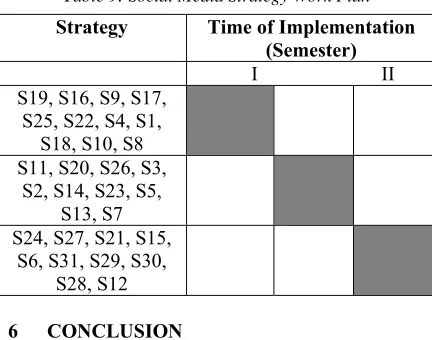
Table 9: Social Media Strategy Work Plan
Strategy Time of Implementation
(Semester)
I II
S19, S16, S9, S17, S25, S22, S4, S1,
S18, S10, S8 S11, S20, S26, S3,
S2, S14, S23, S5, S13, S7 S24, S27, S21, S15,
S6, S31, S29, S30, S28, S12
6 CONCLUSION
This study aims to formulate a social media strategy framework that appropriate with the conditions in government sector which already use the social media, but the interaction rate is still low. There are three stages to define the prioritise the strategies. The first stage is the assessment of
current condition which evaluate the
implementation objectives, external condition, service quality and information quality. The objective defined was engagement, awareness and complaint handling. The second stage is the development of social media strategy which utilise the SWOT analysis and the social media strategy. This stage defined the strategies from various dimension such as scope, capability and governance. The last stages defined the prioritization of strategies implementation.
Complaint handling is the most important objective that need to be addressed in the organization that already use the social media with low rate if interaction. This result is aligned with the condition of social media utilization in the organization which have a low rate of interaction with the public. Firstly, organization need to respond to the public especially respond to their complaint or question through social media. This practice would help to achieve the other objective such as awareness and engagement level. Public will aware of the organization existence if the organization actively respond to them and eventually increase the engagement level.
7 FUTURE WORK
Based on the process by the researcher and the limitations faced in completing this research, the suggestions that can be submitted in this research are:
1. Further research may involve more respondents from different scientific and diverse
backgrounds of experience to gain a broader view of the management of social media.
2. Further research can involve users of the organization's social media services directly to get deeper information about the user’s wishes of the service.
3. Implementation of this social media strategy requires many steps of change and adjustment within the organization. The full commitment and support of the leadership and all relevant employees is needed to make this social media strategy work.
ACKNOWLEDGMENT:
The authors are grateful to the Middle East University, Amman, Jordan for the financial support granted to cover the publication fee of this research article.
REFRENCES:
[1] Agarwal, N., & Yiliyasi, Y. (2010).
Information quality challenges in social media. International Conference on Information Quality (ICIQ 2010). Little Rock, Arkansas.
[2] Applegate, l. M., Austin, R. D., & Soule, D. L.
(2009). Corporate Information Strategy and Management: Text and Cases. New York: McGraw-Hill.
[3] Bertot, J. C., Jaeger, P. T., & Hansen, D.
(2012). The impact of polices on government social media usage: Issues, challenges, and recommendations. Government Information Quarterly, 30-40.
[4] Chaffey, D. (2009). E-Business and
e-commerce management: Strategy,
Implementation and Practice, 4th Edition. New Jersey: Prentice Hall.
[5] Cherry, N. (1999). Action Research: A
Pathway to Action, Knowledge and Learning. Melbourne: Publishing Solutions.
[6] Chui, T. B., Ahmad, M. S., Bassim, F. A., &
Zaimi, N. A. (2016). Evaluation of service quality of private higher education using service improvement matrix. Procedia - Social and Behavioral Sciences, 224(2016), 132-140.
[7] DeLone, W. H., & McLean, E. R. (2003). The
DeLone and McLean Model of Information Systems Success: A Ten-Year Update. Journal of Management Information Systems, 19(4), 9-30.
[8] Facebook. (2017, Maret 1). Company info.
Retrieved from Facebook:
http://newsroom.fb.com/company-info/
[9] Göroner, A., Toker, K., & Uluçay, K. (2012).
8339 Social and Behavioral Sciences, 58(2012), 1525–1534.
[10]Lamersdorf, W., Tschammer, V., & Amarger,
S. (2004). Buildiing The Service Society:
e-Commerce, e-Business, e-Government.
Boston: Kluwer Academic.
[11]Lovett, J. (2011). Social Media Metrics
Secrets: Do What You Never Thought Possible with Social Media Metrics. Indianapolis, Indiana: Wiley Publishing, Inc.
[12]Mergel, I. (2013). A framework for interpreting
social media interactions in the public sector. Government Information Quarterly, 327-334.
[13]Mišanková, M., & Kočišová, K. (2013).
Strategic implementation as a part of strategic management. In Social and Behavioral Sciences, 110(2014), 861-870.
[14]Nam, T. (2012). Suggesting frameworks of
citizen-sourcing via Government 2.0.
Government Information Quarterly, 12-20.
[15]Neiger, B. L., Thackeray, R., Van Wagenen, S.
A., Hanson, C. L., West, J. H., Barnes, M. D., & Fagen, M. C. (2012). Use of social media in health promotion: Purposes, key performance indicators, and evaluation metrics. Health Promotion Practice, 13(2), 159.
[16]Nepal, S., Paris, C., & Georgakopoulos, D.
(2015). Social Media for Government Services. Switzerland: Springer.
[17]Oliveira, L., & Figueira, Á. (2015).
Benchmarking analysis of social media strategies in the Higher Education Sector. Procedia Computer Science, 64(2015), 779-786.
[18]Pfeffer, J., Zorbach, T., & Carley, K. M.
(2014). Understanding online firestorms: Negative word-of-mouth dynamics in social media networks. Journal of Marketing Communications, 20(1-2), 117–128.
[19]Porter, M. E. (1996). What is strategy? Harvard
Business Review, 61-78.
[20]Riley, J. A. (2011). 2011 Social Media
Directory: The Ultimate Guide to Facebook, Twitter, Linkedln Resources. Indianapolis: Pearson Education, Inc.
[21]Ritson, N. (2011). Strategic Management.
Ventus Publishing ApS.
[22]Sá, F., Rocha, Á., Gonçalves, J., & Cota, M. P.
(2016). Model for the quality of local government online services. Telematics and Informatics.
[23]Saaty, T. L., & Vargas, L. G. (2012). Models,
Methods, Concepts & Applications of the Analytic Hierarchy Process - Second Edition. New York: Springer.
[24]Schniederjans, D., Cao, E. S., & Schniederjans,
M. (2013). Enhancing financial performance with social media: An impression management perspective. Decision Support Systems, 55(2013), 911-918.
[25]Şeker, Ş., & Özgűrler, M. (2012). Analysis of
the turkish consumer electronics firm using SWOT-AHP method. Procedia - Social and Behavioral Sciences, 58(2012), 1544–1554.
[26]Sobaci, M. Z. (2016). Social Media and Local
Governments: Theory and Practice.
Switzerland: 2016.
[27]Third Wave Consulting. (2013). Social Media
Strategy Framework.
[28]Thomas, D. B., & Barlow, M. (2011). The
Executive's Guide to Enterprise Social Media Strategy: How Social Network Are Radically Transforming Your Business. Hoboken, New Jersey: John Wiley & Sons, Inc.
[29]Twitter. (2017, Maret 1). Company about.
Retrieved from Twitter:
https://about.twitter.com/company
[30]Ward, J., & Peppard, J. (2002). Strategic
Planning for Information Systems. Cranfield, Bedfordshire, UK: John Wiley & Sons Ltd.
[31]Werder, K., Helms, R. W., & Slinger, J.
(2014). Social Media for Success: A Strategic Framework. PACIS 2014 Proceedings (p. 92). AIS Electronic Library.
[32]YouTube. (2017, Maret 1). Press room.
Retrieved from YouTube:
https://www.youtube.com/yt/press/
[33]Zheng, L., & Zheng, T. (2014). Innovation