Full Length Research Article
TECHNOLOGY DEVELOPMENT FRAMEWORK FOR GHANA: THE ROLE OF TECHNICAL AND
RESEARCH INSTITUTIONS
*Yao-Martin Donani
The University of Nottingham, UK and Ho Polytechnic, Ghana
ARTICLE INFO ABSTRACT
This paper, focused on developing a framework for the manufacturing of technologies for local industry in Africa using Ghana as the case sought to identify causes of technology underdevelopment in Ghana. Ghana’s industrialisation efforts have been faced with persistent failures despite the large acquisition of capital-intensive technologies and, in a broader scope, the historic narrative of Africa’s technology lag, accounting for the rudimentary state of its indigenous technologies. In this view, this study took a cautious approach in its methodology. A mix-research approach was therefore employed, comprising, ethnography, grounded theory and case study. The Findings, among other things, identified ethnic division as a major factor inhibiting knowledge exchange thereby preventing deployment and growth of indigenous technologies. In addition, Government efforts have been devoid of emphasis to meet the technology needs of the local industry, instead sought to develop high-tech, like nano-technology, to catch up with the advanced world. A framework was therefore proposed in this study for the manufacturing of production technologies for the local industry. The study concluded that the framework can only be effective with the presence of a strong technical, vocational and research background, hence, the relevance of their institutions to the development of technology in Ghana.
Copyright © 2015 Yao-Martin Donani. This is an open access article distributed under the Creative Commons Attribution License, which permits unrestricted use, distribution, and reproduction in any medium, provided the original work is properly cited.
INTRODUCTION
The issue of technology development has been problematic in Africa. For example, authors like Austin and Headrick (1983),
Lall and Pitroballi (2002), Johnson, et al. (2003), Lall and
Kraemer-Mbula (2005) and others have been able to
demonstrate the “inexplicable absence” of technology
development from the African cultural setting and government
policies. Indeed, the technology historian, Edgerton (2008), went further to show there is no historical record of any world invention from Africa. This, on the other hand, contradicts the fact that Africa possesses its own technology trajectory; for
example; iron smelting, was discovered by Africans
independently from the rest of the world (Davidson, et al.,
1965). That notwithstanding, Africa is plagued with technology underdevelopment and is at the bottom of the “scoreboard” (Lall and Pitroballi, 2002) performing as the poorest continent in the world (Acemoglu and Robinson 2010). This is not to suggest that there have not been efforts made to reverse the trend of technology drawback.
*Corresponding author: Yao-Martin Donani,
The University of Nottingham, UK and Ho Polytechnic, Ghana.
It is generally known how the industrialisation incentives put forward by various government regimes in Ghana have not yielded the corresponding growth rate in the manufacturing sector (The-Republic-of-Ghana, 2011; Lall and Pitroballi, 2002). This is despite the massive influx of capital-intensive technologies (Akubue, 2000) and the sporadic injection of huge capital (Aryeetey and Fosu, 2008) over the decades into the Ghanaian economy. It may therefore be stated here that the technology problematic does not emanate from a lack of awareness of technology or unavaialability of capital, but a more complex phenomenon requiring a level of detailed studies.
This paper therefore seeks to understand the African technology issue, from the perspective of the Ghanaian society, with the aim of developing a framework for the manufacturing of manufacturing and production technologies required by local industry. The framework aims to institutionalise the means for the technology creation, such that it “entrains” with the cultural “rhythm” (Clemens and Dalrymple, 2005) of the Ghanaian society making technical education and research institutions more relevant. This is in
ISSN: 2230-9926
International Journal of Development Research
Vol. 5, Issue, 01, pp. 2852-2857, January,2015
International Journal of
DEVELOPMENT RESEARCH
Article History:
Received 14th October, 2014
Received in revised form 27th November, 2014
Accepted 10th December, 2014
Published online 26th January, 2015
Key words:
effort to allow its assimilation into the fabric of the society, to situate technology development as part and parcel of local culture and institutional frameworks. On this note, the study calls for a reorientation of the Ghanaian society to create the right environment for the Technical and Vocational Education and Training (TVET) to be repositioned for technology development; otherwise, it will only lead to another failed attempt. A manufacturing model constructed from the framework is seen to provide the impetus necessary for the reorientation of the society for technology development.
TVET and technology development
Technology is built and maintained by technological minds and it is TVET that is rightly positioned to provide the skills and knowledge required by such minds. UNESCO defined TVET as being concerned with the acquisition of knowledge and skills for the world of work (UNESCO-UNEVOC 2012). This definition seems to be well accepted as this study did not find it being challenged by authors anywhere. By description, TVET, from historic references, encompasses such elements as Apprenticeship Training, Vocational Education, Technical Education, Technical-Vocational Education, etc. (ibid) and is delivered informally, non-formally and formally in family businesses, workplace in-house training or at different levels of schooling depending on the country (Conference-of-Ministers-of-Education-of-the-African-Union 2007, Oketch 2007). The formal delivery of TVET expands through secondary education or its parallel level of technical schools in most parts of Africa to the tertiary level which may comprise the polytechnics and in some cases TVET at the university (Oketch 2007).
Application of TVET knowledge is vital to national economies driven by technological growth that leads to eventual technical change. Example of such technical change is seen in the British industrial revolution, Germany and Japan (Oketch 2007). Prior to the industrial revolution in the eighteenth century (Downs 2010), Britain made a conscious effort to develop its technological capability to outwit its closest rival, France (Lundvall and Borras 2005). Similarly, Germany, through the work of Frederich List developed the theory of production economy to catch-up with Britain’s at that time (Freeman 1982, Sharif 2006). The case goes on with other countries such as Japan becoming innovative in adopting and replicating western technologies (Edgerton 2008), Korea, China, India and South East Asia in general and others following suit. The industries on which these economies thrive and advance their technologies rely on TVET for the development of technical minds and skills.
It is worth noting here however that these countries differ from Ghana in a cultural sense, apart from the technology gap. Using language classification as the bases for cultural differentiation, these countries are mainly mono-cultural (at least, at the time of their technological emergence) while Ghana, like other African countries, is largely multicultural, having seventy-nine living languages, excluding the dialects
(Lewis, Gary et al., 2013). That is not to say,
mono-culturalism is a necessary factor for technology development, but it is a point worth noting when drawing conclusions. The Ghanaian multicultural society may therefore require a vehicle that will transcend cultural, social and ethnic barriers. The
structure of TVET, whose principles are based on the universal language of science and technology, looks very suited to serve as this required vehicle.
How TVET is perceived
Literature shows extensively that the notion of technical or vocational education in Africa is derogatory and generally relegated to the academically incapable students (Conference-of-Ministers-of-Education-of-the-African-Union 2007, Oketch 2007). Indeed, Oketch (2007) notes that the low and declining proportion of TVET can be partly attributed to the public’s attitude towards this type of education. This attitude is influenced by such factors as; lack of progression (dead-end jobs), low skill base, less earning and delimiting to the present knowledge economy of the world. Ghana, however, compared with some other African countries, has made efforts to address some of these delimiting factors by making provision for progression through technical schools to the polytechnics and universities. Ghana has also instituted the Council for Technical and Vocational Education and Training –
(COTVET) to oversee technical education in the
country(Conference-of-Ministers-of-Education-of-the-African-Union 2007). There is still, however, a long way to go for TVET to attract its deserved prestigious position in the society. This can be deduced from an author’s observation that:
In Ghana, people in general put a low value on TVET. Their attitude to this type of education is that it is inferior to academic education… As a result of this attitude, it has been
the less bright pupils who opted for TVET courses (Oketch
2007) p.229).
The societal perception and low positioning of this branch of education is extensive and reflects in the relatively low number of intake and the low budgetary allocation of 1.8% as at 2009 compared to 17.3% for regular education that same
year (Education-Sector-Information-Report 2010). The
prevailing assumption on TVET that continues to guide national policy is that it should improve the chances of the youth who are academically disadvantaged in gaining employment or self-employment (Oketch 2007). TVET is thus designed around the world of work (Conference-of-Ministers-of-Education-of-the-African-Union 2007). Such prevailing perception guiding policy makers and the society at large endangers the TVET’s future by denying it some of the best technical brains that should have otherwise made meaningful contribution to this field of technology development and innovation.
METHODS
The issue of technology underdevelopment in Ghana and Africa as a whole is well noted in this paper. Traditionally indigenous technologies are very rudimentary, still almost at their primitive stage and Government efforts to industrialise the economy have been unsuccessful probably due to the neglecting of the rudimentary traditional technologies embedded within the Ghanaian cultures. Government emphases have rather been on importing state-of-the-art high-technologies for the industries. These capital-intensive technologies soon become obsolete and need constant replacement, thus, leading to a vicious cycle that plagues Ghana and Africa at large. Addressing this calls for an encompassing methodological approach with overarching effect. This is discussed briefly below.
Overarching methodology
The overarching methodology adopted for this study replicates an existing successful system of operation which is culturally assimilated in a given society. This is derived from the principles rhythm as presented by Clemens and Dalrymple (2005). The authors showed that every individual, organisation or society has its distinctive rhythm as its natural feature and it is when different rhythms are synchronised that they result in a desired output. This, the authors referred to as entrainment of rhythms. Applying this rhythm concept to the subject of discussion led to a three-step overarching methodological approach. In this approach, the rhythm of the society or organisation of interest is mapped out and “entrained” with the development intent, which in this case is technology development. The steps involved in the approach are: (1) studying the society; (2) identifying a culturally assimilated success project within that society and (3) modelling that success project as a template for the development intent. The research approach found most suitable for the overarching methodology was the mixed-research approach. Mixed-research, also called mixed-methods or multi-methods, has emerged as a distinct research approach on the same ranking as qualitative and quantitative research, thus, establishing three research approaches (Johnson and Onwuegbuzie, 2004; Greene, 2008). The following subsection provides a brief narrative of the mixed-research adopted in this study.
Mixed-Research approach
Mixed-research was developed to address the challenges researchers are constantly confronted with when complex and difficult issues that cannot be handled by mono-methods are encountered (MacKenzie and Knipe, 2006). The research approach has gained a wide application, predominantly in the fields of social sciences and spreading to psychology, anthropology and others. The flexibility of the approach allows combining different methodologies to suit a particular problem (Johnson and Onwuegbuzie 2004; Johnson,
Onwuegbuzie et al., 2007; Greene 2008).
Owing to the complex nature of this study, the methodology mix employed comprises of ethnography, grounded theory and case study. Ethnography (Wolcott 1990) allows a study into the Ghanaian society to describe its cultural inclination, in this case, towards technology creation; grounded theory (Corbin
and Strauss 2008) provides the techniques and tools for data analysis to generate narrative (or theory) from data; and a case study (Yin 2003, Zainal 2007) of the shea butter industry in Ghana gives specific insight of the Ghanaian attitude towards technology creation. In this study, the methods used for data collection includes observation, participant observation, conversation and structured and semi-structured interviews. Photographs were taken along with digital voice recording of the interviews.
Methodological procedure employed
The ethnographic study entailed fieldwork covering selected rural and urban Ghanaian settings. The rural aspect involved spending a month and a week living in two different communities having little or no modern facilities. Due to time constraint, it is best described as micro-ethnography (Wolcott 1990). There, researcher made daily observation of their lifestyle, noting the various artefacts for their livelihood and how they were made (manufactured). Photographs were taken and semi-structured interviews and conversations were done as means of collecting data. Researcher also kept a dairy, recording daily observations and discussions. In the urban experience however, structured interviews were conducted with some government officials, policy makers and department directors. Data was also collected from business owners and company executives, including heads of academic institutions. During the study, some of the successful establishments found in Ghana worth considering for the overarching methodology were the Volta River Authority (VRA) and Ghana Cocoa Board (Cocobod). Cocobod was however preferred owing to its indigenous orientation and assimilation into the Ghanaian cultural setting. It will therefore be modelled as a template for the technology development framework.
The corpus of qualitative data from the ethnography observations and the interviews were analysed using the techniques and procedure of grounded theory as provided by Corbin and Strauss (2008 and 1990). The social science software NVivo was used for the coding processes. Patterns emerging from data formed the constructs of narratives, which discuss the factors considered to contribute to the Ghanaian technology lag. The following section provides a summary of the narrative in findings. Some of the findings were unexpected and novel, while others tend to confirm previous work by other authors, but with new interpretations. Those that may be referred to as common knowledge/information, at least, now gets recorded here if not previously on record. The
prevalence of the subject matter of technology
underdevelopment in Ghana under discussion points to the relevance of the findings until it is resolved. The case study of the shea butter industry involved observing the traditional production method and studying the approach (from interviews and literature) adopted by Government in respect to the industry. A summary of the outcome of the case is also contained in the next section.
Significant findings and discussions
understanding the weak technology base in Ghana. The findings could be summarised as follows:
1. Two forms of productions systems in Ghana, here termed,
traditional production system and local production system. They operate extensively but are officially unrecognised, as such; receive little or no attention for improvement and remain unaided. They are also generally overshadowed by popularly known, small-to-medium enterprises (SME’s) and multinational corporations. These production systems are mainly rural based and rely exclusively on indigenous methods. The Ghanaian population is found to depend heavily on their productions. Some of these local productions include palm kernel oil production, shea butter extraction, gari processing, and all other forms of traditional products of daily use. The traditional producers are characterised by rudimentary indigenous technological heritage, which are
mainly labour-intensive, less efficient and time
consuming. Local producers, on the other hand, attempt to improve on the traditional production methods by themselves, often with a commercial intent. The technologies they employ may lie anywhere between the rudimentary technologies of the traditional producers and modern technologies they can afford. They differ from SMEs in the sense that they are not registered enterprises and lack modern production technologies, neither can they be classed as micro enterprises as yet, as their presence is still “invisible”, but their products are widely available and constantly utilised by the wider public.
2. This study could not identify any framework for dialogue
to engage and identify the traditional group’s
technological needs. Government emphasis is on attracting foreign investors and it appears to be guided by some form of directives through specific funding schemes
like the millennium development goal (MDG),
millennium challenge account (MCA) and other international loans and grants as deduced from respondents.
3. There was no national framework for technology
development found in the country for local industry.
4. Government officials and policy makers who partook in
this research are vague on which institution is responsible for the technology concerns.
5. Manufacturing engineering is not offered as a first degree
course in any of the Ghana public tertiary institutions of technology.
6. Students’ projects are not linked to industry or any
scheme to solve industry’s problems requiring research.
7. Technical education is not esteemed in Ghana as noted
from respondent with technical background and literature alike.
8. An automobile manufactured in Ghana, at the time of
research, cannot be registered, it must necessarily be imported.
9. The ethnic and cultural divide that exist within the
Ghanaian ethnic groups is seen to prevent the proliferation and exchange of indigenous knowledge and technology at the traditional level. This, to some extent, may explain why indigenous technologies have never developed.
10. SMEs are unable to upgrade their production
technologies as they soon become obsolete.
11. The strategy in Ghana is to prepare a workforce in
anticipation of foreign investors.
12. Multinational corporations are criticised by respondents
[image:4.595.309.557.130.338.2]for using government machinations to kill local production in the country through monopoly and intimidation (see Figure 1 for pictorial depiction).
Figure 1. Multination Corporations intimidating Government to “kill” local production systems
13. Findings from the case study
Using the shea butter industry as a case study, this research found that the Ghanaian population was more inclined towards foreign manufactured products than local productions irrespective of quality and cost. Such attitude is seen to inhibit growth in the local production system and preventing its technology development. The shea butter producers target foreign buyers due to low local patronage. Most foreign buyers, on the other hand, prefer purchasing the nuts. This again denies local technologies the opportunity to optimise and develop. This study, while concerned about the inefficient technology in the shea industry, found that Government efforts were rather focused on increasing the yield of the shea tree. Respondents indicated that the shea nuts available in the bush, where they collect for free, far exceed what is demanded or their ability to collect. This raises the argument that increasing the shea yield was not an urgent issue. Government, devoting its resources on that line therefore suggests an avoidance or lack of confidence in developing the industry’s technological base so as to add value to the primary produce.
Technology development framework for Ghana
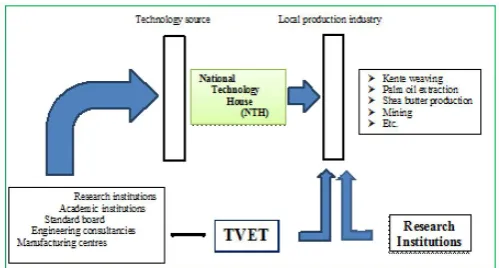
The aim of this study is to develop a framework for technology manufacturing in Ghana. This section attempts to construct a model for the framework. The role of TVET and the research institutions is vital to this end; they serve as the backbone, providing the necessary skills, knowledge and the structure required for any industry.
Figure 2. A model for manufacturing of production technology in Ghana
The operation of Cocobod is such that; Cocobod purchases good quality cocoa beans from farmers through the Licence Buying Companies (LBC) for onward sale onto the international market. Similarly, the framework, through the
National Technology House (NTH), sources the
manufacturing of production technologies for the local production industry from technology sources. Like Cocobod being responsible for cocoa in Ghana, NTH is responsible for technology delivery to the local industry. NTH will work in close collaboration with existing institutions in Ghana, some of which include research institutions, academic institutions, manufacturing centres, e.g. GRATIS and others.
Based on the specification of technology (machine) required, NTH will seek the appropriate design engineers and manufacturers to design and manufacture the required technology, thus, engaging Ghanaian engineers onto commercial production of these technologies. There are pockets of machinery production already in the Ghanaian system mostly undertaken by wayside craftsmen. Those done in organised workshops like GRATIS are mainly metal fabrication. More so, they lack the coordination and linkages which NTH brings with it. NTH is being developed as a business model to source for the manufacturing of the technologies from different areas, not limited to any particular organisation. The business model will operate extensive warehouse and retail outlet system where clients’ products will be open to the market. Thus, providing assured and ready market for the end products of the technologies it supplies. By this, the burden of the producer looking for market for his/her products is eliminated, the same way as Cocobod provides assured market for the cocoa farmer. The study showed that local producers are unable to afford existing technologies for their productions. NTH will work to overcome this by providing the technology to the client based on a detailed formal agreement of which, the producer, only focusing on the production will allow an agreed percentage of the production to go to NTH. The local producer will therefore not need to worry about how to obtain production machines. Further details of the operation of NTH, like its share capital, management structure, etc. will need to be developed in a separate study.
The Relevance of TVET and Research Institutions
When local industry is supplied with its needed technologies, production is expected to be enhanced alongside technology
proliferation throughout the country. At this stage, it can be foreseen that the relevance of TVET and research institutions will come to greater light as technical hands and technical minds will be required by the local industry for the “new” industrial take-off. More so, the entrepreneurial skills of the producers will be enhanced. This will make production to be more competitive in the African sub region and indeed, globally. It will also reduce that feature of the nation; sitting back and waiting for some investors to bring in their technologies. It is more honourable the investors come and meet strong competition already on the ground to contend with.
By this, it is hoped that Ghana will be moving towards truly becoming the manufacturing hub of West Africa as envisaged by the Ministry of Trade and Industry. The Research Institutions will be of great importance here. They will find their role both in researching into the technologies (machine, equipment, tools, etc.) to be manufactured and increasing the product line of the producers. For example, taking the case of the shea butter production; the only known end-product is the butter. The research industry may look into coming up with different brands of butter and oils for cooking, soap making and other products. Also, the potential of shea nuts for making chocolate could be explored. A simplified test conducted by the researcher suggests that the shea nut can be suitably made into chocolate products just like cocoa.
Conclusion
In this paper, a model for the manufacturing of production technologies for local industries in Ghana was constructed. The construction was based on a three-step approach which provides for cultural assimilation into the framework. The approach entails studying the society, identifying a culturally successful institution within that society and modelling the operations of that institution to the development intent. The model is seen to provide the impetus needed to stem technical growth in the Ghanaian society. It requires the vital roles of Technical and Vocational Education and Training (TVET) and the research industries to function effectively. In this way, it makes the institutions more relevant to the Ghanaian society. This study therefore concludes that if Ghana, as a society, truly wants to become the manufacturing hub of Africa, it must change its demurring attitude toward technical education to enhance TVET and research institutions as a matter of high priority. Achieving a success in technology creation will rewrite the African history and help discard existing negative notions about the continent. These notions portray Africans as incapable of developing their technologies to competitively transform their vast raw materials into finished goods for economic growth. This study sees the model proposed as having the potential to lead to such transformation in technology creation and its development.
REFERENCES
Acemoglu, D. and J. A. Robinson 2010. "Why is Africa Poor."
Economic History of Developing Regions, Vol. 25: pp
21-50.
Corbin, J. and A. Strauss, 2008. Basics of Qualitative Research: Techniques and Procedures for Developing Grounded Theory. 3rd Edition. Thousand Oaks, Sage Publications.
Downs, J. 2010. The industrial revolution: Britain, 1770-1810. Oxford, Shire Publications.
Edgerton, D. 2008. The Shock of the Old: Technology and Global History since 1900. London, Profile Books Ltd. Education-Sector-Information-Report 2010. 2010 Education
Sectore Report.
Freeman, C. 1982. Technological infrastructure and
international competiviness. Paper presented to the ad hoc group on Science, Technology and Competiveness. Paris,
Organisation for Economic Cooperation and
Development.
Greene, C., J. 2008. "Is Mixed Methods Social Inquiriy a
Distinctive Methodology?" Journal of Mixed Methds
Research, Vol. 2: pp 7-22.
Johnson, B. R. and A. J. Onwuegbuzie (2004). "Mixed Methods Research: A reseach paradigm whose time has
come." Educational Researcher, Vol. 33(No. 7): pp
14-26.
Johnson, R. B. et al. 2007. "Toward a definition of mixed
methods research." Journal of Mixed Methods Research,
Vol. 1(2): pp 112-133.
Lewis, M. P. P. et al. Eds. 2013. Ethnologue: Languages of the
World, Seventeenth edition. Dallas, Texas, SIL
International. Online version.
Lundvall, B.A. and S. Borras, 2005. Science, Technology and Innovation Policy. In: Fagerberg, J., Mowery, D. C., and
Nelson, R. R., eds. 2005. Oxford, Oxford University
Press.
Oketch, M. O. 2007. "To vocationalise or not to vocationalise? Perspectives on current trends and issues in technical and vocational education and training (TVET) in Africa."
International Journal of Educational Development, Vol.
27(2): pp 220-234.
Sharif, N. 2006. "Emergence and development of the National
Innovation System Concept." The Hong Kong University
of Science and Technology, Research Policy.
UNESCO-UNEVOC (2012, 06/08/2012). "What is TVET?". Retrieved 6 June, 2014, from http://www.unevoc.unesco. org/go.php?q=What+is+TVET.
Wolcott, H. F. 1990. "Making a study “more ethnographic”."
Journal of Contemporary Ethnography, Vol. 19(Issue 1):
pp 44-72.
Yin, R. K. 2003. Case study research; designs and method, 3rd Edition. Thousand Oaks, CA: Sage Publications, Inc.
Zainal, Z. 2007. "Case study as a research method." Journal
Kemanusiaan, (9): pp 1-6.