Full Length Research Article
TRANSIENT MHD MASS TRANSFER FLOW PAST AN IMPULSIVELY STARTED VERTICAL PLATE
IN A POROUS MEDIUM WITH RAMPED TEMPERATURE, THERMAL DIFFUSION AND RADIATION
1
Ravi Kumar, D.,
2Jayarami Reddy, K. and
*,3Nanda Kishore, S.
1
Department of Mathematics, Rayalaseema University, Kurnool, A.P. India
2
Department of Mathematics, K.L. University, Vijayawada, A.P. India
3
Department of Mathematics, N.B.K.R. Institute of Science and Technology, Vidyanagar, A.P. India
ARTICLE INFO ABSTRACT
In this paper we discuss, an exact solution to the problem of a MHD viscous, incompressible free convective flow of an electrically conducting, Newtonian non Grey fluid past a suddenly started infinite vertical plate with ramped wall temperature and concentration in presence of appreciable radiation heat transfer and uniform transverse magnetic field is presented. The fluid is assumed negligible magnetic Reynolds number considered Induced hydro magnetic effects. The equations governing the flow are solved by using Laplace transform technique in closed form. The influence of Hartmann number, radiation parameter, Darcy number, Reynolds number and time on the variations in the fluid velocity, fluid temperature, fluid concentration, skin friction, Nusselt number and Sherwood number at the plate are demonstrated graphically and physically interpreted.
Copyright©2016, Ravi kumar et al. This is an open access article distributed under the Creative Commons Attribution License, which permits unrestricted use, distribution, and reproduction in any medium, provided the original work is properly cited.
INTRODUCTION
Many Engineering problems are susceptible to MHD analysis. The study of flow problems has achieved remarkable interest due to its application in MHD generators, MHD pumps and MHD flow meters etc. MHD principles find its applications in Medicine and Biology also the study of effects of magnetic field on free convection flow is important in liquid metals, electrolytes and ionized gases. Geophysics encounters MHD phenomena in interaction on conducting fluids and magnetic fields. The rotating flow of an electrically conducting fluid in presence of magnetic field has got its importance in Geophysical problems. The present form of MHD is due to the pioneer contributions of several notable authors like Alfven (1942), Cowling (1957), Shercliff (1965), Ferraro and Plumpton (1966) and Crammer and Pai (1978). The natural flow arises in fluid when the temperature change causes density variation leading to buoyancy forces acting on the fluid. Free convection is a process of heat transfer in natural flow. Radiation is another very important factor which plays very significant role in the free convection process that occurs due to temperature difference. Radiative convective flows are encountered in many environmental and industrial processes. So studies on effect of radiation on free convective fluid flows have been drawing great interest among the researchers since long back to present.Gupta and Gupta (1974) [6] studied the effect of radiation on combined free and forced convection of an electrically conducting fluid flow through an open ended vertical channel in presence of uniform magnetic field. Radiation is another process of heat transfer through electromagnetic waves. Radiative convective flows are encountered in countless industrial and environment processes like heating and cooling chambers, evaporation from large open water reservoirs, astrophysical flows and solar power technology.
*Corresponding author: Nanda Kishore, S.
Department of Mathematics, N.B.K.R. Institute of Science and Technology, Vidyanagar, A.P. India
ISSN: 2230-9926
International Journal of Development Research
Vol. 06, Issue, 08, pp.8871-8883, August,2016
International Journal of
DEVELOPMENT RESEARCH
Article History:
Received 19th May, 2016 Received in revised form 22nd June, 2016 Accepted 20th July, 2016 Published online 24th August, 2016
Available online at http://www.journalijdr.com
Due to importance of the above physical aspects, several authors have carried out model studies on the problems of free convective flows of incompressible viscous fluid under different flow geometries taking into account of the thermal radiation. Some of them are Mansour (1990), Raptis and Perdikis (1999), Ganesan and Loganathan (2002), Mbeledogue et al. (2007), Makinde (2005) and Sattar and Kalim (1996). Investigation of problems on natural convective radiating flow of electrically conducting fluid past an infinite plate becomes very interesting and fruitful when a magnetic field is applied normal to the plate. Comprehensive literature on various aspects of free convective radiative MHD flows and its applications can be found in Sattar and Maleque(2000), Samad and Rahman(2006), Orhan and Ahmet (2008), Prasad et al. (2006), Takhar et al.(1996), Ahmed and Sarmah(2009) and Ahmed (2012). The effect of rotation on unsteady hydro magnetic natural convection flow of a viscous in compressible electrically conducting fluid past an impulsively moving vertical plate with ramped wall temperature has been investigated recently by Seth et al. (2011). Very recently, Das et al. (2011) have studied the radiation effect on natural flow of an optically thin viscous incompressible fluid near a suddenly moving vertical plate with ramped wall temperature by adopting Cogley-Vincentine-Gilles equilibrium model (1968). By optically thin, it is meant that the fluid has no self absorption property, but it can absorb radiation emitted by boundaries.
Recently Ahmed and Dutta investigated the effect of a uniform transverse magnetic field on a natural flow of an optically thin electrically conducting viscous incompressible radiating non-Grey fluid (Cogley (1968)) past an impulsively started vertical plate with temporary ramped wall temperature. In the present work an attempt has been made to study the combined effect of mass diffusion and thermal diffusion on the natural flow of an optically thin electrically conducting viscous incompressible radiating non-Grey fluid past an impulsively started vertical plate with temporary ramped wall temperature and ramped concentration. As a magnetic field of uniform strength is assumed to be applied transversely, the medium is considered to be homogeneous due to MHD convection in a porous media emphasized by Nield (2008). In this work, characteristic time to is variable the Reynolds
number Re comes to existence explicitly and hence the influence of the Reynolds number on the flow field, Gr Grashof number of
heat transfer in addition to other similarity parameters is also to be investigated in the of our study.
MATHEMATICAL FORMULATION
The equations governing the motion of an incompressible, viscous, electrically conducting radiating fluid past solid surface in presence of a magnetic field are:
Continuity equation:∇. =0 (1)
Magnetic field continuity equation:∇. =0 (2)
Ohm’s law for moving conductor: =σ ( + x ) (3)
Momentum equation: ρ [
′ + ( .∇) ] = ∇p+ x +ρ +µ∇ (4)
Energy equation: ρ [ ′
′ + ( .∇) T’] =k ∇ T'+ + ′ (5)
Species continuity equation: ( .∇) ̅= ∇ ̅ + ∇ (6)
All the physical quantities are defined in the Nomenclature.
We now consider an unsteady radiative MHD free convective flow of an incompressible viscous and electrically conducting optically thin non-Grey fluid past a suddenly moving infinite vertical plate in its own place with temporary ramped temperature in presence of magnetic field of uniform strength B0 applied normal to the plate directed into fluid region.
Our investigation is restricted to the following assumption:
All the fluid properties are considered constants except the influence of the variation in density in the buoyancy force term.
The viscous dissipation is also assumed to be negligible in the energy equation as the motion is due to free convection only.
The magnetic Reynolds number is so small for that the induced magnetic field can be neglected in comparison to the applied magnetic field.
The plate is electrically non-conducting.
The radiation heat flux in the direction of the plate velocity is considered negligible in comparison to that in the normal direction.
Initially the plate and surrounding fluid were at rest at the same temperature ∞′ and Concentration ∞′. At time ′>0, the plate is
suddenly moved in its own plane with a Constant velocity and the temperature and concentration of the wall is raised to ∞′+
( ′- ∞′) ′
and ∞′+ ( ′- ∞′) ′
for 0< ′≤
and the Constant temperature ′ ( ′ > ∞′) and concentration ′( ′ > ∞′) is
maintained at ′> . We now introduce a coordinate system ( ′, ′, ′) With X-axis along the plate in the upward Direction,
Y-axis normal to the plate directed in the fluid region Z-Y-axis along the width of plate. Let = ( ′, 0, 0) denote the fluid velocity and
[image:3.595.168.442.161.396.2]= (0, , 0) be the applied magnetic field at the Point ( ′, ′, ′, ′) in the fluid.
Figure 1. Physical model
With the foregoing assumptions and under the usual boundary layer and Boussinesq Approximations, the equations (1), (4), (5) and (6) reduce to
′
′ =0, which yields ′
= ′ ( ′, ′) (7)
′
′ =υ ′
′ +g (
′
∞′) +g ( ′ ∞′) ′ (8)
′
′ =k
′
′ ′ (9)
′
′ = DM
′
′ +DT
′
′ (10)
The appropriate initial and boundary conditions are
′=0, ′ =
∞′ ′= ∞′ ∀ ′, ′≤ 0 (11)
′=U
0, ′ = ∞′ + ′
∞′ ′, ′=
∞′+
′
∞′ ′at ′=0, 0 < ′≤ (12)
′
=U0, ′ = ′ ′= ∞′ at ′=0, ′> (13)
′ →
0, ′→ ∞′ ′→ ∞′ at ′→∞ ′>0 (14)
It is emphasized by Cogley et al. (1968) that the rate of radiative flux in optically thin limit for a non-Grey gas near equilibrium is given by
′ =4I ( ′
Where, I=∫ (∞ ) w ( ′) w dλ
On use of (15), (9) reduce to ′′ =α ′′–F ( ′
∞′) (16)
Proceeding with the analysis, we introduce the following non-dimensional variables and similarity parameters to normalize the flow model:
u=
′
, y=
′
, t =
′
, Gr =
( ′
∞′)
,Gm=
( ′ ∞′) , = ′ ∞′ ′ ∞′ = ′ ∞′ ′
∞′ , Pr= µ
, Q= , M= , Re= ,
Sr= (
′
∞′)
( ′
∞′) ,Sc=
Ʋ , α = , F= Ɵ (17)
All the physical quantities are defined in the Nomenclature.
By virtue of transformations cum definitions (17), the equations (8), (9) and (10) in normalized form become
= + + (18)
= (19)
= + (20)
Subject to relevant initial and boundary conditions:
u=0, =0, =0 ∀y≥0 and t ≤ 0 (21)
u=1, =t, =t at y=0, 0< t≤ 1 (22)
u=1, =1, =1 at y=0, t > 1 (23)
u=0, =0, =0 as y→∞ , t > 0 (24)
METHOD OF SOLUTION
On taking Laplace Transform of the equations (18),(19)and (20),the combined initial and boundary value problem reduce to a boundary value problem governed by the equations
– (MR +sRe) = R (Gr ̅+Gm ) (25)
– (s+QRe) PrRe ̅=0 (26)
+ScSr – sSc Re =0 (27)
Subject to the boundary conditions
= , ̅ = (1 ), = (1 ) at y=0 (28)
=0, ̅=0, =0 at y→∞ (29)
The equations (25)-(27) are two ordinary coupled second order differential equations and the solutions of these equations subject to the conditions (28) and (29) are as follows:
̅ = (1 ) ( )
= (1 ) – ( + )(1 ) +
(1 ) ( ) + ( + )(1 ) ( ) (31)
=
( )
(1 ) ( ) + (1 ( )
+ (1 ) ( ) + (1 ) ( )
+ (1 ) ( )
+ (1 )
+ (1 ) ( ) + + (1 )
+ (1 ) + (1 ) (32)
Taking inverse Laplace Transforms of the equations (30), (31) and (32) we have
=Ψ Ψ (33)
= (Ψ Ψ ) ( Ψ Ψ ) ( Ψ Ψ ) + (Ψ Ψ )
+ (Ψ Ψ ) + (Ψ Ψ ) (34)
U =Ψ (Ψ Ψ ) (Ψ Ψ ) (Ψ Ψ ) –
(Ψ e Ψ ) ( Ψ Ψ ) + (Ψ Ψ )+
( Ψ Ψ ) + (Ψ Ψ ) + (Ψ e Ψ ) +
(Ψ Ψ ) + (Ψ Ψ ) + (Ψ Ψ ) +
(Ψ Ψ ) (35)
SKIN FRICTION
The co-efficient of skin friction at the plate is given by
= y=0 = (Ψ Ψ ) Ψ + (Ψ Ψ ) +
(Ψ Ψ ) + (Ψ e Ψ )+ (Ψ Ψ )
(Ψ Ψ ) – ( Ψ Ψ ) (Ψ Ψ ) –
(Ψ e Ψ ) – (Ψ Ψ ) (Ψ Ψ )
(Ψ Ψ ) – (Ψ Ψ )
RATE OF HEAT TRANSFER
The co-efficient of the rate of heat transfer in terms of Nusslet number is given by Nu = y=0 = Ψ Ψ
RATE OF MASS TRANSFER
Sh = y=0 = (Ψ Ψ ) + (Ψ Ψ ) + (Ψ Ψ +Ψ Ψ ) +
(Ψ Ψ + (Ψ Ψ )(Ψ Ψ ) (Ψ Ψ ))
RESULTS AND DISCUSSION
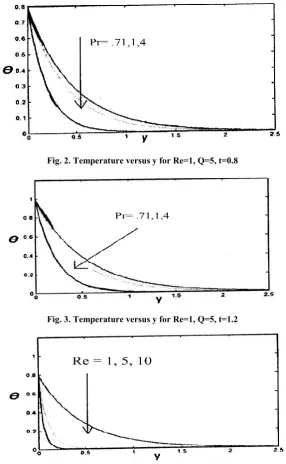
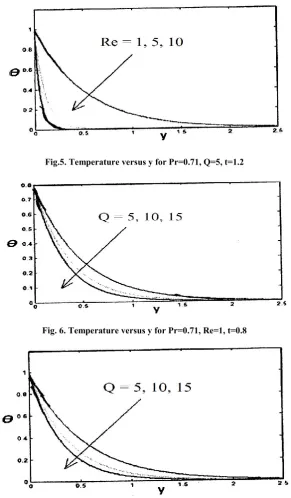
[image:6.595.155.442.279.744.2]In order to get clear insight of the physical problem, numerical computations from the analytical Solutions for the representative temperature field, concentration field, velocity field, the co-efficient of skin friction, the rate of heat transfer at the plate in terms of Nusselt number and the rate of mass transfer in terms of Sherwood number have been carried out by assigning numerical values to the parameters involved in the problem, the normal coordinate y and time t. Throughout our investigation, the value of the Pr have been kept fixed at 0.71, both the values of Gr and Gm are fixed at 10 as the numerical computations are concerned. We recall that Pr=0.71 corresponds physically to air. The numerical results computed from the analytical solutions of the problem have been displayed in Figure 2-17. It is noticed Figures 2-7 correspond to the temperature distribution against y under the influence of Pr, Re and Q. Increasing Pr, Re or Q shows an opposing influence on indicating the fact that the fluid temperature falls steadily for large value of Pr, small viscosity(large Reynolds number)and for high radiation. It is seen that the magnitude of velocity goes up as the value of Da is increased.
Fig. 2. Temperature versus y for Re=1, Q=5, t=0.8
Fig. 3. Temperature versus y for Re=1, Q=5, t=1.2
Fig.5. Temperature versus y for Pr=0.71, Q=5, t=1.2
[image:7.595.162.437.76.216.2]Fig. 6. Temperature versus y for Pr=0.71, Re=1, t=0.8
Fig. 7. Temperature versus y for Pr=0.71, Re=1, t=1.2
Fig. 8. Concentration versus y for Re=1, Q=5, Sr=1, t=8
Fig. 9. Concentration versus y for Re=1, Q=5, Sr=1, t=1.2
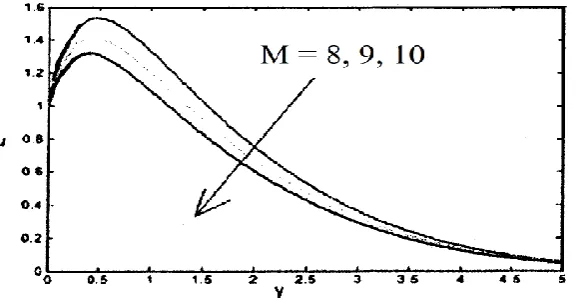
[image:8.595.162.433.58.197.2]Fig. 10. Velocity versus y for Gr=10, Gm=10, Pr=0.71, Sc=0.6, Re=1, Q=5, Sr=1, t=0.8
[image:8.595.157.447.568.721.2]Figures 10and 11 present how the fluid velocity is affected by applied magnetic field for the cases 0< t≤1 and t> 1 respectively. These two figures uniquely show that an increase in the Hartmann number results in a steady decrease in the fluid velocity thereby reducing the thickness of the velocity boundary layer. These two figures further reveal that the fluid velocity first increases in a thin layer adjacent to the plate and there after it decreases asymptotically as we move away from the plate indicating the fact that the buoyancy force has a significant effect on the flow near the plate and its effect is mollified in the free stream.
Fig. 12. Coefficient of skin friction versus Re for Gr=10, Gm=10, Pr=0.71, Sc=.6, Q=5, Sr=1, t=0.8
Fig. 13. Coefficient of skin friction versus Re for Gr=10, Gm=10, Pr=0.71, Sc=.6, Q=5, Sr=1, t=1.2
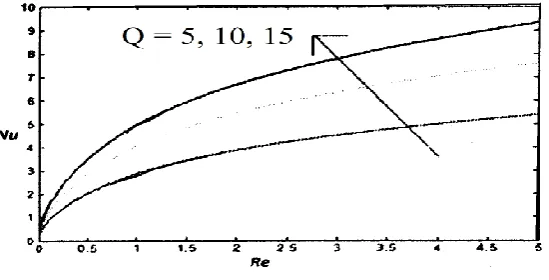
[image:9.595.167.442.608.748.2]Figures 12 and 13 demonstrate the effect of the Hartmann number M and Reynolds number Re on the skin friction at the plate in the direction of the plate velocity. Both the figures indicate that the magnitude of shear stress at the plate is considerably increased with the increase in M and Re.The effects of the radiation parameter Q and the Reynolds number Re on the co-efficient of the rate of heat transfer in terms of the Nusselt number Nu have been displayed in figures 14 and15. These figures predict that Nu is constantly increased for increasing Q or Re.This simulates that the high radiation or small viscosity leads the substantial rise in the heat transfer rate. The effect of Schmidt number on the rate mass transfer from the plate to the fluid for both ramped temperature and isothermal plate has been visualized in figures 16 and 17. Both the figures exhibit that rate of mass transfer coefficients gets enhanced for increasing Sc as well as Re. It is recalled the that Sc increases means mass diffusion decreases i.e. the rate of mass flux falls as the mass diffusivity increases for both the cases(ramped and isothermal).
Fig. 15. Nusselt number versus Re for Pr=0.71, t=1.2
Fig. 16. Sherwood number versus Re for Pr=0.71, Q=5, Sr=1, t=0.8
Fig. 17. Sherwood number versus Re for Pr=0.71, Q=5, Sr=1, t=1.2
The same figures also establish the fact that the Sherwood number Sh increases comprehensively for increasing Reynolds number. In other words the rate of mass transfer rises for low viscosity. Further it is noticed that the effect of Schmidt number on Sherwood number is almost nil for small values of Re (i.e. for high viscosity).
Conclusion
The imposition of the transverse magnetic field retards the flow. As a consequence of this, the growth of thickness of the velocity boundary layer is prevented to some extent which in turn stabilizes the flow.
Magnitude of velocity increases for higher value of Darcy number.
Large value of prandtl number, small viscosity or high radiation causes the fluid temperature to fall and thereby reduces the thickness of the thermal boundary layer.
Magnitude of shear stress at the plate is considerably increased due to application of transverse magnetic field.
High radiation or small viscosity leads the substantial rise in the heat transfer rate.
Rate of mass flux increases with the increase the values of Schmidt number.
[image:10.595.160.445.413.561.2]NOMENCLATURE
is the Magnetic induction vector,
is the strength of the applied magnetic field, is the specific heat at constant pressure,
̅ is the species concentration,
is the coefficient of chemical molecular diffusivity,
is the coefficient of chemical thermal diffusivity, is the electric field,
is the Plank function,
̅
is the Laplace transform of f,
is the gravitational acceleration vector, Gr is the Grashof number for Heat transfer, Gm is the Grashof number for Mass transfer,
is the current density vector, K is the thermal conductivity, M is the Hartmann number, Pr is the Prandlt number, P is the pressure,
is the fluid velocity vector, Q is the radiation parameter,
is the radiative flux, Re is the Reynolds number, t1 is the time,
is the characteristic time, is the reference temperature,
∞ is the temperature far away from the plate,
T is the non dimensional time, T1 is the fluid temperature,
is the plate velocity, is the fluid density,
µ is the co-efficient of viscosity, σ is the electrical conductivity,
is the viscous dissipation of energy per unit volume,
∞ is the density far away from the plate,
is an element of the outward normal,
is the volumetric co-efficient of thermal expression, λ is the wave length,
is the non-dimensional temperature, is the non dimensional concentration,
APPENDIX
Ψ = f (PrRe, Q Re, y, t),Ψ = f (PrRe, Q Re, y, t 1) H (t 1), Ψ = f (ScRe, y, t),
Ψ =f (ScRe, y, t 1) H (t 1),Ψ = (ScRe, y, t), Ψ = (ScRe, y, t 1) H (t 1),
Ψ = (ScRe, , y, t),Ψ = (ScRe, , y, t 1)H(t 1),Ψ = (PrRe, Q Re, y, t),
Ψ = (PrRe, Q Re, y, t 1) H (t 1) , Ψ = (PrRe, QRe , y, t),
Ψ = (PrRe, QRe , y, t 1) H (t 1), Ψ = (Re, MRe, y, t),
Ψ = (Re, M Re, y, t 1) H (t 1), Ψ = (Re, MRe , y, t),
Ψ = (Re, M Re, , y, t 1) H (t 1), Ψ = f (Re, M Re, y, t),
Ψ =f (Re, M Re, y, t 1) H (t 1), Ψ = (Re, ,y, t),
Ψ = (Re, M Re, , y, t 1) H (t 1), Ψ = (PrRe, QRe , y, t),
Ψ = (PrRe, Q Re, , y, t 1) H (t 1) , Ψ = (ScRe, , y, t),
Ψ = (ScRe, , y, t 1) H (t 1),
=ScSrPrRe, =PrRe–ScRe, = , =QRe, = PrR Q, = ,
= , = , = , = + , = 1 ,
= PrRe – Re, = PrR Q MR , =Gr+Gm , = ScRe –Re,
=MR , = , = , = , = ,
= , = , = , = , = Gm ,
= , = , =Gm , = , = , = , = , =
, = , = , = , = , = , = , = ,
= + , = + + , = ,
= , = , = ,
= , = , = + , = + , = + ,
Ψ = (ScRe, t), Ψ = (ScRe, t 1) H (t 1), Ψ = (PrRe, QRe, t),
Ψ = (PrRe, QRe, t 1) H (t 1),Ψ =Ω(Sc, Re, t),Ψ =Ω(Sc, Re, t 1) H (t 1),
Ψ =Φ(PrRe,QRe,t),Ψ =Φ(PrRe,QRe,t 1)H(t 1),
Ψ =Φ(PrRe, QRe , t), Ψ = Φ(PrRe, QRe , t 1) H (t 1),
Ψ = Φ(ScRe, , t),Ψ = Φ(ScRe, , t 1) H (t 1), Ψ =Φ(Re, MRe, t),
Ψ = Φ(Re, MRe, t 1) H (t 1), Ψ = Φ(Re, MRe , t),
Ψ = Φ(Re, MRe , t 1) H (t 1), Ψ = (Re, MRe, t),
Ψ = (Re, MRe, t 1) H (t 1), Ψ = Φ(Re, MRe , t),
Ψ = Φ(Re, MRe , t 1) H (t 1), Ψ = Φ(Re, MRe , t),
Ψ = Φ(Re, MRe , t 1) H (t 1), Ψ = Φ(PrRe, QRe , t),
Ψ = Φ(PrRe, QRe , t 1) H (t 1), Ψ = Φ(ScRe, , t),
Ψ = Φ(ScRe, , t 1) H (t 1),
( , , y,t)=
√ + + √
f ( , ,y,t) = + erfc
√ + + erfc √
Ω ( , , t) = , ( , t) = 2 , Φ( , ,t) =
√ –erf ( )
( , , t) = – + erf , H (t 1) = 0, < 1
REFERENCES
Ahemed, N., Kalita, H. and Baruah, D.P. 2010. Unsteady MHD free convective flow past a vertical porous plate immersed in a porous mediu with Hall current, thermal diffusion and heat transfer, Int. J Engg science and Technology, 2(6), 59-74.
Ahmed, N. 2012. Soret And Radiation Effects on Transient MHD Free Convection from an Impulsively Started Infinite Vertical
Plate, J. of Heat Trans. (ASME) 134/062701-1-9. DOI: 10. 1115/1.4005749.
Ahmed, N. and Sarmah, H.K. 2009. Thermal Radiation Effect on a Transient MHD Flow with Mass Transfer Past an Impulsively Fixed Infinite Vertical Plate, Int.J.of Appl.Math and Mech., 5(5), 87-98.
Ahmed, S. and Battin, A. 2010. Analytical model of MHD mixed convective radiating fluid with viscous dissipative heat,
International journal of Engineering Science and Technology, 2(9), 4902-4911.
Alfven, H. 1942. Discovery of Alfven waves, Nature 150,405.
Anwar, K.1998. MHD unsteady free convection flow past a vertical porous plate, JAMM, 78, 255-270.
Cheng, P. and Pop, I. 1984. Transient free convection about vertical flat plate embedded in a porous medium, International
journal of Engineering Sciences, 22, 253-264.
Cheng, P.and Pop, I. 1984. Transient free convection about vertical flat plate embedded in a porous medium, International
journal of Engineering Sciences, 22, 253-264.
Cogley, A.C.L., Vincenti, W.G. and Gilles, E.S. 1968. Differential Approximation for Radiative Heat Transfer in a Grey Gas Near Equilibrium, American Inst. Of Aeronautics and Astronautics, 6(3), 551-553.
Cowling, T.G. 1957. Magnet hydro dynamics, Wiley Inter Science, New York.
Crammer, K.P. and Pai, S.L. 1978. Magneto Fluid Dynamics for Engineers and Applied Physics (Mc. Craw Hill book Co. New York).
Das, S., Jana, M. and Jana, R.N. 2011. Radiation effects on natural convection near a vertical plate embedded in a porous medium with ramped wall temperature, Open Journal of Fluid Dynamics,1,1-11.
Das, U.N., Deka, R.K. and Soundalgekar, V.M. 1996. Radiation effects on flow past an impulsively started vertical plate, Journal
of Theoretical Mechanics, 1(2)111-115.
Ferraro, V.C.A. and Plumpton, C. 1996. An introduction to Magnetic Fluid Mechanics, (Clarandon Press, Oxford).
Ganesan, P. and Loganathan, P. 2002. Radiation and Mass Transfer Effects on Flow of an Incompressible Viscous Fluid Past a Moving Vertical Cylinder, Int. J. Heat and Mass Transfer, 45(21), 4281-4288.DOI: 10.1016/S 0017-9310(02) 00140-0. Makinde, O.D. 2005. Free Convection Flow with Thermal Radiation and Mass Transfer Past a Moving Vertical Porous Plate, Int.
Comm. In Heat and Mass transfer, 32(10) 1411-1419. DOI: 10. 1016 / j. icheat mass transfer.2005.07.005.
Mansour, M.A. 1990. Radiation and Free Convection Effects on the Oscillating Flow Past a Vertical Plate, Astrophysics and Science, 166(2), 269-275, DOI: 10.1007/BF01094898.
Mbeledogu, I.U., Amakiri, A.R.C. and Ogulu, A. 2007. Unsteady MHD Free Convection Flow of a Compressible Fluid Past a Moving Vertical Plate in the Presence of Radiative Heat Transfer,Int. J. Heat and Mass Trans., 50, 9-10, 326-331, DOI: 10. 1016/j.ijheatmasstransfer. 2006.10.032.
Nield, A. 2008. D0nald, Impracticality of MHD Convection in a Porous Medium, Transp. Porous Med, 73, 379-380, DOI 10.1007/s11242-007-9181-9.
Orphan, A. and Ahmet, K. 2008. Radiation Effect on MHD Mixed Convection Flow about a Permeable Vertical Plate, Heat and Mass Trans., DOI: 10.1007/S00231-008-0428-y.
Prasad, V.R.N.B. 2006. Reddy and Muthucumaraswamy, Transient Radiative Hydro magnetic Free Convection Flow Past an Impulsively Started Vertical Plate with Uniform Heat and Mass Flux, Theo.Appl.Mech. 33(1), 2006, 31-63.
Raptis, A. and Perdikis, C. 1999. Radiation and Free Convection Flow Past a Moving Plate, Appl. Mech And Engineering, 4(4), 817-821.
Samad, M.A. and Rahman, M.M. 2006. Thermal Radiation Interaction with Unsteady MHD Flow Past A Vertical Porous Plate Immersed in A Porous Medium, J. of Naval Architecture and Marine Engineering, 3(1), 7-14.
Sattar, M.A. and Kalim, H. 1996. Unsteady Free-Convection Interaction with Thermal Radiation in a Boundary Layer Flow Past a Vertical Porous Plate, J. of mathematical Phy. 30, 25-37.
Sattar, M.A. and Meleque, M.A. 2000. Unsteady MHD Natural Convection Flow Along an Accelerated Porous Plate with Hall current and Mass Transfer in a Rotating Porous Medium, J. Of Energy, Heat and Mass Transfer, 22, 2000, 67-72.
Seth, G.S. Nandkeolyan, R. and Ansari, M.S. 2011. Effects of rotation on unsteady hydro magnetic natural convection flow past an impulsively moving vertical plate with ramped temperature in a porous medium with thermal diffusion and heat absorption,
int. j .of Appl. Math and Mech, 7(21), 52-69.
Shercliff, J.A. 1965. A Text Book of Magneto hydrodynamics, (Pergomon Press, London).
Takhar, H.S., Gorla, R.S.R. and Sundalgekar, V.M. 1996. Radiation Effects on MHD Free Convection Flui Flow of a Radiating Gas Past a Semi Infinite Vertical Plate, Int. J. Numerical Methods Heat Fluid Flow, 6, 77-83.