0095-1137/05/$08.00⫹0 doi:10.1128/JCM.43.1.259–270.2005
Copyright © 2005, American Society for Microbiology. All Rights Reserved.
Characterization of Sucrose-Negative
Pasteurella multocida
Variants,
Including Isolates from Large-Cat Bite Wounds
Henrik Christensen,
1* Magne Bisgaard,
1Øystein Angen,
2Wilhelm Frederiksen,
3and
John Elmerdahl Olsen
1Department of Veterinary Pathobiology, The Royal Danish Veterinary and Agricultural University, Frederiksberg,1Danish
Food and Veterinary Research, Copenhagen,2and Rødding Tværvej 3, Rødding,3Denmark
Received 16 July 2004/Returned for modification 29 August 2004/Accepted 12 September 2004
To validate the identification ofPasteurella multocida-like bacteria negative for acid formation from sucrose, including isolates from bite wounds caused by large cats, 17 strains were phenotypically and genotypically characterized. Phylogenetic analysis of partially sequencedrpoBandinfBgenes showed the monophyly of the strains characterized and the reference strains ofP. multocida. The sucrose-negative strains formed two groups, one related to reference strains ofP. multocidaand the other related to a separate species-like group (taxon 45 of Bisgaard). DNA-DNA hybridization further documented the species-like nature of this group. Ribotyping showed the heterogeneity of all strains except four strains that shared the same ribotype and that were isolated from bovine lungs. Phylogenetic analysis by 16S rRNA sequence comparison showed the monophyly of the strains characterized and the reference strains ofP. multocida. Two strains isolated from leopard bite wounds were related to the type strain ofP. dagmatis; however, they represented a new taxon (taxon 46 of Bisgaard), in accordance with their distinct phenotypic and genotypic identifications. The present study documents that sucrose-negative strains ofP. multocida-like bacteria belong to two genotypically distinct groups. The study further confirms the phenotypic heterogeneity ofP. multocidastrains and documents two new species-like taxa
ofPasteurellarelated toP. multocida. Until diagnostic tools have been further elaborated, special care should
be taken in the identification ofPasteurella-like bacteria isolated from bite wounds caused by large cats. The evidence of phenotypic and genotypic divergence calls for the further development of PCR tests and DNA sequencing to document doubtful isolates.
Pasteurella multocidahas been isolated from a multitude of
hosts (26), and different lineages ofP. multocidamay be re-sponsible for various diseases in both birds and mammals (9, 15). Human infections withP. multocidaare in most cases of animal origin and are most often related to the bites of carni-vores. However, other types of infections are also occasionally reported (25, 28, 34).
Significant variations in the phenotypic properties ofP.
mul-tocida have been reported (27), leading to confusion in the
definition and identification of this organism. Mutters et al. (37) reclassified the genus Pasteurellaon the basis of DNA-DNA hybridization studies. Three clusters of P. multocida
showing 84 to 100, 91 to 100, and 89 to 100% DNA reassocia-tion between strains subsequently described as P. multocida
subsp.multocida,P. multocidasubsp.gallicida, andP. multo-cidasubsp.septica, respectively, were identified. Representa-tives of the existing capsular types were found to be closely related on the basis of DNA-DNA hybridization (44), despite the diversity of disease manifestations and hosts. This is con-tradictory to the diversity shown by outer membrane protein profiling (17, 18, 19), multilocus enzyme electrophoresis (5), and ribotyping (43). The study of Petersen et al. (43) showed a great diversity of ribotypes among strains classified asP.
mul-tocida subsp.multocida, P. multocida subsp.gallicida, and P.
multocida subsp. septica. However, comparisons of the
se-quences of the 16S rRNA gene and the atpD gene (which encodes thesubunit of ATP synthase) confirmed the overall homogeneity ofP. multocida(43). The study of Kuhnert et al. (33) also showed that variant phenotypes of P. multocida
shared at least 98.5% 16S rRNA sequence similarity with the recognized subspecies of this species.
P. aviumandP. caniswere reported as new species by
Mut-ters et al. (36, 37). Both species were separated into two bio-vars. Strains of P. canisbiovar 2 and P. aviumbiovar 2 and strains ofP. multocidadeviating in key phenotypic characters were subsequently genotyped to examine their relationship
with P. multocida (13). Surprisingly, these investigations
al-lowed the reclassification ofP. multocidato include biovars 2 of bothP. aviumandP. canis, and on the basis of this back-ground, the existence of biovars 2 ofP. aviumandP. caniswas questioned. The redefined speciesP. multocidais genotypically homogeneous, although phenotypically diverse lineages exist with respect to the key characteristics ornithine decarboxylase, indole, and mannitol fermentation, which have been regarded as essential for identification of P. multocida to the species level (13).
P.multocidaandP.multocida-like bacteria have occasionally
been isolated from the wounds of humans bitten by large cats, like lions and tigers (6, 25, 29, 48, 50). Similar organisms have also been isolated from the dental-gingival junction of several species of large cats (50). The majority of these isolates do not ferment sucrose (25, 50) and, consequently, differ from
Pas-teurellasensu stricto, which is defined as sucrose positive (9).
Strain SSI P 876, proposed as “P. leonis” (Table 1), was iso-lated from a man bitten by a lion, and this strain was found to * Corresponding author. Mailing address: Department of
Veteri-nary Pathobiology, The Royal Danish VeteriVeteri-nary and Agricultural University, Stigbøjlen 4, 1870 Frederiksberg C, Denmark. Phone: 45 35282783. Fax: 45 35282757. E-mail: [email protected].
259
on May 16, 2020 by guest
http://jcm.asm.org/
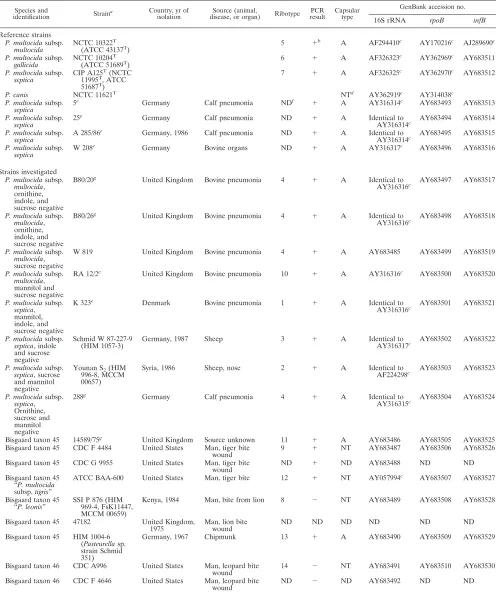
Species and
identification Strain
a Country, yr of isolation
Source (animal,
disease, or organ) Ribotype PCR result
Capsular type
GenBank accession no.
16S rRNA rpoB infB
Reference strains P. multocidasubsp.
multocida NCTC 10322
T
(ATCC 43137T) 5 ⫹
b
A AF294410c
AY170216c
AJ289690c
P. multocidasubsp. gallicida
NCTC 10204T
(ATCC 51689T
)
6 ⫹ A AF326323c AY362969c AY683511
P. multocidasubsp.
septica CIP A125
T
(NCTC 11995T, ATCC
51687T
)
7 ⫹ A AF326325c
AY362970c
AY683512
P. canis NCTC 11621T
NTd
AY362919c
AY314038c P. multocidasubsp.
septica 5 e
Germany Calf pneumonia NDf ⫹
A AY316314c
AY683493 AY683513
P. multocidasubsp. septica
25e Germany Calf pneumonia ND ⫹ A Identical to
AY316314c AY683494 AY683514 P. multocidasubsp.
septica A 285/86 e
Germany, 1986 Calf pneumonia ND ⫹ A Identical to
AY316314c AY683495 AY683515 P. multocidasubsp.
septica
W 208e Germany Bovine organs ND ⫹ A AY316317c AY683496 AY683516
Strains investigated P. multocidasubsp.
multocida, ornithine, indole, and sucrose negative
B80/20g United Kingdom Bovine pneumonia 4 ⫹ A Identical to
AY316316c AY683497 AY683517
P. multocidasubsp. multocida, ornithine, indole, and sucrose negative
B80/26g United Kingdom Bovine pneumonia 4 ⫹ A Identical to
AY316316c AY683498 AY683518
P. multocidasubsp. multocida, sucrose negative
W 819 United Kingdom Bovine pneumonia 4 ⫹ A AY683485 AY683499 AY683519
P. multocidasubsp. multocida, mannitol and sucrose negative
RA 12/2e United Kingdom Bovine pneumonia 10 ⫹ A AY316316c AY683500 AY683520
P. multocidasubsp. septica, mannitol, indole, and sucrose negative
K 323e
Denmark Bovine pneumonia 1 ⫹ A Identical to
AY316316c AY683501 AY683521
P. multocidasubsp. septica, indole and sucrose negative
Schmid W 87-227-9
(HIM 1057-3) Germany, 1987 Sheep 3 ⫹ A Identical toAY316317c AY683502 AY683522
P. multocidasubsp. septica, sucrose and mannitol negative
Younan S2(HIM
996-8, MCCM 00657)
Syria, 1986 Sheep, nose 2 ⫹ A Identical to
AF224298c AY683503 AY683523
P. multocidasubsp. septica, Ornithine, sucrose and mannitol negative 288g
Germany Calf pneumonia 4 ⫹ A Identical to
AY316315c AY683504 AY683524
Bisgaard taxon 45 14589/75g United Kingdom Source unknown 11 ⫹ A AY683486 AY683505 AY683525
Bisgaard taxon 45 CDC F 4484 United States Man, tiger bite wound
9 ⫹ NT AY683487 AY683506 AY683526
Bisgaard taxon 45 CDC G 9955 United States Man, tiger bite
wound ND ⫹ ND AY683488 ND ND
Bisgaard taxon 45 “P. multocida subsp.tigris”
ATCC BAA-600 United States Man, tiger bite 12 ⫹ NT AY057994c AY683507 AY683527
Bisgaard taxon 45 “P. leonis”
SSI P 876 (HIM 969-4, FsK11447, MCCM 00659)
Kenya, 1984 Man, bite from lion 8 ⫺ NT AY683489 AY683508 AY683528
Bisgaard taxon 45 47182 United Kingdom,
1975
Man, lion bite wound
ND ND ND ND ND ND
Bisgaard taxon 45 HIM 1004-6 (Pasteurellasp. strain Schmid 351)
Germany, 1967 Chipmunk 13 ⫹ A AY683490 AY683509 AY683529
Bisgaard taxon 46 CDC A996 United States Man, leopard bite wound
14 ⫺ NT AY683491 AY683510 AY683530
Bisgaard taxon 46 CDC F 4646 United States Man, leopard bite
wound ND ⫺ ND AY683492 ND ND
a
ATCC, American Type Culture Collection; NCTC, National Collection of Type Cultures; CIP, Collection de I’Institut Pasteur; HIM, Hygienischer Institut Marburg; MCCM, Microbiology Culture Collection Marburg; CDC, Centers for Disease Control and Prevention; SSI, Statens Serum Institut.
b⫹, positive reaction by the
P. multocida-specific PCR of Miflin and Blackall (35). c
Accession number of a sequence determined in a previous report. d
NT, no type obtained by the capsular PCR test. e
From an earlier investigation by Christensen et al. (13). f
ND, not determined. g
From an earlier investigation by Bisgaard et al. (4).
260
on May 16, 2020 by guest
http://jcm.asm.org/
[image:2.585.45.541.57.650.2]be genotypically related to P. multocida (30); however, the polyamine pattern of the strain differed from that of the type strain (7). Strain ATCC BAA 600 (Table 1) was isolated from a girl bitten by a tiger. The name “Pasteurella multocidasubsp.
tigris” was proposed for this strain on the basis of phenotypic
characterization and 16S rRNA gene sequence comparisons (8). The phenotypic characteristics reported were in accor-dance with those ofP. multocida, except for the lack of fer-mentation of sucrose and mannitol, the ferfer-mentation of which being which specific characteristics ofP. multocida(39). Dis-regarding the results for sucrose and mannitol fermentation, the combination of sorbitol fermentation and a lack of dulcitol, xylose, and trehalose fermentation would have identified the isolate asP. multocidasubsp.multocida(39).
Among 1,268 cultures ofP. multocidacharacterized by Hed-dleston (27), none were reported to be sucrose negative. Among some 1,500 strains characterized in the laboratory of one of the authors (M. Bisgaard, unpublished data), only 17 were sucrose negative.
The objective of the present study was to characterize su-crose-negative variant strains ofP. multocida-like bacteria, in-cluding isolates obtained from large cats, in order to investi-gate their taxonomic position and host relationship and to identify methods for the identification of these bacteria.
MATERIALS AND METHODS
Selection of bacterial strains and phenotypic characterization.A total of 25 bacterial strains were investigated, including reference strains and strains that have been described previously (4, 8, 13) (Table 1). Phenotypic characterization of 15 strains was performed on the basis of 79 characteristics, as reported previously (4).
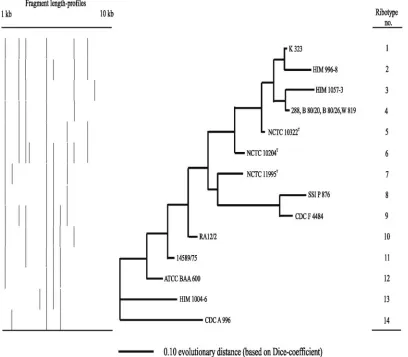
Ribotyping.Ribotyping of 17 strains selected to represent phenotypic variants, including type strains of the three subspecies ofP. multocida, was done as described by Christensen et al. (16). Briefly, 6g of DNA was digested with the HpaII enzyme (New England Biolabs, Beverly, Mass.) at 37°C for 2 h. The digests were separated on a 0.8% agarose gel for 16 h at 35 V. The gel was stained in ethidium bromide, and the DNA was vacuum blotted onto a nitrocel-lulose filter. The filter was reacted with a 16S-23S rRNA-specific probe overnight at 56°C. Ribotype patterns were rendered visible with a digoxigenin wash and block buffer kit (Roche A/S, Hvidovre, Denmark), according to the instructions of the manufacturer. BacteriophageDNA digested with HindIII (New England Biolabs) was included as a size marker. Ribotype patterns were analyzed with Gelcompar software (version 4.0; Applied Maths, Kortrijk, Belgium), and Dice coefficients were used to construct a neighbor-joining dendrogram with the PHYLIP software package (24).
Sequencing of 16S rRNA,rpoB, andinfBgenes.The 16S rRNA gene sequences of 18 strains were determined, and therpoBandinfBsequences of 21 strains were compared (Table 1). The bacteria were cultured overnight in brain heart infusion broth (Difco, Detroit, Mich.) at 37°C. The fragments amplified by PCR were purified and cycle sequenced on an automatic sequencer (ABI 377; Chem-istry Guide; Applied Biosystems, Foster City, Calif.), as described recently (14, 31, 40). DNA sequencing resulted in at least 1,278, 470, and 446 bp of the 16S rRNA,rpoB, andinfBgenes, respectively.
Analysis of sequence data.Searches for homologous DNA sequences in the GenBank database were performed with the BLAST program (1). Pairwise similarities were calculated with the BESTFIT program (Wisconsin Sequence Analysis Package; Genetics Computer Group, Madison, Wis.). Phylogenetic analysis by parsimony analysis was performed with the PROTPARS and CON-SENSE programs with the default settings included with the PHYLIP package (24). Maximum-likelihood analysis, including bootstrap analysis, was performed with fastDNAml software (41) run on a Linux (version 7.2)-compatible server.
DNA-DNA hybridization.DNA-DNA hybridization was determined for 11 pairs of strains by the microwell method (11) with the modifications reported previously (13), including growth with EDDA (ethylenediamine-N,N⬘-diacetic acid) and hyaluronidase to limit capsule formation of isolates with capsular type A.
P. multocida-specific PCR and capsular typing by PCR.The PCR procedure of Miflin and Blackall (35) was followed, as reported recently (13). Briefly, a loopful of an overnight culture was taken from the surface of a blood agar plate and suspended in sterile water. The suspension was boiled, the cells were spun down, and the supernatant was used as the template for the PCR. PCR was performed with primers PM23F1 and PM23R2 (35). After electrophoresis and ethidium bromide staining, an amplicon of 1,432 bp could be visualized under UV light. Capsular typing by PCR was performed as described by Townsend et al. (49).
ITS analysis.PCR typing by the 16S-23S rRNA internal transcribed spacer (ITS) analysis approach was performed for five strains, as reported by Chris-tensen et al. (13).
Nucleotide sequence accession numbers.The nucleotide sequences described in this report have been deposited in GenBank under accession numbers AY683485 to AY683530 and are indicated in Table 1 and Fig. 2 to 4.
RESULTS
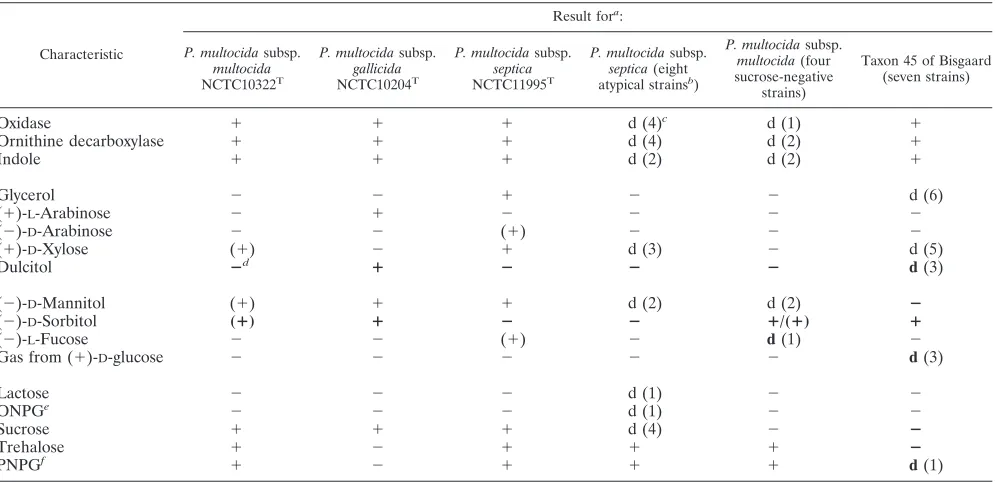
Phenotypic characterization.Seventeen of the 79 character-istics investigated varied between the 22 strains analyzed (Ta-ble 2), all of which were in accordance with the species de-scription ofP. multocidadescribed by Mutters et al. (39) and Christensen and Bisgaard (9) (Table 2). Eight and four strains were classified asP. multocidasubsp.septicaandP. multocida
subsp.multocida, respectively, while nine strains remained un-classified. Seven of these were phenotypically related to P.
multocida subsp. gallicida but could be separated from this
subspecies by sucrose and glycerol utilization, and some could be separated by the formation of gas from (⫹)-D-glucose
(Ta-ble 2). These organisms, tentatively named Bisgaard taxon 45, were obtained from tiger (n⫽3) and lion (n⫽2) bite wounds in humans, a chipmunk, and an unknown source. Two strains, both of which were obtained from leopard bite wounds in humans, also remained unclassified. Both of these isolates dif-fered from the type strain of P. dagmatis in (⫺)-D-sorbitol,
sucrose, and trehalose fermentation, key characteristics for the separation of members of the familyPasteurellaceae. For the same reasons mentioned above, these organisms might repre-sent a new taxon and are consequently named Bisgaard taxon 46.
Ribotyping.Seventeen strains were compared by ribotyping, including the three type strains ofP. multocida. Between three and nine bands were registered at 13 positions in 14 ribotypes (Fig. 1). One band of approximately 5 kb was common to all strains. One group included the two type strains ofP. multocida
subsp.multocidaand P. multocida subsp.gallicidaand seven other strains, all of which were sucrose negative. These nine strains were closely related and shared at least four bands. Four strains even shared the same ribotype. The remaining strains were less uniform with respect to ribotype. This group included taxa 45 and 46; however, strain RA 12/2 ofP. multo-cidasubsp. multocida was also located with these strains by ribotyping.
16S rRNA sequence comparison.Identical 16S rRNA gene sequences were found between sucrose-negative strains HIM 996-8 and 288 and sucrose-positive strain 214 (GenBank ac-cession no. AF224298) (13). Strains B 80/20, B 80/26, and K 323 had the same sequence as previously sequenced strain RA12/2 (GenBank accession no. AY316316) (13), and strain HIM 1057-3 showed a sequence identical to the previously published sequence of sucrose-positive strain W208 (GenBank accession no. AY316317) (13). This shows that
on May 16, 2020 by guest
http://jcm.asm.org/
tive and -negative isolates can have identical 16S rRNA se-quences.
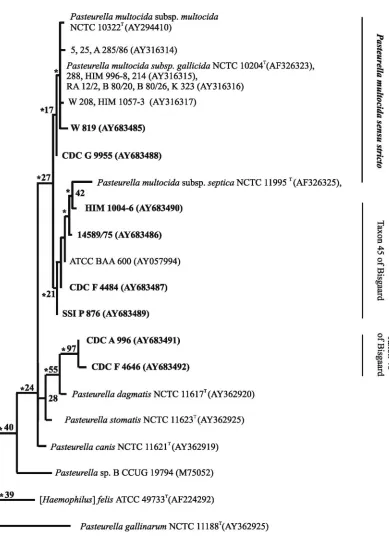
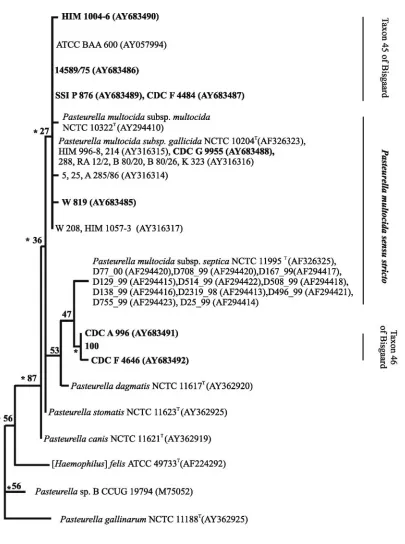
The phylogenetic analysis based on 16S rRNA gene se-quence comparison showed the monophyly of all strains ofP.
multocida, including the sucrose-negative variants of bothP.
multocidaand taxon 45 (Fig. 2, left panel). The level of 16S
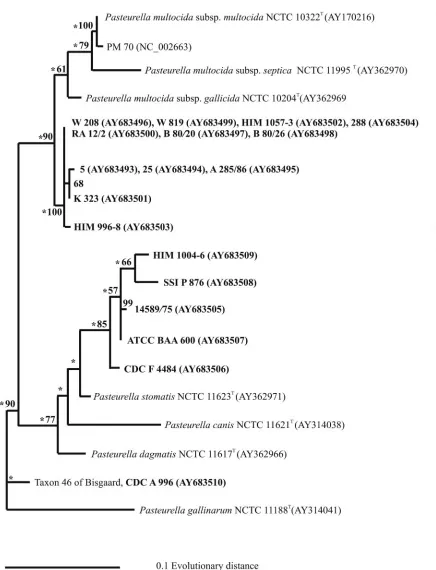
rRNA gene sequence similarity was 98.4% or higher within this group, and the level of similarity was at least 98.6% between all the strains and the type strain ofP. multocida. If only the type strain ofP. multocidasubsp.septicawas included in the phy-logenetic analysis, a tendency for two subgroups to appear within the majorP. multocidagroup was observed (Fig. 2, left panel). Strains classified as taxon 45 (strains ATCC BAA 600, 14589/75, SSI P 876, HIM 1004-6, and CDC F 4484) and the type strain ofP. multocidasubsp.septicashowed at least 99.4% gene sequence similarity. At least 98.4% similarity was found between this group and the other group, including the type strains of the other two subspecies. Low bootstrap values were found for this tree, including the node supporting the two groups ofP. multocida-like strains. The reason for these low bootstrap values was probably the low levels of sequence vari-ation. For this reason the position ofP. multocidasubsp. sep-ticashould also be taken with caution. Repeat analysis after the inclusion of 11 additionalP. multocidasubsp. septica se-quences published previously by Kuhnert et al. (33) changed the positions of the type strain and related strains such that they formed a new group with strain CDC A 996 and CDC F 4646 (taxon 46) and the type strain ofP. dagmatis(Fig. 2, right panel). In this new version of the tree, the remaining strains of
P. multocidacould no longer be separated from taxon 45.
The two strains of taxon 46 formed a monophyletic group with the type strain ofP. dagmatisif only the type strain ofP.
multocidasubsp.septicawas included (Fig. 2, left panel). The
highest degree of similarity found for strain CDC A 996 was to strain F 4646 (99.6%) and the type strain of P. dagmatis
(98.4%). At most, 97.4% similarity to the sucrose-negative and -positive strains ofP. multocidainvestigated was found.
The reason for the instability of the phylogenetic trees based on 16S rRNA sequences when a few more related strains are included is probably caused by a low degree of sequence vari-ation. For this reason, sequencing of the housekeeping genes
infBandrpoBwas initiated.
infB and rpoB sequence comparison. The two groups of
sucrose-negative strains found by ribotyping (except for RA 12/2) were also recognized by phylogenetic analysis of partially sequencedinfBandrpoBgenes (Fig. 3 and 4). The four strains
ofP. multocidaisolated from wounds caused by large-cat bites
and the strain isolated from a chipmunk formed their own monophyletic group. This group was provisionally named taxon 45 of Bisgaard by phenotypic classification (see above). Strains classified as Bisgaard taxon 46 and represented by strain CDC A 996 were place into a group unrelated toP.
multocidaand taxon 45, and comparison of therpoBandinfB
sequences did not allow classification of Bisgaard taxon 46 with
P. dagmatis(Fig. 3 and 4).
[image:4.585.45.546.80.321.2]DNA-DNA hybridization.On basis of the present results and results published by Eckert et al. (22), Stenzel (47), and Chris-tensen et al. (13), an overall high degree of DNA reassociation of at least 78% seems to exist for strains classified in the single subspecies ofP. multocida (Table 3), in accordance with the TABLE 2. Variable phenotypic characteristics ofP. multocidaand taxon 45 of Bisgaard
Characteristic
Result fora:
P. multocidasubsp. multocida NCTC10322T
P. multocidasubsp. gallicida NCTC10204T
P. multocidasubsp. septica NCTC11995T
P. multocidasubsp. septica(eight atypical strainsb)
P. multocidasubsp. multocida(four sucrose-negative
strains)
Taxon 45 of Bisgaard (seven strains)
Oxidase ⫹ ⫹ ⫹ d (4)c d (1) ⫹
Ornithine decarboxylase ⫹ ⫹ ⫹ d (4) d (2) ⫹
Indole ⫹ ⫹ ⫹ d (2) d (2) ⫹
Glycerol ⫺ ⫺ ⫹ ⫺ ⫺ d (6)
(⫹)-L-Arabinose ⫺ ⫹ ⫺ ⫺ ⫺ ⫺
(⫺)-D-Arabinose ⫺ ⫺ (⫹) ⫺ ⫺ ⫺
(⫹)-D-Xylose (⫹) ⫺ ⫹ d (3) ⫺ d (5)
Dulcitol ⴚd ⴙ ⴚ ⴚ ⴚ d(3)
(⫺)-D-Mannitol (⫹) ⫹ ⫹ d (2) d (2) ⴚ
(⫺)-D-Sorbitol (ⴙ) ⴙ ⴚ ⴚ ⴙ/(ⴙ) ⴙ
(⫺)-L-Fucose ⫺ ⫺ (⫹) ⫺ d(1) ⫺
Gas from (⫹)-D-glucose ⫺ ⫺ ⫺ ⫺ ⫺ d(3)
Lactose ⫺ ⫺ ⫺ d (1) ⫺ ⫺
ONPGe ⫺ ⫺ ⫺ d (1) ⫺ ⫺
Sucrose ⫹ ⫹ ⫹ d (4) ⫺ ⴚ
Trehalose ⫹ ⫺ ⫹ ⫹ ⫹ ⴚ
PNPGf ⫹ ⫺ ⫹ ⫹ ⫹
d(1)
a⫹, positive within 1 to 2 days; (⫹), positive within 3 to 14 days;⫺, negative after 14 days; d, variable. b
Including four reference strains (Table 1). c
The number of positive strains is given in parentheses. d
Key characteristics used for separation of taxa are in boldface. e
ONPG,-galactosidase test performed witho-nitro-phenyl-D-galactopyranoside. f
PNPG,␣-glucosidase test determined with 4-nitrophenyl-␣-D-glucopyranoside.
on May 16, 2020 by guest
http://jcm.asm.org/
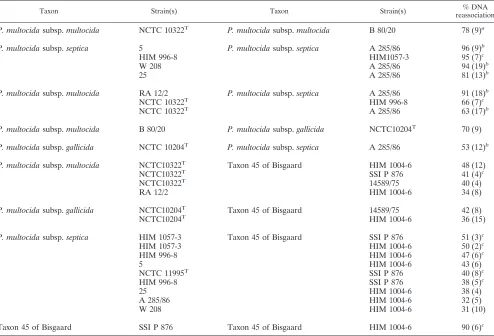
general levels of DNA reassociation of the three subspecies (37). Slightly lower DNA reassociation values were observed between subspecies ofP. multocida, which represent pheno-typically deviating strains. For these strains the rates of DNA reassociation varied between 53 and 91% (Table 3). Strains classified as taxon 45 all showed DNA binding values below the species level (31 to 51%), with the strains representing the three subspecies ofP. multocida; however, 90% DNA reasso-ciation was found between the two strains of taxon 45 (Table 3). When therpoBandinfBsequence analysis results are com-pared with the ribotyping results, taxon 45 seems to differ from
P. multocidaand probably represents a new species-like taxon
ofPasteurella.
PCR. With the exception of a single strain, all strains of taxon 45 surprisingly tested positive by the PCR test of Miflin and Blackall (35) forP. multocida. Both strains of taxon 46 tested negative by the PCR test. In addition, the results of capsular typing remained negative for this taxon; however, negative capsular typing results were also observed for strains of taxon 45. The typeable strains were all of type A.
ITS analysis.ITS analysis showed that strains 288, B 80/20, and B 80/26 had the same profile as the type strain of P.
multocida; however, another profile was found for strains
14589/75 and HIM 1004-6 (data not shown). These results confirm the existence of two groups of sucrose-negative strains that are recognized by ribotyping, rpoB and infB sequence comparison, and DNA-DNA hybridization.
DISCUSSION
The present study has documented that sucrose-negative strains ofP. multocida-like bacteria belong to two genotypically distinct groups. One group that is genotypically similar toP.
multocida contained strains mainly isolated from cows with
pneumonia, whereas the other group was isolated mainly from large-cat bite wounds and formed a new species-like taxon (taxon 45 of Bisgaard). The study supplements previous inves-tigations of phenotypically divergentP. multocidastrains (5, 13, 23, 42), including V factor-dependent strains ofP. multocida
subsp.multocidaisolated from pigs with pneumonia (32). The documentation of phenotypic variations in key characteristics
ofP. multocida, including maltose (42), ornithine
[image:5.585.89.497.71.428.2]decarboxyl-ase, indole, and mannitol (13), and sucrose (the present study) FIG. 1. Genotypic relationships betweenP. multocidaand related atypical strains ofPasteurellainvestigated by ribotyping. Strains with identical profiles for specific ribotypes are indicated at the branch tips. The dendrogram was based on neighbor-joining cluster analysis of the Dice coefficients formed by comparison of the fragment profiles.
on May 16, 2020 by guest
http://jcm.asm.org/
FIG. 2. Phylogenetic relationships between strains ofPasteurella, including the type strain ofP. multocidasubsp.septicaonly (left panel) and 11 additional strains of this taxon (right panel), based on maximum-likelihood analysis of 16S rRNA gene sequences. The support for monophyletic groups by bootstrap analysis is indicated as percentages. Nodes recognized by maximum-parsimony analysis are marked with an asterisk. Strains sequenced in the present study are in boldface type.
on May 16, 2020 by guest
http://jcm.asm.org/
fermentation, makes routine diagnosis on the basis of pheno-typic characteristics difficult and uncertain.
The present investigation confirms previous difficulties asso-ciated with the use of 16S rRNA gene sequence comparisons for separation of the subspecies ofP. multocida, as well as with
the use of phenotypic characteristics for the separation ofP.
gallinarumand related species (12, 43). This problem has also
been reported for other taxa (46). On the basis of 16S rRNA gene sequence comparisons, the four strains of P. multocida
[image:7.585.94.499.58.602.2]subsp.septicawere expected to show a tight relationship with FIG. 2—Continued.
on May 16, 2020 by guest
http://jcm.asm.org/
the type strain of this taxon. Surprisingly, these strains were more closely related toP. multocidasubsp.multocida(Fig. 2). The four strains probably represent sorbitol-negative variants
ofP. multocida subsp. multocida, and they will therefore be
misidentified as P. multocida subsp. septica by phenotyping. Similar observations were made in a previous study (13).
[image:8.585.63.499.62.632.2]The 16S rRNA phylogenetic tree that incorporated all strains ofP. multocidaand related taxa was rather unstable in FIG. 3. Phylogenetic relationships between strains ofPasteurellabased on maximum-likelihood analysis of therpoBgene DNA sequences. The support for monophyletic groups by bootstrap analysis is indicated as percentages. Nodes recognized by maximum-parsimony analysis are labeled with an asterisk. Strains sequenced in the present study are in boldface type.
on May 16, 2020 by guest
http://jcm.asm.org/
relation to perturbations of input sequences (Fig. 2). For this reason, housekeeping gene sequences were compared. The present study is the first to use housekeeping gene sequence comparison for classification of a larger set of strains of P.
multocidaand related bacteria. Davies et al. (20) recently used
housekeeping gene sequence comparison for the diagnostic comparison ofP. multocida isolates. The results for the two genes rpoB and infB analyzed in the present study corre-sponded well, and the analysis seemed to provide a deeper resolution at the species level compared to that achieved by 16S rRNA gene sequence comparison. Recently, infB se-quence comparison has successfully been used for phylogenetic analysis ofHaemophilusand Actinobacillussensu stricto and
rpoBsequence comparison has been used for investigation of
Histophilus somniand members of the familyPasteurellaceae
(3, 14, 31, 40). Although comparison of housekeeping gene sequences has been recommended for classification to the spe-cies level (46), a consensus has not been reached.
[image:9.585.75.498.60.505.2]The results of phenotypic and phylogenetic analyses of se-quences of the housekeeping genesrpoBandinfBpoint to the existence of a new sucrose-negative species ofPasteurella iso-lated mainly from the wounds of bites caused by large cats and tentatively named taxon 45 of Bisgaard. The resolution ob-tained by 16S rRNA sequence analysis did not enable a clear separation of the group fromP. multocida. However, except for one strain, the members of taxon 45 were recognized by ri-botyping. Two strains from the divergent group showed a DNA reassociation rate at the species level of 90% and were well FIG. 4. Phylogenetic relationships between strains ofPasteurellabased on maximum-likelihood analysis of theinfBgene DNA sequences. The support for monophyletic groups by bootstrap analysis is indicated as percentages. Nodes recognized in maximum parsimony analysis are labeled with an asterisk. Strains sequenced in the present study are in bold face type.
on May 16, 2020 by guest
http://jcm.asm.org/
separated from other taxa by less than 51% DNA reassocia-tion. The limit for defining a species on the basis of DNA reassociation within the familyPasteurellaceaehas varied be-tween 80 and 85% (2, 10, 38).
Since “P. multocidasubsp.tigris” strain ATCC BAA 600 (8) was found to be a member of taxon 45 and strain SSI P 876, tentatively named “P. leonis” (47), also belongs to this taxon, priority should be given to SSI P 876 in future studies on the final classification of this taxon. However, it is of vital impor-tance that the present knowledge be used to preserve addi-tional strains from large-cat bite wounds to allow final classi-fication of organisms classified as taxon 45 of Bisgaard.
The polyamine pattern of SSI P 876 deviated significantly from those of the type strains of the subspecies ofP. multocida
(7). The membersP. multocida,P. canis,P. dagmatis, P.
sto-matis, andPasteurellaspecies strain B of 16S rRNA cluster 3B
(21) and strain SSI P 876 mentioned above could all be sepa-rated from most other members of the familyPasteurellaceae
by the presence of the polyaminesym-nor-spermidine (7), sug-gesting that strain SSI P 876 is part of 16S rRNA cluster 3B. Strains HIM 1004-6 and W 208 were included in the study of Schmid et al. (45). Despite their phenotypic variation fromP.
multocida, both strains were found to be closely related to the
type strains of theP. multocidasubspecies by crossed immu-noelectrophoresis analysis, in accordance with the results ob-tained in the present study, including the fact that they belong to capsular type A.
Strains tentatively named taxon 46 seem to represent a new species-like group within the genusPasteurella sensu stricto. These organisms are urease positive and might easily be misi-dentified asP. dagmatissince they are associated with cat-bite lesions in humans. However, this taxon differs fromP. dagmatis
in (⫺)-D-sorbitol, sucrose, and trehalose fermentation; and laboratories that come across similar organisms are encour-aged to keep these isolates or submit them to reference labo-ratories to enable final studies on the classification of this taxon.
The G⫹C contents of strains SSI P 876 and HIM 1004-6 were found to be 37.2 and 41.8 mol%, respectively, and the genome masses were found to be 1.8 and 1.7 GDa, respectively (22, 47). These values are within the range of G⫹C contents of 37.7 to 45.9 mol% and genome masses of 1.4 to 1.9 GDa reported forPasteurellasensu stricto, even though the G⫹C content of strain SSI P 876 is slightly below this limit.
[image:10.585.46.540.81.417.2]Surprisingly, all strains of Bisgaard taxon 45 tested positive for theP. multocidaspecies test of Miflin and Blackall (35), TABLE 3. DNA-DNA hybridization between strains ofP. multocidaand taxon 45 of Bisgaard in relation to that for sucrose-negative variants
Taxon Strain(s) Taxon Strain(s) % DNA
reassociation
P. multocidasubsp.multocida NCTC 10322T P. multocidasubsp.multocida B 80/20 78 (9)a
P. multocidasubsp.septica 5 P. multocidasubsp.septica A 285/86 96 (9)b
HIM 996-8 HIM1057-3 95 (7)c
W 208 A 285/86 94 (19)b
25 A 285/86 81 (13)b
P. multocidasubsp.multocida RA 12/2 P. multocidasubsp.septica A 285/86 91 (18)b
NCTC 10322T HIM 996-8 66 (7)c
NCTC 10322T A 285/86 63 (17)b
P. multocidasubsp.multocida B 80/20 P. multocidasubsp.gallicida NCTC10204T 70 (9)
P. multocidasubsp.gallicida NCTC 10204T P. multocidasubsp.septica A 285/86 53 (12)b
P. multocidasubsp.multocida NCTC10322T Taxon 45 of Bisgaard HIM 1004-6 48 (12)
NCTC10322T SSI P 876 41 (4)c
NCTC10322T 14589/75 40 (4)
RA 12/2 HIM 1004-6 34 (8)
P. multocidasubsp.gallicida NCTC10204T Taxon 45 of Bisgaard 14589/75 42 (8)
NCTC10204T HIM 1004-6 36 (15)
P. multocidasubsp.septica HIM 1057-3 Taxon 45 of Bisgaard SSI P 876 51 (3)c
HIM 1057-3 HIM 1004-6 50 (2)c
HIM 996-8 HIM 1004-6 47 (6)c
5 HIM 1004-6 43 (6)
NCTC 11995T SSI P 876 40 (8)c
HIM 996-8 SSI P 876 38 (5)c
25 HIM 1004-6 38 (4)
A 285/86 HIM 1004-6 32 (5)
W 208 HIM 1004-6 31 (10)
Taxon 45 of Bisgaard SSI P 876 Taxon 45 of Bisgaard HIM 1004-6 90 (6)c
aStandard deviations are given in parentheses. bFrom Christensen et al. (13).
cFrom Eckert et al. (22) and Stenzel (47).
on May 16, 2020 by guest
http://jcm.asm.org/
and the reasons for this remain to be investigated. The test is based on the 23S rRNA gene sequence as a target for the PCR, and sufficient variation might not be present within this gene for separation ofP. multocidafrom taxon 45. Further elabo-ration of DNA sequence-based tests might contribute to a more accurate means of identification of P. multocida and related members of the genusPasteurella.
In conclusion, the present study showed that sucrose-nega-tive variant strains ofP. multocida-like bacteria, including iso-lates obtained from large cats, belong to two taxa. One group of strains mainly isolated from cows with pneumonia belonged
toP. multocida, whereas the other strains mainly isolated from
human bite wounds caused by large cats belonged to a new taxon (taxon 45 of Bisgaard). Two other strains isolated from bite wounds caused by leopards formed a new taxon of
Pas-teurellasensu stricto (taxon 46 of Bisgaard) with similarity toP.
dagmatis. The study showed the limitations of
phenotype-based tests as well as those of genotype-phenotype-based tests, such as 16S rRNA sequence comparison and PCR, for the identification of these bacteria. For the identification of isolates with doubtful identities, the use of a combination of phenotype- and geno-type-based tests test is recommended. Only with the collection and deposition of more isolates like these will further charac-terization in reference laboratories be able to be performed and the taxonomy of these bacteria improved. Further elabo-ration of DNA sequence-based tests, including PCR, might then contribute to a safer means of identification ofP. multo-cidaand related members of the genusPasteurella.
ACKNOWLEDGMENTS
Katrine Madsen and Lisbeth Dam are thanked for excellent techni-cal assistance. Special thanks is given to Paul N. Levett, Special Bac-teriology Reference Laboratory, Centers for Disease Control and Pre-vention (CDC), Atlanta, Ga., for providing access to the CDC strains. The study was financed by the Danish Agricultural and Veterinary Research Council (grant 9702797).
REFERENCES
1.Altschul, S. F., T. L. Madden, A. A. Schaffer, J. Zhang, Z. Zhang, W. Miller, and D. J. Lipman.1997. Gapped BLAST and PSI-BLAST: a new generation of protein database search programs. Nucleic Acids Res.25:3389–3402. 2.Angen, Ø., R. Mutters, D. A. Caugant, J. E. Olsen, and M. Bisgaard.1999.
Taxonomic relationships of the [Pasteurella]haemolyticacomplex as evalu-ated by DNA-DNA hybridizations and 16S rRNA sequencing with proposal ofMannheimia haemolyticagen. nov., comb. nov.,Mannheimia granulomatis comb. nov.,Mannheimia glucosidasp. nov.,Mannheimia ruminalissp. nov., andMannheimia varigenasp. nov. Int. J. Syst. Bacteriol.49:67–86. 3.Angen, Ø., P. Ahrens, P. Kuhnert, H. Christensen, and R. Mutters.2003.
Proposal ofHistophilus somnigen. nov., sp. nov. for the three speciesincertae sedis“Haemophilus somnus,” “Haemophilus agni” and “Histophilus ovis.” Int. J. Syst. Evol. Microbiol.53:1449–1456.
4.Bisgaard, M., S. B. Houghton, R. Mutters, and A. Stenzel.1991. Reclassifi-cation of German, British and Dutch isolates of so-calledPasteurella multo-cidaobtained from pneumonic calf lungs. Vet. Microbiol.26:115–126. 5.Blackall, P. J., N. Fegan, G. T. I. Chew, and D. J. Hampson.1998. Population
structure and diversity of avian isolates ofPasteurella multocidafrom Aus-tralia. Microbiology144:279–289.
6.Burdge, D. R., D. Scheifele, and D. P. Speert.1985. SeriousPasteurella multocidainfections from lion and tiger bites. JAMA253:3296–3297. 7.Busse, H.-J., S. Bunka, A. Hensel, and W. Lubitz.1997. Discrimination of
members of the familyPasteurellaceaebased on polyamine patterns. Int. J. Syst. Bacteriol.47:698–708.
8.Capitini, C. M., I. A. Herrero, R. Patel, and M. B. Ishitani.2002. Wound infection withNeisseria weaveriand a novel subspecies ofPasteurella multo-cidain a child who sustained a tiger bite. Clin. Infect. Dis.34:E74–E76. 9.Christensen, H., and M. Bisgaard.2003. The genusPasteurella. InM.
Dwor-kin (ed.), The prokaryotes, release 3.14. Springer, New York, N.Y. http:// 141.150.157.117:8080/prokWIP/index.htm.
10.Christensen, H., and M. Bisgaard.2004. Revised definition ofActinobacillus
sensu strictoisolated from animals. A review with special emphasis on diag-nosis. Vet. Microbiol.99:13–30.
11.Christensen, H., Ø. Angen, J. E. Olsen, and M. Bisgaard.2000. DNA-DNA hybridization determined in micro-wells utilizing covalent attachment of DNA. Int. J. Syst. Evol. Microbiol.50:1095–1102.
12.Christensen, H., F. Dziva, J. E. Olsen, and M. Bisgaard.2002. Genotypical heterogeneity of Pasteurella gallinarumas shown by ribotyping and 16S rRNA sequencing. Avian Pathol.31:603–610.
13.Christensen, H., Ø. Angen, J. E. Olsen, and M. Bisgaard.2004. Revised description and classification of atypical isolates of Pasteurella multocida from bovine lungs based on genotypical characterization to include variants previously classified as biovar 2 ofP. canisandP. avium.Microbiology
150:1757–1767.
14.Christensen, H., P. Kuhnert, J. E. Olsen, and M. Bisgaard.2004. Compar-ative phylogeny between the housekeeping genesatpD,infB,rpoBand 16S rDNA withinPasteurellaceae. Int. J. Syst. Evol. Microbiol.54:1601–1609. 15.Christensen, J. P., and M. Bisgaard.1997. Avian pasteurellosis: taxonomy of
the organisms involved and aspects of pathogenesis. Avian Pathol.26:461– 483.
16.Christensen, J. P., J. E. Olsen, and M. Bisgaard.1993. Ribotypes of Salmo-nella entericaserovar Gallinarum biovars gallinarum and pullorum. Avian Pathol.22:725–738.
17.Davies, R. L., R. MacCorquodale, S. Baillie, and B. Caffrey.2003. Charac-terization and comparison ofPasteurella multocidastrains associated with porcine pneumonia and atrophic rhinitis. J. Med. Microbiol.52:59–67. 18.Davies, R. L., P. J. Watson, and B. Caffrey.2003. Comparative analyses of
Pasteurella multocidastrains associated with the ovine respiratory and vagi-nal tracts. Vet. Rec.152:7–10.
19.Davies, R. L., R. MacCorquodale, and B. Caffrey.2003. Diversity of avian Pasteurella multocidastrains based on capsular PCR typing and variation of the OmpA and OmpH outer membranes proteins. Vet. Microbiol.91:169– 182.
20.Davies, R. L., R. MacCorquodale, and S. Reilly.2004. Characterisation of bovine strains ofPasteurella multocidaand comparison with isolates of avian, ovine and porcine origin. Vet. Microbiol.99:145–158.
21.Dewhirst, F. E., B. J. Paster, I. Olsen, and G. J. Fraser.1993. Phylogeny of the Pasteurellaceae as determined by comparison of 16S ribosomal ribonu-cleic acid sequences. Zentbl. Bakteriol. Parasitenkd. Infektkrankh. Hyg. Abt. 1 Orig.279:35–44.
22.Eckert, F., A. Stenzel, R. Mutters, W. Frederiksen, and W. Mannheim.1991. Some unusual members of the familyPasteurellaceaeisolated from human sources—phenotypic features and genomic relationships. Zentbl. Bakteriol. Parasitenkd. Infektkrankh. Hyg. Abt. 1 Orig.275:143–155.
23.Fegan, N., P. J. Blackall, and J. L. Pahoff.1995. Phenotypic characterization ofPasteurella multocidaisolates from Australian poultry. Vet. Microbiol.
47:281–286.
24.Felsenstein, J.1995. PHYLIP (Phylogeny Inference Package), version 3.5c. Department of Genetics, University of Washington, Seattle.
25.Frederiksen, W.1989. Pasteurellosis of man, p. 303–320.InC. Adlam and J. M. Ruter (ed.),Pasteurellaand pasteurellosis. Academic Press, London, United Kingdom.
26.Frederiksen, W. 1993. Ecology and significance of Pasteurellaceae in man—an update. Zentbl. Bakteriol. Parasitenkd. Infektkrankh. Hyg. Abt. 1 Orig.279:27–34.
27.Heddleston, B. S.1976. Physiologic characteristics of 1,268 cultures of Pas-teurella multocida.Am. J. Vet. Res.37:745–747.
28.Hubbert, W. T., N. Merton, and M. A. Rosen.1970.Pasteurella multocida infection in man unrelated to animal bite. Am. J. Public Health60:1109– 1117.
29.Isotalo, P. A., D. Edgar, and B. Toye.2000. Polymicrobial tenosynovitis with Pasteurella multocidaand other gram negative bacilli after a Siberian tiger bite. J. Clin. Pathol.53:871–872.
30.Kainz, A., W. Lubitz, and H. J. Busse.2000. Genomic fingerprints, ARDRA profiles and quinone systems for classification ofPasteurella sensu stricto. Syst. Appl. Microbiol.23:494–503.
31.Korczak, B., H. Christensen, S. Emler, J. Frey, and P. Kuhnert.2004. Phylogeny of the familyPasteurellaceaebased onrpoBsequences. Int. J. Syst. Evol. Microbiol.54:1393–1399.
32.Krause, T., H. U. Bertschinger, L. Corboz, and R. Mutters.1987. V-factor dependent strains ofPasteurella multocidasubsp.multocida.Zentbl. Bakte-riol. Mikrobiol. Hyg. Reihe A266:255–260.
33.Kuhnert, P., P. Boerlin, S. Emler, M. Krawinkler, and J. Frey.2000. Phy-logenetic analysis ofPasteurella multocidasubspecies and molecular identi-fication of felineP. multocidasubsp.septicaby 16S rRNA gene sequencing. Int. J. Med. Microbiol.290:599–604.
34.Liu, W., R. F. Chemaly, M. J. Tuohy, M. M. LaSalvia, and G. W. Procop.
2003.Pasteurella multocidaurinary tract infection with molecular evidence of zoonotic transmission. Clin. Infect. Dis.36:E58–E60.
35.Miflin, J. K., and P. J. Blackall.2001. Development of a 23S rRNA based PCR assay for the identification ofPasteurella multocida.Lett. Appl. Micro-biol.33:216–221.
36.Mutters, R., K. Piechulla, K.-H. Hinz, and W. Mannheim.1985.Pasteurella
on May 16, 2020 by guest
http://jcm.asm.org/
avium(Hinz and Kunjara 1977) comb. nov. andPasteurella volantiumsp. nov. Int. J. Syst. Bacteriol.35:5–9.
37.Mutters, R., P. Ihm, S. Pohl, W. Frederiksen, and W. Mannheim.1985. Reclassification of the genusPasteurellaTrevisan 1887 on the basis of DNA homology with proposals for the new speciesPasteurella dagmatis,Pasteurella canis,Pasteurella stomatis,Pasteurella anatis, andPasteurella langaa.Int. J. Syst. Bacteriol.35:309–322.
38.Mutters, R., W. Mannheim, and M. Bisgaard.1989. Taxonomy of the group, p. 3–34.InC. Adlam and J. M. Rutter (ed.),Pasteurellaand pasteurellosis. Academic Press, London, United Kingdom.
39.Mutters, R., H. Christensen, and M. Bisgaard.GenusPasteurellaTrevisan 1887, 94,AL
Nom. cons. Opin. 13, Jud. Comm. 1954.InG. M. Garrity (ed.), Bergey’s manual of systematic bacteriology, 2nd ed., vol. 2, in press. Springer, New York, N.Y.
40.Nørskov-Lauritsen, N., H. Christensen, H. Okkels, M. Kilian, and B. Bruun.
2004. Delineation of the genusActinobacillusby comparison of partialinfB sequences. Int. J. Syst. Evol. Microbiol.54:635–644.
41.Olsen, G. J., H. Matsuda, R. Hagstrom, and R. Overbeek.1994. FastDNAml: a tool for construction of phylogenetic trees of DNA sequences using max-imum likelihood. Comput. Appl. Biosci.10:41–48.
42.Petersen, K. D., J. P. Christensen, and M. Bisgaard.1998. Phenotypic and genotypic diversity of organisms previously classified as maltose positive Pasteurella multocida. Zentbl. Bakteriol. Parasitenkd. Infektkrankh. Hyg. Abt. 1 Orig.288:1–12.
43.Petersen, K. D., H. Christensen, M. Bisgaard, and J. E. Olsen.2001. Genetic diversity ofPasteurella multocidaisolated from fowl cholera as demonstrated
by ribotyping, 16S rRNA and partialatpDsequence comparisons. Microbi-ology147:2739–2748.
44.Pohl, S.1981. DNA relatedness among members ofHaemophilus,Pasteurella andActinobacillus, p. 245–253InM. Kilian, W. Frederiksen, and E. L. Biberstein (ed.), Haemophilus, Pasteurella and Actinobacillus. Academic Press, London, United Kingdom.
45.Schmid, H., M. Hartung, and E. Hellmann.1991. Crossed immunoelectro-phoresis applied to representative strains from 11 differentPasteurella spe-cies under taxonomic aspects. Zentbl. Bakteriol. Parasitenkd. Infektkrankh. Hyg. Abt. 1 Orig.275:16–27.
46.Stackebrandt, E., W. Frederiksen, G. M. Garrity, P. A. Grimont, P. Ka-mpfer, M. C. Maiden, X. Nesme, R. Rossello-Mora, J. Swings, H. G. Truper, L. Vauterin, A. C. Ward, and W. B. Whitman.2002. Report of the ad hoc committee for the re-evaluation of the species definition in bacteriology. Int. J. Syst. Evol. Microbiol.52:1043–1047.
47.Stenzel, A.1992. Untersuchungen zur Taxononie atypischenPasteurellaund Pasteurella-a¨hnlichen Bakterien-Stamme: DNA:DNA hybridisierung und phenotu¨pische Characterisierung. Inaugural-dissertation der Philipps-Uni-versita¨t, Marburg, Germany.
48.Talan, D. A., D. M. Citron, F. M. Abrahamian, G. J. Moran, E. J. Goldstein, et al.1999. Bacteriologic analysis of infected dog and cat bites. N. Engl. J. Med.340:85–92.
49.Townsend, K. M., J. D. Boyce, J. Y. Chung, A. J. Frost, and B. Adler.2001. Genetic organization ofPasteurella multocida caploci and development of a multiplex capsular PCR typing system. J. Clin. Microbiol.39:924–929. 50.Woolfrey, B. F., C. O. Quall, and R. T. Lally.1985.Pasteurella multocidain
an infected tiger bite. Arch. Pathol. Lab. Med.109:744–746.