0095-1137/05/$08.00⫹0 doi:10.1128/JCM.43.1.356–362.2005
Copyright © 2005, American Society for Microbiology. All Rights Reserved.
Quantitative Multiplex Assay for Simultaneous Detection and
Identification of Indiana and New Jersey Serotypes of
Vesicular Stomatitis Virus
Thomas B. Rasmussen,
1,2Åse Uttenthal,
1* Jovita Ferna
´ndez,
3and Torben Storgaard
4Department of Virology, Danish Institute for Food and Veterinary Research, Lindholm, Kalvehave,1The Royal
Veterinary and Agricultural University, Laboratory of Virology, Frederiksberg C,2and Novo Nordisk A/S,
Applied Trinomics, Måløv,4Denmark, and Centro de Investigacio´n en Sanidad Animal
(CISA-INIA), Valdeolmos, Madrid, Spain3
Received 22 April 2004/Returned for modification 17 June 2004/Accepted 3 September 2004
In order to establish a rapid and reliable system for the detection of vesicular stomatitis virus (VSV), we developed a quantitative reverse transcription-PCR assay for the detection, quantification, and differentiation of the major serotypes, VSV Indiana and VSV New Jersey, using a closed-tube multiplex format. The detection system is based on the recently invented primer-probe energy transfer (PriProET) system. A region of the gene encoding the RNA-dependent RNA polymerase was amplified by using VSV-specific primers in the presence of two serotype-specific fluorescent probes. By incorporating nucleotide analogues in the primers, both serotypes were amplified with similar efficiencies. The generation of specific amplicons resulted in fluorescent signals for either of the two serotypes, and the specificities of the reactions were confirmed from the melting temperature profiles of the fluorescent probes. The limits of detection were found to be less than 10 50% tissue culture infective doses/ml for both serotypes. The diagnostic value of the new method was tested with clinical materials from experimentally infected pigs, and it is concluded that the method is a powerful tool for the rapid identification of VSV.
Vesicular stomatitis (VS) is a zoonotic vesicular disease caused by a negative-sense single-stranded RNA virus member of the Rhabdoviridae family, genus Vesiculovirus. VS virus (VSV) contains two main serotypes, Indiana-1 (Ind-1) and New Jersey (NJ), and multiple subtypes, including Ind-2 and Ind-3 (13). The infection is limited to the Western Hemi-sphere, but it has been described in France and South Africa (6). The NJ serotype accounts for more than 80% of the clinical cases reported, and the Ind-1 serotype accounts for the remaining clinical cases in areas of endemicity (13). The Office International des Epizooties classifies VS as a list A disease (9), as the clinical signs in domestic livestock, such as cattle and pigs, are indistinguishable from those of foot-and-mouth dis-ease (FMD) (6). The host spectrum of VSV is wide; cattle, pigs, horses, and numerous other species can be infected, which severely complicates efforts for the eradication of VSV. Even humans can occasionally be infected with VSV (6).
The appearance of typical clinical signs of vesicular disease in domestic livestock should always cause a suspicion of FMD. When clinical samples are negative for FMD virus (FMDV), rapid laboratory tests that reliably identify VSV are of urgent need. The diagnostic tools presently available for the diagnosis of VSV infection include virus isolation (by inoculation of cell cultures) and viral antigen detection (enzyme-linked immu-nosorbent assay and complement fixation and neutralization tests) (9). Detection of VSV by amplification of viral RNA by reverse transcription-PCR (RT-PCR) has been reported
pre-viously (4, 7, 8, 14). These assays are exclusively based on gel-based identification of PCR products and are designed to detect NJ (14), Ind-1 and/or NJ by a heminested assay (4), and Ind-1 and NJ by a multiplex assay (7, 8).
In this study, we developed a quantitative RT-PCR assay for the detection and differentiation of the two main VSV serotypes based on the novel primer-probe energy transfer (PriProET) detection system (5, 12). This fluorescence reso-nance energy transfer detection system combines probe-based real-time monitoring of PCR amplification with confirmation of probe hybridization from the melting temperature (Tm)
curve. The PriProET system uses two primers, one of which is labeled with a donor fluorophore and a fluorescent probe la-beled with a reporter fluorophore. The primers are extended during each amplification cycle. The fluorescent probe anneals to the extended reverse primer, which enables energy transfer from the donor to the reporter fluorophore. This allows quan-tification of the specific amplicon, as the fluorescence emitted from the reporter depends directly on the amount of amplicon formed. A region of the gene encoding the RNA-dependent RNA polymerase (the L gene) was amplified in the presence of two serotype-specific fluorescent probes. Amplification was primed with VSV-specific primers, one of which was labeled with the donor fluorophore 6-carboxyfluorescein (FAM). The two serotype-specific fluorescent probes were labeled with a reporter fluorophore, Texas Red (a serotype Ind-1-specific probe) or cyanine 5 (Cy5; a serotype NJ-specific probe). Gen-eration of amplicons specific for either Ind-1 or NJ caused a fluorescence energy transfer between the fluorophores, and the fluorescent signal was monitored. The specificity of the reaction was further confirmed by theTmprofiles of the
fluo-rescent probes. This quantitative RT-PCR assay was used to
* Corresponding author. Mailing address: Department of Virology, Danish Institute for Food and Veterinary Research, Lindholm, DK-4771 Kalvehave, Denmark. Phone: 45 72 34 79 93. Fax: 45 72 34 79 01. E-mail: [email protected].
356
on May 16, 2020 by guest
http://jcm.asm.org/
determine the amount of VSV RNA in clinical samples from experimentally infected pigs.
MATERIALS AND METHODS
Viruses and clinical samples.VSV laboratory strains of serotypes Ind-1 and NJ grown in primary swine kidney cell cultures were obtained from the virus collection of the Danish Institute for Food and Veterinary Research. The titers were determined to be 107.3
and 108.3
50% tissue culture infective doses (TCID50s)/ml, respectively. For in vivo experimentation, two different groups of
three 3-month-old pigs were inoculated intradermally in the coronary band of the right foreleg with either 2⫻105TCID
50s of VSV serotype NJ (Colombia 1964
strain; pigs 1, 2, and 3) or 1⫻106
TCID50s of VSV serotype Ind-1 (Colorado
1942 strain; pigs 4, 5, and 6) grown in BHK-21 cell cultures. One infected animal from each group (pigs 3 and 5) was euthanized at postinoculation day (PID) 4; the other inoculated pigs (pigs 1, 4, and 6) were slaughtered at PID 14. Pig 2 died of causes not related to the VSV infection at PID 2. Nasal swabs and blood samples, which were placed in tubes with EDTA anticoagulant, were collected on PIDs 0, 1, 2, 3, 4, 7, 9, 11, and 14. Vesicles were obtained, if they were available. Tonsil and lymph node tissue samples were collected at necropsy.
Design of primers and probes.VSV-specific primers were designed to target the most conserved regions of the L gene of the VSV genome. Conserved regions suitable as primer targets were selected from alignments of all available VSV sequences downloaded from the GenBank database. Additionally, the areas of interest of the VSV strains used in this study were sequenced. Totally conserved regions were absent, so regions with the fewest sequence differences were se-lected. In order to achieve equivalent amplification efficiencies, degenerate pu-rine and pyrimidine bases were incorporated into the primers specific for the cDNA synthesized from the very divergent serotypes (3). The nucleotide ana-logues inosine,N6-methoxy-2,6-diaminopurine (dK), and 6H,8H
-3,4-dihydropy-rimido[4,5-c] (1,2)oxazin-7-one (dP) were used as alternatives to traditional degenerated positions; inosine was incorporated in the primer at a position where the sequence could be one of the four nucleotides, dK was incorporated at a position where the sequence could be either A or G, and dP was incorpo-rated at a position where the sequence could be either C or T. For use in the PriProET PCR, the forward primer was covalently modified with a donor flu-orophore (FAM) at the 5⬘end.
Two differently labeled fluorogenic probes that would hybridize to the VSV sequence between the sequences of the VSV-specific primers were designed. The specific fluorogenic probes were included in the assay to allow real-time detec-tion of the 120-bp specific amplicon and simultaneous differentiadetec-tion between serotypes Ind-1 and NJ. One specific probe (the Ind-1-specific probe), which has a covalently linked fluorescent reporter dye, Texas Red, attached to the 3⬘end, would hybridize to amplicons derived from serotype Ind-1 with a specificTmof
67.1°C. Another specific probe (the NJ-specific probe) with a covalently linked fluorescent reporter dye, Cy5, attached to the 3⬘end would hybridize to the amplicon derived from serotype NJ with a specificTmof 67.7°C. The probes
would hybridize to the amplicons in a sequence-specific manner, depending on the template present in the sample, and generate a fluorescent signal due to the close proximity of the donor to the reporter fluorophore. These signals could be distinguished on the basis of the corresponding emission spectra (Texas Red, 610 nm; Cy5, 660 nm). The sequences of the primers and probes are listed in Table 1.
RNA extraction, cDNA synthesis, and PriProET PCR protocol.Viral RNA was extracted from infected cell cultures or clinical samples by using an adapta-tion of the silica-based method (17), and purified total RNA was reverse tran-scribed into cDNA by using random primers, as detran-scribed previously (12). Briefly, the 30-l reaction mixtures contained 16 l of RNA, 3 l of 10⫻
RT-PCR buffer (500 mM KCl, 100 mM Tris-HCl [pH 8.3)], 2 mM MgCl2, 0.5
mM deoxynucleoside triphosphates, 1.5l of RNase inhibitor, 1.5l of Moloney murine leukemia virus reverse transcriptase (Ambion, Austin, Tex.), and 5M random nonamers (New England Biolabs, Beverly, Mass.). The samples were incubated for 45 min at 45°C, and the enzyme was subsequently heat inactivated for 10 min at 90°C. The PriProET PCR protocol was performed essentially as described previously (12) with 2l of cDNA in each reaction mixture. All PriProET PCRs were cycled with an ABI Prism 7700 sequence detection system (Applied Biosystems) under the following conditions: 95°C for 2 min and 55 cycles of 95°C for 15 s, 60°C for 15 s, and 75°C for 15 s. This was immediately followed byTmanalysis: 95°C for 15 s and 70 cycles of 20°C for 10 s with
increments of 1°C/cycle. Fluorescence data were collected during the annealing step (60°C) of each PCR cycle and during the entireTmanalysis. Analysis of the
data resulted in the assignation of a threshold cycle (CT) and aTmto each sample
with a positive PCR result. TheCTwas determined in the exponential phase of
the PCR and was defined as the cycle at which the fluorescence exceeded the baseline fluorescence set during the first 5 to 15 cycles. The fluorescence data were analyzed with a spreadsheet program (Microsoft Excel) in a data sheet preprogrammed in-house. Real-time PCR amplification efficiencies (E) were calculated by the equationE⫽10⫺1/slope(11). The relative quantity of virus (the
viral load) in the clinical samples was expressed as arbitrary values, defined as 50 minus the observedCT.
RESULTS
Selection of optimal target region for VSV detection.A
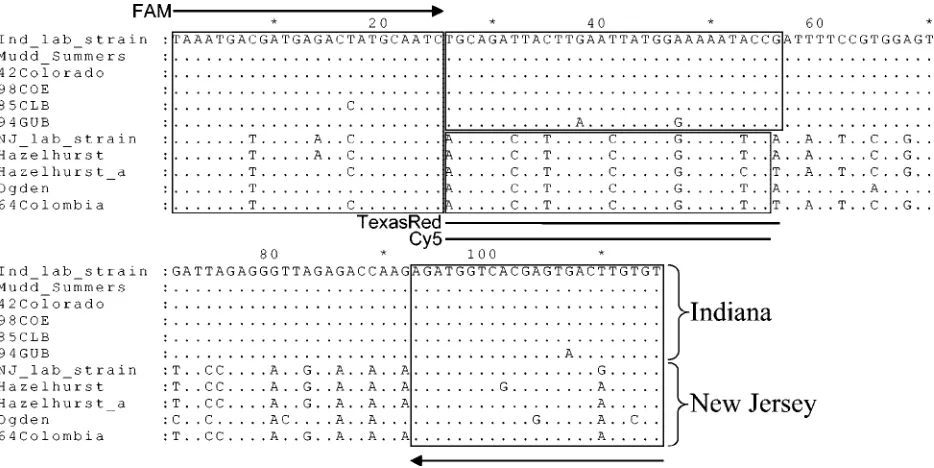
re-gion with limited genetic variability among the VSV serotypes was located in the L gene and spanned nucleotides 7017 to 7131 (numbered relative to the sequence with GenBank acces-sion number J02428) (16). To establish a PriProET assay for VSV, a single primer pair and two serotype-specific fluorescent probes were designed (Fig. 1; Table 1). The primer pair was designed to amplify all the serotypes represented (VSV-spe-cific primers) by the introduction of degenerate positions in the primer sequences. Instead of traditional degenerate positions, the pyrimidine analogue dP was used to mimic a C or a T residue, the purine analogue dK was used to mimic an A or a G residue, and inosine was used to mimic all four nucleotides. The two serotype-specific probes were designed to target the same area in the amplicon in order to have competition for binding, which favors hybridization of the probe with the high-est degree of similarity to the viral target sequence.
Optimization of VSV PriProET assay.Optimization of the
[image:2.585.42.558.82.139.2]VSV PriProET assay was performed in two steps. First, the performances of the VSV-specific primers that were designed were optimized in a retime SYBR Green format. This al-lowed optimization of the PCR conditions, such as the anneal-ing temperature and the magnesium concentration, for the forward and the reverse primers. An annealing temperature of 60°C and a magnesium concentration of 3.5 mM were found to be optimal for homogeneous amplification of both serotypes. Second, the optimal correlation between the primers and the
TABLE 1. Oligonucleotide sequences of primers and probes
VSV serotype Primer or probesa Nucleotide sequenceb Nucleotide positionsc
VSV Forward 5⬘-FAM-TAAATGAPGATGAKACPATGCAATC-3⬘ 7017–7041
VSV Reverse 5⬘-ACKCAIGTPACPCGPGACCATCT-3⬘ 7131–7109
Ind-1 Ind-1-specific probe 5⬘-CGGTATTTTTCCATAATTCAAGTAATCTGCT-Texas Red-3⬘ 7072–7042 New Jersey NJ-specific probe 5⬘-GGAATTTTCCCATAGTTCAAATAGTCTGCT-Cy5-3⬘ 7071–7042
aThe primers and the NJ-specific probe were synthesized by DNA Technology A/S, Aarhus, Denmark. The Ind-1-specific probe was synthesized by TIBMOLBIOL,
Berlin, Germany.
bUnderlined nucleotides indicate positions of dK (K), dP (P), or inosine (I).
cNucleotide positions are numbered relative to the numbering for the VSV Ind-1 sequence (GenBank accession number J02428) (16).
VOL. 43, 2005 VSV DETECTION BY MULTIPLEX PriProET ASSAY 357
on May 16, 2020 by guest
http://jcm.asm.org/
probe was optimized by checkerboard titration. Double the amount of the forward primer with respect to the amount of the reverse primer significantly increased the intensity of the fluorescence energy transfer signal; thus, 600 nM forward primer and 300 nM reverse primer were selected. The probe concentrations had less of an influence on the fluorescence signal, and a concentration of 500 nM each probe was selected.
Multiplex detection of VSV. The ability of the PriProET
assay to detect VSV in a multiplex format was assessed with virus grown in primary swine kidney cell cultures. Serotype Ind-1 or serotype NJ in Eagle’s medium was subjected to RT-PCR with the VSV-specific primers that were designed, with the serotype-specific probes, and by the optimized PriProET RT-PCR protocol. The sensitivity, detection limit, and intra-assay variability of the PriProET assay were deter-mined for each target by testing three replicates of 10-fold dilutions of cell culture-grown VSV serotypes Ind-1 and NJ. The standard curves obtained (Fig. 2E and F) displayed a linear relationship between the log amount of viral nucleic acids in the reaction mixtures and the observedCT, with
cal-culatedEvalues of 1.82 for serotype Ind-1 and 1.88 for sero-type NJ. The average between-run correlation coefficients were 0.99 for both standard curves. The limits of detection were repeatedly found to be below 10 TCID50s/ml for both
sero-types. The intra-assay variability was⫾1CTvalue, which
cor-responds to less than 5% variation between replicates. The interassay variability was evaluated by comparison of the ob-served CT values for the standards included in each
experi-ment. The interassay variability observed was consistently at the same level as the intra-assay variability (data not shown). Simultaneous multiplex detection and differentiation of both serotypes in the same tube was demonstrated by using cDNA derived from a mix of VSV serotypes Ind-1 and NJ. The ob-servedCTvalues (Fig. 2C) were compared to theCTvalues for
samples with either VSV Ind-1 (Fig. 2A) or VSV NJ (Fig. 2B). As shown in Fig. 2A, a specific signal for serotype Ind-1 was obtained in the Texas Red channel when the VSV Ind-1-containing sample was analyzed. Furthermore, a specific signal for serotype NJ was observed in the Cy5 channel when the VSV NJ-containing sample was analyzed (Fig. 2B). When mixed cDNA was used as the template, a specific signal in each channel was observed in same tube (Fig. 2C). This simulta-neous multiplex detection of both serotypes in the same tube displayedCTvalues equivalent to those for the reactions with
only one of the serotypes (Fig. 2A to C). Samples free of VSV RNA were negative (Fig. 2D).
Confirmation of assay specificity and robustness.The
spec-ificities of the reactions shown in Fig. 2 were confirmed by the fluorescent probe Tm profiles (Fig. 3A to D). The serotype
Ind-1-positive reactions showed a specificTmof 67.1°C (Fig.
3A), and the serotype NJ-positive reactions showed a specific Tmof 67.7°C (Fig. 3B). Double-positive reactions showed
spe-cificTmpeaks in both the Texas Red and the Cy5 channels
(Fig. 3C). SpecificTms were absent from all negative reactions
(Fig. 3D). The specificity of the assay was further evaluated by testing the cross-reactivity to viruses causing diseases with
clin-FIG. 1. Nucleotide sequence alignment of a part of the VSV L gene corresponding to nucleotides 7017 to 7131, numbered relative to the sequence with GenBank accession number J02428. The alignment represents all the different L-gene sequences from GenBank as of February 2004. GenBank accession numbers are as indicted for the following Ind-1 strains: Mudd Summers, K0237 and J02428 (16); 98COE, AF483864 (15); 85CLB, AF473865 (15); and 94GUB, AF473866 (15). GenBank accession numbers are as indicted for the following NJ strains: Hazelhurst, AY074803 and AY102918; Hazelhurst_a, M20166 (2); and Ogden, M29788 (1). Additionally, the four different VSV strains used in this study were sequenced, and their sequences were added to the alignment. The nucleotide sequence alignment was used to design the primers and probes. The framed sequences correspond to the target regions for the VSV-specific forward primer (5⬘labeled with FAM), the VSV-specific reverse primer, and the two serotype-specific probes (the Ind-1-specific probe 3⬘labeled with Texas Red and the NJ-specific probe 3⬘labeled with Cy5).
on May 16, 2020 by guest
http://jcm.asm.org/
[image:3.585.59.526.68.302.2]ical symptoms similar to those caused by VSV. Purified RNA obtained from cell culture-propagated high-titer viral prepara-tions of FMDV and swine vesicular disease virus was reverse transcribed and used as the template for the VSV PriProET assay. Positive amplifications and specific Tms were absent
from these reactions (data not shown).
The ability of the method to detect potential new emerging strains of VSV with mutations in the probe region not present in the nucleotide alignment of known VSV sequences (Fig. 1)
was demonstrated by amplifying VSV serotype Ind-1 without the serotype Ind-1-specific probe. As expected, the amplifica-tion plots for these reacamplifica-tions were negative, since the serotype NJ-specific probe does not hybridize to the Ind-1 target se-quence at 60°C (the annealing temperature). However, hybrid-ization was revealed by a positive melting profile with aTmof
41.1°C. Serotype NJ was likewise identified by the
Ind-1-spe-FIG. 2. (A to D) Detection of VSV RNA in cell culture material. Tenfold dilutions of cell culture-grown VSV serotype Ind-1, serotype NJ, and mixtures with each serotype were subjected to RNA extrac-tion, cDNA synthesis, and, subsequently, PriProET PCR. In the mixed dilutions the concentration of Ind-1 was 10 times lower than the con-centration of NJ. Each panel (A to D) displays the readout from the multiplex PriProET PCR, with the fluorescent signals from the Ind-specific probe (diamonds; Texas Red; 610 nm) and the NJ-Ind-specific probe (crosses; Cy5; 660 nm) indicated. For simplification, the results for only one sample are displayed in each amplification plot. (A) Sam-ple positive for Ind-1 with aCTof 36; (B) sample positive for NJ with
aCTof 33; (C) sample positive for Ind-1 with aCTof 36 and positive
for NJ with aCTof 33; (D) sample negative for both serotypes. (E and
F) Standard curves generated by analysis of 10-fold dilutions of VSV Ind-1 (E) and VSV NJ (F) from cell culture with known numbers of TCID50s per milliliter. Each dilution was analyzed in triplicate. TheCT
values plotted were obtained from amplification plots similar to those shown in panels A to D. Real-time PCR amplification efficiencies were calculated by the equationE⫽10⫺1/slope(11). The intra-assay
vari-ability was⫾1CT, which corresponds to less than 5% variation
be-tween replicates.
FIG. 3. (A to D) Confirmation of specificity of amplification of VSV RNA. Each panel displays the readout (⫺dF/dT) from the fluo-rescent probeTmprofile analysis, with the fluorescent signals from the
serotype Ind-1-specific probe (solid lines) and the serotype NJ-specific probe (dotted lines) indicated. (A) Sample positive for Ind-1; (B) sam-ple positive for NJ; (C) samsam-ple positive for both Ind-1 and NJ; (D) sample negative for both serotypes. (E) Cross-detection of VSV serotypes. The diagram displays the readout (⫺dF/dT) from the fluo-rescent probeTmprofiles when only one of the two serotype-specific
probes was included in the PriProET assay. Observe the larger tem-perature range in panel E compared to those in panels A to D; theTm
is shifted approximately 25 to 26°C. Serotype Ind-1 was cross-detected in theTmprofile with a Tm of 41.1°C (dotted line) when only the
serotype NJ-specific probe was included in the assay. Likewise, sero-type NJ was identified in reaction mixtures in which only the serosero-type Ind-specific probe was included (solid line;Tm⫽42.9°C).
VOL. 43, 2005 VSV DETECTION BY MULTIPLEX PriProET ASSAY 359
on May 16, 2020 by guest
http://jcm.asm.org/
[image:4.585.50.276.66.411.2]cific probe in reaction mixtures from which the NJ-specific probe was excluded. A specificTmof 42.9°C was observed in
these reactions (Fig. 3E).
Detection of acute infections. The ability of the PriProET
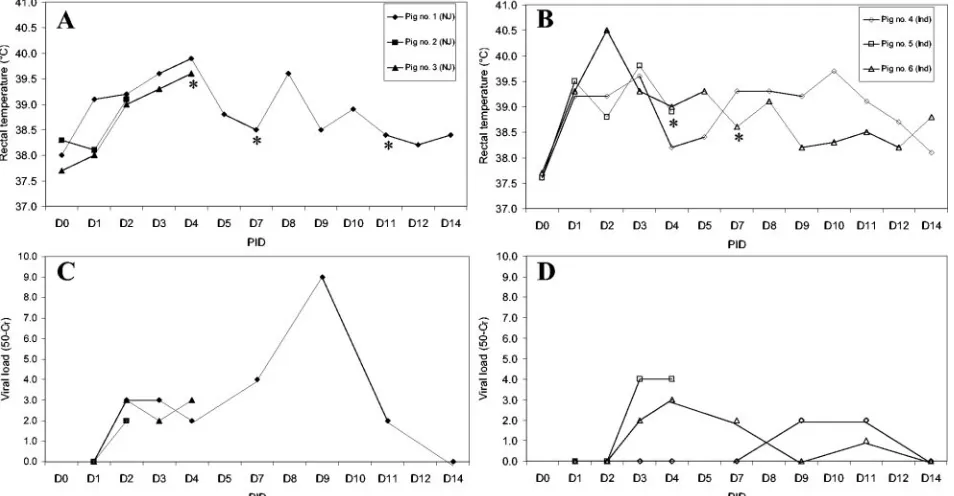
assay to detect VSV during acute infections was analyzed with experimentally infected pigs. Two groups of three pigs each were inoculated with either VSV serotype Ind-1 or VSV sero-type NJ. All pigs had increased rectal temperatures (Fig. 4A and B), and four animals had vesicular lesions. Vesicles were observed in pig 1 at PIDs 7 and 11 and in pig 6 at PID 7. Local vesicular foot lesions at the injection site were observed in pigs 3 and 5 at PID 4. Nasal swab specimens were obtained on PIDs 1 to 4, 7, 9, 11, and 14 and examined by PriProET RT-PCR. VSV nucleic acids were detectable in the swabs at PID 2 for serotype NJ-infected pigs (Fig. 4C) and PID 3 for serotype Ind-1-infected pigs (Fig. 4D). The detection of viral RNA in nasal swab specimens preceded the detection of vesicular le-sions. The largest amount of VSV in the nasal swab specimens was observed in pig 1 between PIDs 7 and 11. Similarly, vesic-ular materials obtained from the diseased pigs were analyzed by the PriProET assay; and selected blood samples and tissues obtained at necropsy, including tonsil and lymph node tissues, were likewise tested for the presence of viral RNA. All the samples obtained from the vesicular lesions contained large amounts of viral RNA. Vesicular materials obtained on PID 4 hadCTvalues of 32 for pig 3 (infected with serotype NJ) and
29 for pig 5 (infected with serotype Ind-1), whereas the CT
values for blood obtained from the same pigs were 43 and 47, respectively. The difference inCTvalues of 11 and 18
corre-sponds to approximately 103- to 105-fold higher virus contents
in vesicles than in blood. Viral RNA was also detected in tonsil and lymph node tissues, but to a lesser extent compared to the amounts detected in vesicular materials.
DISCUSSION
VS is an economically very important infectious disease in animals, since it is clinically indistinguishable from the devas-tating FMD in swine and cattle. It is therefore included in Office International des Epizooties list A, which means that outbreaks of VS must be reported immediately. This situation can cause great economic losses due to trade restrictions. Al-though VS only affects the Americas, it is crucial to have diagnostic tools that permit a definitive laboratory result in a short time when a vesicular disease is suspected. In order to obtain an early diagnosis and to contain future outbreaks of VS, it will be necessary to implement rapid diagnostic assays. This report introduces a new real-time multiplex assay that allows the simultaneous detection and differentiation of viral RNA from the two major VSV serotypes, Ind-1 and NJ. We have previously described the PriProET system (12) and have provided details about the real-time detection system with pan-FMDV-specific primers and a pan-pan-FMDV-specific probe. The cycling conditions for the pan-FMDV assay and the multiplex VSV assay are identical, which allows combined side-by-side detection of FMVD and VSV in the same real-time thermo-cycler. The PriProET assay for VSV described in this paper is a further refinement of the method for multiplex detection and differentiation. So far only a few diagnostic RT-PCR assays for VSV have been reported (4, 7, 8, 14). These are traditional
FIG. 4. (A and B) Rectal temperatures of the group of pigs infected with VSV serotype NJ (A) and VSV serotype Ind-1 (B). Asterisks mark the occurrences of vesicles. (C and D) Detection of viral RNA from serotypes NJ (C) and Ind-1 (D) in nasal swab samples by the multiplex PriProET assay. The viral loads in nasal swabs are displayed as arbitrary units, defined as 50 minus the observedCTvalue. All nasal swab specimens
from NJ-infected animals were negative for Ind-1 by the multiplex PriProET assay, whereas all nasal swabs from Ind-1-infected animals were negative for NJ.
on May 16, 2020 by guest
http://jcm.asm.org/
[image:5.585.55.532.71.319.2]gel-based assays, and none of these are designed for the quan-titative detection of VSV. Two of the assays (7, 8) are multiplex assays that detect both VSV serotypes with a combination of serotype-specific primers. To our knowledge a VSV-specific primer set has not been described before, and the high degree of genetic variability in the VSV genomes complicates the design of such primers. Nevertheless, pan-virus-specific prim-ers with sequences conserved between all known serotypes of a virus or even a family of viruses are very attractive for diag-nostic purposes, as they result in very robust assays. Pan-virus-specific primers will, for example, allow the detection of ge-netic recombinants formed between different viral serotypes, and pan-virus-specific primers will likewise be assumed to de-tect future emerging serotypes of a given virus (5, 10, 12). Despite the extraordinarily high degree of sequence diver-gence between the two serotypes of VSV, even when the se-quence divergence is compared to those of other RNA viruses, we were able to design a VSV-specific primer set in the present study. The primer set covers the very diverse serotypes Ind-1 and NJ, as demonstrated by the experiments performed in this study. Since these serotypes represent the majority of the vi-ruses causing clinical cases of disease (13), it is likely that the primer set will amplify the majority of unknown VSV strains. Whether the primers also amplify serotype Ind-2 or Ind-3 has not been demonstrated due to a lack of nucleotide sequences for these strains. The uniform amplification of serotypes Ind-1 and NJ with equal sensitivities and efficiencies was made pos-sible by the incorporation of nucleotide analogues (inosine, dK, and dP) in the primers. This is consistent with the findings of Hill et al. (3), who found that oligonucleotides containing up to six residues replaced by a mixture of dK and dP primed DNA synthesis efficiently. From a theoretical point of view, the use of multiple dK, dP, and especially inosine residues in the primer sequence results in a less specific hybridization and, as a result, a less specific diagnostic assay. However, this problem was circumvented in the assay described here, in which the specificity of the PCR amplicon was confirmed not only by hybridization of a specific probe but also by precise determi-nation of the Tm for this hybridization. The end result is a
unique combination of high specificity and robustness to se-quence divergence. The robustness of the VSV assay devel-oped is, however, not restricted to the use of VSV-specific primers. Use of the unique primer-to-probe energy transfer gives a unique robustness to the detection of sequence diversity in the probe region compared to the robustness of other probe-based real-time technologies, such as the TaqMan and molec-ular beacon detection systems. This robustness of the system was evaluated by testing the ability of the system to detect VSV types with multiple mutations in the probe sequence-specific region, as shown in Fig. 3E. VSV strains with up to 6 nucleo-tide differences in the probe-specific region could be detected by the Tm profile, although it could not be quantified. If a
specific hybridization with a shiftedTmis observed in theTm
profile, the DNA of the amplicon can rapidly be sequenced for precise typing. In cases in which this DNA sequencing reveals completely new variants, cDNA will still be available for rapid PCR amplification and DNA sequencing of other regions of the viral genome. As such, the PriProET system is a powerful tool not only for the detection of viruses that have high muta-tion rates or that cover very distant genotypes but also as a tool
for surveillance for newly emerging viral variants. In the future, we foresee that the unique sequence flexibility of the PriProET system can be extended to cover even whole virus families.
The sensitivity of the novel quantitative multiplex RT-PCR method was shown to be less than 10 TCID50s/ml and to be
similar for both principal VSV serotypes when serial dilutions of serotype Ind-1 and NJ viral isolates were used. Nevertheless, to further validate the assay as a diagnostic tool, a collection of clinical samples from pigs experimentally infected with sero-type Ind-1 or NJ was tested and the results were compared with those obtained by a previously described gel-based RT-PCR method (8). The results obtained in the present study reflect the qualitative results obtained with the same clinical materials by the gel-based RT-PCR. The multiplex PriProET method allowed relative quantification of the viral load in the clinical material and permitted the detection of VSV in nasal swab specimens at PIDs 2 and 3 for NJ- and Ind-1-infected pigs, respectively, even before the typical vesicular lesions appeared in the affected animals. Furthermore, large amounts of viral RNA were detected in the samples obtained from vesicular lesions. Therefore, whenever vesicles are present, they should be sampled for early diagnosis. ATmanalysis confirmed the
specificity of the fluorescence yield for each of the experimen-tal samples. In comparison to the gel-based method, the use of the ABI 7700 system allowed the simultaneous detection and differentiation of both serotypes in a closed-tube format, which represents a less laborious and much faster method. In addi-tion, as the real-time detection format eliminates the need for postamplification handling of the PCR products, the risk of contamination is minimized, and thus, the risk of false-positive reactions is also minimized.
In summary, the results presented here show that the novel PriProET assay can be a powerful diagnostic tool that gives a definitive result in hours from the time of sample receipt and that it can be applied to different clinical materials. We have demonstrated that the use of the present quantitative RT-PCR method provides a sensitive tool for the simultaneous detec-tion and differentiadetec-tion of the two major VSV serotypes, Ind-1 and NJ. The merging of a fast and robust means of detection, identification, and quantification makes this method a very useful tool for diagnostic laboratories.
ACKNOWLEDGMENTS
Preben Normann is thanked for excellent technical assistance. We are grateful to Nigel Ferris (Institute for Animal Health, Pirbright Laboratory), who provided us with the VSV strains used for the animal experiment.
This study was partly funded by the European Union (Project QLK2-CT-2000-00486).
REFERENCES
1.Barik, S., E. W. Rud, D. Luk, A. K. Banerjee, and C. Y. Kang. 1990. Nucleotide sequence analysis of the L gene of vesicular stomatitis virus (New Jersey serotype): identification of conserved domains in L proteins of non-segmented negative-strand RNA viruses. Virology175:332–337.
2.Feldhaus, A. L., and J. A. Lesnaw.1988. Nucleotide sequence of the L gene of vesicular stomatitis virus (New Jersey): identification of conserved do-mains in the New Jersey and Indiana L proteins. Virology163:359–368. 3.Hill, F., D. Loakes, and D. M. Brown. 1998. Polymerase recognition of
synthetic oligodeoxyribonucleotides incorporating degenerate pyrimidine and purine bases. Proc. Natl. Acad. Sci. USA95:4258–4263.
4.Hofner, M. C., W. C. Carpenter, N. P. Ferris, R. P. Kitching, and B. F. Ariza. 1994. A hemi-nested PCR assay for the detection and identification of vesicular stomatitis virus nucleic acid. J. Virol. Methods50:11–20.
VOL. 43, 2005 VSV DETECTION BY MULTIPLEX PriProET ASSAY 361
on May 16, 2020 by guest
http://jcm.asm.org/
5.Ladekjaer-Mikkelsen, A. S., J. Nielsen, T. Stadejek, T. Storgaard, S. Kra-kowka, J. Ellis, F. McNeilly, G. Allan, and A. Botner.2002. Reproduction of postweaning multisystemic wasting syndrome (PMWS) in immunostimulated and non-immunostimulated 3-week-old piglets experimentally infected with porcine circovirus type 2 (PCV2). Vet. Microbiol.89:97–114.
6.Letchworth, G. J., L. L. Rodriguez, and J. D. C. Barrera.1999. Vesicular stomatitis. Vet. J.157:239–260.
7.Magnuson, R. J., J. Triantis, L. L. Rodriguez, A. Perkins, C. O. Meredith, B. Beaty, B. McCluskey, and M. Salman.2003. A single-tube multiplex reverse transcription-polymerase chain reaction for detection and differentiation of vesicular stomatitis Indiana 1 and New Jersey viruses in insects. J. Vet. Diagn. Investig.15:561–567.
8.Nunez, J. I., E. Blanco, T. Hernandez, C. Gomez-Tejedor, M. J. Martin, J. Dopazo, and F. Sobrino.1998. A RT-PCR assay for the differential diagnosis of vesicular viral diseases of swine. J. Virol. Methods72:227–235. 9.Office International des Epizooties.2000. Vesicular stomatitis.InManual of
standards for diagnostic tests and vaccines. Office International des Epizooties, Paris, France. [Online.] http://www.oie.int/.
10.Oleksiewicz, M. B., A. Botner, K. G. Madsen, and T. Storgaard.1998. Sensitive detection and typing of porcine reproductive and respiratory syn-drome virus by RT-PCR amplification of whole viral genes. Vet. Microbiol. 64:7–22.
11.Pfaffl, M. W.2001. A new mathematical model for relative quantification in real-time RT- PCR. Nucleic Acids Res.29:2002–2007.
12.Rasmussen, T. B., A. Uttenthal, K. de Stricker, S. Belak, and T. Storgaard. 2003. Development of a novel quantitative real-time RT-PCR assay for the simultaneous detection of all serotypes of foot-and-mouth disease virus. Arch. Virol.148:2005–2021.
13.Rodriguez, L. L.2002. Emergence and re-emergence of vesicular stomatitis in the United States. Virus Res.85:211–219.
14.Rodriguez, L. L., G. J. Letchworth, C. F. Spiropoulou, and S. T. Nichol.1993. Rapid detection of vesicular stomatitis virus New Jersey serotype in clinical samples by using polymerase chain reaction. J. Clin. Microbiol.31:2016–2020. 15.Rodriguez, L. L., S. J. Pauszek, T. A. Bunch, and K. R. Schumann.2002.
Full-length genome analysis of natural isolates of vesicular stomatitis virus (Indiana 1 serotype) from North, Central and South America. J. Gen. Virol. 83:2475–2483.
16.Schubert, M., G. G. Harmison, and E. Meier.1984. Primary structure of the vesicular stomatitis virus polymerase (L) gene: evidence for a high frequency of mutations. J. Virol.51:505–514.
17.Uttenthal, A., T. Storgaard, M. B. Oleksiewicz, and K. de Stricker.2003. Experimental infection with the Paderborn isolate of classical swine fever virus in 10-week-old pigs: determination of viral replication kinetics by quan-titative RT-PCR, virus isolation and antigen ELISA. Vet. Microbiol.92:197– 212.