www.impactjournals.com/oncotarget/ Oncotarget, 2016, Vol. 7, (No. 52), pp: 86584-86593
Elevated expression of STIM1 is involved in lung tumorigenesis
Yadong Wang1,2, Haiyu Wang1, Li Li1, Jiangmin Li1, Teng Pan3, Ding Zhang1, HaiyanYang3
1Department of Toxicology, Henan Center for Disease Control and Prevention, Zhengzhou 450016, China
2Henan Collaborative Innovation Center of Molecular Diagnosis and Laboratory Medicine, Xinxiang Medical University, Xinxiang 453003, China
3Department of Epidemiology, School of Public Health, Zhengzhou University, Zhengzhou 450001, China
Correspondence to: Yadong Wang, email: [email protected], [email protected] Haiyan Yang, email: [email protected]
Keywords: STIM1, A549 cell, lung cancer, tumorigenicity, cell cycle
Received: September 14, 2016 Accepted: October 29, 2016 Published: November 15, 2016
ABSTRACT
This study aimed to address the potential role of STIM1 (stromal interaction molecule 1) in lung tumorigenesis. Colony formation in soft agar assay and tumorigenicity in nude mice assay were conducted. Western blot, immunohistochemistry and quantitative real-time polymerase chain reaction were used to measure the STIM1 expression. The distribution of cell cycle was detected by flow cytometry assay. Our results showed that the expression of STIM1 mRNA was significantly higher in human lung tumors than that in adjacent non-neoplastic lung tissues. Significantly increased expression of STIM1 mRNA and protein was observed in 16HBE-benzo(a)pyrene (BaP) cells and in BaP-treated mice lung tissues compared with 16HBE-control cells and the control group, respectively. Silencing STIM1 inhibited the proliferation and colony formation of A549 cells in in vitro experiments, attenuated the growth of tumor xenografts of A549 cells in in vivo experiments and induced the arrest of cell cycle in the G1 phase. The markedly decreased expression of cyclin D1 protein was observed in STIM1 cells as compared to shRNA-control cells. The markedly increased expression of p21 protein was observed in A549-shRNA-STIM1 cells as compared to A549-shRNA-control cells. The expression levels of β-catenin and TGIF proteins were lower in A549-shRNA-STIM1 cells than those in A549-shRNA-control cells. In conclusion, this study indicated that the elevated expression of STIM1 might be involved in lung tumorigenesis.
INTRODUCTION
An estimated 1.8 million new lung cancer cases occurred in 2012, accounting for approximately 13% of total cancer diagnoses. In men, lung cancer was the most commonly diagnosed cancer and the leading cause of cancer-related death in 2012. In women, lung cancer was the leading cause of cancer-related death in more developed countries and the second leading cause of cancer-related death in less developed countries [1]. Smoking, particularly of cigarettes, is by far the main contributor to lung cancer, and other risk factors include exposure to radon gas, asbestos, air pollution and some metals, and genetic alterations [2–8]. Similar to many other cancers, lung cancer is initiated by activation of oncogenes or inactivation of tumor suppressor genes
[9–11]. The molecular mechanisms involved in lung tumorigenesis remain incompletely understood.
STIM1 (stromal interaction molecule 1) was
identified as a novel human gene that maps to a region
of chromosome 11p15.5 [12]. STIM1 protein is mainly resident in the endoplasmic reticulum (ER), and activates a set of plasma membrane Ca2+ channels termed
store-operated calcium channels (SOCs) when the concentration of free Ca2+ within the ER drops transiently as a result
of Ca2+ release from this compartment [13]. It has been
reported that STIM1 protein has novel and unexpected physiological and pathophysiological roles in several
tissues [14], the clinical phenotype of STIM1-deficient patients was characterized by immunodeficiency together
with autoimmune disease, congenital myopathy and ectodermal dysplasia [15].
www.impactjournals.com/oncotarget
STIM1 was initially suggested to be a tumor suppressor given that it induced the inhibition of rhabdoid tumor and rhabdomyosarcoma cell lines [16]. Suyama et al. reported that knocking down STIM1 accelerated the cell motility of melanoma cells, and STIM1 was
identified as an anti-metastasis gene [17]. However,
recent data reveal opposite functions. Wong et al. reported that the presence of STIM1 overexpression in colon adenocarcinomas was associated with cell migration and cell motility properties [18]. Yang et al. reported that STIM1 silencing inhibited the migration and metastasis of breast cancer cells [19]. Chen et al. reported that a poorer
clinical outcome was statistically significant in primary
tumors with STIM1 upregulation. STIM1 overexpression markedly enhanced cervical tumor cell growth, local spread and angiogenesis and promoted cancer cell migration and invasion [20]. Additional studies showed that knocking down STIM1 resulted in reduced cancer metastasis in colorectal cancer [21], melanoma [22, 23] and hepatocellular carcinoma [24].
However, the potential role of STIM1 in lung
tumorigenesis has not yet been clearly understood. One published paper reported that higher levels of STIM1 protein expression were observed in the samples of patients with non-small cell lung cancer (NSCLC) compared with adjacent non-neoplastic lung samples as detected by immunoblotting analysis and immunohistochemistry [25]. To further understand the potential role of STIM1 in lung tumorigenesis, we measured the expression levels of STIM1 in malignant human bronchial epithelial
(16HBE) cells transformed by benzo(a)pyrene (BaP) and mice lung tissues treated with BaP. We also investigated the influences of STIM1 silencing on the proliferation
and tumor formation of A549 cells in in vitro and in vivo
experiments, and the distribution of cell cycle of A549 cells.
RESULTS
Elevated STIM1 expression in human lung tumors
To investigate whether or not STIM1 has a potential role in lung cancer, we examined STIM1 expression by
qRT-PCR assay. Thirty human lung cancer tissues and
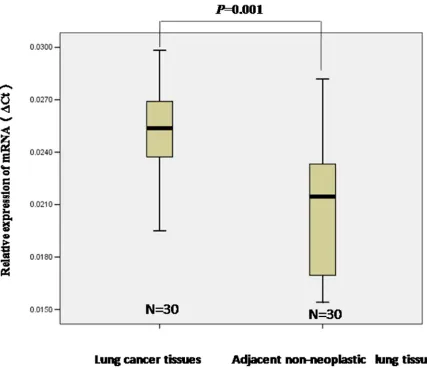
paired adjacent non-neoplastic lung tissues were collected. Our results demonstrated that STIM1 mRNA expression was higher in human lung tumors than that in adjacent non-neoplastic lung tissues (P = 0.001) (Figure 1).
Elevated STIM1 expression in malignant 16HBE cells transformed by BaP and mice lung tissues treated with BaP
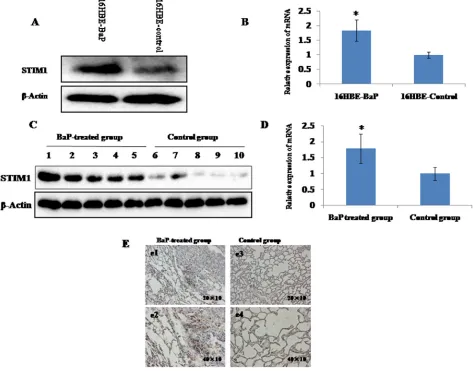
STIM1 mRNA and protein expression profiles were examined by qRT-PCR and western blot assay. Increased
STIM1 protein (Figure 2A) and mRNA (Figure 2B) expression was observed in 16HBE-BaP cells compared with 16HBE-control cells. Consistent with the data
from cell line, increased expression of STIM1 protein (Figure 2C) and mRNA (Figure 2D) was observed in mice
lung tissues treated with BaP as compared with the control
group. The immunohistochemistry analysis demonstrated that the staining signal of STIM1 was strong in the nucleus
and cytoplasm in some cells in the BaP-treated group but
weak in the control group (Figure 2E).
Silencing efficiency of STIM1 gene in A549 cells
Figure 3A showed that the markedly decreased expression of STIM1 protein was observed in A549-shRNA-STIM1 cells as compared to A549-shRNA-control cells. This observation suggested that an A549 cell line stably silencing STIM1 was successfully engineered.
Silencing STIM1 suppressed the proliferation of
A549 cells
We investigated the effects of STIM1 silencing on the proliferation of A549 cells. Our results indicated that
the significantly slower growth rate was observed in
A549-shRNA-STIM1 cells as compared to A549-shRNA-control
cells at 72 h and 96 h (P < 0.05).
Silencing STIM1 attenuated the colony
formation in soft agar of A549 cells
After observing that silencing STIM1 inhibited A549 cell proliferation, we further investigated whether or not silencing STIM1 had effects on the colony formation in soft agar of A549 cells in vitro. As shown
in Figure 4A and 4B, A549-shRNA-STIM1 cells (18±4)
exhibited markedly decreased colony formation compared
with A549-shRNA-control cells (35±5) (P < 0.05).
Silencing STIM1 suppressed tumor growth of
A549 cells in vivo
We observed that silencing STIM1 inhibited colony formation in soft agar of A549 cells in vitro. To test the potential role of silencing STIM1 in the ability of tumor growth of A549 cells in vivo, nude mice xenograft models were established by subcutaneous injection with A549-shRNA-STIM1 cells and A549-shRNA-control cells. As shown in Figure 4C and 4D, on the 16th day, the mean of tumor weight was significantly decreased in the
group of mice injected with A549-shRNA-STIM1 cells
(0.23±0.08 g) as compared to the group of those injected with A549-shRNA-control cells (0.96±0.27 g) (P<0.05), suggesting that silencing STIM1 markedly suppressed the growth and formation of tumors of A549 cells in in vivo
Silencing STIM1 arrested cell cycle in G1 phase
We observed that silencing STIM1 inhibited A549 cell proliferation. To further investigate whether or not the cell growth inhibition was induced by cell cycle
arrest, we performed the flow cytometry assay to detect
the distribution of cell cycle. Our results showed that the
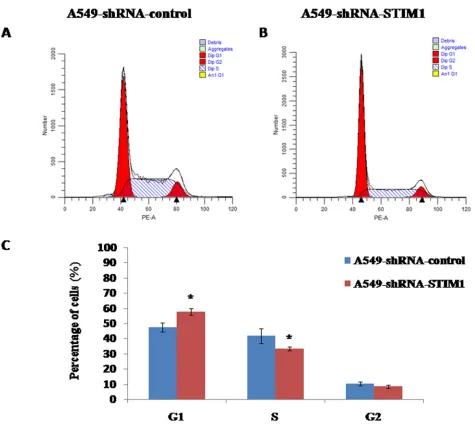
percentage of G1 phase cells was significantly higher in A549-shRNA-STIM1 cells (57.9±2.1%) than that in A549-shRNA-control cells (47.7±2.9%) (P<0.05), and the percentage of S phase cells was markedly decreased in
shRNA-STIM1 cells (33.4±1.2%) than that in A549-shRNA-control cells (41.9±4.9%) (P<0.05) (Figure 5). In addition, we observed that the proliferation index in
A549-shRNA-STIM1 cells (42.0±2.2%) was markedly
decreased as compared to that in A549-shRNA-control
cells (52.3±2.9%) (P<0.05). These findings suggested that
silencing STIM1 might inhibit the growth of A549 cells by arresting the cell cycle in the G1 phase.
Silencing STIM1 downregulated cyclin D1 expression and upregulated p21 expression
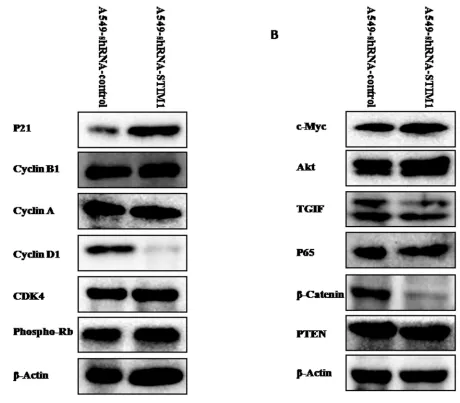
To explore the potential mechanism related to the cell cycle arrest, the expression levels of cell cycle-related proteins were measured by western blot analysis. Our results indicated that silencing STIM1 reduced cyclin D1 protein expression and increased p21 protein expression
(Figure 6A). No significant alterations in the expression levels of cyclin B1, cyclin A, CDK4 and phospho-Rb
proteins were noted between A549-shRNA-STIM1 cells and A549-shRNA-control cells (Figure 6A).
Silencing STIM1 downregulated the expression
levels of β-catenin and TGIF proteins
We further tentatively investigated whether or not silencing STIM1 could have effects on the expression
[image:3.612.87.514.296.664.2]levels of Akt, c-Myc, TGIF, β-catenin, p65 and PTEN
www.impactjournals.com/oncotarget
proteins, since these proteins play important roles in lung
tumorigenesis. As shown in Figure 6B, western blot results indicated that the expression levels of β-catenin and TGIF proteins were significantly reduced in
A549-shRNA-STIM1 cells as compared to A549-shRNA-control cells.
No significant alterations in the expression levels of PTEN,
c-Myc, p65 and Akt proteins were noted between A549-shRNA-STIM1 cells and A549-shRNA-control cells.
DISCUSSION
In this present study, higher expression of STIM1 mRNA was observed in lung tumors compared with adjacent non-neoplastic lung tissues, suggesting that STIM1 overexpression may be involved in lung tumorigenesis. A previous study observed higher STIM1
protein expression in lung tumors compared with adjacent non-neoplastic lung tissues detected by immunoblotting analysis and immunohistochemistry [25]. Our results may
enhance the confidence of previous findings to a certain extent. To confirm the results observed in human samples,
we measured STIM1 mRNA and protein expression in malignant human bronchial epithelial cells transformed
by BaP and lung tissues from mice treated with BaP.
Our results consistently showed that higher expression of STIM1 mRNA and protein was observed in malignant
16HBE cells transformed by BaP and lung tissues from mice treated with BaP compared with corresponding controls, which supported our findings at the cellular level
and in an animal model to a certain extent.
Previous experimental studies showed that
[image:4.612.70.543.264.635.2]suppression of STIM1 inhibited cell proliferation of
Figure 2: STIM1 expression in malignant 16HBE cells transformed by BaP and BaP-treated mice lung tissues were measured by qRT-PCR and western blot assay. The levels of STIM1 protein A. and mRNA B. were higher in malignant 16HBE cells transformed by BaP than those in control cells. The levels of STIM1 protein C. and mRNA D. were higher in BaP-treated mice lung tissues than those in the control group. The level of STIM1 in BaP-treated mice lung tissues was detected by immunohistochemistry
E. Plates e1 (200×) and e2 (400×) represent the lung sections of BaP-treated group, and plates e3 (200×) and e4 (400×) represent the lung sections of the control group. The BaP-treated group exhibited strong cytoplasmic and nuclear STIM1 staining in some cells (e1 and e2).
Figure 3: The silencing efficiency of STIM1 in A549 cells and the effects of silencing STIM1 on A549 cell proliferation.
A. Western blot analysis showed that shRNA specifically targeting STIM1 markedly decreased the level of STIM1 protein expression in
A549 cells compared with control. B. STIM1 silencing inhibited A549 cell proliferation at 72 h and 96 h. *P<0.05.
Figure 4: Effects of silencing STIM1 on colony formation and tumor growth in mouse xenograft models. Dramatically decreased colony formation was observed in A549-shRNA-STIM1 cells compared with A549-shRNA-control cells A and B. The mean of
[image:5.612.71.548.377.688.2]www.impactjournals.com/oncotarget
glioblastoma [26], melanoma [22], hepatocellular
carcinoma [27], human epidermoid carcinoma [28] and
hypopharyngeal carcinoma [29]. In this current study, we observed that silencing STIM1 inhibited A549 cell proliferation. Combined with previous results, silencing STIM1 inhibited the growth of many types of tumor cells. To further investigate the effects of silencing STIM1 on tumor formation in vitro and in vivo, a soft agar colony formation assay was performed, and a mouse tumor xenograft model was established. Our results demonstrated that suppression of STIM1 reduced the tumor growth and formation of human non-small cell lung cancer cell line of A549 in in vitro experiments and in in vivo experiments,
which confirmed our above observations that STIM1
might play an important role in lung tumorigenesis.
One of the major causes of reducing the proliferation of cancer cells is cell cycle arrest. Our data indicated that silencing STIM1 arrested the cell cycle of A549
in G1 phase. The significantly increased percentage of
cells in G1 phase was observed in A549-shRNA-STIM1 cells as compared to that in A549-shRNA-control cells. Accompanied with G1 phase arrest, we observed the downregulation of cyclin D1 protein in A549-shRNA-STIM1 cells. Studies showed that increased cyclin D1 expression in cancer cells resulted in an uncontrolled growth advantage [30]. In addition, silencing STIM1 in
this study significantly increased p21 protein expression.
p21 is one of the major cyclin-dependent kinase inhibitors
(CDKI), which exerts negative effects on cell cycle
[image:6.612.71.546.250.684.2]progression and arrests proliferation by binding to
Figure 5: Effects of STIM1 silencing on cell cycle distribution. Representative flow cytometric histograms showed the distribution
active cyclin-CDK (cyclin-dependent kinase) complex
and inhibiting their kinase activities [31–34]. Lin et al. observed that STIM1 silencing in U251 cells resulted in a marked decrease in cyclin D1 expression and a marked increase in p21 expression [26]. Chen et al. reported that knocking down STIM1 induced the expression of p21
in cervical cancer SiHa cells [20]. Taken together, the
silencing of STIM1 induced G1 phase cell cycle arrest may be mediated via downregulating cyclin D1 and
upregulating p21 in A549 cells. However, the potential
molecular mechanisms of STIM1 regulating the expression of cyclin D1 and p21 were not investigated in this present study and should be the focus of future studies. A previous study proposed that posttranslational regulation via the 26S-proteasome-dependent pathway might contribute to the mechanisms controlling p21 upregulation in STIM1-knock-down cervical cancer cells [20].
TGIF (TG-interacting factor) was initially reported as a negative regulator of retinoic acid (RA) and the
transforming growth factor β (TGF-β) signaling pathway
[35, 36]. Zhang et al. reported that TGIF participated in
the regulation of Wnt/β-catenin signaling pathway [37].
Our published paper revealed that the increased expression of TGIF was related to lung tumorigenesis [38]. Silencing TGIF suppressed the growth and tumor formation of A549 cells [39]. In this current study, silencing STIM1
suppressed the expression of TGIF and β-catenin proteins.
One published paper reported that TGIF could regulate
the expression of β-catenin protein in non-small cell
lung cancer cells. Overexpression of TGIF increased
the expression of β-catenin protein, and knocking down TGIF reduced the expression of β-catenin in A549 cells [40]. Taking these findings together, STIM1 may play a potential role in regulating Wnt/β-catenin signaling in
NSCLC cells.
[image:7.612.88.548.291.694.2]In summary, our data suggest that increased expression of STIM1 has a potential role in lung tumorigenesis. Silencing STIM1 attenuated the tumor
Figure 6: Effects of silencing STIM1 on the expression of several proteins. Western blot analysis showed that silencing STIM1
www.impactjournals.com/oncotarget
growth of A549 cells. In addition, STIM1 suppression induced A549 cell cycle arrest in G1 phase by upregulating p21 and downregulating cyclin D1. This study provides new insights into the molecular oncogenesis of lung cancer and suggests that STIM1 may be a potential molecular target for human lung cancer therapy.
MATERIALS AND METHODS
Cell linesThe A549 cell line was cultured in RPMI-1640
medium according to our published paper [39]. Control shRNA lentiviral particles-A (sc-108080) and STIM1
shRNA (h) lentiviral particles (sc-76589-V) were obtained from Santa Cruz Biotechnology (Santa Cruz, CA, USA).
We infected A549 cells with lentiviral particles according to the manufacturer’s instructions (Santa Cruz, CA,
USA). The infected A549 cells were cultured in RPMI 1640 with 10 μg/ml of puromycin for 3 weeks (Gibco,
USA). The stable clone infected with STIM1 shRNA (h) lentiviral particles was termed A549-shRNA-STIM1 and the stable clone infected with control shRNA lentiviral particles was termed A549-shRNA-control. The malignant
16HBE cell line transformed by BaP (16HBE-BaP) and its control cell line (16HBE-control) were maintained in our
laboratory [38].
Patient samples
Samples from thirty human lung cancer patients were reported in our previous study [38]. The histological
diagnosis of the specific type of lung cancer was determined according to the recommendations of the WHO. The Ethics Committee of the First Affiliated Hospital of Zhengzhou
University approved this work, and we carried out the experiments in accordance with the relevant guidelines, including any relevant details. All patients participating in this study provided informed consent.
Cell proliferation analysis
Cells (STIM1 and
A549-shRNA-control) were seeded in 12-well plates (4×10⁴ cells/well). At 24, 48, 72 and 96 h after seeding, cells were detached
and counted in accordance with our previous paper [39].
Colony formation in soft agar assay
The detailed procedures of soft agar colony formation assay were described in our previous publications [38, 39].
Nude mice tumorigenicity
The Ethics Committee of Henan Center for Disease Control and Prevention approved this work. All animal
experiments were carried out in accordance with the
approved guidelines. Ten female BALB/c nude mice aged four weeks were obtained from Vital River Laboratory Animal Technology Co. Ltd (Beijing, China). Cells
(A549-shRNA-STIM1 and A549-shRNA-control) were prepared and injected to each mouse in accordance with
our previous papers [38, 39]. The mice were sacrificed at
16 days post-injection.
Quantitative real-time polymerase chain reaction (qRT-PCR)
Total RNA was extracted using RNAiso Plus
(Takara, Japan). cDNA was synthesized using the
reverse transcriptase kit (Prime ScriptH RT reagent Kit-Perfect Real Time, Takara, Japan). The cDNA products were analyzed using the SYBR Green PCR Master Mix (Premix Ex TaqTM-Perfect Real Time, Takara, Japan) and 7300 Real-Time PCR machine (Applied Biosystems) according to the manufacturer’s instructions.
The primers sequences used were as follows: mouse STIM1, 5’-TGAAGAGTCTACCGAAGCAGA-3’ (sense) and 5’-AGGTGCTATGTTTCACTGTTGG-3’ (antisense); human STIM1, 5’- CCTCGGTACCATCCA TGTTGTAGCA -3’ (sense) and 5’- GCGAAAGC TTACGCTAAAATGGTGTCT-3’ (antisense); and
GAPDH, 5’- GACCCCTTCATTGACCTCAAC-3’ (sense)
and 5’-CTTCTCCATGGTGGTGAAGA-3’(antisense). Relative STIM1 gene expression was represented as 2-ΔCt (ΔCt=CtSTIM1-CtGAPDH).
Western blot assay
Tissues or cells were lysed in RIPA buffer (Pierce,
USA) supplemented with phosphatase inhibitors and
protease inhibitors (Pierce, USA), and the protein concentration was quantified by the BCA kit (Pierce, USA). Soluble lysates (30 μg protein) were fractionated by 10% SDS-PAGE gels and transferred to nitrocellulose (NC) membranes (PALL, USA). The membranes were immersed in Tris-buffered saline-Tween 20 (TBST) containing 5% bovine serum albumin (BSA) to block non-specific background staining and then incubated at 4°C overnight with primary antibody. STIM1 (sc-68897), TGIF (sc-9084), Akt (sc-8312), cyclin A (sc-751), cyclin B1 (sc-752), CDK4 (sc-260), cyclin D1 (sc-718), p21 (sc-397), and β-Actin (sc-8432) were obtained from Santa Cruz Biotechnology (Santa Cruz, CA, USA). PTEN (#9188S), phospho-Rb (#8516S), p65 (#8242S), β-catenin (#9582S), and c-Myc (#13987S) were obtained
from Cell Signaling Technology (Cell Signaling, USA).
The membranes were washed with TBST and incubated
with goat anti-rabbit or mouse-IgG secondary antibodies
(peroxidase conjugated, ZSGB-BIO, Beijing, China) at
Cell cycle assay
The flow cytometry (BD, Biosciences) was applied
to measure the distribution of cell cycle. The detailed procedures of cell cycle analysis were reported in our previous paper [39].
STIM1 immunohistochemistry
BaP-treated mice lung tissues and control lung
tissues were maintained in our laboratory [38]. The
Ethics Committee of Henan Center for Disease Control and Prevention approved this work. All the animal
experiments were performed in accordance with the approved guidelines. Immunohistochemistry analysis was performed according to the manufacturer’s instructions
(Beijing ComWin Biotech Co., Ltd; CW0120).
Statistics
The data are presented as the mean ± standard
deviation (SD) or median. Student’s t test and Mann-Whitney U test were performed. All the tests were two-sided, P < 0.05
was considered to be significant. Statistical analyses were carried out by using SPSS 13.0 software (SPSS, Chicago, IL).
ACKNOWLEDGMENTS
This work was supported by grants from the National Natural Science Foundation of China (U1404815) and
the Henan Collaborative Innovation Center of Molecular Diagnosis and Laboratory Medicine (XTCX-2015-PY7).
The funders had no role in study design, data collection and analysis, decision to publish, or preparation of the manuscript.
CONFLICTS OF INTEREST
The authors declare that they have no potential
conflicts of interest.
Author contributions
Y.W. contributed to method design, implementation,
experiments, data analysis, and manuscript writing. H.W. and
Y.W. contributed to animal model experiments and soft agar assays. L.L. and Y.W. contributed to western blot analysis. J.L. and Y.W. contributed to immunohistochemistry assays.
Y.W. and T.P. contributed to quantitative polymerase chain reaction. Y.W. and H.Y. contributed to cell cycle analysis. H.Y., D. Z. and Y.W. contributed to data analysis.
REFERENCES
1. Torre LA, Bray F, Siegel RL, Ferlay J, Lortet-Tieulent J and
Jemal A. Global cancer statistics, 2012. CA Cancer J Clin.
2015; 65: 87-108.
2. Yoon JY, Lee JD, Joo SW and Kang DR. Indoor radon
exposure and lung cancer: a review of ecological studies. Ann Occup Environ Med. 2016; 28: 15.
3. Buonanno G, Giovinco G, Morawska L and Stabile L. Lung
cancer risk of airborne particles for Italian population. Environ Res. 2015; 142: 443-451.
4. Schwartz A and Cote M. Epidemiology of Lung Cancer.
Adv Exp Med Biol. 2016; 893: 21-41.
5. Larsen JE and Minna JD. Molecular Biology of Lung
Cancer: Clinical Implications. Clin Chest Med. 2011; 32:
703-740.
6. Hao C, Wang L, Peng S, Cao M, Li H, Hu J, Huang X, Liu W, Zhang H, Wu S, Pataer A, Heymach JV, Eterovic AK, Zhang Q, Shaw KR, Chen K, Futreal A, Wang M, Hofstetter W, Mehran R, Rice D, Roth JA, Sepesi B, Swisher SG, Vaporciyan A, Walsh GL, Johnson FM and Fang B. Gene
mutations in primary tumors and corresponding patient-derived xenografts patient-derived from non-small cell lung cancer.
Cancer Lett. 2015; 357: 179-185.
7. Ha SY, Choi SJ, Cho JH, Choi HJ, Lee J, Jung K, Irwin D, Liu X, Lira ME, Mao M, Kim HK, Choi YS, Shim YM, Park WY, Choi YL and Kim J. Lung cancer in
never-smoker Asian females is driven by oncogenic mutations, most often involving EGFR. Oncotarget. 2015; 6:
5465-5474. doi: 10.18632/oncotarget.2925.
8. Luanpitpong S, Wang L, Stueckle TA, Tse W, Chen YC and Rojanasakul Y. Caveolin-1 regulates lung cancer stem-like cell induction and p53 inactivation in carbon nanotube-driven tumorigenesis. Oncotarget. 2014; 5: 3541-3554. doi: 10.18632/oncotarget.1956.
9. Cooper WA, Lam DC, O’Toole SA and Minna JD. Molecular biology of lung cancer. J Thorac Dis. 2013; 5
Suppl 5: S479-490.
10. He Y, Zhou Z, Hofstetter WL, Zhou Y, Hu W, Guo C, Wang L, Guo W, Pataer A, Correa AM, Lu Y, Wang J, Diao L, Byers LA, Wistuba, II, Roth JA, Swisher SG, Heymach JV and Fang B. Aberrant expression of proteins involved in
signal transduction and DNA repair pathways in lung cancer
and their association with clinical parameters. PLoS One. 2012; 7: e31087.
11. De Marco C, Malanga D, Rinaldo N, De Vita F, Scrima M, Lovisa S, Fabris L, Carriero MV, Franco R, Rizzuto A, Baldassarre G and Viglietto G. Mutant AKT1-E17K
is oncogenic in lung epithelial cells. Oncotarget. 2015; 6: 39634-39650. doi: 10.18632/oncotarget.4022.
12. Parker NJ, Begley CG, Smith PJ and Fox RM. Molecular
cloning of a novel human gene (D11S4896E) at chromosomal
region 11p15.5. Genomics. 1996; 37: 253-256.
13. Pozo-Guisado E and Martin-Romero FJ. The regulation of STIM1 by phosphorylation. Commun Integr Biol. 2013; 6:
e26283.
14. Soboloff J, Rothberg BS, Madesh M and Gill DL. STIM
proteins: dynamic calcium signal transducers. Nat Rev Mol
www.impactjournals.com/oncotarget
15. Berna-Erro A, Woodard GE and Rosado JA. Orais and
STIMs: physiological mechanisms and disease. J Cell Mol
Med. 2012; 16: 407-424.
16. Sabbioni S, Barbanti-Brodano G, Croce CM and Negrini M. GOK: a gene at 11p15 involved in rhabdomyosarcoma and rhabdoid tumor development. Cancer Res. 1997; 57: 4493-4497.
17. Suyama E, Wadhwa R, Kaur K, Miyagishi M, Kaul SC, Kawasaki H and Taira K. Identification of metastasis-related
genes in a mouse model using a library of randomized
ribozymes. J Biol Chem. 2004; 279: 38083-38086.
18. Wong HS and Chang WC. Correlation of clinical features and genetic profiles of stromal interaction molecule 1
(STIM1) in colorectal cancers. Oncotarget. 2015; 6: 42169-42182. doi: 10.18632/oncotarget.5888.
19. Yang S, Zhang JJ and Huang XY. Orai1 and STIM1 are
critical for breast tumor cell migration and metastasis. Cancer Cell. 2009; 15: 124-134.
20. Chen YF, Chiu WT, Chen YT, Lin PY, Huang HJ, Chou CY, Chang HC, Tang MJ and Shen MR. Calcium store sensor
stromal-interaction molecule 1-dependent signaling plays an important role in cervical cancer growth, migration,
and angiogenesis. Proc Natl Acad Sci U S A. 2011; 108:
15225-15230.
21. Zhang Z, Liu X, Feng B, Liu N, Wu Q, Han Y, Nie Y, Wu K,
Shi Y and Fan D. STIM1, a direct target of microRNA-185, promotes tumor metastasis and is associated with poor prognosis in colorectal cancer. Oncogene. 2015; 34: 4808-4820.
22. Umemura M, Baljinnyam E, Feske S, De Lorenzo MS, Xie LH, Feng X, Oda K, Makino A, Fujita T, Yokoyama U,
Iwatsubo M, Chen S, Goydos JS, Ishikawa Y and Iwatsubo
K. Store-operated Ca2+ entry (SOCE) regulates melanoma proliferation and cell migration. PLoS One. 2014; 9:
e89292.
23. Sun J, Lu F, He H, Shen J, Messina J, Mathew R, Wang D, Sarnaik AA, Chang WC, Kim M, Cheng H and Yang S.
STIM1- and Orai1-mediated Ca(2+) oscillation orchestrates invadopodium formation and melanoma invasion. J Cell
Biol. 2014; 207: 535-548.
24. Yang N, Tang Y, Wang F, Zhang H, Xu D, Shen Y, Sun S and Yang G. Blockade of store-operated Ca(2+) entry inhibits
hepatocarcinoma cell migration and invasion by regulating focal adhesion turnover. Cancer Lett. 2013; 330: 163-169. 25. Li W, Zhang M, Xu L, Lin D, Cai S and Zou F. The
apoptosis of non-small cell lung cancer induced by cisplatin
through modulation of STIM1. Exp Toxicol Pathol. 2013; 65: 1073-1081.
26. Li G, Zhang Z, Wang R, Ma W, Yang Y, Wei J and Wei Y. Suppression of STIM1 inhibits human glioblastoma cell proliferation and induces G0/G1 phase arrest. J Exp Clin Cancer Res. 2013; 32: 20.
27. Wu Z, Qing J, Xia Y, Wang K and Zhang F. Suppression of stromal interaction molecule 1 inhibits SMMC7721
hepatocellular carcinoma cell proliferation by inducing
cell cycle arrest. Biotechnol Appl Biochem. 2015; 62: 107-111.
28. Yoshida J, Iwabuchi K, Matsui T, Ishibashi T, Masuoka T and Nishio M. Knockdown of stromal interaction molecule
1 (STIM1) suppresses store-operated calcium entry, cell proliferation and tumorigenicity in human epidermoid
carcinoma A431 cells. Biochem Pharmacol. 2012; 84:
1592-1603.
29. Sun Y, Cui X, Wang J, Wu S, Bai Y, Wang Y, Wang B and
Fang J. Stromal interaction molecule 1 (STIM1) silencing inhibits tumor growth and promotes cell cycle arrest and apoptosis in hypopharyngeal carcinoma. Med Oncol. 2015; 32: 150.
30. Hall M and Peters G. Genetic alterations of cyclins,
cyclin-dependent kinases, and Cdk inhibitors in human cancer.
Adv Cancer Res. 1996; 68: 67-108.
31. Toyoshima H and Hunter T. p27, a novel inhibitor of G1
cyclin-Cdk protein kinase activity, is related to p21. Cell.
1994; 78: 67-74.
32. Grana X and Reddy EP. Cell cycle control in mammalian cells: role of cyclins, cyclin dependent kinases (CDKs),
growth suppressor genes and cyclin-dependent kinase
inhibitors (CKIs). Oncogene. 1995; 11: 211-219.
33. Kagawa S, Fujiwara T, Hizuta A, Yasuda T, Zhang
WW, Roth JA and Tanaka N. p53 expression overcomes
p21WAF1/CIP1-mediated G1 arrest and induces apoptosis in human cancer cells. Oncogene. 1997;
15: 1903-1909.
34. Munoz-Alonso MJ, Acosta JC, Richard C, Delgado MD,
Sedivy J and Leon J. p21Cip1 and p27Kip1 induce distinct
cell cycle effects and differentiation programs in myeloid
leukemia cells. J Biol Chem. 2005; 280: 18120-18129.
35. Wotton D, Lo RS, Lee S and Massague J. A Smad
transcriptional corepressor. Cell. 1999; 97: 29-39.
36. Bartholin L, Powers SE, Melhuish TA, Lasse S, Weinstein
M and Wotton D. TGIF inhibits retinoid signaling. Mol Cell
Biol. 2006; 26: 990-1001.
37. Zhang MZ, Ferrigno O, Wang Z, Ohnishi M, Prunier C, Levy L, Razzaque M, Horne WC, Romero D, Tzivion G, Colland F, Baron R and Atfi A. TGIF governs a
feed-forward network that empowers Wnt signaling to drive
mammary tumorigenesis. Cancer Cell. 2015; 27: 547-560.
38. Wang Y, Wang H, Gao H, Xu B, Zhai W, Li J and Zhang
C. Elevated expression of TGIF is involved in lung
carcinogenesis. Tumour Biol. 2015; 36: 9223-9231.
39. Wang Y, Pan T, Wang H, Li L, Li J, Zhang C and Yang H. Silencing of TGIF attenuates the tumorigenicity of A549 cells in vitro and in vivo. Tumour Biol. 2016; 37: 12725-12730.
40. Xiang G, Yi Y, Weiwei H and Weiming W. TGIF1 promoted
the growth and migration of cancer cells in nonsmall cell