Open Access
Research article
Thyroid function in clinical subtypes of major depression: an
exploratory study
Konstantinos N Fountoulakis*
1, Apostolos Iacovides
2,
Philippos Grammaticos
3, George St Kaprinis
4and Per Bech
5Address: 1Laboratory of Psychophysiology, 3rd Department of Psychiatry, Aristotle University of Thessaloniki, University Hospital AHEPA,
Thessaloniki Greece, 23rd Department of Psychiatry, Aristotle University of Thessaloniki, University Hospital AHEPA, Thessaloniki Greece, 3Laboratory of of Nuclear Medicine, Aristotle University of Thessaloniki, University Hospital AHEPA, Thessaloniki Greece, 43rd Department of
Psychiatry, Aristotle University of Thessaloniki, University Hospital AHEPA, Thessaloniki Greece and 5Frederiksborg General Hospital Department
of Psychiatry, Hillerod Denmark
Email: Konstantinos N Fountoulakis* - [email protected]; Apostolos Iacovides - [email protected]; Philippos Grammaticos - [email protected]; George St Kaprinis - [email protected]; Per Bech - [email protected] * Corresponding author
depressionthyroid functionpsychoneuroendocrinologyautoimmune disorders.
Background: Unipolar depression might be characterized by a 'low-thyroid function syndrome'. To our knowledge, this is the first study which explores the possible relationship of DSM-IV depressive subtypes and the medium term outcome, with thyroid function.
Methods: Material: Thirty major depressive patients (DSM-IV) aged 21–60 years and 60 control subjects were included. Clinical Diagnosis: The SCAN v 2.0 and the IPDE were used. The psychometric Assessment included HDRS the HAS and the GAF scales. Free-T3, Free-T4, TSH, Thyroid Binding Inhibitory Immunoglobulins (TBII), Thyroglobulin antibodies (TA) and Thyroid Microsomal Antibodies (TMA) were measured in the serum. The Statistical analysis included 1 and 2-way MANCOVA, discriminant function analysis and Pearson Product Moment Correlation Coefficient.
Results: All depressive subtypes had significantly higher TBII levels in comparison to controls. Atypical patients had significantly higher TMA in comparison to controls. No significant correlation was observed between the HDRS, HAS and GAF scales and thyroid indices. Discriminant function analysis produced functions based on thyroid indices, which could moderately discriminate between diagnostic groups, but could predict good response to treatment with 89.47% chance of success.
Conclusion: Although overt thyroid dysfunction is not common in depression, there is evidence suggesting the presence of an autoimmune process affecting the thyroid gland in depressive patients Published: 15 March 2004
BMC Psychiatry 2004, 4:6
Received: 15 September 2003 Accepted: 15 March 2004
This article is available from: http://www.biomedcentral.com/1471-244X/4/6
Background
It is believed that depression might be characterized by a 'low-thyroid function syndrome' [1-3]. Hypothyroidism might be associated with anxiety [4] or refractory depres-sion, suggesting that this characterizes one biological sub-type of refractory depression. However, screening thyroid tests are often routine for depressed inpatients, and data suggest that thyroid screening may add little to diagnostic evaluation. Overt thyroid disease is rare among depressed inpatients [5], and the role of thyroid hormones in the pathophysiology of affective disorders remains to be clar-ified [6].
Depression is traditionally classified into two opposite poles [7-10], today named 'melancholic' [11] or 'somatic' syndrome [12] and 'atypical' features, that is 'reverse neu-rovegetative symptoms' (increased appetite, weight gain, increased sleep etc) and interpersonal rejection sensitivity [13-15].
It is reported that in melancholia, the autonomous nerv-ous system and the stress response seem hyperactive [16]. Patients are anxious, dread the future, lose responsiveness to the environment, have insomnia, lose appetite, there is a diurnal variation with depression at its worst in the morning. Corticotropine Releasing Hormone (CRH) sys-tem may be hyperactive. On the contrary growth hormone and reproductive axes may have diminished activities. Patients with atypical depression present with a constella-tion of symptoms that seems the antithesis of melancho-lia [10]. They are lethargic, fatigued, hyperphagic, hypersomnic, reactive to the environment, and show diur-nal variation of depression that is at its best in the morn-ing. Some authors suggest that there is a down-regulated hypothalamic-pituitary adrenal axis and CRH deficiency of central origin present in atypical depression [17].
On the other hand, it is suggested that conditions associ-ated with significant changes in stress system activity, such as acute or chronic stress or even cessation of chronic stress, severe exercise, pregnancy, the postpartum period, and anxiety and mood disorders, may suppress or poten-tiate autoimmune diseases activity and/or progression through modulation of the systemic or local pro/antiin-flammatory cytokine balance [18]. It has been also reported that patients affected by celiac disease tend to show a high prevalence of personality and major depres-sive disorders. Association with subclinical thyroid dis-ease appears to represent a significant risk factor for these psychiatric disorders [19,20].
Thus, there is a lot of evidence suggesting the presence of an underlying autoimmune disorder in unipolar depres-sion, with the possible involvement of the thyroid gland,
however studies are inconclusive and fail to differentiate between different clinical subtypes of depression.
The present study aimed to investigate the relationship between subtypes of unipolar major depression, medium term (2 years) outcome and thyroid function in patients and controls. To our knowledge, this is the first study which explores the possible relationship of DSM-IV depressive subtypes and the medium term outcome, with thyroid function.
Methods
Material
Thirty patients (10 males and 20 females) aged 42.43 ± 11.82 years (range 21–60) suffering from Major Depres-sive disorder according to DSM-IV [11], and 60 normal controls (25 males and 35 females aged 41,01 ± 9.72 years (range 25–58) entered the study. Ten patients fulfilled atypical features (according to DSM-IV), 12 melancholic features (according to DSM-IV) and 8 did not fulfill crite-ria for any specific syndrome ('undifferentiated' patients).
Patients and controls were free of any medication for at least two weeks and were physically healthy with normal clinical and laboratory findings (Electroencephalogram, blood and biochemical testing, test for pregnancy, B12 and folic acid).
No patient with catatonic or psychotic features or seasonal affective disorder was included and no-one fulfilled crite-ria for another DSM-IV axis-I disorder, except from gener-alized anxiety disorder and panic disorder. No-one had history of manic or hypomanic episode in the past, or had prior history of lithium or thyroid hormones treatment.
The normal control group was composed by members of the hospital staff, and students. A clinical interview con-firmed that they did not suffer from any mental disorder and their prior history was free from mental and thyroid disorder.
All patients and controls provided written informed con-sent before participating in the study. The protocol was approved by the Investigational Review Board of the hospital.
Method
The clinical diagnosis was reached by consensus of two examiners. The Schedules for Clinical Assessment in Neu-ropsychiatry version 2.0 [21,22] were directly applied and the International Personality Disorders Examination [23-26] was retrospectively applied to the data.
The psychometric assessment included the Hamilton Depression Rating Scale (HDRS) [27,28], the Hamilton Anxiety Scale (HAS) [29], and the Global Assessment of Functioning Scale (GAF) [30].
Assessment of thyroid function
Free-T3 (FT3) was assessed by an AMERLEX-MAB™ Immu-noradiometric Assay (RIA) kit The sensitivity of the assay is 0.7 pmol/lt. Normal are values 3.3–8.2. Free-T4 (FT4) was assessed by an AMERLEX-MAB™ Immunoradiometric Assay (RIA) kit The sensitivity of the assay is 0.6 pmol/lt. Normal are values 11–25 pmol/lt. The Thyroid Stimula-tion Hormone-TSH was assessed with an Ortho-Clinical Diagnostics™ Immunoradiometric Assay (RIA). The sensi-tivity of the assay is 0.04 µIU/mlt. The specificity was < 0.001% for FSH, LH and Hcg. Normal values are 0.3–3 mU/lt. Thyroid Binding Inhibitory Immunoglobulins-TBII were measured with a BRAHMS Diagnostica GmbH DYNOtest® TRAK human kit Radio Receptor Assay (RRA).
The test has 98.8% sensitivity and 99.6% specificity. The analytical sensitivity of the assay is 0.3 IU/lt, and the func-tional assay sensitivity (20% inter-assay variation coeffi-cient) is 0.9 IU/lt. Normal are values below 10%. Thyroglobulin antibodies-TA were assessed by a RADIM™ Immuroradiometric Assay (RIA). The analytical sensitivity of the assay is 15 U/mlt and the functional sensitivity (with 20% inter assay variation coefficient is 40 IU/mlt. Normal are values below 100 U/ml. Thyroid Microsomal Antibodies-TMA (or autoantibodies to Thyroid Peroxi-dase-anti-TPO) were assessed by a MEDIPAN DIAGNOS-TICA™ radiolingand assay. The functional assay sensitivity (10% within assay and 20% between assay variation coef-ficient) is 35 IU/mlt. Normal are values below 50 IU/ml. All measurements concern the serum levels of patients. The ratio FT4/FT3 was also calculated.
Although anti-TPO Ab assay by monoclonal antibody-assisted RIA appears to be more sensitive and specific for thyroid autoimmune diseases than other methods [31] unfortunately it was not available in our laboratory at the time the study took place.
The statistical analysis included one and two-way Multi-ple Analysis of Covariance (MANCOVA) with Scheffe as post-hoc test. Age, the presence of personality disorder and the presence of anxiety disorder served as covariates. Two Discriminant function (stepwise method) analyses were performed with diagnostic group and outcome as grouping variables and thyroid indices as dependent vari-ables. Discriminant function analysis produces one func-tion for each group by using the dependent variables appropriately weighted. In this way each case obtains a score (a function of its weighted dependent variables; in our case of weighted thyroid indices) that corresponds to every group, and is classified in the group in whose func-tion obtains the highest score. The forward stepwise method reduces the number of dependent variables used in these functions to a minimum. The Pearson Product Moment Correlation Coefficient was also calculated. Since 2 MANCOVAs were performed and 21 correlation coefficients were calculated, the Bonferroni correction led to the adoption of the p < 0.0021 level (0.05/23 = 0.0021) as the level for significance for all tests (including post-hoc tests)
Results
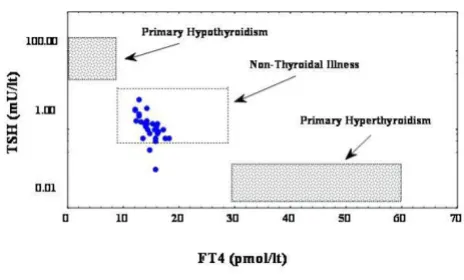
No patient had FT3, FT4, or TA levels outside the normal range. The plot of FT4 values vs. a logarithmic TSH values (figure 1) suggests that all depressed patients and controls are located in the normal reference area, away from pri-mary hypo- and hyperthyroidism. Four patients (13.3%) had increased TSH levels (1 melancholic-8.31% and 3 undifferentiated-37.5%), 12 patients (26.6%) had increased TMA levels (5 atypicals-50%, 6 melancholics-50% and 1 undifferentiated-11.1%), and 5 (16.6%) had increased TBII levels (2 atypicals-20% and 3 undifferentiated-37.5%).
[image:3.612.317.549.517.657.2]Bivariate scatterplot between TSH and FT4 levels
Figure 1
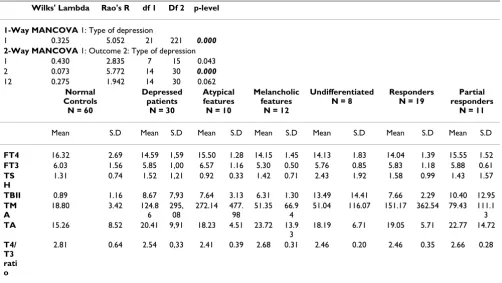
The means and standard deviations for each group are shown in table 1.
MANCOVA results revealed a main effect for the type of depression alone (p < 0.001, table 1). Post hoc analysis (table 2) revealed significant differences between all depressed subtypes and controls in terms of TBII levels (p < 0.0021) and between atypicals and controls in terms of TMA (p < 0.001).
These results should be considered a true effect of the type of depression since age, the presence of anxiety disorder and the presence of personality disorder were used as covariates.
There were no significant correlations between the HDRS, the HAS and the GAF scales and thyroid indices. No cor-relation was significant even at p < 0.05.
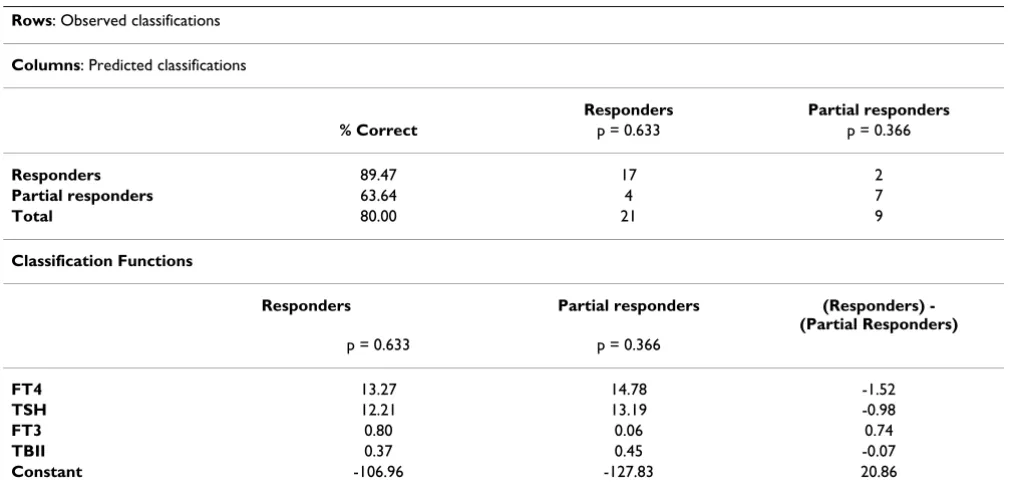
Discriminant function analysis results are shown in table 3 for depressed subtypes and in table 4 concerning the short-term outcome.
Discriminant functions may discriminate controls from depressives with 98.33% accuracy (only one control is
falsely classified) however the success rate is far lower for depressives (around 60% for all subtypes), however is still higher than chance (which would be 25% success).
[image:4.612.55.557.110.393.2]However, the success in discriminating between respond-ers and poor respondrespond-ers is far higher. The functions suc-ceeded in an 80.00% correct classification of depressed patients on the basis of thyroid indices. If we subtract the two functions, then we obtain the following function: 20.86-1.52*(FT4)-0.98*(TSH)+0.74*(FT3)-0.07*(TBII). When this function takes values above zero, then the respected depressed patient is predicted to be a responder with an 89.47% chance of success. These rates are clearly higher than the 50% (by chance).
Table 1: 1-way MANCOVA between the diagnostic groups in terms of thyroid results, with age, 2-way MANCOVA between the short term outcome (factor 1) and diagnostic groups (factor 2) in terms of thyroid results
Wilks' Lambda Rao's R df 1 Df 2 p-level
1-Way MANCOVA 1: Type of depression
1 0.325 5.052 21 221 0.000 2-Way MANCOVA 1: Outcome 2: Type of depression
1 0.430 2.835 7 15 0.043
2 0.073 5.772 14 30 0.000
12 0.275 1.942 14 30 0.062 Normal
Controls N = 60
Depressed patients
N = 30
Atypical features N = 10
Melancholic features
N = 12
Undifferentiated N = 8
Responders N = 19
Partial responders
N = 11
Mean S.D Mean S.D Mean S.D Mean S.D Mean S.D Mean S.D Mean S.D
FT4 16.32 2.69 14.59 1,59 15.50 1.28 14.15 1.45 14.13 1.83 14.04 1.39 15.55 1.52 FT3 6.03 1.56 5.85 1,00 6.57 1.16 5.30 0.50 5.76 0.85 5.83 1.18 5.88 0.61 TS
H
1.31 0.74 1.52 1,21 0.92 0.33 1.42 0.71 2.43 1.92 1.58 0.99 1.43 1.57
TBII 0.89 1.16 8.67 7,93 7.64 3.13 6.31 1.30 13.49 14.41 7.66 2.29 10.40 12.95 TM
A
18.80 3.42 124.8 6
295, 08
272.14 477. 98
51.35 66.9 4
51.04 116.07 151.17 362.54 79.43 111.1 3 TA 15.26 8.52 20.41 9,91 18.23 4.51 23.72 13.9
3
18.19 6.71 19.05 5.71 22.77 14.72
T4/ T3 rati o
2.81 0.64 2.54 0,33 2.41 0.39 2.68 0.31 2.46 0.20 2.46 0.35 2.66 0.28
In both analyses, age, the presence of anxiety disorder and the presence of personality disorder as covariates. Scheffe test served as post-hoc test
Table 2: Scheffe Post Hoc test results.
Index Groups compared P
TBII Undifferentiated vs. Normal controls <0.001 Atypicals vs. Normal controls <0.001 Melancholics vs. Normal controls 0.002 TMA Atypicals vs. Normal controls <0.001
[image:4.612.313.554.647.720.2]Table 3: Results of Discriminant function analysis (forward stepwise method) with diagnostic groups as the grouping variables.
Rows: Observed classifications
Columns: Predicted classifications
Undifferentiated Atypicals Melancholics Normal controls
% Correct p = 0.088 p = 0.111 p = 0.133 p = 0.666
Undifferentiated 62.50 5 1 1 1
Atypicals 60.00 0 6 1 3
Melancholics 58.33 0 0 7 5
Normal controls 98.33 0 0 1 59
Total 85.56 5 7 10 68
Classification Functions (coefficients)
Undifferentiated Atypicals Melancholics Normal controls p = 0.088 p = 0.111 p = 0.133 p = 0.666
TBII 1.04 0.57 0.49 0.14
TSH 6.78 4.03 4.47 3.87
TMA 0.01 0.01 0.00 0.00
TA 0.17 0.10 0.25 0.12
FT4 2.39 2.85 2.02 2.73
T4/T3 ratio 2.36 0.45 4.00 2.46
Constant -39.08 -31.56 -29.45 -29.58
The analysis succeeded in a 85.56% correct classification of all cases on the basis of thyroid indices. Only one control was falsely classified. Each case is predicted to belong to the group in whose function obtains the highest value. The chance of success of this prediction depends on the group. The four groups seems to lie on a continuum with melancholics closer to controls and undifferentiated being the group more distant to controls, and atypicals in the middle.
Table 4: Results of Discriminant function analysis (forward stepwise method) with outcome as the grouping variables.
Rows: Observed classifications
Columns: Predicted classifications
Responders Partial responders
% Correct p = 0.633 p = 0.366
Responders 89.47 17 2
Partial responders 63.64 4 7
Total 80.00 21 9
Classification Functions
Responders Partial responders (Responders)
-(Partial Responders) p = 0.633 p = 0.366
FT4 13.27 14.78 -1.52
TSH 12.21 13.19 -0.98
FT3 0.80 0.06 0.74
TBII 0.37 0.45 -0.07
Constant -106.96 -127.83 20.86
[image:5.612.53.563.459.705.2]Discussion
The present study reports that while FT3, FT4 and TSH of depressed patients are generally within the normal range (figure 1), thyroid binding inhibitory immunoglobulin levels were higher in depressed patients in comparison to controls. Microsomal antibodies levels were higher in atypical patients in comparison to controls. No differ-ences were detected when depressive subtypes were com-pared. The way discriminant function analysis classified depressed patients is interesting. Melancholics are classi-fied either correctly or as normals, atypicals are classiclassi-fied either correctly or as melancholics (N = 1) or normals (N = 3) and finally falsely classified 'undifferentiated' patients are classified one in each one of the three other groups. This may mean that melancholics are a more clearly defined and 'core' group, while atypicals and undifferentiated patients may constitute groups that fur-ther deviate away from normality and the 'melancholic core' of depression. Atypical patients were both more refractory to treatment and had higher microsomal anti-bodies (apart from TBII).
Microsomal antibodies are frequently present in patients with chronic lymphocytic thyroiditis, while thyroid bind-ing inhibitory immunoglobulines inhibit the bindbind-ing of TSH to its receptor, and lead to hypothyroidism.
Depressed patients may have an altered thyroid-stimulat-ing hormone response to thyrotropin-releasthyroid-stimulat-ing hormone (TRH), an abnormally high rate of antithyroid antibodies and elevated cerebrospinal fluid (CSF) TRH concentra-tions. Moreover, tri-iodothyronine has been shown con-clusively to augment the efficacy of various antidepressants. It has been suggested that the Hypothala-mus-Pituitary-Thyroid (HPT) axis alterations may be par-tially trait and parpar-tially state markers [32]. Other studies suggest that depression (and especially bipolar depres-sion) is characterized by brain hypothyroidism despite apparent euthyroidism indicated by routine peripheral blood thyroid hormone results[33,34].
The finding that depression often co-exists with autoim-mune subclinical thyroiditis suggests that depression may cause alterations in the immune system, or that in fact it is an autoimmune disorder itself. Whereas acute stress may initiate a transient immunologically protective response, prolonged or poorly controlled psychosocial stressors may result in depression of different components of the immune system. These responses may be related to, or independent of, changes in the neuroendocrine system. As the rather prolific literature in this infant area of psy-choneuroimmunology reveals, there are many complex levels of interaction that require further investigation [35], concerning a close relationship between delayed hyper-sensitivity to neural tissue antigens and
immunopsychiat-ric diseases, and they may imply that cell-mediated immune mechanisms are involved in the pathogenesis of certain mental disorders [19,20,36].
The availability of thyroid testing led to a bulk of research on thyroid dysfunction in non-thyroidal illness. Data sug-gest that within a given patient's status, change of thyroid function is determined by the severity and duration of ill-ness as well as the presence of mitigating influences that are associated with the specific underlying disorders. These thyroid disturbances in the frame of non-thyroidal illness is a diagnostic problem which needs focused atten-tion. Figure 1 represents a graphical solution suggested by Kaptein[37]. In this figure, it is evident that most depressed patients are clearly euthyroid, with some of them falling in the 'non-thyroid illness' area.
There are several papers suggesting that the thyroid func-tion of depressed patients is within the normal range, hypothyroidism and hyperthyroidism are extremely uncommon and that the presence of subtle thyroid func-tion abnormalities does not have an impact on treatment outcome [38-43]. However, on the contrary there are even more papers supporting the idea of a subclinical thyroid dysfunction, especially in melancholic or refractory patients, possibly of an autoimmune origin [44-55] sug-gesting that subclinical hypothyroidism may lower the threshold for the occurrence of depression[56], or gener-ally to any mental disorder [57-59]. It is reported that most patients with depression may have alterations in their thyroid function including slight elevation of the serum FT4, blunted TSH response to thyrotropin-releasing hormone (TRH) stimulation[60], and loss of the noctur-nal TSH rise and this may reflect brain hypothyroidism in the context of systemic euthyroidism[61].
Concerning the role thyroid status may play in the aetio-pathogenesis and neurobiology of depression it has been suggested that most patients with depression, although generally viewed as chemically euthyroid, have alterations in their thyroid function which are generally reversed fol-lowing alleviation of the depression [61-66].
reduced function is more pronounced in those patients without HPT axis abnormality. In this frame, HPT dysreg-ulation may be regarded as a compensatory mechanism for diminished central 5-HT activity[68], which is a suggestion similar to another one proposed concerning the Hypothalamus-Pituitary-Adrenal Axis[69]. This just reflects the fact that the true relationship of peripheral indices to brain function is always an open question[70].
The most robust relationship between thyroid dysfunc-tion and depression concerns gestadysfunc-tion and the postpar-tum period. Thyroid antibody-positive women are prone to hypothyroidism, which is often preceded by transient hyperthyroidism after delivery[71]. Also, lower range total and free thyroxine concentrations during late pregnancy may be related to postpartum depressive symptoms[72]. The presence of abnormal thyroid function tests is not related with a distinct clinical picture[73]. However, again, the literature is split and the results are inconclusive [74-76].
Thus, the review of the literature suggests that there are no conclusive data on the role of thyroid function in depres-sion. It is clear that depression is not characterized by an overt thyroid dysfunction. It is also clear that a subgroup of depressed patients may manifest subtle thyroid abnor-malities, or an activation of an autoimmune process, however the cause of this phenomenon and its implica-tions are unclear. There is a strong possibility that the presence of a subtle thyroid dysfunction is a negative prognostic factor for depression and may demand specific therapeutic intervention. On the other hand, it should be stressed that atypical patients are over-represented in the 'partial responders' group of the current study. Thus, the results of the current study report a triangular relationship between atypicality, thyroid dysfuction and refractory depression. It is not possible to arrive at a reliable causal relationship at this stage. Further focused research is necessary.
The major advantage of the current study is the follow up period of 2 years in clearly and solidly diagnosed subtypes of unipolar major depression. There is no other similar study in the literature.
The main disadvantage of the study is the relatively small study population which is at the limit of parametric meth-ods. Thus, results should be accepted with caution.
Conclusion
The results of the current study, in accord with the litera-ture, suggest that overt thyroid dysfunction is not com-mon in depressive patients. No significant differences can be traced concerning the thyroid function between differ-ent clinical subtypes of depression nor there is any
corre-lation between specific clinical symptoms and thyroid indices. This is again in accord with the literature. Depressed patients had higher Thyroid Binding Inhibitory Immunoglobulins (TBII), which is suggestive of the pres-ence of an underlying autoimmune process in depression, and is independent of the clinical subtype. Response to treatment could be predicted on the basis of thyroid indi-ces alone with 89.47% chance of sucindi-cess, which is a rather high success rate. Further study is necessary in order to investigate the mechanisms of this process and the extent of this autoimmune activation.
The current study constitutes only an exploratory effort to search for the relationship between subtypes of unipolar depression, thyroid function and clinical outcome. This effort is restricted both by the study sample as well as from limitation of the methodology employed. Further research is essential in order to arrive to solid conclusions.
Competing interests
None declared.References
1. Staner L, De La Fuente JM, Kerkhofs M, Linkowski P, Mendlewicz J:
Biological and clinical features of recurrent brief depression: a comparison with major depressed and healthy subjects. Journal of Affective Disorders 1992, 26:241-245.
2. Legros S, Mendlewicz J, Wybran J: Immunoglobulins, autoanti-bodies and other serum protein fractions in psychiatric disorders.Eur Arch Psychiatry Neurol Sci 1985, 235:9-11.
3. Rao ML, Ruhrmann S, Retey B, Liappis N, Fuger J, Kraemer M, Kasper S, Möller HJ: Low plasma thyroid indices of depressed patients are attenuated by antidepressant drugs and influence treat-ment outcome.Pharmacopsychiatry 1996, 29:180-186.
4. Iacovides A, Fountoulakis KN, Grammaticos P, Ierodiakonou C: Dif-ference in symptom profile between generalized anxiety dis-order and anxiety secondary to hyperthyroidism.International Journal of Psychiatry in Medicine 2000, 30:71-81.
5. Ordas DM, Labbate LA: Routine screening of thyroid function in patients hospitalized for major depression or dysthymia? Annals of Clinical Psychiatry 1995, 7:161-165.
6. Joffe RT, Sokolov ST: Thyroid hormones, the brain, and affec-tive disorders.Crit Rev Neurobiol, 1994, 8:45-63.
7. Roth M: The phenomenology of depressive states.Can Psychiatr Assoc J 1959, 4(suppl):32-54.
8. Van Praag HM, Uleman AM, Spitz JC: The Vital Syndrome Interview.Psychiatr Neurol Neurochir 1965, 68:329-349.
9. Overall JE, Hollister LE, Johnson M: Nosology of Depression and Differential Response to Drugs.JAMA 1966, 195:946-950. 10. Fountoulakis KN, Iacovides A, Nimatoudis I, Kaprinis G,
Ierodia-konou Ch: Comparison of the Diagnosis of Melancholic and Atypical Features According to DSM-IV and Somatic Syn-drome According to ICD-10 In Patients Suffering from Major Depression.European Psychiatry 1999, 14:426-434. 11. APA: Diagnostic and Statistical Manual of Mental Disorders,
4th Edition, DSM-IV.Washington DC, American Psychiatric Press; 1994.
12. WHO: The ICD-10 Classification of Mental and Behavioural Disorders-Diagnostic Criteria for Research.Geneva; 1993. 13. Liebowitz MR, Quitkin FM, Stewart J, McGrath PP, Harrison W,
Markowitz J, Rabkin J, Tricamo E, Goetz D, D Klein: Antidepressant Specificity in Atypical Depression.Archives of General Psychiatry
1988, 45:129-137.
14. Sargant W: Some Newer Drugs in the Treatment of Depres-sion and their Relation to Other Somatic Treatments. Psycho-somatics 1960, 1:14-17.
16. Fountoulakis K, Fotiou F, Iacovides A, Goulas A, Tsolaki M, Ierodia-konou Ch: Changes in Pupil Reaction to Light in Melancholic patients.International Journal of Psychophysiology 1999, 31:121-128. 17. Gold PW, Chrousos GP: Organization of the stress system and
its dysregulation in melancholic and atypical depression: high vs low CRH/NE states.Mol Psychiatry 2002, 7:254-275. 18. Elenkov IJ, Chrousos GP: Stress hormones, proinflammatory
and antiinflammatory cytokines, and autoimmunity.Ann N Y Acad Sci 2002, 966:290-303.
19. Carta MG, Hardoy MC, Boi MF, Mariotti S, Carpiniello B, Usai P:
Association between panic disorder, major depressive disor-der and celiac disease: a possible role of thyroid autoimmunity.J Psychosom Res 2002, 53:789-793.
20. Carta MG, Hardoy MC, Usai P, Carpiniello B, Angst J: Recurrent brief depression in celiac disease. J Psychosom Res 2003,
55:573-574.
21. Wing JK, Babor T, Brugha T: SCAN: Schedules for Clinical Assessment in Neuropsychiatry. Archives of General Psychiatry
1990, 47:589-593.
22. WHO: Schedules for Clinical Assessment in Neuropsychia-try-SCAN version 2.0) Greek Version. Edited by: Mavreas V. Ath-ens, Research University Institute for Mental Health; 1995.
23. Loranger AW, Sartorious N, Andreoli Al: The World Health Organisation/Alcohol, Drug Abuse and Mental Health Administration International Pilot Study of Personality Disorders.Archives of General Psychiatry 1994, 51:215-224. 24. WHO: International Personality Disorders Examination.
Geneva; 1995.
25. Fountoulakis KN, Iacovides A, Kaprinis G, Ierodiakonou Ch: World Health Organisation: International Personality Disorders Examination, Greek Edition.Thessaloniki Greece. unpublished 26. Fountoulakis KN, Iacovides A, Ioannidou Ch, Bascialla F, Nimatoudis
I, Kaprinis G, Janca A, Dahl A: Reliability and cultural applicabil-ity of the Greek version of the International Personalapplicabil-ity Dis-orders Examination.BMC Psychiatry 2002, 2:6.
27. Hamilton M: A rating scale for depression.J Neurol Neurosurg Psychiatry 1960, 23:56-62.
28. Williams J: A structured interview guide for the Hamilton Depression Rating Scale.Arch Gen Psychiatry 1988, 45:742-747. 29. Hamilton M: The Assessment of Anxiety States by Rating.
British Journal of Medical Psychology. 1959, 32:50-55. 30. APA: Diagnostic and Statistical Manual of Mental Disorders.
4th (DSM-IV)th edition. Washington DC; 1994:32.
31. Mariotti S, Caturegli P, Piccolo P, Barbesino G, Pinchera A: Antithy-roid peroxidase autoantibodies in thyAntithy-roid diseases.J Clin Endo-crinol Metab 1990, 71:661-669.
32. Musselman DL, Nemeroff CB: Depression and endocrine disor-ders: focus on the thyroid and adrenal system.Br J Psychiatry
1996, (suppl)(30):123-128.
33. Sullivan GM, Hatterer JA, Herbert J: Low Levels of Transthyretin in the CSF of Depressed Patietns.American Journal of Psychiatry
1999, 156:710-715.
34. Bauer MS, Whybrow PC, Winokur A: Rapid Cycling Bipolar Affective Disorder I: Association with Grade I Hypothyroidism.Archives of General Psychiatry 1990, 47:427-432. 35. Schindler BA: Stress, affective disorders, and immune
function.Medical Clinics Of North America 1985, 69:585-597. 36. Jankovic BD: Neural tissue hypersensitivity in psychiatric
dis-orders with immunologic features. J Immunol 1985,
135(2suppl):853s-857s.
37. Kaptein EM: Clinical Application of Free Thyroxine Determinations.Clinical and Laboratory Medicine 1993, 13:653-672. 38. Fava M, Labbate LA, Abraham ME, Rosenbaum JF: Hypothyroidism and hyperthyroidism in major depression revisited.Journal of Clinical Psychiatry 1995, 56:186-192.
39. Joffe R, Segal Z, Singer W: Change in thyroid hormone levels fol-lowing response to cognitive therapy for major depression. American Journal Of Psychiatry 1996, 153:411-413.
40. Haggerty JJ, Silva SG, Marquardt M, Mason GA, Chang HY, Evans DL, Golden RN, Pedersen C: Prevalence of antithyroid antibodies in mood disorders.Depression And Anxiety 1997, 5:91-96.
41. Pop VJ, Maartens LH, Leusink G, vanSon MJ, Knottnerus AA, Ward AM, Metcalfe R, Weetman AP: Are autoimmune thyroid dys-function and depression related?Journal Of Clinical Endocrinology And Metabolism 1998, 83:3194-3197.
42. Harris B, Fung H, Johns S, Kologlu M, Bhatti R, McGregor AM, Rich-ards CJ, Hall R: Transient post-partum thyroid dysfunction and postnatal depression. Journal Of Affective Disorders 1989,
17:243-249.
43. Joffe RT: Antithyroid antibodies in major depression.Acta Psy-chiatrica Scandinavica 1987, 76:598-599.
44. Howland RH: Thyroid dysfunction in refractory depression: implications for pathophysiology and treatment.Journal of Clin-ical Psychiatry 1993, 54:47-54.
45. Rao ML, Vartzopoulos D, Fels K: Thyroid function in anxious and depressed patients.Pharmacopsychiatry 1989, 22:66-70.
46. Nemeroff CB: Clinical significance of psychoneuroendocrinol-ogy in psychiatry: focus on the thyroid and adrenal.Journal of Clinical Psychiatry 1989, 50 Suppl:13-20.
47. Maes M, D'Hondt P, Blockx P, Cosyns P: A further investigation of basal HPT axis function in unipolar depression: effects of diagnosis, hospitalization, and dexamethasone administration.Psychiatry Research 1994, 51:185-201.
48. Bunevicius R, Kazanavicius G, Telksnys A: Thyrotropin response to TRH stimulation in depressed patients with autoimmune thyroiditis.Biological Psychiatry 1994, 36:543-547.
49. Banki CM, Vojnik M, Arato M, Papp Z, Kovacs Z: Dexamethasone suppression and multiple hormonal responses (TSH, prolac-tin and growth hormone) to TRH in some psychiatric disor-ders.European Archives of Psychiatry and Neurological Sciences 1985,
235:32-37.
50. Rupprecht R, Rupprecht C, Rupprecht M, Noder M, Mahlstedt J: Tri-iodothyronine, thyroxine, and TSH response to dexamethasone in depressed patients and normal controls. Biological Psychiatry 1989, 25:22-32.
51. Gewirtz GR, Malaspina D, Hatterer JA, Feureisen S, Klein D, Gorman JM: Occult thyroid dysfunction in patients with refractory depression.American Journal Of Psychiatry 1988, 145:1012-1014. 52. Marchesi C, Chiodera P, DeRisio C, Dassò L, Govi AM, DeFerri A,
Piagneri B, Minelli R, Bianconi L, Gnudi A: Dopaminergic control of TSH secretion in endogenous depression.Psychiatry Research
1988, 25:277-282.
53. Nemeroff CB, Simon JS, Haggerty JJ, Evans DL: Antithyroid anti-bodies in depressed patients.American Journal Of Psychiatry 1985,
142:840-843.
54. Kjellman BF, Ljunggren JG, Beck-Friis J, Wetterberg L: Effect of TRH on TSH and prolactin levels in affective disorders.Psychiatry Research 1985, 14:353-363.
55. Haggerty JJ, Stern RA, Mason GA, Beckwith J, Morey CE, Prange AJ:
Subclinical hypothyroidism: a modifiable risk factor for depression?American Journal Of Psychiatry 1993, 150:508-510. 56. Haggerty JJ, Evans DL, Golden RN, Pedersen CA, Simon JS, Nemeroff
CB: The presence of antithyroid antibodies in patients with affective and nonaffective psychiatric disorders. Biological Psychiatry 1990, 27:51-60.
57. O'Donnell M, Silove D, Wakefield D: Current perspectives on immunology and psychiatry.Australian And New Zealand Journal Of Psychiatry 1988, 22:366-382.
58. Stein MB, Uhde TW: Autoimmune thyroiditis and panic disorder.American Journal Of Psychiatry 1989, 146:259-260. 59. Loosen PT: The TRH-induced TSH response in psychiatric
patients: a possible neuroendocrine marker. Psychoneuroendo-crinology 1985, 10:237-260.
60. Jackson IM: The thyroid axis and depression. Thyroid 1998,
8:951-956.
61. Jackson IM: The thyroid axis and depression. Thyroid 1998,
8:951-956.
62. Sagud M, Pivac N, Muck-Seler D, Jakovljevic M, Mihaljevic-Peles A, Korsic M: Effects of sertraline treatment on plasma cortisol, prolactin and thyroid hormones in female depressed patients.Neuropsychobiology 2002, 45:139-143.
63. Konig F, Hauger B, vonHippel C, Wolfersdorf M, Kaschka WP: Effect of paroxetine on thyroid hormone levels in severely depressed patients.Neuropsychobiology 2000, 42:135-138. 64. Szuba MP, O'Reardon JP, Rai AS, Snyder-Kastenberg J, Amsterdam JD,
Gettes DR, Wassermann E, Evans DL: Acute mood and thyroid stimulating hormone effects of transcranial magnetic stimu-lation in major depression.Biological Psychiatry 2001, 50:22-27. 65. Orth DN, Shelton RC, Nicholson WE, Beck-Peccoz P, Tomarken AJ,
Publish with BioMed Central and every scientist can read your work free of charge "BioMed Central will be the most significant development for disseminating the results of biomedical researc h in our lifetime."
Sir Paul Nurse, Cancer Research UK
Your research papers will be:
available free of charge to the entire biomedical community
peer reviewed and published immediately upon acceptance
cited in PubMed and archived on PubMed Central
yours — you keep the copyright
Submit your manuscript here:
http://www.biomedcentral.com/info/publishing_adv.asp
BioMedcentral
bioactivity during sleep deprivation in depression.Archives of General Psychiatry 2001, 58:77-83.
66. David MM, Owen JA, Abraham G, Delva NJ, Southmayd SE, Wooltor-ton E, Lawson JS: Thyroid function and response to 48-hour sleep deprivation in treatment-resistant depressed patients. Biological Psychiatry 2000, 48:323-326.
67. vanWest D, Maes M: Activation of the inflammatory response system: A new look at the etiopathogenesis of major depression.Neuroendocrinology Letters 1999, 20:11-17.
68. Duval F, Mokrani MC, Bailey P, Correa H, Diep TS, Crocq MA, Macher JP: Thyroid axis activity and serotonin function in major depressive episode. Psychoneuroendocrinology 1999,
24:695-712.
69. Fountoulakis KN, Fotiou F, Iacovides A, Karamouzis M, Goulas A, Demetriadou A, Kaprinis G: Relationship between pupillometric findings, DST and melancholia.Acta Psychiatrica Belgicain press:. 70. Frye MA, Dunn RT, Gary KA, Kimbrell TA, Callahan AM, Lucken-baugh DA, Cora-Locatelli G, Vanderham E, Winokur A, Post RM:
Lack of correlation between cerebrospinal fluid thyrotropin-releasing hormone (TRH) and TRH-stimulated thyroid-stimulating hormone in patients with depression. Biological Psychiatry 1999, 45:1049-1052.
71. Harris B: Postpartum depression and thyroid antibody status. Thyroid 1999, 9:699-703.
72. Pedersen CA: Postpartum mood and anxiety disorders: a guide for the nonpsychiatric clinician with an aside on thy-roid associations with postpartum mood. Thyroid 1999,
9:691-697.
73. Kent GN, Stuckey BG, Allen JR, Lambert T, Gee V: Postpartum thyroid dysfunction: clinical assessment and relationship to psychiatric affective morbidity. Clinical Endocrinology 1999,
51:429-438.
74. Harris B, Oretti R, Lazarus J, Parkes A, John R, Richards C, New-combe R, Hall R: Randomised trial of thyroxine to prevent postnatal depression in thyroid-antibody-positive women.Br Psychiatry 2002, 180:327-330.
75. Lucas A, Pizarro E, Granada ML, Salinas I, Sanmarti A: Postpartum thyroid dysfunction and postpartum depression: are they two linked disorders?Clinical Endocrinology 2001, 55:809-814. 76. Kuijpens JL, Vader HL, Drexhage HA, Wiersinga WM, vanSon MJ, Pop
VJ: Thyroid peroxidase antibodies during gestation are a marker for subsequent depression postpartum.European Jour-nal of Endocrinology 2001, 145:579-584.
Pre-publication history
The pre-publication history for this paper can be accessed here: