2017 2nd International Conference on Communications, Information Management and Network Security (CIMNS 2017) ISBN: 978-1-60595-498-1
Super Optimal S-boxes Based on Pure Non-linear 3-quasigroups
Jiang-ping LI and Yun-qing XU
*Department of Mathematics, Ningbo University, Ningbo 315211, China *Corresponding author
Keywords: Optimal S-Box, 3-quasigroup, Latin cube, Branch number, Algebraic degree.
Abstract. In this paper, we present an approach to construct cryptographically strong 44-bit S-boxes with pure non-linear 3-quasigroups. PRESENT is a light weight block cipher included in ISO and IEC. The S-box used in PRESENT is optimal in linearity, differential uniformity, branch number and algebraic degree. Our methodology is based on 3-quasigroup operations and it enables someone to get 44-bit S-boxes optimal in all the above four properties that PRESENT S-box has.
Introduction
An mn-bit S-box is a mapping form finite fields 2
m
F to 2
n
F . S-boxes are widely used in hash functions and block ciphers. S-boxes are usually the only non-linear part in block ciphers and therefor they have to be chosen carefully to make the cipher to resist any kind of attack.
It is conjectured that a good S-box may be a randomly chosen mapping with sufficient large size. However, a small S-box needs less resources than a large one. For example, a 44-bit S-box requires less than a quarter hardware resources than that of an 88-bit S-box (in gate equivalences). So, small S-boxes are much more efficient, especially in hardware. Many lightweight block ciphers and hash functions use 44-bit S-boxes, such as PRESENT [1], SPONGENT [2] and LED [3], etc.
PRESENT is a light weight block cipher designed for situations where low-power consumption is desired. The PRESENT S-box is get by an exhaustive search of all 16! bijective mappings on F24.
Instead of the exhaustive search of all 16! bijections on F24 for PRESENT, in this paper we give a
compact, elegant and fast method for constructing cryptographically strong S-boxes by using 3-quasigroups of order 4. Our purpose is to give cryptographers an efficient method to get cryptographically strong S-boxes for the designs of symmetric lightweight cryptography.
Quasigroup applications in cryptology growth rapid now. The theory of quasigroups is widely used in the design of block ciphers, stream ciphers, hash functions, etc[4]. Mihajloska and Gligoroski[5], Z. Yu and Y. Xu[6] gave a method for constructing 4×4-bit optimal S-boxes with quasigroups and 3-quasigroups respectively. In this paper, we will construct 4×4-bit S-boxes which have the properties that the PRESENT S-box has.
The paper is organized as follows: in Section 2 we analyze the properties of the PRESENT S-box. In Section 3 we discuss the pure non-linear 3-qusigroups. In Section 4 we give the construction of 44-bit super optimal S-boxes. Section 5 contains concluding remarks.
PRESENT S-Box and Its Properties
An S-box is usually defined as a vector valued Boolean function. A Boolean function with m variables is a map f : 2
m
F F2, where F2 is the finite field with elements in {0, 1}. An mn-bit S-box S is a
Boolean map of m bits to n bits S : F2mF2n.
, 2
m
u vF , u( , ,u u0 1 ,um1), v( , ,v v0 1 ,vm1), the inner product of u and v can be defined
1 0 , m i i i
u v u v
.Let f be a Boolean function with m variables, f F: 2mF2 and aF2m, the Walsh coefficient of f at a is defined as
2
( ) ,
[ ] ( 1)
m
f x a x W
x F
f a
. The linearity of f is defined as
2
Lin( ) max | [ ] | m
W
a F
f f a
.
Let S be an S-box mapping m bits to n bits S F: 2m F2n and b F2n\ {0}, the component
function of S corresponding to b is defined as a Boolean map : 2
m b
S F 2n
F .
2
( ) , ( ) , m.
b
S x b S x x F
The linearity of S is defined as
2 , 2\{0}
Lin( ) max | [ ] |
m n
W b a F b F
S S a
.
For an S-box, the linearity gives a measure for the resistance against the linear cryptanalysis. The smaller the linearity is, the more secure the S-box is against linear attacks. The smallest known linearity of a permutation on F2m is 2m/2+1 if m is even[6].
0 1 1 2 0 1 1 2
( , , , m ) m, ( , , , n ) n
u u u u F v v v v F
, Let
2
( , ) { m: ( ) ( ) }
S u v x F S x u S x v
. Define the differential uniformity of S as
2 \{0}, 2
Diff( ) max ( , )
m n S
u F v F
S u v
.
Diff(S) gives a measure to the resistance of S against differential cryptanalysis. Similarly, the smaller the differential uniformity is, the more secure an S-box against differential cryptanalysis. It is obvious that Diff(S) is always even. It has been shown[7] that for any S-box S , Diff ( )S 2, and therefore we have Diff ( )S 4. An S-box S is said to be optimal if Lin(S) and Diff(S) reach the minimum.
Definition 1[7]. Let S be a 4 4 -bit S-box. S is said to be optimal if it satisfies the following conditions: (1) S is a bijection; (2) Lin( )S 8;(3) Diff ( )S 4.
Another property of S-boxes is the branch number. It is an important property to describe the diffusion capabilities.
Definition 2[8]. The branch number of an n n -bit S-Box S is
,
BN( ) min wt( ) wt( ( ) ( )) ,
a b a
S a b S a S b
where , 2
n
a bF and wt( )x is the Hamming weight of a binary vector x.
It is obvious that the branch number of a bijective S-Box is at least 2. The larger the branch number is, the better the S-box is. The largest branch number of 4 4 -bit S-boxes is 3 (see [8]).
Algebraic degree is also an important criterion of an S-box. A Boolean function : 2
m
f F F2 can
0 1 1
2
0 1 1 0 1 1
( , , , ) m
m
v v v
m v m
v F
f x x x c x x x
.
The algebraic degree of f is the maximal weight of v such that cv 0. Each m n -bit S-box S has
2n1 components S xa( ) a S x, ( ) ,aF2n\{0}. The algebraic degree of an S-box S is the maximal degree of the components:
2\{0}
deg( ) max deg( )
n a
a F
S S
.
A good S-box should have a high algebraic degree. It is known[5] that for any 44-bit S-box S, 2 deg(S) 3.
If an S-box is optimal with linearity, differential uniformity, branch number and algebraic degree, it is said to be super optimal.
Definition 3. Let S be a 4 4 -bit S-box. S is said to be superoptimal if it satisfies the following conditions: (1) S is a bijection; (2) Lin( )S 8;(3) Diff ( )S 4;(4) BN( )S 3; (5) deg( )S 3.
As mentioned in the introduction, the S-boxes used in the block cipher PRESENT were obtained by an exhaustive search for all the 16! bijections with checking some optimality criteria for the linearity and the differential potentials. The PRESENT S-box P is shown in Table 1. It is an optimal S-box, i.e., Lin(P) = 8 and Diff(P) = 4. The branch number of P reach the upper bound of 44-bit S-boxes, i.e., BN(P) = 3, and it can be check that the algebraic degree of P is 3.
Table 1. The S-box used in light weight block cipher PRESENT.
x 0 1 2 3 4 5 6 7 8 9 A B C D E F
P(x) F 7 8 C D 6 5 B 9 4 A 3 1 2 E 0
Instead of exhaustive search of all 16! permutations, in Section 4, we will give a compact, elegant and fast and elegant method for constructing cryptographically strong S-boxes by using 3-quasigroups of order 4.
Pure Non-linear 3-Quasigroup
A Latin square of order r is an r r matrix with elements in an r-set Q, such that each symbol in Q occurs exactly once in each row as well as in each column. A Latin cube of order r is a 3-dimensional array on Q, such that each symbol of Q appears exactly once in each 1-dimensional subarray. In a Latin cube, each 1-dimensional subarray with just the 1st (2nd, 3rd) coordinate changes is called a fiber (row, column). It is obvious that every 1-dimensional subarray in a Latin cube is a permutation on set Q. Keeping the 1st (2nd, 3d) coordinate fixed we get a layer (slice, floor). Each layer contains r rows and rcolumns, each slice contains rcolumns and r fibers, each floor contains rfibers and rrows. Each layer is a Latin square and this also true for each slice and each floor.
Let L be a Latin cube with elements and indices from .Q Denote ( , , )L i j k the element of Lin position ( , , ).i j k Let be a ternary operation on Q satisfies
( , , )x y z L x y z( , , ), x y z, , Q.
The ordered pair ( , )Q is called a 3-quasigroup on .Q The cardinal number of Q is called the order of ( , ).Q
A Latin cube equivalent to a 3-quasigroup. In this paper, the concepts of a Latin cube and a 3-quasigroup will be freely interchanged.
Lemma 1[9]. Let ( , )Q be a 3-quasigroup, and x y z, , be variables. , ,a b cQ, the following equations
( , , )x a b c, ( , y, )a b c, ( , , )a b z c,
Let ( , )Q be a 3-quasigroup of order 2 .t
r Then can be viewed as a Boolean function, :
3
2 2,
t t
F F i.e., can be viewed as a 3t t -bit S-box. If all the 2t 1 components of are non-linear, then ( , )Q is said to be pure-non-linear.
There are 55296 Latin cubes of order 4, and they can be divided into 55296/4! = 2304 floor isomorphism classes[10]. Let L be a Latin cube on set {0,1, 2,3}. If the elements on the top left corner of the four floors of L are 0, 1, 2, 3 respectively, Then L is said to be floor standard. In every floor isomorphism class, there is just one floor standard Latin cube, it is called the representative of this class. These 2304 representatives are denoted by L1, L2, …, L2304 [10]. There are 15552 pure-non-linear
3-quasigroups of order 4 and they form 648 floor isomorphism classes. The index numbers of the pure-non-linear representatives are listed in Table 1 of [10].
Construction of Super Optimal 44-bit S-Boxes
In this section, by using 3-quasigroups of order 4, we offer a methodology for constructing 44-bit S-boxes optimal with linearity, differential uniformity, branch number and algebraic degree. In order to get S-boxes optimal with algebraic degree, we use only the 15552 pure-non-linear representatives shown in [10].
Definition 4. Let Q be an r-set and ( , )Q be a 3-quasigroup, q q1, 2Q and qq q1| 2. Define a
mapping q:Q Q Q Q as follows. x = ( ,x x1 2) Q Q
1 2
( , )
q y y
where
1 1 2 1
2 2 1 2
( , , ),
( , , ).
y x x q
y x y q
Then q is called a Q -function based on ( , )Q .
Theorem 1[10]. The Q-function q is a bijection on Q Q .
Define a bijection on F2n, ISHC as follows: x F2n and integer k,
ISHC(x, k) := Left shift x cyclically by k bits.
Let h15 be a positive integer, per = (p p1, 2, ,ph) be a permutation on {1,2,…, h}. Let pk1,pk2
{0,1,2,3}, pk pk1|pk2 (k1, 2, , )h . Define bijections Pk on F24 as follows: X 4 2
F
( ) ISHC( , 2mod( , 2) 1) , 1, 2, , ,
k k
P X X k k h
where ( ) : ( ). k
k p
Define a 44-bit S-box, S, as follows:
4
2 1 2
( ) h( ( ( )) ), .
S X P P P X X F
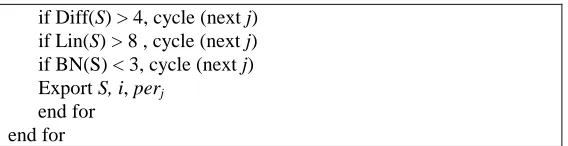
Let I = {i | Li is pure-non-linear}. Let {perj | 1 jh!} be the set of all permutations on {1, 2,…, h}. By using the algorithm shown in Table 2 we can get super optimal 44-bit S-boxes
Table 2. The algorithm for generating super optimal S-boxes for i =1 to 15552
Take pure-non-linear representative Ci
for j = 1 to h!
generate perj = (p1,p2,...,pk)
if Diff(S) > 4, cycle (next j) if Lin(S) > 8 , cycle (next j) if BN(S) < 3, cycle (next j) Export S, i, perj
end for end for
Let h = 7 we get 4 different super optimal S-boxes listed in Table 3. The 4 components of the algebraic normal form of the first S-box in Table 3, S1, S2, S4, S8, are shown in Formula (1).
4 2 \ {0},
a F
a = a4|a3|a2|a1, we have deg(Sa) 2:
[image:5.595.158.442.69.142.2]Sa = a1S1 a2S2 a3S4a4S8.
Table 3. The 4 super optimal S-boxes get by h = 7.
x 0 1 2 3 4 5 6 7 8 9 A B C D E F
S(x)
7 E D 8 C B 6 5 A 1 3 4 F 2 0 9
1 B A 5 C 7 F 9 8 6 3 0 2 D 4 E
3 0 4 D 5 E B 1 8 6 7 A F 9 2 C
D 4 7 A 2 E C 9 B 8 1 F 5 3 6 0
Let h = 8 we get 38 different super optimal S-boxes; h = 9 we get 419 different super optimal S-boxes; h = 10 we get 3078 different super optimal S-boxes.
1 0 1 3 2 3
2 0 2 0 3 1 2 3 1 3 1 2 3 2
4 0 1 0 2 1 2 3 2 3 3
8 0 1 2 0 1 0 2 3 0 2 0 1 2 3 2 3
1
1
1
S x x x x x
S x x x x x x x x x x x x x
S x x x x x x x x x x
S x x x x x x x x x x x x x x x x
(1)
Conclusion
In this paper, we have given a method for generating cryptographically strong 44-bit S-boxes with properties that the PRESENT S-box has. Our methodology is based on 3-quasigroup operation with h rotations. With different h, we can get more and more 44-bit super optimal S-boxes, this S-boxes are optimal in in linearity, differential uniformity, branch number and algebraic degree. A natural extension of this work would be generating cryptographically strong S-boxes of other size, such as 64-bit super optimal S-boxes and 88-bit super optimal S-boxes.
Acknowledgement
This research was financially supported by the National Natural Science Foundation of China under Grant No. 61373007 and Zhejiang Provincial Natural Science Foundation of China under Grant No. LY13F020039.
References
[1] A. Bogdanov, L.R. Knudsen, G. Leander, C. Paar, A. Poschmann, M.J.B. Robshaw, Y. Seurin, C. Vikkelsoe, PRESENT: An Ultra-Lightweight Block Cipher. In: P. Paillier, I. Verbauwhede (eds.) CHES 2007. LNCS, vol. 4727, pp. 450–466. Springer, Heidelberg.
[2] A. Bogdanov, etc, SPONGENT: A Lightweight Hash Function. In: B. Preneel, T. Takagi (eds.), CHES 2011, LNCS, vol. 6917, pp. 312–325. Springer.
[4] V.A. Shcherbacov, Quasigroups in cryptology. Computer Science Journal of Moldova, 2010(2): 193-228.
[5] H. Mihajloska, D. Gligoroski, Construction of Optimal 4-bit S-boxes by Quasigroups of Order 4. In: The Sixth International Conference on Emerging Security Information, Systems and Technologies, SECURWARE 2012, Rome, Italy, pp163-168.
[6] F. Chabaud, S. Vaudenay, Links between differential and linear cryptanalysis, in Advances in Cryptology — EUROCRYPT'94. Springer Berlin Heidelberg, 388-404.
[7] G. Leander, A. Poschmann, On the Classification of 4 bit S-boxes. In: C. Carlet, B. Sunar (eds.), WAIFI 2007. LNCS, vol. 4547, pp. 159-176. Springer, Heidelberg.
[8] M.J.O. Saarinen, Cryptographic Analysis of all 4x4-bit S-boxes, in Proceedings of the 18th International Conference on Selected Areas in Cryptography, ser. SAC’11. Springer-Verlag, 2012, pp. 118–133.
[9] S. Lyu, Y. Xu, String Transformation Based on 3-quasigroups, Journal of Computational Information Systems Vol.11 (2015) No.19, 6989-7000.