2017 2nd International Conference on Computational Modeling, Simulation and Applied Mathematics (CMSAM 2017) ISBN: 978-1-60595-499-8
Detached Eddy Simulation for the Stator-Rotor Interaction of the
Compressor High-Pressure Cascade
Fan FENG and Yao-bing XIAO
*Key Laboratory for Thermal Science and Power Engineering of Ministry of Education, Tsinghua University, Beijing, 100084, People’s Republic of China
*Corresponding author
Keywords: Detached eddy simulation, Stator-rotor interaction, Compressor cascade.
Abstract. The potential of predicting stator-rotor interaction of detached eddy simulation (DES) was researched by applying it to simulate high Reynolds-number complex flows of compressor high-pressure cascade. By developing the full-matching grid method and incorporating multi-block into one block, the stator-rotor interface is treated for high-accuracy and large-scale-parallel at first. Then, DES and S-A simulation were employed to study the interaction between the stator and the rotor on approximately six million grids. Results show that DES has better capability to describe the structures of flow field than S-A. Compared with S-A, DES obtains the approximate same results from 20% span to 80% span, but predicts obvious lower loss near the hub because of the similar mechanism as “clocking”, and higher loss near the shroud because of stronger tip leakage flows.
Introduction
In the past several decades, simulation method based on Reynolds-Averaged Navier-Stokes equations (RANS) was developed rapidly and various turbulence models were proposed. RANS was widely used to predict the flowfield in turbomachinery [1-3] as well as in other aspects, in spite of its fundamental deficiencies. While the most popular RANS models appear to yield predictions of useful accuracy in attached flows as well as some with shallow separations, RANS predictions of complex flows such as massive separation or intensive unsteady flow can’t assure enough accuracy.
Large Eddy Simulation (LES) are accurate methods for the complex flows, and have some successful application in low-Reynolds-number turbine blade [4-6]. However, LES needs huge computational resources, especially for high-Reynolds-number flows, because the grid density should increase with Re1.8 in the boundary layers and Re0.4 in regions away from the solid walls.
Compared with LES, the grid density of RANS should follow ln(Re) only in wall-normal direction. Then, Detached Eddy Simulations (DES) [7, 8], the typical strategy of combining the RANS in the boundary layer with LES in the main flows, seems attractive for realistic high-Reynolds-number complex flows. DES is less expensive than LES but has the potential of maintaining the fidelity of the LES model in regions with rich eddy content, and has many successful cases such as backward-facing step flow [9], boundary layers and wakes [10] and flow in ribbed duct [11]. Therefore, the interest of DES for turbomachinery has been raised and correlative researches are urgent.
In this paper, the potential of predicting stator-rotor interaction of detached eddy simulation (DES) was researched. The outline of this paper is as follows. Chapter 1 gives the numerical method and chapter 2 discusses a method for the stator-rotor interface with high-accuracy and large-scale-parallel. Chapter 3 compares the results between RANS and DES models and discusses some interesting phenomena. Finally, chapter 4 closes the paper with some concluding remarks.
Numerical Method
scale of S-A model d, which is defined as the nearest distance between the cell and the solid wall, is replaced by d depended on not only the grid but also the eddy-viscosity and velocity field:
max(0, )
d DES
d d f dC
(1)
where fd 1 tanh([8 ])rd 3, 2 2
, ,
t d
i j i j r
U U d
, and max( x, y, z).
For the purpose of comparison, RANS simulation using S-A model is also carried out. The grid system is 96*112*286 in azimuthal, spanwise and streamwise directions for both stator and rotor, and more than 20 spanwise grids are set in tip clearance. The blade of stator and rotor are set to equal number 140, and then the passing frequency f is 7000 Hz. We can define time period as T=1/f. After treating the stator-rotor interface by the method discussed in next section, the grid system is decomposed to 64 sub-domains for 64-CPU parallel computation.
A LES scheme [12-14], which is developed form improved Roe scheme for all-speed flows [15-17], is adopted to discretize the convection terms for all-speed LES flows with high-order reconstruction MUSCL method [18]. Because DES is the unsteady simulation, dual-time-stepping method for time marching is used for high convergence efficiency.
A Parallel High-Accurate Method for the Stator-Rotor Interaction
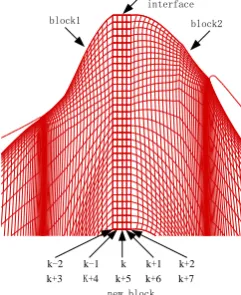
Undoubtedly, it is crucial for simulating stator-rotor interaction to treat the stator-rotor interface with a high-accurate and parallel method, especially for the simulation requiring high accuracy and high computational cost such as DNS, LES or DES. Therefore, a parallel full-matching grid method is developed in this section to satisfy this requirement.
interface
k k-1
k-2 k+1 k+2 k+5
K+4
k+3 k+6 k+7
block1 block2
[image:2.595.237.358.413.561.2]new block
Figure 1. The large-scale parallel and high-accurate method for the stator-rotor interaction.
process0 process1 process2 process3
send receive
process0 process1 process2 process3 send receive send receive
send
receive receive send receivesend
(a) Decomposition of computational domain (b) Communication of subdomains Figure 2. Sketch of the large-scale parallel strategy in one dimension for single block.
[image:2.595.117.476.585.714.2]calculation and the interpolation error in classical method treating interface can be avoided. In order to obtain better results, the two layer grids in both sides of the interface are also set with the same radius and azimuthal distances.
The large-scale parallel strategy will become complex because the stator block is independent of the rotor block. Based on the full-matching technique for interface, blocks can be integrated into one block by rearrange the streamline indexes. Then, the large-scale parallel strategy as shown in Fig.2 for single block can be adopted easily. Fig.1 shows the strategy of streamline subscript of grids near the interface for the new block, and the grids with subscript from k+1 to k+5 are regarded as a kind of boundary, which values are obtained directly from the calculation of the grids with subscript k+6, k+7,
k-2, k-1 and k, respectively.
Results
[image:3.595.166.431.303.409.2]Analysis of Flows at 50% Span
Fig. 3 shows the unsteady entropy distribution at 50% span at the same time. It can be noticed that S-A and DES obtain the results only with little discrepancy.
(a) SA (b) DES Figure 3. Entropy distribution by S-A and DES.
Fig. 3 shows the unsteady entropy distribution at 50% span. It can be noticed that S-A and DES obtain the results only with little discrepancy.
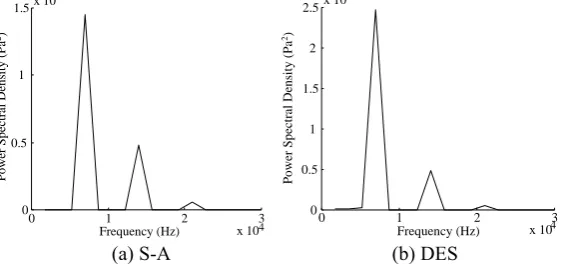
Fig. 4 shows the frequency spectra of pressure changing at the leading edge of the rotor. The frequencies of pressure excitation computed by DES and S-A are both decided by the rotor blade passing frequency, and the periodic influences can clearly be distinguished from each other.
0 1 2 3
x 104 0
0.5 1 1.5x 10¹²
P o w er S p ec tr al D en si ty ( P a 2) Frequency (Hz)
0 1 2 3
x 104 0
0.5 1 1.5 2 2.5x 10¹²
[image:3.595.160.445.506.638.2]P o w er S p ec tr al D en si ty ( P a 2) Frequency (Hz) (a) S-A (b) DES
Figure 4. Frequency pressure spectra at the leading edge of the rotor.
Analysis of Flows at 97% Span
Unlike the results at 50% span, the flowfields at 97% span show obvious difference between S-A simulation and DES.
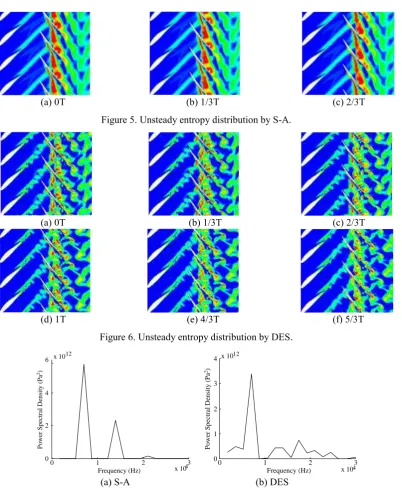
Fig. 5 indicates that the wake by S-A simulation is steady and small wiggle of the tip leakage vortices can be observed due to the interaction between the wake and the leakage vortices. Spectrum in Fig.7 (a) also shows that the rotor blade passing frequency is the only factor to decide the frequencies of pressure excitation by S-A.
although the main frequency is also decided by the passing frequency. In Fig.6 it can also be noticed that the strength of leakage vortices of DES is greater than that of the S-A because the cores of leakage vortices show more “broken” shapes and the leakage flows impinge with the adjacent blade earlier.
(a) 0T (b) 1/3T (c) 2/3T Figure 5. Unsteady entropy distribution by S-A.
(a) 0T (b) 1/3T (c) 2/3T
(d) 1T (e) 4/3T (f) 5/3T Figure 6. Unsteady entropy distribution by DES.
0 1 2 3
x 104 0
2 4 6 x 10
12
P
o
w
er
S
p
ec
tr
al
D
en
si
ty
(
P
a
2)
Frequency (Hz)
0 1 2 3
x 104
0 1 2 3 4 x 10¹²
P
o
w
er
S
p
ec
tr
al
D
en
si
ty
(
P
a
2)
Frequency (Hz)
[image:4.595.101.504.118.614.2](a) S-A (b) DES
Figure 7. Frequency pressure spectra at the leading edge of the rotor.
Analysis of Flows at 3% Span
[image:5.595.100.504.64.551.2]
(a) 0T (b) 1/3T (c) 2/3T Figure 8. Unsteady entropy distribution by S-A.
(a) 0T (b) 1/3T (c) 2/3T
(d) 1T (e) 4/3T (f) 5/3T Figure 9. Unsteady entropy distribution by DES.
0 1 2 3
x 104 0
1 2 3 4x 10
12
P
o
w
er
S
p
ec
tr
al
D
en
si
ty
(
P
a
2)
Frequency (Hz)
0 1 2 3
x 104 0
1 2 3 4 x 10¹²
Frequency (Hz)
P
o
w
er
S
p
ec
tr
al
D
en
si
ty
(
P
a
2)
(a) S-A (b) DES Figure 10. Frequency pressure spectra at the leading edge of the rotor.
Conclusions
In the paper, a parallel CFD code is developed for DES in turbomachinery and a high-accuracy large-scale-parallel method is proposed to treat the stator-rotor interface appropriately. DES and S-A simulation are carried out to study the stator-rotor interaction on approximately six million grids and investigate the potential of DES for turbomachinery. Some conclusions can be obtained for this example:
1. In the flow regions with shallow separations, DES has similar capability as S-A simulation as shown in the analysis of flows at 50% span. In fact, the approximate same results are obtained from 20% span to 80% span in this example.
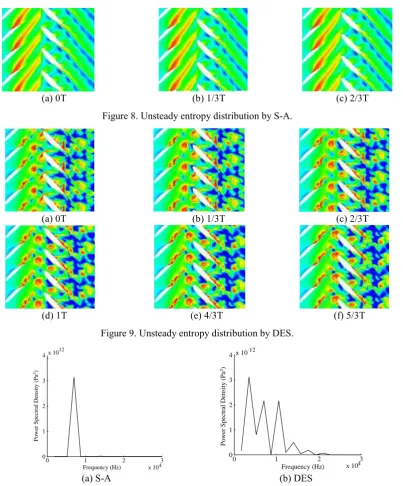
3. Compared with S-A, DES predicts obvious higher loss in the rotor tip regions because it obtains stronger leakage and double leakage flows.
4. DES predicts obvious lower loss near the hub than S-A simulation because of the similar mechanism as “clocking” due to impinging between the dynamic shedding vortices of wakes and the leading edge of the rotor.
References
[1] D.G. Huang, X.S. Li, Rotordynamic Characteristics of a Rotor with Labyrinth Gas Seals. Part 1: Comparison with Childs' Experiments, Proceedings of the Institution of Mechanical Engineers - Part A: Journal of Power and Energy 218(2004) 171-177.
[2] D.G. Huang, X.S. Li, Rotordynamic Characteristics of a Rotor with Labyrinth Gas Seals. Part 2: a Non-Linear Model. Proceedings of the Institution of Mechanical Engineers - Part A: Journal of Power and Energy 218(2004) 179-185.
[3] C.W. Gu, H. Wang, X. Ji, et al., Development and application of a thermodynamic-cycle performance analysis method of a three-shaft gas turbine, Energy 112(2016) 307-321.
[4] B. Raverdy, I. Mary, P. Sagaut, High-Resolution Large-Eddy Simulation of Flow Around Low-Pressure Turbine Blade, AIAA Journal 41(2003) 390-397.
[5] S. Sarkar, P.R. Voke, Large-Eddy Simulation of Unsteady Surface Pressure Over a Low-Pressure Turbine Blade due to Interactions of Passing Wakes and Inflexional Boundary Layer, ASME Journal of Turbomachinery 128(2006) 221-231.
[6] X.S. Li, J.Z. Xu, C.W. Gu, Preconditioning Method and Engineering Application of Large Eddy Simulation, Science in China - Series G: Physics Mechanics and Astronomy 51(2008) 667-677.
[7] P.R. Spalart, W.H. Jou, M. Strelets, et al., Comments on the Feasibility of LES for Wings, and on a Hybrid RANS/LES Approach. Advance in DNS/LES, 1st AFOSR Int. Conference on DNS/LES, 4-8 Aug. Greyden Press, Columbus, OH, 1997.
[8] P.R. Spalart, S. Deck, M. L. Shur, et al., A New Version of Detached-eddy Simulation, Resistant to Ambiguous Grid Densities, Theoretical and Computational Fluid Dynamics 20(2006) 181-195.
[9] S. Šaric et al. A Periodically Perturbed Backward-Facing Step Flow by Means of LES, DES and T-RANS: An Example of Flow Separarion Control, ASME Journal of Fluids Engineering 127(2005) 879-887.
[10]E.G. Paterson, L.J. Peltier, Detached-Eddy Simulation of High-Reynolds-number Beveled-Trailing-Edge Boundary Layers and Wakes, ASME Journal of Fluids Engineering 127(2005) 897-906.
[11]A.K. Viswanathan, D.K. Tafti, Detached Eddy Simulation of Turbulent Flow and Heat Transfer in a Ribbed Duct, ASME Journal of Fluids Engineering 127(2005) 888-896.
[12]X.S. Li, C.W. Gu, Mechanism of Roe-type schemes for all-speed flows and its application, Computers & Fluids, 86(2013) 56-70.
[13]X.S. Li, Uniform Algorithm for All-Speed Shock-Capturing Schemes, International Journal of Computational Fluid Dynamics 28(2014) 329-338.
[14]X.S. Li, X.L. Li, All-speed Roe Scheme for the Large Eddy Simulation of Homogeneous Decaying Turbulence, International Journal of Computational Fluid Dynamics 30(2016) 69-78.
[16]X.S. Li, C.W. Gu, J.Z. Xu, Development of Roe-type scheme for all-speed flows based on preconditioning method, Computers & Fluids, 38(2009) 810-817.
[17]X.S. Li, C.W. Gu, An All-Speed Roe-type scheme and its asymptotic analysis of low Mach number behaviour, Journal of Computational Physics, 227(2008) 5144-5159.