2017 2nd International Conference on Computer, Mechatronics and Electronic Engineering (CMEE 2017) ISBN: 978-1-60595-532-2
Research on Multi Station Automatic Assembly System
Xin YE
*, Shao-peng CAI
,
Zhi-jing ZHANG, Chao SHAO and Fei-fei WU
School of Mechanical Engineering, Beijing Institute of Technology 5 South Zhongguancun Street, Haidian District, Beijing, P.R.China, 100081
*Corresponding author
Keywords: MEMS, Multi station, Automatic assembly, Work principle.
Abstract. A multi station automatic assembly system was designed for MEMS products. The system includes three assembly stations and the loading and unloading station. It can finish the automatic assembly totally form part to product. This paper introduces the structure and the work principle. Experimental results show that the automatic assembly system plays an important role in the application of the automatic assembly of MEMS with better accuracy and efficiency.
Introduction
MEMS products are assembled together with numerous micro parts. Some dimensions of the parts are less than 1mm and the structural features of the parts are in micrometer scale. Such small size and scale make the parts easily damaged during assembly. Hence, the two characteristics of parts make assembly difficult and inefficient. The assembled MEMS product is a microelectromechanical system. The annual output is 100,000 sets, but the manual method cannot achieve the efficiency. Therefore, the multi station automatic assembly system is proposed to realize the automatic and quick assembly of micro MEMS devices.
Because of the high requirements of MEMS assembly, and it is mainly assembled in a manual manner at present. Therefore, the micro-assembly technology has become one of the key technologies that restrict the development of MEMS, which also becomes the focus of research.
Hofmann proposed a micro-flexible concept to accommodate micro and intermediate-scale
assembly lines [1]. Zhang proposed a two-degree-of-freedom robot that can be combined with a
two-degree-of-freedom plane robot "courier" to complete a precision assembly task at a mini-factory
[2]
. Estevez developed a remote haptic system that replaces pure handmade micro-assemblies to
improve the performance of various micro-assembly tasks [3]. Fleischer achieved a small automatic
supply parts which based on the principle of micro-smoothing [4]. Burisch studied a small robot that
could grab and place micro parts in the precision assembly [5]. Kagerer studied a low-cost manual
micro-assembly system with integrated heaters [6]. Jain proposed a newly micro-operating system
which designed a micro-gripper for the operation of micro-parts [7]. Lee presented a miniature
assembly system equipped with a top camera and a side vision camera with a rotating mirror system
[7]. Ye proposed a micro-assembly system with coaxial alignment function (MSCA) [9].
Although a lot of research has been carried out, the level of automation is not high in MEMS assembly field and the assembly efficiency is low. Aiming at the shortcomings of the existing research, this paper proposes a multi station automatic assembly system.
The Multi Station Automatic Assembly System
The marble seat provides a flat surface and a good vibration isolation for the system. The support structure provides the sustain and can adjust the horizontal of the system.
Figure 1. The mutli station automatic assembly system.
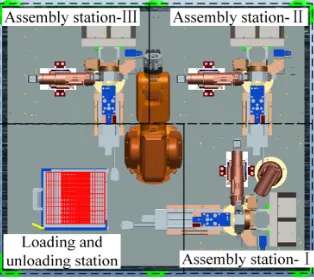
[image:2.612.226.383.321.461.2]As shown in Figure 2. The work space is divided into four parts according to the assembly requirements, including three assembly stations and the loading and unloading station.
Figure 2. The distribution of the work space.
The loading and unloading station is shown as Figure 3(a). It consists of the material box, a six degrees of freedom robot and the gripper. The material box can hold many parts. The robot with the gripper can clamp three parts simultaneously, and then transport to the specified loading position. The three assembly stations have the same configuration and functionality. It includes an assembly module, a detection module and an adjust module. The assembly station is shown as Figure 3(b).
[image:2.612.203.412.556.663.2]Figure 4. The assembly station configuration.
As shown in Figure 4(a). The assembly module consists of a column, a Z-axis motion stage, a turntable and a gripper. The column provides sustain for the Z-axis motion table. The turntable is mounted on the Z-axis motion stage and the gripper is mounted on the turntable. They are combined together to complete the assembly of parts. The detection module is shown as Figure 4(b). The detection module consists of a camera component, a prism, an adjust mechanism and two motion stages. The detection module can detect the X, Y direction and angular pose information of the part. The adjust module is shown as Figure 4(c). The adjust module is composed of an X-axis motion stage, a Y-axis motion stage, a turntable and a gripper. It can adjust the pose of X, Y direction and the angle of the part.
The Control System and the Work Principle
Figure 5. The structure of the control system.
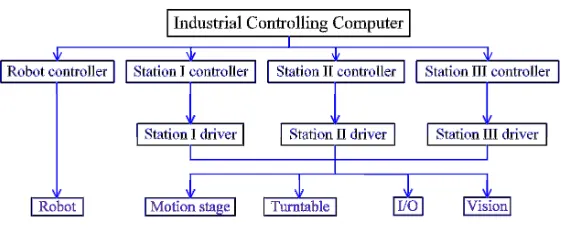
The assembly system can achieve the part loading, clamping, position and orientation detection, position adjustment, part assembly and product unloading automatically, and cycle to complete the assembly of product. Therefore, the control system must possess multi axis motion control, multi I/O logic control, assembly force feedback, visual feedback control and multi station coordinated control. The structure of the control system is shown as Figure 5. According to the controlled object, the system is divided into three layers structurally. The top layer is the industrial computer, the middle layer is the controller and the bottom layer is the driver. To achieve the control of the movement axis
and I/O quantity, the controller includes the robot controller, the station I controller, the station Ⅱ
controller and the station Ⅲ controller, which correspond to the four parts of the work space. The
[image:3.612.166.450.333.448.2]Figure 6. The system work principle.
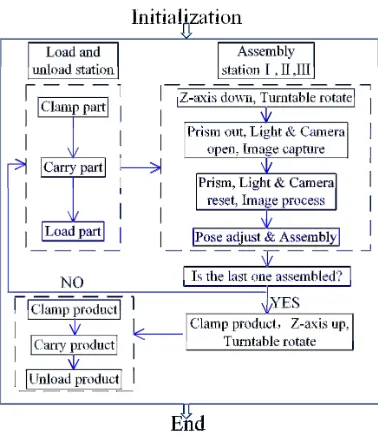
The work principle of the multi station automatic assembly system is shown as the Figure 6. Firstly, the system completes initialization. After that, the load and unload gripper clamps the parts, and the robot moves the parts to the designated position and completes the unloading. Then, the assembly station starts working. The gripper on the assembly module clamping the part moves with the turntable and the Z-axis to the designated position. At the same time, the prism moves out, the light source and camera are opened. Next, the image of the part is captured. In the process of image processing, the prism and light source are reset. After the image processing, the position and orientation of the part is adjusted according to the position deviation, and completes the assembly. Did the last part complete the assembly? If the last one is not assembled, starting the assembly of the next part. When the last part completed the assembly, the assembly module clamps the product and follows the Z-axis and turntable to the initial position. At this moment, the loading and unloading station gripper clamps the product, and the robot moves to the box to complete the unloading.
Experiment and Results
Figure 7.The multi station automatic assembly system.
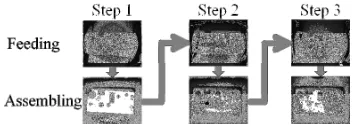
Figure 8. The results of the part automatic assembly.
Conclusion
For the MEMS parts, a kind of multi station automatic assembly system was designed to realize automatic assembly. The prototype of the system was built according to the design. The assembly results show that the system improves the assembly accuracy and efficiency compared with the manual assembly, and realizes the automatic assembly of the MEMS device totally. The assembly efficiency of this system is three times as much as that of manual assembly. The design of the multi
station automatic assembly system plays an important role in the micro-assembly filed.
Acknowledgements
This work was financially supported by the National Natural Science Foundation of China (51575052).
Reference
[1] Hofmann, Andreas, et al. "MicroFLEX—a new concept to address the needs for adaptable
meso and micro assembly lines." Assembly and Manufacturing (ISAM), 2011 IEEE International
Symposium on. IEEE, 2011.
[2] Zhang, Jun, and Ralph Hollis. "A 2-DOF manipulator for micro-assembly in a minifactory."
Robotics and Biomimetics (ROBIO), 2016 IEEE International Conference on. IEEE, 2016.
[3] Estevez, Pablo, et al. "A Haptic Tele-operated system for Microassembly." International
Precision Assembly Seminar. Springer, Berlin, Heidelberg, 2010.
[4] Fleischer, J., S. Herder, and U. Leberle. "Automated supply of micro parts based on the micro
slide conveying principle." CIRP Annals-Manufacturing Technology 60.1 (2011): 13-16.
[5] Burisch, A., Raatz, A., & Hesselbach, J. (2010). Challenges of precision assembly with a
[image:5.612.219.401.217.280.2][7] Jain, Ravi Kant, et al. "Micro manipulation by a compliant piezoelectric micro gripper
towards robotic micro assembly." International Journal of Mechatronics and Manufacturing Systems
9.1 (2016): 3-23.
[8] Lee, D., Kim, M. Y., & Cho, H. (2013). Path planning for micro-part assembly by using active
stereo vision with a rotational mirror. Sensors and Actuators A: Physical, 193, 201-212.
[9] Ye, Xin, Jun Gao, and Zhi Jing Zhang. "A microassembly system with coaxial alignment