2017 International Conference on Computer, Electronics and Communication Engineering (CECE 2017) ISBN: 978-1-60595-476-9
Low-complexity Channel Estimation for Large-scale Receiving
Antenna Systems Based on PASTd
Wei-tao LIU
1,*, Qian-lin CHENG
1, Zhong-xi XIA
1, Dong-lin YANG
1,
You SUN
1and Xiao-fei ZHANG
1,2,31College of Electronic and Information Engineering Nanjing University of Aeronautics and Astronautics, China
2State Key Laboratory of Millimeter Waves, Southeast University, Nanjing, China, 210096
3National Mobile Communications Research Laboratory, Southeast University, Nanjing, China, 210096.
*Corresponding author
Keywords: PASTd, DOA, Channel estimation, Low complexity.
Abstract. Subspace estimation is an important procedure when we make predictions about the direction of arrival (DOA). Low-complexity projection approximation and subspace tracking of deflation (PASTd) is able to estimate signal subspace without computing eign-value decomposition of the cross correlation matrix or singular value decomposition of the received signal. Furthermore, we regard the channel estimation as the combination of angular information and path attenuation. In this paper, we discuss PASTd comes into play in DOA and channel estimation. Simulation results in MATLAB verify the effectiveness in angular and channel estimation.
Introduction
In massive received antenna array system, not a few of algorithms have been studied deeply to capture targets’ angle information. The methods of two-dimensional DOA estimation includes the 2D-MUSIC algorithm [1], 2D-ESPRIT algorithm [2], propagator method (PM) algorithm [3] and so on. The same point lies in the necessary procedure of solving the signal subspace. However, the way in these algorithms is to calculate covariance matrix and then obtain signal and noise subspace with the eign-decomposition of covariance matrix. In recent years, subspace tracking algorithm such as PAST [4] and PASTd [5] have attracted wide attention because of their low complexity.
Massive antenna arrays have been accepted and will be surely utilized in mmWave communication system. Because of the short wavelength (less than 10 millimeter), the receiver can integrate dozens of hundreds of antennas in a small area [6]. Even though huge antenna arrays bring about a great number of advantages [7,8,9], an nonnegligible problem is the increased complexity resulting from the matrix dimension concerning antenna numbers. Therefore, decreasing algorithm complexity becomes the key of our research in this paper. We expilot PASTd [4,14] combined with the idea of ESPRIT algorithm for DOA based on two-dimension rectangular antenna array. This method need not much computational cost comparing to traditional ESPRIT.
The channel estimation can be regarded as the combination of angular information and path attenuation [10,11]. Angular estimation accuracy has an influence on channel estimation. It is necessary to analyze how to balance the accuracy and complexity. The main contribution of this paper lies in applying PASTd algorithm to DOA estimation and then studying the channel estimation performance based on PASTd. The pilots are utilized to estimate channel state information [12] and we compare our algorithm with traditional Least Square (LS) channel estimation algorithm under the condition of additive pilot sequence.
channel estimation is analyzed in section III. Simulation results based on MATLAB are presented in section IV. Finally, we have an inclusion in section V.
Notation: ( ) , ( ) ,( ) -1,( ) and ( )* denote transpose, conjugate-transpose, inverse, conjugate operation, respectively. Dn( ) is to extract the n th row of its matrix argument and rebuild a
diagonal matrix out of it. X means estimated value of the matrix X. diag( ) is to build up a diagonal matrix which the elements in the brackets take up the diagonal positions. means Frobenius norm of a matrix or vector.
Data Model
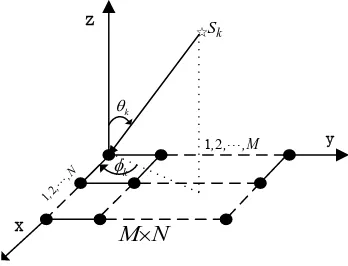
We consider the base station is equipped with M and N antenna elements in X-axis and Y-axis, which are arranged with half-wavelength spacing between adjacent antennas as Figure 1 shows. There exist K uncorrelated targets in far field impinging on the antenna array.
z
x
y
M N
k
S
☆
k
k
1 2,, ,N
[image:2.612.218.392.265.398.2]1 2, ,,M
Figure 1. Large-scale receiving antenna array.
The targets emit uncorrelated narrow band signals from the direction Θ ,Θ , ,Θ1 2 K, where
( , )
i i i
, i1, 2, , K . i and i are the elevation and azimuth angle of the i th incident signal.The received signal of the BS can be expressed as [11,13]: X H S* N.
1, ,...,2 K
S s s s, s1L is the transmitted signal of K targets. L is the number of snapshots. H is the channel matrix. N is a NrL matrix, whose elements are uncorrelated zero mean circularly symmetric complex Gaussian noise. X is the received matrix whose dimension is also NrL. H means the channel matrix and we divided it into two parts, as H A( ) . A is the directional matrix, is the path attenuation coefficient. We assume the source signal from targets arrive the BS through signal path and every path has one specific compelx-valued attenuation coefficient on the basis of respective environment.
In rectangular antenna arrays, the directional vectors on the x-axis and y-axis are
2 sin cos / 2 ( 1) sin cos /
( ) 1 j d k k j M d k k
x k e e
a and ( ) 1 j2 dsin ksink/ j2 (N 1) sind ksin k/
y k e e
a
. The directional matrix on the x-axis and y-axis can be written as
1 2
Ax ax( ) ax( ) ax(K) and Ay ay( )1 ay(2) ay(K) .Hence, the
antenna array directional matrix can be expressed as
1( ); 2( ); ; ( )
MN K
x y x y x N y
DOA and Channel Estimation Algorithm Based on PASTd
Signal Subspace Tracking Algorithm Based on PASTd
In traditional DOA estimation algorithms, such as ESPRIT and MUSIC, we calculate the covariance matrix of the received data at first, and then make eigenvalues decomposition. In this paper, we introduce the subspace tracking method in [4] to obtain the signal subspace. And then, we continue to solve the azimuth and elevation angles as the same as ESPRIT.
We define the cost function as Eq.2. According to [4], the signal subspace can be obtained by minimizing the cost function.
H H H
( ( )) ( ) ( ) ( ) ( ) [ ( )] [ ( ) ( ) ( )] [ ( ) ( ) ( ) ( ) ( )] 2
n
n-i H
i=1
J W n =
X i -W n W n X i =tr R n - 2tr W n R n W n tr W n R n W n W n W n ,(2)where 0 1 is the forgetting factor. n represents the -n th snapshot. We have known ( )= E[ ( ) H( )]
R n X n X n , and (n)R is the covariance matrix and we replace it with
H H
1
( )= n n i ( ) ( ) ( 1) ( ) ( )
i
R n X i X i R n X n X n
. (3) In [4], it has been proved that ( )W n will be close to the eigenvectors of signal subspace in (n)R . Then, we use recursive least squares (RLS) methods to track the signal subspace efficiently. The approximation of W n( ) with W n( -1) works well for stationary or slowly varying signals.The elaborate steps of PASTd algorithm to obtain signal subspace are listed as follows: Step 1: initialize eigenvalue (0)di and eigenvector Wi(0).
Step 2: for n1, 2, , L ( L is gross snapshots), the received signal of every source is ( ) X( )
i
x n n .
Step 3: for i1, 2, , K , the projection of received signal is represented as: H
( ) ( 1) ( )
i i i
y n W n x n , update eigenvalue as: d ni( )d ni( 1) y ni( )2, update eigenvector as: *
i i i i i i i
W ( )=W ( -1)+[x ( )-W ( -1)y ( )][y ( )/d ( )]n n n n n n n , update received signal of every source as:
1( ) ( ) ( ) ( )
i i i i
x n x n w n y n . Repeat step 3 after i i 1.
Step 4: let n n 1, and make eigenvalues and eigenvectors update after every interation. Finally, ( )
i
W L could be treated as the signal subspace, and name it Es.
DOA Estimation
The signal subspace obtained above is utilized in ESPRIT, We define Ex Es(1: (N M -1),:),
( 1: ,:)
y s
E E N NM , and can get
1
1
x
y y
E A T
A T E
, (4) where Es(1 :N M -( 1),:) represents the 1st to N M -( 1) rows of Es , therefore, we can obtain
1
y x y x y
E E T T E , where y T 1 yT
. until now, Ex and Ey can span similar subspace. And
the diagonal elements of y are the eigenvalues of y. y E Ex y
can been acquired using LS method.
Conduct eigenvalues decomposition to y , get ry [sin sin1 1,sin sin2 2, , sinKsinK].
Reconstruct signal subspace,
1 2
= ( ); ( ) ; ( )
s y x y x y N x
Use similar method as above, we can
obtain x diag(exp(j2
dcos sin
1 1/ ), ,exp(j2
dcos sin
K
K/ ))andrx [cos sin1 1,cos sin2 2, , cosKsinK].
After pairing, we can get final angular estimated values.Angles can be calculated as
2 2
1 2
[ K] arcsin rx ry
, , , and[ 1 2 K] arctan( / )r ry x
, , , , where rx
and
y
r
are the estimated values of rx and ry when adding gaussian white noise in the channel. Until now, we have estimated
the angular information through making use of PASTd to obtain signal subspace. In traditional
ESPRIT, we use H
X
R = XX / L and [EV,D = eig R] ( X)to obtain Es. RX is the covariance matrix of received signal. eig means conducting eigenvalue decomposition. D is the diagnoal matrix whose diagnonal elements are eigenvalues of RX The signal subspace can be obtained from the eigenvectors EV . Comparing to ESPRIT, we find the proposed method has lower computational load because its linear complexity superposition rather than nonlinear one when solve subspace in ESPRIT. The complexity of this trdiational method to get Es is
2 3
(( ) +( ) )
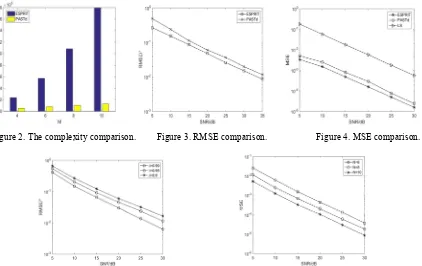
O MN L MN . However, the complexity of PASTd is O KL( (4MN2)). In Fig.2, the complexity comparison is listed in the form of bar graph. We keep other parameters constant except M. It’s obvious that the low-complexity PASTd performs much better than ESPRIT, especially when M becomes bigger and bigger.
Channel Estimation
The obtained angles in last section can be used in channel estimation. After then, we utilize LS method to get the path attenuation coefficient as Eq.6.
For estimating the attenuation, some pilots are used and known to the BS. We replace the signal source with the pilot, expressed asP. The length of pilots is lP. Also, through the DOA estimation above, the BS is able to achieve A. We can calculate that
( )
A YP A A P N P A A PP A NP . (6)
if ignore the influence of noise here, we can get A YP .At last, [ , 1 2...K] diag( )
. It’s necessary to declare that the length of pilots must be longer than the number of users to meet the requirement that P has full row rank.
Hence, the channel matrix estimation can be expressed asH A( k)
Finally, the estimated A and the attenuation coefficients are combined to produce channel matrix.
Simulation Results
Eq.7 represents the root-mean-square error (RMSE) of DOA estimation. The received array has 8 8
antennas whose spacing distance is half wavelength, that is d / 2.
2 2
, ,
1 1
1 K 1
Q
k q k q
q k
RMSE
K Q
, (7)where k q,
andk q,
are the k-th target’s estimated values of q th- Monte-Carlo simulation. Q is the times of Monte Carlo trail. When estimating the attenuation by pilots, mean-square error (MSE) is used to measure the channel estimation and express it as
2 1
MSE H H
MN K
Simulation 1: Fig.3 shows the peoformance of ESPRIT and PASTd on DOA estimation with K = 2, L=200, Q = 500, and =0.99. It verifies that our algorithm can also have accurate estimated values just a little worse than ESPRIT.
Simulation 2: Fig.4 is the contrastive curve of LS [12], ESPRIT and our algorithm about channel estimation. Hadamard matrix is used to produce pilot sequences. By the way, the length of pilots must be longer than K. It’s obvious the channel estimation based on angular information is better than traditional LS algorithm. And our algorithm’s peformance is also satisfactory.
Simulation 3: In view of the performance of PASTd in DOA and channel estimation, we have done following simulations. Firstly, we assume that there are two unrelatted targets in far field whose angles are (10°,10°) and (20°,20°). In Fig.5When the forgetting factor getting bigger, RMSE becomes lower. The reason is that represents how much the past snapshots will reserve and have an influence on present results.
Simulation 4: Fig.6 show channel estimation performance of our algorithm with K=2, M=8, and different N. From them, the performances are improved with the number of receiving antennas increasing.
[image:5.612.100.522.271.537.2]
Figure 2. The complexity comparison. Figure 3. RMSE comparison. Figure 4. MSE comparison.
Figure 5. RMSE comparison of different forgetting factors. Figure 6. MSE with M=8 and different values of N.
Summary
In this paper, we exploit PASTd to obtain the signal subspace and then combine the idea of ESPRIT algorithm for DOA estimation. Moreover, the estimated angular values are utilized to estimate the channel state information. Because our algorithm make use of orthogonal pilots to estimate path attenuation coefficients, lots of transmitted resource for channel estimation will be saved which makes a big difference for actual communication system. Through the simulations above, our algorithm has lower complexity and similar performance as ESPRIT without much computational cost.
Acknowledgement
Jiangsu NSF (BK20161489), the open research fund of State Key Laboratory of Millimeter Waves, Southeast University (No. K201826), and the Fundamental Research Funds for the Central Universities (NO: NE2017103).
References
[1] Wax M., Shan T.J., Kailath T. Spatio-temporal spectral analysis by eigen structure methods [J]. IEEE Transactions on Acoustics Speech & Signal Processing, 1984, 32(4): 817-827.
[2] Zoltowski M.D., Haardt M., Mathews C.P. Closed-form 2-D angle estimation with rectangular arrays in element space or beam space via unitary ESPRIT [J]. Signal Processing IEEE Transactions on, 1996, 44(2): 316-328.
[3] Tayem N., Kwon H.M. L-shape 2-dimensional arrival angle estimation with propagator method [J]. IEEE Transactions on Antennas & Propagation, 2005, 53(5): 1622-1630.
[4] Yang B. Projection approximation subspace tracking [J]. IEEE Transactions on Signal Processing, 2002, 43(1): 95-107.
[5] Park S.B., Ryu C.S., Lee K.K. Multiple target angle tracking algorithm using predicted angles [J]. IEEE Transactions on Aerospace & Electronic Systems, 1994, 30(2): 643-648.
[6] Tabikh W., Slock D., Yi Y.W. Optimal beamforming with combined channel and path CSIT for multi-cell multi-user MIMO [C]// Information Theory and Applications Workshop. IEEE, 2017. [7] Roh W., Seol J.Y., Park J., et al. Millimeter-wave beamforming as an enabling technology for 5G cellular communications: theoretical feasibility and prototype results [J]. IEEE Communications Magazine, 2014, 52(2): 106-113.
[8] Liu P., Renzo M.D., Springer A. Line-of-Sight Spatial Modulation for Indoor mmWave Communication at 60 GHz [J]. IEEE Transactions on Wireless Communications, 2016, 15(11): 7373-7389.
[9] Rozé A., Crussière M., Hélard M., et al. Comparison between a hybrid digital and analog beamforming system and a fully digital Massive MIMO system with adaptive beam steering receivers in millimeter-Wave transmissions[C]// International Symposium on Wireless Communication Systems. IEEE, 2016: 86-91.
[10] Fan D., Zhong Z., Wang G., et al. Channel estimation for 60GHz wireless local area networks with massive receiving antennas [C]// International Workshop on High Mobility Wireless Communications. IEEE, 2015: 63-67.
[11] Fan D., Gao F., Wang G., et al. A 2D-DFT Based Channel Estimation Scheme in Indoor 60GHz Communication Systems with Large-Scale Multiple-Antenna [C]// IEEE, Vehicular Technology Conference. IEEE, 2016: 1-5.
[12] Nadar J.I., Koti J., Jayaswal D. OFDM pilot based channel estimation [C]// International Conference on Advances in Engineering and Technology Research. IEEE, 2015.
[13] Van D B J J. On channel estimation in OFDM systems [J]. Proc. IEEE Vehicular Technology Conf.chicago IL, 1999, 2(2):815-819 vol.2.