Conceptualizing and Validating Organizational Networking as a
Second-Order Formative Construct
Sabrina C. Thornton a,b *
Stephan C. Henneberg c,1
Peter Naudé b,2
a
University of Huddersfield Business School, Queensgate, Huddersfield, HD1 3DH, UK
b
mIMP Research Group, Manchester Business School, Booth Street West, Manchester, M15 6PB, UK
c
Business Ecosystem Research Group, Queen Mary University of London, School of Business and Management, The Bancroft Building, Mile End Road, London E1 4NS, UK
Submitted for Review
Industrial Marketing Management
Initial submission January 2014 Revised submission April 2014
*Corresponding author. Tel.: +44 (0) 1484 472565.
E-mail addresses: [email protected] (S.C. Thornton), [email protected] (S.C. Henneberg), [email protected] (P. Naudé)
1
Tel.: +44 (0) 20 7882 8570. 2
Tel.: +44 (0) 161 275 7782.
Acknowledgement: This work was supported by the Economic and Social Research Council [grant number ES/I903445/1].
Biography
Sabrina C. Thornton is a Lecturer in Marketing at the University of Huddersfield Business
School, UK, and a PhD candidate at Manchester Business School, UK. Her main research
interests lie in the area of business relationships and strategic network management.
Stephan C. Henneberg is Chair Professor of Marketing and Strategy at Queen Mary University
of London, UK. He is also the Director of the Business Ecosystem Research Centre. His main
research interests are in the areas of strategic marketing, business relationships and network.
Peter Naudé is Professor of Marketing at Manchester Business School, UK. His research
Abstract
Based on an existing conceptualization in the literature, this study operationalizes the construct
of organizational networking, through a rigorous two-stage scale construction and validation
process. Organizational networking refers to firm behaviors, i.e. the activities/routines/practices,
which enable an organization to make sense of and capitalize on their networks of direct and
indirect business relationships. We conceptualize the measurement model as a second-order
formative construct with four first-order reflective constructs based on a four-dimensional view
of organizational networking comprising information acquisition, opportunity enabling,
strong-tie resource mobilization and weak-strong-tie resource mobilization. The scale validation was
undertaken at the first- and second-order levels. The result confirms the four distinct first-order
measurement models. At the second-order level, a MIMIC (multiple indicators and multiple
causes) model was employed to assess the validity of the formative measurement model. The
results suggest that all four components significantly contribute to the overarching construct of
organizational networking, with strong-tie resource mobilization being the most important
contributor. Thus, our operationalization confirms the uniqueness of the different dimensions of
organizational networking that should be configured as a strategy of sensing and seizing the
network. The organizational networking scale will provide future research with a basis to explore
different strategic patterns of networking behaviors in varying contexts, and its role in relation to
other organizational behaviors and outcome variables, such as firm performance.
Keywords
Organizational networking; network management; industrial network approach; strong and weak
1. Introduction
The implications of firms being embedded in business networks have been well established in
the literature, suggesting that the business relationships, which make up these networks, enable
firms to identify opportunities, access rich information, and undertake effective and efficient
knowledge transfer and resource mobilization (Achrol & Kotler, 1999; Möller & Rajala, 2007;
Uzzi, 1996). From a network structure perspective, achieving a ‘beneficial’ network position that
allows firms to explore business opportunities is critically important, and a main strategic aim of
firms (Baum, Cowan & Jonard, 2013; Hagedoorn, Roijakkers & Van Kranenburg, 2006).
However, understanding organizational behaviors, i.e. how a firm can increase its
competitiveness through consciously changing its network position and utilizing resource
synergies identified in its network, is a complex and under-researched issue. Given the
importance of this topic and its potential implications for practitioners operating in business
markets, there is surprisingly little in the current literature when it comes to empirical studies that
investigate the scope and the content of such active strategic network management.
Academics in business-to-business marketing have attempted to conceptualize and
operationalize different perspectives of network management from the vantage point of a focal
firm; this was mostly based on a dynamic capability perspective (e.g. Mitrega et al., 2012; Ritter,
1999; Walter, Auer & Ritter, 2006). This approach has deepened our understanding of how firms
can efficiently and effectively manage their relationship portfolio (and therefore their network
position) by developing and establishing internal processes to deal with multiple direct
relationships simultaneously. However, there is an underdeveloped and yet steadily growing
stream of research focusing on the strategic aspect of outward-facing networking behaviors,
wider network dynamics and capitalize on them based on their perceptions of the network
(Håkansson et al., 2009). In this wider context the concept of organizational networking
becomes important.
From a conceptual perspective, a better understanding of the definition as well as the
dimensions of organizational networking is needed. Recent studies have contributed to the
conceptualization of organizational networking, which established the essence of such focal firm
behaviors that are aimed at the wider network context through the theoretical lens of the
industrial network approach (INA) (Ford & Mouzas, 2010; 2013; Håkansson et al., 2009). In
addition, economic sociology embedded in the wider social exchange theory has provided some
evidence to indicate the strategic implications of utilizing different types of relationships in
relation to firm performance from a structuralist perspective (Granovetter, 1985; Uzzi, 1996).
However, further research is needed to understand the implications of a focal firm being
embedded in a network, and its strategic organizational behaviors in terms of networking in
response to a networked environment. To date research in this area remains largely conceptual,
and it is still in need of empirical and quantitative research to further advance our understanding
of organizational networking.
Such conceptual considerations are linked to issues around operationalization: a scale for
measuring organizational networking behavior is needed, which will enable future studies to
advance our understanding of the implications of such a construct in relation to other existing
organization behavioral constructs and outcome variables (e.g. firm performance). In addition,
since existing studies identify different aspects of organizational networking, specific
justification needs to be provided for specifying organizational networking as a measurement
networking. In short, a conceptually derived and empirically tested measurement model
specification for organizational networking is needed. This will also provide useful managerial
implications, as firms operating in business markets will benefit from a clear framework of how
they might be able to sense and seize network opportunities embedded in direct and indirect
business relationships, which will help them to interact more responsively and effectively with
their partners in the business network.
Our argument will provide such a conceptually derived and empirically tested measurement
model specification for organizational networking. Based on the above issues, this paper is
organized as follows. First, we review, compare and contrast the existing organizational
networking studies in the literature. Secondly, a two-stage research design for the scale
development as part of the measurement model will be introduced, and the data analyses
regarding scale purification and testing, as well as the empirical results will be presented.
Finally, we will conclude with a discussion of our findings, contributions to the existing
literature, and limitations and future research direction.
2. The Construct of Organizational Networking
Networking as a concept has been commonly used at a personal level to reflect the set of
social skills of a person (e.g. owner of a firm) to leverage social relations in order to benefit from
them (e.g. Chetty & Campbell-Hunt, 2003; Ferris et al., 2007; Jaklic, 1998; Semrau & Sigmund,
2010). As such, the ability to realize benefits that arise from the network structure and the web of
different types of relationships can be seen as an actor’s social capital (Coleman, 1990).
However, we focus our discussion on organizational networking. We are interested in the
from studying personal networking in business (such as in the area of entrepreneurship and
SMEs) (e.g. Ferris et al., 2007; Semrau & Sigmund, 2010).
In this context of organizational networking, the perspective of our study is a focal firm
embedded in its business network which consists of various types of direct and indirect business
relationships that link this firm to the wider network context (Anderson, Håkansson & Johanson,
1994; Pfeffer & Salancik, 1978). The position of the firm in the network is therefore related to
these relationships and provides unique opportunities as well as threats. The set of available
resources, which can be mobilized by the firm, is linked to its network position, i.e. derived from
its web of relationships and the wider context (Burt, 2000; Zaheer & Bell, 2005). As such, the
focal firm’s behaviors and decisions are influenced and shaped by the dynamics derived from its
web of relationships (Astley, 1984). In line with the INA it is posited that companies affect their
network position by certain strategic activities, such as behaviors aimed at instigating new
business relationships, changing existing ones, as well as ending some interactions with business
partners (Mitrega et al., 2012). These strategic activities are subsumed under the concept of
networking as part of Ford et al.’s (2003) theory of managing in business networks. However,
while the concept is well introduced in studies of business marketing and supply chain
management, there exists only very limited empirical research on aspects of organizational
networking (Ford & Mouzas, 2013). Therefore, in this section we first position the construct, i.e.
organizational networking, in relation to the relevant research area, i.e. network management.
This allows us to proceed to a critical appraisal of the relevant studies that specifically focus on
2.1. Differentiating Organizational Networking
The literature provides a number of studies that focus on conceptualizing and operationalizing
different aspects of network management, which are conceptually related by different from the
construct of organizational networking. For clarification purposes we provide a concise summary
of the key differences based on a detailed analysis by Thornton, Henneberg & Naudé (2013).
The conceptualization and operationalization of network competence by Ritter (1999) signifies
the need to develop firm routines and practices in response to the embedding multi-firm network.
Such competence allows a firm to execute relationship-specific tasks. Based on this initial
conceptualization of network management, various studies follow this perspective, often using a
dynamic capabilities perspective (Teece, Pisano & Shuen, 1997). For instance, networking
capabilities consider a firm’s ability to manage and utilize business relationships (Mitrega et al.,
2012), with particular attention to the completeness of the relationship life cycle. The key
components of networking capabilities are relationship initiation, development and termination.
The above studies deepen our understanding of how a firm can manage its web of direct
relationships by establishing certain internal organizational practices. Based on Day’s (1994)
categorization of organizational capabilities, such conceptualizations of network management
capture the inside-out practices, which are established as internal processes to deal with the
efficiency of a firm’s relationship portfolio.
Following the same logic by Day (1994), organizational networking on the other hand should
be viewed as the outside-in capabilities of organizations, which are related to network sensing
and strategizing (Holmen & Pedersen, 2003). The focal point of these practices is therefore
externally focused. In contrast with research in network management, organizational networking
al., 2013). Organizational networking goes beyond managing direct relationships. Instead, the
structure of the network, related to a firm’s network position, gives rise to the patterns of
interactions by the focal firm (Ford & Mouzas, 2013). These interactions are not only with
directly connected counterparts of a firm, but also indirectly connected ones. Within this context,
direct relationships of a firm serve not only as the means to capture resources (Zaefarian,
Henneberg & Naudé, 2011), but also as the bridge for mobilizing the resources that are
embedded in indirect relationships (Mouzas & Naudé, 2007).
Organizational networking (as contrasted with existing research on network management) is a
relatively under-developed construct (Ford & Mouzas, 2013). Existing studies, which
contextualize and conceptualize the construct, provide limited empirical evidence to suggest
what constitutes organizational networking (Thornton et al., 2013). We therefore collated studies
that specifically focus on the conceptualization of organizational networking to form the basis
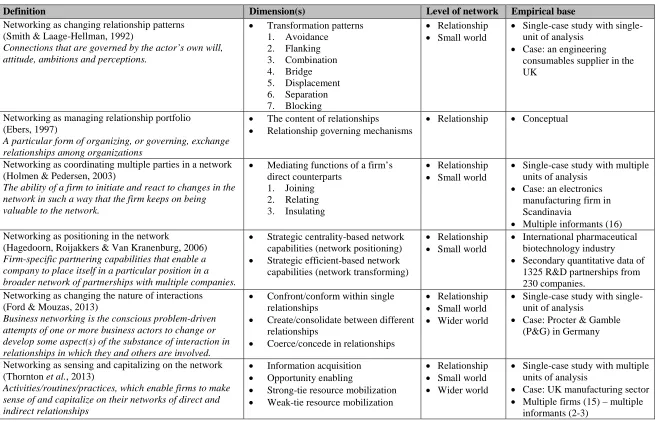
for the discussion and analysis. Table 1 contains an overview of the conceptual and empirical
studies on organizational networking as well as some closely related concepts, such as strategic
network capabilities (Hagedoorn et al., 2006) and network strategizing (Holmen & Pedersen,
2003). While most of the studies concerning organizational networking are built on the
theoretical foundation provided by the INA, the empirical study by Hagedoorn et al. (2006)
draws on the extant literature in strategic management, and Thornton et al. (2013) utilize the
INA coupled with the notion of embeddedness linked to economic sociology.
The following discussion will juxtapose the relevant conceptualizations based on the proposed
definitions and dimensions of organizational networking, their use of the network context (i.e.
the level of network characteristics included in the definition), and their empirical base. Through
empirically, which serves as a prerequisite for the purpose of rigorously operationalizing the
construct at hand (Churchill, 1979).
---
Insert Table 1 about here
---
2.2. Definitions and Dimensions
Organizational networking has been conceptualized in slightly varying forms by the studies
listed in Table 1. Smith and Laage-Hellman (1992) and also Ford and Mouzas (2013) see
networking in a similar vein and conceptualize it as actors’ attempts to change the content and
pattern of their interactions with business partners (also see Ford & Mouzas, 2010; Håkansson et
al., 2009). They do, however, differ in the dimensions identified to capture organizational
networking. The former utilizes a triadic approach to illustrate different types of connection
patterns as the result of actor-centered efforts to change the relationship formation, while the
latter predominately focuses on the idea of networking as a means for ‘problem-coping’ by
changing the pattern of the business interactions. Thus, Ford and Mouzas (2013) define
networking as “the conscious problem-driven attempts of one or more business actors to change
or develop some aspect(s) of the substance of interaction in relationships in which they and
others are involved” (p. 436). Networking is thus the process of making choices regarding their
business relationship portfolio when firms are faced with problems of dealing with complex
networks. They further argue that “the conscious attempts to change the structure or process of
interaction and the unplanned outcomes” (p. 436) should be clearly distinguished. Within the
INA, organizational networking is a problem-driven process without specific outcomes that can
On the other hand, Ebers (1997), Holmen and Pedersen (2003) and Thornton et al. (2013)
provide an overlapping view in their conceptualization of organizational networking. These three
studies explicitly incorporate strategic intent as a driver of organizational networking in their
conceptualization, thereby emphasizing resource mobilization and information gathering as the
key motives of networking (Pfeffer & Salancik, 1978; Zaefarian, Henneberg & Naudé, 2011).
Therefore, such a perspective of organizational networking, based on a focal firm’s strategic
intent, takes into account the cognitive processes of actors as they consciously act/react, with
certain anticipated effects in mind. Firms thus consciously interact with their direct, indirect or
new business counterparts. Such a way of thinking about organizational networking has some
conceptual similarity with the argument by Hagedoorn et al. (2006). Their study, adopting a
dynamic capabilities approach coupled with a social network perspective, proposes two key
dimensions for capturing a focal firm’s strategic networking, which mainly tap into network
positioning and relationship portfolio management for the purpose of maximizing useful
information and resources afforded by its network. However, the actor’s cognitive process and
the interactive nature of organizational networking are not at the center of their
conceptualization.
We partly agree with Ford and Mouzas (2013) that networking outcomes are unpredictable,
but contend that firms act or re-act based on the anticipated outcome of networking, rather than
purely as a coping device. Although the strategic intent, which is guiding networking behaviors,
does not necessarily force the anticipated outcomes to be realized, networking behaviors are
nevertheless planned and thus based upon actors’ perception of the network dynamics and the
anticipated effects they wish to achieve (or wish to avoid). In addition, the recent study by
in their conceptualization of organizational networking. This has resulted in different yet
complimentary dimensions of organizational networking being identified, compared to those of
Ebers (1997) and Holmen and Pedersen (2003). Thornton et al.’s (2013) empirical data suggests
that strong- and weak-tie relationships have different benefits for a focal firm, and these
differences are reflected in the distinct networking dimensions they identified, namely
information acquisition, opportunity enabling, strong-tie resource mobilization and weak-tie
resource mobilization. These four dimensions encapsulate “activities/routines/practices, which
enable firms to make sense of and capitalize on their networks of direct and indirect
relationships” (p. 2). Although these activities are all based on the interactions that take place in
either established or less established relationships, the authors argue that the four dimensions are
conceptually distinctive from one another, and that the different purposes guide firms to
undertake different forms of networking. For the purpose of our study, we will use the definition
by Thornton et al. (2013) as a starting point for conceptualizing organizational networking.
2.3. Level of Network Characteristics
Ford and Mouzas (2013) propose a three-level framework for the context of organizational
networking, namely relationship, small world and wider world. At the relationship level, the unit
of analysis is dyads, whereas the small world includes interconnected direct and indirect
relationships. In addition, the wider world taps into those areas of the network that go beyond a
firm’s small world, and are less ‘visible' to the firm and form a kind of amorphous
‘environment’. This approach echoes Hagedoorn’s (2006) three levels of embeddedness (i.e.
dyadic, interorganizational, including direct and indirect relationships, and environmental
embeddedness) with the exception that the environmental embeddedness is further distinguished
The above studies have deepened our understanding of firms’ behavioral patterns within the
context of being embedded in the network (Zaheer, Gözübüyük & Milanov, 2010). However
firms themselves act and react to network changes based on their perception of the network
(Corsaro et al., 2011; Henneberg, Mouzas & Naudé, 2006; Ramos & Ford, 2011). Academics
using an INA approach argue that actors have limited cognitive ability, and therefore they can
only understand the complex network in an idiosyncratic manner, which implies that they choose
their own ‘network theories’ (Johanson & Mattsson, 1992; Wilkinson & Young, 2002). This
makes the boundary or horizon of individual firms’ perceived networks somewhat arbitrary
(Anderson et al., 1994; Holmen & Pedersen, 2003). However, firms are usually more aware of
their close network context compared to aspects further afield, and there is always an ‘unknown’
(or less-known) part of the network. Nevertheless, through interacting with their counterparts,
firms can enable an understanding even of those unexplored areas of the network (Jack, 2005;
Thornton et al., 2013). It is therefore important to assess the organizational networking studies
based on their conceptualization, incorporating the network structure characteristics, such as the
interconnectedness and embeddedness. We thus determine at which level(s) these organizational
networking studies are operating, which will allow us to form a picture of how these studies have
contributed to the concept of organizational networking.
As outlined in Table 1, most studies cover a dyadic perspective as well as ‘small world’
organizational embeddedness, except Ford and Mouzas (2013) and Thornton et al. (2013). We
note that although Ford and Mouzas (2013) suggest that it is possible to look at organizational
networking at all different network levels, their proposed definition and the suggested
dimensions do not seem to include the multi-level view and the wider network context. On the
(2013) capture a wider network context, at least including the meso level (i.e. industry) of the
wider network context suggested by Hagedoorn (2006). Thornton et al. (2013) identify some
networking behaviors that firms utilize to understand and influence the shaping of the industry
through interacting with various parties, particularly with those that are not in close proximity
and that are not trading with them (i.e. weak-tie relationships).
2.4. Empirical Base
The main objective of our study is to operationalize the construct of organizational
networking. It is therefore critically important to assess the research design of already existing
conceptualizations, in order to evaluate whether the proposed definitions and the dimensions are
suited for the purpose of developing a measurement model (i.e. an operationalization). This
reasoning is in line with the scale development process proposed by Churchill (1979). To form a
comparable analysis regarding the research design of the studies listed in Table 1, we put less
emphasis on the study by Hagedoorn et al. (2006) due to the fact that it has a very different
methodological base (i.e. quantitative analyses based on secondary data) and it focuses on the
construct of organizational networking to a far lesser extent than the other studies. Similarly, we
also put less emphasis on the purely conceptual study by Ebers (1997) as it does not provide any
evidence beyond conceptual reasoning for its concept definition of organizational networking,
which leaves four remaining empirical case studies to form the basis for the following
discussion. According to Yin (2009), to judge the quality of the research design of an exploratory
case study, one must understand its construct validity, external validity and reliability.
First, construct validity in the case study sense is related to the definition of the constructs
under study and the identification of key themes of the constructs. All four studies satisfy the
satisfying construct validity is concerned, only two studies discuss construct validity related to
the key themes or operational measures in a qualitative sense. Holmen and Pedersen (2003) used
multiple sources of evidence, such as interviews and observations, to form their findings.
Thornton et al. (2013) utilized an abductive approach in an iterative process of data collection
and analysis (see Dubois & Gadde, 2002), using multiple researchers to interpret the data.
Secondly, external validity is related to the extent to which the research findings can be
generalized analytically. As three out of the four studies have chosen a single focal firm as their
subject of study, they do not display a strong external validity. It is not clear how they
“generalize a particular set of results to some broader theory” (Yin, 2009, p. 43). Although
Holmen and Pedersen (2003) utilized a replication logic of multiple interviews with different
individuals, it does not contribute to the study’s external validity as the construct being studied is
at a firm level, rather than the personal level. Thornton et al. (2013) chose the UK manufacturing
sector as a single case with 31 executives from 15 firms embedded within the case. They also use
a replication logic of a multiple informant approach to cross-validate the themes identified across
two or three informants within each firm. The research findings thus have some degree of
generalizability.
Thirdly, reliability is related to the extent to which the procedure of a case study can be
repeated and generate the same findings. Only Holmen and Pedersen (2003) and Thornton et al.
(2013) provide a detailed description of the way in which the researchers carry out their
investigation, such as recruiting participant firm(s), the sources of evidence, data collection
2.5. Operationalizing Organizational Networking
Based on the critical appraisal of these studies’ empirical base, we conclude that the study by
Thornton et al. (2013) has demonstrated a suitable foundation for further operationalization of
the construct of organizational networking. First, the definition and dimensions identified by
their empirical study encapsulate the cognitive processes by conceptualizing the construct of
organizational networking as an anticipated-outcome driven interaction. Secondly, the
conceptualization covers direct and indirect relationships as well as the meso level of the wider
network context. Finally, the study’s results have an adequate level of construct validity, external
validity and reliability, which is a prerequisite for operationalizing any constructs (Churchill,
1979). Based on the above discussions, we therefore adopt their definition and the suggested
dimensions as a starting point for our operationalization of organizational networking. The
construct of organizational networking is thus defined as “activities/routines/practices, which
enable firms to make sense of and capitalize on their networks of direct and indirect
relationships” (Thornton et al., 2013, p. 1155). This definition captures the strategic intent of
organizational networking by focusing on sensing the network and anticipating the inherent
opportunities and threats.
Four key dimensions of anticipated-outcome driven networking behaviors are information
acquisition, opportunity enabling, strong-tie resource mobilization and weak-tie resource
mobilization. Each dimension reflects its manifested behaviors, which captures a distinct way in
which firms utilize their business relationships in an attempt to achieve their anticipated goals
(see Appendix A for definitions and descriptions of each dimensions of organizational
networking). Given that Thornton et al.’s (2013) conceptualization of organizational networking
the four dimensions have only been evaluated qualitatively, our study aims at furthering their
research findings in order to develop a rigorous measurement model and to establish its validity
across both manufacturing and service firms.
3. Operationalization Methodology
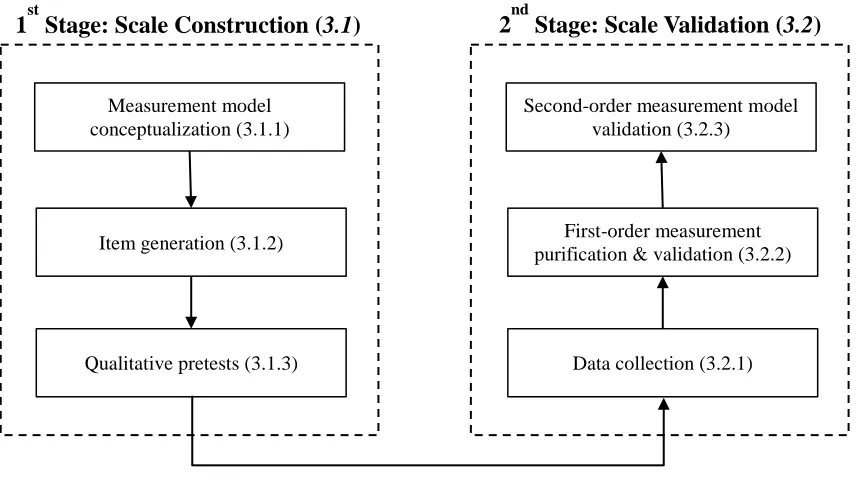
The research design entails a two-stage empirical process, which is detailed in Figure 1. The
first stage involves the generation and the qualitative pre-test of an item pool based on the
conceptualization by Thornton et al. (2013) to form a scale for organizational networking, which
is detailed in section 3.1. In stage two, the scale is subjected to a series of quantitative tests
through a resulting web-based survey, which is outlined in section 3.2. This research design
allows us to test the reliability, validity and generalizability of the first-order four-dimension
measurement model as well as the validity of the specified second-order formative measurement
model. For the purpose of clarity, each step within each stage is labeled in Figure 1 using its
corresponding subsection.
---
Insert Figure 1 about here
---
3.1. Stage 1: Scale Construction
3.1.1. Measurement model conceptualization
We conceptualize organizational networking as a formative second-order construct that is
created by four first-order constructs, namely information acquisition, opportunity enabling,
strong-tie resource mobilization and weak-tie resource mobilization. These are assumed to be
reflective in nature. We use the terminology of a formative second-order measurement model in
measurement structure is what Diamantopoulos et al. (2008) classify as a Type II measurement
model. It is necessary to allow these two levels (orders) of abstraction in order to understand the
characteristics of the key construct, i.e. organizational networking. MacKenzie, Podsakoff and
Jarvis (2005, p. 715) state that a second-order formative measurement model “faithfully
represents all of the conceptual distictions that the researcher believes are important, and it
provides the most powerful means of testing and evaluating the construct”.
In light of the continued debate about the validity and applicability of formative measurement
models in recent special issues in the Journal of Business Research (2008 & 2013) and the
Academy of Marketing Science Review (2013), the conceptualization of the measurement model
addresses two key issues suggested in the literature. The first issue is related to the
conceptualization of a formative measurement model. While some scholars argue that no
construct is inherently reflective or formative (Baxter, 2009; Wilcox, Howell & Breivik, 2008),
others suggest that a construct must be either reflective or formative based on its conceptual
meaning (Diamantopoulos & Winklhofer, 2001; Jarvis, Mackenzie & Podsakoff, 2003;
Podsakoff et al., 2003). We take the stance of the latter view on the basis that the construct in
question has a clear definition and specified dimensions, which were established through
qualitative research. This conceptualization indicates a formative nature.
We based our conceptualization of the formative measurement model on two conceptual
criteria suggested by Bollen & Bauldry (2011). First, if the set of indicators are indeed causal to
the latent variable, then they should be “essential” to the latent variable (p. 272). Secondly, a
change in any indicators must also result in a change in the latent variable. According to the
results of their empirical research, Thornton et al. (2013, p. 1162) conclude that “these four types
network. This implies that organizational networking is formed by these four types of behaviors,
and that each type contributes independently to the totality and the configuration of a firm’s
organizational behaviors. From a measurement perspective, each first-order construct has its
unique property that is dinstict from others and therefore the removal of any component “is
omitting a part of the construct”, which will substantially change the meaning of the
second-order formative construct (Bollen & Lennox, 1991, p. 308). Thus, it is posited that when one
component of organizational networking changes, organizational networking itself as the
overarching latent construct will change accordingly. For instance, we infer that when a firm
changes its interaction patterns in its strong-tie relationships, this is likely to change the way they
network overall. On the other hand, each first-order construct is reflected by the manifested
networking behaviors as represented by its specific measurement items, which overlap and are
interchangeable within their corresponding construct. Within this measurement conceptualization
organizational networking can thus be seen as an overarching construct that serves to represent
four dimensions, and the higher level of abstraction is “theoretically meaningful and
parsimonious” (Law, Chi-Sum & Mobley, 1998, p. 741).
The second key issue is that a formative measurement by nature is sensitive to its outcome
variables (Lee & Cadogan, 2013; Wilcox et al., 2008). The path coefficients of the causal
indicators and the disturbance term (error term) of the formative measurement respond to
different outcome variables used. This implies that using the same formative measurement to
predict different outcome variables would to some extent change the nature of the formative
construct. This has been argued as being a major hindrance for formative measurement to
advance theory building (Blalock, 1982). Bollen & Bauldry (2011) suggest that causal indicators
outcome variables of that formative latent variable. However, one can only realize this by
subjecting the formative measurement model to empirical tests (Diamantopoulos, 2013;
Diamantopoulos & Temme, 2013; Petter et al., 2007). This implies that a step-wise approach
needs to be taken by initially conceptualizing the structure of the measurement model, and then
subjecting it to empirical tests to determine as to whether the data does fit the specified model, as
suggested by Bollen & Bauldry (2011). More importantly, the validity of such a measurement
model needs to be examined in future research.
3.1.2. Item generation
For the operationalization of the first-order measurement models with reflective indicators,
we follow the scale development procedure by Churchill (1979) by first generating several
overlapping measurement items that capture the key aspect of each first-order construct to form
an exhaustive pool of items. The initial pool was refined, before we arrived at a preliminary list
of 37 measurement items. We paid particular attention to the clarity of the statements. It is
already necessary at this stage to ensure the content validity of these items, which will in turn
strengthen the overall construct validity (Peter, 1981).
3.1.3. Qualitative pretests
A three-step qualitative pretest was carried out to ensure that the construct of organizational
networking is clearly captured by the measurement items developed. We first checked with two
senior academics, whose research domain is in business-to-business marketing, regarding the
face validity of the measurement items. They both supported our conceptualization of the four
dimensions of organizational networking being distinctive and different from a theoretical
perspective. They also suggested some minor changes to ascertain clarity of the suggested items.
interviews was to corroborate whether our interpretation of the measurement items is in line with
organizational networking in practice. We compared all the points raised by the five managers
and focused particularly on those items that were frequently questioned by the managers. We
amended the item pool accordingly. Lastly, the amended scales were then tested on a small
group of 30 experienced MBA students with business-to-business management experience from
a leading business school in the UK. This test was administered in the form of a questionnaire,
the purpose of which was to further purify the scales before they were subjected to a large scale
survey. After the last step of the qualitative pretest, we arrived at an initial item pool of 37 items
(see Appendix B).
3.2. Stage 2: Scale Validation
In the scale validation stage, we conducted a web-based survey using Qualtrics, an integrated
platform for survey design and data collection, and subsequently subjected the collected data to a
series of validation tests, in particular to ascertain whether organizational networking is best
represented as a formative second-order construct with four reflective first-order constructs. The
fact that organizational networking is a higher-order construct means that the measurement
assessment needs to be undertaken at two levels after an initial scale purification using
exploratory factor analysis (EFA). First, at the first-order construct level construct validity,
including internal indicator consistency, convergent validity and discriminant validity of the
measurement model of the four first-order dimensions will be assessed using confirmatory factor
analysis (CFA) (Churchill, 1979; Gerbing & Anderson, 1988). In addition, a measurement
invariance test is employed, using multi-group CFA to cross-validate the measurement structure
Secondly, at the second-order construct level, the proposed relationships between the
first-order constructs and the second-first-order construct need to be assessed in terms of their
“significance and strength” (MacKenzie et al., 2005, p. 727). We follow the procedure of
evaluating a formative measurement model provided by Diamantopoulos and Winklhofer (2001)
and MacKenzie et al. (2005). The evaluation requires the usage of a multiple indicators and
multiple causes (MIMIC) model in order to identify the model due to the fact that a formative
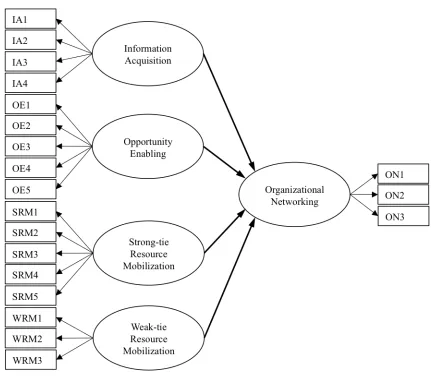
measurement model is naturally not identified (Diamantopoulos & Winklhofer, 2001). Figure 2
depicts the MIMIC measurement model that is subjected to a validity test. This approach
requires the construct, which includes four formative components, to be measured additionally
by at least two reflective indicators that serve as the effects of the construct (ON1 – 3 in Figure
2).
---
Insert Figure 2 about here
---
3.2.1. Data collection
Not only the measurement items for the four dimensions of organizational networking were
included in the questionnaire, but also other relevant existing scales (see Appendix C for the full
list of items), which will be used to assess the nomological validity of the final measurement
model of organizational networking. A seven-point Likert scale (labelled at the two endpoints, 1
= ‘completely disagree’ and 7 = ‘completely agree’) was used for all the items of the substantive
constructs. We utilized a sampling frame of 3,500 managers from a proprietary international
An invitation was initially sent to all potential respondents in November 2012, followed by
three reminders at one-week intervals. At the end of the survey period 1249 responses were
recorded, including partially completed responses. After deleting 460 unfinished responses, the
survey resulted in 789 completed responses, which yields a response rate of 23%. However, to
ensure the quality of the dataset, we further eliminated responses completed in less than 15
minutes, which gives 603 valid responses for the subsequent analyses. The threshold of 15
minutes was decided as the cut-off point of a ‘valid’ response based on a pre-test which showed
that faster results indicated ‘pattern responses’ (Fricker et al., 2005).
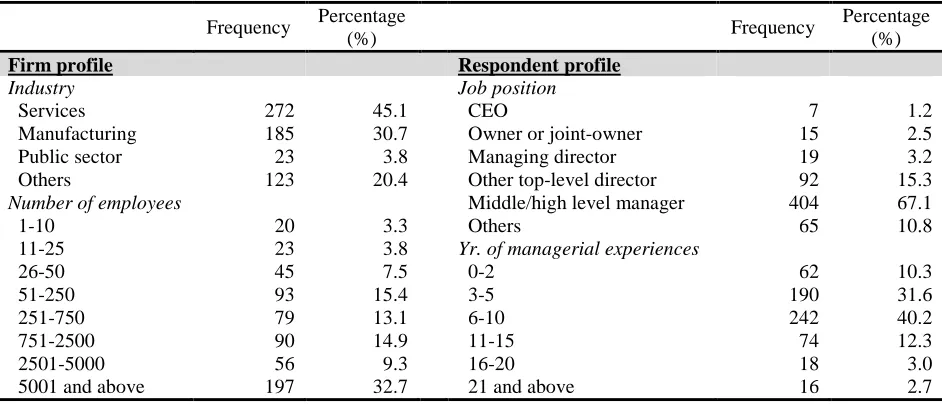
Table 2 summarizes the profile of the respondents and their organizations. A total of 45.1% of
603 respondents come from service industries, while 30.7% work in the manufacturing sector
(public sector: 3.8%, and others: 20.4%). In terms of their organization size, the three largest
groups by the number of employees are ≥ 5001 (32.7%), 51-250 (15.4%) and 751-2500 (14.9%).
With regard to respondent characteristics, the majority of the respondents are at a position of
either middle to high management (67.1%) or top-level director (15.3%) in their organizations.
In addition, 40.2% of the respondents have 6-10 years of managerial experience, followed by 3-5
years (31.6%) and 11-15 (12.3%) years.
---
Insert Table 2 about here
---3.2.1.1. Assessing non-response bias
The literature suggests three methods for estimating nonresponse bias suggested, namely a
comparison with known values for the population, subjective estimates, and extrapolation
use two methods, (1) comparing early and late responses and (2) comparing survey results with
known values for the population, to help assess the possible nonresponse bias in our data.
First, as we had four waves of responses (based on the initial invitation letter, and the three
reminders) we compared the responses collected before the first reminder letter with the
responses after the third reminder letter was sent. The former group represents the early
respondents, and the latter group represents late respondents (and are assumed to approximate
those who did not respond at all, i.e. non-respondents). We assess non-response bias for all the
measurement items of networking behaviors, and the respondent characteristic variables.
Chi-square tests were performed for assessing whether these two groups of respondents gave
significantly different responses. The results show that there is no significant difference in the
respondent characteristics, as well as in most of their responses for the organizational networking
items. We further examined the four variables (one item in Dimension 1 and three items in
Dimension 2), which show significant differences for early and late responses. Across all four
items the responses from the early respondents have a significantly higher mean than those from
the late respondents. However, these four items are similar to other items in their corresponding
dimensions and the assessment of the respondent characteristics and the responses in the
majority of the variables in these two groups indicate no significant differences. We conclude
that the differences that exist in these four variables are not a result of differences in early and
late respondents.
Secondly, we compared via Chi-square tests of known values such as industry sectors for the
population with our survey sample. Non-significant Pearson’s Chi-squares suggest that the
survey respondents are not dissimilar from the overall population. The results of these two tests
3.2.2. First-order measurement purification and validation
3.2.2.1. Two-step purification
In order to purify the measurement items, an EFA was performed using principal components
as an extraction method with varimax rotation, using SPSS 19.0. A seven-factor model initially
fits the data with sums of squared loading at 62.11%, which displays an adequate level of
explanatory power. The item pool originally contained 37 items, which were reduced to 28 items
after eliminating items that are cross-loading (cut-off point of 0.32) and that have low factor
loadings (lower than 0.5) on their factors. Note that this process is not completely data driven.
We checked the item descriptions for further consideration to assess the importance of those
items for their corresponding latent construct (Clark & Watson, 1995; Hinkin, 1995). We thus
took the integrity of the conceptualization and operational definition of the constructs into
account during the item elimination process. After an iterative process a six-factor solution
resulted: 21 out of 28 items loaded on their corresponding dimensions, which corroborated the
four-dimension measurement, while the other 7 items appear to form two distinctively separate
factors.
A close examination of these two factors was needed in order to determine whether the
adopted conceptualization of organizational networking has comprehensively captured all the
key aspects. Five out of those seven items related to organizations attending trade events,
including taking part in trade shows, seminars and meetings. We investigated the possible
reasons for them to load on a separate factor rather than their supposed corresponding factor. Out
of these five items two (item 31 and 32, Dimension 1, see Appendix B) are behaviors regarding
gathering information, while the other three items (11, 13 and 14, Dimension 2, see Appendix B)
sensing opportunities can be interpreted as gathering information regarding business
opportunities at a trade event.
The channels through which firms can sense and seize opportunities in their networks are not
defined in the definition of organizational networking. However, firms in general utilize an array
of behaviors to network for various purposes through two main channels, i.e. established
relationships and non-established indirect relationships. Trade events can be defined as a stage
for firms to interact as part of such relationships. We can further infer that the reason why the
five items depart from their originated constructs is that trade events are an occasion for
interactions to take place rather than interactions within and across different types of
relationships, the latter of which is the core of organizational networking. When considering the
integrity and parsimony of the overarching organizational networking construct, we decided to
eliminate these five items. Furthermore, by eliminating all items related to trade events, the
resulting scale is more universally useful to various industries (i.e. also those where trade shows
are less common, as in the services sector), and at the same time it still captures the importance
of sensing the market by interacting with business partners and business contacts, both of which
in some way include those firms they would meet during trade events.
In addition, items 21 and 22 in Dimension 2 (see Appendix B), i.e. interactions with regulatory
bodies, are important for several firms, particularly in the industries where offerings have to
comply with regulations set by governing bodies or if customers are in the public sector.
Furthermore, being able to lobby seems to require certain resources or being in a strategic
position where a firm can interact with such regulatory bodies. Thornton et al. (2013) note in
their study that only relatively large companies (in specific industries) find themselves benefiting
not lobby in a way which would generate comparable benefits that would warrant such resource
investments. The survey data seems to confirm this point as the relevant items are separated from
the factor they originated from. We examined the correlation between company size and these
two items (21 and 22, Dimension 2, see Appendix B), and it shows that both of them
significantly correlate with company size (r = 0.178** and 0.195**, p<0.05 respectively), while
most of the items in the original factor display no such correlation. This partly explains the
reason why the factor does not fit the data as expected. Based on our observations in the
qualitative data from Thornton et al. (2013) and evidence from our quantitative survey, we thus
decided to eliminate these two items from the scale in order to preserve the integrity of the
conceptualization and the generalizability of the scale.
After the elimination process, we arrived at a four-factor solution with 21 items. As far as the
adequacy of the sample size for assessing this measurement model is concerned, the KMO
(Kaiser-Meyer-Olkin) measure of sample adequacy of 0.92 indicates that the number of
responses (n=603) is well sufficient for the purpose of model assessment. The final measurement
model explains 60.58% of the variance of the underlying construct, which shows a good level of
explanatory power. Each factor under the overarching construct also displays fair to good levels
of reliability. Information acquisition, opportunity enabling, and strong-tie resource mobilization
have Cronbach’s α of 0.86, 0.89 and 0.84 respectively, while weak-tie resource mobilization has
a slightly lower reliability with Cronbach’s α at 0.74, which is still above the cut-off point of
0.70 (Nunnally, 1978). Next, the final solution resulted from the EFA is subjected to a
confirmatory factor analysis (CFA), using Lisrel 8.8. Initially, the measurement model achieves
an acceptable model fit (RMSEA = 0.05, SRMR = 0.054, NFI = 0.97, CFI = 0.98, IFI = 0.98,
However, the slightly low AGFI (0.88) and high χ2 (458.29, df = 183, p < 0.001) indicates the
possibility of further improvement. We eliminated further four items from the measurement
model (EFA solution): Dimension 1 (item 11), Dimension 3 (item 12) and Dimension 4 (items
12 and 22) (Appendix B) based on the cross examination of factor loadings and model
diagnostics, i.e. path estimates, modification indices and standardized residuals (Hair et al.,
2008). Note that the elimination of these items does not affect the integrity of the factors as we
only eliminated items, which were covered to a large extent by other (overlapping) items as well.
The elimination of these items improved all model fit indices. Although χ2
is still significant (p <
0.001), it has been substantially improved (Δχ2 = 242.62, Δdf = 70, p < 0.001). Hair et al. (2008)
suggest that when the sample size is more than 250 (n=603 in the CFA analysis) and the
observed variables are between 12 and 30 (the resulting number of indicators is 17), a significant
χ2
can be expected and still indicates a good model fit. We therefore conclude that the fit of the
measurement model is deemed to be satisfactory, given the excellent fit indices after the second
purification process (RMSEA = 0.039, SRMR = 0.046, NFI = 0.98, CFI = 0.99, IFI = 0.99, GFI
= 0.94, AGFI = 0.92).
3.2.2.2. Convergent and discriminant validity
Convergent validity is concerned with whether or not a set of items share a high proportion of
common variance. Hair et al. (2008) suggest the following criteria for satisfying acceptable
convergent validity: (1) factor loadings should be above 0.5, (2) average variance extracted
(AVE) should reach 0.5 as a minimum, and (3) composite reliability (CR) should be above
0.6-0.7. All the items have factor loadings above 0.6 (0.63-0.90) with the exception of one item at
0.57, which is still above the cut-off point of 0.5. All four factors have an AVE value that is
0.76-0.89 (see Table 3). Based on the above evaluation, we conclude that the measurement
model has satisfied the criteria of convergent validity.
---
Insert Table 3 about here
---
Secondly, discriminant validity is the extent to which a construct distinctly differentiates from
others. In this context, we assess whether the four factors are different from one another by
testing whether the square root of the AVE for any given two factors is greater than the
correlation between these two factors (Fornell & Larcker, 1981). According to Table 3 this is the
case, leading us to conclude that these four factors, derived from theory, have distinctive
properties that capture different aspects of organizational networking.
3.2.2.3. Measurement invariance test
The conceptualization of organizational networking we employ was originally developed
based on interview data gathered from UK manufacturing firms (Thornton et al., 2013). Our
operationalization, on the other hand, is aimed also at services firms. Although these two sectors
are different in terms of the offerings they produce, they are often mixed in a business network,
and they both interact with direct counterparts as well as indirect ones (Batt & Purchase, 2004;
Gummesson, 1987). We do not expect the way in which services firms network to be
substantially different from that of manufacturing firms. However, from a measurement
validation perspective there is still a need to understand the extent to which this scale is
applicable to the services sector. We thus undertake two invariance tests with nested competing
multi-group (services vs. manufacturing) models in order to assess the applicability of the scale
question as to whether the managers from manufacturing and services firms interpret and use the
scales in a same way (Hair et al., 2007). Finally, a scalar invariance test provides the answer to
the question of whether or not these four dimensions of networking have the same meaning to
manufacturing and services firms (Hair et al., 2007).
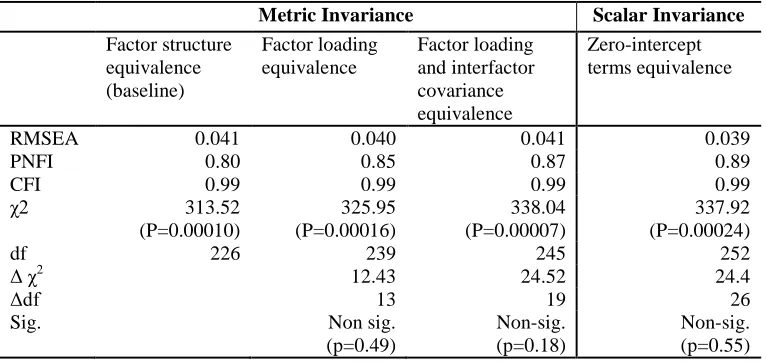
Table 4 summarizes the results of the full matrix invariance test and scalar invariance test. The
baseline model specifies the hypothesized structure of the measurement model that has been
confirmed in section 4.1 and allows all parameters to be freely assessed in both groups. It is
meant to confirm that the measurement model contains the same number of latent constructs and
the observed variables associated to them across two groups. It displays a good level of model fit
based on the suggested fit indices for assessing competing models, such as RMSEA (0.041),
PNSI (0.80) and CFI (0.99) (Hair et al., 2007). Next, two competing models are created with the
constraints of (1) factor loadings and (2) factor loading and inter-factor covariance being set to
equivalence across the two groups. These two models represent different levels of constraint with
(1) being the more constrained than the baseline model, and (2) being more constrained than (1).
Each model was compared against the baseline model (without constraint) to see whether the
increase of degree of freedom (Δdf) would substantially worsen the model fit (Δχ2
) (Byrne,
1998). Based on the results of the matric invariance test in Table 4, the scale demonstrates equal
measures in factor loadings (Δ χ2 = 12.43, Δdf = 13, p = 0.49) and inter-construct relationships
(Δ χ2 = 24.52, Δdf = 19, p = 0.18) across service and manufacturing sectors.
---
Insert Table 4 about here
The scalar invariance test indicates the invariance of the observed variable intercepts (means)
on their associated latent constructs (Δ χ2 = 24.40, Δdf = 26, p = 0.55), which allows for a
meaningful comparison for the construct means of the four factors across the two groups. The
result suggests that manufacturing firms and services firms network similarly based on the four
dimensions. The Kappa parameters were estimated for the services group (i.e. latent construct
mean differences compared to manufacturing group), which are -0.14 (t = -1.62, p = 0.11), -0.04
(t = -0.34, p = 0.71), -0.19 (t = -1.88, p = 0.06) and -0.18 (t = -1.79, p = 0.08) for information
acquisition, opportunity enabling, strong-tie resource mobilization, and weak-tie resource
mobilization respectively. Although services firms show lower means in all four dimensions,
none of the differences are statistically significant.
3.2.3. Second-order MIMIC measurement model validation
An essential assessment for any formative measurement model relates to establishing whether
multicollinearity is present among the formative components. High levels of multicollinearity
will make it difficult to assess the unique contribution from each component (Diamantopoulos &
Winklhofer, 2001). The variance inflation factors (VIF) among the four components range from
1.334 to 1.657, which is well below the suggested threshold of 10 (e.g. Hair et al., 2008), and
within the more stringent cutoff point of 3 (Petter et al., 2007). Multicollinearity therefore does
not pose a problem for the formative measurement model operationalization. Next, we proceed
to assess the MIMIC model as depicted in Figure 1, using structural equation modeling (LISREL
8.8). Given that the reflective measures of the four first order components are deemed
satisfactory, now the focus turns to the assessment of the proposed relationships of these four
components as part of organizational networking. Three new reflective indicators were used to
relationships, the effectiveness of resource mobilization among relationships, and fast response
to competitors’ actions. The first two items were developed for this study specifically to capture
the construct in question. We were also able to make use of one item (response to competition)
from the existing scale of competitor orientation, originally developed by Narver and Slater
(1990).
There is an on-going debate regarding how the weights of formative components and the error
term of the formative construct should be specified, either allowing them to be freely assessed
(Diamantopoulos, 2013; Diamantopoulos & Temme, 2013) or predefined by the researcher (Lee
& Cadogan, 2013). In light of the debate we provide two solutions for the MIMIC measurement
model in the overall sample, the results of which are presented in Table 5. We performed the
alternative measurement model assessments by constraining the weights of the first-order
constructs to be equal at 0.25 (1 divided by number of formative components) and the
disturbance (error term) of the second-order construct to be 0 (Diamantopoulos & Temme, 2013;
Lee & Cadogan, 2013).
As expected the standardized parameters (standard MIMIC model) for the four formative
components are all significant. Strong-tie resource mobilization (λ = 0.42) is the most important
component that contributes to the overall organizational networking, followed by information
acquisition (λ = 0.29), opportunity enabling (λ = 0.28) and lastly, weak-tie resource mobilization
(λ = 0.18). The four components explain 90% of the variance in organizational networking.
Overall, the MIMIC model displays a very good fit (RMSEA = 0.041, SRMR = 0.048, NFI =
0.98, CFI = 0.99, IFI = 0.99, GFI = 0.93, AGFI = 0.91).
With regard to the constrained measurement model, the disturbance term at the second-order
0.25 as there is no a priori rule that could guide us on predefining the weights (Diamantopoulos
& Temme, 2013). Contrary to the findings of Diamantopoulos and Temme (2013) , the fit
indices of our constrained MIMIC model show that the constraints did not cause the model fit to
drastically deteriorate. Their study also demonstrated that the predefined weights are not the
cause for the substantial drop in fitness, but the fixed error term are. As the four components
explained 90% of the variance, the relatively small error term might have been the reason why
our model fit does not decrease drastically when the constraint on the error term was imposed.
---
Insert Table 5 about here
---
Lastly, nomological validity is concerned with the extent to which a construct is related to
other existing relevant constructs. Organizational networking is assumed to provide important
implications to management practice in business-to-business markets, e.g. in terms of how it
fosters or amplifies other important organizational capabilities. We establish the nomological
validity based on two hypotheses. First, organizational networking increases a firm’s ability to
coordinate among their portfolio of relationships. Through networking a firm understands better
how to allocate resources vis-à-vis specific business partners, and therefore, it will be able to
better organize and coordinate these relationships based on this understanding (Håkansson et al.,
2009; Holmen & Pedersen, 2003). Secondly, organizational networking increases a firm’s
competitor orientation, because it allows a firm to gauge its competitors’ actions more
effectively, and respond to them timely and accordingly (Tsai, 2001). Figure 3 shows the
structural model that we propose to test the relationships between organizational networking and
al., 2006) and competitor orientation (Narver & Slater, 1990), both of which have Cronbach’s α
of 0.86. We assess the discriminant validity of the six constructs in the proposed model, shown
in Figure 3 (Fornell & Larcker, 1981). The result shows that the discriminant validity for the
given six constructs is satisfactory (see Appendix D).
The results of the structural equation model shows that the two structural paths emanating
from organizational networking are significant with the standardized coefficient of
organizational networking on relationship coordination at 0.89 (p < 0.001) and competitor
orientation at 0.75 (p < 0.001). The overall model displays a good fit (RMSEA = 0.038, SRMR =
0.050, NFI = 0.98, CFI = 0.99, IFI = 0.99, GFI = 0.91, AGFI = 0.89). In addition, organizational
networking explains 60% and 43% of the variances of relationships coordination and competitor
orientation respectively, which shows a considerable explanatory power. The results support the
nomological validity of organizational networking as a second-order formative construct (for the
standardised coefficients of each indicators in the model please see Appendix D).
---
Insert Figure 3 about here
---
4. Discussion and Implications
Organizational networking as a construct has implications in four areas: theory,
conceptualization, measurement, and practice. We organize the discussion around these areas.
4.1. Theory Building in Organizational Networking
We utilize three criteria to critically review a small body of literature focusing on the strategic
aspects of organizational networking based on their definitions and dimensions, the network
state of literature on organizational networking, which is still in need of more empirical research.
We concluded that the definitions and the dimensions need to explicitly reflect the strategic
intent of a focal firm in order to capture its motives for initiating different ways of networking
behaviors, because these are largely driven by anticipated outcomes (even if these subsequently
do not materialize). In addition, the definition and the used dimensions of organizational
networking also need to reflect the level(s) of network structures, because organizational
networking is the way in which firms learn about their surroundings and accordingly, reap the
benefit from them or mitigate potential harmful network effects. Without considering all three
levels of network embeddedness, i.e. dyadic, organizational and environmental embeddedness as
suggested by Hagedoorn (2006), organizational networking as a firm-centered construct cannot
be fully understood and conceptualized. Finally, for the purpose of operationalizing the scale for
the construct by utilizing dimensions provided by one of these existing empirical studies, we
assess their empirical base by examining the construct validity, external validity and reliability in
a qualitative sense (Yin, 2009). This is critically important when developing a scale from a
conceptualization based on qualitative studies (Churchill, 1979).
4.2. The Conceptualization of Organizational Networking
Our empirical study corroborated and further advanced the organizational networking
typology developed by Thornton et al. (2013). We conceptualize organizational networking as a
second-order formative construct that is created from four reflective first-order constructs,
information acquisition, opportunity enabling, strong-tie resource mobilization and weak-tie
resource mobilization. The quantitative results suggest that these four dimensions, driven by
firms’ anticipated outcomes, are a valid way of conceptualizing organizational networking.
together, they cover almost the entire breadth of organizational networking (R2=0.9). Although
each of them makes a significant contribution to explain organizational networking, strong-tie
resource mobilization is the most important component of all. Strong-tie relationships can be
utilized relatively effectively compared to weak-tie relationships for information sharing and
resource mobilization, due to the fact that trust serves as catalyst to facilitate problem solving
and cooperation between firms (Uzzi, 1996). However, without other components, organizational
networking as a whole is not complete from a conceptual perspective (Thornton et al., 2013).
This echoes our proposition regarding the theoretical considerations outlined above in that
organizational networking needs to include actors’ actions toward different levels of network
embeddedness, which brings about different types of activities firms make use of for different
purposes, based on their own idiosyncratic understanding and definition of the network.
4.3. The Operationalization and Measurement Model Specification
We implemented a thorough two-stage scale construction and validation process. We posit that
the measurement model for organizational networking consists of four first-order reflective
constructs, which cause the overarching second-order formative construct. The two-stage
validation process was designed to purify the items and validate the measurement model at the
first- and second-order levels respectively. At the first-order level the results suggest that the
measurement model displays an excellent model fit, and that the four first-order constructs are
indeed distinct from each other. The measurement model also withstands an invariance
multi-group test at its strictest level, which makes it applicable in both manufacturing and services
contexts. At the second-order level, the causal relationships of the four reflective first-order
constructs on the second-order construct were examined using a MIMIC model proposed by by
organizational networking shows a very good model fit, and it also exhibits adequate
nomological validity. The results show that organizational networking positively affects
competitor orientation and relationship coordination and explains much of their variances (R2 =
43% and 60%).
In light of the on-going debate regarding the validity of formative measurement models and
whether or not the weights of the causal relationships should be predefined, we also provided an
alternative solution to reflect this discussion (i.e. constrained weights and error term at the
second-order construct level). The results are not comparable to those of Diamantopoulos and
Temme (2013), however, our position on the matter of whether or not to pre-define weights for
formative components is in agreement with Diamantopoulos and Temme (2013) and Petter et al.
(2007) in that the relationships between first- and second-order constructs and the components of
a formative construct need to be subjected to hypothesis tests, rather than purely based on a
researcher’s discretion. Since organizational networking captures the way in which firms utilize
different types of interactions with their counterparts in order to achieve their anticipated goals, it
follows that predefining how important a certain type of networking is in relation to the total
networking portfolio is not reasonable. More specifically, the ‘fixed’ approach would
compromise a deeper understanding of how firms network in different contexts, such as different
industries and varying levels of technological turbulence.
4.4. Managerial Implications
Since the measurement assessment confirms that organizational networking is formed by the
identified four components of Thornton et al. (2013), firms operating in business-to-business
markets need to consider and plan their networking efforts based on these components. The