2016 International Conference on Electronic Information Technology and Intellectualization (ICEITI 2016) ISBN: 978-1-60595-364-9
Research on the Development of Large Scale
Face Recognition Technology Based on
Optoelectronic Hybrid Joint Transform
Correlator
Yanfei Liu, Qi Li, Dacheng Luo and Yanhui He
ABSTRACT
Large-scale face recognition is one of the image processing technologies. According to the development and characteristics of the Opto-Electronic Hybrid Computing, the key technology and present research status are described. Focused on increasing the speed of large-scale face recognition system and reducing its cost, some important researches on the Opto-Electronic Hybrid Computing are reviewed. The key technologies of Opto-Electronic Hybrid Computing are generalized.
INTRODUCTION
Face recognition is a technology based on the face feature information identification, which is widely applied in home entertainment, security, military and many other fields. In the home entertainment and other fields, it can be applied to the intelligent toys which can recognize the identity of the owner, household and virtual games with realistic face[9], etc; in the field of security, it can be applied to criminal identification system, bank and customs monitoring system and automatic guard system[2-8]; in the military field, it can be applied to the interactive communication equipment which used by soldiers, to achieve IFF and information extraction[9], etc.
__________________________
Depending on the size of face database, face recognition can be divided into small and medium-scale and large-scale face recognition. small and medium-scale face recognition use the computer technology when given the face image and the database’s template image to 1:1 image ‘matches’ and achieve face recognition sequentially. Currently, small-scale face recognition technology is more mature. In 2009, Hanwang Technology developed PC platform face recognition system which can recognize 15 times for one second, and its recognition success rate is 95%. large-scale face recognition is a face recognition which refers to massive database. Many scholars research the database and recognition algorithms in depth, but the low recognition rata, longer time to identify and other issues remain unresolved. It’s technical bottleneck is that the computing time will increase exponentially with the larger database, unable to meet the requirements of real-time recognition. Thus, large-scale face recognition based on computing technology often requires the use of large services, graphics workstations and other large-scale mainframe computers, but because of its high cost, it is difficult to be widely used.
This paper based on the published literature in country and the long time research to relevant device, analyzed the development status of Opto-Electronic Hybrid Computing, summarized the key technology of Opto-Electronic Hybrid Computing, pointed out the research direction of Opto-Electronic Hybrid Computing.
THE PRESENT RESEARCH STATUS OF OPTO-ELECTRIC COMPUTING
The optical pattern recognition is based on the optical matched filter[12]. Vande Lugt Correlators (VLC) is the first representative of an optical pattern recognition system, VLC need to produce correlators in advance and require the center of correlators match the center of face spectrum plane[12].
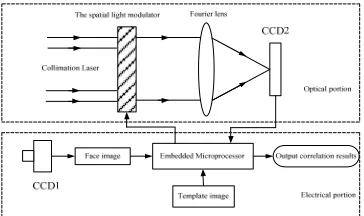
As show in figure 1, Opto-Electronic Hybrid Computing is consisted of the optical system and electrical system. The optical system completes Fourier transform of the face, the electrical system completes uploading and acquisition of the image signal, process control, and the judgment of the results of the work. Both of them exchange signals by photoelectric conversion device CCD.
[image:2.612.109.291.548.656.2] [image:2.612.322.484.549.656.2]
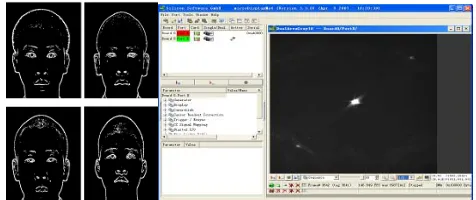
Figure 3. The style of template image and the show of correlation calculation results.
The schematic diagram of Opto-Electronic Hybrid Computing shown in Figure 1. It’s work process: under the control of an embedded microprocessor, CCD acquire face image firstly, then combine with template image to form the input image, and the embedded microprocessor will input the image to the optical light modulator, modulate by collimation laser, complete the Fourier transform by Fourier lens, the embedded microprocessor read the joint power spectrum collected by CCD2, and input it to the spatial light modulator, use the optical system again to complete the Fourier transform of image, finally embedded microprocessor read the correlation output collected by CCD2 ,thereby completing the correlation operation of the image. Figure 2 is the structure diagram of Opto-Electronic Hybrid Matched Filter, the meanings of the numbers are as follows: 1 semiconductor laser, 2 expanded beam collimator, 3 mirror, 4 amplitude spatial light modulator (include DMD and control panel D4100), 5 Fourier lens, 6 CCD detector.
In 1966, C.S. Weaver, J.W. Goodman and J.E. Rau proposed Joint Transform Correlators (JTC), JTC does not need to produce filter in advance, but inputs the face image and reference image to input surface together, it overcomes the shortcoming of the spatial matched filter[12-18]. With these two advantage, JTC rapidly replace the spatial matched filter to become the mainstream of optical pattern recognition[12-18].
In 2003, based on COPaC I and II they used multiple light sources developed MLCOPaC(Mult-light source Compact Optical Parallel Correlator)which could identify 20 channel and it’s speed is 30 ms/face; In 2004, they turned to the research of face recognition based on VLC, in 2005, it was reported that FARCO(Fast Face Recognition Option Correlator)could calculate at the speed of 100 FPS (frames per second), but also had the ability to identify 4 channel, and completed recognition operations at the speed of 4000 times per second; In 2009, they developed the S-FARCO(super high-speed FARCO)by using of holographic storage technology whose optical correlation speed can reach 370000 frames/s.
professor of Defense Technology University, achieved small displacement measurement and analysis by using of Opto-Electronic Hybrid Computing.
THE SHORTAGE OF OPTO-ELECTRONIC HYBRID COMPUTING
At present, domestic and foreign experts has made many achievements in the study of JTC, but still has the following disadvantage:
①JTC has a strong zero-order diffraction, while the diffraction efficiency of the
surface of output is low, which influence the detection of the correlation peak;
②The zero-order diffraction occupied a larger area, limited the size and relative
position of the face image and reference image of the input surface, reduced the usage of the space bandwidth of input surface.
In order to solve above two shortcomings of the Opto-Electronic Hybrid Computing, in recent years domestic and foreign experts mainly study the following two aspects: Improve power spectrum, enhance cross-correlation strength in order to weaken or eliminate the zero-order diffraction, inhibit side lobe, enhance the intensity of mutual correlation peak, many scholars done a lot of improvements in the method of joint power spectrum processing, proposed many effective methods, such as nonlinear filtering, fringe modulation filtering, amplitude modulation filtering, wavelet transform, the subtraction of the power spectrum and so on. In order to overcome the problem of the reduce of the speed of JTC caused by the subtraction of the power spectrum, Cheng and Tu proposed MZJTC(a Mach-Zehnder JTC), and on this basis, based on the Lagrange Multiplier reference to enhance the correlation results. Based on the subtraction of power spectrum and the technology of filtering[13] .the project team proposed joint converter, which can be used to identify multiple face.
THE KEY TECHNOLOGIES OF OPTO-ELECTRONIC HYBRID COMPUTING
The Opto-Electronic Hybrid Computing involves many key technologies, according to the operation feature, status and development of Opto-Electronic Hybrid Computing, it’s key technologies are:
image, so that the lens can achieve high accurate Fourier transform over the entire field of view and all aperture.
2)Suitable for image pre-processing and power spectrum processing method of large-scale face recognition. The image pre-processing method mainly include image segmentation, image compression and image edge extraction, it can minimize the image size, increase the number of input template image and utilization of the spatial light modulation; The power spectrum processing method mainly include the elimination of the zero-order items, items between the template image, enhance and sharpen the correlation peak.
CONCLUSION
Opto-Electronic Hybrid Computing is one of the key technology of optical face recognition, has become a major research direction of the optical face recognition technology. Aiming at the characteristics of Opto-Electronic Hybrid Computing, its recognition process and direction, study the key technology of Opto-Electronic Hybrid Computing further, and promote the research results converse to practical application, provide scientific theoretical basis and technical support to the software and hardware design of the optical face recognition.
REFERENCES
1. Kresimir Delac and Mislv Grgic. 2007. Face Recogintion. I-TECH Education and Publishing. 2. Eriko Watanabe and Kashiko Kodate. 2005. Fast Face-Recognition Optical Parallel Correlator
Using High Accuracy Correlation Filter [J]. Optical Review. No. 6, 460-466.
3. Rieko INABA, Asako Hashimoto and Kashiko Kodate. 1999. Discrimination of Portraits using hybrid parallel Joint Transform Correlator system [J]. SPIE. 3740: 529-532.
4. Rieko Inaba, Naoko Kawakami, Kumiko Oguma, Eriko Watanabe and Kashiko Kodate. 2000. Compact Parallel Joint Transform Correlator for Facial Recognition [J]. SPIE.4089, 384-392. 5. Eriko Watanabe, Sayuri Ishikawa and Kashiko Kodate. 2007. A Highly Accurate Face
Recognition System Using Filtering Correlation [J]. Optical Review. 5(14): 255-259.
6. Eriko Watanabe, Mami Ishikawa, Maiko Ohta, Kashiko Kodate. 2005. High-accuracy and robust Face Recognition System Based on Optical Parallel Correlator using a Temporal Image Sequence [J]. Pro. of SPIE. 5908, 1-8.
7. Chihung Chen, Chulung Chen, Chung-Cheng Lee, and Chiwen Chen. 2004. Color Face-Image Recognition with Liquid-Crystal Spatial Light Modulators [J]. Microwave and Optical Technology Letters. 3(42), 234-237.
8. Eriko Watanabe and Kashiko Kodate. 2005. Implementation of a high-speed face recognition system that uses an optical parallel correlator [J]. Applied Optics. 5(44): 666-676.
9. Li Yanmin. 2002.www.chinanews.com.
10. Savvides, M. et al, Eigen phases vs. 2004. Eigen faces. Proc. ICPR. Vol. 3, 10-813.
12. Fu Jianhui. Research on the technology of photoelectric hybrid joint transform correlation recognition [C]. Nanjing University of Science and Technology. 2006: 9.