2016 International Conference on Electronic Information Technology and Intellectualization (ICEITI 2016) ISBN: 978-1-60595-364-9
Architecture in an Age of Augmented
Reality: Applications and Practices for
Mobile Intelligence BIM-based AR in
the Entire Lifecycle
Jiang Ren, Yingying Liu and Zhicheng Ruan
ABSTRACT
This paper explores the opportunities for mobile Augmented Reality based on BIM across the planning, design, construction, and operation and maintenance phases of architectural practice. It identifies that high-level uses for mobile Augmented Reality across these phases will extremely helpful to achieve the overall efficiency in AEC industry. Meanwhile, written primarily as an introduction to the development of a mobile intelligence Augmented Reality system for our designers and workers on the construction phase, the paper also analysis important aspects of the system we designed and provide solutions to lightweight BIM data and 3D registration.
INTRODUCTION
At present, the AEC industry is under threat that the production capacity and the production efficiency have been declining from 1964, because of the inadequate investment of technical means and the natural defects of project implementation methods. With the development of construction projects which becomes large-scale, complex and diverse increasingly, it is necessary to change the situation that there are so much rework, waste and low-value of projects in AEC industry, according to
________________________
the use of advanced construction systems and technical tools. However, as a digital representation that integrates various physical and functional properties information in all aspects of construction projects, BIM provides an information sharing platform which contains production data and management of engineering data from the planning, design, construction, operation and maintenance until the removal of the entire lifecycle.
Meanwhile, with the development and the substantial reduction in costs of software and hardware technology, Virtual Reality(VR) technology has been developing in high speed, which combined with BIM provide a new way of presentation and interaction for visual presentation of construction projects. As a technology developed from VR, Augmented Reality (AR) technology has played a greater value in obtaining, identifying and analyzing the real world information accurately, which provides advanced technical weapons for information understanding, communication, analysis, storage, etc. at information-intensive construction industry that is relying on ‘the traditional drawings’ to the construction. Therefore, the research on the mobile intelligence applications of AR technology based on BIM in the AEC industry will extremely helpful to achieve the overall efficiency throughout the life cycle.
AUGMENTED REALITY TECHNOLOGY
With the display technology, interactive technology, sensor technology and computer graphics and multimedia technology, AR technology integrates the virtual environment generated by computer and the real environment around the user, in order to enhance the user's understanding of the real environment. Compared to the VR technology that brings construction visualization by virtual environment, AR technology introduces a feedback mechanism to straight chain-type lifecycle processes. In this way, the actual field data will be obtained in real time to feedback loop, helping engineers to make more accurate and more rapid judgments.
hard hat uses cameras, sensors, and other tools to create an AR experience that can help workers directly on the jobsite complete their work faster and more efficiently. Acquired by Apple Inc., Metaio develops AR tools that use 3D tracking capable devices for development and deployment of AR apps. On the smart tablet, the iPad's light body, camera technology, CPU and graphics horsepower will allow users to carry 3D design mappings to work sites and share information with AEC clients and other stakeholders. Atheer Labs is on the forefront of the mobile 3D platform for the future. Their AR technology uses natural human interfaces to deliver an immersive virtual experience anywhere and everywhere. Their platform consists of the Atheer AiR Smart Glasses and Atheer AiR OS which are powered by Atheer's mobile gesture recognition, comfortable visual ergonomics, and contextual AR [3].
TECHNICAL IMPLEMENTATION MECHANISM
AR is composed of three core elements: 3D registration, fusion reality, real-time interaction. Among them, 3D registration is a process of adding virtual objects to the real environment in an accurate position, which is the basis of AR technology. In practice, the process of accurately placing the BIM model in the correct position at the construction site is 3D registration. And the process of seamlessly integrating the construction site and BIM in this virtual space is fusion reality, which will provide a new environment for the user to experience more realistic visual effects and more abundant scene information. What’s more, the process of merging yourself with the surrounding space and objects instead of simply facing screen to communication is real-time interaction, which enables interaction to extend from the exact location to the entire environment.
Changes in external environment usually lead to a domino effect, BIM combined with AR technology will solve this problem effectively. On one hand, the combination will optimize simulation analysis which is based on BIM. On the other hand, this will helpful for making management arrangements more reasonable and flexible. What’s more, the combination will get the maximum value of full life cycle data flow, promote the application of BIM information and improve use efficiency in various stages, and provide intelligent analysis and decision for users.
MOBILE INTELLIGENCE APPLICATIONS IN THE ENTIRE LIFECYCLE
(1)Planning Phase--Early Judgment and Analysis
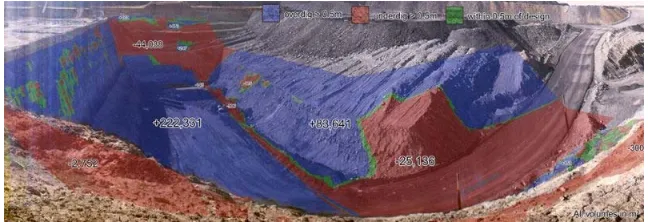
The application of AR technology in the planning phase has been extended from making large scale city model to the urban and regional environmental design and planning. In the three dimensional space that integrates the real environment and BIM, planners can quickly understand the parameters of the space so that they can make the decision more quickly. Meanwhile, combined with advanced laser scanning and GIS technology, users will obtain more related information like volume, location and so on, as shown in Figure 1.According to the AR technology for mobile display and interaction, users can not only make an interpretation and judgment combined with realistic terrain conditions, but also make the project planning more smoothly and reasonably through the cooperation with the foundation professionals, road professionals, line professional and so on.
(2)Design Phase - Visual Communication and Feedback
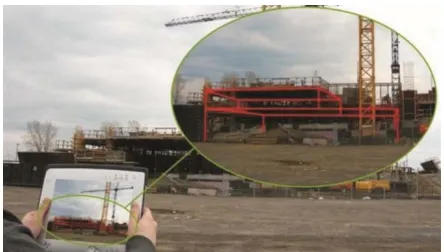
AR allows users to have the ability to view a proposed 3D model in the actual environment. Using data from BIM, the system can combine the 3-D architectural layout of a building with GPS data of a person’s location on the site, allowing them to put on goggles or hold up an iPad and get a three dimensional concept of where things need to go relative to where they are standing[4]. This will give each user the ability to go to a job site and see the future of the construction within the model, from their perspective, as shown in Figure 2.
[image:4.612.135.459.489.600.2]What’s more, combined with simulation and analysis of the physical environment on BIM, such as numerical analysis of the structure, light illumination analysis, heating and ventilation analysis, voice transfer analysis, heat and wet analysis and so on, AR technology allows designers to experience the future building before completion which is the fusion of the construction scene and BIM in fact. Therefore, designers may verify the design of the building is reasonable or comfortable.
Figure 2.Visualization of a future Structure model on tablet.
(3)Construction Phase -Improving Quality & Efficiency
AR technology isn’t limited to external views of buildings. Internal decorations and fittings, as well as underground pipes and other hidden features, can also be displayed on mobile application. Therefore, huge losses may be reduced due to misunderstanding drawings and exchanging information incorrectly between workers.
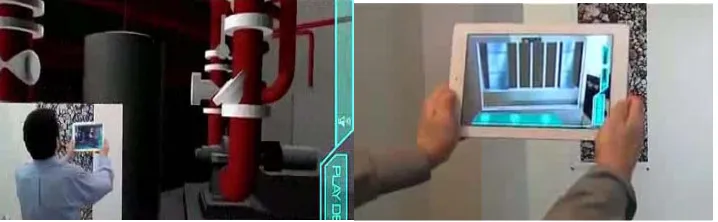
AR can provide the ability to more promptly locate and review installed project component information, materials and equipment during installation and quality control reviews. Inspectors with AR interfaces can work without reference to conventional printed construction drawings and ensuring that every item which needs to be checked is, in fact, inspected[5]. For example, as shown in Figure 3, the complex nature of the stairs and its immediate context required unorthodox sequencing, in which field welds had to take place directly adjacent to already-installed feature glass. To solve this problem, workers can use 4D visualization and AR tools to plan and communicate the work with the labor crews. While the 4D visualization enabled workers to study sequencing, the AR tools enabled the team to understand the proposed work in context, intuitively and at full scale. Craft workers could literally get their heads into a complex detail by simply walking around with a ruggedized tablet that overlaid co-located BIM geometry in real time, rather than being hampered by a mouse-and-keyboard interface to navigate a model at a desk remote from the site.
(4)Operation and Maintenance Phase --Easing Up Building Maintenance & Renovation
damage that they currently cause. A “see-through” element for mapping the position of plumbing and ventilation systems behind walls and panels and other concealed components such as walls and beams could ease the work of building maintenance and renovation, as shown in Figure 4.
[image:6.612.111.484.224.332.2]Meanwhile, AR based on BIM can help identify, visualize, and confirm areas where 3D design information does not merge appropriately with existing structures or construction information – for instance, when the overlay of a mechanical and electrical (M&E) design does not fit properly with the steel structure.
Figure 3. AR based on BIM coordinate the complex process of the stair construction process.
Figure 4. A “see-through” element for mapping the position of plumbing and ventilation systems behind walls.
THE PRACTICE OF MOBILE INTELLIGENCE CONSTRUCTION
[image:6.612.119.478.389.500.2]continuity requirement for construction, high quality requirements for construction technology, complex construction organization, and difficult construction management) of constructors. Besides, AVIC Capital Building also faces the following problems: large amount of work, many processes, a large number of cross-operating works, close cooperation between the various types of work, and higher degree of mechanization.
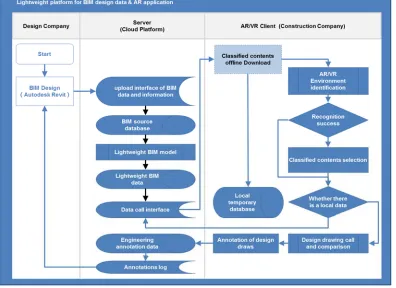
[image:7.612.102.500.322.502.2]Based on this, we propose a method that BIM design information can be called up and the information of construction site can be fed back. And this is also a server-client solution, which will provide more convenient option instead of the comparison of the original blueprint and expensive setting machine. Specifically, the solution would use AR technology to achieve fast call and immediate comparison of BIM in the construction site, and would establish feedback channels for workers. What’s more, these feedback information will be stored and managed by class, finally forming useful data for decision-making of operation and maintenance personnel. The whole process also is shown in Figure 5.
Figure 5. The intelligent solution process of AR technology in the construction site.
The system we designed will implement client-server mode software which is J2EE based framework for BIM application data. Details of technology realization are as follows:
a) Provide solutions and interfaces for the lightweight transform of BIM data to satisfy the requirements of mobile applications.
b) Formulate corresponding BIM operating specifications according to lightweight transform requirements for the source data.
d) Develop a set of interfaces that the client can call BIM data and lightweight data from the server by online or offline mode.
e) Achieve real-time or offline synchronization and storage management for feedback data from the client.
Meanwhile, we will develop the app application of Android or IOS version in client in order to facilitate the use in the construction site. Considering the actual working environment, we choose the mobile device which meets the needs of industrial environment such as Dustproof, waterproof, and so on. The app will achieve real-time collection of partial structures or components in the construction site by the camera on the mobile device. According to the effective identification of AR technology, the app will read and display related information (including: design model, logo, designer, manufacturer information of component, construction workers, construction schedule, etc.) from BIM server platform, and immediately compare these information with the situation of actual construction site on the terminal device. What’s more, the app application also supports other ways to read BIM data such as the way of contents. After the comparison of design model and actual situation, construction workers could collects amendments information. These amendments information also be feedback to the cloud server in real-time, which will achieve synchronization and collaboration among many different types of terminal devices. This process also is shown in the right of Figure 5.
Based on a series of contrast test, we finally choose Project Tango of Google which brings Motion Tracking technology, Depth Perception technology to mobile devices to determine the location information of the real scene quickly. Then the lightweight BIM model of corresponding position which is called from cloud server will be integrated with real scene. Specific development process is shown in Figure 6.
However, it is important that 3D registration is a critical factor which has a significant impact on the efficiency of this system. With Motion Tracking alone in Tango, the device tracks its movement and orientation through 3D space and tells you where it is and which way it’s facing, but it retains no memory of what it sees. Area Learning gives the device the ability to see and remember the key visual features of a physical space—the edges, corners, other unique features—so it can recognize that area again later. To do this, it stores a mathematical description of the visual features it has identified inside a searchable index on the device. This allows the device to quickly match what it currently sees against what it has seen before without any cloud services, as shown in Figure 7.
Figure 6. The development flow chart of the lightweight BIM data and AR system.
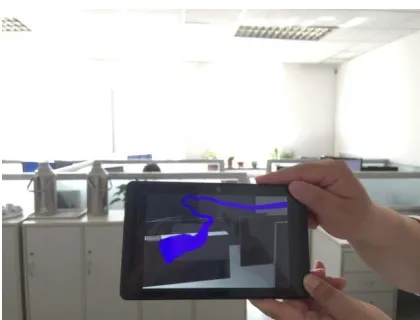
[image:9.612.148.443.445.594.2]Figure 8. The accuracy verification of position tracking in office based on Area Learning (The blue part is the record of the actual walking route, and the office
model built by 1:1 of the real environment).
CONCLUSION
Actually there’re still two difficult problems remained on this app application system. On one hand, when the BIM data is running in the mobile client application, the number of surface in BIM need to be reduced in order to run smoothly. But now the technology on automatically reducing the number of surface is not good enough for optimization of BIM. On the other hand, the object recognition of AR technology is still need to be improved, and illumination is another limitation. Sometimes the virtual model cannot fully match the real object in practical application due to recognition errors or incorrect three-dimensional coordinate projection, which will have an impact on the experience of users.
However, it is undeniable that the tide of AR technology has come. The next generation of AR could completely revolutionize the way we construct our built environment, eliminating tape measures and paper plans. Eventually, the design process of buildings will be completely mobile and finger-oriented so that computers and keyboards probably will be eliminated; the construction process is fully mechanized and automated so that workers may rarely appear on the site anyway; the operation and maintenance process will be remote and intelligent so that various maintenance problems may be resolved before their occurring. Times change so fast, and only by keeping up with technology trends and constant innovation, industry and individuals will benefit from sustainable development!
REFERENCES
1. Jake Meister. 2016, “Applications for Virtual, Augmented Reality Plentiful”, Goldman Sachs Global Investment Research and Statist.
3. Rana Abboud. 2014,” Opportunities and Obstacles for Mobile AR in Design, Construction, and Post-Completion. ” NAWIC International Women’s Day Scholarship Recipient. March, 2014.
4. Broschart D., Zeile P., Streich B. 2013,” Augmented Reality as a Communication Tool in Urban Design Processes”, Proceedings REAL CORP, 119-126.
5. Irizarry J., Gheisari M., Williams G., et al. 2013,“Info SPOT: A mobile Augmented Reality method for accessing building information through a situation awareness approach”, Automation in Construction, 33, 11-23.