Becoming an Architect: the role of work-based learning in architect training
Abstract
This article examines the work-based placement of trainee architects in the United Kingdom to examine how trainees become architects. The trainee architects in this study experienced varying levels of participation and
responsibility during their year-long placements. Despite this diversity, however, developing the trainees on placement was found to be integral to the professional role of the architect. That pedagogic role was valued. The trainees’ placements involved practical problem solving while their university-based element of architecture training focused primarily on abstract design. Yet this apparent tension encouraged the trainees to integrate architectural theory and practice. They developed both aesthetically and technically while on placement. The trainees’ experience of working in an architectural studio on placement often confounded their expectations of architects’ practice. Yet, becoming an architect retained its personal significance. Issues remain, though, around the unequal access to opportunities on placement and how this inequality might affect trainee architects’ learning.
Keywords: architecture training; placements; professional training; work-based learning.
Introduction
Architecture is an ancient discipline. In western countries, however, training courses for architects in educational institutions is a relatively recent
development. Paris’s first architectural training course opened in 1849; in 1847 a night school was established at the Architectural Association in London;
disputed in architecture (Richards 2009; 44), as it is in other fields. This tension is echoed in ambivalence over whether architects are ‘educated’ or ‘trained’, as is discussed below. But throughout the world architects have to satisfactorily complete academic studies as well as practical work-based experience to be certified for professional practice (Crinson & Lubbock 1994; Brady 1996). Workplace learning should not be seen as appendage to institutional learning (Billett 2010, p1), and what architecture students learn during their periods of work experience is under-researched. This article specifically addresses that lack by examining the experience of a group of architecture students from a university in the north of England. The similar structure of architecture courses throughout western countries suggests that the experience of this group of students should be similar to that of trainee architects elsewhere. The architecture students in this study experienced a relatively benign and functional learning culture while on placement. We argue that this culture is integral to the architectural profession in the United Kingdom (UK), making it a valuable area of research in work-based learning (WBL) more widely.
Before discussing the concepts that underpinned our study and its methodology, we discuss the place of architecture and architecture training in the UK. As developed below, our study suggests that qualified architects were conscious of their own pedagogical role in developing trainee architects. Arguably, this is a cultural expectation within the architecture profession as reflected in the positive learning environment within the architectural firms where the students were placed. The issue of trainee architects’ unequal access to learning opportunities remains, however, crucial. But generally, work placements enabled these trainees to ‘become’ architects even when their expectations of architectural practice diverged significantly from what they encountered in architectural firms.
The Architectural Profession in Britain
of architecture in the UK, which has maintained high status alongside medicine and law. Surprisingly, this high status is not matched by the average salaries for architects which, as in the US, have been falling in recent years and which compare unfavourably with doctors or barristers (Richards 2009; RIBA Journal 2011). Architecture training is controlled by RIBA and since 1958 the Institute has required within that training five years’ study at university and two years’
placement in architectural offices (RIBA 2012). RIBA uses the words “training” and “education” interchangeably in their documentation. There exists,
nevertheless, a conceptual distinction between the two terms: the former emphasises technical competence; the latter emphasises “the development of knowledge and understanding, in both breadth and depth” (Dearden 1984, 62). Education tends to hold higher status than training. RIBA’s use of both terms is partly indicative of the elevated place of architects in British society. Because of the high status of the profession itself, the status distinction between education and training is relatively unimportant. Moreover, as Dearden also identified (p64): “A process of training could be liberally conceived in such a way as to explore relevant aspects of understanding, and in a way which satisfies the internal standards of truth and adequacy.” This describes architecture training in the UK with its cognitive and functional elements, so training is the term adopted in this article.
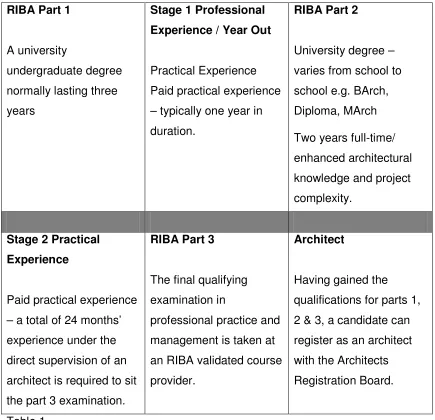
practice and management is the RIBA Part 3 examination. The title of architect in the UK is protected by law. So, having gained the necessary qualifications, a graduate must finally register as an architect with the Architects Registration Board and with RIBA.
RIBA Part 1
A university
undergraduate degree normally lasting three years
Stage 1 Professional Experience / Year Out
Practical Experience Paid practical experience – typically one year in duration.
RIBA Part 2
University degree – varies from school to school e.g. BArch, Diploma, MArch Two years full-time/ enhanced architectural knowledge and project complexity.
Stage 2 Practical Experience
Paid practical experience – a total of 24 months’ experience under the direct supervision of an architect is required to sit the part 3 examination.
RIBA Part 3
The final qualifying examination in
professional practice and management is taken at an RIBA validated course provider.
Architect
[image:4.595.81.516.204.624.2]Having gained the qualifications for parts 1, 2 & 3, a candidate can register as an architect with the Architects Registration Board.
Table 1
RIBA expects the practical application of design to develop within Stage 1
The work-based learning of architects
For this study we examined what the students learned on their Stage 1 and how this related to their becoming architects. Roth (2010, 41) describes an ‘abyss’ between what is taught in the institution and what is required in the workplace. By contrast, however, we found that distinguishing between what the trainees learnt at university and what they learnt on placement was not straightforward
(Hodkinson 2005, 521; see also Frederick 2007). Nevertheless, we concentrated on unplanned, ‘informal’ learning because trainee architects on placement are expected to ‘absorb’ from what is around them, as if through osmosis. Clarity in how we understood learning was important in planning this study. As Hodkinson and Macleod (2010) found, how learning is theorized not only affects
methodological decisions; but also that any chosen methodology tends to highlight particular influences on learning and overlook others. “Put bluntly, it means that choice of a particular research methodology is likely to skew the research into understanding learning in particular ways” (p185). Our
This conceptualisation made the connection between learning, identity and practice, which is salient to architecture training and becoming an architect. Some caution is required because Edwards’ (2005, 55) criticism of Eraut’s learning as participation conceptualisation is also pertinent to our study. She argued that such conceptualisations, which include ‘learning as becoming’ stress socialisation into beliefs, values and identity and thus may neglect important changes in cognition. Edwards (2005, 50) defined learning as something which “[modifies] the way in which we interpret and may act on our worlds.” Her definition highlights the dialectical concept of quantitative change (learning new things) leading eventually to qualitative change (becoming an architect). There is a connection between changes in trainee architects’ cognition, even learning relatively mundane technical skills such computer aided design (CAD), and their developing sense of professional identity. Those technical skills were part of what eventually modifies how the trainees perceive the world and themselves within it.
To examine the context for architecture students on placement, Fuller and Unwin’s (2004) expansive and restrictive framework of approaches to workforce development was adopted as a conceptual instrument. This helped to identify and analyse the structural affordances that the workplace provided to promote or constrain workplace learning. Fuller and Unwin describe two ends of a continuum of approaches to professional development. At one end are expansive
approaches that enhance opportunities for learning; at the other end are restrictive approaches that limit workforce development. Within this continuum are two broad categories (Evans et al 2006, 41-42):
1. “Those which arise from understandings about the organizational context and culture (for example, work organization, job design, control, and distribution of knowledge and skills).”
Descriptors of a restrictive approach to workforce development include (Fuller & Unwin 2004, 130):
Technical skills taken for granted
Virtually all on-the-job: limited opportunities for reflection
Lack of organisational recognition of and support for employees as learners
The equivalents that characterise expansive approaches are:
Technical skills valued
Planned time off-the-job including for knowledge-based courses and for reflection
Organisational recognition of and support for employers as learners
These twin conceptualisations of ‘learning as becoming’ and the framework of expansive/restrictive environments for learning informed and shaped this study as described in the next section.
The study
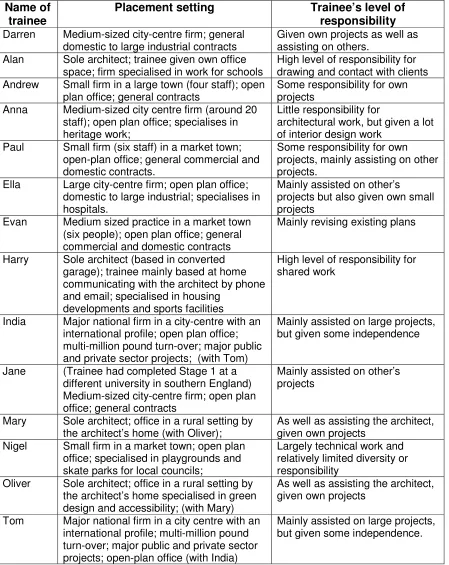
Table 2: List of participants Name of
trainee
Placement setting Trainee’s level of responsibility
Darren Medium-sized city-centre firm; general
domestic to large industrial contracts
Given own projects as well as assisting on others.
Alan Sole architect; trainee given own office
space; firm specialised in work for schools
High level of responsibility for drawing and contact with clients
Andrew Small firm in a large town (four staff); open
plan office; general contracts
Some responsibility for own projects
Anna Medium-sized city centre firm (around 20
staff); open plan office; specialises in heritage work;
Little responsibility for
architectural work, but given a lot of interior design work
Paul Small firm (six staff) in a market town;
open-plan office; general commercial and domestic contracts.
Some responsibility for own projects, mainly assisting on other projects.
Ella Large city-centre firm; open plan office;
domestic to large industrial; specialises in hospitals.
Mainly assisted on other’s
projects but also given own small projects
Evan Medium sized practice in a market town
(six people); open plan office; general commercial and domestic contracts
Mainly revising existing plans
Harry Sole architect (based in converted
garage); trainee mainly based at home communicating with the architect by phone and email; specialised in housing
developments and sports facilities
High level of responsibility for shared work
India Major national firm in a city-centre with an
international profile; open plan office; multi-million pound turn-over; major public and private sector projects; (with Tom)
Mainly assisted on large projects, but given some independence
Jane (Trainee had completed Stage 1 at a
different university in southern England) Medium-sized city-centre firm; open plan office; general contracts
Mainly assisted on other’s projects
Mary Sole architect; office in a rural setting by
the architect’s home (with Oliver);
As well as assisting the architect, given own projects
Nigel Small firm in a market town; open plan
office; specialised in playgrounds and skate parks for local councils;
Largely technical work and relatively limited diversity or responsibility
Oliver Sole architect; office in a rural setting by
the architect’s home specialised in green design and accessibility; (with Mary)
As well as assisting the architect, given own projects
Tom Major national firm in a city centre with an
international profile; multi-million pound turn-over; major public and private sector projects; open-plan office (with India)
Semi-structured interviews were used as the most direct and practical means to gather data on the participant students’ perceptions. These were conducted either towards the end or shortly after their Stage 1 placement. Despite the inherent shortcomings of interviews (Hammersley 2008, 89) they allowed some self-analysis for the interviewees who described experiences and situations. These interviews also exposed how the interviewees understood the experience of their placements. All the interviews were transcribed and analysed with the aid of Atlas-ti software using both a priori and emergent codes. The a priori codes related to: social contact on placement; learning; and perceptions of being an architect. The emergent codes related to: the relationship between theory and practice in design; responsibility while on placement; and the use of computer aided design (CAD) tools. The next sections consider some of the major themes from this phase of our study.
Findings
The purpose of this phase was to scope for divergence and commonality
amongst the experience of the trainee architects. Though our sample was small, the diversity of the architectural offices where the trainees were placed for Stage 1 was striking (see table 2). One was in a rural setting, several were in the centre of major cities, others were in market towns. Four students found placements with sole architects. One of these worked from a converted domestic garage that was too small to share with the placement student (Harry) who therefore worked from his own home. These two would only meet once or twice a fortnight and communicated mainly by email and phone. Harry explained, “he would email me work that needed doing and plans and then I would work from home and email
him back.” Though Harry wished for a different experience for his Stage 2, he
The level of responsibility each student had on placement differed widely, too. Anna’s day in a large practice was normally spent on drawings: “I felt like a technician really and I tended to draw stuff up and that was quite helpful because
you get to use software and you learn to manage the details [of architectural
drawings].” Andrew in a much smaller office had his own projects to manage, as
did Alan working with a sole architect. Another differentiating factor was how often, if at all, the students were invited to meet clients or visit sites. Anna only had one site visit during her year while Harry attended many client meetings and regularly visited sites. Jane in a relatively small firm visited sites under
construction and her whole office would visit completed sites together. Oliver and Mary, also placed with a sole architect, were always taken to visit clients. Only one participant, Evan, was never involved with any clients or taken on any site visits. Generally those in smaller offices had more opportunities to get involved in such activities, which are central to the work of the architect. Inequality of access to opportunities for professional leaning is significant here, but regardless of the size of the firm each of the students described feeling appreciated. India said, “they seem to value what the students can bring”; for Tom in the same practice, “you will be heard if you challenge a few things.” The symbiotic connection between the students’ gaining professional knowledge through participation and the architects’ gaining fresh ideas was considered mutually beneficial.
Professional development was perceived as integral to the practice of architecture and many features of an expansive approach to professional development were present in these architecture firms, as explored below.
Learning relationships
circumstances fostered a relatively egalitarian atmosphere that facilitated what we termed learning relationships. The relative equality of these studios was suggested by who made the tea or coffee and with whom the trainees ate. As an example, Ella explained how the people in her studio “make each other cups of tea all through the day” and that often on Fridays they would go to the pub
together. Alan’s team ate lunch together, as did many others. In a much smaller firm, Oliver had eaten each day with the other placement student in the home of the architect although he said, “it was fairly classic workplace hierarchy, but it was less formal.” Nevertheless he also added, “you have to do what you’re told
and you don’t get to ask too many questions, really.” The firm where Evan was
placed had, he explained: “a rota system: one person does it at ten and another at one o’clock. I had this thing when I first started which was like a brew round
and they printed it off and you had to sign it. It was like a joke kind of thing but it
kind of stuck. …It’s a good way to start meeting people.” Evan had “loved” being
in the architectural practice but as with Oliver, hierarchy was present in the firm. Andrew said of the architect with whom he worked: “Well, obviously he’s my boss but we get on very well and, in a way, he’s a friend. He’s the sort of person who
wants to help you and bring you on and give you the experience that can give
you enough exposure to the work so that you learn.” Though these architectural
firms did reflect the inequalities inherent in workplaces, there was social contact with senior staff. Alan said of the architect with whom he was placed: “I couldn’t have asked for anything better, really. He showed me different things like
professional learning; he opened my eyes to things that we hadn’t done in
degree level.”
The role of the ‘host’ architect in developing the trainee is formally written into RIBA’s criteria for the Stage 1. But beyond this requirement many of the trainees developed learning relationships with other Stage 2 trainees or with architectural technologists in the firm. Andrew found that a “Part 2 guy was really, really helpful…he basically took me under his wing.” Evan spent most time with a
and he sort of understood what I needed to know and where I was going and he
was a big help as well and he actually sat down and showed me everything as
well when I first started.” The senior architect would also, “happily go down for
twenty minutes and he would explain what needed to be done or he’d show you
what book you might need to look at.” Anna described how she spent time with
the technologists because, “they were quite helpful and so I was always quite interested in seeing what they were doing…they were willing to sit down and
explain things.” The experience of the majority of the participants was of learning
about architecture not just through practice, but also through a purposeful dialogue that articulated professional development. This went further than the formal requisites of the three-month reviews within the Stage 1.
Billett (2002, 30) identified three key contributors to a workplace pedagogy. These were: engagement in everyday tasks at work; close or direct guidance from fellow workers; and indirect guidance from the workplace and others
working there. Billett further identified (p32) how the quality of workplace learning was influenced by “direct interpersonal guidance in assisting less experienced workers to access and develop capacities that they would not discover alone.” These four elements informed our a priori coding of the interviews and so allowed us to consider the extent and quality of pedagogy in the architectural practices. The full participation of trainees in the whole gamut of the architect’s role distinguished the situation of those participants with most affordance to learning, who were in the majority. Involvement in tasks under the direction of more experienced others was characteristic of the trainees’ experiences. For each of the participants, moreover, there was adherence to the formal
requirements of RIBA for the placement. Most of the trainees had a relatively structured workplace learning experience with graduated access to a range of situations and experiences. This all suggests a form of purposeful workplace pedagogy as described by Billett.
architectural offices and their relatively less structured learning. Hodkinson et al (2008, 34) define a learning culture as “a particular way to understand a learning location as a practice constituted by the actions, dispositions and interpretations
of the participants.”The trainees assimilated the sets of social practices within
the learning culture of the architectural offices. The concept of a learning culture
as used by Hodkinson et al. recognises that individuals are influenced by the
learning culture, but an individual’s presence and actions also contribute to the
culture in which they practise. Significantly, the trainees’ contribution to the
culture of the architectural offices came at least partly from their university
course, which emphasised design above the vicissitudes and financial strictures
of architectural firms.
Conscious learning
Eraut (2004) observed how participants involved in WBL research can limit their description of learning to that which is institutionalised, most often associated with schools or colleges. This may mean that less tangible learning associated with the workplace remains unrecognised and ignored. By contrast, many of the participants in this study could articulate what they had learned in the
architectural firms and how they had themselves been changed. This self-conscious learning again suggests a purposeful pedagogy and curriculum. As Andrew explained, “After having worked in placement you just look at things differently…you have an understanding so that instead of designing a building
without having any idea of how it is going to be built, you have some idea of how
it is going to be built.” He identified, in particular, what he referred to as
“materiality: what you put into a building because you don’t want too much going on or it doesn’t look right”. Andrew also had learnt about costing a project and he
looked more critically at the work of prominent architects. Evan had learned to “concentrate more on my floor plans… it might be something as simple as fire exits and things like that. India identified learning about contracts and structuring
things faster”, as did India. Alan recognised that he had learned, “The different
roles of an architect like chairing site meetings and site inspections; looking at
how to deal with issuing certificates for completion of work. Things which at
undergraduate level, you don’t really see or hear about.” Many of the participants
referred to how they had learnt to use software packages. This may be explained by such technical learning being easily discernible and also easily articulated during an interview. CAD was, however, seen by many as a necessary
professional skill. To become an architect in twenty-first century Britain you have to know how to use CAD, as it were. Though not pursued here, this idea does alert us to Sennett’s (2009, 44) particular warning about CAD. People might let the machine do the learning rather than developing their own expertise.
More generally, raised confidence was referenced by many of the participants, especially in how they dealt with clients’ telephone calls in those open-plan offices where everyone can hear. The accounts from participants who were given their own projects especially demonstrate the triangular relationship between challenge, support and confidence (Eraut 2010, 51). The trainees were challenged enough for them to develop, but not so much for them to be
overwhelmed or beleaguered. That is, they believed they could achieve the tasks expected of them.
The interaction between what is learnt on an academic course and what is learnt on a work placement is important within a very wide range of professional
then you get to work and you learn something completely different.” Jane had
completed her Part 1 at a different university in England on a course that she described as “very much arty and conceptual.” So she had had “to learn quite quickly on [her] work placement.” Yet, strikingly most of the sample articulated
their approval of the divide between the abstract and the applied. Although some believed the course could have better prepared them for practice in, for example, the legal requirements on architects, there was broad appreciation of how the university course had allowed them to focus on aesthetic design. Even those who would have sought better preparation were not antagonistic towards their course. Mary said, “I think that you learn the design aspect when you are at university and when you get in practice you learn the practical side.”
As noted above, Roth (2010, 41) has criticised the distance between what is taught in an educational institution as preparation for the workplace and practice in the workplace (see also Eraut 2010, 49). In the instance of these trainee architects, however, that discrepancy appears to have been productive. That is, there was a creative tension between the university’s emphasis on ‘pure’ design and the everyday restrictions of architectural practice in the real world. Without that tension the trainees may simply have learned to cope within the busy architectural offices. The distinction between the university course and professional practice ensures that trainee architects think creatively, not just technically. Supporting this view, India reported how an architect at her
placement firm had stressed to her how at university she must be as creative as possible and ignore the constraints of budgets; “so I think it’s good the uni pushes creativity.” The Stage 1 placement allowed the integration of
Becoming an architect
The students’ expectations of architects’ practice were often confounded by their experience of their Stage 1, though their desire to become architects remained strong. Anna had never anticipated designing bespoke furniture as part of the architect’s role, for example. Like many of the other participants she was surprised by how little time she spent on designing buildings, “because you spend so many weeks actually getting the design and then you just kind of work
it up but then there is all the other paperwork that you have to do with it which
takes up quite a lot of time, such as answering emails and queries.” Her time on
placement had been spent more on “queries and answering questions” than design. She had, moreover, come to realise that this pattern was normal for architects. Anna was adamant, however, that she still wanted a career in the profession. Similarly, Andrew had not anticipated the problem-solving elements of being an architect. He said, “People go into architecture because they are interested in the drawing aspect of it, but in practice you find this is a relatively
small percentage of what you do, but you’ve learnt to enjoy the rest of the
work….You can go home at the end of the day thinking that you’ve sorted that
problem out.”
India, too, described this divergence between her expectations, that architects are designing most of the time, with what she actually experienced on placement. Nevertheless, she relished finding solutions to problems in order to make the “environment feel nicer” for the patients at the hospital on which she was working; even just placing a light in the right position. Alan had been initially “underwhelmed’ by his experience on Stage 1, because it had involved so little design. But his Stage 2 colleague at the office had “opened [his] eyes up to what architecture actually is” and Alan still wanted to become an architect.
after the Part 1. Nevertheless, this separation between the participants’
expectation and their actual experience of everyday architectural practice points to an interesting paradox. Being an architect had been and remained important to these participants, despite the challenge to their understanding of what architects spend their time doing. The participants on placement found themselves
immersed in a set of practices that they had not predicted but to which they were attracted. They learned to thrive within those circumstances and in so doing they adopted the identity of architect. They learned to be something they had not anticipated. To return to Collin et al. (2008, 191) they valued “the feeling of
‘weness’” involved in being within the social community of architects. This chimes strongly with Wenger’s (1998) notion of learning as belonging and suggests the prominence of socialisation into beliefs, values and identity. Yet, the relation between belonging and learning is complex. Felstead et al. (2007)
operationalised Lave and Wenger’s (1991) concept of communities of practice to identify the necessary constituent elements for the existence of a meaningful community of practice. They highlighted (p1): “the degree to which work tasks are: jointly carried out; discussed before, during and after completion; and used to enhance belonging at and beyond the workplace.” Such discursive
collaboration before, during and after tasks was recognised and articulated by the trainees. The attitude of the architects and others in the firms encouraged the trainees’ sense of belonging to the profession. So, they learned to be part of a community.
description of learning, cited above, as “a change in state, which alters how we act on the world and in turn change it by our actions.”
Guile demystifies the process of becoming a professional through enculturation of the practices of a defined group. His (2011, 109) summary of how professional development is promoted by immersion in a professional tradition includes two features apparent in the situation of these trainee architects. Firstly, the trainees learnt “to know why a professional field has been constituted in a particular way and why certain things are or are not the case from the perspective of the field.” Secondly, “on the basis of discerning other professional’s intentions [the trainees acted] accordingly by offering support or challenging the conclusion and the action that is being proposed on the basis of that conclusion.” So, the trainees were transformed by their Stage 1, partly by the new knowledge and skills they had acquired, partly by how they identified themselves with the profession. However, it was the combination of these that was crucial in their transition to being architects.
The expansive workplace
The architectural firms were characterised by their open-plan offices (see table 2). These offices provided an important space for the trainees’ development through collaboration and discussion with others. As mentioned above, Fuller and Unwin’s (2004, 130) framework was used to analyse how these workplaces enhanced or restricted learning. This analysis indicated the positive effect of the cultural expectation of pedagogy within the profession of architecture, as
experienced by the trainees on placement.
There was a vision of workplace learning that specifically included seeing employees as learners as suggested by the involvement of even senior
architects with the trainees. There was reification of a workplace curriculum, most apparently though the RIBA requirements and these were well understood
Teamwork was perceived by the trainees to have been valued, as were trust and expertise. In the larger offices there was often participation in multiple
communities of practice. There was a gradual transition to full, rounded
participation on placement because the trainees were ‘allowed’ to make mistakes and often to experiment. The pursuit of good design provided a shared grammar and vocabulary that served to partly equalise workplace relationships, even between the senior architects and the Stage 1 trainees. Indeed, the innovation that the young trainees brought was frequently perceived to have been
appreciated and so the trainees were actively incorporated into the architects’ world. The trainees’ accounts of the environment for learning in the architectural firms was overwhelmingly favourable and the expansive elements identified above were shared across the diversity of the trainees’ accounts. The next stage of our research will involve observation of trainees in their placement settings to further test the suggestion that this is integral to the architecture profession in the UK.
Conclusion
Distinctive themes stand out from this research that pertain to the expectations and practices of the workplace and how these allow the trainees to eventually become architects. The sample is small so generalisations are difficult to justify. Nevertheless, the variability of the trainees’ experiences on the Stage 1 and their unequal access to prestigious architectural studios are troubling issues because these affect the affordances available to the trainee. All of the students had applied ‘cold’ to architectural firms for their placement; that is, they had had no previous link to the firms. Some had applied to hundreds of firms before being taken on. In a highly competitive environment many felt fortunate to have a placement at all. Traditionally, trainees on placement had been paid, but many of the sample were not. They had to support themselves or rely on family for
architects and also greater financial wherewithal to sustain the seven years’ training. These kind of social and economic advantages may provide more opportunities to find Stage 1 placements, especially in leading studios. As a result, the profession of architecture may become restricted to those from privileged backgrounds with the necessary social and financial wherewithal to access architectural training. We have planned a subsequent examination of the experience of architecture trainees from an elite university to test this
assumption.
As this discussion demonstrates, class pervades education and training in England (Avis 2009). There is a chasm between low status vocational training and the expectations of high-status vocational training, such as for architects, (Wolf 2011). The culture in the architectural studios valued the trainees and encouraged them to develop. Most of the trainees had affordances for learning in the workplace and encountered what Eraut (2010, 41) describes as the key factors in informal learning: “appropriate levels of challenge and support,
confidence and commitment, and personal agency.” The majority had autonomy to work on their own projects or aspects of larger ones under the guidance of more experienced employees. From the most senior architects to other trainees on their Stage 2, all took seriously their role as architectural pedagogues. This study further suggests that there was an expectation of teaching as a
fundamental element of being a professional architect. Just as they had been ‘taught’ on their own placement, so qualified architects reciprocated as part of their profession. These learning relationships were, moreover, encouraged by the material form of the culture within most of the architectural firms, their open-plan layout. The firms’ literal openness shaped how people related.
student to architect. This suggests that trainees can benefit from work-based placement without being specifically prepared for the practices on their placement. Furthermore, it implies that the contrast between preparation and practice may even be productive.
Duffy and Hutton (1998, 141) accurately described architecture as “a learning profession” with design as its “rock-hard common core.” This core of design facilitated engagement, discussion and development. Yet Coleman’s (2010) caustic critique of current architectural practice is worth highlighting. He wrote (p208) “most [architectural] practice is not really worth thinking about, except to criticise and/or to challenge it on the grounds that it largely confirms the
degeneration of architecture from the status of serious cultural work to the production of trifles intended to either be consumed or to smooth the wheels of consumption.” The circumstances for learning may be benign, but Coleman argues that what trainees learn is limited by the commercialism and banality of much contemporary architecture. Nevertheless, our study indicates the role of a benign professional culture in the development of trainee architects and their eventual transition to full professional status. The trainees on placement identified with the profession and they assimilated its practices, even when the profession was not as they had expected.
References
Avis, J. (2009) Education, Policy and Social Justice. London: Continuum. Billett, S. (2002) Toward a Workplace Pedagogy: Guidance, Participation, and Engagement. Adult Education Quarterly, 53 (1), 27-43.
Billett, S. (2010) Learning through Practice. In S. Billett (Ed) Learning Through Practice Models, Traditions, Orientations and Approaches (pp1-20). New York: Springer.
Coleman, N. (2010) The Limits of Professional Architectural Education, International Journal of Art & Design Education, 29 (2), 200–212.
Colley, H., James, D., Tedder, M. & Diment, K. (2003) Learning as Becoming in Vocational Education and Training: class, gender and the role of the habitus. Journal of Vocation Education and Training, 55 (4), 471-497.
Collin, K., Paloniemi, S., Virtanen, A. & Etelapelto (2008) Constraints and Challenges on Learning and Construction of Identities at Work.
Vocations and Learning, 1 (1) 191-210.
Crinson, G & Lubbock (1994) Architecture — art or profession: three hundred years of architectural education in Britain, Manchester: Manchester University Press.
Dearden, R. (1984) Education and Training, Westminster Studies in Education, Vol 7. 1. 57-66
Duffy, F. & Hutton, L. (1998) Architectural Knowledge: The idea of a profession, London: E and FN Spon.
Edwards, A. (2005) Let’s get beyond community and practice: the many meanings of learning by participating. The Curriculum Journal, 16 (1), 49-65. Eraut, M. (2004) Informal learning in the workplace. Studies in Continuing Education, 26 (2), 247-273.
Eraut, M. (2010) Knowledge, Working Practices, and Learning. In S. Billett (Ed.) Learning Through Practice Models, Traditions, Orientations and Approaches (pp37-58). New York: Springer.
Evans, K. Hodkinson, P. Rainbird, H. & Unwin, L. (2006) Improving Workplace Learning, London: Routledge.
Felstead, A., Fuller, A., Jewson, N., Unwin, L. & Kakavelakis, K. (2007) Learning, Communities and Performance. Leicester: NIACE.
Frederick, M. (2007) 101 Things I learnt in architecture school, Cambridge, Mass.: MIT Press.
Guile, D. (2011) Interprofessional Activity in the ‘Space of Reasons’: Thinking, Communicating and Acting, Vocations and Learning, 4, 93-111.
Hammersley, M. (2008) Questioning Qualitative Inquiry. London: SAGE.
Hodkinson, P. (2005) Reconceptualising the relations between college-based and workplace learning, Journal of Workplace Learning, 17 (8), 521-532. Hodkinson, P., Biesta, G. & James, D. (2008) Learning Culturally: Overcoming the Dualism Between Social and Individual Views of Learning, Vocations and Learning 1, 27-47.
Hodkinson, P. & Macleod, F. (2010): Contrasting concepts of learning and contrasting research methodologies: affinities and bias, British Educational Research Journal, 36 (2), 173-189
Holland, D.; Lachicott. W.; Skinner, D. & Cain, C. (1998) Identity and agency in cultural worlds. Cambridge, Mass.: Harvard University Press.
Lave, J. & Wenger, E. (1991) Situated Learning. Cambridge: Cambridge University Press.
RIBA (2011) RIBA Procedures for Validation and Validation Criteria for UK and International Courses and Examinations in Architecture, London: RIBA.
RIBA (2012) Becoming an architect. Website available at:
http://www.architecture.com/EducationAndCareers/BecomingAnArchitect/Becomi nganarchitect.aspx
RIBAJournal (2011) available at:
http://www.ribajournal.com/index.php/feature/article/salaries_show_signs_of_eas ing/
Richards, M. (2009) Architecture Degree Structure in the 21st Century, Multi: The Journal of Plurality and Diversity in Design, 2 (2), 44-58.
Schein, E. (2004) Organizational Culture and Leadership. San Francisco: Jossey-Bass.
Roth, W. –M. 2010 Learning in Praxis, Learning for Praxis In S. Billett (Ed.) Learning Through Practice Models, Traditions, Orientations and Approaches (pp21-36). New York: Springer.
Shotter, J. (1993) The Cultural Politics of Everyday Life. Buckingham: Open University Press.
Webster, H. (2008) Architectural Education after Schön: Cracks, Blurs
Boundaries and Beyond. Journal for Education in the Built Environment, 13 (2), 63-74.
Wenger, E. (1998) Communities of practice: learning, meaning and identity. Cambridge: Cambridge University Press.