R E S E A R C H A R T I C L E
Open Access
Reliability and validity of the Sheehan disability
scale modified for pathological gambling
David C Hodgins
Abstract
Background:An interview format version of the Sheehan Disability Scale (SDS) modified to assess gambling treatment outcomes was assessed for reliability and validity. The SDS assesses impairment in work, family and social functioning related to mental disorders.
Methods:A pilot study (N = 21) determined the preferred wording for oral administration. Participants with pathological gambling in a relapse prevention clinical trial completed the scale and other validation measures at baseline, six and twelve month follow-ups (N = 169).
Results:Confirmatory factor analysis supported a one factor solution and the scale had good internal reliability for a three item scale. The SDS was sensitive to change and correlations with recent gambling behaviour and severity were moderate as expected. Similarly, correlations with self-efficacy, perceived control over gambling, and craving were moderate, but they were lower for less directly related constructs such as depression and perceived family and friend support.
Conclusions:The SDS is a brief, psychometrically sound, outcome measure of impairment associated with gambling disorders that can be administered by telephone.
Keywords:Functional Impairment, Pathological Gambling, Sheehan Disability Scale, Clinical Trials
Background
The Sheehan Disability Scale (SDS) was originally designed to assess functional impairment associated with anxiety disorder diagnoses [1]. Functional impairment or disability is related to, but conceptually distinct from, symptom severity and distress. The SDS is a three-item self-completion scale measuring the impact of symptom-atology on work, social and family functioning. Because of its simplicity, brevity, and high face validity, and because of the lack of competing brief measures of functional impairment, the SDS has become a widely used out-come measure in clinical trials of a variety of mental health disorders. The SDS has been used for obsessive compulsive disorder, post-traumatic stress disorder, major depressive disorder, panic disorder, social anxiety disorder, schizophrenia [2] and, most recently, patho-logical gambling [3-6]. As of 2007, the SDS had been translated from English into 48 languages [2].
Despite its popularity, limited data on the psychomet-ric properties of the SDS have been published. Leon, Shear, Portera and Klerman [7] analyzed clinical trial data obtained from patients with panic disorder. The au-thors reported that the scale had adequate internal reli-ability (α = .56 to .86) and a stable one factor structure at baseline and post-treatment follow-up. They also demonstrated that the measure is sensitive to treatment-related change and that the scores, as expected, were moderately associated with panic symptoms. Leon and colleagues [8] also examined the SDS in a sample of pri-mary care outpatients concurrently assessed for mental health disorders. Internal reliability was excellent (α= .89) and a one factor structure was also supported. In terms of validity, patients who met the criteria for a mental dis-order had more impairment than those who did not. The authors used a cut-point of five or greater on the 30-point scale, and they found that the SDS had good sensitivity and specificity in identifying the mental disorder patients.
Sheehan and Sheehan [2] reviewed the use of the scale in published clinical trials in order to establish
Correspondence:[email protected]
Department of Psychology, University of Calgary, 2500 University Drive NW, Calgary, AB T2N 1N4, Canada
interpretation guidelines for patient improvement. They provide preliminary recommendations that a total score of 6 or less indicates remission and a score of 12 or less indi-cates treatment response. A reduction of approximately 4 points indicates improvement [2].
In the gambling arena, a number of well validated interview and self-rated measures of symptom severity are available [9] including: the South Oak Gambling Screen (SOGS) [10], the Problem Gambling Severity Index (PGSI) of the Canadian Problem Gambling Index [11,12], the National Opinion Research Centre DSM Screen for Gambling Problems (NODS), [13], the Gambling Symptom Assessment Scale [14], and the Gambling Treatment Outcome Monitoring System [15]. Addition-ally, interview measures of self-reported gambling be-haviours (frequency, money and time spent) show good psychometric properties [16,17]. Measures of impair-ment include the SDS as well as a gambling adaptation of the Addiction Severity Index (ASI-G), which is an interview measure that assesses functioning and need for treatment in a variety of domains including gambling problems, physical health, employment, social relation-ships, psychiatric functioning, alcohol and other drug use and legal problems. The gambling subscale has been well validated in treatment populations [18-20] whereas the other subscales have been mostly validated with substance abuse populations. The SDS has not been assessed psy-chometrically despite its use.
The purpose of this report is to provide data on the reliability and validity of an interview version of the Sheehan Disability Scale modified for gambling (SDS-G). Data from a trial of a distance relapse prevention pro-gram were used to assessment the psychometric proper-ties. One of the unique features of the SDS is that the scale items are presented visually as a horizontal line marked with both numbers (0 to 10) and verbal anchors (0 = Not at all, 1–3 = mildly, 4–6 = moderately, 7–9 = markedly, and 10 = extremely). The numbers are presented in a larger font than the verbal anchors and respondents are required to choose a specific number to indicate their response. This design is easy for patients to complete, but, unfortunately, limits the scale from be-ing used in a face-to-face or telephone interview format. Because telephone follow-up is often used in gambling treatment studies, the first step in this investigation was to solicit feedback from interviewers and respondents with pathological gambling about the clarity of different response options in an interview format. The response options were modified from the instructions provided for the self-completion version.
Methods
Ethical approval for this study was provided by the Conjoint Faculties Ethic Review Board at the University
of Calgary and all participants provided written informed consent.
Examination of response options
Two experienced interviewers participated in this pilot examination of response options. The pilot study was conducted to determine the preferred wording for tele-phone interviews. Participants (N=21) meeting the cri-teria for pathological gambling, as part of a telephone assessment, were informed by the interviewer that: “I am going to ask you some questions regarding how your gambling problem has affected your life in the past month”. Participants where then asked two questions about each of the three domains. The domains were asked in the standard order used previously (work, social and family), but question response order was random-ized. For example: “To what extent has your gambling disrupted your work or studies in the past month? Would you say not at all, mildly, moderately, markedly, or very severely? To what extent has your gambling problem disrupted your work or studies in the past month on a scale of 0 to 10, with zero indicating not at all and 10 indicating severely?” Participant agreement across the two response options was computed and the interviewers provided qualitative feedback on their preferences.
Psychometric examination Participants
For the trial of the distance relapse prevention program, a sample of individuals meeting criteria for pathological gambling (N = 169) was recruited through media an-nouncements and was assessed via telephone [21]. Gambling outcomes included self-reported gambling behaviours, confirmed by collateral reports, and gam-bling problem severity. Assessments were conducted at baseline, six weeks, six months and twelve months by trained research assistants. Results indicated that ex-tended versus brief support did not improve gambling outcomes over 12 months.
Interview measures
Based upon the pilot study, the specific questions asked were:
To what extent has your gambling problem
disrupted your work or studies in the past month on a scale of 0 to 10, with zero indicating not at all and 10 indicating extremely?
To what extent has your gambling problem disrupted your social life in the past month on a scale of 0 to 10, with zero indicating not at all and 10 indicating extremely?
To what extent has your gambling problem
disrupted your Family life/household responsibilities in the past month on a scale of 0 to 10, with zero indicating not at all and 10 indicating extremely?
The six month follow-up interviews included: a time-line follow-back to capture gambling behaviour since the last assessment; the GASS; the SDS-G; and a measure of perceived control over gambling (0–10 point scale). The twelve month assessments included: the instruments used at six months plus the past-year versions of the NODS and SOGS and a third measure of problem severity, the PGSI; the CES; an unpublished six item past week gam-bling craving measure; and a measure of perceived social support provided by family and friends [25].
Analyses
Internal reliability was computed for baseline, six and twelve month data. Confirmatory factor analysis, using maximum likelihood structural equation modelling, was computed using six and twelve month data. To maximize sample size, baseline data were excluded and missing data (6 cases at 12 months) were estimated using full informa-tion maximum likelihood [26]. Model fit was assessed using the χ2/df ratio, comparative fit index (CFI) and the root mean square error of approximation (RMSEA). Criteria for good fit was considered to beχ2/dfratio < 3.00 [27], CFI > 0.95 [28] and RMSEA < 0.05 [29]. Concurrent validity was assessed with Pearson correlations between SDS-G scores and measures of gambling behaviour, problem gambling se-verity and self-efficacy at each assessment. Sensitivity to change was assessed in two ways. Changes in SDS-G scores over time were examined using one-way repeated measures ANOVA. The association between change in SDS-G scores and change in SOGS, days of gambling and depression from baseline to the 12 month follow-up was examined using Pearson correlations of difference scores. Analyses were conducted using SPSS and AMOS V.19.
Results
Examination of response options
Intraclass correlation coefficients showed that the two response options correlated strongly for each of the
three domains, work ICC = 0.95, social life ICC = 1.00, family/home responsibilities ICC = 0.94. The two inter-viewers preferred the 0 to 10 point scale option, indicat-ing that it was easier to administer orally.
Psychometric examination
A total of 169 participants met the inclusion criteria for this study. The SDS-G was administered after the trial had already commenced; therefore, we did not have baseline data for 113 participants. However, the final 56 participants recruited did complete the SDS-G at baseline. All participants successfully followed at six (n = 146) and twelve months (n = 142) completed the SDS-G. There were no significant differences in baseline demographics or gambling variables between participants who did and did not complete the SDS-G at baseline or partici-pants who were or were not followed at six and twelve months [21].
Participant mean age was 42 years (SD = 11.2, range 21–65) and 42% were female. Most participants reported problems with video lottery terminals (VLTs, 80%), slot machines (38%) and casino games (20%). Participants reported having had a gambling problem since the mean of age 34 (SD = 11.2) and 60% had had previous treat-ment or had attended Gamblers Anonymous. The mean SOGS total was 11.3 (SD = 3.3) and the mean lifetime NODS score was 8.6 (SD = 1.2).
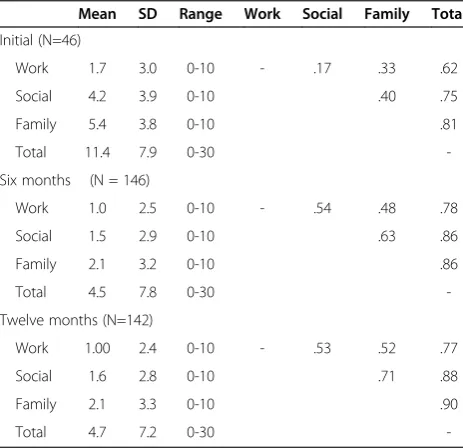
[image:3.595.305.537.509.733.2]Table 1 displays means (SD) and the Pearson correla-tions between the individual items and total scores at each assessment. Internal reliability was estimated at α = 0.56 at baseline, α = 0.78 at six months and α = 0.81 at 12 months. All three values are adequate for a three item
Table 1 Means (SD) and Pearson correlations between individual items and total scores at each assessment
Mean SD Range Work Social Family Total
Initial (N=46)
Work 1.7 3.0 0-10 - .17 .33 .62
Social 4.2 3.9 0-10 .40 .75
Family 5.4 3.8 0-10 .81
Total 11.4 7.9 0-30
-Six months (N = 146)
Work 1.0 2.5 0-10 - .54 .48 .78
Social 1.5 2.9 0-10 .63 .86
Family 2.1 3.2 0-10 .86
Total 4.5 7.8 0-30
-Twelve months (N=142)
Work 1.00 2.4 0-10 - .53 .52 .77
Social 1.6 2.8 0-10 .71 .88
Family 2.1 3.3 0-10 .90
-scale. The relatively low value for the baseline may be partly due to the smaller sample size.
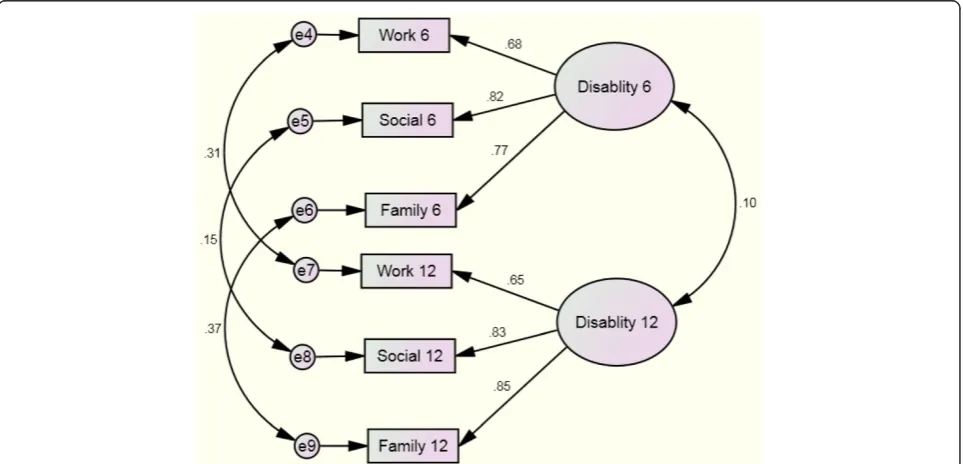
Figure 1 displays the one factor structure at six and twelve months along with standardized coefficients. The fit indices suggested excellent fit: χ2/df ratio = 1.30, CFI = 0.99 and RMSEA = 0.044. The work variables loaded slightly less strongly on the latent disability constructs than family and social impairment items.
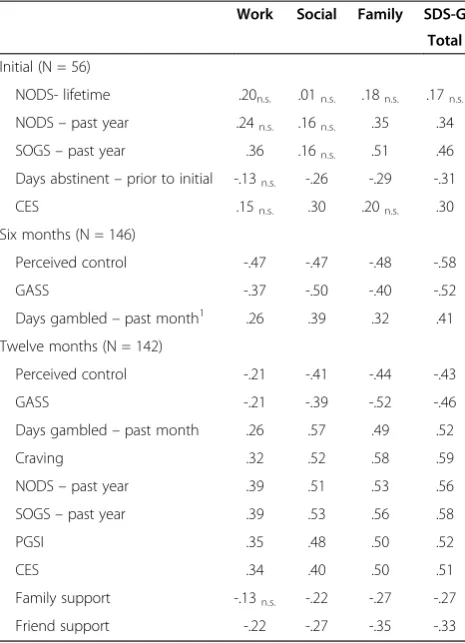
Table 2 displays Pearson correlations between gambling behaviour and severity measures and measures of a num-ber of other constructs such as depression and social sup-port. Correlations with each of the three SDS-G items as well as the total score are provided. Correlations with re-cent gambling behaviour and severity were moderate as expected. Similarly, correlations with self-efficacy and per-ceived control over gambling and craving were moderate. However, correlations with lifetime problem gambling severity (NODS) were non-significant. This measure was obtained at baseline and with a smaller sample size. Fi-nally, SDS items and total correlated with depression and perceived family and friend support.
In terms of sensitivity to change, SDS-G total scores for individuals followed at all three assessments showed a significant reduction from baseline (M = 10.5, SD = 8.0) compared to the six (M = 3.1, SD = 5.2) and twelve month follow-up periods (M = 4.4, SD = 7.0; F (2, 41) = 15.3; p<0.0001; partial eta squared = 0.43). Change in SOGS scores, days of gambling, and CES depression scores from baseline to twelve month follow-up corre-lated with changes in SDS-G scores at r = 0.54, 0.33, and 0.53 respectively (p<0.0001).
Discussion
These analyses provide evidence in support of a gam-bling modified SDS to assess gamgam-bling treatment out-comes via interview. Because of the nature of the relapse prevention study, this sample of pathological gamblers includes a range of gambling involvements from abstin-ent to heavy gambling, which is optimal in terms of validating a scale. The results supported a one factor solution and the scale had good internal reliability for a three item scale. The SDS-G appears sensitive to change and it appears to correlate more strongly with other measures of current functioning than lifetime measures.
[image:4.595.58.540.480.712.2]Future research should assess of retest reliability of the scale and it would also be useful to assess concurrent validity of the very brief scale against more lengthy measures of functional impairment such as the Social Adjustment Scale [30] and the Medical Outcome Study SF-36 [31]; however, these scales have not been validated for pathological gambling samples. Validation of a self-completion version would also be valuable. Moreover, some clinical trial studies report the individual item scores in addition to the total scores. The reliability and validity of individual items needs further examination. In the structural equation model, the work variables loaded less strongly on the latent disability construct than the family and social variables and, similarly, the work vari-able correlated less strongly with the SDS-G total (see Table 1). The work variable also correlated less strongly with the concurrent validity variables than did the social, family and total scores (see Table 2). This difference may be related to the fact that gambling problems have less
impact on work functioning or that preservation of work functioning is important to finance continued gambling (see mean scores on Table 1), or it may indicate a weaker measure of the work disability construct.
Although these analyses support the psychometric strength of this brief scale, they do not provide validated interpretation guidelines for improvement or adequate social functioning. The existing guidelines are not dis-order specific and are meant to be used for a variety of disorders. Nonetheless, validation for each disorder indi-vidually is crucial. Interpretation guidelines would increase the practical utility of using this scale in outcome studies as well as use by clinicians monitoring patent outcome.
Conclusions
In conclusion, the SDS-G total score should work well as an outcome measure that is correlated with both gambling behaviour and gambling problem severity, but also conceptually and statistically distinct. Despite its
brevity, it shows good internal reliability, good evidence of factorial validity and it is sensitive to patient changes.
Competing interests
David Hodgins has no competing interests.
Acknowledgements
This research was supported by an operating grant from the Alberta Gambling Research Institute. I would like to thank Nicole Peden for help with data collection and Rodney Steadman for input into the manuscript.
Received: 31 January 2013 Accepted: 28 June 2013 Published: 1 July 2013
References
1. Sheehan DV:The Anxiety Disease.New York: Charles Scribner and Sons; 1983. 2. Sheehan KH, Sheehan DV:Assessing treatment effects in clinical trials
with the discan metric of the Sheehan Disability Scale. Int Clin Psychopharmacol2008,23:70–83.
3. Black DW, Shaw M, Forbush KT, Allen J:An open-label trial of escitalopram in the treatment of pathological gambling.Clin Neuropharmacol2007, 30:206–212.
4. Black DW, Arndt S, Coryell WH, Argo T, Forbush KT, Shaw MC,et al: Bupropion in the treatment of pathological gambling: a randomized, double-blind, placebo-controlled, flexible-dose study.
J Clin Psychopharmacol2007,27:143–150.
5. Black DW, Shaw MC, Allen J:Extended release carbamazepine in the treatment of pathological gambling: an open-label study.Prog Neuropsychopharmacol Biol Psychiatry2008,32:1191–1194.
6. Grant JE, Kim SW, Odlaug BL:N-acetyl cysteine, a glutamate-modulating agent, in the treatment of pathological gambling: a pilot study. Biol Psychiatry2007,62:652–657.
7. Leon AC, Shear MK, Portera L, Klerman GL:Assessing impairment in patients with panic disorder: the Sheehan Disability Scale.Soc Psychiatry Psychiatr Epidemiol1992,27:78–82.
8. Leon AC, Olfson M, Portera L, Farber L, Sheehan DV:Assessing psychiatric impairment in primary care with the Sheehan Disability Scale. Int J Psychiatry Med1997,27:93–105.
9. Hodgins DC, Stinchfield R:Gambling Disorders. InA guide to assessments that work.Edited by Hunsley J, Mash EJ. New York: Oxford University Press; 2008:370–388.
10. Lesieur HR, Blume SB:The South Oaks Gambling Screen (SOGS): A new instrument for the identification of pathological gamblers.
Am J Psychiatry1987,144:1184–1188.
11. Ferris J, Wynne H:The Canadian Problem Gambling Index: Final Report. Ottawa, Ontario: Phase II final report to the Canadian Inter-Provincial Task Force on Problem Gambling; 2001.
12. Currie SR, Hodgins DC, Casey DM:Validity of the Problem Gambling Severity Index interpretive categories.J Gambl Stud2012,29:311–327. 13. Gerstein DR, Volberg RA, Toce MT, Harwood H, Johnson RA, Buie T,et al:
Gambling Impact and Behavior Study: Report to the National Gambling Impact Study Commission.Chicago, IL: NORC, at the University of Chicago; 1999.
14. Kim SW, Grant JE, Potenza MN, Blanco C, Hollander E:The Gambling Symptom Assessment Scale (G-SAS): a reliability and validity study. Psychiatry Res2009,166:76–84.
15. Stinchfield R, Winters KC, Botzet A, Jerstad S, Breyer J:Development and psychometric evaluation of the Gambling Treatment Outcome Monitoring System (GAMTOMS).Psychol Addict Behav2007,26:174–184. 16. Hodgins DC, Makarchuk K:Trusting problem gamblers: Reliability and
validity of self-reported gambling behavior.Psychol Addict Behav2003, 17:244–248.
17. Weinstock J, Whelan JP, Meyers AW:Behavioral assessment of gambling: An application of the timeline followback method.Psychol Assess2004, 16:72–80.
18. Petry NM:Concurrent and predictive validity of the Addiction Severity Index in pathological gamblers.Am J Addict2007,16:272–282. 19. Petry NM:Validity of a gambling scale for the addiction severity index.
J Nerv Ment Dis2003,191:1–9.
[image:5.595.57.290.111.433.2]20. Lesieur HR, Blume SB:Evaluation of patients treated for pathological gambling in a combined alcohol, substance abuse and pathological
Table 2 Pearson Correlations between SDS-G total and items and external constructs
Work Social Family SDS-G Total
Initial (N = 56)
NODS- lifetime .20n.s. .01n.s. .18n.s. .17n.s.
NODS–past year .24n.s. .16n.s. .35 .34
SOGS–past year .36 .16n.s. .51 .46
Days abstinent–prior to initial -.13n.s. -.26 -.29 -.31
CES .15n.s. .30 .20n.s. .30
Six months (N = 146)
Perceived control -.47 -.47 -.48 -.58
GASS -.37 -.50 -.40 -.52
Days gambled–past month1 .26 .39 .32 .41
Twelve months (N = 142)
Perceived control -.21 -.41 -.44 -.43
GASS -.21 -.39 -.52 -.46
Days gambled–past month .26 .57 .49 .52
Craving .32 .52 .58 .59
NODS–past year .39 .51 .53 .56
SOGS–past year .39 .53 .56 .58
PGSI .35 .48 .50 .52
CES .34 .40 .50 .51
Family support -.13n.s. -.22 -.27 -.27
Friend support -.22 -.27 -.35 -.33
Note.NODSNORC DSM Screen for Gambling,SOGSSouth Oaks Gambling Screen,CESCentre of Epidemiologic Studies–Depressed Mood Scale,GASS
Gambling Abstinence Self-Efficacy Scale,PGSIProblem Gambling Severity Index. All correlations significant except where indicated (ns=non-significant). 1
gambling treatment unit using the Addiction Severity Index.Br J Addict 1991,86:1017–1028.
21. Hodgins DC, Currie SR, El Guebaly N, Diskin KM:Does providing extended relapse prevention bibliotherapy to problem gamblers improve outcome?J Gambl Stud2007,24:41–54.
22. Hodgins DC, Peden N, Makarchuk K:Self-efficacy in Pathological Gambling Treatment Outcome: Development of a Gambling Abstinence Self-efficacy Scale (GASS).Int Gambl Stud2004,4:99–108.
23. Tavares H, Zilberman ML, Hodgins DC, El Guebaly N:Comparison of craving between pathological gamblers and alcoholics.Alcohol Clin Exp Res2005,29:1427–1431.
24. Radloff LH:The CES-D scale: A self-report depression scale for research in the general population.Appl Psych Meas1977,1:385–401.
25. Procidano ME, Heller K:Measures of perceived social support from friends and from family: Three validation studies.Am J Community Psychol1983, 11:1–24.
26. Arbuckle JL:AMOS.Chicago, Illinois: Smallwaters Corporation; 2007. 27. Joreskog KG:A general approach to confirmatory maximum likelihood
factor analysis.Psychometrika1969,34:183–202.
28. Hu L, Bentler PM:Cut-score criteria for fit indices in covariance structure analysis: Conventional criteria versus new alternatives.Struct Equ Modeling1999,6:1–55.
29. Byrne BM:Structural Equation Modeling with AMOS: Basic Concepts, Applications, and Programming.2nd edition. Ottawa: Psychology Press; 2010. 30. Weissman MM, Bothwell S:Assessment of social adjustment by patient
self-report.Arch Gen Psychiatry1976,33:1111–1115.
31. Ware JE Jr:SF-36 health survey update.Spine2000,25:3130–3139.
doi:10.1186/1471-244X-13-177
Cite this article as:Hodgins:Reliability and validity of the Sheehan disability scale modified for pathological gambling.BMC Psychiatry 201313:177.
Submit your next manuscript to BioMed Central and take full advantage of:
• Convenient online submission
• Thorough peer review
• No space constraints or color figure charges
• Immediate publication on acceptance
• Inclusion in PubMed, CAS, Scopus and Google Scholar
• Research which is freely available for redistribution