University of Huddersfield Repository
Alviano, Mario and Faber, Wolfgang
Properties of Answer Set Programming with Convex Generalized Atoms
Original Citation
Alviano, Mario and Faber, Wolfgang (2013) Properties of Answer Set Programming with Convex
Generalized Atoms. In: Sixth International Workshop on Answer Set Programming and Other
Computing Paradigms, 25 August 2013, Istanbul, Turkey.
This version is available at http://eprints.hud.ac.uk/id/eprint/21036/
The University Repository is a digital collection of the research output of the
University, available on Open Access. Copyright and Moral Rights for the items
on this site are retained by the individual author and/or other copyright owners.
Users may access full items free of charge; copies of full text items generally
can be reproduced, displayed or performed and given to third parties in any
format or medium for personal research or study, educational or notforprofit
purposes without prior permission or charge, provided:
•
The authors, title and full bibliographic details is credited in any copy;
•
A hyperlink and/or URL is included for the original metadata page; and
•
The content is not changed in any way.
For more information, including our policy and submission procedure, please
contact the Repository Team at: [email protected].
Generalized Atoms
Mario Alviano and Wolfgang Faber
Department of Mathematics and Computer Science University of Calabria
87036 Rende (CS), Italy {alviano,faber}@mat.unical.it
Abstract. In recent years, Answer Set Programming (ASP), logic programming under the stable model or answer set semantics, has seen several extensions by generalizing the notion of an atom in these programs: be it aggregate atoms, HEX atoms, generalized quantifiers, or abstract constraints, the idea is to have more complicated satisfaction patterns in the lattice of Herbrand interpretations than traditional, simple atoms. In this paper we refer to any of these constructs as generalized atoms. Several semantics with differing characteristics have been proposed for these extensions, rendering the big picture somewhat blurry. In this paper, we analyze the class of programs that have convex generalized atoms (orig-inally proposed by Liu and Truszczy´nski in [10]) in rule bodies and show that for this class many of the proposed semantics coincide. This is an interesting result, since recently it has been shown that this class is the precise complexity boundary for the FLP semantics. We investigate whether similar results also hold for other semantics, and discuss the implications of our findings.
1
Introduction
Various extensions of the basic Answer Set Programming language have been proposed by allowing more general atoms in rule bodies, for example aggregate atoms, HEX atoms, dl-atoms, generalized quantifiers, or abstract constraints. A number of seman-tics have been proposed for such programs, most notably the FLP semanseman-tics [7] and a number of coinciding semantics that we will collectively refer to as PSP semantics (from Pelov, Son, and Pontelli) [13,17]. All of these semantics coincide with traditional ASP semantics when no generalized atoms are present. Moreover, they coincide on pro-grams that have atomic rule heads and contain only monotonic generalized atoms. In [9] it is furthermore hinted that the semantics also coincide on programs that have atomic rule heads and contain only convex generalized atoms. However, no formal proof is available for this claim, and the informal explanation given in [9] is not as general as it could be, as we will show.
In this paper, we undertake a deeper investigation on the similarities and differences between the FLP and PSP semantics. In order to do this, we consider a simplified, yet expressive propositional language: sets of rules with atomic heads and bodies that are formed of a single “structure,” which are functions mapping interpretations to Boolean values1. Clearly, structures encompass atoms, literals, and conjunctions thereof, but can
1Note that (apart from the name) there is no connection to structures in first-order logic.
represent any propositional formula, generalized atom, or conjunctions of generalized atoms. Each structure has an associated domain, which is the set of propositional atoms on which the structure’s truth valuation depends. We can then classify the structures by their semantic properties, in particular, we will focus on the class of convex structures, which have single contiguous areas of truth in the lattice of interpretations. Convex structures include atoms and literals, and they are closed under conjunction (but not under negation or disjunction).
We first formally prove the claim that the FLP and PSP semantics coincide on pro-grams with convex structures, as originally reported in [9]. We will then move on to the main focus of this paper, trying to understand whether there is any larger class for which the semantics coincide. It is known that for programs with general structures all PSP answer sets are FLP answer sets, but not all FLP answer sets are PSP answer sets. The precise boundary for exhibiting the semantic difference is instead unknown.
We will approach this question using complexity arguments. Recently, we could show that convex structures form the precise boundary for a complexity jump in the polynomial hierarchy on cautious reasoning (but most other decision problems as well) for the FLP semantics. Cautious reasoning isΠP
2-complete for the FLP semantics when allowing any non-convex structure and its variants (renaming atoms) in the input pro-gram, but it is coNP-complete for convex structures. When considering the PSP se-mantics, cautious reasoning is alsoΠP
2-complete when allowing any kind of structures in the input. This follows from a result in [13], and we provide an alternative proof in this paper. Analyzing this proof, it becomes clear that there is a different source of complexity for PSP than for FLP.
We then show that this different source of complexity also yields a different shape of the boundary for the complexity jump in PSP. Indeed, we first show that for a simple non-convex structure, cautious reasoning is still incoNPfor the PSP semantics, while the problem isΠP
2 -hard in the presence of this structure for the FLP semantics. It turns out that the same argument works for many non-convex structures, in particular, for all structures with a domain size bounded by a constant. The domain size therefore serves as a parameter that simplifies the complexity of the problem for the PSP semantics (unless the polynomial hierarchy collapses to its first level). This also means that the complexity boundary for PSP has a non-uniform shape, in the sense that an infinite number of different non-convex structures must be available for obtainingΠ2P-hardness for cautious reasoning. This is in contrast to the FLP semantics, where the presence of a single non-convex structure is sufficient.
2
Syntax and Semantics
2.1 Syntax
LetUbe a fixed, countable set of propositional atoms. An interpretationIis a subset of
U. A structureSonU is a mapping of interpretations into Boolean truth values. Each structureS has an associated, finite domainDS ⊂ U, indicating those atoms that are
relevant to the structure.
Example 1. A structureS1modeling a conjunctiona1, . . . , an(n≥0) of propositional
atoms is such thatDS1 = {a1, . . . , an}and, for every interpretationI,S1 mapsIto true if and only ifDS1 ⊆I.
A structureS2 modeling a conjunction a1, . . . , am, not am+1, . . . , not an (n ≥
m≥0) of literals, wherea1, . . . , anare propositional atoms andnotdenotesnegation
as failure, is such thatDS2 ={a1, . . . , an}and, for every interpretationI,S2mapsI to true if and only if{a1, . . . , am} ⊆Iand{am+1, . . . , an} ∩I=∅.
A structureS3modeling an aggregateCOUNT({a1, . . . , an})6=k(n≥k≥0),
wherea1, . . . , an are propositional atoms, is such that DS3 = {a1, . . . , an}and, for every interpretationI,S3mapsIto true if and only if|DS3∩I| 6=k.
A general ruleris of the following form:
H(r)←B(r) (1)
whereH(r)is a propositional atom inU referred as the head ofr, andB(r)is a struc-ture onUcalled the body ofr. A general programPis a set of general rules.
Example 2. LetS4 map to true any interpretationI such thatI∩ {a, b} 6= {b}, and letS5 map to true any interpretationI such thatI∩ {a, b} 6= {a}. Hence, program
P1={a←S4;b←S5}is equivalent to the following program with aggregates:
a←SUM({a= 1, b=−1})≥0
b←SUM({a=−1, b= 1})≥0
Note that no particular assumption is made on the syntax of rule bodies; in the case of normal propositional logic programs these structures are conjunctions of literals. We assume that structures are closed under propositional variants, that is, ifSis a structure, for any bijection σ : U → U, also Sσis a structure, and the associated domain is
DSσ={σ(a)|a∈DS}.
Example 3. ConsiderS4andS5from Example 2, and a bijectionσ1such thatσ1(a) =
b. Hence,S5=S4σ1, that is,S5is a variant ofS4.
Given a set of structuresS, by datalogS we refer to the class of programs that may contain only the following rule bodies: structures corresponding to conjunctions of atoms, any structureS∈S, or any of its variantsSσ.
Example 4. For everyn≥m ≥0, letSm,ndenote the structureS
2from Example 1. The class of normal datalog programs is datalog{Sm,n|n≥m≥0}
.
2.2 Semantics
LetI ⊆ U be an interpretation.Iis a model for a structureS, denotedI |= S, ifS
mapsIto true. Otherwise, ifSmapsIto false,Iis not a model ofS, denotedI6|=S. We require that atoms outside the domain ofSare irrelevant for modelhood, that is, for any interpretationIandX ⊆ U \DS it holds thatI |=Sif and only ifI∪X |=S.
Moreover, for any bijectionσ:U → U, letIσ={σ(a)|a∈I}, and we require that
Iσ|=Sσif and only ifI|=S.Iis a model of a rulerof the form (1), denotedI|=r, ifH(r) ∈ I wheneverI |= B(r).I is a model of a programP, denotedI |= P, if
I|=rfor every ruler∈P.
Example 5. Consider programP1 from Example 2. It can be observed that∅ 6|= P1 and{a, b} 6|=P1 (both rules have true bodies but false heads), while{a} |= P1and
{b} |=P1.
Structures can be characterized in terms ofmonotonicityas follows.
Definition 1 (Monotone Structures).A structureSis monotonic if for all pairsX, Y
of interpretations such thatX ⊂Y,X |=SimpliesY |=S.
Definition 2 (Antimonotone Structures). A structure S is antimonotonic if for all pairsY, Z of interpretations such thatY ⊂Z,Z|=SimpliesY |=S.
Definition 3 (Convex Structures).A structureSis convex if for all triplesX, Y, Zof interpretations such thatX ⊂Y ⊂Z,X |=SandZ |=SimpliesY |=S.
Note that monotonic and antimonotonic structures are convex. Moreover, note that con-vex structures are closed under conjunction (but not under disjunction or negation).
Example 6. StructureSm,n from Example 4 is convex in general; it is monotonic if
m = n, and antimonotonic ifm = 0. StructureS3from Example 1, instead, is non-convex ifn > k >0; it is monotonic ifk= 0, and antimonotonic ifn=k.
We first describe a reduct-based semantics, usually referred to as FLP, which has been described and analyzed in [6,7].
Definition 4 (FLP Reduct).The FLP reductPI of a programP with respect toIis defined as the set{r∈P |I|=B(r)}.
Definition 5 (FLP Answer Sets).Iis an FLP answer set ofPifI|=PI and for each
J ⊂Iit holds thatJ 6|=PI.
We will next describe a different semantics, using the definition of [17], called “fix-point answer set” in that paper. Theorem 3 in [17] shows that it is actually equivalent to the two-valued fix-point of ultimate approximations of generalized atoms in [13]2, and therefore with stable models for ultimate approximations of aggregates as defined in [14]. We will refer to it as PSP to abbreviate Pelov/Son/Pontelli, the names most frequently associated with this semantics.
Definition 6 (Conditional Satisfaction).A structureSonU isconditionally satisfied by a pair of interpretations(I, M), denoted(I, M)|=S, ifJ |=Sfor eachJsuch that
I⊆J ⊆M.
Definition 7 (PSP Answer Sets).An interpretationM is a PSP answer set ifM is the least fixpoint of the following operator:
KMP(I) ={H(r)|r∈P∧(I, M)|=B(r)}. (2)
Example 8. Consider programP1from Example 2 and the interpretation{a}. The least fixpoint ofKP1
{a}is{a}. In fact,∅ |=S4and{a} |= S4, hence(∅,{a}) |= S4, while
{a} 6|= S5 and thus(∅,{a}) 6|= S5 and({a},{a}) 6|= S5. Therefore,{a} is a PSP answer set. Also{b}is a PSP answer set.
On programs considered in this paper, PSP answer sets also coincide with “answer sets” defined in [18] (by virtue of Proposition 10 in [18]) and “well-justified FLP answer sets” of [15] (by virtue of Theorem 5 in [15]). The latter is particularly interesting, as it is defined by first forming the FLP reduct. Indeed, as shown in [15], the operatorKP
M
can be equivalently defined as follows:
KMP(I) ={H(r)|r∈PM∧(I, M)|=B(r)}. (3)
There are several other semantic definitions on programs that have some restrictions on the admissible structures, which also coincide with the PSP semantics on programs as defined in this paper with the respective structure restriction. Examples are [12] for monotonic structures (that are also allowed to occur in rule heads in that paper), or [16] that allows for structures corresponding to cardinality and weight constraints and largely coincide with the PSP semantics (see [13] for a discussion on structures on which the semantics coincides).
In this paper we are mainly interested in cautious reasoning, defined next.
Definition 8 (Cautious Reasoning).A propositional atomais a cautious consequence of a programPunder FLP (resp. PSP) semantics, denotedP |=FLP
c a(resp.P |=PSPc
a), ifabelongs to all FLP (resp. PSP) answer set ofP.
Example 9. Consider programP1from Example 2. We haveP16|=FLPc aandP16|=FLPc
b, and similar for PSP semantics. If we adda←bandb←ato the program, then there is only one FLP answer set, namely{a, b}, and no PSP answer sets. In this caseaand
bare cautious consequences of the program (under both semantics).
2
3
Exploring the Relationship between the FLP and PSP Semantics
In this section, we examine in detail how the FLP and PSP semantics relate. We shall proceed in three steps. First, we formally prove that FLP and PSP semantics coincide on programs with convex structures in Section 3.1. Next, we turn towards complexity as a tool to understand whether there can be any larger class of coinciding programs. We start in Section 3.2 with a result that shows that programs without restrictions ex-hibit the same complexity under both FLP and PSP semantics. However, it is known that the semantics do not coincide for programs without restrictions, and we examine the complexity proofs to highlight the different complexity sources. These findings are then applied in Section 3.3 in order to identify programs with bounded non-convex structures, on which the complexities for FLP and PSP semantics differ. Under usual complexity assumptions, this also implies that programs with convex aggregates is the largest class of programs on which FLP and PSP coincide.
3.1 Unison: Convex Structures
In this section we show that for programs with convex aggregates the FLP and PSP semantics coincide. In [9] it is stated that many semantics (and in particular, FLP and PSP) “agree on [...] programs with convex aggregates” because “they can be regarded as special programs with monotone constraints.” However, the comment on regarding convex aggregates as monotone constraints relies on a transformation described in [10] that transforms convex structures into conjunctions of positive and negated monotone constraints. Since our language does not explicitly allow negation, and in particular since convex structures are not closed under negation, we next prove in a more direct manner that the FLP and PSP semantics coincide on convex structures.
One direction of the proof relies on the well-known more general fact that each PSP answer set is also an FLP answer set. This has been stated as Theorem 2 in [17] and Proposition 8.1 in [14].
Theorem 1. Let P be program whose body structures are convex, and let M be an interpretation.M is an FLP answer set ofPif and only ifM is an PSP answer set of
P.
Proof. The left implication follows from Theorem 2 in [17]. For the right implication, letM be an FLP answer set ofP. LetK0 :=∅,Ki+1 :=KMP(Ki)fori≥0, and let
Kbe the fixpoint of this sequence. SinceM is a minimal model ofPM by definition
of FLP answer set, we can prove the claim by showing (i)K|=PM and (ii)K⊆M.
(i) Consider a ruler ∈ PM such thatK |= B(r). We have to showH(r) ∈ K.
Sincer∈PM,M |=B(r)holds. Thus,(K, M)|=B(r)and thereforeH(r)∈K.
(ii) We proveKi ⊆ M for eachi ≥ 0. We use induction oni. The base case is
trivially true asK0 = ∅ ⊆ M. SupposeKi ⊆ M for somei ≥ 0in order to prove
Ki+1 ⊆ M. By definition ofKMP, for eacha ∈ Ki+1 there is r ∈ PM such that
H(r) =aand(Ki, M)|=B(r). Thus,M |=B(r), which impliesa∈M. ut
3.2 Consonance: Complexity of Unrestricted Structures
In this section we will examine the computational impact of allowing non-convex struc-tures. We will limit ourselves to structures for which the truth value with respect to an interpretation can be determined in polynomial time. Moreover, we will focus on cau-tious reasoning, but similar considerations apply also to related problems such as brave reasoning, answer set existence, or answer set checking.
It is known that cautious reasoning over programs with arbitrary structures under the FLP semantics isΠP
2 -complete in general, as shown in [7]. Pelov has shownΣ2P -completeness for deciding the existence of PSP answer sets in [13], from whichΠP
2 -completeness for cautious reasoning under the PSP semantics can be derived. We for-mally state this result now and provide a different proof than Pelov’s that will more directly lead to the subsequent considerations.
Theorem 2. Cautious reasoning under PSP semantics isΠP
2-complete.
Proof. Membership follows by Corollary 1 of [17]. For the hardness, we provide a reduction from 2-QBF∀. Let Ψ = ∀x1· · · ∀xm∃y1· · · ∃yn E, where E is in 3CNF.
Formula Ψ is equivalent to¬Ψ0, whereΨ0 = ∃x1· · · ∃xm∀y1· · · ∀yn E0, andE0 is
a 3DNF equivalent to¬E and obtained by applying De Morgan’s laws. To prove the claim we construct a programPΨ such thatPΨ |=PSPc w(wa fresh atom) if and only if
Ψ is valid, i.e., iffΨ0is invalid.
LetE0= (l1,1∧l1,2∧l1,3)∨ · · · ∨(lk,1∧lk,2∧lk,3), for somek≥1. ProgramPΨ
is the following:
xTi ←not xFi xFi ←not xTi i∈ {1, . . . , m} (4)
yiT ←not yFi yiF ←not yTi i∈ {1, . . . , n} (5)
yT
i ←sat yiF ←sat i∈ {1, . . . , n} (6)
sat←µ(E0) (7)
w←notsat (8)
whereµis defined recursively as follows:
– µ(E0) := (µ(l
1,1)∧µ(l1,2)∧µ(l1,3))∨ · · · ∨(µ(lk,1)∧µ(lk,2)∧µ(lk,3)); – µ(xi) :=xTi andµ(¬xi) :=xFi for alli= 1, . . . , m;
– µ(yi) :=yTi andµ(¬yi) :=yFi for alli= 1, . . . , n.
Note that structureµ(E0)can also be encoded by means of asumaggregate as shown in [1].
Rules (4)–(5) force each PSP answer set ofPΨ to contain at least one ofxTi ,x F i
(i ∈ {1, . . . , m}), and one ofyT
j,yjF (j ∈ {1, . . . , m}), respectively, encoding an
as-signment of the propositional variables inΨ0. Rules (6) are used to simulate universality
of they variables, as described later. Having an assignment, rule (7) derivessatif the assignment satisfies some disjunct ofE0 (and hence also E0 itself). Finally, rule (8) deriveswifsatis false.
We first show thatΨ not valid impliesPΨ 6|=PSPc w. IfΨ is not valid,Ψ0is valid.
Hence, there is an assignmentνforx1, . . . , xmsuch that no extension toy1, . . . , yn
(which is also a model ofPΨ):
M ={xTi |ν(xi) = 1, i= 1, . . . , m} ∪ {xFi |ν(xi) = 0, i= 1, . . . , m}
∪ {yiT, yiF |i= 1, . . . , n} ∪ {sat}
We claim thatM is a PSP answer set ofPΨ. In fact,KMPΨ(∅)⊇ {x T
i |ν(xi) = 1, i=
1, . . . , m} ∪ {xFi | ν(xi) = 0, i = 1, . . . , m}because of rules (4) inPΨM. Since any
assignment for theys satisfies at least a disjunct ofE0, from rule (7) we derivesat ∈
KPΨ
M (K PΨ
M (∅)). Hence, rules (6) force allyatoms to belong toK PΨ
M (K PΨ
M (K PΨ
M (∅))),
which is thus the least fixpoint ofKPΨ
M and coincides withM.
Now we show thatPΨ 6|=PSPc wimplies thatΨ is not valid. To this end, letM be
a PSP answer set ofPΨ such thatw /∈M. Hence, by rule (8) we have thatM |=sat.
From sat ∈ M and rules (6), we haveyT
i , yiF ∈ M for all i = 1, . . . , n. And M
contains eitherxT
i or xFi fori = 1, . . . , mbecause of rules (4). Suppose by
contra-diction thatΨ is valid. Thus, for all assignments ofx1, . . . , xm, there is an assignment
fory1, . . . , yn such thatEis true, i.e.,E0is false. We can show that the least fixpoint
of KPΨ
M isK
PΨ
M (∅) = {x T
i | ν(xi) = 1, i = 1, . . . , m} ∪ {xFi | ν(xi) = 0, i =
1, . . . , m}. In fact, satcannot be derived becauseKPΨ
M (∅) 6|=µ(E
0). We thus have a
contradiction with the assumption thatM is a PSP answer set ofPΨ. ut
It is also known that the complexity drops tocoNP if structures in body rules are constrained to be convex. This appears to be “folklore” knowledge and can be argued to follow from results in [10]. An easy way to see membership incoNPis that all convex structures can be decomposed into a conjunction of a monotonic and an antimonotonic structure, for which membership incoNP has been shown in [7].
It is instructive to note a crucial difference between theΠP
2-hardness proofs in [7] (and a similar one in [8]) and the proofs for Theorem 2 and theΣP
2 result for PSP in [13].
The fundamental tool in the FLP hardness proofs is the availability of structures
S1, S2that allow for encoding “need to have either atomxT orxF, or both of them, but the latter only upon forcing the truth of both atoms.”S1, S2have domainsDS1 =
DS2 ={x
T, xF}and the following satisfaction patterns:
∅ |=S1 {xT} |=S1 {xF} 6|=S1 {xT, xF} |=S1
∅ |=S2 {xT} 6|=S2 {xF} |=S2 {xT, xF} |=S2
The reductions then use these structures in a similar way than disjunction is used in the classicΣ2P-hardness proofs in [3]. In particular, the same structures are used for all instances to be reduced.
On the other hand, in the PSP hardness proofs, one dedicated structure is used for each instance of the problem reduced from (2QBF in Theorem 2). Indeed, a con-struction using structures S1, S2 as described earlier is not feasible for PSP, because (∅,{xT, xF})6|=S
1and(∅,{xT, xF})6|=S2. This is because there is one satisfaction “hole” between∅and{xT, xF}for bothS
3.3 Dissonance: Complexity of Non-convex Structures with Bounded Domains
In this section, we look more carefully at programs with non-convex structures and identify computational differences between the FLP and PSP semantics. In [2] it has been shown that any non-convex structure (plus all of its variants) can be used in order to implementS1andS2. This result makes it clear that the presence of any non-convex structure that is closed under variants causes a complexity increase for the FLP seman-tics (unless the polynomial hierarchy collapses). From the above considerations, it is immediately clear that the same construction is not feasible for PSP. It turns out that also no alternative way exists to obtain a similar result, and that the difference in the
ΠP
2-hardness proofs for FLP and PSP is intrinsic.
We start by considering a simple non-convex structureA˚ withD˚
A = {x, y}and
I |=A˚ if and only if|I∩D˚
A| 6= 1. Therefore,A˚ behaves like a cardinality constraint
COUNT({x, y})6= 1.
Proposition 1. Deciding whether an interpretationMis a PSP answer set of a datalog{A˚} programPis feasible in polynomial time, in particularDT IM E(m2), wheremis the number of rules inP.
Proof. For any interpretation, testing whether(I, M)|=A˚σ(for a variantA˚σofA˚) can be done by examining|I∩DA˚
σ|=iand|M ∩DA˚σ|=jand returning false if either
one ofi,jis 1, or ifi= 0andj= 2. Alternatively, in a less syntax dependent way, one can test whetherM |=A˚σand(I∪J)|=A˚σfor eachJ ⊆(M∩D˚
Aσ)\(I∩DA˚σ).
Since there are at most 4 differentJ for eachI, either method is feasible in constant time.
For determining whetherM is a PSP answer set ofP, we can check whether it is the least fixpoint ofKP
M. Computing the least fixpoint takes at mostmapplications of
KP
M (wheremis the number of rules inP). Each application ofKMP involves in turn at
mostmtests for(I, M)|=A˚σ. ut
Given Proposition 1 it follows that cautious reasoning is still incoNPfor datalog{A˚} programs under the PSP semantics.
Proposition 2. Given a datalog{A˚}programP and an atoma, decidingP |=PSP
c ais
incoNP.
Proof. The complement has an immediate nondeterministic polynomial time algorithm: guess an interpretationM and verify in polynomial time thata6∈ M and thatM is a PSP answer set ofP (by virtue of Proposition 1). ut
It follows that for datalog{A˚}cautious reasoning (and also answer set existence and brave reasoning) is more complex for the FLP semantics than for the PSP semantics (unless the polynomial hierarchy collapses to its first level).
Examining this result and its proof carefully, we can see that it depends on the fact that eachDA˚
σ contains 2 elements and therefore at most 4 satisfaction tests are
Theorem 3. Let P be a program. Ifkis an upper bound for the domain size of any structure occurring inP, then checking whether a given interpretationM is a PSP an-swer set ofP is decidable inDT IM E(2km2p(n)), wheremis the number of rules in
Pandp(n)is the polynomial function (in terms of the input sizen) bounding determin-ing satisfaction of any aggregate inP.
Proof. We show that the least fixpoint ofKP
M can be computed in timeO(2km2p(n)).
In the worst case, each application of the operator derives at most one new atom, and thus the fixpoint is reached after at mostmapplications of the operator. Each application requires at most the evaluation of all rules ofP, and thus at mostm2rule evaluations are sufficient. To evaluate a rule, the truth of the body has to be checked w.r.t. at most 2kinterpretations (similar to Proposition 1, in whichk= 2), each requiringp(n)time.
We thus obtain the boundO(2km2p(n)). ut
This means that actually most languages with non-convex structures exhibit a com-plexity gap between the FLP and PSP semantics. There is a uniformity issue here, which we informally noted earlier when examining theΠ2P-hardness proof for cautious rea-soning under PSP. We can now formalize this, as it follows from Theorem 3 that we need an infinite number of inherently different non-convex structures in order to obtain
ΠP
2 hardness.
Corollary 1. LetSbe any finite set of structures, possibly including non-convex struc-tures. Cautious reasoning over datalogSis incoNP under the PSP semantics.
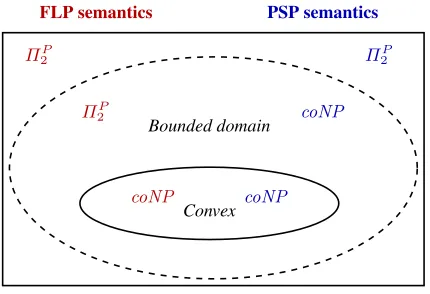
This means that there is also a clear difference in uniformity between the complexity boundary of the FLP and the PSP semantics, respectively. It also means that it is im-possible to simulate the FLP semantics in a compact way using the PSP semantics on the class of programs with bounded domain structures, unless the polynomial hierarchy collapses to its first level. The general picture of our complexity results is shown in Fig-ure 1. We can see that the complexity transition fromcoNP toΠP
2 is different for the FLP and PSP semantics, respectively. The solid line between convex and non-convex structures denotes a crisp transition for FLP, while the dashed line between bounded non-convex and unbounded non-convex structures is a rougher transition.
4
Discussion
Looking at Figure 1, the transition fromcoNP toΠP
2 appears somewhat irregular for PSP, as the availability of single non-convex structures does not cause the transition, but only their union. However, in practice the availability of an infinite number of different structures is not unusual: indeed, if aggregates are considered, the presence of one ag-gregate function and suitable comparison relations usually gives rise to such an infinite repertoire of structures.
Example 10. Consider the availability ofCOUNT over any set of atoms and the com-parison relation6=. The structures generated by aggregates of the formCOUNT(S)6=i
do not have a bound on the domains of non-convex aggregates. Indeed, for any structure
coNP coNP
Convex
Π2P coNP
Bounded domain ΠP
2 Π2P
[image:12.612.201.416.116.263.2]FLP semantics PSP semantics
Fig. 1.Complexity of cautious reasoning
one can formulate alsoCOUNT({a1, . . . , ak+1})6= 1, which is also non-convex and has a larger domain.
However, as noted earlier, for expressingΠ2P-hard problems, one needs a non-uniform approach for PSP, in the sense that a dedicated aggregate has to be formulated for each problem instance, whereas for FLP one can re-use the same aggregates for all problem instances.
In practical terms, our results imply that for programs containing only convex struc-tures, techniques as those presented in [1] for FLP can be used for computing answer sets also for PSP, and techniques presented for PSP can be used for FLP in turn. It also means that this is the largest class for which this can be done with currently available methods in an efficient way. There are several examples for convex structures that are easy to identify syntactically: count aggregates with equality guards, sum aggregates with positive summands and equality guards, dl-atoms that do not involve∩−and rely on a tractable Description Logic [4]. However many others are in general not convex, for example sum aggregates that involve both positive and negative summands, times aggregates that involve the factor 0, average aggregates, dl-atoms with∩−, and so on. It is still possible to find special cases of such structures that are convex, but that requires deeper analyses.
The results also immediately imply impossibility and possibility results for rewritabil-ity: unless the polynomial hierarchy collapses to its first level, it is not possible in the FLP semantics to rewrite a program with non-convex structures into one containing only convex structures (for example, a program not containing any generalized atoms), un-less disjunction or similar constructs are allowed in rule heads. On the other hand, such rewritings are possible for the PSP semantics if the non-convex structures are guaran-teed to have bounded domains. This seems to be most important for dl-programs, where such rewritings are sought after.
is shown to be equivalent to the PSP semantics. There are other proposals, such as [4], which appears to be different from both FLP and PSP already on convex structure. In future work we plan to relate also these other semantics with FLP and PSP and attempt to identify the largest coinciding classes of programs.
References
1. Alviano, M., Calimeri, F., Faber, W., Leone, N., Perri, S.: Unfounded Sets and Well-Founded Semantics of Answer Set Programs with Aggregates. Journal of Artificial Intelligence Re-search 42, 487–527 (2011)
2. Alviano, M., Faber, W.: The complexity boundary of answer set programming with gener-alized atoms under the flp semantics. In: Cabalar, P., Tran, S.C. (eds.) Logic Programming and Nonmonotonic Reasoning — 12th International Conference (LPNMR 2013). Springer Verlag (Sep 2013), accepted for publication
3. Eiter, T., Gottlob, G.: On the Computational Cost of Disjunctive Logic Programming: Propo-sitional Case. Annals of Mathematics and Artificial Intelligence 15(3/4), 289–323 (1995) 4. Eiter, T., Ianni, G., Lukasiewicz, T., Schindlauer, R., Tompits, H.: Combining answer set
programming with description logics for the semantic web. Artif. Intell. 172(12–13), 1495– 1539 (2008)
5. Eiter, T., Ianni, G., Schindlauer, R., Tompits, H.: A Uniform Integration of Higher-Order Reasoning and External Evaluations in Answer Set Programming. In: International Joint Conference on Artificial Intelligence (IJCAI) 2005. pp. 90–96. Edinburgh, UK (Aug 2005) 6. Faber, W., Leone, N., Pfeifer, G.: Recursive aggregates in disjunctive logic programs:
Se-mantics and complexity. In: Alferes, J.J., Leite, J. (eds.) Proceedings of the 9th European Conference on Artificial Intelligence (JELIA 2004). Lecture Notes in AI (LNAI), vol. 3229, pp. 200–212. Springer Verlag (Sep 2004)
7. Faber, W., Leone, N., Pfeifer, G.: Semantics and complexity of recursive aggregates in an-swer set programming. Artificial Intelligence 175(1), 278–298 (2011), special Issue: John McCarthy’s Legacy
8. Ferraris, P.: Answer Sets for Propositional Theories. In: Baral, C., Greco, G., Leone, N., Terracina, G. (eds.) Logic Programming and Nonmonotonic Reasoning — 8th International Conference, LPNMR’05, Diamante, Italy, September 2005, Proceedings. Lecture Notes in Computer Science, vol. 3662, pp. 119–131. Springer Verlag (2005)
9. Liu, L., Pontelli, E., Son, T.C., Truszczy´nski, M.: Logic programs with abstract constraint atoms: The role of computations. Artificial Intelligence 174(3–4), 295–315 (2010)
10. Liu, L., Truszczy´nski, M.: Properties and applications of programs with monotone and con-vex constraints. Journal of Artificial Intelligence Research 27, 299–334 (2006)
11. Lukasiewicz, T.: A novel combination of answer set programming with description logics for the semantic web. IEEE Transactions on Knowledge and Data Engineering 22(11), 1577– 1592 (2010)
12. Marek, V.W., Niemel¨a, I., Truszczy´nski, M.: Logic Programming with Monotone Cardinality Atom. In: Lifschitz, V., Niemel¨a, I. (eds.) Proceedings of the 7th International Conference on Logic Programming and Non-Monotonic Reasoning (LPNMR-7). LNAI, vol. 2923, pp. 154–166. Springer (Jan 2004)
13. Pelov, N.: Semantics of Logic Programs with Aggregates. Ph.D. thesis, Katholieke Univer-siteit Leuven, Leuven, Belgium (Apr 2004)
15. Shen, Y.D., Wang, K.: FLP semantics without circular justifications for general logic pro-grams. In: Hoffmann, J., Selman, B. (eds.) Proceedings of the 26th AAAI Conference on Artificial Intelligence (AAAI-12) (Jul 2012)
16. Simons, P., Niemel¨a, I., Soininen, T.: Extending and Implementing the Stable Model Seman-tics. Artificial Intelligence 138, 181–234 (Jun 2002)
17. Son, T.C., Pontelli, E.: A Constructive Semantic Characterization of Aggregates in ASP. Theory and Practice of Logic Programming 7, 355–375 (May 2007)