Badger, David Ian
Hauntings – A nodalist study
Original Citation
Badger, David Ian (2013) Hauntings – A nodalist study. Masters thesis, University of Huddersfield.
This version is available at http://eprints.hud.ac.uk/id/eprint/23291/
The University Repository is a digital collection of the research output of the University, available on Open Access. Copyright and Moral Rights for the items on this site are retained by the individual author and/or other copyright owners. Users may access full items free of charge; copies of full text items generally can be reproduced, displayed or performed and given to third parties in any format or medium for personal research or study, educational or notforprofit purposes without prior permission or charge, provided:
• The authors, title and full bibliographic details is credited in any copy;
• A hyperlink and/or URL is included for the original metadata page; and
• The content is not changed in any way.
For more information, including our policy and submission procedure, please contact the Repository Team at: [email protected].
Hauntings – A Nodalist Study
David Ian Badger
A portfolio of original videomusic, multimedia, and
one software instrument – plus accompanying
commentary – submitted to The University of
Huddersfield in partial fulfillment of the requirements
for the MA by Research
Table of Contents
Written Commentary on Videomusic Pieces
Introduction 6
Eight-eighty 10
Grandma’s House 24
Saudade se286181.anomalies 46
The Bay Faeries 60
Concluding Remarks 79
Appendix
Multimedia Pieces
All of these are supplied with the included 16 GB memory card, enclosed in a DVD-style plastic wallet. They include:
Hauntings, a multimedia application for Mac OSX, created using Hyperstudio. This contains technical details for the four videomusic pieces offered, sample sounds derived from my Max-built instrument Séance, and background information about the BBC Radiophonic Workshop, the British hauntology movement (two key influences on my piece Grandma’s House) and the story of photo-optic sound
production. Although academically referenced, this written material should NOT be considered to be part of my written commentary; it is included merely to help
contextualize the work for those who may be interested in reading further, or those who may be completely unfamiliar with finer historical details.
The Hyperstudio Player required to play and view the above application on Mac OSX.
Séance in Action, a very short QuickTime video which demonstrates that my Max-built ‘drawn sonification’ synthesizer, Séance, does indeed function on my MacBook Pro.
Four VideoMusic Pieces
Eight-eighty (14:40), 2012
Grandma’s House (6:50), 2013
Saudade se286181.anomalies (10:46), 2012
The Bay Faeries (16:34), 2012-13
Abstract
Since Deleuze and Guattari first described the concept of the rhizome as a model of cultural transmission in A Thousand Plateaus (1980), a new way of processing information in the Arts and Social Sciences has emerged – ‘Nodalism’. Philip Gochenour has convincingly argued that units of culture can now be thought of as ‘nodes’ existing in a nonhierarchical, web-like network. Information transfer between nodes in the network is horizontal, omni-directional and not necessarily teleological, a way of viewing the world which has been paralleled and actualized in the last twenty years by the emergence, growth and ubiquity of the internet and the World Wide Web.
The author – a developing audiovisual artist – here offers four videomusic pieces and one virtual sound-synthesis tool. At first glance, the pieces may appear to have little in common. However, the commentary will attempt to show that they are subtly linked together, immersed in a cocoon of rhizomatic, pluralistic, thread-like connections. The strongest ‘thread’ holding them together appears to be the trope of being ‘haunted’ in some way – either by influence, genre, or overarching concept. However, this thesis will attempt to show how a detailed consideration of each piece results in a highly complex final picture in which the pieces can be thought of as individual cultural nodes suspended in a dense rhizomatic mass of lateral cultural threads. For the sake of completion, however, the project has received the name
Hauntings in reference to one of the strongest shared tropes running throughout all five works.
Copyright Statement
i. The author of this thesis (including any appendices and/or schedules to this thesis) owns any copyright in it (the “Copyright”) and s/he has given The University of Huddersfield the right to use such Copyright for any administrative, promotional, educational and/or teaching purposes.
iii. The ownership of any patents, designs, trademarks and any and all other intellectual property rights except for the Copyright (the “Intellectual Property Rights”) and any reproductions of copyright works, for example graphs and tables (“Reproductions”), which may be described in this thesis, may not be owned by the author and may be owned by third parties. Such Intellectual Property Rights and Reproductions cannot and must not be made available for use without the prior written permission of the owner(s) of the relevant Intellectual Property Rights and/or Reproductions.
Acknowledgements
Many thanks to:
Introduction
“An artist is now much more seen as a connector of things, a person who scans the enormous field of possible places for artistic attention, and says, ‘What I am going to do is draw your attention to this sequence of things.’”
-Brian Eno[1]
I am, as the quotation above illustrates, a self-confessed rhizomatic nodalist. I am merely a vessel, a conduit, for various influences. I cherry-pick ideas as and when I require them, and then try, like a detective, to attempt to find the links between what seem to be very disparate ideas. Deleuze and Guattari (1980) describe the term ‘rhizome’ in A Thousand Plateaus.[2] It is a model of cultural transmission that rejects the hierarchical, chronologically linear, teleological cause-effect system. With the rhizome, each unit of cultural transmission is horizontally connected to another such unit (rather like the vertex points on a Complete graph). If the links between cultural units are severed, each unit of culture can regenerate to forge new links independently.
This portfolio consists of four videomusic pieces and one sound-producing instrument. Each of the four videomusic pieces is accompanied by an essay. As well as an exploration of audiovisuality, a common thread running throughout the work is the trope of being ‘haunted’ in some way. However, as each piece is considered, it becomes clear that many rhizomatic links exist between them. Firstly, let us consider the four pieces and software in turn:
Eight-eighty is a videomusic piece which is transparently haunted by its past influences: James Tenney, Phill Niblock, Eliane Radigue and La Monte Young.
Grandma’s House is a videomusic piece influenced by hauntology, a recent cultural trope in the Arts and Social Sciences.
Saudade se286181.anomalies is a psychogeographical videomusic piece which explores how an abandoned train station ‘haunts’ its environment geographically, acting as a hidden, embedded figment of the past.
The Bay Faeries is a travelogue piece inspired by the haunting quality of vague memory, and the way in which its spell can be broken after years by Proustian ‘involuntary recall’.
Séance is a sound-producing device which is haunted by similar ideas about ‘drawn-sound’ sonification theorized and practiced by pioneers in the Soviet Union and England in the mid-20th Century.
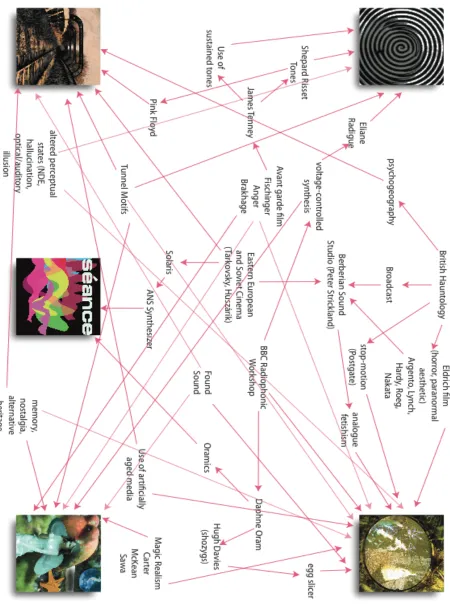
To illustrate the hidden depths within this commentary, let us examine one specific rhizomatic multiplicity:
Séance was inspired by the work of Daphne Oram and her Oramics system. The Oramics machine
the Radiophonic Workshop. The Workshop had links with Tristram Cary, who had links with EMS. Pink Floyd used an EMS VCS3 on their mid-1970s albums. A pastiche of Pink Floyd’s music forms part of the audio score for Saudade se286181.anomalies. The latter contains artificially aged digital images. Grandma’s House also contains artificially aged images. A voltage-controlled analogue synthesizer can be heard on the score to Grandma’s House; the same synthesizer can be heard on the score to The Bay Faeries, where it is playing sustained tones. Sustained tones form the basis of Eight-eighty. James Tenney’s use of a Shepard-Risset tone on For Ann (rising) has influenced Eight-eighty. Tenney appears in Cat’s Cradle, a film by Stan Brakhage. Pink Floyd used a Shepard-Risset glissando at the end of their piece Echoes. Pink Floyd introduced their composition Time with a chorus of chiming clocks. A ticking clock forms the pulsitile backbone of the audio score for Grandma’s House…
…and so on (a visual representation of this idea can be seen in Figure One, p.9). The beauty of the rhizomatic model is that one is able move from node to node in the rhizome multidirectionally, and individual units of culture can be reached via any pathway one chooses. This is how I conceive of this project: as five discrete entities bathed in a cocoon of threadlike connections. The question of exactly what connections may be made is entirely up to the audience. The above is simply an example extruded from one particular ‘entry point’, as it were. It is only right that the viewer form his or her own conclusion concerning perceived consonances and dissonances between the pieces presented in this web.
References
Eno, Brian (1995) “Gossip Is Philosophy”. Wired volume 3, issue 5, p. 207.
Deleuze, G. and Guattari, F. (1980) A Thousand Plateaus: Capitalism and Schizophrenia. Continuum International Publishing Group Ltd. (2004 ed.).
Eight-eighty (14:40). 2012.
Introduction
Eight-eighty is a fixed-media videomusic piece which seeks to show how audiovisual stimuli alone can effect real perceptual changes in the viewer (the perceptant). The stereo audio track makes use of two psychoacoustic phenomena – binaural beats and the Shepard-Risset tone – whilst the visual
presentation exploits a category of Gestalt optical illusions known as the ‘motion after effect’. Eight-eighty
attempts to alter human consciousness in a safe, socially responsible way, without recourse to
pharmaceutical agency. As such, its aims can be thought of as being similar to Brion Gysin’s celebrated
Dreammachine.[1]
Most importantly, Eight-eighty is not presented as a novel, or pioneering piece; it is transparently influenced by the work of other artists: in particular, the work of composers who have previously explored sustained tones – in some cases, more than forty years ago - such as La Monte Young, James Tenney, Phill Niblock and Eliane Radigue. It is therefore haunted by its influences; where its chief interest lies is in its nodal approach – the conjugation of Gestalt illusion and sustained / rising tones.
Discussion of the Audio Component
The global audio structure of Eight-eighty was planned to produce a sustained tone piece in which timbral density swells vertically over time. The piece is built from 16 separate ‘tone layers’ which
equivalency with every other part. The term was coined by James Tenney).[2]
The foundation of the piece is created from binaural beats. The physicist Heinrich Wilhelm Dove first described these in 1839, in his book Repertorium der Physik,[3] but the subject remained a scientific curiosity until Gerald Oster reviewed the phenomenon for Scientific American in 1973.[4] Binaural beats require the combined action of both ears, and they are illusory: they exist as a consequence of the interaction of cortical neuronal networks within the brain. The subjective mental sensation of binaural beats occurs when two sinusoids differing slightly in frequency (this is called the Interaural Frequency Difference, or IFD) are presented dichotically. If sinusoids of 220 Hz and 224 Hz are presented, a beat (a precise definition of audio beats can be found in Cipriani and Giri, pp. 212-219)[5] of 4 Hz, existing in neither monaural signal, will be perceived. The brain somehow internally combines the monaural tones, in the aural equivalent of an optical illusion.
The remainder of Oster’s 40 year-old article remains a good introduction to the subject. He goes on to explain that the addition of white or pink noise to the signal chain seems to enhance the perception of binaural beats as opposed to masking them. Oster also notes that binaural beats are most effective when the IFD is below 30 Hz.
There is a widespread claim that binaural beats can somehow be used for ‘brainwave entrainment’ to achieve states of altered consciousness.[6, 7] The basic idea is that brainwaves will try to fall in sync with the IAF difference between binaural sinusoids over a long exposure time – the so-called ‘frequency following response’. There is some scientific support for this.[8 - 11]
This is not a scientific study, however – it is a discussion of a videomusic piece, and a full, critically balanced review of all the peer-reviewed literature surrounding the supposed ability of binaural beats to alter human consciousness is beyond its scope. Instead, I will conclude here by stating that binaural beats have been included on the basis that they might, under certain conditions, cause perceptual shifts in the observer. However, the main criterion for their inclusion is that they constitute a proven
psychoacoustic auditory illusion. Illusory effects represent, almost by definition, a perceptual shift. Along with the Shepard-Risset tone also included in the piece, binaural beats form an audio ‘mirror’
counterpart to the motion after-effect illusion which forms the visual component of Eight-eighty.
fifth (1320 Hz) is added. The seventh tone layer consists of pink (1/f) noise, low pass filtered, with the cutoff point of the filter under LFO control. This was added in response to Oster’s postulation that the addition of noise to binaural beats actually enhances beat perception.[4]
At this point I decided to add ‘real’ instruments to the piece. I was conscious of wanting to break free from pure sinusoids, and I was curious about what would happen if I were to add more harmonically complex tone layers. I chose initially to add e-bow guitar, as this is a very convenient way to make the electric guitar sustain indefinitely. Inspiration came from the work of Phill Niblock,[14 - 20] and
specifically his use of the e-bow in tape compositions such as Guitar Too, for Four (1996),[12] or Sethwork (2003),[13] which was written for virtuoso guitarist Seth Josel, and consists of layers of unamplified acoustic guitar played with e-bow.
The main ideas appropriated from Niblock’s output are: a) the multi-layering of harmonically complex string sounds, b) the use of inconsistencies in human playing technique to create harmonic interest throughout the piece.
Filtering, delay and reverb has been added to the e-bow parts. Later additional tone layers would be more electroacoustic in nature anyway, and it wasn’t my intention to copy what seems to be Niblock’s ‘ideal’ of photographic accuracy in recording whilst talking about Five More String Quartets:
‘The 24 track tape was mixed to stereo, again with no processing (reverb, delay, etc.). The music is the purest, unadulterated sound of the instruments that we could achieve.’[20]
Perhaps of more interest to me here was the idea of juxtaposing real, fallible human performance with extremely precise digitally-controlled oscillators. Glover (2013)[19] recalls an e-mail communication between Benjamin Gait and the MELA Foundation in which Gait requested permission to perform La Monte Young’s Composition 1960 #7 (which consists of a sustained, just-intoned perfect fifth formed by B and F#, and the simple text instruction, ‘to be held for a long time’) at the University of York in 2007. Young specified that the piece should only be realized using ‘continuously tunable sustained instruments such as bowed strings and winds’.[21] The resulting deviations of pitch and timbre occur in spite of the sparse instructions. I was interested in exploring the same category of issues in Eight-eighty. The first e-bow guitar part enters the piece and reaches its full amplitude at 7:20, remaining in the piece until 14:40. I found it remarkably difficult to keep either my left (fretting) or right (‘bowing’) hand at a
themselves prior to the piece’s termination, I was interested in the way that human fallibility might produce slow, almost imperceptible modulations of pitch and timbre, both within a single layer of guitar and between the guitars and the sinusoid layers running in tandem. There are four tone layers of guitar, layers 8/9 and 11/12. Layer eight plays the note A2, layer nine plays A3, layer 11 plays C#4, and layer 12 plays G4. With the addition of a layer of processed violin (tone layer 13), the final harmonic structure of the piece (disregarding the many overtones which may be perceived) is roughly A C# E F# G, an A major 6/7th chord.
Tone layer 10 of Eight-eighty introduces another aural illusion: that of the Shepard-Risset tone.[22] Actually, I have not employed a straightforward Shepard-Risset tone, but I used a recording of the phenomenon as the basis for an electroacoustic tone layer based on the illusion, taking care to preserve its basic character. Cipriani and Giri (2010)[5] define a Shepard-Risset tone as being ‘an infinite
glissando. The sound generated by this particular effect seems to slide endlessly, without ever arriving at a final pitch or passing beyond hearing. It can be obtained by crossfading between instances of a
wavetable that are slightly out of phase with each other’.
Cipriani and Giri (2010) give a full explanation of how to create the Shepard-Risset tone illusion in Max/MSP,[5, pp. 455 – 461] and also helpfully supply a Max patch. It was the output of this patch that I have recorded and used as the raw material for tone layer 10 of Eight-eighty. The patch was adapted so that sawtooth waves, rather than sinusoids, create the sound. I was unhappy with the timbral quality of the raw Shepard tone, and for purely aesthetic reasons, I decided to run it through Christopher
Hipgrave’s ‘Ambient’ application. The latter is a sophisticated granular pitchshifting environment which also has delay, reverb, state-variable filtering and stereo widening capabilities. Itself built using Max/MSP, it is available from Audiobulb records.[23] Great care was taken to select a processing route that did not entirely destroy the illusion. The final tone layer is comprised of processed Shepard-Risset tones (which appear to be descending in pitch) and an unprocessed Shepard-Risset tone that appears to be ascending in pitch.
Tone layer 10 of Eight-eighty can be considered as a homage to Tenney’s work (although, in actual fact, the first time I ever heard the illusion was at the conclusion of Pink Floyd’s progressive rock composition
Echoes (1971)).[27]
Some of Tenney’s Postal Pieces (1965–71) have also informed Eight-eighty. The ten Postal Pieces were mostly written at Cal. Arts. Each score is small enough to be written on a postcard, and each piece explores one of three fundamental concepts; intonation, the idea of ‘swelling’, and the creation of steady-state structures which might produce meditative perceptual states.[28] In Swell Piece No. 2 for Pauline Oliveros (for five or more different sustaining instruments) (1971), ‘each performer plays A-440, beginning as softly as possible, building up to maximum intensity, then fading away again into (individual) silence. This process is repeated by each performer in a way that is rhythmically independent of any other performer.’ There should be as little change of pitch or timbre as possible within each tone. The decision to base Eight-eighty on a base pitch of A-440 Hz was informed by this score.
Specifically talking about the Postal Pieces, Tenney says:
‘Those pieces have a lot to do…with…the avoidance of drama. They have a very high degree of predictability. If the audience can just believe it, after they’ve heard the first 20 seconds of the piece, they can almost determine what’s going to happen the whole rest of the time. When they know that’s the case, they don’t have to worry about it anymore…what they can do is begin to really listen to the sounds, get inside them, notice the details, and consider or meditate on the overall shape of the piece, simple as it may be.’[29]
James Tenney, interviewed by Gayle Young for Only Paper Today, 1978
Finally, tone layers 14–16 were created using a MiniMoog Voyager analogue monosynth. The Moog on tone layer 15 plays an ‘E’, and the two other Moogs play an ‘A’; one Moog is pitched an octave below the other in the latter case. I experimented with making very small cumulative changes to the cut-off frequency of the Moog’s low-pass ladder filter in real-time as recording was taking place. The
Moog’s oscillators are continuously variable from a sawtooth wave to a pulse wave, and the third of its oscillators can be used as an LFO to modulate the waveform shape of another oscillator. Some gentle pulse-width modulation can also be heard.
The decision to include three layers of analogue synthesizer in Eight-eighty is a form of homage to my favourite ‘sustained tones’ artist, the French composer Eliane Radigue.[31 – 36] In an interview with Tara Rodgers, Radigue is forthcoming about her compositional practice:
‘I always avoid dramatic change. This is what I’ve been involved with – [this] very slow changing, and also a great insistence on the game of the partial, of the subharmonic and the overtones.’[33, p.57/8]
What strikes me as being radical about Radigue’s work is that she is clearly fascinated by the sonority of the electronic tones themselves; it’s as if she hears these sources as possessing some innate physical vitality of their own. This allows her to create long-form pieces which ‘transport’ the listener by using sound sources that many composers might find drab or uninspiring. The ‘slow change’ in Radigue’s work comes from properties of timbre intrinsic to the sounds themselves and not through some other process overlaid on the sound.
A final analysis of the musical component of Eight-eighty must include some discussion about the form of the piece; or, more pertinently, is Eight-eighty a truly ‘minimalist’ piece? Is it a ‘process’ piece? Does it exhibit teleology?
1) Use of static harmony. This refers to the minimalist tendency to stay on one chord, or to vacillate between a small repertoire of pitches. Eight-eighty is a piece which gradually introduces a single chord, that formed by the pitches A, C#, E, F#, G.
2) Use of static instrumentation. The early minimalist ensembles, such as Young’s Theatre of Eternal Music, were based on the concept of every voice playing simultaneously. Furthermore, in the classic European tradition, each instrument in an ensemble tends to add its colour as and when required, with instruments entering into a ‘division of labour’ paradigm; some have a rhythmic role, others a ‘solo voice’ role, others are counterpoint, etc. In Eight-eighty, once a tone layer is added, it remains in the piece at the same amplitude until conclusion. By the end of the piece, all voices are sounding with equal weight simultaneously.
3) Linear transformation. This reflects a generalization for some minimalist pieces to move from one state to another over the course of the piece, e.g. from maximum tonality to maximum
dissonance. Eight-eighty moves uni-directionally from a state of Cagean ‘non silence’ to a state of maximum (within its own pre-defined limits) ‘vertical timbral saturation’ by addition of tone layers until its conclusion.
4) Metamusic. This is slightly more controversial; ‘metamusic’ refers chiefly to the unintended acoustic details that arise as a side-effect of compositional processes. They might be heard as changing overtone patterns as one wanders through one of Young’s sine-tone installations, for example. Eight-eighty might achieve this for some listeners. However, the inclusion of binaural beats in the piece is quite intentional, so one might refer to a sort of ‘directed metamusic’ in this case. 5) Influence of Non-Western cultures. Eight-eighty was not written with Indian classical music or
gagaku in mind, but a lot of music that literally ‘haunts’ the piece was influenced by non-Western cultures (Eliane Radigue, La Monte Young).
Criterion six is the most interesting, as it raises questions about teleology and process. Eight-eighty is not a ‘process piece’ in the same way that Reich’s It’s Gonna Rain[38] (1965) is a process piece, because in the latter, once initial conditions for the process have been set up, the piece effectively ‘runs itself’ until the process is concluded. Furthermore, many minimalist pieces are omni-directional; it would be possible to play a recording of Young’s Composition 1960 #7 or 1/1 from Brian Eno’s Music For Airports (1978)[39] from any point in the WAV file and it would ostensibly be impossible to say whether we were listening to the beginning or the end of the piece. Eight-eighty is clearly not like this. Yet there is indeed a ‘process’ of sorts at work – each new tone layer is added after a predetermined length of time has elapsed, until all 16 tone layers have been added and the chord is complete. The process at work then does help to define the global form, but it is not synonymous with the form itself. Furthermore, the piece appears to be goal-driven. As Mertens[40] explains, the term teleology is derived from the Greek telos, meaning purpose, but in modern parlance a distinction can be made between ‘end’ (Zweck) and ‘purpose’ (Absicht). We can then think in terms of directedness, and whether this is external or internal to the piece. ‘External’ directedness – Absicht – includes the expression of feelings, symbolization of situations and imitation of actions. Internal directedness – Zweck – would refer to evolution within the music itself, and not to representational content directed from outside. We could then say that Eight-eighty is a-teleological from the ‘Absicht’ perspective, but a-teleological from the ‘Zweck’ perspective.
However, an analysis of teleology from a harmonic point of view tells us more about Eight-eighty. Nested within the final chord reached is an A dominant 7th, which in traditional Western European dialectical harmony implies a ‘pull’ back to a tonic chord. The piece can therefore be seen as a gradual
accumulation of pitches leading to the formation of a chord which ‘wants’ to resolve, yet never does; the whole piece is perpetually ‘waiting’ for a Beckettian deus ex machina which never arrives. In this analysis,
Eight-eighty begins to look like an absurdist piece. However, this was not my intention. I discovered this feature of the piece well after completion.
Discussion of the Visual Component
The motion after-effect (also known as the ‘waterfall effect’, henceforth MAE) was first noted by Aristotle in his Parva Naturalia (circa 330 BC).[41] In the late 1870s, Hering noted that an observer, after fixating steadily on a patch of uniformly blue colour, would perceive an illusory ‘yellow’ patch when forced to look at a neutral white surface immediately afterwards. This led him to speculate, based on the theories of Helmholtz, an ‘opponent process’ theory of colour vision. Central to this idea is the notion that there are competing neuronal populations which exist in a balance of tonic activity. Optical illusions of colour or motion perception might arise if a subpopulation of neurons became ‘fatigued’, allowing another subpopulation of neurons to ‘dominate’ temporarily in the ‘tug of war’ for the overall perceptual outcome.[42] This view was further supported by Sutherland[43] after Hubel and Wiesel discovered the existence of direction-sensitive cortical cells in the cat.[44]
In 1963, Barlow and Hill also bolstered support for the ‘fatigue’ theory of MAE. They recorded the firing rate of motion/direction sensitive ganglion neurons in the rabbit retina during and following prolonged stimulation with a rotating random dot pattern. When the retina was exposed to the
stimulus, the initial firing rate was high, but decreased gradually over the first 15–20s. When the moving stimulus stopped, the firing rate actually fell below its baseline level, only recovering over a period of about 30 seconds. Later discoveries of adaptation effects in the feline and primate cortex encouraged the view that the origin of the MAE was probably adaptation in motion-selective cells in the primary visual cortex (V1). Experiments with human observers seemed to suggest that the duration of the MAE was a square-root function of the duration of the adapting stimulus.[45]
Bibliography
1) http://briongysin.com/?category_name=dreamachine. Accessed 26/08/2013.
2) Priest, Eldritch (2013) Boring Formless Nonsense: Experimental Music and the Aesthetics of Failure. p. 39. Bloomsbury Publishing Plc, London/New York.
3) Dove, Heinrich Wilhelm (1839) Repertorium der Physik.
http://books.google.co.uk/books/about/Repertorium_der_Physik.html?id=lbcwAQ AAMAAJ&redir_esc=y. Accessed 27/08/2013.
4) Oster, Gerald (1973) Auditory Beats in the Brain. Scientific American, October 1973. Volume 229, issue 4, pp. 94–102.
5) Cipriani, A, Giri M. (2010) Electronic Music and Sound Design: Theory and Practice with
Max/MSP Volume 1. ConTempoNet s.a.s., Rome, Italy.
6) Atwater, F.H. (1997) ‘Accessing Anomalous States of Consciousness with a Binaural Beat Technology’. Journal of Scientific Exploration, Volume 11, no.3, pp.263–274.
7) http://free-binaural-beats.com/
https://itunes.apple.com/us/app/brainwave-entrainment-vol./id304857917?mt=8.
http://www.neuroacoustic.com/entrainment.html
http://www.monroeinstitute.org/resources/hemi-sync. All accessed 27/08/2013.
9) Padmanabahn, R., Hildreth, A.J., Laws, D. (2005) ‘A prospective, randomized, controlled study examining binaural beat audio and pre-operative anxiety in patients undergoing general anaesthesia for day case surgery’. Anaesthesia, Volume 60, Issue 9, pp. 874–877.
10) Lane, J.D., Kasian S.J., Marsh, G.R. (1998) ‘Binaural Auditory Beats Affect Vigilance Performance and Mood’. Physiology and Behavior, Volume 63, No.2, pp. 249–252.
11) Brady, B., Stevens, L. (2000) ‘Binaural-Beat Induced Theta EEG Activity and Hypnotic Susceptibility’. American Journal of Clinical Hypnosis, Volume 43, Issue 1, pp.53–69.
12) Niblock, Phill (1996) Guitar Too, For Four (G2/44+x2). Moikai Records CD, 2002. http://www.youtube.com/watch?v=8CUp52K8lgY. Accessed 27/08/2013.
13) Niblock, Phill (2003) Sethwork. Available on Touch Three CD, Touch Records, 2006. http://www.youtube.com/watch?v=3Xc7vO-1f8M. Accessed 27/08/2013.
14) Saunders, James (2009) ‘Phill Niblock’. In The Ashgate Research Companion to Experimental Music, edited Saunders, J. Farnham Publishing, 2009, p.322.
15) Warburton, Dan (2006) ‘Phill Niblock’ In The Wire magazine, Issue 265, p.37.
16) http://vimeo.com/25837726. Accessed 27/08/2013.
17) Glover, Richard (2012) ‘Phill Niblock through the Ages’. In: MuGI conference on 'Gender, Musical Creativity and Age', 6th–7th October 2012, University of
Huddersfield. (Unpublished).
Available at: http://eprints.hud.ac.uk/15615/
Available at: http://eprints.hud.ac.uk/16270/
19) Glover, Richard (2013) ‘Minimalism, Technology and Electronic Music’. In:
Ashgate Research Companion to Minimalist and Post-Minimalist Music. Ashgate. (In Press). pp. 19–23.
Available at: http://eprints.hud.ac.uk/16269/.
20) Straebel, Volker (2008) ‘Technological implications of Phill Niblock's drone music, derived from analytical observations of selected works for cello and string quartet on tape.’ Organised Sound, 13, pp 225–235.
21) Reference 19 (Glover 2013), page 12.
22) Shepard, R.N. (1964) ‘Circularity in Judgments of Relative Pitch’. Journal of the Acoustical Society of America, Volume 36, Issue 12, pp. 2346–2353
http://www.bbc.co.uk/programmes/p00gfdg1. Accessed 27/08/2008.
23) http://www.audiobulb.com/create/Ambient/AB-Ambient.htm. Accessed 27/08/2008.
24) Tenney, James (1969) For Ann (Rising). Available on: James Tenney: Selected Works 1961–1969. New World Records CD, 2003.
http://www.youtube.com/watch?v=RqRd555v0Hg&list=TLiJRTL8LAwjE. Accessed 27/08/2013.
25) Polansky, L. (1983/4) ‘The Early Works of James Tenney’. In Soundings Vol.13: The Music of James Tenney. Santa Fe, New Mexico: Soundings Press. Edited by Peter
Garland.
http://eamusic.dartmouth.edu/%7elarry/published_articles/tenney_monograph_so undings/index.html. Accessed 27/08/2013.
27) Pink Floyd (1971) Echoes. Available on Meddle CD, EMI Recordings Ltd., 1994.
28) See Reference 25 (Polansky, 1983/4). Chapter VII, ‘Postal Pieces’.
29) Tenney, J. (1978). Gayle Young interviews James Tenney. Only Paper Today, 5.5, 4.
30) http://www.paddockorchestra.org/index.php?page=violin_1. Accessed 27/08/2013.
31) http://www.youtube.com/watch?v=CGk9B9tzk0U. Accessed 27/08/2013.
32) Warburton, Dan (2010) Invisible Jukebox with Eliane Radigue. In TheWire magazine, 312, pp. 26–29.
33) Rodgers, Tara (2010) Pink Noises: Women on Electronic Music and Sound. pp. 54–60. Duke University Press, Durham NC.
34) Radigue, Eliane (1984) Songs of Milarepa. Lovely Music CD, 1999.
35) Radigue, Eliane (1986) Jetsun Mila. Lovely Music CD, 2007.
https://www.youtube.com/watch?v=DtB3bFQ0u_0. Accessed 27/08/2013.
36) Radigue, Eliane (1988-93) Trilogie de la Mort. Xi Recordings/Stickfigure CD set, 1998. https://www.youtube.com/watch?v=PnbGirPTgF0. Accessed 27/08/2013.
37) Gann, Kyle (2004) ‘Thankless Attempts at a Definition of Minimalism’. In: Audio Culture: Readings In Modern Music, Edited Cox, C. and Warner, D. Continuum
International Publishing Group Ltd, New York/London.
Taken from:
38) Reich, Steve (1965) It’s Gonna Rain. Available on: Reich, Steve: Early Works. Nonesuch Records CD, 1992.
http://www.youtube.com/watch?v=anXcSl5uFig. Accessed 27/08/2013.
39) Eno, Brian (1978) ‘1/1’. Available on: Eno, Brian (1978) Ambient 1: Music For Airports. Available on Virgin Records CD, 2004.
http://www.youtube.com/watch?v=RfKcu_ze-60. Accessed 27/08/2013.
40) Mertens, Wim (1983) American Minimal Music. Kahn and Averill, London (1998). Translation J. Hautekier.
41) Aristotle (c. 330 BC): On the Soul. Parva Naturalia. On Breath. Loeb Classical Library, Revised. 1997.
42) Eagleman, David M. (2001) Visual Illusions and Neurobiology. Nature Reviews Neuroscience, Volume 2, pp. 920–926.
43) Sutherland NS. (1961) ‘Figural aftereffects and apparent size.’ Quarterly Journal of Experimental Psychology. 13:222–228.
44) Hubel DH, Wiesel TN. (1959) ‘Receptive fields of single neurones in the cat’s striate cortex’. Journal of Physiology. 148:574–591.
45) Anstis, S., Verstraten, F.A.J., Mather, G. (1998) ‘The motion aftereffect’. Trends in Cognitive Sciences, Volume 2, no. 3, pp. 111–117.
Grandma’s House (6:50). 2013.
Introduction
Grandma’s House fits broadly into a genre which has, over the last 15 years or so, come to be known as ‘hauntology’. The neologism ‘hauntology’ was first coined by Jacques Derrida in his 1993 book Spectres de Marx: l’état de la dette, le travail du deuil et la nouvelle Internationale.[1] The word is a pun on ‘ontology’, as the pronunciations of the words ‘hauntology’ and ‘ontology’ are almost indistinguishable in the French tongue.[2] Originally, Derrida was answering the political theses of Neo-Conservative thinkers such as Francis Fukuyama, who predicted the ‘end of ideology’ in Western and Eastern politics at the close of the 1980s, following the collapse of the Berlin Wall.[3]
Derrida’s term was then appropriated by contemporary popular culture. The original polemic was de-emphasized, and instead deployment of the word ‘hauntology’ has more to do with the idea that ontology – the state of simply being – is itself haunted. In other words, popular culture contains within itself ghostly traces of the past, a past which constantly informs the present, and may therefore go on to inform the future.[2,4] If the meme is a cultural unit of transmission (Dawkins, 1976),[5] then memes may linger in culture, recombining with other memes over time to form new cultural phenotypes. The presence of these ghostly memes may be explicitly acknowledged, or be ‘felt’ to be there in some inexpressible, inchoate way. Much debate around the music and visual culture deemed to be
accessibility and nonlinear temporality of vintage television shows, film and recorded sound on internet video-sharing sites such as YouTube or Vimeo.[2,4]
The past also seems to be haunting the present in palpable respects too; over the last few years, there has been an explosion in the availability and accessibility of creative digital tools that seek to artificially simulate obsolete analogue technologies. Grandma’s House takes direct inspiration from these ideas, absorbing many of their aesthetic cues in acknowledgement of recent macro-cultural trends.
However, this strand of thought informs only part of Grandma’s House. The micro – the personal – is also addressed. My grandmother, who will be 87 in February 2014, has dwelt in her bungalow for more than 40 years, and, like a lot of elderly people’s domiciles, it almost reads like a curatorial record of the years 1955–1985. Her vacuum cleaner dates from around 1962. She owns a ceramic coffee-grinder dating from the 1950s. I found a Paterson slide viewer dating from the early 1960s in a cupboard. Her record turntable is of similar vintage. By the time a person reaches their ninth decade, their possessions are not simply statements of their gender, class, politics or aesthetic tastes; they have formed a kind of narrative documenting the minutiae of their lives, too. Sometimes this inventory is accidental – the accumulation of objects that simply ‘got forgotten about’ and so were never discarded.
Grandma’s House is also about the future, too. At the present time, some of the kitsch objects featured in the film act as comforting signifiers when I’m visiting my grandmother at home. However, her mobility took a turn for the worse in February 2011 when a heavy fall
necessitated a hemiarthroplasty. I have a heightened awareness that she is now in the twilight of her life; time spent with her now feels more precious, more ‘stolen from fate’. Upon her passing, these kitsch objects will have something of David Toop’s ‘sinister resonance’ about them.[6] They will, quite literally, be the spectral traces – the ghosts – of my grandmother, both in their physical presence and what they have come to signify in my psyche. Perhaps they will one day evoke their own soundtracks in my private aural space.
Implementation and Exposition of Selected Elements
Two key influences on the piece – the British hauntology movement and the output of the BBC Radiophonic Workshop – are contextualised in the multimedia application Hauntings.
The British hauntology movement, in particular, is difficult to define precisely. Its aim is to create what Sexton, (citing Foucault) calls a ‘psychic heterotopia’,[4] an ‘alternative history’ full of esoteric popular culture references culled roughly from the years 1960 – 1979, what Reynolds calls a ‘technocratically utopian’[2] vision of Britain embodied by educational
Penguin paperbacks, library records, the rise of Polytechnics, ‘New Build’ towns and a slightly starchy State maternalism. However, there is a darker side to the movement, one which acknowledges the eldritch in the everyday; some public information films from the period were disturbing to the childish imagination, as were some ostensibly ‘early years’ children’s programmes. There is also a preoccupation with horror films: a ‘wyrd pastoralism’ is
explored, the movement citing Robin Hardy’s The Wicker Man as an influence, for example.[4]
Visual Material
A cursory viewing of the film immediately reveals a number of tropes.
Use of Stop-Motion Animation
Stop-motion animation of found objectsis used periodically throughout Grandma’s House, most notably between 01:42 and 02:02, when my grandmother’s 1950s mechanical ceramic coffee grinder appears to come to life autonomously, its central lever rotated by invisible hands. My decision to use stop-motion animation for the project is a homage to, and an attempt to recreate the atmosphere of, children’s television from the 1970s cited by the British hauntologists – particularly the work of Oliver Postgate.[2, 4]
Stop-motion animation seems to leave a perceptible epistemological gap between observable patterns and non-visible processes; in some intangible way, one is still peripherally aware of the human activity behind invisible events. This is ghostly in itself, even before the
consideration. Thus, it made perfect sense to choose stop-motion as the modus operandi for a film that seeks to deal with the notion of ‘hauntings’.
Some of the stop-motion marionettes employed have significance. The white ‘powder brush lady’ was chosen because she resembles a stereotypical ghost, and also superficially reminds me of the ‘lady in the radiator’, one of the central characters in David Lynch’s 1977
surrealist-noir debut feature Eraserhead.[7] The red-and-white Royal Doulton figure was chosen because it represents the end of my grandmother’s working life (the ceramic figure was a retirement present from office colleagues). The brass horse was chosen for reasons of intertextuality. Hiraki Sawa (b. 1977) is an artist who constructs beautiful video dreamscapes from pedestrian subjects. Sawa’s three-channel video projection Going Places Sitting Down
(2004) is similar to Grandma’s House in that it attempts to make the prosaic poetic through the medium of magic realism. Sawa uses digital tools to transmogrify the interior of an English country house into a child’s eye-view of a magical playground, one which includes rocking horses mysteriously moving of their own volition, bobbing rhythmically in a bathtub, or galloping through a white sheepskin rug that has been digitally manipulated to resemble a snow-covered forest.[8, 9]
The trope of inert marionettes magically coming to life is no stranger to literature. Over the years, I have gained inspiration from the work of English novelist Angela Carter (1940–1992). In her short story The Loves of Lady Purple (1973)[10] Carter introduces an elderly Professor who travels West with his puppet show. The protagonist is an marionette orphan who seduces her foster-father, and then stabs her adoptive parents before becoming a courtesan. As the Professor grows increasingly frail, Lady Purple becomes ever more vital, as if she is literally deriving her power through sucking the life from her curator.
Use of vibrant/oversaturated colours
Use of translucent composite images, often in multiple
All the pieces in my portfolio, with the exception of Eight-eighty, make use of image compositing techniques. I am intrigued by the way in which interstices between separate elements are obfuscated, leading to a kind of ‘visual acousmaticism’; it sometimes becomes hard to divine the source material, or find the boundaries between one image and another. Anger’s Inauguration of the Pleasure Dome makes extensive use of this kind of compositing, but another good example would be Ian Hugo’s experimental short Bells of Atlantis (1952).[13]
Bells of Atlantis is notable, and deserving of further discussion, as the dreamlike
phantasmagoria it evokes is pertinent to all my work. Additionally, it has a wholly electronic score, produced by Louis and Bebe Barron. Louis Barron was inspired by Norbert Weiner’s book on feedback systems, Cybernetics: Or Control and Communication in the Animal and Machine (1948).[14] Louis applied Wiener’s ideas, making random alterations to his electronic sound-producing circuits, which would respond in turn; very often the circuits would burn out, and any specific electronic sonority could be produced and recorded only once. Bebe’s role was to record, process and splice these electronic fragments together to produce finished
compositions.
Whilst the Barrons met and collaborated with John Cage, David Tudor and others on (The)
Williams Mix (1952–3),[15] they also worked on Bells of Atlantis with Hugo.[16] The finished nine-minute film is an impressionistic collision of protean phantasmagorical images, recordings of Hugo’s partner, the celebrated French/Cuban diarist/novelist/actress Anaïs Nin, reading from her volume of prose-poetry, House of Incest (1936),[17] and the Barrons’ electronic tonalities. The imagery – of water in flux, Nin reclining in a hammock – comprises vividly coloured, visually inscrutable superimpositions.[13]
Grandma’s House takes a similar approach at times. The sequence which runs from 05:10– 05:21 consists of several composite images, producing an impressionistic, fleeting collage: a dead spider filmed in my grandmother’s garage, a shot of French bay windows treated with a ‘ghosting’ effect – produced by prismatic separation of the RGB channels, each moving independently (in partial homage to the projected component of Nam June Paik’s site-specific
an abstract fractal animation, an image of running water taken from a stream in Wither Wood (Skelmanthorpe), winter trees, and two image layers derived from coffee coasters owned by my grandmother – one depicting a fishing harbour, and another depicting a stylized Ancient Athenian trireme ship.
The ‘Matryoshka Effect’: Images Within Images
Most of the ‘action’ in Grandma’s House takes place within a ‘magic mirror’, which effectively acts as a mutoscopic window to an alternative universe in which impossible events occur. Thus we have images (the ‘stage’) nested inside another image (the mirror-frame), which is itself nested inside the frame of the film – a ‘Matryoshka effect’. The idea is revisited in my piece The Bay Faeries, when the viewer is presented with an ersatz dual-screen ‘installation’ within the interior of Boggle Hole cave.
My treatment of the mirror frame itself is also worthy of further comment. When it first appears (00:56–01:07), it is free from organic detritus. As the film proceeds, the mirror frame becomes covered with arboreal textures, giving it an increasingly gnarled, weathered appearance; it is succumbing to entropic forces. The effect, which helps to imbue the film with magical realism, suggests that the mirror is somehow ‘alive’ and possesses internal autonomy.
The visual aesthetic of David McKean’s film MirrorMask (2005)[19] was an influence on the
visual appearance of the mirror. McKean is best known for his illustration work for Neil Gaiman. MirrorMask sometimes has a visual aesthetic reminiscent of Victorian peepshows.[20]
Central to the peep show was the Mutoscope.[21] The Mutoscope also features as a prominent
plot device in Angela Carter’s picaresque, surrealist novel The Infernal Desire Machines of Doctor Hoffman (1972).[22] In Carter’s story, the protagonist Desiderio visits seaside resorts to view
A mirror features prominently in Hideo Nakata’s horror film Ringu (1998).[23] When the
film’s protagonist, the investigative journalist Reiko Asakawa (Nanako Matsushima) views a cursed videotape for the first time, she is presented with a series of disturbing and seemingly unrelated cyanotype images, one of which is an image of Sadako Yamamura (Rie Inõ), the deceased instigator of the curse, combing her hair methodically in a mirror. The
hauntology movement makes intertextual reference to horror movies, and the inclusion of a mirror in Grandma’s House might be seen as an attempt to follow suit. Grandma’s House also begins with the unprocessed sound of a VHS cassette being ejected, a subliminal nod to this item of cult cinema.
The ‘Accidental Archive’, Heritage and Analogue Fetishism
I often think of my grandmother’s house as an ‘accidental archive’ of Duchampian readymades. I have intensely focused my gaze on a few key pieces of obsolete analogue technology, allowing the camera to linger upon them for more than a fleeting moment. The fetishization of obsolete analogue technology is a repeated trope of hauntology.
In 2012 director and screenwriter Peter Strickland released his second feature through Warp X films, Berberian Sound Studio.[24] The film is essentially an exploration of what
happens to mild-mannered Foley artist Gilderoy when he is placed in a claustrophobic, hostile environment far from the comfort of home. Eventually Gilderoy’s psyche fragments; the film is ultimately ambiguous in interpretation.
‘[Strickland’s] interest in sound is profound…but then there’s this other area that he’s also interested in…which is the actual physical kinesthetic pleasure of watching tape spooling and unspooling, of the kind of industrial design of those machines…’
-Toby Jones, Interview for The Making of Berberian Sound Studio, 2011.[24]
I watched Berberian Sound Studio for the first time whilst making Grandma’s House, and these ideas have made their way into my piece. More specifically, my inclusion of a 1950s ceramic coffee grinder (01:42–02:02), an early 1970s Bush vinyl record player in action (05:11–05:35), a Grundig TK-18 reel-to-reel tape recorder from the early 1960s (05:35–05:48) and a Gnome slide projector (05:48–06:11) – probably also from the early 1960s – can be seen as analogue fetishism. Two of these items – the tape recorder and the slide projector – are also ‘ghosts’ of their former selves because they are currently inoperative. In the case of the Grundig
recorder, I have artificially breathed life back into it through the use of stop-motion techniques, rendering it ‘undead’.
The ‘archival’ aspect of this equipment is also important to the film. These antiquated pieces tell, in a sense, the ‘story’ of my grandmother’s life. This is most keenly illustrated by the ‘record player’ sequence (05:11–05:35) in which footage of the player’s mechanism is composited with a stop-motion sequence that pays homage to the inventory of my grandmother’s vinyl collection.
My own interpretation of the decision to include and focus on these antiques also has something to do with obsolescence. It could be argued that contemporary culture presents built-in obsolescence of consumer goods as a normalized condition. I sometimes feel that we extrapolate this flippancy about material objects to the elderly themselves, something which contributes to (my) perceived marginalization of the elderly in Western culture. On 29th May 2013, Grandma’s House was screened for one night alongside the work of
Use of Artificially Senescent Images
Purveyors of hauntology on the Ghost Box label will often use vinyl sources to signal that their work is about the past and the way it is embedded into the present. The visual corollary of this practice is the use of images which are either genuinely aged, or the use of digital images which have been filtered to simulate a distressed look. Grandma’s House
contains both types of image. For example, the image of my mother as a young woman (04:33–04:51), was originally a mounted slide taken by my father on Kodachrome or Agfa 35mm film stock in about 1965. I placed the slide into an heirloom Paterson viewfinder, filming the slide whilst it was backlit by the lamp of the viewfinder; I used the camcorder’s optical zoom to zone in on the image. However, the sequence from 05:48–06:11, which contains a panning close-up of a Gnome slide projector (early 1960s vintage) has been treated with filters provided by a commercial plug-in tool (DigiEffects Damage for Adobe After Effects).[27] This particular plug-in was chosen for its parametric flexibility; it offers
seven categories for achieving the appearance of distressed/aged film, and each separate category contains further customisable parameters.
Still images, whether they have been used in isolation or as part of a stop-motion sequence, have also mostly been post-processed using Instagram-like tools such as Nevercenter’s Camerabag 2.0[28] or Digital Film Tools Photocopy 1.0[29] software.
Geographical Dislocations, Juxtaposition of ‘Impossible’ Elements, Hallucinatory Elements
These tropes are dotted throughout Grandma’s House. In the immediate hours following her fall, it would appear that as severe pain resulting from the fracture increased, my
grandmother experienced a hallucinosis. Several scenes in the film allude to these biographical events.
Topological dislocation was a feature of my grandmother’s experience; elements from one room in her house would appear in another; very often these visual dislocations would have the appearance of sepia-toned films, apparently ‘projected’ from some unseen source onto the walls. In the piece, dislocated geographical elements appear during a sequence situated in the guest room (02:02–02:12), most notably the appearance of a cherub-themed soap holder (from the bathroom) materialising on the walls. In the following sequence, roses – the subject of an amateur oil painting hanging on the wall – become hyper-real. This is a
reference to a ‘full sensorium’ hallucination in which my grandmother’s field of vision was filled with ‘beautiful flowers, unlike any found on Earth’. From 04:18–04:33, ornamental crystal fawns (from the front room) appear to be lying down on a bridleway, part of the Trans-Pennine trail which can be accessed from Cross Lane, Skelmanthorpe. In the kitchen scene (01:42), a Brobdingangian mollusc shell is given Surrealist pride of place on the kitchen table.
Predominance of ‘winter’ motifs
Grandma’s House explores the twilight of human life. It seemed natural to use photographs of snowy scenes to suggest this. However, my decision to film denuded trees is also a direct reference to an extant hauntological text, Julian House’s in-concert film for the British band Broadcast, Winter Sun Wavelengths. Grandma’s House is full of arboreal motifs, as is House’s film, and in some cases, the treatment is similar – particularly the use of inverted silhouettes between 04:46 and 04:50 (compare with 0:16 in Winter Sun Wavelengths.[30]). Grandma’s House
Further Discussion of Selected Scenes
After the title sequence has elapsed, the viewer is introduced to an establishing shot depicting Arquiva’s Emley Moor transmission tower. At 1083 ft, this Grade II listed building is the tallest freestanding tower in the UK, and the 25th tallest in the world. In March 1969, a combination of strong winds and the weight of ice forming on the tower apex and guy wires led to its total collapse.[31] Erection of the replacement tower was completed in 1971, when UHF colour transmissions commenced. My grandmother moved to her bungalow in Skelmanthorpe the same year; the two stories are intertwined.
The brief sequence of a verdant passageway near my grandmother’s house (00:35–00:47) has been symbolically included because it is this very passageway that now acts as a geographical barrier to her leading a fully autonomous life. It represents a sanction on her independence. The clip has been composited from two vantage points to suggest the downward motion of ‘falling’, or the misalignment of a ‘fracture’.
From 01:10–01:31, we are presented with a series of composites; images of my grandmother’s front room are composited with crystal ornaments, lit from behind by candles in a crepuscular environment. The production of coal in the UK was severely limited by late 1973 due to industrial action by coalminers and the NUM. In the early part of 1974, Edward Heath proposed that consumer-level consumption of electricity be limited to three consecutive days per working week to conserve resources. This short-term austerity measure ran from January–March 1974, and resulted in almost everyone in the UK using candles to provide domestic lighting during regular power cuts. The candles act as signifiers of this historical episode.
From 01:31–01:42 we move from ‘austerity’ to ‘glamour’. The furniture of my grandmother’s bedroom has remained largely unchanged since the 1950s, a period
traditionally associated with a kitschy, Hollywood-inspired über-vibrant post-war glamour (Dyhouse, 2011).[32] I have assayed my grandmother’s vanity table in ultra-feminine pinks and blues. This concentration on notional ‘glamour’ is also a conscious nod to Kenneth Anger’s 16mm short Puce Moment (1949),[33] a fragment from his never-completed feature
‘Puce Women was my love affair with mythological Hollywood…with all the great goddesses of the silent screen. They were to be filmed in their homes; I was, in effect, filming ghosts.’
-Kenneth Anger, quote taken from the booklet accompanying Magick Lantern Cycle DVD (BFI)[33]
One particular scene in Puce Moment (3:15 in Anger’s film),[34] a shot of a vanity table, bears more than a passing resemblance to the ‘bedroom scenes’ in Grandma’s House, and my inclusion of the vanity table with its associated paraphernalia in stereotypically ‘feminine’ hues is a nod to Anger’s treatment of a similar subject.
Between 02:24 and 02:40, we see a scene that has a passing resemblance to one of Oskar Fischinger’s early abstract films in terms of colour, shape and kinetics – 1933’s Kriese
(Circles).[35] Fischinger’s work anticipates the Op-Art of the 1960s so beloved of
hauntologists (as typified by Julian House’s sleeve for Broadcast’s Microtronics.) Satisfied with this happy accident, I realized that footage of ordinary domestic props (the ‘circles’ were processed footage of my grandmother’s antique Cannon K16/E gas fire) could be manipulated digitally to create painterly, non-representational effects. The strategy is repeated between 04:51 and 05:10. In the foreground, to the left of the frame, a moving luminous feathered texture of indeterminate origin appears to be projected from an
unknown source onto a tree trunk. The texture was actually derived from source footage of my grandmother’s bedroom carpet. Layer masking and feathering was used to blend the texture onto the trunk of the tree. The overall notion of projecting ‘unidentifiable’ textures onto trees was appropriated from a brief shot in Dario Argento’s Suspiria[25] (04:51 in Argento’s film). Grandma’s House thus contains modest nods to early pre-digital abstract expressionist videomusic, avant-garde cinema and horror movies – hauntological tropes.
Audio Score
I envisaged the audio score for the piece drawing upon a key hauntological audio
from the manipulation of magnetic tape loops and turned increasingly to voltage-controlled subtractive synthesis.[45]
I also thought it fitting that the audio score should reflect the archival or ‘found source’ preoccupations of hauntology. As such, electroacoustic components of the audio score all use, as their source sounds, les objets sonores from my grandmother’s bungalow. They include:
• An antique mechanical clock made by Elliot and sold by Fillans of Huddersfield. • The iterated transient noise made by my grandmother’s antique coffee percolator as it reaches the climax of its brewing cycle
• Various crystal and brass ornaments owned by my grandmother, struck once with a small hammer and recorded from initial transient to final release
• The alarm of my grandmother’s battery-operated alarm clock (I presume that this is a simple transistorized oscillator)
• The churning and bubbling sounds made by my grandmother’s turkey soup as it simmered in the pan
• The sonority resulting when the antique coffee grinder featured in the film is filled with beans and mechanically ground by hand
• The sound of coffee beans being poured into the cavity of the coffee grinder • The sound of a VHS cassette being auto-ejected from a 1980s Toshiba video player/recorder
• An egg-slicer which I found in my grandma’s kitchen utility drawer. The ‘blades’ of the egg slicer are taut wires that act like the strings of a zither; plucking and
strumming gestures were used to produce various sonorities, which were then recorded for electroacoustic processing.
I deliberately chose an egg-slicer as one of my ‘found sound’ sources for intertextual reasons. I attended a research seminar entitled ‘Hugh Davies and Stockhausen’ by Dr James
Davies had a very diverse career. He read music at Worcester College, Oxford from 1961– 64. Whilst he was still an undergraduate, Daphne Oram became his mentor, giving him private lessons in electronic music. She introduced Davies to EMS founder Peter Zinovieff. It seems likely that Davies knew about Oram’s prototype Oramics machine well before its wider recognition. In 1963, he completed an electronic tape piece entitled The Scarecrow in Oram’s private Tower Folly studio in Wrotham, Kent for a theatre production.[37]
Davies began to construct hand-made musical instruments from unlikely sources. He referred to these generically as ‘Shozygs’. The name was derived from the first two such creations (1969), whose contents were packaged in the cover of the final volume of an encyclopaedia, which covered everything from ‘SHOAL’ to ‘ZYGOTE’. The Shozygs were Heath Robinson-like affairs constructed from found objects such as bedsprings, guitar headstocks and, recurrently, egg-slicers. Mooney alluded to Davies’s growing belief in the idea of the ‘instrument as score’ – the idea that the instrument’s ontology is its own score.[38] Davies’s work is therefore rhizomatically connected to mine in three ways: firstly, he built Shozygs from egg-slicers, and I have used an egg-slicer as a concrete sound source in
Grandma’s House; secondly, he was connected to Daphne Oram, co-founder and first studio manager of the Radiophonic Workshop, a key touchstone for the film - the principle behind my Max patch, Séance, is shared with the Oramics machine; and thirdly, Séance, given how it is configured, could be considered to ‘be its own score’.
It is the sound of a mechanical clock that forms the backbone of the audio score for
Grandma’s House, imparting a pulsitile momentum, and also reiterating the implication that the film is about the passage of time. It was a simple matter to create more complex polyrhythms from the initial clock recording using Max/MSP. I intended the score for
manipulations. This same rationale was applied to the sound of the coffee percolator; its single-shot percussive ‘thud’, followed by hiss (01:29) has been left almost unadulterated by DSP.
I felt that, because the clock and percolator sources remain relatively untreated, this left me the freedom to be a little more outré when treating some of the other concrete sound sources. I used mainly granular synthesis techniques to produce a variety of textures and timbres. Perhaps the most pleasantly surprising effect accidentally achieved after feeding my sound sources into these tools was a transmogrification of the egg-slicer. Audiobulb’s Ambient software transformed this unlikely ‘stringed instrument’ into a tremolando texture reminiscent of a cimbalom[39] – a concert hammered dulcimer. In Grandma’s House, this electroacoustic texture can clearly be heard between 03:24 and 05:03.
The film begins with a clear, unprocessed sound of a VHS cassette being ejected, a sonic signifier that the film might refer to, or contain, obsolete archiving tools. This is followed, almost immediately, by a high-frequency cloud of pitch-manipulated coffee beans; the effect is curiously like a cold winter wind.
Between the start of the score and approximately 01:30, a time-reversed metallic texture, a graduated continuant sound, rising in amplitude, its reversed transient coinciding with scene changes, appears four times. This texture was created from processing various sound
sources – crystal and brass ornaments, struck once then allowed to decay – through the ‘Spectrum Synth’ room of Metasynth, which contains complex Fast-Fourier algorithms for analysis of partials and resynthesis (partials can be tuned or erased). The processed sounds were layered together and time-reversed, with reverb being added in postproduction. An upper-mid frequency ‘pad’ sound can also be heard at 01:10; this was derived from an alarm clock using Audiobulb’s Ambient software, which allows the user to vary the
The use of concrete sound within Grandma’s House symbolize the early years of its key
musical influence, the Radiophonic Workshop. Sounds symbolic of the ‘middle years’ of the Workshop, created using a voltage-controlled analogue synthesizer, complement the
electroacoustic timbres and complete the score. My synthesizer of choice was the
MiniBrute, a single-oscillator analogue monosynth made by Arturia, a company hitherto best-known for software emulations of ‘classic’ analogue synthesizers such as the Yamaha CS-80.[40] The MiniBrute was chosen because it eschews presets, forcing the user to be genuinely creative every time he or she turns it on. The MiniBrute’s single analogue
oscillator is almost as advanced as those found on modular synthesizers.[41] Every waveform – sawtooth, pulse, triangle and white noise – is simultaneously available, and the relative contribution of each shape to the final waveform is adjustable via a mixer section. A sub-oscillator is available, with a choice of sine or square waves. The Minibrute’s multi-mode filter is well-specified, offering a 12dB/octave low-pass mode or 6dB/octave high-pass, band-pass and notch modes. The filter, modelled on that found in Nyle Steiner’s
Synthacon, will self-oscillate at high resonance (Q) values. The Steiner-Parker Synthacon was produced between 1975 and 1979,[42] and although the Minibrute is a contemporary synthesizer, to my ears it sounds remarkably like a vintage 1970s machine –a Korg MS20.[43] The Minibrute’s LFO is also well-specified, its internal clock generating frequencies of up to 100 Hz, meaning it is capable of frequency, ring and amplitude modulation. Arturia collaborated with Yves Usson of YuSynth,[44] a man with many years experience in building modular synthesizers.
The featured synthesizer parts attempt to recall and conjoin the wild, anarchic style of erstwhile Radiophonic Workshop composer Malcolm Clarke (as heard on his contribution to the score for the Dr. Who serial The Sea Devils), and the more melodic/harmonically orthodox style of Paddy Kingsland. I had only owned the Minibrute for a few weeks prior to recording, and I added the synthesizer parts before becoming fully conversant with specific features offered by the hardware. According to Niebur,[45] Malcolm Clarke’s score for The