2016 International Conference on Artificial Intelligence: Techniques and Applications (AITA 2016) ISBN: 978-1-60595-389-2
Periodic Function as Activation Function for Neural Networks
Ding XU, Yue GUAN
*and Ping-ping CAI
School of Software Engineering, Huazhong University of Science and Technology, Wuhan, 430074, China
*Corresponding author
Keywords: Machine learning, Neural network, Convolutional neural network, Activation function.
Abstract. In this paper, we explore the periodic function as alternative activation function for neural network. Previously sigmoid function is used as standard activation function for neuron and now linear rectifier function are used. Even max-out function can be learned as a general form convex activation function. We explore the possibility in the other direction, where we use periodic function as activation function. We expect network with less layer and less neuron can capture the target distribution. The experiments verify our expectation and show that period function can act as an alternative activation function.
Introduction
Deep learning [1] becomes the cutting edge technology in variety of problems in machine learning. The idea of deep learning is that we transfer the presentation of the data layer by layer and we train the model to expect the final stage presentation can answer problem easily. There are variety of deep network, including supervised learning networks like convolutional network [2] and multiple layer neurons [3]. And it also includes unsupervised learning algorithms like, stacked restricted Boltzmann machine and autoencoder. The development of the deep presentation follows the long history of neural network. The basic ideas of such as using neuron, as basic building block and using back propagation as main training approach don’t change much over the course of development of neural network based learning. The merging success of deep learning is also supported by ever stronger hardware support, especially bridging computing power of GPU to neural network training via general-purpose GPU programming. A dominant case is the CUDA [4] from NVidia and several frameworks built on it.
output of max-out function is the maximum value of several linear functions. The parameter of the linear function is learned during training and max-out function is always a convex function.
Other form of activation function can be used is periodic function. Periodic function as activation function is often related to multiple valued neuron [9, 10]. Multiple valued neuron appears in the activation function and neural network where input and output value are both complex number with unitary length and this directly leads to consider sine and cosine function as the activation function in this case. And people have tried to compare training time between the periodic function and other activation function such as sigmoid [11]. It’s interesting to see how the periodic functions are compared to more recently used activation function such as linear rectifier function. However, periodic function doesn’t become popular as time goes by. There are several factors contributing to this situation. One is well known universal approximation theorem [3] which says a feed-forward network with a single hidden layer containing a finite number of neurons can approximate a wide range of functions if the activation function is not constant, bounded and monotonically-increasing continuous function. Universal approximation theorem is powerful in the sense that it expresses the ability of said activation function. However it doesn’t exclude other functions as activation function. In fact, there is no much requirement for activation function other than the non-linearity requirement. Otherwise, the whole neural network will be linear system and cannot represent non-linear functions, thus loses it presentation power. While conventional choice for activation focuses on simple form of the function, enough gradient to drive back propagation and low computation consumption, we can choose other form for activation function. In this paper, we seek periodic function as alternative to current used activation. And we can see the benefit of using periodic function as activation in several synthetic and real-world experiments. The paper is organized as the following section presents the periodic function we will use to replace popular activation function such as liner rectifier function. Then we discuss the possible benefit for using periodic function and specific periodic function we will use. At last, in the experiment section, we show that by using periodic function we can have comparable capacity as using other activation function.
Periodic Function as Activation Function
For neural networks, from multiple layer neurons to convolution neural network, the basic form of neuron remains the same across different networks as following in equation 1:
( ) ( i i )
y x f
w x b (1)The neuron forms like a linear combination of input with a constant bias feeds into an activation function. In different network, input is connected differently. For fully connected network, the inputs in equation 1 are from all the neuron in the previous layer. In convolutional network, the inputs in equation 1 are local and shared. The inputs are only from small area of the input and used over all tiles of the input image. In the output layer, the network structure is problem dependent. For typical classification problem, a soft-max function follows neuron from the last layer to normalize the output, then cross-entropy usually are used as cost function to drive the learning process.
The activation function in equation 1 usually is a sigmoid function in equation 2
1 ( )
1 x
f x
e
(2) The problem with equation 2 is that once the learning process drives the state into far left or far right side of sigmoid function, the gradient becomes small and cannot drive function anymore. To solve the problem with sigmoid function, people starts to use linear rectifier function 3:
From previous section, we see that most activation function used are either convex function or sigmoid like function. Both kinds of functions have limited maximum/minimum value. For example, sigmoid function has one maximum/minimum and max-out function has two maximum and one minimum. The number of maximum/minimum of the activation function actually determines the VC dimension of the one layer neuron.
Here we want to extend the number of the maximum/minimum to infinite. In this case, we extend the expression capacity of the neuron in this risk of increasing the training time of the whole network. For all periodic function available, we try sine and tooth like function. The shifted sine function has the similar role as sine function with the difference that linear combination bias term. The sine function as used in its original form of equation 4:
f(x)=sin(x) (4)
And we are also interested in tooth like functions. The tooth like function is defined in equation 5
( ) ( ( )) 2 1 2 1
f x x floor x (5) It’s like sine function as it’s a continuous function but with discontinuous first order gradient. There is actually a trade-off between using sine function and tooth like function. As sine function has continuous first order gradient, we expect network using sine function will get close to optimal point if fixed training rate is used. But tooth like function will have difficulty in getting close to optimal points as it will overshoot to the other side of the valley. This may suggest it’s better to use learning rate decay when training with tooth like function. This situation is like training with sigmoid function and linear rectify function where learning rate decay is a usual practice with linear rectify function. On the other side, using tooth like function instead of sine function can give a boost in training speed as tooth like function has constant gradient while a gradient for a sine function requires a quite more computation resources considering the large training size of current convolutional neural network. This is also an existing practice like we usually don’t train network with sigmoid function directly but using linear segment function to approximate it.
Of course there are other kinds of periodic function can be used as activation function for neural networks. However, there are preferences on choosing activation function even a general periodic function is used. First, the periodic function should be continuous. Discontinuous function will not serve well as activation function as steepest gradient learning will break on this situation. Second, it’s better to have one global maximum value and one global minimum value. If the periodic function has multiple global maximum and minimum value, learned optimal point will jump from one maximum/minimum from another if linear combined value is large enough. This scenario will cause training converges more slowly compared to other periodic function such as sine. As we can see from experiment section, it’s not important to have continuous gradient. In fact, discontinuous gradient but with constant gradient will make learning faster. When model learned is stable, we can apply learning rate decay to fine tune the model to achieve comparable performance with those periodic function with continuous first order gradient.
Experiment
We present experiment here to show that the period function can act as the activation in the neuron. The activation functions used in experiment include sine function and tooth like function.
convolutional layers, there is a standard fully connection layer and softmax output layer. We use 625 neurons for hidden layer.
We use MNIST digit data set to test our hypothesis about the possibility of using periodic function as activation function. There are 50000 digits samples for training and 10000 for testing.
[image:4.595.55.501.143.310.2]The platform we run the experiments on has i7 CPU and a Quadro K4000 GPU.
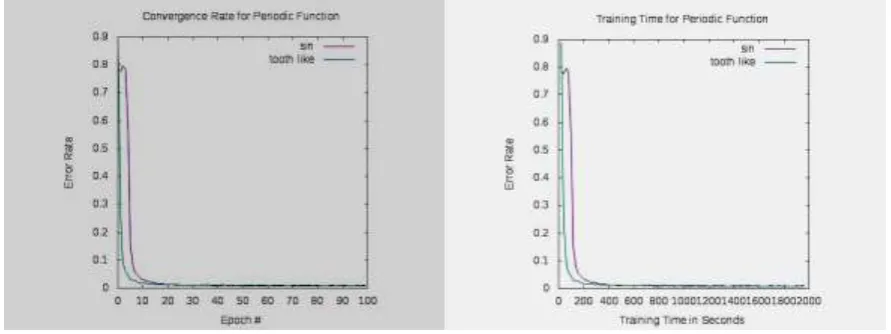
Figure 1. Experiments on sine function and tooth like function. Left figure shows error rate against number of epochs. Right figure shows error rate against training time.
From Figure 1 we can see that tooth like function converges faster than sine function both against number epochs and training time. The experiment performed here includes fine tuning steps for tooth like function, so the final results for both methods are comparable.
Conclusion
In this paper we exam alternative choice for activation function in neural networks. Especially we focuses on periodic function including sine function and tooth like function. We show they can be used as activation just as sigmoid or tangent function. And we also suggest sine function and tooth like function is similar to each other on performance but tooth like function may be preferred because of less training time.
Acknowledgment
This research was financially supported by the Fundamental Research Funds for the Central Universities 2014QNRC020.
References
[1] Y. LeCun, Y. Bengio, and G. Hinton, “Deep learning,” Nature, vol. 521, no. 7553, pp. 436-444, 2015.
[2] A. Krizhevsky, I. Sutskever, and G. E. Hinton, “Imagenet classification with deep convolutional neural networks,” in Advances in neural information processing systems, pp. 1097-1105, 2012.
[3] K. Hornik, M. Stinchcombe, and H. White, “Multilayer feedforward networks are universal approximators,” Neural networks, vol. 2, no. 5, pp. 359-366, 1989.
[4] C. Nvidia, “Programming guide,” 2008.
[5] G. Gybenko, “Approximation by superposition of sigmoidal functions,” Mathematics of Control, Signals and Systems, vol. 2, no. 4, pp. 303-314, 1989.
[7] A. L. Maas, A. Y. Hannun, and A. Y. Ng, “Rectifier nonlinearities improve neural network acoustic models,” in Proc. ICML, vol. 30, 2013.
[8] I. J. Goodfellow, D. Warde-Farley, M. Mirza, A. C. Courville, and Y. Bengio, “Maxout networks.,” ICML (3), vol. 28, pp. 1319-1327, 2013.
[9] I.Aizenberg, “Periodic activation function and a modified learning algorithm for the multivalued neuron,” IEEE Transactions on Neural Networks, vol. 21, no. 12, pp. 1939-1949, 2010.
[10] I.Aizenberg, “Multi-valued neuron with a periodic activation function,” in Complex-Valued Neural Networks with Multi-Valued Neurons, pp. 173-206, Springer, 2011.