2016 International Conference on Artificial Intelligence and Computer Science (AICS 2016) ISBN: 978-1-60595-411-0
A Real-time Security Situation Assessment System
Designed for Cloud Platform
Zhen-ling WANG
1,*, Rui XUE
1,2, Chi CHEN
1,2and Pei-song SHEN
11State Key Laboratory of Information Security, Institute of Information Engineering, Chinese
Academy of Sciences, Beijing 100093, China
2The University of Chinese Academy of Sciences, Beijing 100049, China
*[email protected] *Corresponding author
Keywords: Cloud platform security, Situation assessment, Multi-source heterogeneous data, Indictor system, Data fusion.
Abstract. Security situation assessment is an effective way to analyze the situation of cloud platform, which helps administrator understand the current cloud platform security status and develop policies to reduce risks in time. However, the existing researches for security situation assessment mostly focus on network security situation assessment. The proposed methods for network are not so suitable for cloud platform. For the first time, we propose a security situation assessment system for cloud platform. In consideration of diversity, heterogeneous, multi-source of data in cloud platform security assessment, we use the cloud computing security indicator system to construct a multi-source heterogeneous data fusion method which is used to assess the situation of cloud platform. In detail, we utilize big data processing tools and real-time data processing tools to transform the multi-source and heterogeneous data of cloud platform into the situational indicators of each protection level, which are further used to calculate the overall security situation in real time. The accuracy and practicability of the security situation assessment system are verified on real-word cloud platform in our experiments.
Introduction
In recent years, the security of cloud platform has become the research focus of scholars [6-9]. Prasad et al [6] proposed a quantitative impact and risk assessment framework for cloud security, the typical attack was mapped to the six key security object, which enables stakeholders to comparatively assess the relative robustness of different cloud vendor offerings. Dong Z et al [7] focused on solutions for container-level security, virtual machine-level security, network level security of PaaS cloud platform. It has been found that there are no study on cloud platform security situation assessment, except the work on the security situation assessment for campus cloud platform written by Xu d et al [8]. In this work, the security situation assessment method based on data fusion technology of D-S evidence theory was proposed, aiming at the characteristics of campus cloud platform. But this method is just for campus cloud platform, has poor generality.
In this paper, a cloud platform security situation assessment system is designed for the security assessment of cloud platform. We conclude our contributions as follows:
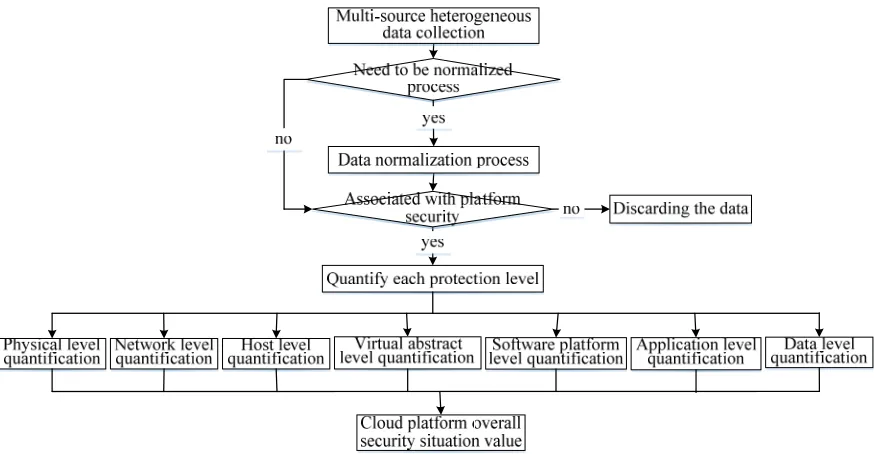
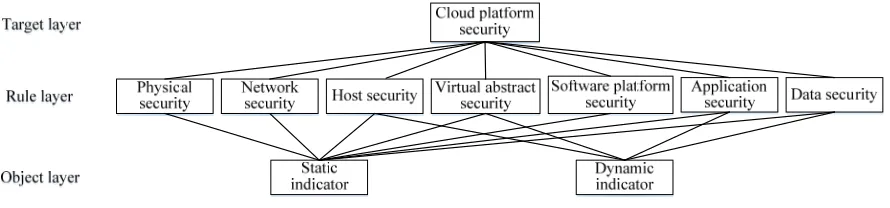
(1) A security situation assessment system for cloud platform is proposed for the first time; (2) The cloud computing security indicator system is introduced to construct an analytic hierarchy char of three levels for cloud platform, in which the object level corresponds to the indicators, the rule level corresponds to the protection level and the target level corresponds to the whole cloud platform security situation, we merge the diverse, multi-source and heterogeneous data of cloud platform level by level, finally calculate the whole security situational value;
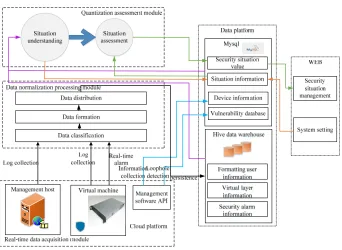
(3) We utilize big data processing tools to deal with a large number of multi-source heterogeneous data, include collection, processing and storage, real-time data processing tools is used to detect security events of cloud platform in real time and alarm timely, so as to let the administrator grasp cloud platform running situation in real time.
System Design
System Architecture Design
Figure 1. System Frame Structure.
System Business Process Design
Figure 2. Situation Process Quantification.
Security Situation Assessment
Security Situation Assessment Indication System Page Numbers.
[image:4.612.156.458.541.692.2]According to the cloud computing security indication system put forward by the cloud computing conference [10], combined with the characteristics of cloud platform, seven protection levels of cloud platform security situation assessment are established: physical security, network security, host security, virtual abstract security, software platform security, application security, data security. Virtual abstract security and software platform security are different from traditional information systems, which are based on the characteristics of cloud platform. The protection objects of the other protection levels also have their own particularity. For example, traditional protection of information systems is based on host security, only considering the physical host, which cannot be applied to the virtual machine, in the virtual environment, considering the security of virtual monitor and virtual machine is necessary. Cloud platform security situation assessment indication system is shown in Table 1, a total of 281 indicators.
Table 1. Cloud Platform Security Situation Assessment Indication System.
Protection Level Protection Object Indicator Amounts Physical Security Physical devices, media, physical environment 33 Network Security Network structure, network equipment, virtual network 40 Host Security Host, virtual machine 37 Virtual Abstract Security Virtual machine monitor, hypervisor 65 Soft Platform Security Development framework, middleware 50 Application Security Management platform, interface 40 Data Security Business data, system management data 16
Quantization of Multi-Source Heterogeneous Data.
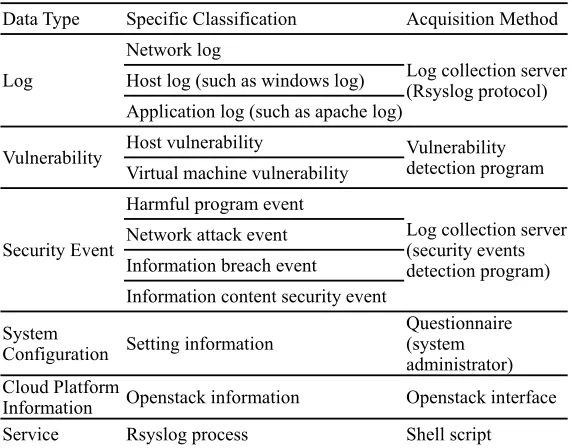
platform running process. The data sources are classified according to the data source type, data acquisition mode and so on, as shown in Table 2.
Table 2. Data Source Information and Its Acquisition.
Data Type Specific Classification Acquisition Method
Log
Network log
Log collection server (Rsyslog protocol) Host log (such as windows log)
Application log (such as apache log)
Vulnerability Host vulnerability Vulnerability detection program Virtual machine vulnerability
Security Event
Harmful program event
Log collection server (security events detection program) Network attack event
Information breach event
Information content security event System
Configuration Setting information
Questionnaire (system administrator) Cloud Platform
Information Openstack information Openstack interface Service Rsyslog process Shell script
According to the different ways of obtaining the data source information, the indicators of the cloud security assessment indication system are divided into two categories in this paper, one is the static indicator and the other is the dynamic indicator. The static indicator is the system configuration obtained from multiple assessment experts by completing the questionnaire, while the dynamic indicator is the information obtained from the remaining data sources.
1) Quantization of static indicator
For the quantization of static indicators, we need to determine the reference level. Assuming level = {satisfy (L1), most meet (L2), some meet (L3), most do not meet (L4), do not meet (L5)}, and its corresponding quantization value is: level = {1.0, 0.75, 0.5, 0.25, 0.0}. This level is used as the criterion for evaluating and identifying the static indicator of cloud platform security situation. Assessment experts according to the actual situation of the cloud platform select the appropriate level of the corresponding static indicator. In general different experts have different knowledge and understanding, and their authority and experience are not the same. Therefore, the reliability coefficients of w1, w2, … , wn are set in advance for n experts involved in the assessment. Among them, wi [0.8, 1], i=1, 2, …, n. The overall quantization value for a certain static indicator Imis
m
I
M , Im i
level represents expert i’s judgment on static indicator Im. Normalizing the indicator Im,
comprehensive multi-expert rating on indicator Im , the final score is obtained.
m m m m I I 1 I I ' 1 n i i i n i i
M level w
M M w
. (1)
2) Quantization of dynamic indicator
The quantification of dynamic indicators can be divided into three categories: quantification of vulnerabilities, quantification of security events and quantification of the remaining dynamic indicators.
successfully, and the effect of the vulnerability being exploited successfully. In order to improve the reasonableness of quantification, this paper investigates the equivalence of the threat index of vulnerabilities at different impact levels. Most security researchers generally agree that the threat index of exploiting the vulnerability whose impact level is 1 for 100 times is equivalent to exploiting the vulnerability whose impact level is 2 for 10 times, exploiting the vulnerability whose impact level is 3 for 1 times. So, define the quantification value of the vulnerability-related indicators is:
( , , ) 10cj
j j j j j
T f u s c
u s . (2)Among them, T represents the threat value of host/virtual machine,uj is on behalf of the possibility of exploitation of the vulnerability j, sj is on behalf of the possibility of successful exploitation of vulnerability j, cj is on behalf of the impact of successful exploitation of vulnerability j.
(2) Security events quantification. A statistical method is used to quantify the indicators related to security events extracted from the data warehouse table for a certain period of time. We use Et to represent the number of security events for the current time period t, Et-1 is the number of security events in the previous time period, Pt represents the number of security events processed in the current time period, and Ht represents the number of security events happened in the current time range.
1
t t t
E E P H. (3) (3) Remaining dynamic indicators quantification. The quantification of the remaining indicators is to determine whether the corresponding indicator is met based on the data provided by the information sources.
Security Situation Assessment.
[image:6.612.87.532.437.541.2]Analytic hierarchy process is used to analyze the characteristics of the cloud platform, and the analytic hierarchy chart shown in Fig. 3 is obtained. The security situation of the cloud platform is calculated after the fusion of the situation indication of each protection level and the fusion of all the protection level situations.
Figure 3. Analytic Hierarchy Chart.
1) Situational indicator integration
The integration of the situational indicator is based on the integration of situation indication belongs to each protection level and its importance weight relative to the protection level. In order to make the overall security situation value of cloud platform has the characteristics of strong fluctuation and good real-time performance, the weight value of the dynamic indicators with strong volatility will be enhanced. For the static indicators with week volatility, their weight value will be reduced.
Assuming that the weight of the situation indicator Im is wIm, its importance to this protection level is
m
I
m m m m m I I I I ' I ( ) i w w P M
. (4)2) Protection level situation integration
The integration of protection level situation is based on the security situation of each protection level and its importance weight relative to the overall security of cloud platform, so as to get the security situation value TS of cloud platform, the calculation formula is as follows:
1
( )
n
i Pi
i
TS P w
. (5) Among them, Pi is the security situation value of the protection level i, WPi is the importance weight of the protection level i, relative to the overall security of cloud platform, n is the number of protection level, and in our system, its value is 7.
System Implementation
In this section, we verify the reliability and accuracy of the cloud platform security situation assessment system. The experimental environment concludes 6 Dell PowerEdge R730 servers. The system’s web server is running on one server, and two servers are used to build Openstack cloud platform. We deploy the Hortonworks data platform on the remaining three servers. The data of different cloud users, different degrees of importance, and different degrees of sensitivity, are not isolated and backup. We do not fix vulnerability in the virtual machines in order to measure risks in our system.
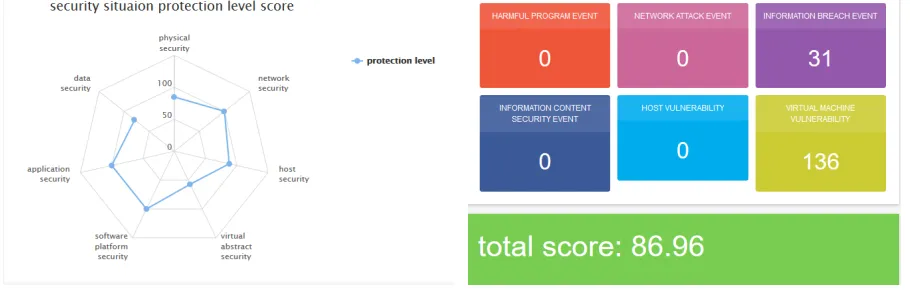
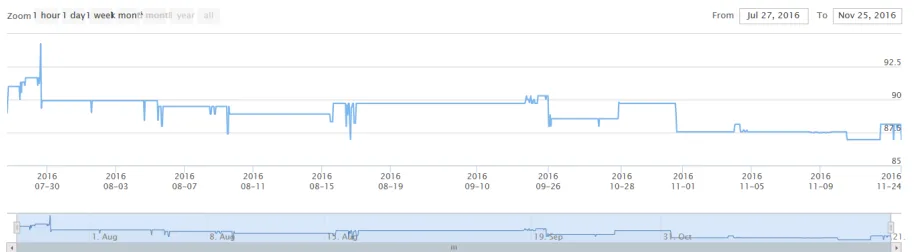
After running the system to assess the security situation of the cloud platform. The security situation assessment results are shown in Fig. 4 and Fig. 5. From Figure 4a, we can access the security situation value of each protection level. In the event of security problems, we can verify the problem and make emergency measures in time to reduce the loss caused by the security problem. As can be seen from the figure, the data security level, host security level and virtual abstract level have certain security risks, which need to be improved. It is in accordance with the actual situation of the cloud platform. From Figure 4b, we can obtain the overall security situation of the cloud platform and the real-time statistics on security incidents, because the virtual machine on the cloud platform is not timely bug fixed, from the figure, the number of vulnerabilities of the virtual machine can be real-time viewed, in line with the actual situation. Fig. 5 reflects the change of the security situation of the cloud platform. It is a real-time record of the security situation of the cloud platform. It can be used to analyze the trend of the security situation.
[image:7.612.80.535.546.694.2]
Figure 5. Security Situation Trend.
To sum up, the system can reflect the real-time security status of the cloud platform, with high accuracy. The unified and intuitive web interface can notify administrator the security status of cloud platform and provide a reliable basis for timely and accurate decision-making.
Conclusions
In this paper, the cloud platform security situation quantification assessment system based on diverse, multi-source and heterogeneous data is proposed in view of the insufficiency of information collection and the imperfection of security monitoring for cloud platform. The system provides a complete process from data collection to security situation assessment. The cloud computing security indicator system is introduced to construct a multi-source heterogeneous data of cloud platform fusion method. Big data processing tools and real-time data processing tools are used to realize the real-time processing for a plenty of multi-source heterogeneous data. We use a quantitative value range from 0 to 100 to represent the security situation, the higher the value, the more secure the situation. With our system, administrator can obtain the security situation at any time, and is provided a reliable basis for timely and accurate decision-making. The next step is to further improve the quantitative assessment method for the security situation of cloud platform, and do some research for the forecast of cloud platform security situation.
Acknowledgement
This work was supported by Strategic Priority Research Program of Chinese Academy of Sciences (No. XDA06040601) and Xinjiang Uygur Autonomous Region science and technology plan (No. 201230121).
References
[1] Li X., Zhao H. Network security situation assessment based on HMM-MPGA [C]// 2016 2nd International Conference on Information Management (ICIM). 2016: 57-63.
[2] Sharma Y., Bhartiya R., Sharma A. A Unified Method for Hybrid Network Security Situation Assessment Using HPPAL Approach [C]// Proceedings of the ACM Symposium on Women in Research 2016. 2016: 169-172.
[3] Xing-zhu W. Network Information Security Situation Assessment Based on Bayesian Network [J]. International Journal of Security and Its Applications. 2016; 10(5): 129-38.
[5] Jia Y., Wu H., Jiang D. A Hierarchical Framework of Security Situation Assessment for Information System [C]// Cyber-Enabled Distributed Computing and Knowledge Discovery (CyberC). 2015: 23-28.
[6] Saripalli P., Walters B. Quirc: A quantitative impact and risk assessment framework for cloud security [C]// 2010 IEEE 3rd International Conference on Cloud Computing. 2010: 280-288.
[7] Dong Z., Wang X., Hu J. et al. A multi-level cloud platform security solution [J]. Electronic Technology Application, 2013, 04: 133-136.
[8] Xu D., Zhang P. Security situaiton assessment and prediction analysis for campus cloud platform [J]. Network Security Technology and Application, 2016, 05: 77-80.