2017 3rd International Conference on Electronic Information Technology and Intellectualization (ICEITI 2017) ISBN: 978-1-60595-512-4
Studies on Phase Transition and
Microstructure Evolution of WC-CoCr
during High-Temperature
Transient Thermal Spraying
Hongyan Xu, Runhui Zhou and Ju Xu*
ABSTRACT
Laser is characterized as fast hating and quick cold, the laser real-time heating method was used to simulate phase transition and microstructure evolution during high temperature transient thermal spraying process in this paper, and thermodynamics calculation conformed the main phases during thermal spraying process. The wettability and chemical reaction between main phases were studied by the sessile method. Main phases and microstructure of the coatings were analyzed by XRD and SEM. By clarifying the coupling mechanism of diffusion mass transition and chemical reaction between inter-phases, the optimal spraying process parameters and excellent mechanical properties of WC-CoCr coating were determined. An important theoretical basis for the preparation technology of high properties and long lifer coating was provided.
INTRODUCTION
With the rapid development of modern manufacturing industry, new machinery and equipment have been required to have higher efficiency, reliability and longer service life. Especially for engineering equipment in aerospace, ship, petrochemical, _________________________
hydraulic, metallurgical, mining and other fields, they often works in high-speed rotation, erosion or marine salt spray corrosion and other harsh operating conditions, resulting in higher performance requirements for manufacturing materials. WC-CoCr coating is one of the most widely used protective coatings in the medium and low temperature environment. Its stability and service life are still needed to be improved. However, the mechanism of its phase transition, instantaneous interphases wetting, mass transfer and micro-interface reaction in thermal spraying process are still not clear, which restrict the improvement of coating property basically.
Researchers mainly focused on the effect of spraying process parameters on the online particle flight features and coating properties. J.A. Picas et al. [1] studied the effect of oxygen / fuel ratio on the particle velocity, temperature and coating properties in the supersonic sprayed WC-CoCr process, and improved the coating performance by optimizing the spray process parameters, but the performance improvement was limited. He[2] also studied the effects of different spraying distance and temperature on coating properties, the results showed that the flying state of the particles greatly influences the porosity, hardness and corrosion performance. When the agglomeration particles fully melted, WC particles have minimal decarburization, the best wearing resistance of the coating could be obtained, but there are no further studies on how to control the ratio of decarburization of WC. Lidong Zhao et al.[3] used online particle monitoring to study the effects of different spraying power and gas flow rate on particle velocity and particle surface temperature during coating process. The results showed that the larger the total gas flow rate, the higher the particle velocity, the higher the temperature, the larger the density and the hardness of the coating, but failed to reveal the mechanism of phase transition and mass transfer. Ondrej Racek [4] studied the effect of the coating reacting with the substrate on the coating microstructure and corrosion resistance.
failure behavior; A CVD coating was performed in the supersonic spray coating surface by G. Bolelli et al.[11-13] to study the coating process on the coating performance.
All the above studies did not take into account the effects of complex interactions such as wetting, diffusion, mass transfer and chemical reactions on the wear resistance and corrosion resistance of the coating at high temperature spraying process, so can not to improve the coating properties and extend service life basically. Due to the rapid heating and rapid quenching characteristics of the laser could retain the tissue and structure of high temperature state, laser heating was chosen to study the microstructure evolution and phases transition on high transient thermal spraying. Wetting mechanism within main phases was clarified, which provides theoretical basis and guidance for the preparation of high-performance CoCr/WC coating.
EXPERIMENTAL PROCEDURE
Co, Cr, and WC used in this paper are provided by Kepujia Co., Ltd. China. The particle size of Co, Cr powder is 30-50 microns and the WC is 20-30 microns.
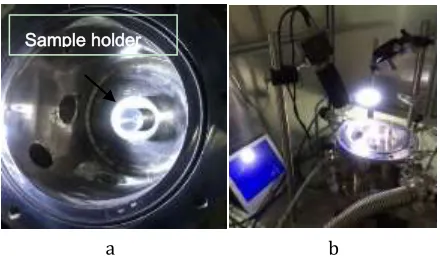
The laser heating experiments were done by home-made set-up as shown in figure 1 which include a semiconductor laser (model: STL808T1-30W, wavelength: 808nm, power 100W), a sample holder and a gas blowing system. Typically, the sample is suspended in the air above the sample holder by the inert gas blowing and melted by the laser at the same time. The sample were prepared by the mixture and hydraulic pressing under the pressure range of 30 ~ 40MPa.The mixture of CoCr / WC powder with the ratio of 17:4:79. After the sample cooled, the microstructure and texture of CoCr / WC reactant were analyzed by a scanning electron microscope (SEM, JEOL, JSM-5510S) and X-ray energy dispersive spectrometer (EDS JXA-8800R), the interfacial phases were checked by X-ray diffraction analyzer.
Sample holder
[image:3.612.195.415.368.498.2]a b
Figure 1. The set-up of laser heating system a) sample holder with gas lowing exit, b) heating system showing a sample is melting.
RESULTS AND DISCUSSION
High-temperature Transient Characteristic Study Method of Supersonic Spraying WC - CoCr Process
The high-temperature transient characteristic of supersonic spraying make it difficult to determine reason and process of the phase transition and microstructure evolution during high-velocity oxygen-fuel (HVOF) process, which restricts the properties improvement of coating. The flame temperature and spraying distance of the HVOF is 1800 ~ 2200 ℃ and 190 ~ 230mm respectively, while the laser heat source temperature and heating distance is adjustable for wide range, the heating particle size is wide adaptability. Especially the rapid quenching feature of laser could retain the high temperature state of WC-CoCr system during heating process, so it can be used to simulate HVOF process and study the physical and chemical changes of multi-phases. The laser wavelength and power required for heating the metal can be derived from equations (1) and (2); Equation (1) represents the heat absorbed by the metal during the laser heating process, Equation (2) is the absorption rate of the material:
Q= P* t* 𝛼=ρ*c*V*∆T (1)
Where P is the heating power, t is the heating time, α is the heat absorption rate of the material, ρ is the material density, c is the specific heat capacity of the material, V is the volume of the heated block, ΔT is the heating temperature difference.
𝛼=4𝜋𝑘/λ (2)
Among them, 𝑘 is about material properties, λ is the laser wavelength.
The absorptivity of the Co and Cr blocks in the laser heating process could be calculated or deduced from equation (2), due to the low absorption rate of carbon dioxide lasers, even with maximum power, it is still difficult to melt the Co and Cr metal, as shown in table 1, absorption rates of argon, ruby, and solid-state lasers are all larger than 0.3 and low power can melt the metal. Therefore, a laser with a wavelength of about 1μm can be selected. In this paper, a YAG semiconductor laser is used, and the wavelength of the laser for heating the CoCr block is 30 to 80W, which was calculated by the equation (1).
completely melted, but the crack phenomena do not affect the interaction and mass transition process.
Reaction Wettability Characteristics between Main Phases of WC – CoCr system during Laser Heating
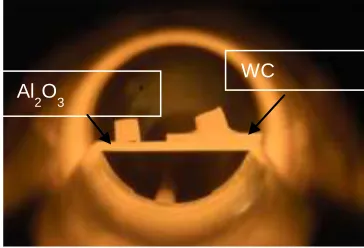
The main phases of the reaction process were CoCr alloy and WC hard phase. As shown in Figure 2, the wettability of CoCr on reactive substrate WC and non-reactive Al2O3 substrate were studied comparatively in the temperature range of
1800 ~ 2200℃. When the laser heating temperature is below the melting point of Co or Cr (1250 ~ 1450℃), the chemical reaction between CoCr and WC is intensive. With the increase of temperature, the CoCr metal reacts strongly with WC, and it can be seen that the strong drag happened on the interface, the CoCr metal block gradually becomes smaller and smaller until it disappeared. The chemical reaction rate within phases is faster than that of wetting and mass diffusion transformation, so the decomposition rate of WC and the formation of CrxCy compounds are controlled
by the rate of reaction between phases. CoCr was completely reacted with WC by continuous heating for 30min laser. While melted CoCr on the surface of Al2O3
substrate was not spread due to non-wetting with Al2O3 substrate. It can be seen that
in order to reduce the decomposition of WC-CoCr system or the occurrence of side reactions during the thermal spraying process, the decomposition of WC and the formation of CrxCy compounds should be controlled by controlling the reaction
kinetics such as increasing the spraying rate, reducing the spraying distance, temperature and so on.
The Morphology and Microstructure Evolution of WC-CoCr during Laser Heating
The phases of CoCr/WC system is complex at the high temperature, which may contain CoCr alloy, WC, W2C, Cr7C3, Cr23C6, Co3W3C etc., due to the strong affinity with C, Cr are preferentially captured by C in the WC to form Cr-C compounds, for example Cr23C6, Cr7C3, and Cr3C2 in WC-CoCr system, according to C-Cr phase diagram, the forming temperature of Cr3C2, Cr7C3, and Cr23C6 is 2100℃, 2000℃ and 1850℃ respectively, T(Cr3C2)>T (Cr7C3)>T (Cr23C6). The standard formation Gibbs free energy of the intermetallic compounds at different temperatures was calculated by HSC5.0 thermodynamic calculation software, for example, the generation Gibbs free energy of each phase at 2000℃ is as following:
[image:5.612.100.475.102.150.2]ΔGf (Cr7C3) =-55.154 (3)
TABLE I. ABSORBANCE OF MATERIALS UNDER DIFFERENT TYPES OF LASERS. Materials Argon
/0.488μm
Ruby /0.694μm
YAG/ 1.06μm
carbon dioxide /10.6μm
ΔGf (Cr23C6) =-108.717 (4)
ΔGf (Cr3C2) =-28.063 (5)
HVOF processing temperature is about 2000℃, all the phases of Cr7C3,
[image:6.612.220.402.205.329.2]Cr23C6 and Cr3C2 are possible to form and the Cr23C6 phase has the lowest
Figure 2. High temperature transient reaction wetting coupling process.
formation Gibbs free energy, which has the highest formation possibility and is the most stable of all. Cr7C3 is the second, Cr3C2 generation possibility is the
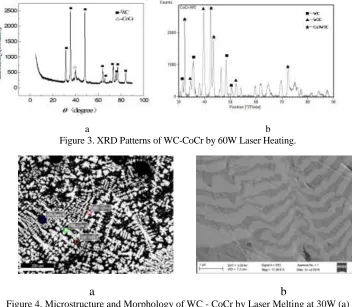
smallest. Therefore, in the HVOV process, in addition to CoCr and WC phase, there may be Cr-C phase compounds. The composition and phases were studied at different power level by using the semiconductor laser. The XRD analysis of the block after laser heating was carried out. Even though the WC-CoCr system was not completely melted during laser heating, but it did not affect the reaction wetting and mass transition within phases. When the power is 30W, the main phases of WC-CoCr system were WC and CoCr, as shown in Fig. 3(a). As the power increased, the main phases of WC-CoCr system were WC, W2C and
Co3W3C, as shown in Fig. 3(b). Because W2C, Co3W3C are brittle metals and
reduce the hardness and life of the coating, so they should be avoided to generate. It can be seen from Fig. 3(a) and (b) that the increased power increases the unstable phases such as W2C and Co3W3C. Therefore, it had better stability,
corrosion resistance and hardness under 60W semiconductor laser heating.
The microstructure and morphology of the WC-CoCr system is studied by different laser heating powers level, which are shown in Fig. 4. When the heating power is 30W, the dendritic hard phase WC is evenly distributed in the matrix of WC-CoCr, which is shown in Fig.4 (a), the enlarged structure is shown in Fig.4 (b).
Al
2O3
substrate
a b
Figure 4. Microstructure and Morphology of WC - CoCr by Laser Melting at 30W (a) is a SEM image of the bulk, and (b) is an enlarged view of the scale-like morphology of (a).
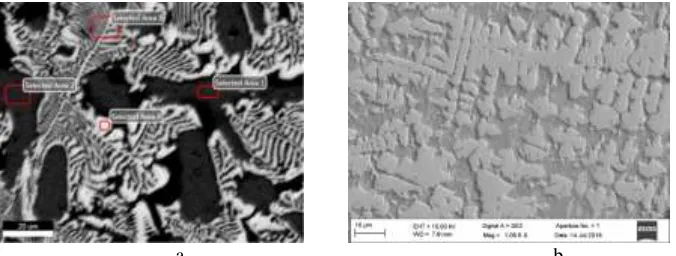
The dendritic structure dispersion distribution could avoid stress concentration of hard phase WC, and WC could not be easy to absorb heat to decompose to W2C and Co3W3C. But when the power increased, WC decarburization phenomenon is more serious, which destroy the organizational integrity of the WC. The distribution of the WC in the system is not as uniform as the 30W, as shown in Fig.5 (a), which enlarged organization is shown in Fig.5 (b). The organization of WC-CoCr system at 60W is less regular than that at 30W. Wearing resistance and corrosion resistance greatly weakened, on the one hand due to high brittle phases, low stability of WC, on the other hand due to its incomplete dendritic organizational morphology. It can be seen that the main phases of WC-CoCr system are WC, CoCr at low power level, and due to the chemical reaction rate between WC and CoCr is much larger than that of wetting and mass transfer, the interface effect of thermal spraying is mainly controlled by the rate of chemical reaction within the phases, so the thermal spraying time and energy input should be control to be as shorter and smaller as possible to avoid WC decomposition and brittle phase generation. Thus, hard phase WC is evenly distributed in the coating, which can strengthen and support the coating, while the
binder phase, CoCr, is distributed throughout the coating and serves to bond the hard phase.
[image:8.612.122.460.149.277.2]a b
Figure 5. Microstructure and Morphology of WC - CoCr by Laser Melting at 60W(a) shows the SEM image of the WC-CoCr system at 10000x magnification, and (b) shows an enlarged view
of the dendritic morphology in (a).
CONCLUSIONS
In this paper, by using laser heating to study WC-CoCr phase transition and microstructure evolution during high-temperature instantaneous thermal spraying process. The wavelength, power level and type of semiconductor lasers were determined according to the absorbance property of WC-CoCr system. The reaction wetting phenomenon of main phases of WC-CoCr system was experimentally studied. The results showed that the mass transfer within main phases is controlled by the chemical reaction rate.
By calculating the reaction thermodynamics of the main phases of WC-CoCr system in the thermal spraying process, the possible products in the coatings were determined theoretically, which shows that the main phases may include WC, CoCr, Cr23C6, Cr7C3, Cr3C2. Further imitation experiment by laser heating showed that the phases in coating were WC and CoCr at low power level, as power increased, the W2C and Co3W3C brittle phases increased, which will lead to coating properties decreased.
ACKNOWLEDGEMENT
This research work is financially supported by the National Natural Science Foundation of China (No. 140l022, No. 51777203) and the Chinese Academy of Science "Hundred Talents" project.
REFERENCES
1. J A Picas, M Punset, M T Baile, et al. 2011. Effect of oxygen/fuel ratio on the in-flight particle parameters and properties of HVOF WC-CoCr coatings. Surf. & Coat. Tech., 205: 364-368.
2. J A Picas, E Ruperez, M Punset, A Forn. 2013. “Influence of HVOF spraying parameters on the corrosion resistance of WC-CoCr coatings in strong acidic environment”. Surf. & Coat. Tech., 225: 47-57.
3. L Zhao, M Maurer, F Fischer, E Lungscheider. 2004. “Study of HOVF spraying of WC-CoCr using on-line particles monitoring”. Surf. & Coat. Tech., 185:160-165.
4. O Racek. 2010. “The Effect of HVOF Particle-Substrate Interactions on Local Variations in the Coating Microstructure and the Corrosion Resistance”. J. of Ther. Spr. Tech., 19: 841-851
5. A Ghabchi, T Varis. 2010. “Behavior of HVOF WC-10Co4Cr Coatings with Different Carbide Size in Fine and Coarse Particle Abrasion”.J. of Therm. Spr. Tech., 19: 368-377. 6. S. Armada, B.G. Tilset, M. Pilz, R. Liltvedt, H. Bratland.2011. “Sealing HVOF Thermally
Sprayed WC-CoCr Coatings by Sol-Gel Methods”.J. of Ther. Spr. Tech., 20: 918-926. 7. T Sahraoui, S Guessasma, M. A Jeridane, M Hadji.2010. “HVOF Sprayed WC-Co
Coatings: Microstructure, Mechanical Properties and Friction Moment Prediction”. Mater. and Des., 31: 431-1437.
8. K Kumari, K. Anand, M Bellacci, M Giannozzi.2010. “Effect of Microstructure on abrasive wear behavior of thermally sprayed WC-10Co4Cr Coatings”. Wear, 268: 1309-1319.
9. G. Bolelli, B. Bonferroni, G. Coletta. 2011. “Wear and Corrosion Behaviour of HVOF WC-CoCr/CVD DLC Hybrid Coating Systems Deposited onto Aluminium Substrate”.Surf. & Coat. Tech., 25: 4211-4220.
10. A.K. Maiti, N.M. Hopadhyay, R. Ram.2009. “Improving the Wear Behavior of WC-CoCr-based HVOF Coating by surface Grinding”.J. of Mat. Engin. and Perf., 18: 1060-1066. 11. L Zhao, M Maurer, F Fischer, E Lungscheider.2004. “Study of HVOF spraying of
WC-CoCr using on-line particles monitoring”.Surf. & Coat. Technology, 185:160-165.
12. L Zhao, M Maurer, F Fischer, E Lungscheider.2004. “Influence of spray parameters on the particle in flight properties and the properties of HVOF coating of WC –CoCr”. Wear, 257: 41-46.