UNCERTAIN MASCULINITIES
Jake Abrams
Student Number U1219032
Professional Doctorate in Fine Art
A report submitted in partial fulfilment of the requirements of the
School of Arts and Digital Industries,
University of East London
for the degree of Professional Doctorate in Fine Art
ACKNOWLEDGEMENTS
CONTENTS
Introduction 1
Personal and Creative Context 3
Theory & Creative Practice 11
• The Human Chair- Objects and Anthropomorphism 2012-2013 11
• The Meaning of Things 2013-2014 32
• Stuff & Psychoanalysis 2014-2015 59
• Objects of Masculinity 2015-2016 98
• Towards an End 2016-2017 154
• Supplementary Perspectives 2017 175
• Professional Practice 207
Summary 209
Bibliography 212
INTRODUCTION
This study is an autoethnographic undertaking. It has been an intense and thorough examination of my own artistic process yet also a profound departure and reinterpretation. The enquiry has inaugurated a whole series of working procedures and seen the emergence of significant new ways of creating artworks. It has been a most insightful and transformative experience, yet at the same time most difficult and unnerving. It has not always been a straightforward journey, especially as I have, in the course of the research, delved deep into my own psychological motivations and incumbent neurosis.
At the outset of this study I held a rather amorphous idea that I could express a succession of personal themes through using and adapting found objects and items of furniture but it soon honed down to a preoccupation with one solitary multifaceted entity: the chair. I became fascinated with its variability, its ubiquity and its potential for metaphor and metamorphosis. The chair subsequently became an essential fulcrum for most of my work.
Notions of masculinity, both personal and societal, have also been rooted in this research. Masculinity has long held a fascination for me. I have invariably felt both an insider and an outsider to it. As a heterosexual male, a father, a wage-earner, I am aware that I conform to many of its prerequisites and values yet at the same time I have always tried to vie against it, viewing it as posturing, unfair and even absurd. This conflict also lies at the heart of much of my artistic exploration.
examined artists that have used them as central conduits for their ideas. I have immersed myself in writings about the chair, its history, design and cultural significance. I have considered how aspects of art and psychology interrelate. I have read widely, made personal discoveries, made wrong turns and long deviations.
During the doctorate, I have examined my themes using a wide range of different working methodologies. I have had to learn how to programme a plasma-cutter to cut sheets of steel, I have used blow-torches to scorch wood, pincers to cut lead, and worked within an array of other unfamiliar procedures. I have experimented with constructing my ideas in virtual reality and also coped with the realities of collaborative making. Through this period I have evolved a methodical and critical working process; it commences with a series of small drawings that are evaluated, then rendered and refined at a larger scale; this is then followed by a series of explorative maquettes or paintings which in turn, culminate in what I see as a definitive ‘artwork’ stage. I have also learnt that what seems definitive is not always so. I have learnt that some of the sketches, models and preparations hold potency in their own right.
PERSONAL AND CREATIVE CONTEXT
The doctoral programme at UEL has supported my transition from professional illustrator to practising artist. This process has permitted me to feel more confident in blurring the boundaries of what I have always felt as a series of coexisting disciplines within my work. Recent debate, especially within British Art Show 8 and the Turner Prize, has given me confidence in validating this redefinition.
My rationale for this doctorial study and some of its research preoccupations are deep seated. Making art has always been my mainstay. Throughout school my workbooks were ornately embellished with drawing. My free time was dedicated to drawing, painting, design and making. In 1984 whilst still at school, I became Young Engineer for the Midlands
and subsequently, during my first year of undergraduate study, became runner-up in the national Young Engineer for Britain finals. I had designed a walking aid, for the disabled or infirm, which integrated a seat.
My Masters study was preoccupied with notions of masculinity, studying how men are perceived, represented and stereotyped across the media. I researched and ‘quite literally’ drew extensively on this subject. I was interested in how much work and analysis had been done in relation to women’s issues and roles, compared to how little had been made about men. I examined male archetypes, proclivities, and obsessions, and through my creative work attempted to confront some entrenched stereotypes.
On graduating from my MA, I gained British Council sponsorship to participate in the
Thapong International artistic residency in Botswana (1989). This pivotal moment in my career, gave me the opportunity to work alongside a range of artists from around southern Africa as well as the American sculptor Willard Beopple. From this experience Zimbabwean sculptor Adam Madebe and Boepple held particular significance for me. Madebe’s imposing figurative work, fashioned from salvaged and rusting metal, envisioned aspects of both statuesque yet ultimately frail male posturing. Beopple’s succession of towers or ladders (fig.1) conduct their beholder into realms of abstract form and negative space. For me, his skeletal structures insinuate notions of aspiration and also vulnerability. At a time where I was preoccupied with two-dimensional imagery these sculptural revelations held a lasting resonance and I subsequently, whilst pursuing a career in editorial illustration, persisted with experiments in sculptural making.
Fig.1 Beopple.W (2014) Inside Out. Aluminium 84x 43 x23.4 inches.
On returning from this residency, my creative practice moved in several concurrent directions, as Illustrator, Artist, Draughtsman, Printmaker and Educator.
I became a successful illustrator working for a range of periodicals and magazines. I did regular commentary pieces for The Independent, The Spectator (fig.2), The New Statesman,
The Daily Telegraph, The FinancialTimes, and The Observer. I worked for Punch, GQ, The Guardian, the Times and the Evening Standard. I created for a monthly comment strip for
Creative Review (back page- Brief Lives) and contributed satiric pieces for a panoply of other publications at home and overseas. I worked on book cover images for Jonathan Cape, Vintage, Penguin and Picador, advertising campaigns for Smile Bank, Holstein Pils, Amnesty International and design work for a range of clients such as the Post Office and
Waterstones. As an illustrator, I learnt to succinctly encapsulate an idea for the reader. Written ideas were synthesised, or made less dense and impenetrable. Through humour and satire, I found that I could engage in political or social commentary that had immediacy as well as the benefit of a diverse and extensive audience.
Alongside illustrating, I had always made more personal, self-initiated artistic work. I created paintings triggered by political or social events. Large (2 metres sq.) paintings of cowboys and Indians were conceived to comment on the wars in the Middle East. Paintings of vast coiling snakes, offset with diminutive and insignificant ladders, referred to social immobility.
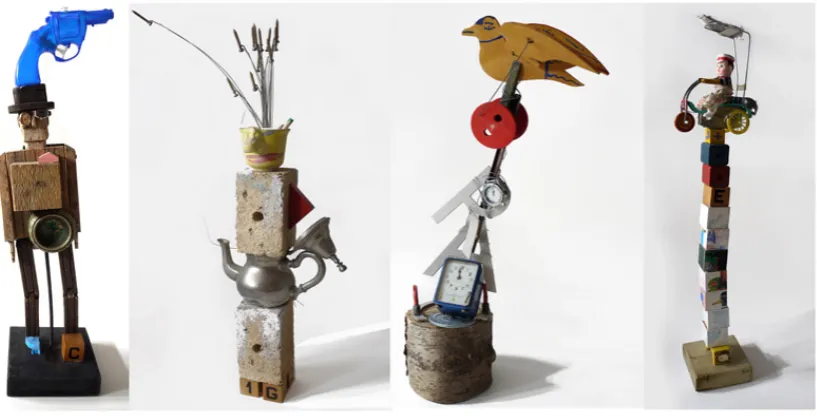
[image:9.595.149.508.377.742.2]In the years prior to my doctorial study, I started to make more sculptural work (figs. 3 and 4), creating ’amalgam’ pieces from objects that had been sourced or scavenged. These pieces aimed to celebrate an aesthetic within discarded objects as well as to allude to their previous purpose and history, whilst also aiming to remind their beholder of unrestrained waste and our throwaway culture. Other pieces had a conceptual basis to these combinations. For example, a shed (fig.3) is encrusted with a shimmering layer of recycled keys alluding to ideas of ownership, intrusion, belonging and security. The shed has no lock, just a key handle to pull its door open.
Fig. 4 Abrams. J (2011) ‘Amalgam’ sculptures.
Fig. 5 Abrams, J (2009) Adams Rehearsal. Drawing from London Sinfonietta Residency.
Using printmaking to examine and expand my ideas has also been a consistent preoccupation. I displayed a series of A0 hanging screenprints as the centrepiece to the exhibition at the Southbank Centre. These abstract prints were derived from gestural ink drawings that responded to different aspects of the ensemble’s avante-garde classical repertoire.
Fig.6 Abrams, J (2006) Z-A combined image. Screenprint 594 x 841 mm.
THEORY AND CREATIVE PRACTICE
This period of doctoral study has afforded me the opportunity to research the context and motivations of my artistic compulsion and formulate significant new methodologies and working trajectories. It has been a primarily auto-ethnographic process contextualised with reference to other artists and relevant theoreticians.
For this document, I have recorded a succession of artistic enterprises that have been pivotal to my research. I have placed them, as best as I can, in a chronological sequence in order to exemplify the trajectory of this study. I discuss the developmental process behind the establishment of an artwork and then I note some of the key artists, theorists and influential exhibitions which I have referenced to extend my understandings of the subject matter.
THE HUMAN CHAIR- OBJECTS AND ANTHROPOMORPHISM
2012-2013
illustrator, to develop a personal and expansive artistic vision that could communicate in a more thought provoking and evocative manner.
By amalgamating found objects I wanted to construct installations that could produce conceptual collisions and I envisaged creating speculative and experimental artworks that would invite the viewer to deeper contemplation of the issues with which I was involved. For this process to happen, I set about radically changing my process and working methodologies, meticulously creating chronological experimental sketches, paintings and maquettes. These I refined, evaluated, and realised as three-dimensional sculptures. My research re-defined my practise as an artist and became significantly more self-reflective. I had been interested in the writings of Donald Schön (1983) and his practical views on
reflection-in-action and I wanted to put his ideas to the test. My aim was to engender a practice that was expansive and interrogatory, investigating a range of methodologies and techniques with the purpose of creating original and provocative art works.
I became interested in the implications of the objects and materials I was experimenting with. I referenced Sherry Turkle who in her book Evocative Objects, Things We Think With,
brings together essays by a range of artists, scientists and designers who contemplate the power and resonance of objects as diverse as a yellow raincoat, a slime mould, a wooden toy radio, a glucometer and a mummified body. In her analysis she reflects on the theory behind these evocations.
In one intriguing example, a radio, fashioned for or by an impoverished child in Durban, South Africa from wood, paper and broken glass is an object of emulation and imagination
(Turkle, 2007 p.106) and it is not only a powerful signifier of those that have and those that have not, but also of a subversive view on the status of objects. The child can be seen as carrying his silent radio aloft as a loud proclamation of aspiration but also as a reminder of his poverty.
The wooden radio subverts itself as a commodity and reveals the social relations that
commodities are designed to hide. (2007 p.312)
a power to stand in for a sense of abandoned ownership and belonging , in this case the child’s mother. The inanimate object is imbued with another sort of poignancy: the power of inner and outer realities (p.315) and is reminiscent of artist Grayson Perry’s tricycles and
Alan Measles teddy.
In Winnicott’s view the transitional object becomes important in an infant’s development and can lead us to conceive of the infant’s play as an early version of later cultural activity
(Walsh, 2013 p.116). The first objects a child recognizes as not part of their own body: the breast, the teddy, the comforter; all have power in forming our associations later in life.
Turkle also cites the French ethnologist and anthropologist Claude Lévi-Strauss whose ideas on bricolage (Turkle, p.4) are relevant to my scavenging and piecing together of found objects to construct new ideas and meanings. Bricolage is:
a way of combining and recombining a closed set of materials to come up with new
ideas. Material things, for Lévi-Strauss, were goods-to think-with and, following the
pun in French, they were good-to think-with as well. (p.4)
Turkle also discusses a range of psychoanalytic concepts in relation to objects, particularly the Freudian idea of ‘the uncanny’ in which familiar ‘homely’ things are rendered unfamiliar through repression. Normal objects, she notes, can be altered in subtle yet unnerving ways. In one example, some rocks, the belongings of a dead spouse, become powerfully evocative and an almost tangible presence in the life of his widow (p.8). The rocks disorientate. They are not just reminders of, but seem to become, the dead husband. Objects can, Turkle reminds us, house psychological potency.
Whilst developing ideas for my artwork I also became interested in sociologist and theorist Richard Sennett’s ideas on materials and on making. In The Craftsman (2008), his explorations into material consequences and the honest material (p. 137) highlight how even the most humble of materials can be imbued with poignancy and purpose, making them culturally consequent (p. 144). In utilising the example of the common brick he
(Our anthropomorphic projection) into materials does not aim at explanation; its purpose is to heighten our consciousness of the materials themselves and in this way to
think about their value.( p. 137)
Investing inanimate objects with human qualities also functions to provide a type of personal ‘metamorphosis’:
Marking an object can be a political act, not in the programmatic sense, but in the more
fundamental matter of establishing one’s presence, objectively. Anthropomorphosis
reveals the power of metaphor and a technique for manufacturing symbols. (p. 144)
Materials, carefully crafted, are good to think with (p.129) but he also discusses how the craftsman or artist can deliberately plan resistance and ambiguity creating momentary disorientation to entertain and inform (p. 232). This disorientation is an essential strategy I aim to employ.
Improvisation is also a relevant theme that Sennett investigates. Craftsmen modulate their output by taking detours (p. 238) and straying beyond the prescription of the everyday; like a jazz musician they anticipate, develop and improve:
Intuitive leaps happen, in reflections people make on the actions of their own hands or in
the use of tools (p. 290)
These creative transitions are far from haphazard. They are seated in a deep understanding of the nature of the materials: their design, structure and implications.
I was interested in how Richard Wentworth appropriates the form of objects in his constructions, delivering new narratives and meanings. In Fable (fig.7) he utilises a salvaged ladder that struggles its way pointedly across a room. Its lowly salvaged ‘left out in the rain’ patina is juxtaposed with a shiny metal bowl that provides its support and jarring counterbalance. The ladder is a signifier of aspiration and ambition yet it forlornly leads nowhere. Images such as this are imbued with a narrative yet allow their audience ample room for contemplation. As Marina Warner points out:
The juxtapositions and combinations propose an alternative formal system, turning the
invisible into the visible, the humdrum into the significant, ground into figure, the
dumb into the telling. His buckets and ladles and ladders and water tanks and doors
and strainers and ballcocks and dibbers…are dumb things encrypted in sentences, made
to talk. (Warner, 1993, p.11).
Wentworth’s process is not to seek things out but to happen upon them.
I like to be near things at the end of their social life…that plate lying in the gutter is
symbolic, somehow; you know you can save that plate, you can take it home and put it
on the wall and never eat off it, and so it’s the most important plate in the world, you
can put back into it all that meaning, or you can stand on it and it’s on its way to a
landfill (Warner, p.13).
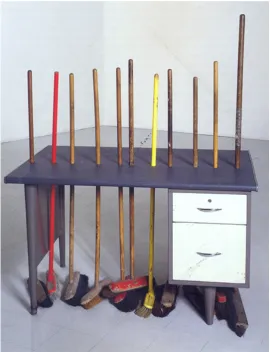
[image:19.595.185.456.401.754.2]Wentworth’s process is unfettered by the constraints of a particular medium. He insists that his medium is ‘thoughtfulness’ (Raney, 2003, p223) and that he does not employ ‘tidy strategies for making work’ (p216 In The Stile (Fig.8), he sets up a dialogue between objects that would not habitually coincide; brooms puncture through an office desk, rendering both useless. Social meanings are evoked: the nature of work, hierarchy of roles and the low-paid who come in when the deskwork is done. Wentworth fashions a new story from objects that would otherwise be mute or retain a single prosaic meaning.
I also found Grayson Perry pertinent to my research. His work exhibits a rich vein of social commentary on gender and politics, rendered in a richly adorned sardonic style. Whether creating ceramics, embroidery, fabrics or prints, the materials are deliberately chosen and are central to the meaning. He revels in subverting found artefacts and artworks, relishing their skilful craftsmanship, and then transcribing his own personal histories and viewpoints onto versions of them.
When asked about the meaning of his work, Perry replied It’s no good asking me. I put forward the question in the work, I don’t answer it. (Jardine, 2004, p.5) The questions he poses are pointed ones: the nature of craft, the vexed relationship between high art and low art, gender, decoration and illustration.
[image:20.595.221.436.509.764.2]Perry revels in candid expression and brings it to the centre of his own artistic pieces, which are also highly personal and intimate. On first examination, they can appear salacious, can be jokey and juvenile. A rural scene on one of his ceramic pots Taste and Democracy (fig.9) is punctuated by comic book asides. A muscleman exclaims in speech bubble format ‘It’s about time a transvestite won the Turner Prize’. The bikini-clad woman he carries glibly proclaims ‘Pottery is the New Video’. But the points are serious ones about gender, the nature of judgements and prizes, and the faddishness of what is lauded by the art world. Despite his assertions that he does not know the meaning in his work, he communicates with disarming eloquence.
Perry’s fascination with crafted objects was prevalent in his show and in the curatorship
The Tomb of the Unknown Craftsman at the British Museum in 2011/12. Here he mixed
30 of his original creations with a selection of pieces from the museum’s collection, railing against the glossy conceptualism (Anonymous, 2011) of international-style art. He relishes the eclectic, as well as an object’s individuality and its craftsmanship, above its assigned anthropological value. He too makes reference to Winnicott’s concept of the
transitional object
Transitional objects and transitional phenomena belong to the realm of illusion which is
at the basis of initiation of experience. This early stage in development is made possible
by the mother’s special capacity for making adaptation to the needs of her infant, thus
allowing the infant the illusion that what the infant creates really exists. (Winnicott, 1971 p.16)
Perry’s childhood teddy bear is emboldened with the power and significance of a religious icon or reliquary.
This ‘transitional object’, he says, helped him survive a harrowing upbringing: ‘All gods
are like cuddly toys insofar as they are inanimate things onto which people project their
ideas’. (Anonymous, The Economist, 2011)
The exhibition highlighted key aspects of Perry’s working methodology which is very personal and autobiographical; one commentator called it a walk around Grayson Perry’s head (Imagine, 2011 ). The exhibition exemplifies how his creativity habitually stems from
a visual, historic (Artsnewspapertv, 2009 ) starting point and then he brings his own ideas to
the artifacts he sources. ‘I look at things and trust the intuition and make.. choices.’
(Imagine, 2011 ).
The structures themselves have a resonance too:
The surface and shapes of his ceramic vessels are narrations of his own ideas and
biography. They also much more directly have their own personalities and have,
according to him, an inherent ‘anthropomorphism, with their necks, shoulders, bellies
Although renowned for his pottery, Perry also makes artwork with a variety of other
mediums unified by an interest in traditional craft skills and the home-fashioned. His
embroidered dress Mother of all Battles (fig.10) has, almost literally, embroidered layers of
meaning. The battle is the painstaking craftwork that has gone into making the dress, the
emblem of and homage to , the tireless mother whom he would have liked to have had. It
is an ostentatious but, at the same time, homely embodiment of his transvestite alter-ego
Claire, which simultaneously rails against the rape, torture, disembowelment, blanket
bombing and viciousness of the Bosnian conflict.
Fig.10: Perry, G (1996) The Mother of All Battles 1996. (Klein, p.70)
Fig. 11. Perry, G (1997) Tree of Death (Klien, p.105)
The materials Perry uses confront the accepted mediums of the art-world; they allude to normality and domesticity and at the same time question our value systems.
Fig. 12. Hatoum, M (2002) Grater. Divide
http://images.tate.org.uk/sites/default/files/images/monahatoumgraterdivide2002.jpg (last Accessed 28th. August 2016)
The work is meant to disrupt [the] idea of the home and what it means. (Tusa, 2005 ) Her sculptures subvert our preconceptions about comfort and normality by skewing everyday
domestic objects and thereby imbuing them with menace and danger. In doing so she
provokes questions about gender, nurture, memory, abuse and violence.
Her pieces are carefully pared down to minimal components and stark combinations:
For me that was a, very great balance for me between kind of making a work that is
visually very kind of concise and contained and minimal within, in its elements, using
Although Hatoum’s Palestinian background and exile are often cited, the artworks are not intended to comment on specific political situations or inequities, but rather have a generalized resonance in relation to exile, displacement and institutional violence:
It could be related to a number of people who are exiled, who are displaced, who suffer
a kind of cultural or political oppression of, of any kind. (Antoni, 1998)
The sculptures by their very everyday domestic nature seduce their audience in and then they become complicit with the structure’s inherent subterfuge and violence.
My work is always constructed with the viewer in mind. The viewer is somehow
implicated or even visually or psychologically entrapped in some of the installations. The
sculptures based on furniture are very much about the body too; they encourage
the viewer to mentally project themselves onto the objects. (Hatoum quoted in Antoni, 1998)
I was interested in how Hatoum also used changes in scale to produce specific effects. In
Untitled (fig.13) two chairs are placed facing each other, one big, one small. They are manufactured from rigid symmetrical mesh. Hatoum sets out to confound our understanding of the chair as comfortable and everyday. The materials she makes them from are quite literally uncomfortable but so is the confrontation on display. The big chair dominates the diminutive one. It pushes up uncomfortably close like an overbearing parent or teacher. The small chair is made in the same way as its dominator; it will grow up to overbear its successors in turn. The apparent simplicity of the pairing makes the relationship between them more intense. Hatoum describes this interplay:
The two chairs have an unequal but inescapable relationship. They are very angular,
cold and cage-like, but at the same time there’s a symbiotic relationship between them
Fig 13: Untitled 1992 Two steel wire mesh chairs. Mona Hatoum (Brett, 1997, p.24).
A number of Hatoum’s works use the motif of a cot. Protection, homely maternal nurture, the care of the most fragile is alluded to by this structure but, in Hatoum’s hands this is radically altered. In Incommunicado (fig. 14) the cot becomes a prison, the mattress replaced by rows of razor wire, which would do violence to a body rather than protect it:
It has been stripped to the bare metal, which makes it cold and harsh, and instead of
having a solid base to support the mattress, there are thin wires that have been stretched
across the frame. It looks more like an egg-slicer, and you immediately associate it with a
situation of danger and abuse. I called it Incommunicado to associate it with prisoners
in solitary confinement. But also an infant in those situations has no ability to
communicate about extremes of fear or pain. (Antoni, 1998 ).
The sculpture’s power lies in its disorientating, disquieting take on normality:
‘I want to create a situation where reality itself becomes a questionable point where
(people) have to reassess their assumptions and their relationship to things around them’.
At first glance it presents itself as almost plausible. It conjures up maternal love, sweetness, innocence; then we register its cold hospital sterility, and then its evocations of abuse. Again, Hatoum manages these conflicting ideas through simple juxtapositions and transpositions.
Fig. 14 Hatoum, M (1993) Incommunicado mild Steel and Wire
Fig. 15. Shonibare,Y (2003) Scramble for Africa (Shonibare, 2008, p104)
I also considered Yinka Shonibare’s work in reference to my own, as his sculptural work is richly laden with political, social and historical commentary. Mannequins dressed in period costumes cavort, hunt, conduct business, study and copulate. The fabrics, they wear are colourful, vibrant and clashing African textiles. With these strident juxtapositions Shonibare urges us to contemplate our colonial history and its inherent abuses and iniquities and we are reminded of issues such as slavery and of enforced migration. The Dutch wax fabric signifying ‘Africa’ but originating in Dutch Indonesia and produced in England, is an amusing commentary on notions of authentic and constructed identity.
Shonibare’s sculptures confound visions of Western etiquette, progressive culture and refined order, managing to pose larger questions on imperialism and domination. He deliberately references the mores of art history to adopt the iconography of power to deconstruct power itself (Downey, Shonibare, 2008, p.41). In his interpretation of Henry Raeburn’s Reverend Walker Skating on Duddinston Loch his Reverend (fig. 16) becomes freed from cold cultural straightjackets with the addition of colourful African textiles. His three-dimensional rendition is meant as an irreverent and refreshing cultural alternative to the glum, pompous and austere.
Fig. 16. Shonibare, Y (2005) Reverend Walker Skating on Duddinston Loch (c.1795) by Henry Raeburn and Reverend on Ice (Shonibare,2008, p98)
Shonibare imbues his sculptures with colourful irreverence but also manages to deliver controlled and powerful cultural and social commentary.
At the commencement of my practical work for this doctorate study, I sourced specific objects and materials with nascent ideas in mind. I found a prosthetic leg on Ebaywith the intention of making a sculptural commentary on what I considered to be a prevalent atmosphere of bellicosity in contemporary society particularly pertaining to ongoing conflicts in the Middle East. I wanted to create a sculptural statement that honed down complex issues into a singular and arresting statement. On receiving the leg in the post, I investigated a succession of alternative configurations in my sketchbook. I also initiated a practice of photographing the leg and drawing on printouts, which engendered a wider variety of potential permutations (fig.17).
Fig. 17. Abrams, J ( 2012) Diminution– developmental process 2012 Sketchbook-log 1
personification. I wanted it to insinuate that the fate attributed to this chair could relate to anyone. Its ‘disability’ is both personal but also an attribute of our collective jingoistic state.
On completing Diminution, I started to develop a related concept in which I envisaged developing a chair conjoined to a pair of crutches with the intention of expressing ideas of remembrance, solitude and the debilitating aftermath of conflict. I scoured online for an appropriate pair of crutches and then visualised a sequence of ideas by drawing on photographs of them in my sketchbook (fig.19). I eventually settled on a similarly pared down solution to my previous artwork where the crutches formed the back legs and high back to the chair. I wanted the result (fig.20) to appear utterly congruous, as if it had always meant to be integral yet at the same time disarmingly dissonant.
Fig.20. Abrams, J ( 2012) Crutch Chair. Salvaged Crutches and chair amalgamation. 120 x 46x 44cm.
queried the simplicity of the pairings and suggested adding additional elements to create more tension. One critical commentary was that the artwork too conveniently resided within a prevailing fashionable mode of upcycling and that the component parts, because of their age, lacked real pertinence to the contemporary issues that I wished to explore. The commentator suggested more contemporary chairs coupled with more contemporary ambulatory aids would be more relevant. Whilst appreciating this viewpoint, I felt the artefacts I had used did manage to allude to on-going personal histories and remembrance, and that because of this, they did retain a present day relevance. This input did however strengthen my resolve to further investigate aspects of material culture and look more into the chair in all its multifarious forms.
Fig.22. Abrams, J (2012) Showcase Exhibition View.
THE MEANING OF THINGS
2013-2014
Following on from this period of my study, I became more and more interested in using the chair motif to further explore themes of age, gender, sexuality and human fragility. I investigated theorists who had researched the nature of our relationships with the objects that we own in the domestic setting, as well as those who had looked into the various purposes and significance of the chair. I also researched a number of artist practitioners who had utilised objects and themes within similar domains to my own; notably Sarah Lucas and Hans Bellmer. In addition to this, in a much more focused manner, I visited exhibitions that had direct relevance to my study with the purpose of further contextualising my own creative work.
Sarah Lucas’ sculptures are determinably lewd and confrontational. Her ribald treatments transform everyday objects into statements on sexuality and everyday life. Her work, first lauded in the 1990s ‘Brit Art’ scene, vented an angry response to what she perceived as the laddish and boorish culture in Britain at the time. She continues to pursue these themes today with similar humour and force. Her work shown at her solo show SITUATION Absolute Beach man rubble at the Whitechapel Gallery (2013), amongst other things, investigated contemporary attitudes to gender and sexuality. Her sculpture is full of glaring innuendos that expose, through clever combinations and placement of found and everyday objects, enigmatic contradictions on both misogynistic and misandrist behaviours. It is violent, brash and gratuitous work that concurrently rails against and celebrates the sexist, sordid and profane.
At first take, the sculpture Au Naturel (fig.24) appears frivolous, but then the onlooker comes to ponder its deeper intents. The mattress, slumped against the wall, is both redolent of domestic comfort and repose but also the site of sexual congress, illness and death. Its shabby and sunken stature evokes history, memories, age and wear. The ripe fruit emanating from it signify fertility but also immanent and inevitable decay. Lucas
places sex, absurdity and transience in careful equivalence. Passion is destined to be
crassness. Her inspiration being real life observations and interactions such as when visiting a local market the guy I’m buying it off winks when I’m buying it. Life is imbued with this
[image:37.595.114.538.141.484.2]continual innuendo…(Friedman, 1994 p31.)
Fig. 24. Lucas, S (1994) Au Naturel. Mattress, water bucket, melons, oranges and cucumber http://www.saatchigallery.com/aipe/sarah_lucas.htm (Last accessed 28th. November 2013)
Clarrie Wallis notes in her essay ‘In the Realm of the Senseless’ on Lucas’s joint show at the Tate (2004) that through a process of transformation, of subtly altering everyday objects, Lucas...questions the way we perceive the world around us. This suggests an art historical lineage
connecting Lucas’s work to Richard Wentworth’s transformation of discarded materials.
(Muir, p.99).
comically evoke a very British prudery combined with a licentious ‘Carry On’ masculine sexuality. The man about the house becomes preposterously brutish yet banal. The sculpture’s title reinforces this duality with a double entendre that can be read both as a sordid act of fellatio or an expression of solid respectable steadfastness.
Fig.26. Lucas, S (2000) Absolute-Beach-Man-Rubble. The Whitechapel Gallery.
Available at:http://www.theguardian.com/artanddesign/gallery/2013/sep/30/sarah-lucas-whitechapel-gallery-in-pictures#/?picture=418650484&index=0 (Accessed: 11 December 2013).
Fig.27 Lucas, S (1997) Bunny, tights, plywood chair, clamp, kapok stuffing with wire. Rosenthal,N (1998) p.119.
Lucas’ astute use of objects is pivotal in the intention and power of the artworks she produces.
Lucas appears to be searching for the moment when dumb, everyday stuff is redeemed by
its ability to provoke unlooked-for fusions of representation and metaphor. For Lucas,
this turn to how matter and materials might connect to a truer sense of bodies and of
being – sidestepping cliché and refusing the accessible language of stereotype that only
conceals what it pretends to communicate – comes back to an austere commitment to the
simplicity of materials and unembellished form: things that refuse to be other than they
are, and in which the artistic intervention is what transforms them into something more
Whilst contemplating Lucas, I began to reconsider the work of Hans Bellmer in relation to my work. In an era of pervasive Internet pornography, Hans Bellmer’s (1902-75) twisting female flesh forms and forthright sexual imagery still remain powerful and provocative. An inspiration, according to Frieze Magazine (Duncan, 1993 ) for a wide range of contemporary artists varying from Robert Gober to Matthew Barney and providing an indebted legacy for the likes of Louise Bourgeois, Bruce Nauman, Francis Bacon, and Frederick Sommer to fufill. Other artists such as Jake and Dinos Chapman should perhaps be added to this list.
For Bellmer, his artwork aimed to deride the entrenched moral degeneracy in society: ‘if my work is found to scandalise that is because, for me, the world is scandalous’ (Webb, p12), by means of an on-going fascination with the erotic ‘All my work is erotic - it always has been… eroticism has always been of the greatest importance to me.’ (Webb, p1)
I was particularly interested in how, in his drawing, he adeptly employs paradoxical methodologies. He manages to depict licentious and violent extremes in a delicate and dainty manner. This contradiction enabled him to highlight his eras’ moral prudery, casuistry, and its just-below-the-surface violence and hypocrisy. Reduced to copulating sexual parts and gaping orifices, the drawings shock in their bold and uninhibited sexuality with its aim of condemning and eviscerating notions of high moral correctitude. In
Fig.28 Bellmer, H (1963) Untitled. Semff, N (2006) p.220.
Fig.29 Bellmer, H (1937/61) The Machine-Gunneress in a State of Grace. Semff, N (2006) p.14.
The work is vehement in its intensity and sardonic humour. It rails against the censorious and urges the viewers to confront their own moral boundaries. Its virulence, its mix of drawing and sculpture and its dark satire sits well as an adjunct of and inspiration for my own artistic practice.
(p.246). Probing how household objects are inherently loaded with symbolic meaning, they discovered how these meanings changed for different age and gender groups,.
They note that objects have transient meanings which fluctuate throughout a person’s life:
When we confront a thing, we usually do so in a context of cultural meanings that help
us interpret the object. As existential philosophers are fond of saying, the network of
cultural meanings is ‘always already there,’ mediating the transactions. At the same
time, we believe that new signs are constantly being created by people throughout their
lives, some embodying enduring meaning in new forms, others expressing new meanings
in forms that can be traditional or unprecedented. (p.15)
and personal interpretations also hold significant resonance:
But it is more difficult to admit that the things one uses are in fact part of one’s self; not
in any mystical or metaphorical sense but in cold, concrete actuality. My old living room
chair with its worn velvet fabric, musty smell, creaking springs, and warm support has
often shaped signs in my awareness. These signs are part of what organizes my
consciousness, and because my self is inseparable from the sign process that constitutes
consciousness, that chair is as much part of my self as anything can possibly be. (p.15)
In their analysis of peoples’ attitudes to furniture, utilitarian qualities were found to be of relatively low concern. Their research found that memories, style and experience counted more for the individual:
They tend to be considered special for a limited range of reasons: because they embody
memories and experiences; because they are signs of the self and of one’s family. (p.62).
Fig.30 Csikszentmihalyi, M (1981) p. 88.Distribution and percentages of meaning classes making up object categories, table.
They also recognised that these results could be unravelled further repeating the analysis with different age groups, cultures and gender. Given my interests in gender and my previous research into portrayals and ideas around of masculinity, their findings in this subject area were of particular interest. They found that men ascribed objects of significance that diverged from women (fig. 31). Women had a greater disposition towards the familial, and objects that implied nurturing whilst men leant towards those that held
recognised that their conclusions cluster into generalities, their research showed a significant leaning towards prevailing gender stereotypes.
Fig. 31. Csikszentmihalyi, M (1981) p. 107.Most Frequently named objects mentioned by each sex, table.
Men were observed valuing objects of ‘action’ (cars, tools, appliances) where women valued more contemplative items such as family photographs and objects relating to memories and personal relationships.
The actual domestic space was also observed as pertinent in a variety of ways. Reminiscent of the prescient response by Frank Lloyd Wright to Le Corbusier’s adage ‘The House is a machine for living in’, who added ‘Yeah, just like a human heart is a suction pump.’ they note that the importance and resonance of ‘The Home as symbolic environment’ (p.121.). Space, again, moves away from the solely utilitarian needs of shelter and warmth but becomes a projection of the inhabitants’ self. To men the home was seen as valedictory of his accomplishments. Its scale, its accoutrements and its additions, such as kitchens and bathrooms had importance. For women the home was more of an emotional concept expressing personal relationships and interactions.
In addition to this, objects in the home can delineate his or her social status. Their research findings show how we project ideas of hierarchy through our presentations of objects such as expensive furniture, gadgets, cars (p.142).
Galen Cranz, in his book The Chair: Rethinking Culture, Body and Design (2000)concurs with these themes adding points on ethnicity, education and religious affiliation:
And the home is the place where people communicate their social identity. This is
connected not just to income but to what work one does for a living, how one choses to
spend money, one’s educational level, travel experience, family and religious affiliations.
(Cranz, p.48)
be potent symbols with an array of meanings that stray among themes as varied as authority and dominance, gender status and sex and submission.
The utility of the chair is seemingly obvious; The toddler’s buggy takes the weight of, and conveys, its seated user; The wheelchair supports the aged or disabled body; The toilet supports us as we carry out our bodily functions. Chairs are entwined with our physical being. They define our stance and posture in our increasingly sedentary occupations and lifestyles. They hold us as we slump whilst watching television, sit eating our meals, wait at the dentist and work at the office. They are designed with anthropometric and ergonomic consideration. They should be of appropriate size and carry particular weight. However, we forget that these are relatively modern inventions and interventions that we now have come to understand as necessities. Before the impact of modernity chairs were almost solely used by aristocracy (Massey. p.16.).
Also a relatively modern concept is that the chair is integral to our comfort and repose, but Massey notes that to sit on a chair is not particularly suited to our anatomical make-up and that our sedentary lifestyles can result in a whole variety of back and joint problems.
Fig.32. Scarff, O (2012). The British Throne. Getty Images http://www.gettyimages.co.uk/detail/newsphoto/pageboys- stand-by-as-britains-queen-elizabeth-ii-sits-on-news-photo/144057328. Accessed 14 April 2014.
Another significant purpose of the chair is the expression of status, power, dominance and control. Throughout history it has reflected the status of the individual who commissioned and used it…whether pharaoh, maharaja, pope or emperor, the chair was reserved largely for the
elite (p. 16).
Fig.33. Canhavato, C(2001). Throne of Weapons
http://www.museum.wa.gov.au/extraordinary-stories/highlights/throne-weapons (Last accessed 25th. April 2014).
Massey also reminds her reader of another incarnation of dominance and control by using the example of Andy Warhol’s images of the electric chair which express the ultimate symbol of premeditated, deliberate killing and execution on behalf of society (p.202). The chair becomes both a homely reminder but also its antithesis.
Fig.34. Morley, L (1963) Christine Keeler, Gelatin-silver print. Victoria and Albert Museum, London/Lewis Morley. http://www.vam.ac.uk/content/articles/c/christine-keeler-photograph-a-modern-icon/ (Last accessed 15 April 2014).
The work of Allen Jones provokes Massey to ruminate on issues pertaining to forniphilia and she then moves on from his work to consider the Bear Chair (fig.35) of Edwin and Nancy Reddin Kienholz as one of the most controversial uses of chair in modern Western art
Fig.35 Reddin Kienholz (1991) Bear Chair.
http://31.media.tumblr.com/17527fcd6272b00bb0518e7b63ab9246/tumblr_mrlnd5uByR1r7s5hko1_1280.jpg Accessed 25 April 2014.
These strands of research ran alongside my development of a series of maquettes and artworks and proved useful in engendering new approaches and methodologies. I intended
Scorched (fig.23), with its inverted and elongated female legs, to be redolent of stifled sexuality and domesticity. The height and stature of the sculpture became totemic, a flag to the issues I wished to express.
could hint at the ageing and changing of an imagined female householder: her sexual identity and desirability confronted with age and rebuttal. I deliberately wanted the scorched inner thighs of the legs to jar against the scratched patina of the abandoned chair. The chair and its imagined history is intended to be both a self-portrait and portrait of my mother.
Its metal screw bolts (fig. 36) conjure her hip operation. Once active, beautiful, young and strong, she is now slowed by age and decay, her prosthetic hip screwed in painfully. I wanted to exemplify pathos at life’s cruel and inexorable trajectory towards disintegration.
Fig.36. Abrams,J (2013) Scorched. Rear detail of wooden back-legs joined with 4 wing-nuts.
possibilities. The ones I consider the most successful in expressing these ideas (fig.37) are then developed through to working drawings. To assist in this process these are periodically combined drawings with photos of the chairs I have sourced. I also built small-scale maquettes to try out some of the key forms that I was envisaging. These tests became effective ways of trying out a number of permutations and assisted in, quite literally, solidifying my thoughts (fig.38).
Fig.37. Abrams, J (2013) Ideas Sketch Book 2 Scorched developmental drawings.
At this juncture, I visited The Royal Academy in London (January 2014), where I saw Bill Woodrow’s exhibition. I was interested in how he playfully dissects household objects, setting up a series of paradoxes and visual metaphors. A Hoover sucks up, or spews out, its component parts (fig.39); a kettle is spliced to reveal its inner anatomy. Everyday objects become anthropomorphised and dissected like human cadavers. Other items are cut to transmogrify into different entities. A dual-washtub’s metal housing is cut and bent to exude an orbiting space satellite. Woodrow attempts to conjure jocular ideas around the rapid evolution in technology in our society. The washtub, the washing machine, thence the spacecraft: where next? I found the narratives within his sculptures refreshingly direct and thought provoking and I resolved to consider my own in light of this work.
Fig. 39. Woodrow, B (1979) Hoover Breakdown, Upright vacuum cleaner, wooden replica vacuum cleane http://www.billwoodrow.com/dev/sculpture_by_letter.php?page=2&i=17&sel_letter=h
(Last accessed 27th. January 2014).
a jettisoned dining chair in a similar fashion to the previous chair (fig .40). I intended the two chairs to stand opposite each other, totemic reiterations of this emotional turmoil.
Fig 40. Abrams, J(2014) Scotched (detail). Burnt wood. Scotched and Scorched together (Interim Exhibition, UEL 2014).
Fig.41 Abrams, J (2013). Rough for In Commemoration -roughs in Ideas Sketchbook Workbook 2
These artworks led to a succession of subsequent ideas which I then deliberated upon through a series of drawings in my Sketchbook Workbook 2. I had found a cluster of walking sticks in a seaside junk shop and I wanted to use them as part of a chair. I considered a range of options but a single stick piercing a chair (fig.41 far right) held, for me, the most resonance. It succinctly got to the essence of what I wanted to project, managing to not only represent personal remembrance (that of my ebullient and characterful maternal grandfather) but also to evoke a more generalist reflection on age and death. I subsequently manufactured this piece after sourcing an appropriate chair (fig.42).
Fig.42. Abrams, J (2013) Remembrance Chair. Sourced stick and salvaged chair. Fig. 43. Abrams, J (2013) Mirror Chair. Chair and mirror.
Fig 44. Abrams, J (2013) Seated Male . Salvaged wood. 73x 35x 46 cm.
Fig 45. Abrams,J (2014) Straight Up. Salvaged kitchen school and painted hardboard. 2mx 32cmx32cm. Fig. 46 Abrams,J (2014) Exhibit1 Salvaged wood sculpture (30cm)in bell jar.
Fig.47. Abrams,J ( 2014). Exhibition view. UEL, London.
Later that year at the Doctorate Showcase exhibition 2014 (fig.48), I tested alternative configurations for my pieces, choosing to exhibit just one of my high scorched chairs (Scorched, 2013), my Remembrance Chair, Mirror Chair alongside a towered sculpture comprising of my oldest son’s shoes showing his growth through the years. The ensuing group discussion touched on a number of points about my show and the decisions I had made in choosing its contents and their placement. There was also a valuable discussion on the merits of each artwork but also pointed advice, from one respondent, to make a more pronounced exploration within my doctoral research that highlighted a more experimental and divergent approach. He felt that the outcomes in this research period too closely mirrored the explorations of the previous year. This advice proved pivotal for me.
STUFF & PSYCHOANALYSIS
2014-2015
During the subsequent period of study, I made fewer sculptural artefacts and instead my practice diverged into the creation of more paintings and collaged artworks. These images, whose origins were the working drawings and paintings for sculptures, gradually became more significant to me as they became less like preparatory designs and more like finished artistic statements. They managed, at this juncture, to retain more immediate emotional and visceral potency than I felt I had achieved with some of my sculptural forms. I contextualised this body of work by looking at artists and theorists whom I felt were relevant. I studied the photographs and films of Melanie Bonajo, the sculptures and paintings of Gao Lei and contemplated the contemporary relevance of Lynn Chadwick. I visited a wide range of relevant and inspirational exhibitions not least the Anselm Kiefer and Allen Jones exhibitions at the Royal Academy in London. I continued my investigations into aspects of ownership of material objects by examining the writings of Daniel Miller and dug deeper into considering the psychological underpinnings of my work through Maria Walsh’s Art & Psychoanalysis (2013).
Fig.50. Bonajo, M ( 2009) As Thrown Down From Heaven.
http://www.re-title.com/public/newsletters/21_May_09_-_Photography,_Film_&_Video_0.htm.
Melanie Bonajo’s work held a particular significance at this stage of my research and I was interested in how in her collection of photographs Furniture Bondage (fig. 50, 51 and 52), she conjoins everyday domestic objects with the naked female form to create potent statements on exposure, domesticity and gender. Bonajo uses sculpture, performance, installation and photography to produce stark and thought-provoking pieces. Her female subjects are contorted and trussed amongst domestic paraphernalia such as ladders, mops and buckets. Her subject is, quite literally, bound within her role as sexual object and housewife drudge. Bonajo keeps faces hidden to lend a universality and anonymity to the women: they are subjugated, robbed of identity, personality and voice.
The nudeness addresses the vulnerability of the human when [taking] away [from] the image, that part of the identity that belongs to the public domain. The head is turned
away because the figure is not about the individual portrayed on the picture, it is an
archetype, it should be viewed as such. This aspect is emphasized by its anonymity. (Grider, 2008).
Fig.51. Bonajo, M (2009) Furniture Bondage.
The harsh studio lighting that Bonajo employs also helps to emphasize these issues by producing a mundanely dispassionate and sterile atmosphere. It has both the brutal 'every glaring detail’ of pornography and the no-nonsense particularity of an instructional manual. Her ironic delivery makes the content still more affecting.
The contortions she presents us with are not aimed to stimulate sexual arousal but instead are meant as uncomfortable reminders of some of the unremitting iniquities and indignities suffered by women. The bodies are posed to show a limp resignation to this fate.
Fig.52. Bonajo, M (2009) Furniture Bondage
Bonajo, perhaps counter-intuitively, professes that she does not see this work as a feminist piece of art at all (Grider) but something different:
It is way more personal and at the same time related more to the abstract level of the
soul-consciousness of man which illuminates matter, instead of from a gender point of
view, looking at it from this perspective would always be interpreted as opposing to men
and that is not what it is about. I believe in equal rights, social, political, and
economical, but I don’t believe in equal roles, I think men and women have both very
specific qualities that are not gender crossable and therefore man and women function
better in gender related places within society although I do think exceptions make the
rules and that every individual should have the freedom to choose whatever they function
in best (Grider).
Bonajo is also making other points about arousal, exposure and shame with these images:
We are more naked in public [than] ever before. The border between private and public interests me. Especially how we define our comfort zone. What are contemporary
territories of intimacy? What are the rules? Who is in the game? Where does
participation stop? (Mandel, 2013).
According to Wyatt Niehaus, Bonajo works in a beguilingly polarized manner:
Bonajo’s images are locked in a middle ground between self-aware escapism and a
poignant critique of modern living- this dichotomy is what leads viewers in and at the
same time, keeps them at a distance. Is this the purpose of Bonajo’s work? Does she seek
to alienate us from her images as a way to provoke us to examine the alienation we
experience in our own lives? At this point in contemporary art, this is a tired trope.
There is no shortage of image-makers who ruminate endlessly on man’s alienation from
nature. This has been a persistent narrative since the advent of industrialization. So is
Melanie Bonajo merely playing into this worn out line of post-industrial criticism? It
doesn’t feel immediately clear that this is the case. If anything, Melanie’s work is
Fig.53. Lei, G (2014) Windows, Stainless Steel, fabric. Museum of Contemporary Art, Taipei. 1200x 300x 300cm.
One of the Lei’s consistent themes is how authority has shaped our surroundings (MOCA Exhibition Video, 2014). To express this theme, he employs a range of different creative strategies ranging from small-scale ‘peep-hole’ structures, through large-scale amalgamations of three-dimensional objects and sculptures, to paintings and digitally manipulated photography.
Outside the exhibition hall he displayed large flagpoles flying conjoined flags based on the Microsoft Windows logo (fig.53). The artwork, aimed to show a powerful and preeminent global conglomerate quite literally at its peak, but also how ubiquitous, dominant and invasive its technological products are. The flag motif is at once powerful and totemic whilst also bland, forgettable and absurd: a proud colonial standard fluttering for the moment, but destined for inexorable demise.
Fig.54 Lei, G (2012) T-3217 Stainless Steel Water Pipes, bronze, copper, stainless steel and aluminum. MOCA, Taipei, exhibition view.
The odd juxtaposition of components in M-275 (fig. 55) at first seem wholly absurd. However, on further contemplation, the giraffe, a cage, a wind up pyramid, some chains, start to evoke a succession of interconnecting metaphorical interpretations. The graceful yet awkward shape of the giraffe, forged in metal, alludes to the natural world being usurped by the remorseless demands of industrialization, reminding the viewer of the destruction of natural habitats and species. Wind it up and this mechanized sham will ponderously emulate its almost extinct ancestor. In turn, as the viewer, we are reminded that we are all complicit in this destruction and are chained and caged into this inevitable equation. The pyramid motif also sarcastically alludes to this being the pinnacle of human achievement and is a prescient reminder of inevitable demise, such that befell the great civilizations of ancient Egypt.
Fig. 56 Lei, G (2013) L-01 IKEA table, socket and stretchable baton. 60x 128cm. MOCA, Taipei, exhibition view.
Fig. 57 Lei, G (2013) Z-772, Aluminum pots, water cannon, syringe. MOCA, Taipei, exhibition view.
I was also interested in the numeric and alphabetic titling that Lei assigns to his artworks as these engender, for me, a further feeling of emotional distance and alienation. They manage to conjure the dispassionate categorization of engineering parts, scientific specimens or, for that matter, the depersonalisation of inmates in an internment camp.
Lei’s paintings also seem relevant to my research. Although delicate, bright and pale, they paradoxically manage to feel as claustrophobic and ominous as his sculptures. His soft and subtle paintwork is in pronounced and deliberate contrast to the content; the viewer craves the lightness and freedom suggested by the rendition and therefore is doubly confounded. In addition to this, he renders a grid structure across his compositions which lends an added feeling of claustrophobic tension. It has the impersonal rigidity of computer design programming (Lei first studied digital media) and the semblance of ever- present incarceration.
Fig.58. Lei, G (2014) N-31. Mixed media on canvas180 x240 cm. MOCA, Taipei, exhibition view.
Tutorial feedback suggested I might consider Lynn Chadwick’s work in relation to my own developing artistic practices. His sculpture manages to be at once totemic, brutalist and whimsical. Alongside contemporaries such as Kenneth Armitage, Bernard Meadows and Hubert Dalwood, Chadwick created forms that inhabit a very particular post-war British aesthetic which encapsulates the confidence of the victor but also an almost tangible evocation of post-traumatic stress alongside communal austerity. His bold metal forms a strange hinterland between figuration and abstraction. This strangeness is heightened by how Chadwick manages to imbue his manifestly cumbersome metal sculptures with a contradictory air of movement and animation. In the maquette for Inner Eye (fig.60) he creates a lumbering splayed carcass revealing but firmly guarding its jewel-like interior. It is a disturbing incantation of defiance in tandem with primitive violence: a reminder of the horrors of war and its precious yet vapid spoils.
Chadwick’s methodology has a refreshing directness and it is something from which I tried to learn. He uses an open and improvisational process that clearly incorporates the possibilities of the material alongside the inherent constraints:
I can straighten or bend or taper, but there are limitations, and I visualize in terms of
the possibilities and limitations. I believe that it is necessary for the artist to have feeling
for the method in which he works, whatever his medium. (Farr, p.9)
His sculptural forms evolved during manufacture in an intuitive heuristic process and this way of working led to a steadily evolving family of forms (Bird, p.8). Welding together materials felt for Chadwick akin to working things out through drawing. His experiments with different combinations of materials resulted in new methodologies, surfaces and then new forms.
Fig.62. Chadwick, L (1977). Pair of Walking Figures- Jubilee. [Bronze]in Lynn Chadwick. Bird, M( 2014) Farnham: Lund Humphries. p. 151
Fig.63. Chadwick, L (1959). Stranger III- Working Model. [Bronze] in Lynn Chadwick. Bird, M( 2014) Farnham: Lund Humphries. p. 110
Many of the sculptors whose work I had examined so far, had been reviewed from within the confines and contexts of the art gallery space but, through reviewing Chadwick’s work (fig.62, 63, 64), I was also reminded of the pertinence of the location and contextual positioning of the sculptural form. Chadwick’s public and site-specific commissions are prescient reminders of how such art interplays with its environment and how potent this counter dependence can be.
I was interested in how Anselm Kiefer imbued his artworks with such powerful atmosphere at his show at the Royal Academy of Arts (2014). All of his paintings and sculptures had an almost overbearing sense of oppression and claustrophobia. The heavy impasto layering of his paintings and lugubrious palette contribute to the ominous mood and this is compounded by his series of unrelentingly sombre subject matter. I desire to engender tense and visceral atmospheres in my artworks and so I found reviewing his work was insightful and I subsequently pondered more about the materials that I could utilize in my productions.
Many of his paintings become more disorientating as they are disrupted by three-dimensional components rupturing their surface. Books, brambles, desiccated flowers create menacing schisms. In Untitled (fig.65) the two-dimensional becomes a dense three-dimensional scene with the addition of a thicket of brambles and layered concrete. The whole scene exudes a potent feeling of confinement, anxiety and repression.
Fig.65. Kiefer, A ( 2006-8) Untitled. Lead, concrete, roses, brambles, acrylic, oil, emulsion, ash and
Books are a recurrent motif employed by Kiefer. In Black Flakes (fig.66) a large book discordantly extrudes from the surface of a barren winter landscape. The materials used exude an idea of impenetrability or obfuscation. In The Language of Birds (fig.67) a double-edged metaphor gives wings to a pile of books. Literature is at first seen to metaphorically elevate their reader before we realize that the wings are made of lead and that this is a false promise. Culture liberates but also confines: it can be a key but also a lock.
Fig.66. Kiefer, A (2006) Black Flakes. Oil, emulsion, acrylic, charcoal, lead book, branches and plaster on canvas. Royal Academy of Arts, December 2014.
Fig.67. Kiefer, A (2013) The Language of Birds. Lead, metal, wood and plaster.