2017 2nd International Conference on Information Technology and Industrial Automation (ICITIA 2017) ISBN: 978-1-60595-469-1
Research on CPK Authentication Based on
Cloud Environment
Danhong Xie, Jun Qin, Yaoyuan Liang and Yiwan Shu
ABSTRACT
In this paper, we introduce the principle of CPK from the security of cloud computing, analyzes and compares two kinds of identity authentication scheme of CPK and PKI, and discusses the applicability of CPK in cloud environment. Then introducing Role Based Access Control in detail, analyzing the cloud platform access control framework model based on the roles, we propose a scheme which combined a CPK authentication method with RBAC3 model. Finally, the simulation experiment results demonstrate that the CCPK identity authentication scheme improves the authentication efficiency.
INTRODUCTION
With the rapid development of information technology, cloud computing has penetrated into people's daily life. However, a series of security issues are the problems urgent need to solve in the development of cloud computing, such as the security issues of remote storage of data in cloud computing, protecting the privacy of user data and user identity authentication. Cloud computing has a huge number of users, so how to manage the user's privacy data is a very complicated problem. In this paper, through introducing the principle of CPK, we conclude that CPK can provide identity authentication for disorderly network environment, access control can control the user’s access authority during the access. Therefore these can reduce the risk of leaks and provide a secure network environment for cloud computing.
______________________
The Principle of CPK
On the basis of asymmetric encryption algorithm, CPK identity authentication algorithm producing the combination of key pair is based on the theory of Elliptic Curve Cryptography (ECC) key compound theorem[1].
The composite theorem ECC can be expressed as: the public key and the private key are arbitrarily selected in the public and private key matrix, and the new public key pair can be obtained by operating of point addition of the public key and the private key. The following steps are generated for the identification key.
First of all, the matrix is constructed, and the public key matrix PSK and the private key matrix SSK [2] can be constructed on the basis of a given elliptic curve cryptosystem parameterT(a,b,G,n,p):
PSK=
[
(x11,y11) (x12,y12) ⋯ (x1h,y1h)
(x21,y21) (x22,y22) ⋯ (x2h,y2h)
⋯ ⋯ ⋯ ⋯
(xm1,ym1) (xm2,ym2) ⋯ (xmh,ymh)] (1)
SSK=[
r11 r12 ⋯ r1h r21 r22 ⋯ r2h
⋯ ⋯ ⋯ ⋯
rm1 rm2 ⋯ rmh
] (2)
The matrix is m×h. The elements of PSK recorded as Xij are the elements of subgroup S, which are generated by the base point G. The elements of SSK recorded as rij are multiple of the value of Xijfor the base point G, that is, rijG=Xij=(xij,yij)(1≤rij≤(n-1)) . The elements of PSK and SSK in any of the corresponding positions, Xij=(xij,yij) and rij, constitute a public key and private key pair.
respectively. The size of the replacement table is 8×8, belonging to the secret and protecting in the encrypted CPK chip.
Finally, we compute identification key. Based on the mapping values of the entity, we pick out the corresponding elements from the public key matrix and the private key matrix. Combined together, these elements respectively make the public key and the private key pair of an entity in CPK[2].
The value of identity mapping of row and column set
is: (i1,j1),(i2,j2),(i3,j3),…,(ii,ji) .And then the public key
is: PK=Xi1,j1+Xi2,j2+…+Xit,jt=(xi1,ji,yi1,j1)+(xi2,j2,yi2,j2)+…+(xit,jt,yit,jt) . And the
private key is:SK=(ri1,j1+ri2,j2+rit,jt)mod n.
Public key and private key matrix arem×h matrices. The matrix has a total of H columns and each column has m elements. m×h matrix can generatepublic key and private key pair. For example, if m=h=32, 3232 = 2160 = 1048 public key and private key pair can be generated. One of the main ideas of CPK is a very large number of public key and private key pair can be generated through the "combination" from a small scale "matrix", achieving the purpose of the scale of the key management.
The Applicability of CPK in Cloud Computing
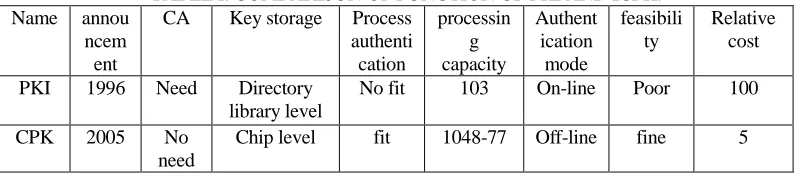
PKI authentication technology is mature and support prefect equipment. Therefore, most authentication systems are implemented based on PKI. However, there are some disadvantages when comparing PKI with CPK. TABLEI provides a comparison of the main features of CPK and PKI.
From the TABLEI, the PKI key generates separately and the model of PKI is centralized management. User’s private key is generated and saved by itself. The public key is a set of data randomly generated by a computer. So the production of public key does not have the scale. It relies on the CA chain for authentication, and the LDAP directory library has been in the online state, which has a huge amount of maintenance. When the capacity of CA processing reaches the limit, once the core CA fails, the entire PKI authentication system will be destroyed. The credibility of multilayer structure of CA will fade in the process, so that the security of user data is in bad condition.
TABLE I. COMPARISON OF FUNCTION OF PKI AND ICPK.
Name annou
ncem ent
CA Key storage Process
authenti cation processin g capacity Authent ication mode feasibili ty Relative cost
PKI 1996 Need Directory
library level
No fit 103 On-line Poor 100
CPK 2005 No
need
Chip level fit 1048-77 Off-line fine 5
Access Control in Cloud Computing Environment-Role Based Access Control
In the cloud environment, the service structure is extremely complex and unstable, so it is necessary to authenticate and control access to a large number of users. Access control can allow legitimate users with access to protected content, but also prevent illegal users from access and using the contents which are not their permissions, so we can better maintain cloud computing environment.
Access Control Model
The access control model mainly includes Role Based Access Control [6] (RBAC), Discretionary Access Control (DAC) and Mandatory Access Control (MAC). Among them, Role Based Access Control (RBAC) is widely used in cloud computing. Role Based Access Control will not directly establish a relationship between access authority and the users, but indirectly access through the "role", which Role Based Access Control can assign permissions and easily expand authority through the "role".
The basic idea of Role Based Access Control (RBAC) is to establish the "role" between the users and the accesses, which has the corresponding authorities and relatively stable. There are many kinds of mappings between the user and the role. The user assigned a role has all the permissions for that.
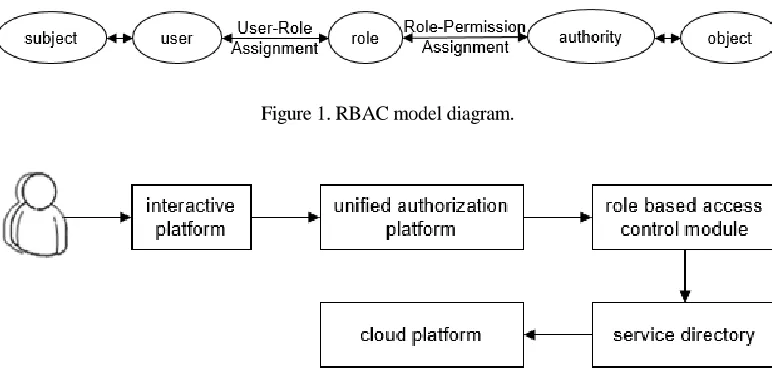
The RBAC model includes: the principle of the minimum privilege, the separation of responsibilities and data abstraction [5]. Adding the intermediate mapping relationship of the role, the model divides the user from the authority. The user assigned a corresponding role of the authority has that authority. Figure 1 shows the diagram of RBAC model. There are many to many relationships between users and roles, also between roles and operating authority.
Figure 1. RBAC model diagram.
Figure 2. The cloud platform access control framework model based on the roles.
Design of Role Based Access Control in Cloud Environment
The cloud platform access control framework model based on the roles, which is design of Role Based Access Control in cloud environment, as shown in Figure 2. The model includes five functional modules: interactive platform, unified authorization platform, role based access control module, service directory, and cloud platform.
Figure 2 shows the model of work process: when need services, the users firstly log in and apply for the role which is require permissions in the interactive platform, and then the users can be distributed the corresponding role permissions according to the user's information and the relationship between the roles of theirs’ and permissions in unified authorization platform. In the role based access control module, the user's access resources need to be tested by the legitimacy, and the user can only access the resources under the permission of the role, which does not allow invalid the access resources which the user want to assess to be passed. After the test is passed, the user can see all kinds of resources that can be accessed in the service directory, and select the part which is permitted to be accessed. Finally, users can use the service on the interactive platform in the cloud platform.
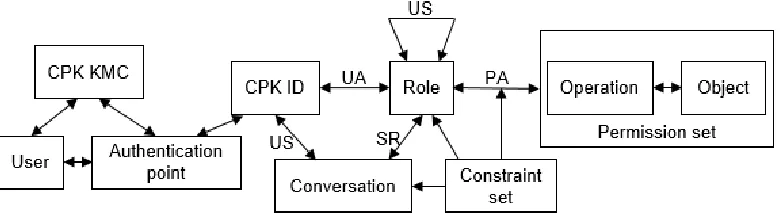
In Figure 3, U represents the user set, P represents the permission set, S represents the conversation set, and R represents the user set. UA represents a many distribution relationship between roles and users. PA represents a many-to-many distribution relationship between roles and permissions. US represents a one-to-one mapping relationship between users and dialogue. SR represents a one-one-to-one correspondence relationship between the conversation and the role. RH represents the role hierarchy, that is, the inheritance relationship of RBAC model.
Figure 3.The concept map of the combination of CPK and RBAC3.
As can be seen from Figure 3, CPK and access control are linked together by user identification. In the CPK system, the user issued an application to the registration center, and then the identification will be sent to Key Management Center (KMC) through the registration center. KMC contacts Key Generation Center to generate the key pair returned to the registration center. Registration center generates user ID certificate returned to user. Access control assign roles according to the user ID and the appropriate level of authority according to the role of the user. Moreover the inheritance and constraints of RBAC improve the security of cloud computing.
Experimental Results and Analysis
Simulation programming language uses java language, introducing CloudSim cloud simulation open source library. The hardware configuration of the computer of simulation experiment is: CPU is Intel Core i5-3850, memory is 8GB, hard disk size is 500GB, operating system is Windows 7 ultimate 64Bit Service Pack 1 and the development software is Eclipse. When the Cloud Sim package is imported into the Eclipse, project can begin the experimental simulation.
authentication scheme uses bidirectional authentication, so user A as the receiver, the user B as the sender in the second authentication. The system uses secondary encryption methods. A random number will be encrypted with the password, and then a private key matrix will be encrypted with a random number. CPK ID certificate of user is stored in the U-Key issued to the user. If an attacker wants to attack the entire system through U-Key, it is necessary to analyze a large number of internal procedures. However, the time and cost of the analysis is huge, so the success rate of such attacks is very low.
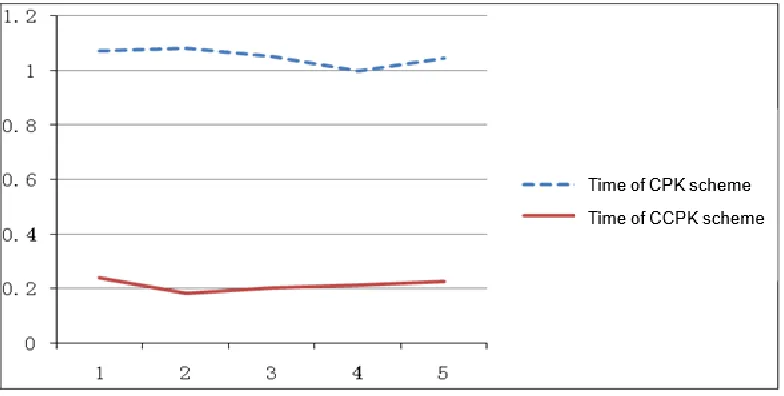
Figure 4. The comparison of authentication time of CPK and CCPK.
The CCPK authentication scheme proposed in this paper is an improved CPK authentication scheme based on cloud environment. We compare and analyze running time of CPK authentication scheme and CCPK. The experimental results are shown in figure 4.
As can be seen from Figure 4, CCPK authentication scheme requires much less computing time compared with CPK. Especially, the computing task is the heavier, the CCPK advantage is the more obvious. It can be concluded that the CCPK authentication scheme saves the service cost and improves the efficiency of authentication.
CONCLUSIONS
security issues, such as user data leakage or loss, data stolen by internal personnel, etc. Identity authentication and access control can solve these problems. CPK is used to solve the security of identity authentication in cloud computing, and the role based access control model is introduced to enhance the security of cloud computing. We obtain the expected results, through the simulation experiment about CCPK authentication scheme.
REFERENCES
1. Xianghao Nan, December 2008, CPK cryptosystem and the security. Beijing:National Defence
Industry Press, 238.
2. Jun Luo, 2012, Access Control by Encryption Mechanism in Cloud Computing Environment[J].
Information Security and Communications Privacy, 11:44-46.
3. Chunyu Shao, Jinhai Su, 2011, User Public Key Authentication Algorithm Based on Combined
Public Key[J].Computer Engineering,04:145-146+149.
4. Sandhu R, Coyne E J, Feinstein H L, et al., 1996, Role Based Access Control Models .Computer, 29(2):38-47.
5. Wei Liu, 2003, Implementation of Role-Based access Control Model in Secure Operating System. Institute of Software, Chinese Academy of Science.
6. Jun Guo, 2012, Research on the Hierarchical Authorization Management of Role-Based Access