© 2016, IRJET | Impact Factor value: 4.45 | ISO 9001:2008 Certified Journal | Page 1597
Real Time Application of Effective Segmentation based on Triclass
Thresholding
M.M. Raghavendra
1, S.priyanka
2, S.Samiullah
2, M.Manoj Kumar reddy
2, P.Sudharshana
Charyulu
21
Asst Prof Department of ECE Brindavan Institute of Technology & ScienceKurnool, India
2
Department of ECE Brindavan Institute of Technology & ScienceKurnool, India
---***---Abstract -
A new Iterative Triclass Thresholding method in image segmentation which uses the Otsu’s method to segment the image. This method iteratively searches for the sub-regions of the images, instead of treating the full image as a whole region for segmentation. First the Otsu’s method is applied on the input image to find the Otsu’s threshold and compute the mean values of two classes as separated by the threshold and based on this the image is divided into three sub-region instead of two as the standard Otsu’s method does. The three classes are determined as foreground, background and “to-be-determined” [TBD] region. The foreground and background are not included for further processing. The Otsu’s method is again applied on the TBD region to find the new threshold value and the two class mean, based on this the TBD region is again divided into three sub-regions. The iteration stops when the Otsu’s threshold calculated between two successive iterations is less than that of the pre-set threshold. Finally all the previous foreground and background is combined to form the final output. The obtained output will achieve better result than the standard Otsu’s method.
Key Words
:
Binarization, Otsu’s method, segmentation, threshold, triclass segmentation1.INTRODUCTION
Now days we can see that the huge amount of development in technology take place. Which led to human being need multimedia technology in real-life documents, including stylistic text strings with various illuminations, decorated objects and colorful backgrounds? Traditional otsu’s thresholding methods cannot effectively segment all important objects into separate regions. So we required a proper segmentation method for segmenting an image into multiple object regions with original image. Generally Images are considered as one of the most important medium of conveying information, in the field of computer vision, by understanding images the information extracted from them can be used for other tasks.
In this paper, we present a new iterative method that is based on Otsu’s method but differs from the standard application of the method in an important way. At the first
iteration, we apply Otsu’s method on an image to obtain the Otsu’s threshold and the means of two classes separated by the threshold as the standard application does. Then, instead of classifying the image into two classes separated by the Otsu’s threshold, our method separates the image into three classes based on the two class means derived. The three classes are defined as the foreground with pixel values are greater than the larger mean, the background with pixel values are less than the smaller mean, and more importantly, a third class we call the “to-be-determined” (TBD) region with pixel values fall between the two class means. Then at the next iteration, the method keeps the previous foreground and background regions unchanged and re-applies Otsu’s method on the TBD region only to, again, separate it into three classes in the similar manner. When the iteration stops after meeting a preset criterion, the last TBD region is then separated into two classes, foreground and background, instead of three regions. The final foreground is the logical union of all the previously determined foreground regions and the final background is determined similarly. The new method is almost parameter free except for the stopping rule for the iterative process and has minimal added computational load. We tested the new iterative method on synthetic and real images and found that it can achieve superior performance in segmenting images such as zebrafish and nuclei images acquired by microscopes. Results show that the new method can segment weak objects or fine structures that are typically missed by the standard Otsu’s method.
1.1 Segmentation
© 2016, IRJET | Impact Factor value: 4.45 | ISO 9001:2008 Certified Journal | Page 1598
level of segmentation are decided by the particular type ofimage and characteristics of the problem being considered.
Based on different technologies, image segmentation approaches are currently divided into following categories, based on two properties of image.
Detecting Discontinuities
It means to partition an image based on abrupt changes in intensity, this includes image segmentation algorithms like edge detection.
Detecting Similarities
It means to partition an image into regions that are similar according to a set of predefined criterion, this includes image segmentation algorithms like thresholding, region growing, region splitting and merging.
Segmentation Based on Edge Detection
This method attempts to resolve image segmentation by detecting the edges or pixels between different regions that have rapid transition in intensity are extracted and linked to form closed object boundaries. The result is a binary image . Based on theory there are two main edge based segmentation methods- gray histogram and gradient based method.
Thresholding Method
Image segmentation by thresholding is a simple but powerful approach for segmenting images having light objects on dark background. Thresholding technique is based on image space regions i.e. on characteristics of image. Thresholding operation convert a multilevel image into a binary image i.e., it choose a proper threshold T, to divide image pixels into several regions and separate objects from background. Any pixel (x, y) is considered as a part of object if its intensity is greater than or equal to threshold value i.e., f(x, y) ≥T, else pixel belong to background. As per the selection of thresholding value, two types of thresholding methods are in existence, global and local thresholding. When T is constant, the approach is called global thresholding otherwise it is called local thresholding. Global thresholding methods can fail when the background illumination is uneven. In local thresholding, multiple thresholds are used to compensate for uneven illumination . Threshold selection is typically done interactively however, it is possible to derive automatic threshold selection algorithms.
Histogram shape
Based methods, where, for example, the peaks, valleys and curvatures of the smoothed histogram are analyzed
Clustering
Based methods, where the gray-level samples are clustered in two parts as background and foreground
(object), or alternately are modeled as a mixture of two Gaussians
Entropy
Based methods result in algorithms that use the entropy of the foreground and background regions, the cross-entropy between the original and binarized image, etc.
Object Attribute
Based methods search a measure of similarity between the gray-level and the binarized images, such as fuzzy shape similarity, edge coincidence, etc.
Spatial
Based methods use higher-order probability distribution and/or correlation between pixels.
Local
Based methods adapt the threshold value on each pixel to the local image characteristics. In these methods, a different T is selected for each pixel in the image.
Region Based Segmentation Methods
Compared to edge detection method, segmentation algorithms based on region are relatively simple and more immune to noise. Edge based methods partition an image based on rapid changes in intensity near edges whereas region based methods, partition an image into regions that are similar according to a set of predefined criteria.
2. OTSU’S METHOD
© 2016, IRJET | Impact Factor value: 4.45 | ISO 9001:2008 Certified Journal | Page 1599
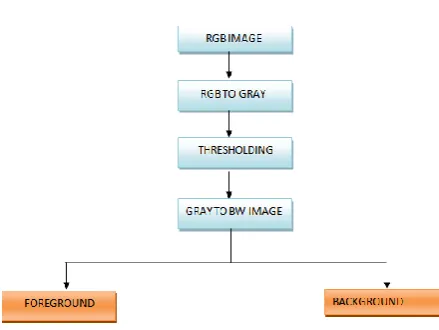
BLOCK DIAGRAMFig 1: Block diagram of Otsu’s method
Otsu’s method searches the histogram of an image to find a threshold that binarizes the image into two classes, the background with a mean of μ0 and the foreground with a mean of μ1. Without loss of generality, here we assume that the foreground is brighter than the background, i.e., μ1 > μ0. Otsu’s method selects the threshold by minimizing the within-class variance of the two groups of pixels separated by the thresholding operator. It does not depend on modeling the probability density functions, however, it assumes a bimodal distribution of gray-level values (i.e., if the image approximately fits this constraint, it will do a good job).
Means and variances
Consider that we have an image with L gray levels and its normalized histogram (i.e., for each gray-level value i, P(i) is the normalized frequency of i). - Assuming that we have set the threshold at T, the -normalized- fraction of pixels that will be classified as background and object will be:
q0=
q1=
and the individual class variances are given as
(T)=
(T) P(i)/ (T)
(T)=
P(I)/ (T)
Determining the threshold
Since the total variance does not depend on T, the T minimizing 2W will be the T maximizing 2B.Let’s consider maximizing 2B we can rewrite 2B
as follows:
T =arg (T)
Where (T)=q0(T) (T)+q1(T) (T)
the subscript 0 and 1 denote the two classes, background and foreground, respectively, and qi and σi , i = [0, 1] are the estimated class probabilities and class variances, respectively.
Start from the beginning of the histogram and test each gray-level value for the possibility of being the threshold T that maximizes 2B
2.1 PROPERTIES OF OTSU’S METHOD
Otsu threshold is equal to the average of the mean levels of two classes partitioned by this threshold. Otsu threshold biases toward the component with
larger within-class variance.
2.2 ALGORITHM
Start
Read original image
Determine threshold using Otsu’s method
Set the intensity values less than threshold as 0(black)
Set the intensity values greater than threshold as 255(white)
Display the final image End
2.3 DESCRIPTION OF ALGORITHM
The main objective of the algorithm is to perform these operations:
First select the threshold based on the Otsu’s method then sets the intensities as 0 and 255 for the respective regions.
Display the segmented image.
2.4 DRAWBACK OF OSTU’S METHOD
The method assumes that the histogram of the image is bimodal (i.e., two classes). - The method breaks down when the two classes are very unequal (i.e., the classes have very different sizes).
* In this case, 2Bmay have two maxima.
* The correct maximum is not necessary the global one. * The selected threshold should correspond to a valley of the histogram.
*The method does not work well with variable illumination.
3. ITERATIVE METHOD
© 2016, IRJET | Impact Factor value: 4.45 | ISO 9001:2008 Certified Journal | Page 1600
“to-be-determined” (TBD) region with pixel values fallbetween the two class means. Then at the next iteration, the keeps the previous foreground and background regions unchanged and re-applies Otsu’s method on the TBD region only to, again, separate it into three classes in the similar manner. When the iteration stops after meeting a preset criterion, the last TBD region is then separated into two classes, foreground and background, instead of three regions. The final foreground is the logical union of all the previously determined foreground regions and the final background is determined similarly.
Fig 2: Block diagram of Iterative Method
By our definition, we have
U
=
F
[1]∪
B
[1]∪
_
[1](7)
where
∪
is the logical union operation. At the second
iteration, we apply Otsu’s method to find threshold
T
[2]on region
_
[1]only. We then calculate the two class
means in
_
[1]separated by
T
[2]as
μ
[02] andμ
[12].Similarly, the second iteration will generate a new
F
[2],
B
[2], and
_
[2]such that
U[1] = F[2] U B[2] U
_[2]
(8)
where
F
[2]is defined as the region in
_
[1]with pixel
values greater than
μ
[12],B
[2]as the region in
_
[1]with
pixel values less than
μ
[02], and_
[2]are the new TBD
region. The iteration stops when the difference
between two consecutive threshold |
T
[n+1]−
T
[n]| is
less than a preset threshold. At the last iteration [
n
+
1],
_
[n+1]is separated into two instead of three classes,
i.e., foreground
F
[n+1]is defined as the region of
_
[n]that
is greater than
T
[n+1]instead of
μ
[1n+1]and background
B
[n+1]is defined as the regions with pixel value less than
T
[n+1].
The innovation of the new method is to
iteratively
define the TBD regions to gain a high
distance ratio, which will result in better segmentation
by applying Otsu’s method.
The new method is almost parameter free except for the stopping rule for the iterative process and has minimal added computational load. We tested the new iterative method on synthetic and real images and found that it can achieve superior performance in segmenting images such as zebra fish and nuclei images acquired by microscopes. Results show that the new method can segment weak objects or fine structures that are typically missed by the standard Otsu’s method.
3.1 Algorithm
The steps involved for this new iterative triclass thresholding is given below:
Start
Read original image
Determine first threshold using Otsu’s method While two successive threshold values are not
same do
Compute pixels with intensity less than specified threshold
Compute pixels with intensity more than specified threshold, foreground
calculate mean1 against foreground and mean2 against background for both the regions
Set background pixel intensity as 0(black) Set foreground pixel intensity as 255(white) Display the intermediate image
compute TBD region as set of pixels with intensity greater than mean1 and less than mean2
compute new threshold for the TBD region goto step 4
End loop
Display the final image End
3.2 DISCRIPTION OF ALGORITHM
The main objective of the algorithm is to perform these operations:
First select the threshold based on the Otsu’s method by using any function what we have used in Otsu’s method.
Based on the threshold method three classes are identified (foreground, background, TBD) Next iteration performed on TBD region based on
new calculated threshold value.
© 2016, IRJET | Impact Factor value: 4.45 | ISO 9001:2008 Certified Journal | Page 1601
Iteration will stop when it matches the threshold criteria.
The final iteration gives the best segmented image.
3.3 APPLICATIONS OF PROPOSED METHOD
We applied new iterative triclass thresholding technique for one real microscopic image and a MRI image.The first image is just used for image pattern recognition. This method takes the advantage of traditional otsu’s method of being parameterless and also overcomes the disadvantage of missing weak objects.
The second image is used for biomedical applications, especially to detect cancer in particular organ .This can be clearly explained by the block diagram shown below. Here, the first background and foreground are kept constant and it focuses only on second new region called TBD region. At each iteration, the tri-class approach keeps regions that are determined to be foreground and background unchanged and focuses on the third TBD region. At each succeeding iteration, the TBD region area decreases and more pixels are assigned to the foreground and background classes. After the process of iterative thresholding segmentation, the BFO optimization algorithm is combined with this obtained result to produce good results.
4. RESULT
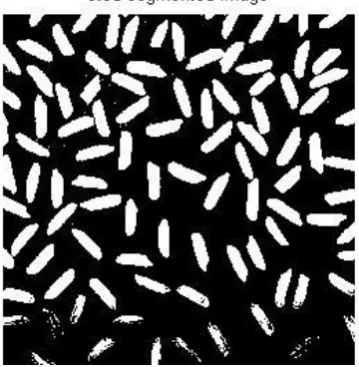
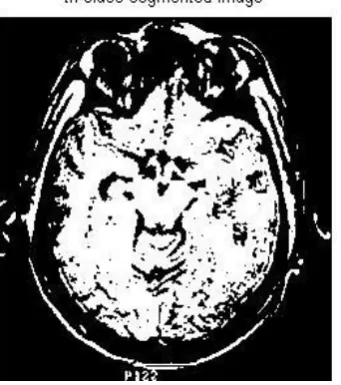
We applied our proposed method on microscopic
image and MRI image those results are shown below
Fig 3:[a] otsu’s segmented image
Fig 3: (b) triclass segmented image
In the above figure, we can see the fully segmented rice grains in our proposed method
[image:5.595.311.492.111.301.2] [image:5.595.312.481.376.554.2] [image:5.595.40.220.468.652.2]
© 2016, IRJET | Impact Factor value: 4.45 | ISO 9001:2008 Certified Journal | Page 1602
Fig 4 :(b) triclass segmented image
In this second example is the MRI image of brain. Our proposed method will segment the weak objects of this type of image and further used for detection of cancer in brain.
5. COMPARISIONS
We compared the results obtained by both the methods
The comparison is given in a comparison table given
below
Otsu’s
Method
Iterative
Method
Iterative
Method
Iterative
Method
Image
s
Otsu’s
Threshol
d
Threshol
d
Threshold
-1
Threshold
-Main
Rice
0.5137
0.513
0
-0.513
Brain
0.3451
0.3451
0.53
0.192
Table 1:
comparison of otsu’s method and iterative
method
6. CONCLUSIONS
As Otsu’s method is widely used as a pre-processing step to segment images for further processing, it is important to achieve a high accuracy. But it misses out weak objects.In this paper, we proposed to take advantage of Otsu’s threshold by classifying images into three tentative classes instead of two permanent classes in an iterative manner. The three classes are designated as the true foreground and background, and a third TBD region that is to be further processed at the next iteration. The iteration stops until the change in thresholds of two consecutive iterations is less than a threshold.
The performance of the new algorithm is evaluated on both synthetic and real microscopic images. results
demonstrate that the proposed algorithm can achieve superior performance in segmenting weak objects and fine details. The new method is also almost parameter-free except for the preset threshold to terminate the iterative process. The added computational cost is minimal as the process usually stops in a few iterations and each iteration only processes a monotonically shrinking TBD region.
REFERENCES
[1] L. Herta and R. W. Schafer, “Multilevel threshold using edge matching,”
Comput. Vis., Graph., Image Process., vol. 44, no. 3, pp. 279– 295,Mar. 1988.
[2] R. Kohler, “A segmentation system based on thresholding,” Comput.Graph. Image Process., vol. 15, no. 4, pp. 319–338, Apr. 1981.
[3] X. Xu, “A method based on rank-ordered filter to detect edges in cellular image,” Pattern Recognit. Lett., vol. 30, no. 6, pp. 634–640, Jun. 2009.
[4] S. Baukharouba, J. M. Rebordao, and P. L. Wendel, “An amplitude segmentation method based on the distribution function of an image,”
Comput. Vis., Graph., Image Process., vol. 29, no. 1, pp. 47–59, Jan. 1985.
[5] M. J. Carlotto, “Histogram analysis using scale-space approach,” IEEETrans. Pattern Anal. Mach. Intell., vol. 9, no. 1, pp. 121–129, Jan. 1987.
[6] J. Kittler and J. Illingworth, “Minimum error threshold,”
Pattern Recog-nit., vol. 19, no. 1, pp. 41–47, Jan. 1986.
[7] P. Sirisha, C. N. Raju, and R. P. K. Reddy, “An efficient fuzzy technique for detection of brain tumor,” Int. J. Comput. Technol., vol. 8, no. 2,
pp. 813–819, 2013.
[8] C. H. Bindu and K. S. Prasad, “An efficient medical image segmentation using conventional OTSU method,” Int. J. Adv. Sci. Technol., vol. 38, 67–74, Jan. 2012.
[image:6.595.43.214.113.306.2]© 2016, IRJET | Impact Factor value: 4.45 | ISO 9001:2008 Certified Journal | Page 1603
BIOGRAPHIES
Mr.M.M.Raghavendra has pursued his B.Tech from st.jhons College of Engg.& Tech, Kurnool and M.Tech from TKRCET , hyderabad. Presently he is working as Asst.Prof in Dept of ECE in Brindavan Institute of Technology & science, Kurnool. He has published 3 International Journals .His research areas of interest are VLSI for signal & Image processing, Wireless communications, Antenna design, Analog & Digital communications, Digital integrated circuit design.
Ms.S.Priyanka is pursuing her B.Tech in Electronics and communication Engineering from Brindavan Institute of Technology & science, Kurnool.
Mr.S.Samiullah is pursuing his B.Tech in Electronics and communication Engineering from Brindavan Institute of Technology & science, Kurnool.
Mr.M.Manoj Kumar Reddy is pursuing his B.Tech in Electronics and communication Engineering from Brindavan Institute of Technology & science, Kurnool.